
Paltrow seemed to arrive on the scene having everything and wanting for nothing.
Funny, that’s also the most accurate description of an AWFL ever penned. Who the hell are they, and where did they come from? How do they have the free time and endless disposable cash to do literally every single thing they do?
In 2001, she promoted Shallow Hal — in which she played Rosemary, an obese woman whose “inner beauty” is only visible to Hal (Jack Black) — by talking about doing practice runs in her character’s fat suit. “I got a real sense of what it would be like to be that overweight, and every pretty girl should be forced to do that.”
Wait, this is supposed to be a hit piece? Because that might be the most sensible thing I have ever heard a woman say. Yes, definitely they should be forced to do that, if not the full Norah Vincent. If you’re halfway presentable, ladies — hell, if you’re not grossly deformed — you’re playing life on “God mode”. Look at all the simps in your social media feeds, and tell me I’m wrong. Being forced to go around in a fat suit for a week or two is a necessary corrective.
Paltrow’s first big trip on the Hollywood hater-go-round was 1998, the year she won the Best Actress Oscar for Shakespeare in Love and gave a memorably messy, genuinely emotional acceptance speech. (Days after her win, Salon was among many outlets eviscerating her.) What viewers didn’t see, Odell notes, is the amount of effort by Miramax head Harvey Weinstein to make Shakespeare a winner, raise the profile of his still-independent studio, and solidify his belief that Paltrow belonged to him.
I’m going to stop here, because there’s really no point. I just wanted everyone to remember Shakespeare in Love. You do remember Shakespeare in Love, don’t you?
Of course you don’t; it was silly and forgettable at the time, and now is remembered, if at all, as a bizarre footnote — it’s the movie that won Best Picture over Saving Private Ryan. From the perspective of 2025, then, it sure looks like 1998 was the official start of the Girlboss Era.
Severian, “Kvetching Up With Karen: DC Edition”, Founding Questions, 2025-08-14.
December 19, 2025
QotD: “1998 was the official start of the Girlboss Era”
December 18, 2025
“You can still hunt”
The Canadian federal government is working diligently (well, “diligently” by civil service standards) to disarm Canadians, and have been doing so for decades now. Rather than cracking down on criminal use of firearms, which would be difficult, they concentrate their efforts on literally the most law-abiding group of Canadian citizens — legal gun owners … because it’s easy, safe, and gets them lots and lots of friendly media coverage from the equally anti-gun Canadian media (few of whom even know any gun owners personally).
One of the constant replies when legal gun owners protest against yet another gun grab or tightened legal restriction is along the lines of “this doesn’t affect you: you can still hunt” … but hunting is only a part of Canadian gun ownership, and not the largest part. On the social media site formerly known as Twitter, Gun Owners of Canada explains why “you can still hunt” is neither helpful nor constructive in the larger conversation:
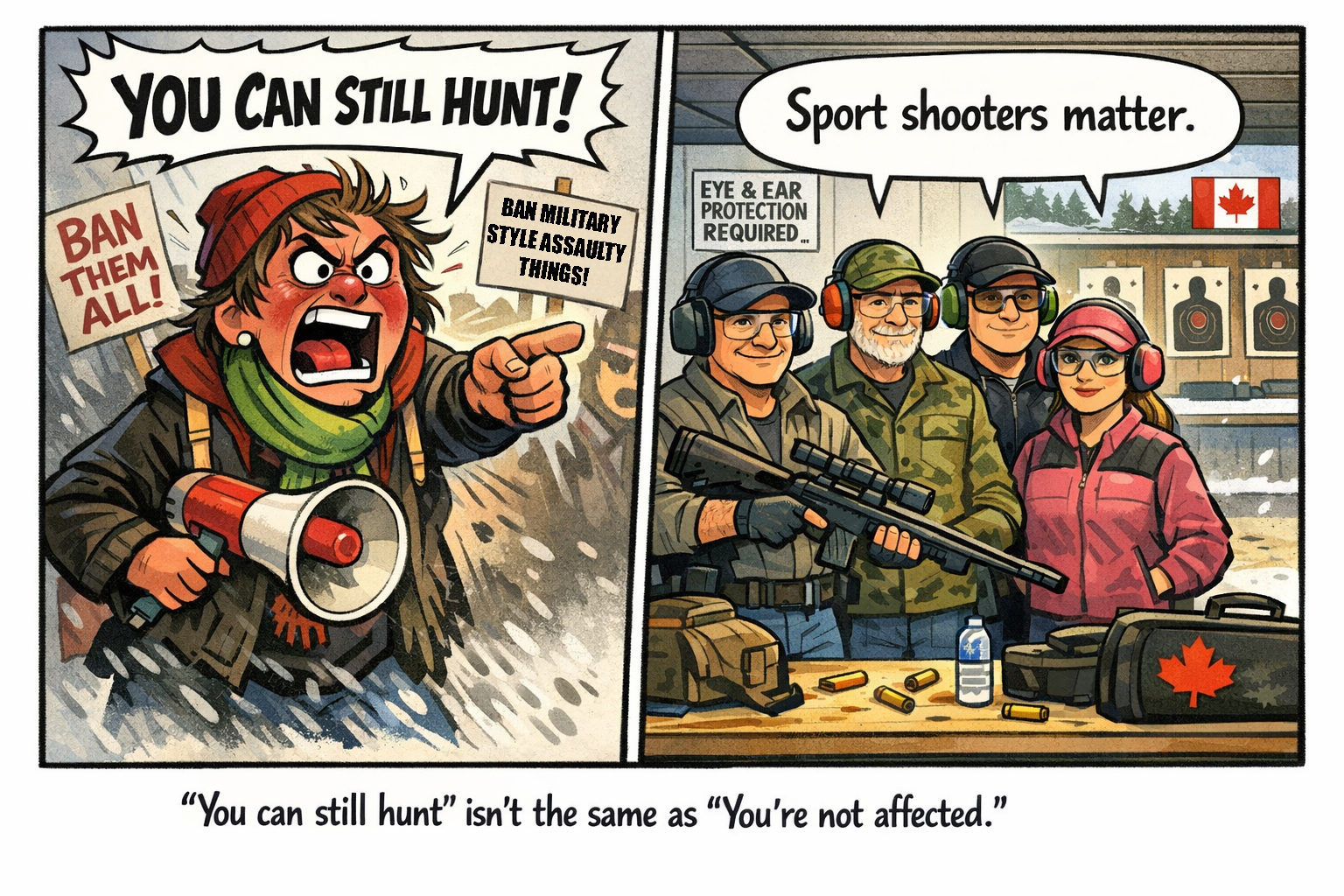
We keep hearing the same tired line:
“You can still hunt.”
But that’s not what this is about.
That phrase exists because it’s simple, relatable, and politically convenient for people who don’t understand Canada’s firearm laws or their history. If you do understand them, you’re in the minority.
For most Canadian firearm owners, shooting has never been just about hunting. Yes, we hunt — but the bulk of our time is spent at the range, participating in recreational and competitive target shooting. That’s where families gather, skills are learned, friendships are built, and the next generation is introduced to safe, responsible firearm ownership.
Sport shooters are the backbone of the firearms community and the industry that supports it. We shoot year-round, we buy ammunition regularly, and we keep ranges and retailers alive. Many hunters will bring the same box of ammo to camp year after year. Both matter — but they are not the same.
Over the past six years, lawful firearms have been prohibited, replaced, and then prohibited again. Models that once brought families together at the range can no longer be used. That experience — one many of us grew up with — is increasingly out of reach for our kids.
This admin grew up at the range with parents and grandparents deeply involved in Canadian shooting sports. That’s where lifelong relationships were formed. Many of those people don’t hunt at all — but they are responsible, licensed, community-minded Canadians.
So when restrictions strip away lawful, safe activities while violent criminals face little consequence, don’t expect silence — or gratitude.
This isn’t about hunting.
It’s about what’s been taken, who it’s been taken from, and who’s expected to quietly accept it.
Don’t accept it. Get involved. It’s not like there aren’t enough advocacy groups to join and political avenues to get involved in.
For my own part, I no longer have the resources to do any shooting, but I was always interested in target shooting, not hunting. It was fun, and isn’t that what your hobbies should be for? Back when I sometimes travelled on business, I used to envy my American co-workers who had legal access to a plethora of shooting ranges and a much-less restrictive licensing regime. Every chance I got to go out to the range and try new-to-me rifles and pistols was like an adult version of a trip to the candy store. The one time I was nearly shot, ironically, was on a military target range when I was in the army reserves … an idiot (who out-ranked me) had a misfire with his submachine gun and turned away from the target towards me as the round fired. Fortunately, the bullet went in a safe-ish direction and nobody was hurt.
Update, 19 December: Welcome, Instapundit readers! Please do have a look around at some of my other posts you may find of interest. I send out a daily summary of posts here through my Substack – https://substack.com/@nicholasrusson that you can subscribe to if you’d like to be informed of new posts in the future.
December 17, 2025
“The ‘liberal international order’ – a technocratic oligarchy sustained by tightly interlocked institutions”
Last week, Len D. Pozeram wrote about how the real (but mostly unacknowledged) American empire is facing unprecedented challenges and may indeed be in serious decline:

“The Empire’s Mask is Slipping”, The Libertarian Alliance
For generations, Americans were sold a saccharine myth: that our nation’s vast global presence — its military bases on every continent, its endless wars, its economic interventions — was all done in the name of “freedom” and “human rights”. This was the sales pitch. Washington, we were told, was the benevolent policeman of a dangerous world, upholding a Pax Americana designed to uplift humanity.
But for those willing to look beyond the rhetoric, the truth was never hidden — only ignored. This narrative was never more than a sophisticated marketing campaign, engineered to pacify a domestic public and legitimize imperial conquest abroad. From the very beginning, the post-WWII global order was not about freedom, but about power — and who would control it after the collapse of the old European empires.
With the fall of the British Empire, America did not merely “step up” to defend the West — it seized control of the imperial machinery and rebranded it. The British financial aristocracy gave way to a new though related American elite, its nucleus formed around Wall Street banks, the military-industrial complex, Big Oil cartels, and, increasingly, a rising Zionist lobby with ambitions stretching far beyond Tel Aviv.
Under the guise of “containing communism” or “defending democracy”, this new managerial class waged a quiet war against genuine national independence movements across the globe. Countries seeking to control their own resources, chart their own destinies, or resist Western financial domination were systematically targeted for destabilization or outright annihilation.
Guatemala in 1954. Iran in 1953. Indonesia in 1965. The Congo. Chile. Nicaragua. Greece. Even Australia, whose 1975 constitutional crisis remains a textbook case of covert Anglo-American regime change. The public, of course, was kept in the dark. History books were rewritten. Journalists who strayed from the script were destroyed or silenced. CIA fingerprints are now visible in dozens of these cases — operations sanctioned not to spread freedom, but to preserve a system of elite extraction and control.
This system — often referred to in polite company as the “liberal international order” — is, in fact, a technocratic oligarchy. It is sustained by tightly interlocked institutions: the Federal Reserve, the IMF, the World Bank, NATO, and a sprawling Intelligence Community whose true loyalties lie not with the American public, but with transnational networks of finance, energy, and geopolitical strategy. To the extent that ideology plays a role, it is the convergence of evangelical apocalypticism and messianic Zionism — two religious currents that have dangerously informed U.S. foreign policy since the Reagan era.
Yet today, this system is beginning to eat itself. The ideology of endless war, and top-down control has run up against hard limits: financial, and political. The de-dollarization trend in the Global South, the rise of multipolar alliances like BRICS, and the exposure of elite criminality — from Epstein to the endless intelligence scandals — are all symptoms of imperial overstretch and rot.
We are watching the slow collapse of an empire built not on democratic values but on lies, coercion, and institutionalized greed.
From a slightly different viewpoint, Spaceman Spiff maintains that the narratives that have been used to direct and control political thought in the west are in the process of collapsing:
Image from Postcards from the Abyss
As reality intrudes the naivety behind many sacred cows is exposed. The emperor is naked and his supporters look equally naked. The narratives driving their fantasies are failing.
The big three issues common in the West illustrate why people are noticing.
Diversity and immigration
The promotion of diversity as a strength is a consequence of blank slate thinking, a belief disparate populations are substantially the same with most observable differences due to environment only.
This is at odds with what we observe, the significant range in ability and proficiency between distinct groups that becomes apparent when we interact. So artificial variety is sold as a positive in an attempt to downplay the homogeneity that gets better results.
The consequence of this is quotas, where arbitrary rules are enforced to ensure a diverse outcome.
This destroys competency even if we ignore the potential for conflict when foreigners are imported in large numbers.
The main effect of pushing this absurd policy seems to be the rise of ethnic awareness among those who must step aside to accommodate it. How could it not? When people are excluded because of their ethnicity it becomes important to them.
This is not what advocates of diversity intended but is already happening.
Climate
Climate and energy policy is based on anti-scientific magical thinking. With the current emphasis on carbon dioxide we are told a tiny portion of our atmosphere is responsible for most of the future changes that will cause widespread harm. There is no evidence for such claims.
The reality of climate is different from the narrative. It is resilient, as many things are. Our obsession is arrogance. A belief we matter more than we do.
Intellectuals are prone to get lost in their theories of how the world ought to work. Activists then latch on to their utopian ideas to gain some sense of meaning in their lives.
Society also has people lacking conscience who will profit from anything no matter how much damage it causes. Combining these two, dreamers with schemers, is often lethal. Seemingly opposing forces, left-wing activists and capitalist profiteers, can cooperate even if they embrace distinct beliefs.
As many memes remind us, if you have corporate sponsorship you are not the resistance. This is precisely what we see.
Narratives begin to collapse as we witness ruthless corporations promote feelgood nonsense about climate while fleecing taxpayers in the background. Many are noticing.
And the effects of suicidal climate goals are difficult to hide. Every closed factory or power station kills another element of credibility.
Socialism
Socialism is based on the idea an educated elite can make decisions for us all while simultaneously conditioning us to be better versions of ourselves. It ignores all of history and everything we have learned of human psychology to embrace a literal fantasy utopia that no one has even come close to realizing.
Nothing sums up the bankruptcy of our intellectuals more than their inability to reject this failed ideology.
But it also shows us the Anglo-Saxon instinct to restrict others’ control over us is the only way to counter it.
It teaches us of the wisdom of documents like Magna Carta or the Bill of Rights, designed to constrain the powerful regardless of their motives, ambitions or mental state. Rare moments of historical sanity that remind us what effective countermeasures can look like.
It would seem this lesson must be relearned every few generations. But we are learning it. Real life is reminding us why we must limit government and its agents no matter how inconvenient.
Bad ideas are inevitable. It is the ability of activists and the powerful to enact them many are now waking up to as narratives visibly fail.
“The core hypocrisy of modern Western governance”
On the social media site formerly known as Twitter, Tom Marazzo discusses the extremely weird experience we’ve all lived through since 9/11 in almost every major western nation:
For more than 20 years, Western governments told their citizens that Islamist extremism posed an existential threat. Entire generations were sent to fight the Global War on Terror. Soldiers were killed, families were broken, civil liberties were curtailed, and trillions were spent, all justified by the claim that terrorism had to be stopped over there so it would not reach us here.
Then something strange happened.
The same governments that built their legitimacy on that fear now insist that even discussing the cultural, security, or integration risks associated with mass immigration from unstable regions is immoral. Raise concerns and you are no longer a citizen asking questions, but a bigot, an extremist, or a threat yourself. In some countries, speech alone now draws police attention, while violent acts are reframed as isolated incidents or stripped of ideological context.
The irony deepens when you look at the timeline.
During the first years of Covid, terrorism all but vanished from news coverage, just as Covid seemed to erase the common cold, cancer, and every other cause of death from public discourse. Nothing had disappeared. The narrative had simply changed. Attention was redirected. Fear was reassigned.
Now, as governments pursue aggressive mass immigration policies, the public is told that questioning outcomes is unacceptable, even as the very threats once used to justify war reappear domestically. The message is clear and profoundly cynical: the danger was real when it justified foreign wars, but discussion becomes forbidden when it complicates domestic policy.
This is not tolerance. It is coercion.
And now comes the final insult.
The same political class that demands silence at home is preparing to demand sacrifice abroad. The same citizens who are told to accept social breakdown, rising crime, collapsing services, and cultural fragmentation are being told they may soon be required to fight Russia to “defend our way of life”.
What way of life, exactly?
The one being systematically dismantled by the very governments issuing the call. The one they are actively transforming into something unrecognizable through reckless policy, moral intimidation, and managed decline. They are asking people to die for values they no longer practice and for societies they are actively degrading.
This is the core hypocrisy of modern Western governance.
We were told to fight, bleed, and die to defend liberal democratic values. Now we are told those same values require silence, compliance, and obedience, while our countries are reshaped without consent and against the will of the people who built them.
A government that suppresses debate at home while demanding loyalty abroad is not defending democracy. It is consuming it.
And history is not kind to regimes that ask their people to die for a future they are busy destroying.
December 15, 2025
“America has always been a racist country”
On the social media site formerly known as Twitter, Devon Eriksen responds to an agent provocateur on the topic of racism:
Lance Cooper @lmauricecpr
A white woman called a Somali couple niggers and raised $153k in five days. America has proven again that it is a racist country. They don’t even bother to hide it anymore.America has always been a racist country in a racist world.
Indigenous Tribals were racist.
Whites were racist.
Blacks were racist.
Orientals were racist.
Arabs were racist.
Jews were racist.
Hispanics were racist.After being shocked by the excesses of the Third Reich, Whites stopped being racist for a while, and suffered for it.
Everyone else stayed racist, and prospered by it at White people’s expense.
Now White people are sick of it, and they’re becoming racist again, because the only other solution is for everybody else to stop being racist, and there’s no way to make them do that.
So the future is racist. Doesn’t particularly matter if you think that’s good or bad, or if I think that’s good or bad, or if anyone thinks it’s good or bad. It is what’s going to happen.
There was a time when it might have been possible to for everyone to simultaneously stop being racist. But it didn’t happen, because only White people were being told to stop, only White people listened, and only White people stopped.
Everyone else was told that, in the abstract, racism was bad, but they were never called out, lectured, or confronted about their own racism. In fact, that racism was tacitly encouraged, for profit and ego gratification.
Someone even invented rationalizations that only White people even could be racist, because only White people had Power™, which was different from power, because white people somehow had Power™ even if they had no power, and everyone else had no Power™ even if they were billionaires or the King of Sumatra.
So Power™ was just another word for Whiteness.
Around the time when some people started openly calling for the elimination of Whiteness from the nation, the globe, and the human race, White people’s common sense finally started winning out over our desire to be nice and and cooperative and have everyone like us.
We realized it was impossible for everyone else to like us.
Because they didn’t hate us for not being nice. Hell, the nicer we got, the more they hated us. No, they hated us for being White. They hated us for not being like them. They hated us for being successful. They hated us for thriving. They hated us for building civilization. And they wanted us to just hand it over to them, despite the clearly evident fact that a great many of them lacked the skills and temperament to even to maintain it, much less to build more.
(Hint: that desire to be nice and cooperative and have people like us is what enabled us to build all that stuff and get rich in the first place.)
So we’re just going to have to settle for liking each other, preferring each other’s company, and not particularly worrying about whether other races like us or not.
Because that’s the only remaining alternative to suicide.
And, yeah, sure, whatever, you can call me delusional or a liar. You can say White people never stopped being racist, or that we just didn’t anti-racist hard enough.
But, even if that were true, so what? The rest of y’all never stopped being racist. And you never did the anti-racist thing at all. Y’all just kept telling us to do it.
Well, no thanks. Juice isn’t worth the squeeze, because there is no juice, and we’re the ones who were getting squeezed.
And yeah, sure, that’ll keep happening for a while, because some White people haven’t figured it out yet.
And yeah, sure, you can continue to lecture me about how racism is evil, as if you weren’t super-racist yourself, every goddamn day.
But I no longer believe that moral lectures about racism from non-Whites are anything but an attempt to make Whites drop loot.
So I’m not listening.
A lot of people are about to learn the meaning of the term “preference cascade”, and it isn’t going to be pretty.
ESR responded:
I am deeply unhappy about Devon’s conclusion here. But I fear he is probably correct.
There is an alternative, which is to be explicitly high-IQist and mostly ignore skin color. But I admit that such an attempt would probably be sabotaged by the same people who insisted that anti-white racism should be government policy everywhere.
Clankers on the bench, again
On Substack, Helen Dale discusses the most recent high profile case of clanker mis-use in the justice system, as Scottish Employment Judge Sandy Kemp clearly leaned far too heavily on ChatGPT or another AI instance to crank out 312 pages of dubious content:

Grok generated this in response to the request for “Robbie the Robot as a judge”
Maybe Judge Kemp only identifies as a judge, because the farrago of nonsense he’s managed to produce in the Peggie matter is, well, a sight to behold.
Industry news/gossip magazine Roll on Friday — otherwise known as the “orange time-suck” among City solicitors — has a handy run-down of the most egregious fake quotations, selective editing, and incorrect citations. It’s a concise one-stop-shop for Peggie errors, although they’ve already had to add to it since it was published yesterday.
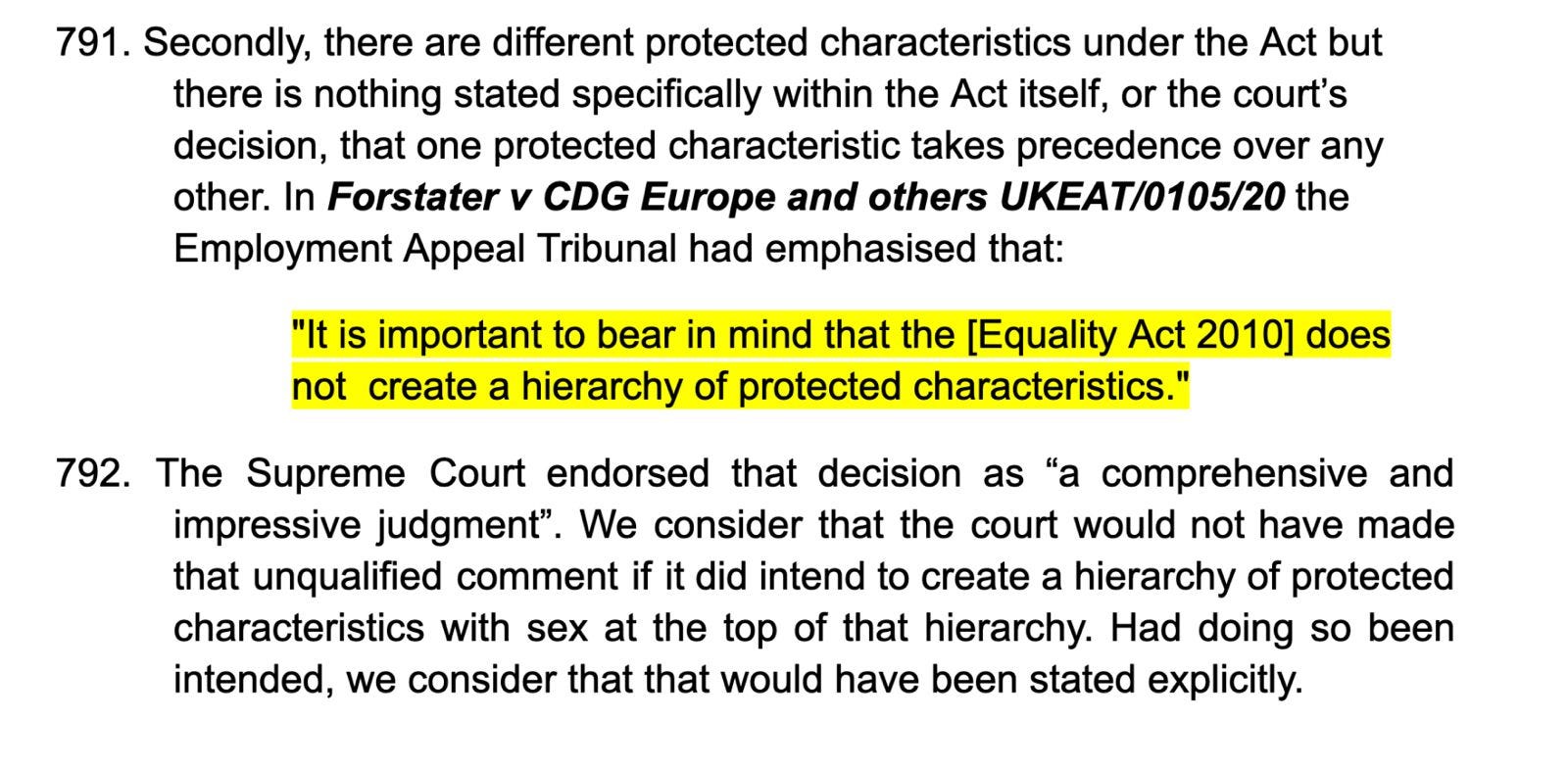
The situation is far more serious than the single — and that was bad enough — fake quotation from Forstater, since corrected by means of what lawyers call “the slip rule”. Notably, the corrected quotation does not support the point Judge Kemp wanted to make, rendering the passage nonsensical.
The slip rule or procedure — something many of us have seen in practice — exists to fix typos, wrong page/paragraph numbers, misspellings. One common error I remember from my pupillage days is fat-fingered judges leaving the “o” out of county in “County Court”, which of course litters the judgment with “Cunty Court”. Yes, everyone laughs and says “typo”, but things like this do have to be fixed.
The Roll on Friday piece notes that the Peggie opinion presents “a summary as if it was a quote from a judgment”, something that “appears to be a recurring issue”. This, as most people know by now, is a hallmark of AI.
I can’t prove that Judge Kemp used ChatGPT or Grok or a bespoke AI made available through the Judicial Office, although my suspicions are strong on this point. As an associate back in the oughts (a special kind of pupil barrister who works for a judge in a superior state or federal court in Australia), I’ve drafted multiple legal judgments. I have a good idea about what goes into them.
I also don’t know if Judge Kemp is on the transactivist side of this particular debate. I do know, however, that the judgment is dreadfully written and full of woolly reasoning, and — as other people have pointed out — all the errors tend in one direction.
I’m now going to set out what I think has happened, with the caveat that I could be wrong — something no-one will know until the appeal is heard and an opinion handed down.
QotD: Free-form Jazz
The music here is “free-form jazz”, which appears to be several heroin addicts chasing a melody glimpsed in a hallucination.
James Lileks, The Bleat, 2005-09-05.
December 14, 2025
Andrea Dworkin – feminism’s anti-sex evangelist
On her Substack, Janice Fiamengo examines the life and work of Andrea Dworkin, whose influence on modern feminism is still quite strong, twenty years after her death:

A friend wrote a couple of days ago to say that he had seen shiny new copies of works by feminist author Andrea Dworkin (1946-2005) in Munro’s Books, one of Canada’s premier independent bookstores. One of the books was positioned on a shelf with the cover facing out to indicate that it was being showcased.
It is both shocking and unsurprising that Picador Books decided to reprint three of Dworkin’s texts in the past year, calling her a “prescient and visionary writer” who was “ahead of her time”. Anti-male paranoia is a sanctioned, cultivated taste more popular now, perhaps, than ever before, and Andrea Dworkin is its most notorious propagandist.
Known for her physical bulk, impassioned rhetoric, unkempt hair, and lesbian-identified overalls, Dworkin was a feminist icon in the 1980s and 90s, loved and hated in equal measure. No one did more to outline and consolidate the modern feminist understanding of sex than she, writing on the subject obsessively and with unparalleled fervor in books with titles such as Woman Hating (1974) and Pornography: Men Possessing Women (1981). The MeToo movement is almost unimaginable without the influence of Dworkin’s pronouncements.
Like other radical feminists, Dworkin wrote about rape, pornography, and prostitution, but her special focus was the degradation for women of sex itself: regular sex, the commonly accepted, normalized indignity that men allegedly inflict on women every day. Tempering her words in the white-heat of her revulsion, Dworkin became feminism’s anti-sex evangelist.
Sex, Dworkin believed, embodied nothing less than men’s hatred of everything female: “Intercourse is the pure, sterile, formal expression of men’s contempt for women” (p. 175). This is the thesis of her most representative book, Intercourse, which was first published in 1987 when Dworkin was 41 years old. Dworkin’s characterization of heterosexual sex as the ultimate enactment of misogyny has had an enduring impact on North American culture.
Intercourse set out to illuminate, through select readings of literary texts, what Dworkin believed to be a constant of male culture: the “hatred of women, unexplained, undiagnosed, mostly unacknowledged, that pervades sexual practice and sexual passion” (pp. 175-76). The phrase she most often used in the book to refer to intercourse was “the fuck”, which was meant to signify the raw dehumanization that supposedly characterized it.
Dworkin nominated herself the expert on male contempt for women because she had been its victim. “Specifically, am I saying that I know more than men about fucking?” she asked defiantly in the book’s preface, and answered, “Yes, I am […] the way anyone used knows the user” (p. xxxi).
While she also claimed in the preface that the book “does not say that all men are rapists or that all intercourse is rape” (p. xxxii), she does essentially say that, if not in quite those words. As she asserted only a page after the denial, “Intercourse conveys […] what it means that men — and now boys — feel entitled to come into the privacy of a woman’s body in a context of inequality” (p. xxxiv).
In another segment, she clarified that most, even the vast majority, of men were sexually abusive. She charged that men object to feminist criticism of pornography and prostitution because “So many men use these ignoble routes of access and domination to get laid,” that “without them the number of fucks would so significantly decrease that men might nearly be chaste” (p. 61). The implication was that men who objected to her arguments about the omnipresence of sexual exploitation were themselves sexual abusers who didn’t like the thought of their exploitation being curtailed.
This was the Dworkin who made feminists swoon with admiration: bombastic, hyperbolic, and incandescent with accusatory rage.
A Fire Upon The Deep and the Identity Gradient
Feral Historian
Published 8 Aug 2025Vernor Vinge’s A Fire Upon The Deep would take a two-hour video to completely dissect. This is not that video. Instead, I’m looking just at the recurring ideas of collective identity and distributed consciousness. And all without a single mention of Skroderiders.
This one has been sitting around for about a year, due to lack of b-roll to cover the numerous jumpcuts due to my rambling and the rather persistent flies on that particular day. It’s a little rough, but let’s just roll with it.
(more…)
December 12, 2025
British Columbia’s embrace of UNDRIP entails vast unintended consequences
The government of British Columbia may have downplayed or even deliberately lied about the impact of incorporating the United Nations Declaration on the Rights of Indigenous People (UNDRIP) into BC’s legal system, but I suspect even they are suddenly realizing just what a legal disaster they have unleashed on their province (and indirectly, on the rest of Canada):

A map showing the Cowichan title lands outlined in black. These lands were declared subject to Aboriginal title by the BC Supreme Court earlier this year, in accordance with the UNDRIP provisions added to BC law in 2019.
When the B.C. NDP introduced a 2019 act committing the province to the United Nations Declaration on the Rights of Indigenous People (UNDRIP), they very specifically assured critics that it would not be a “veto” over existing laws.
“The UN declaration does not contain the word veto, nor does the legislation contemplate or create a veto”, Scott Fraser, the province’s then Indigenous relations minister, told the B.C. Legislative Assembly.
Fraser explained that it was not “bestowing any new laws”, it would not “create any new rights” and it certainly wouldn’t make B.C. subservient to a UN declaration.
Fraser would even explicitly assure British Columbians that there was no conceivable future in which, say, a private landowner could suddenly see their property declared Aboriginal land.
“We are not creating a bill here that is designed to have our laws struck down,” he said.
That it only took six years for all of these scenarios to take place may explain why there is so much panic in B.C. right now.
The newly appointed head of the B.C. Conservative Party is calling for an emergency Christmas session of the legislature to excise UNDRIP from provincial law, saying it has become an anti-democratic tool.
Even B.C. Premier David Eby — a onetime champion of the legislation — has said that “clearly, amendments are needed”.
And British Columbians, whose support for the UN law was already not great, are growing restless. According to an Angus Reid Institute poll released on Wednesday, Eby ranks as one of the least popular provincial leaders in the country.
What changed was a Dec. 5 B.C. Appeals Court ruling that not only struck down a B.C. law (the Mineral Tenure Act) on the grounds that it violated UNDRIP, but effectively ruled that any law or government action could similarly be overturned if it wasn’t in line with the 32-page UN declaration.
By writing UNDRIP into B.C. law, the province had adopted the Declaration as “the interpretive lens through which B.C. laws must be viewed and the minimum standards against which they should be measured”, read the majority decision.
Although UNDRIP is mostly filled with uncontroversial declarations about languages and traditional medicine, its clauses are pretty uncompromising when it comes to issues of land use or resource development.
“Indigenous peoples have the right to the lands, territories and resources which they have traditionally owned, occupied or otherwise used or acquired”, reads a subsection of Article 26. It also states that Indigenous peoples “own, use, develop and control” any land that they’ve held traditionally.
Eby is saying that the courts took it too far, and that writing UNDRIP into B.C. law was only ever meant as a holistic decision-making guide, rather than a law superceding all others.
As Eby told reporters this week, by signing onto UNDRIP, B.C. wasn’t intending to put courts “in the driver’s seat”.
Starships and Walls : Which Shall We Build?
Feral Historian
Published 25 Jul 2025While faster than light travel may be impossible, proclaiming absolutes based on the understanding of a particular time has a spotty record. But even if we are limited to sublight travel by the fundamental nature of the universe, we as a civilization have several macro-level choices to make, one of the most significant being which foundational concept do we want to build a future on: Ships? Or walls?
00:00 Intro
01:50 The Athenian Sailor
05:25 Frontiers
06:00 Assuming it’s Impossible
07:26 Picard Without Starfleet?
09:40 Culture over Economics
15:28 Founders of Worlds🔹 Patreon | patreon.com/FeralHistorian
🔹 Ko-Fi | ko-fi.com/feralhistorian
December 11, 2025
US Democrats, like Canadian Liberals, love performative gestures but ghost on delivery
I’ve remarked many times that Canada’s federal Liberals love themselves some photo ops, sound bites, ribbon-cuttings, and making announcements in front of temporary stages … they can’t help themselves, they’re what happens to theatre kids who don’t have to grow up. The American Democrats seem to be falling into the same pattern of “putting on a show” rather than implementing policies that address whatever the declared problem really is:
In 2015, the City of Los Angeles announced an ambitious plan (led by the person we then referred to as Mayor Yogapants) to completely eliminate traffic deaths by 2025. It was a vision: Vision Zero, they called it. Ten years later, traffic deaths in Los Angeles have doubled. A wonderfully progressive local government announced a plan to eliminate something, so we got much more of that thing. A community group, @peoplesvisionzero, is now trying to carry out some version of the failed plan with guerilla traffic engineering, sneaking new safety infrastructure into place without city permission. Recent result:
In similar fashion, Gavin Newsom announced his ten-year plan to end California homelessness in 2008. I struggle with the math, but there’s a possibility that we’ve passed the ten-year mark since then. […]
Theater-kid governance is the empty-to-the-point-of-ruin declaration of a symbol-desire, a performance about what we want and don’t want. It doesn’t do anything; it’s a posture, not an action. To the extent that it does do any actual thing in physical reality, it creates pots of money to be looted by NGOs and metastasizing government bureaucracies.
Infamously, when California audited $24 billion in state homelessness spending last year, auditors couldn’t track where a bunch of the spending went, or figure out what it had paid for. See also the growing scandal over Somalian immigrant social services fraud in Minnesota. Facial expressions are made. Symbols are invoked. Money goes … somewhere. It’s a show, with a rich loot bucket, not an actionable set of policies that produce positive trends toward declared goals. By the way, it’s been fifteen years since the Obama administration and a Democratic-majority Congress made healthcare affordable.
California infrastructure is a persistent disaster, because the California legislature and our sociopathic idiot governor are deeply invested in signaling about warm and wonderful trans kids and standing up to Mean Orange Hitler. They don’t stoop to highways and bridges — they’re much too progressive. Related, the increasingly sharp near-term projected decline of fuel production in California is becoming a national security problem in a state that needs to gas up a lot of military traffic. The state performs constantly against Big Oil and its mean climate change agenda, and somehow keeps losing refineries. The endless symbol-gestures cause the loss of real things.

Your words are violence to an astounding 91% of US college students surveyed
J.D. Tuccille presents some depressing poll results from American college students who have massively bought into the illogical position that words can be the same as actual violence:
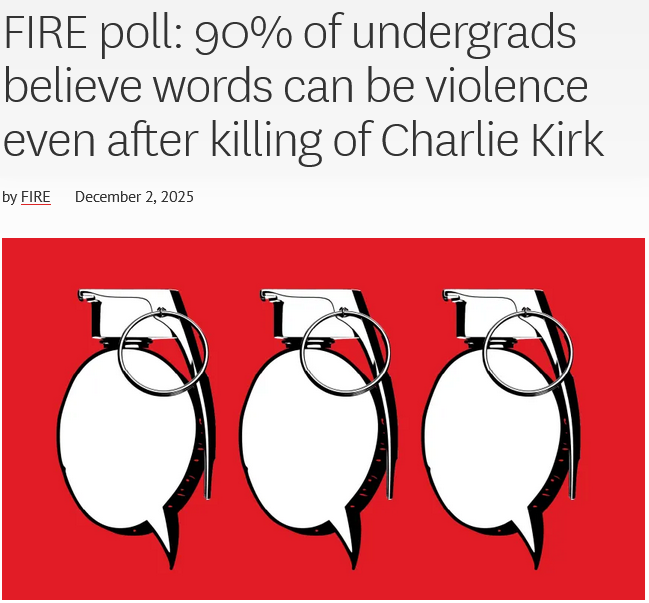
Of all the stupid ideas that have emerged in recent years, there may be none worse than the insistence that unwelcome words are the same as violence. This false perception equates physical acts that can injure or kill people with disagreements and insults that might cause hurt feelings and potentially justifies responding to the latter with the former. After all, if words are violence, why not rebut a verbal sparring partner with an actual punch? Unfortunately, the idea is embedded on college campuses where a majority of undergraduate students agree that words and violence can be the same thing.
Most Believe Words Can Be Violence
“Ninety one percent of undergraduate students believe that words can be violence, according to a new poll by the Foundation for Individual Rights and Expression [FIRE] and College Pulse”, FIRE announced last week. “The survey’s findings are especially startling coming in the wake of Charlie Kirk’s assassination — an extreme and tragic example of the sharp difference between words and violence.”
The survey posed questions about speech and political violence to undergraduate students at Utah Valley University, where Kirk was murdered, and at colleges elsewhere — 2,028 students overall. FIRE and College Pulse compared the student responses to those of members of the general public who were separately polled.
Specifically, one question asked how much “words can be violence” described respondents’ thoughts. Twenty-two percent of college undergraduates answered that the sentiment “describes my thoughts completely”, 25 percent said it “mostly” described their thoughts, 28 percent put it at “somewhat”, and 15 percent answered “slightly”. Only 9 percent answered that the “words can be violence” sentiment “does not describe my thoughts at all”.
It’s difficult to get too worked up about those who “slightly” believe words can be violence, but that still leaves us at 75 percent of the student population. And almost half of students “completely” or “mostly” see words and violence as essentially the same thing. That’s a lot of young people who struggle to distinguish between an unwelcome expression and a punch to the nose.
Depressingly, 34 percent of the general public “completely” or “mostly” agree. Fifty-nine percent at least “somewhat” believe words can be violence.
In 2017, when the conflation of words and violence was relatively new, Jonathan Haidt, a New York University psychology professor, worried that the false equivalence fed into the simmering mental health crisis among young people. He and FIRE President Greg Lukianoff wrote in The Atlantic that “growing numbers of college students have become less able to cope with the challenges of campus life, including offensive ideas, insensitive professors, and rude or even racist and sexist peers” and that the rise in mental health issues “is better understood as a crisis of resilience”.
Conflating Words and Violence Encourages Violence
Telling young people who haven’t been raised to be resilient and to deal with the certainty of encountering debate, disagreement, and rude or hateful expressions in an intellectually and ideologically diverse world plays into problems with anxiety and depression. It teaches that the world is more dangerous than it actually is rather than a place that requires a certain degree of toughness. Worse, if words are violence it implies that responding “in kind” is justified.
“At a time of rapidly rising political polarization in America, it helps a small subset of that generation justify political violence,” Haidt and Lukianoff added.
December 10, 2025
QotD: The “rules” of Gonzo journalism
- The story behind the story is the real story.
- The writer is now the hero of each episode.
- All this gets written in the style of a personal communication to the reader of the real, dirty inside stuff — straight, with no holds barred.
Why couldn’t you write journalism like this? In fact, a whole generation learned to do just that, mostly by imitating Hunter S. Thompson.
But it grows tired and predictable in the hands of today’s imitators — and the Gonzo King never invited either of those modifiers. Yes, blogs and Substacks are part of his legacy, formats that blur the line between diary, confession, and journalism. But he did it before all the rest, not as a desktop publisher — instead putting his life at risk on the road with total fear and loathing.
So if Substack is the grandchild of Hunter Thompson and New Journalism, it is a tame, well-behaved descendant — and nothing like its brave forebear, who kept going full speed without a helmet until the end.
Even the reader has to run to keep up.
Ted Gioia, “The Rise and Fall of Hunter Thompson (Part 2 of 3)”, The Honest Broker, 2025-09-08.
December 9, 2025
The “Great Feminization” of western culture
In the National Post, Barbara Kay outlines the way society has been trending further away from traditional values and more and more toward the values of “empathy, safety, and cohesion” which have been predominantly feminine values in contrast to more male-oriented values of “rationality, risk, and competition”:
In September, public intellectual Helen Andrews caused a stir when she delivered a provocative 17-minute speech, titled “Overcoming the Feminization of Culture”, to the National Conservatism Conference, later published as an article for Compact, titled “The Great Feminization“.
Andrews summarized feminization as the prioritizing of feminine over masculine interests, but additionally prioritizing “empathy over rationality, safety over risk, cohesion over competition”. All these traits combine, she believes, in institutions where females are numerically dominant, to define “wokeness” and “cancel culture”.
Andrews points to Bari Weiss’ 2020 resignation letter from the New York Times where Weiss was labeled and ostracized for her social ties and cut off by perceived friends. In 2018, the newsroom there had tipped to a female majority which Andrews argues changed the work environment’s dynamics to one where cohesion is preferred, and covert undermining would replace open debate in favour of emotional harmony.
And I would argue that the more feminized society’s institutions become, the more readily extreme, empathic attitudes replace rational decision-making at policy-making levels, and the more society loses confidence in its ability to thrive.
Ironically, instead of directing empathy towards our own citizens, feminization also tends to direct empathy internationally. That is exactly what is happening at our national level, when our government earmarks funds for programs such as “Gender-Just, Low-Carbon, Rice Value Chains in Vietnam”.
This is also happening at a micro-level to the Jewish community in North America. Our spiritual leadership in non-orthodox synagogues is growing increasingly female, and, by no coincidence, is wokeness spreading, and, by no further coincidence, so is alignment with radical anti-Zionism.
[…]
Claims that Israel was guilty of genocide and apartheid, the authors write, were a constant feature of their education. Most shockingly, they write — and this at a rabbinical training institution headed by a female rabbi — that “the sexual violence Israelis experienced (on October 7) was never mentioned, even during Women’s History Month”.
What about the Christian clergy? A 2024 report on female Christian clergy found that in a 2018 sample, about 14 per cent of U.S. churches were headed by a senior female clergyperson. So, churches are not yet in danger of feminization. Good luck to them.
If there is a solution to the feminization-linked problem of anti-Zionism in the non-Orthodox rabbinate, I don’t know what it is. I only know this trend cannot end well for our community. What is essential in Jews’ spiritual homes now, more than ever in our history, is that they be spaces where “ahavat Yisrael” — love of Israel — is the prevailing norm. If we are not for ourselves, who will be?
On a more individual level, the Great Feminization has worked not to make women equal, but to increase their existing privileges and to demonize men who even notice the inequality now runs directly opposite to the narrative:

Image from Steve’s Substack
Over thirty years ago, I knew a woman who felt ecstatic joy taunting men with her nudity. She loved to flash her breasts at truckers on the highway. Thrilled at the thought that she left them frustrated, she would boast about her sexual power.
This is clear, unequivocal abuse. Imagine her taunting a village of starving Africans with BBQ’d steak. She then flees to her 5-star hotel, laughing and bragging that she had left them hungry and frustrated. This is how the West raises women. Self-obsessed, over-entitled and insufferable (insert obligatory, “not-all-women” clause here – yawn).
Feminists have gotten more sophisticated with their abuse since then. We now have transgressions that include absurd accusations like prolonged looking, mansplaining and manspreading. TikTokers go to the gym essentially nude in order to video and humiliate men who happen to notice.
We had the, “Yes means Yes” campaign that insists a man should repeatedly pester his partner with endless questions for permission during every intimate encounter. Never mind that a normal woman is likely to leave the bed after a few of these interruptions, rightly despising the insecure man who obeys that tripe. Anywhere outside of a deep feminist indoctrination camp, a woman will wonder whether your mother dropped you on your head as a child. I’ll bet that not even the most committed believer follows their own advice. This is not good communication — it denies healthy context, body language and facial expression.
And there’s nothing romantic about it; it is designed for feminist power. There is no number of reassurances that could possibly satisfy. The emphasis upon a non-stop verbal Q&A is courtroom strategy. And that’s the point: eliminate the human context, and set a trap for the man. “Did he ask permission to engage in number 17 of the 32 listed steps before sex? No, your honor, that’s where the sexual assault happened.”
Human intimacy is negotiated using mostly unspoken signals, and everybody likes it that way. Obviously there’s a need for clear communication, especially in a new relationship. I only need to include this disclaimer because the world is filled with pedantic manhating feminists eager to accuse me of denying women’s humanity. Grow up, child. Healthy women have absolutely no problem setting their own limits during intimacy. I’ve never met one who didn’t.
We cover for even the worst of women’s transgressions. When a woman murders her child, we call it infanticide and blame postpartum depression. When she murders her husband we call it battered wife syndrome, which is the title of a book by Canadian feminist law professor, Elizabeth Sheehy. Feminist lawyers even argue to eliminate female incarceration and close all women’s prisons, and for decriminalization of husband murder. This nonsense from the feminist cult for women with daddy issues protects mentally ill women who need psychological help, and/or belong in prison.
Every woman has a plethora of options, and near-infinite sympathy and support, in Western culture. Maybe that’s the problem: we don’t hold women responsible for their own behavior. Many women have not been socialized into adulthood.
At risk of making this a TLDR post, here’s Mark Steyn on the cultural side of our ever-more-feminized culture:

Welcome to another in our ongoing series of As I Said Twenty Sod-Bollocking Years Ago. Women have inherited the thrones of great powers — Elizabeth I, Catherine the Great, Victoria — and presided over massed ranks of courtiers drawn from the “pale, male and stale” (thank you, David Cameron). But America and its client states are the first in history in which every significant venue aside from ladies’ sport is now dominated by women. The west is closer than any society should be to the end of men — which is a big source of the terrible confusion in our schools that has led children to offer themselves up for bodily mutilation and irreversible infertility. Helen Andrews’ much noted “viral” essay on the phenomenon informs us inter alia that by 2024 American law schools were fifty-six per cent female and that sixty-three per cent of judges appointed by Joe Biden’s autopen are likewise on the distaff side. Elsewhere, fifty-five per cent of New York Times reporters are women (up from ten per cent half-a-century ago) and 57.3 per cent of US undergraduates are what we would once have called “coeds”.
At the same time, the principal source of immigration to the west is from a patriarchal culture even more severe (if you can believe it) than 1950s sitcom dads. If you live in London, Paris, Brussels, Stockholm, Dearborn, do you see more body-bagged crones on the streets than you did a generation back? Are you figuring on seeing more still in another twenty years? Or are you betting that the tide will have receded?
It is at the intersection of these two not entirely compatible trendlines — a feminised society with a patriarchal immigration policy — where lies the future (such as it is) of the western world. With that in mind, the annual commemoration of the 1989 Montreal massacre each December 6th has a symbolism that extends far beyond my own deranged dominion. Not just because it was an early example of the state hijacking the actual news to impose a narrative more helpful to its own needs. In the dismantling of manhood and manliness, no lie is too outrageous. As I wrote in The National Post of Canada on December 12th 2002 – twenty-three years ago:
For women’s groups, the Montreal Massacre is an atrocity that taints all men, and for which all men must acknowledge their guilt. Marc Lépine symbolizes the murderous misogyny that lurks within us all.
M Lépine was born Gamil Gharbi, the son of an Algerian Muslim wife-beater, whose brutalized spouse told the court at their divorce hearing that her husband “had a total disdain for women and believed they were intended only to serve men”. At eighteen, young Gamil took his mother’s maiden name. The Gazette in Montreal mentioned this in its immediate reports of the massacre. The name “Gamil Gharbi” has not sullied its pages in the thirteen years since.
The Gazette notwithstanding, that might open up many avenues of journalistic investigation, don’t you think? The potential implications of Canadian immigration policy. The misogyny in particular of Islam, and its compatibility with developed societies. But instead everyone who mattered in the Dominion’s elite decided it was all the fault of Canadian manhood in general — of Gordy and Derek’s, or Émile and Pierre’s, culture of toxic masculinity. That narrative has held for two generations. The only even slight modification has been from a sliver of academics who posit Gamil Gharbi as “the first incel“. I’m not sure “incels” — young men who are “involuntarily celibate” — existed as a mass phenomenon back in 1989: they are a consequence of the societal feminisation Ms Andrews writes about. The “incel” segment was by far the most interesting part of the Tucker/Fuentes convo, and the least remarked upon, but the notion that they’re itching to kill women bolsters the original 1989 framing, so the media are minded to entertain it.
Yet we all know, surely, that the young ladies in that Montreal classroom would have benefited from a little bit of available “masculinity” that day. Alas, the men to hand were in a certain sense far more profoundly disarmed than the wildest dreams of “gun control” advocates. From my book After America:
To return to Gloria Steinem, when might a fish need a bicycle? The women of Montreal’s École Polytechnique could have used one when Marc Lépine walked in with a gun and told all the men to leave the room. They meekly did as ordered. He then shot all the women.
Which is the more disturbing glimpse of Canadian manhood? The guy who shoots the women? Or his fellow men who abandon them to be shot? For me, the latter has always been the darkest element of the story. From my column in Maclean’s, January 9th 2006:
Every December 6th, our own unmanned Dominion lowers its flags to half-mast and tries to saddle Canadian manhood in general with the blame for the Montreal massacre — the fourteen women murdered by Marc Lépine, born Gamil Gharbi, the son of an Algerian Muslim wife-beater, though you wouldn’t know that from the press coverage. Yet the defining image of contemporary Canadian maleness is not M Lépine/Gharbi but the professors and the men in that classroom, who, ordered to leave by the lone gunman, obediently did so, and abandoned their female classmates to their fate — an act of abdication that would have been unthinkable in almost any other culture throughout human history. The “men” stood outside in the corridor and, even as they heard the first shots, they did nothing. And, when it was over and Gharbi walked out of the room and past them, they still did nothing. Whatever its other defects, Canadian manhood does not suffer from an excess of testosterone.
So the annual denunciation of manhood in general is the precise inversion of the reality of the event. That was unusual in 1989, but has become routine since: the UK Government’s “Prevent” programme, set up in the wake of the July 7th Tube bombings to “prevent” further “Islamist” attacks, now focuses its energies on the threat from a “far right” boorish enough to insist on noticing all these Islamic provocations; January 6th is an insurrection for which trespassing gran’mas have to be hunted down and banged up in solitary, but Thoroughly Modern Milley telling the ChiComs he’ll ignore his commander-in-chief or James Comey taking to Twitter to urge his chums to “eighty-six” the President is true patriotism of the highest order; in German cities saving democracy is so critical that it is necessary to ban the leading political party.
So the inversion of reality is pretty much standard operating procedure these days. There is, however, a sense in which that terrible one-off atrocity from the late Eighties has become a portent of tomorrow — of a western world thoroughly unmanned. Your average feminist lobby group doesn’t see it that way, naturally. “The feminism I think of is the one that embodies inclusivity, multiculturalism and the ability to change the world through the humanity that women do bring,” says Stephanie Davis, executive director of Atlanta’s Women’s Foundation. “If there were women in power in representative numbers — fifty-two per cent — I think that the World Trade Center would still be standing.”


