
The Critical Drinker
Published 1 Sept 2025Toxic makeup, deadly pyrotechnics, abusive directors, drugged-up child actors and horny midgets — The Wizard Of Oz had it all, and much more. Join me as I recount the insane production of the 1939 classic.
December 27, 2025
Production Hell – The Wizard Of Oz
Comments Off on Production Hell – The Wizard Of Oz
December 26, 2025
The Pinnacle of Movie ⚔️Swordfights⚔️
Jill Bearup
Published 8 Sept 2025Scaramouche had, until recently, the longest swordfight in cinema history. It’s still regarded as one of the best. Why? Let’s talk about it.
Comments Off on The Pinnacle of Movie ⚔️Swordfights⚔️
December 25, 2025
Bing Crosby’s “White Christmas” is still the best-selling single of all time
I knew Bing Crosby was big with my parents’ generation (including my father, unusually, who generally had little time for American singers), but I didn’t know that Bing’s recording of “White Christmas” is still, after all these years, the top single. Ted Gioia has more:
Pop culture devours its own. The destiny of all bestsellers is to fall off the charts. Even the stars in Hollywood, like those in outer space, eventually stop shining — and it happens a lot sooner.
Consider the case of Bing Crosby. Some of my readers might not even recognize the name. But a few people still alive today can recall when Crosby was both the biggest pop singer in the world and the hottest movie star in Hollywood.
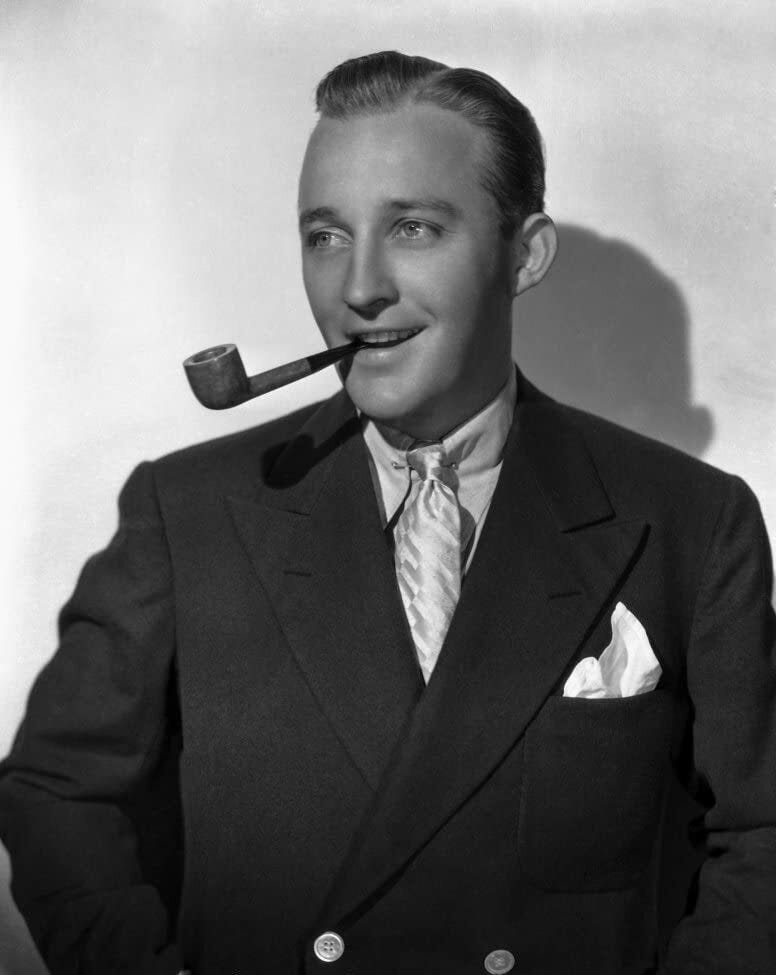
Bing Crosby publicity photo from the 1930s via The Honest Broker
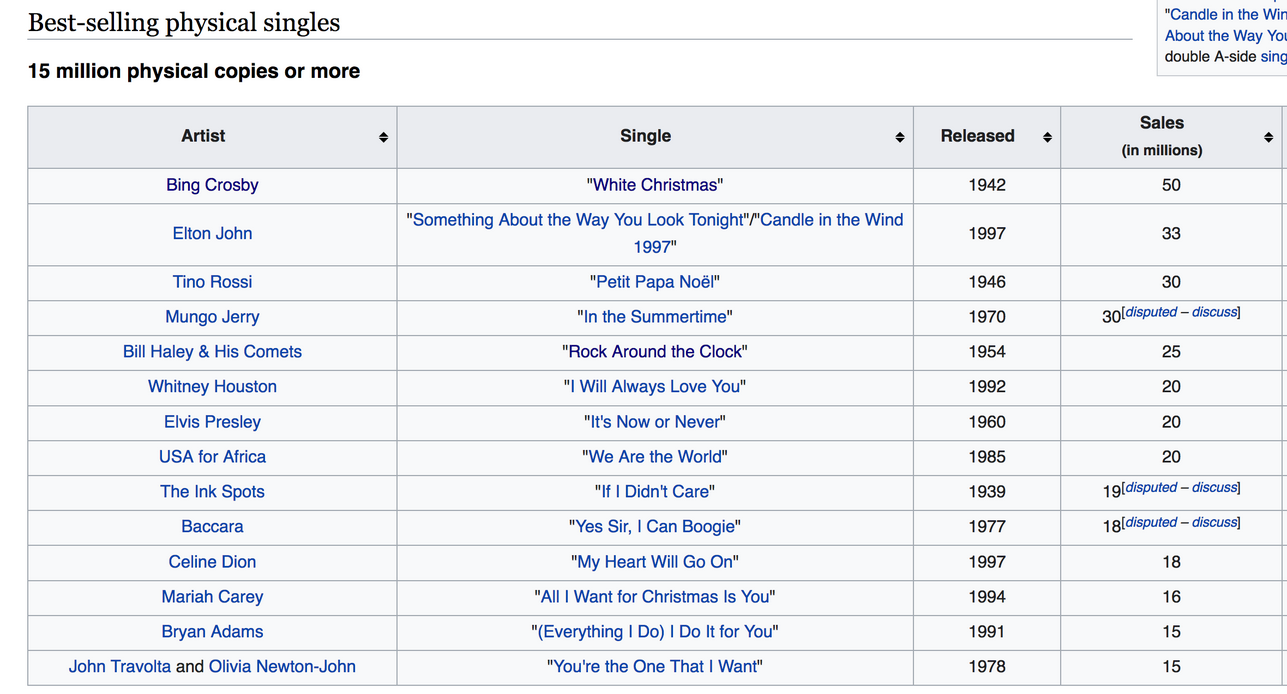
If he’s remembered nowadays, it’s only during December, when his version of “White Christmas” briefly returns to heavy rotation. Even today, it ranks as the bestselling single of all time. There aren’t many records that last eighty years, and least of all in the record business, but Crosby still sits atop this chart.
Here it is (courtesy of Wikipedia):
I’ve written about Crosby before, and will again. But today I want share four of my favorite (and very different) perspectives on Bing.
Comments Off on Bing Crosby’s “White Christmas” is still the best-selling single of all time
Repost – “Fairytale of New York”
Time:
“Fairytale of New York” by The Pogues featuring Kirsty MacColl
This song came into being after Elvis Costello bet The Pogues’ lead singer Shane MacGowan that he couldn’t write a decent Christmas duet. The outcome: a call-and-response between a bickering couple that’s just as sweet as it is salty.
Comments Off on Repost – “Fairytale of New York”
December 24, 2025
Welcome to Bland World
Ted Gioia yearns for the return of the weirdo, the eccentric, and the non-conformist to spice up our bland, smooth, grey world:

“People are less weird than they used to be,” claims psychologist Adam Mastroianni. He describes this as “an epidemic of the mundane”.
The strangest thing, he believes, is absence of strangeness. Nobody wants to make waves — or even trickles. Conformity is the flavor of the month, and it tastes the same every month.
We live in a “smoothness society”, explains philosopher Byung-Chul Han. He points to the smooth, rounded contours of the iPhone as a symbol of society’s desire to remove friction. Our phone apps demonstrate the exact same thing. We scroll and swipe with such ease, and anything with complexity, nuance, or resistance is eliminated from consideration.
“The smooth is the signature of the present time”, he claims. Everything from the Brazilian wax job applied to human bodies to the wax coating put on fruits and vegetables aims at the same ideal.
Resistance is futile. Everything must be smooth. Paradise now really is that paved parking lot.
In a world without complexity or resistance, nothing ever changes. Most movies, music, books feel like stagnant rehashes of the same formulas. And that’s intentional.
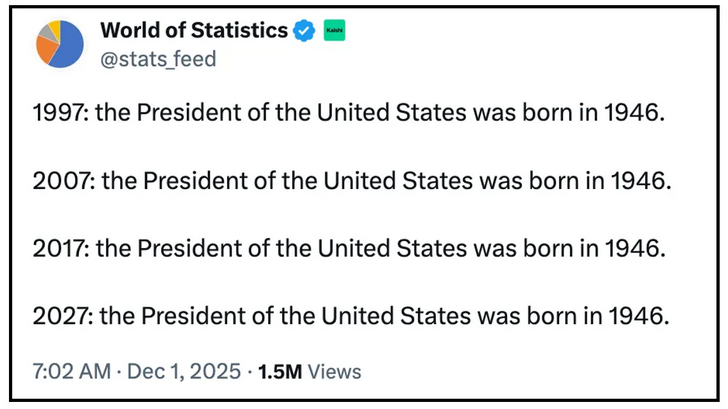
For the first time in history, fashions don’t change. We don’t change.
Others have noticed this avoidance of anything new or different. Things are designed to blend in, not stand out. Jessica Stillman, writing in Inc., complains about a “blandness epidemic“. Brian Klaas calls it the “surefire mediocre“.
Everywhere you look, the system is serving up more of the same.
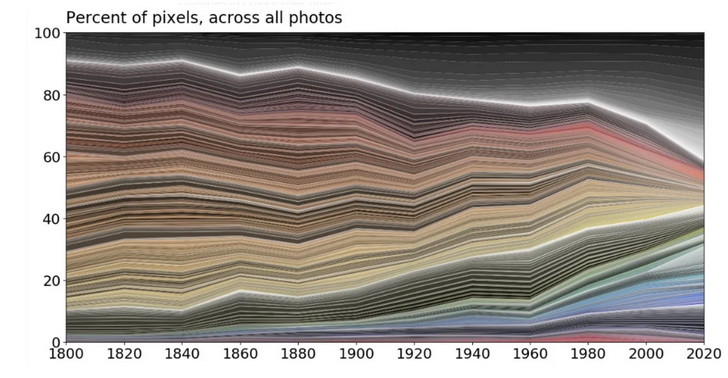
It’s not just in our imagination — the “world really is getting grayer“. A researcher recently studied photos of household items going back two centuries. An analysis of the pixels showed a scary collapse in color.
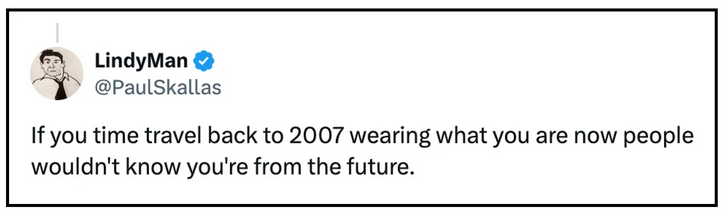
Even the Victorians — often considered as conformists — lived a more color-filled life. We have almost completely abandoned red and yellow and other bright hues in favor a boring black-and-white spectrum.
But what’s most striking is how this descent into grayness has accelerated during the last few years. The most popular color is now charcoal — and at the current rate it will soon account for half of the marketplace.
Comments Off on Welcome to Bland World
The real agenda
On the social media site formerly known as Twitter, Karl Harrison makes a case for fighting against the key element of the federal government’s all-encompassing drive to control the lives of Canadians because it’s the one that will enable all the other controls to operate:

All Canadians should read this carefully:
“They are flooding Parliament with distraction bills so the public is overwhelmed and cannot see the one bill that makes the entire system possible. More than a dozen federal bills are advancing simultaneously — each attacking a different pillar of Canadian freedom but S206 is the key. They fall into clear clusters:
Bills attacking due process and court rights.
Bill S-206 — Administrative Monetary Penalties (the central pillar) enables penalties without hearings, judges, trials, or common-law protections.
Bill C-63 — Online Harms Act. Undefined “harm”, digital speech penalties, CRTC enforcement authority.
Bill C-27 — Digital Charter Act. Creates federal AI regulators empowered to issue compliance orders without court oversight.
Bill C-52 — Beneficial Ownership Transparency. Expands federal surveillance and administrative enforcement.Bills attacking parliamentary supremacy (power shift to agencies).
Bill C-26 — Critical Cyber Systems Act. Sweeping regulation by order-in-council, bypassing Parliament.
Bill C-11 — Online Streaming Act. Gives the CRTC unprecedented control over content curation and digital reach.
Bill C-18 — Online News Act. Allows federal regulators to determine access to, and compensation for, digital journalism.Bills attacking property rights.
Bill C-234 — Agricultural Fuel Restrictions. Expands federal control over farm operations and production.
Bill S-241 — Jane Goodall Act. Sweeping biosafety authority over wildlife, land, and private property.
Bill C-49 — Atlantic Accord Amendments. Expands federal control over offshore land, climate restrictions, and energy development.Bills attacking freedom of speech and assembly
Bill C-63 — Online Harms Act. Criminalizes undefined “harm”, empowers bureaucrats to judge speech.
Bill C-261 — Misleading Communications Act. Penalties for “misleading” speech — undefined and discretionary.
Bill C-70 — Foreign Interference Act. Mass surveillance powers with vague thresholds.Bill attacking religion freedom.
Bill C-9 — “Harmful Conduct” Redefinition. Allows the state to regulate spiritual beliefs and pastoral work under “harm”.The critical pattern. Different bills, different sectors and different rights being attacked. But here is the truth: Every single one of these bills depends on ONE central enforcement pillar, and that pillar is:
Bill S-206 — The Administrative Penalty SwitchBill S-206, the hub of the entire system, gives federal departments the power to issue penalties without:
▪︎ a hearing
▪︎ a judge
▪︎ a trial
▪︎ due process
▪︎ common-law protections
▪︎ judicial review in practiceIt turns federal agencies into their own courts — investigator, prosecutor, judge, and enforcer. No democracy on Earth should tolerate this.
This is the enforcement engine behind:
▪︎ Digital ID
▪︎ CBDCs
▪︎ Carbon allowances
▪︎ Biosafety / One Health rules
▪︎ Smart-meter penalties
▪︎ Travel scoring
▪︎ Online speech controls
▪︎ Zoning & land-use mandatesData alone cannot control a population. They need the power to punish. S-206 provides it. Remove the keystone → the arch collapses.
Why scatter us with other bills? Because if Canadians focus on S-206, the agenda dies The distraction bills serve one purpose:
▪︎ to scatter attention and exhaust the public.
▪︎ to keep citizens debating side issues
▪︎ to hide the enforcement bill under noise
▪︎ to make resistance impossible to organize
▪︎ to create outrage fatigue
This is how large control systems are built — through distraction around the edges while the core is slipped into place.What are they building – and why S-206 is the core. Here is the architecture of the planned digital-governance system:
▪︎ Digital ID → who you are
▪︎ CBDCs → what you buy
▪︎ Carbon scoring → how you move & heat your home
Comments Off on The real agenda
December 23, 2025
Vagabond by Tim Curry
Andrew Doyle reviews Tim Curry’s new autobiography Vagabond:

Tim Curry, Nell Campbell, Richard O’Brien and Patricia Quinn in The Rocky Horror Picture Show (1975)
Tim Curry is a shapeshifter. I have a childhood memory of the moment I learned that the demon in Legend (1985), the villain in Annie (1982), the butler in Clue (1985) and the cross-dressing alien scientist in The Rocky Horror Picture Show (1975) were all played by the same man. It was quite the revelation.
Curry’s protean talents have meant that as a personality he has forever remained mysterious. He rarely gives interviews – only grudgingly whenever there is a movie to promote – and fans have therefore tended to project onto this reclusive figure the persona that best fits their expectations or desires. When more insistent fans have formed an emotional bond with the Tim Curry of their imaginations, he has on occasion been forced to put them right. “I’m just a person,” he says, “and I’m not your person”.
Fans will therefore be delighted at the publication of Curry’s memoir, Vagabond, which offers fascinating snapshots from his life. The approach is episodic, with chapters devoted to particular projects in his career. As such, Curry offers us morsels in lieu of a meal. Those who are hoping for salacious anecdotes about his love life will be disappointed, because – as he rightly points out – “specifics about my affairs of the heart or the bedroom are – respectfully – none of your fucking business”. Instead, we have a wonderfully compelling account of Curry’s origins and how his philosophy of life has informed his craft.
Tim Curry as Wadsworth in Clue and King Arthur in Spamalot
His vagabond status has been well earned. As the child of a military father, he was forever on the move, and it is easy to see how these early experiences shaped his capacity to embody such a wide breadth of humanity. His first accolade came early when he was awarded the prize for the “Most Beautiful Baby in Hong Kong”. His family relocated roughly every eighteen months for the first eleven years of his life, which is why he tells us that “mutability felt like a part of my DNA”. It was the ideal apprenticeship for his future vocation.
Writing in 1817, William Hazlitt called actors the “motley representatives of human nature” who “show us all that we are, all that we wish to be, and all that we dread to be”. For his part, Curry sees the actor as the vagabond of his book’s title. “How can you trust somebody, or truly know somebody, who appears as a king one day and a jester the next? What does it mean when neither role is the true identity of the person, and when that very person might be gone the next day?” In this, he could be paraphrasing Hazlitt’s description of actors as “today kings, tomorrow beggars”, and how “it is only when they are themselves, that they are nothing”.

Comments Off on Vagabond by Tim Curry
December 21, 2025
Women are walking away from the corporate world
On her Substack, Elizabeth Nickson starts her most recent post with the shocking headline that “400,000 women left the workforce this year”:

Digging into these reports, it seems the problem is that no one wants to mentor young women, as seniors traditionally have done for young men. No one seems to want to promote women as equally as they do men. Also women don’t want to “work as hard”. They aren’t “as ambitious” as men.
Also women do twice as much uncompensated labor as men, taking on the great majority of household chores, and, as well, are expected to organize the Christmas party. Not me, I might add — on a personal note. I cook. He does everything else.(editors note)
This means they are over-burdened and resentful and they are quitting. Four hundred thousand women left the workforce in 2025, putting down their tools and refusing to spend their lives working for “the man”.
The reports and accompanying “analyses” in the mainstream cry that government and corporations should do more! More of other people’s money chasing a fruitless dream that goes against human nature and sets sex against sex, turns family dynamics into a conflict zone, and takes away yet another chunk of private life to be traded on the market.
Quitting is the right choice.
Rather than leaving a job they love, they are quitting for a better life. As one creator said, “Women, during the pandemic, got a sense of what it felt like to not be tied to a desk five days a week in an office. Women started to expand their dreams, expand what was inside of them, and they started to really tun into what was in their gut and in their heart. And a lot of that was ‘I don’t want to work for somebody else’s dreams. I want to spend more time with my kids, I want to spend more time in community, I want to launch a business, I wanna a robust side hustle. I want to be an author, I want to be a content creator.’ I’m excited to see what women build when they are untethered to a corporate job. For a lot of millennial women, it’s I’m going to do something better, I’m gonna do something different.”
This in fact, is enormously exciting to me. Because our towns and cities are bereft of female genius — which is not moving widgets around for McKinsey. Our main streets are mostly barren wastes of utility, and the only town center in most places is the parking lot of a big box store. Unless you live in a tourist town and then it’s commercial cosplaying of an earlier better time.
Charitable work is equally as utilitarian, and the assignment of care of the weak to government is brutal and failing. There are more homeless, more lost and broken people every single year. It’s as if the vast, resplendently-funded homeless bureaucracies think that filing quarterly and annual reports filled with noble-sounding “initiatives” is the same as actually solving the problem. I had one middle-class woman warrior in my house say that they were trying to get more hookers on the streets of good neighborhoods. These people are literally, insane.
Women individuating and returning to a private life indicates they are yearning after a more traditional and based occupation for women and I’m not talking about submission, early child bearing and a boss daddy. My pioneer family women, all ten thousand of them ran small businesses, a home farm, the general store, did bookkeeping, ran a workshop, and/or (usually and) some kind of business in town that was charitable, before that was taken over by corporatism and the ravenous maw of the public service who never saw an innovation they didn’t want to ruin by systematizing and ripping out the heart and purpose.
That and only that is the history of women in America, not this cobbled together whining, mewling, weak, oppressed, screeching, “stressed”, “exhausted”, victim. Women, from 1600-1950 had real problems to solve. They were fully adult.
The generations since tried corporate life. It sucked. And they’re not going back. I think this is a forerunner of the life pattern of women into the future. In fact, in millennial-world, one person with a W-2 job and one person with an entrepreneurial spirit is touted as how you game the system to perfection. Taxes are limited, security is up-levelled, and you can actually build something together, rather than both partners slaving away in the globalist maw.
I expect this to take flight almost immediately.
Because women in corporate life?
Nightmare.
This is what these reports are ignoring. Senior officers do not want to mentor or promote women because they are nightmares to work with. They have been trained by their universities and culture to be ideological freaks, demanding and whining and surreptitiously tearing each other down. There was a study done in the 80’s, before ideology took over social research, that found women in corporate life practiced Power Dead Even, which meant crabs in a bucket, baby. If someone was perceived as too powerful, tear them down.
Introduce that into corporate “culture” and nothing gets done. No wonder senior executives don’t mentor or promote women.
Update, 22 December: Welcome, Instapundit readers! Please do have a look around at some of my other posts you may find of interest. I send out a daily summary of posts here through my Substack – https://substack.com/@nicholasrusson that you can subscribe to if you’d like to be informed of new posts in the future.
Boomers – A vampiric generation battening on the blood of the young
As a member of the recently identified “Generation Jones”, I could take part in the widespread boomer hate with a clear conscience … but as Scott Alexander points out, the hate may be more than a little over-done:
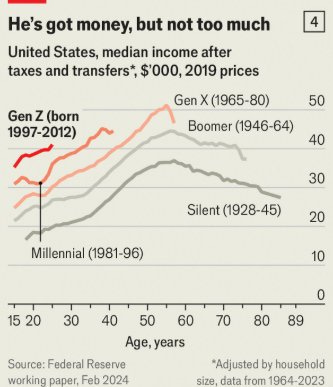
“… Millennials and Generation Z have more money (adjusted for inflation ie cost-of-living, and compared at the same age) than their Boomer parents, to about the same degree that the Boomers exceeded their own parents. This is good and how it should be. The Boomers have successfully passed on a better life to their children”
There’s a more developed theory of Boomer-hating. The more developed theory goes: Boomers are plundering the young. We know this, because their share of resources is high and keeps increasing. They use their large population share and good voter turnout to vote themselves ever-higher pensions at the expense of working taxpayers.
How might we investigate this theory? We can’t use total social security spending, because the number of elderly has gone up. Can we use social security spending per elderly person? No; the amount of social security paid out depends on the amount paid in. If each year’s retirees earned more during their career than the previous year’s did (this is true), then each year’s will get a higher SSI payment, even if the system’s “generosity” stays the same.
We might start by looking at change in social security payment divided by change in median income. Over the past fifty years, average Social Security payment in inflation-adjusted dollars increased 60%. If we expect these payments to reflect earnings twenty years before disbursement, we can look at real median personal income from 1953 to 2003; this also increased 60%. There is no increase in generosity.
Or we can just look at the history. The Social Security Administration’s own website says that its generosity peaked in 1972, when the program primarily served the Greatest Generation; since then, it’s been one contraction after another. In 1983, the government increased the full retirement age from 65 to 67; in 1993, they made Social Security more taxable. Since then, most of the changes have been cost-of-living increases, which are indexed to inflation and not the result of active lobbying on old people’s behalf.
Why do so many believe that old people have discovered a vote-themselves-infinite-benefits hack? Since old people represent an increasing fraction of the population, are living longer, and face a secular trend of rising healthcare costs, even when their benefits per capita per year are stable or declining the government will spend more money on them as a group. This spending is indeed rapidly becoming unsustainable, the elderly will need to accept big benefit cuts to make it sustainable again, and they are resisting those cuts.
So have we finally discovered the fabled Boomer selfishness? Call it what you want. But remember that the Boomers did pay money into Social Security to support their own parents, believing that they would be supported in turn. Learning that yours is the generation where the pyramid collapses is a hard pill to swallow. Maybe they should suck it up and take the sacrifice. You’d do this, right? Voluntarily give up money which is yours by right, in order to help other generations? Oh, sorry, you didn’t hear the question, you were too busy writing your 500th “You don’t hate Boomers enough, why won’t they hurry up and die, we need to declare intergenerational warfare and seize our rightful inheritance” post.
Update, 22 December: Welcome, Instapundit readers! Please do have a look around at some of my other posts you may find of interest. I send out a daily summary of posts here through my Substack – https://substack.com/@nicholasrusson that you can subscribe to if you’d like to be informed of new posts in the future.
December 20, 2025
Ours is a culture that actively conspires against and sabotages its own children
Following up on yesterdays post (here) on the viral essay about the Millennial “lost generation”, John Carter enumerates the extent of damage done to Millennials in general and Millennial men in particular:
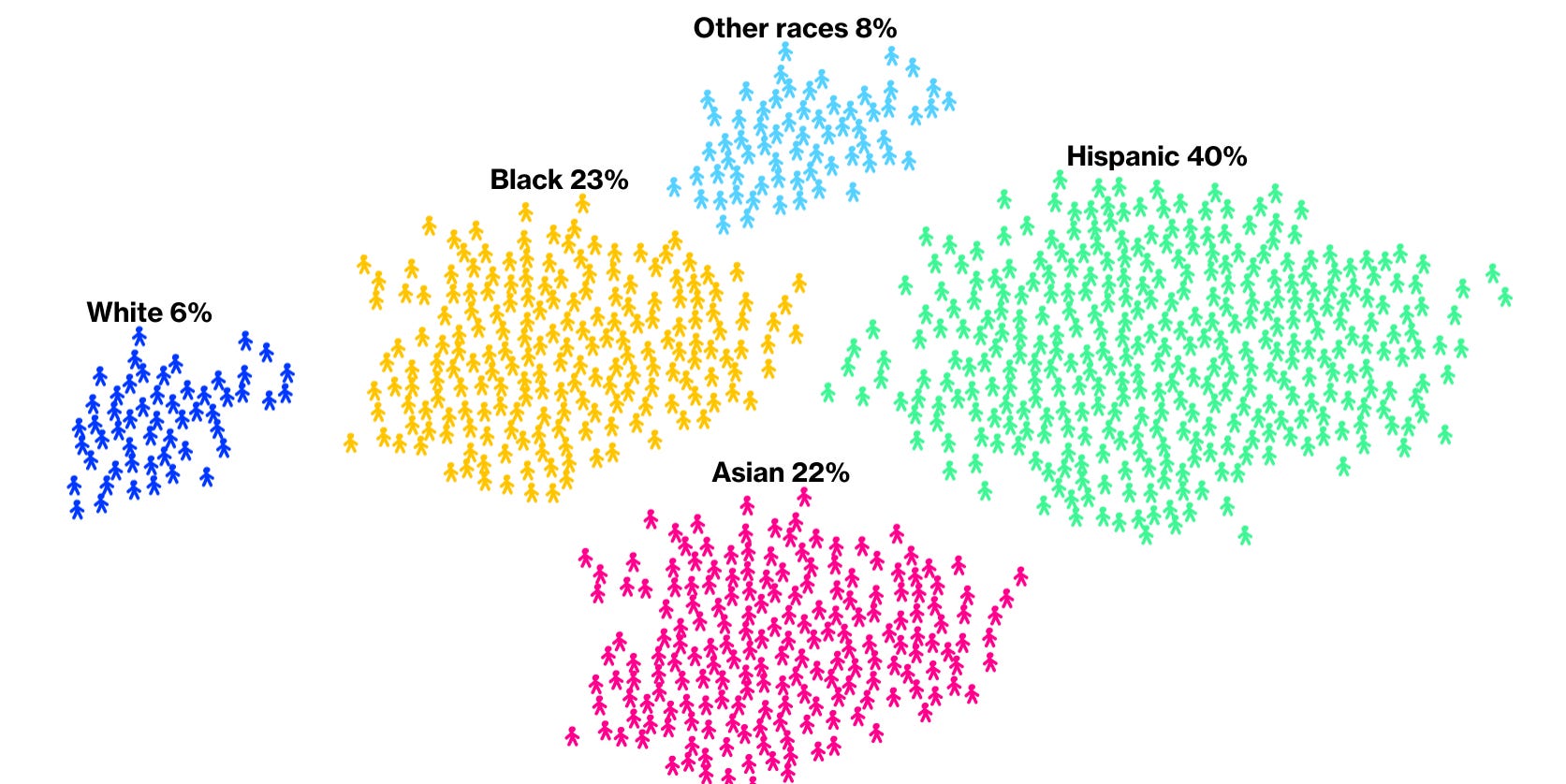
A Bloomberg report from 2023 tracked reported hiring by 88 Standard & Poor’s 100 companies and of 323,094 reported hires from 2018-2021, only 6% were white.
The response to the essay has been an outpouring of suppressed rage that has been simmering for years in an emotional pressure cooker of silenced frustration. The author, Jacob Savage, provides a ground-level view of the DEI revolution’s human cost, beginning with his personal experiences as an aspiring screenwriter, and then widening the reader’s perspective via interviews with would-be journalists and academics. Every subject described a similar pattern of frustrated ambitions in which, starting around the middle of the 2010s, their careers stalled out for no other reason than their melanin-deficiency and y-chromosome superfluity. Young white men were systematically excluded from every institutional avenue of prestige and prosperity. Doors were closed in academia, in journalism, in entertainment, in the performing arts, in publishing, in tech, in the civil service, in the corporate world. It didn’t matter if you wanted to be a journalist, a novelist, a scientist, an engineer, a software developer, a musician, a comedian, a lawyer, a doctor, an investment banker, or an actor. In every direction, Diversity Is Our Strength and The Future Is Female; every job posting particularly encourages applications from traditionally underrepresented and equity-seeking groups including women, Black and Indigenous People Of Colour, LGBTQ+, and the disabled … a litany of identities in which “white men” was always conspicuous by its absence.
The Lost Generation does not rely only on the pathos of anecdote. Savage includes endless reams of data, demonstrating how white men virtually disappeared from Hollywood writing rooms, editorial staff, university admissions, tenure-track positions, new media journalism, legacy media, and internships. He shows how, after the 2020s, they even stopped bothering to apply, because what was the point? The comprehensive push to exclude young white men from employment wasn’t limited to prestigious creative industries, of course. The corporate sector has also adopted a practice of hiring anyone but white men, as revealed two years ago by a Bloomberg article which gloated that well over 90% of new hires at America’s largest corporations weren’t white.
The Bloomberg article was criticized for methodological flaws, but judging by the outpouring of stories it elicited (just see the several hundred comments my own essay got, the best of which I summarized here) it was certainly directionally accurate.
The real strength of Savage’s article isn’t the cold statistics, though, but the heartrending poignancy with which it highlights the emotional wreckage left in the wake of this cultural revolution.
Hiring processes are opaque. If an employer doesn’t extend an offer, they rarely explain why; at best one receives a formulaic “thank you for your interest in the position, but we have decided to move forward with another applicant. We wish you the best of luck in your endeavours.” They certainly never come out and say that you didn’t get hired because you’re a white man, which is generally technically illegal, for whatever that is worth in an atmosphere in which the unspoken de facto trumps the written de jure. Candidates are not privy to the internal deliberations of hiring committees, which will always publicly claim that they hired the best candidate. Officially a facade of meritocracy was maintained, even as meritocracy was systematically dismantled from within.
The power suit-clad feminists who body-checked their padded shoulder into C-suites and academic departments in the 1970s flattered themselves that they were subduing sexist male chauvinism by outdoing the boys at their own game and forcing the patriarchy to acknowledge their natural female excellence. Growing up I would often hear professional women say things like “as a woman, to get half as far as a man, you have to be twice as good and work twice as hard”. [NR: usually with a smug “fortunately, that’s not difficult” tacked on] The implication of this was that women were just overall better than men, because the old boy’s club held the fairer sex to a higher standard than it did the good old boys. Of course this was almost never true, these women were overwhelmingly the beneficiaries of affirmative action programs motivated by anti-discrimination legislation that opened up any corporation that didn’t put a sufficient number females on the payroll to ruinous lawsuits. Moreover, a fair fraction of them were really being recruited as decorative additions to the secretarial harems of upper management. Nevertheless it helped lay the foundation for the Future Is Female boosterism that stole the future from a generation of young men.
There was a time, not so long ago, where I naively assumed that my own situation was simply the inverse of the one women had faced in the 70s and 80s. I was aware that I was being rather openly discriminated against, but imagined that this simply meant that I had to perform to a higher standard, that if I was good enough, the excellence of my work would shatter the institutional barriers and force someone to employ me. It took me several long and agonizing years to realize that this just wasn’t true. The crotchety patriarchs of the declining West may have been principled men capable of putting stereotypes aside to recognize merit; in fact, the historical evidence suggests that they overwhelmingly prized merit above any other consideration (just as the evidence suggests that their stereotypes were overwhelmingly correct). The priestesses of the present gynocracy hold themselves to no such standard. They don’t care about your promise or your performance, at all. If anything, performing well is a strike against you, because it threatens them. Nothing makes them seethe more than being outperformed by men. They champion mediocrity as much to punish as to promote.
Young white men had been raised to expect meritocracy. They’d also been raised to be racial and sexual egalitarians. People in the past, they believed, had been bigoted, believing superstitious stereotypes about differences of ability and temperament between the sexes and races that had no foundation in reality, pernicious falsehoods that were developed and propagated as intersectional systems of oppression with the purpose of justifying slavery, colonialism, imperialism, and genocide. Naturally they were appalled to have such charges laid at their feet, and so they they agreed that we were all going to try and correct this injustice, and we’d do it by carefully eliminating every potential source of racial or sexual bias, eliminating all the unfair barriers to advancement within society, in particular although not certainly not exclusively via university admissions and institutional hiring. That was the original official line on DEI: that it wasn’t about excluding white men, heaven forbid, no, it was simply about including everyone else, widening the talent pool so that we could ensure both the fairest possible system of advancement, and that the best possible candidates were given access to opportunity. In practice, we were told, this wouldn’t be a quota system: everything would still be meritocratic, but if it came down to a coin flip between two equally qualified candidates, one of whom was a white man and the other of whom was not, the not would win. Fair enough, the young white men thought at first: we’ll all compete on a level playing field, in fact we’ll even accept a bit of a handicap in the interests of correcting historical injustices, and may the best human win.
But the DEI commissars had absolutely no interest in a level playing field. That the playing field wasn’t already as level as it could be was, in fact, one of their most infamous lies. The arena has always been level: physics plays no favourites in the eternal struggle for survival and mastery. If some always end up on top – certain individuals, certain families, certain nations, certain races – this is invariably due to their own innate advantages over their competitors. An interesting example of this was provided by the Russian revolution. The Bolsheviks cast down the old Czarist aristocracy, stripping them of land, wealth, and status, and then discriminated against them in every way possible; a century later, their descendants had clawed their way back to power and prominence. The only possible conclusion from this is that the Russian aristocrats were, at least to some degree, aristos – the best, the noblest – in some sense that went beyond inherited estates.
The young white men did not think of themselves as aristocrats with a blood right to a certain position in life, but as contestants in a fair competition, who would rise or fall on their own merits and by their own efforts. They then abruptly found themselves competing in a system in which it was simply impossible for them to rise, but which also lied to them about the impassable barrier that had been placed in their way. If you noticed the unfairness, you were told that this was ridiculous, that as a white man you were automatically and massively privileged, that it was impossible to discriminate against you because of this, and that in addition to being a bigoted racist you were also quite clearly mediocre, a bitter little man filled with envy for the winners in life, the brilliant beautiful black women who had obviously outcompeted you because they were just so much smarter, so much more dedicated, and so much better because after all they had succeeded in spite of the deck being stacked against them whereas you had failed despite having been born with every unearned advantage in the world.
An entire generation had their future ripped from their hands, and were then told that it was their fault, their inadequacy. They were gaslit that there was no systemic discrimination against them, that their failure to launch was purely due to their individual failings … while at the same time being told that those who were so clearly the beneficiaries of a heavy thumb on the scale were the victims of discrimination, that the oppressors were the oppressed, and that to cry “oppression” yourself was therefore itself a form of oppression.
Do you see how cruel that is? How sadistic? It is more psychologically vicious by far than anything the Bolsheviks did to the Russian aristocracy. At least the Bolsheviks were honest. Although, it must be said, the psychological sadism of the gay race commissars is part of a tradition, communists have often been noted for their demonic cruelty.

The “pursuit” of the Brown University shooter as a parable of incompetence
Mark Steyn is supremely unimpressed with the quality of police work demonstrated by the “forty-seven genius law-enforcement agencies” apparently involved in investigating the murders at Brown University and the murder of an MIT nuclear fusion expert:

The Brown University shooter has been found dead by his own hand in a storage locker in southern New Hampshire. The entire officialdom of Providence, Rhode Island celebrated by throwing “the most worthless, uninformative, cover-your-ass press conference I have ever seen in my entire life“.
You’ll be glad to hear that the DEI Mayor of Providence has declared “we believe that you remain safe in our community“. He said this at 11pm last Sunday, but his statement was technically true because at that point the shooter was driving out of “our community” up to someone else’s community to kill an MIT professor, who would assuredly be alive today had not everybody in Providence bungled everything that could be bungled. The storage-locker guy and the Boston guy are both Portuguese nationals of the same age who are believed by the FBI to have attended the same university in Lisbon at the end of the last century. What that means, who knows? A random mass-shooting as prelude to something more personal and targeted? As is now traditional, I doubt we shall ever know, […] However, we do know how the forty-seven genius law-enforcement agencies “cracked the case”. An Internet user saw this post on Reddit, and brought it to the attention of one of the forty-seven agencies, who shortly thereafter swung into what passes for action. Here’s what the Redditor wrote:
I’m being dead serious. The police need to look into a grey Nissan with Florida plates, possibly a rental. That was the car he was driving. It was parked in front of the little shack behind the Rhode Island Historical Society on the Cooke St side. I know because he used his key fob to open the car, approached it and then something prompted him to back away. When he backed away he relocked the car. I found that odd so when he circled the block I approached the car and that is when I saw the Florida plates. He was parked in the section between the gate of the RIHS and the corner of Cooke and George St.
That’s it. That’s the entire “investigation”. “He blew this case right open. He blew it open,” cooed the Rhode Island Attorney-General, Peter Neronha. “That person led us to the car, which led us to the name, which led us to the photographs of that individual renting the car, which matched the clothing of our shooter here in Providence, that matched the satchel which we see here in Providence.”
Great. His name is “John”, and he had multiple interactions with the killer on the day of the shooting — both in the bathroom of the building two hours beforehand and by the car to which the killer kept circling back to see if “John” had ended his apparent stakeout of the vehicle. He spoke to the man long enough to determine that he had an “Hispanic” accent. In fact, Portuguese. But close enough. Or closer than the forty-seven kick-ass agencies.
But here’s the thing: “John” only wrote his post on Reddit because nobody on the scene was interested in what he’d seen that day. “John” is apparently a homeless man who lives in the basement below the scene of the shooting.
Come again? Brown University lets the homeless live in its faculty buildings? You might want to bear that in mind if you’re thinking of taking on six-figure debt to be gunned down at the Ivy League.
Oh, wait, no, relax: “John” is not any old homeless man but a graduate of Brown. They’re not all working as baristas. So it’s some grandfathered-in alumni legacy racket.
Which brings us to the other thing: He was generally known to be living there. So, on Saturday or at the very latest Sunday, why did no-one from the forty-seven kick-ass agencies seek to interview him? His would surely have been a unique perspective: neither teacher nor pupil, but someone who knows the building after-hours and observes the comings and goings. One expects the three-mil-a-year DEI president’s “campus security” to totally suck, but how can you call in the FBI and then the elite best-of-the-best G-men not be aware that there’s a guy living in the basement under the scene of the crime who had multiple interactions with the perp?
As I have had cause to remark a thousand times, nothing works anymore. When I observe that of the UK, English readers get mildly peeved. When I observe it of the Fifth Republic, French readers start gabbling and waving their Gauloise-stained hands around so animatedly their strings of onions fall from their shoulders. And, when I observe it of the United States, American readers get particularly chippy. But I’m an equal-opportunity civilisational doom-monger: we’re all going over the falls, and arguing that the canoe of the Euro-pussies or the tight-assed Brits is a foot-and-a-half ahead isn’t really much consolation. Police-wise, the Aussie constabulary bollocksed Bondi Beach and the forty-seven Yank agencies bollocksed Brown and MIT.
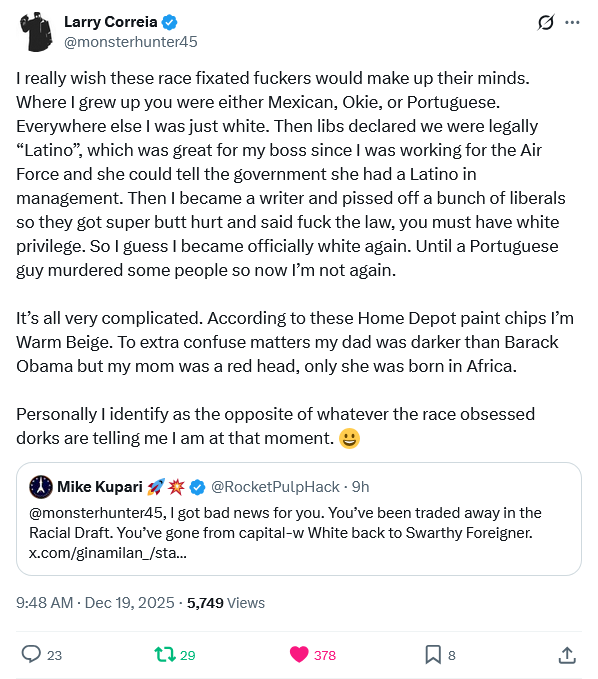
Of course, with the revelation that the shooter may have been Portuguese, the race hustlers are busy re-sorting the hierarchies of victimhood:
“We don’t want to change Canada; we want the Canada we grew up in back”
On the social media site formerly known as Twitter, Gun Owners of Canada refute claims that they want to change the nation and explain that the nation has been radically changed to the agenda of a small, urban pressure group by compliant politicians and civil servants:

For those of us who grew up in or lived through the 1980s and 1990s, the change is impossible to miss.
We remember a Canada where firearms ownership was ordinary, regulated, and largely uncontroversial. Target shooting, hunting, and collecting were part of everyday life. Gun clubs existed quietly on the edge of town. Weekend trap shoots, small-bore leagues, cadets, and hunting camps weren’t political statements, they were just normal parts of growing up.
That Canada had rules. Before the mid-1990s, ownership was governed through the Firearms Acquisition Certificate (FAC) system. You were screened, approved, and expected to act responsibly. Misuse was punished severely. But lawful owners weren’t treated as provisional citizens, waiting to see if the rules would change again next year.
Context matters. In the Canada of the 1980s, firearms that are now politically charged were treated very differently. The AR-15, for example, existed openly within the shooting sports community and was classified as non-restricted at the time. It was regulated, owned by vetted individuals, and largely absent from public controversy.
That isn’t shocking to people who lived through it. It simply illustrates how much the framework has shifted.
Firearms ownership in that era wasn’t limited to a single purpose. Most people participated through sport, hunting, or collecting. Some also possessed firearms with personal security in mind, particularly in rural areas, remote communities, or professions where police response was distant. This wasn’t sensationalized, and it wasn’t politicized. It was understood as part of lawful ownership, governed by responsibility and accountability.
In the Canada many of us grew up in, following the law meant something. If you complied with the rules as they existed, you could reasonably expect stability.
That’s what’s been lost.
Beginning in the mid-1990s, Canada transitioned to the modern licensing system and expanded registration, classification, and regulation. The shooting sports community adapted, again, to our own fault. We trained, we licensed, we registered, and we complied in good faith.
What we didn’t grow up with was the idea that entire classes of legally owned firearms could be redefined by regulation overnight. Or that decades of compliance could still end in confiscation, not because of misuse, but because of shifting political definitions and political theatre.
When firearm owners push back against this, we’re told we want to “change Canada.”
From our perspective, we’re responding to the change, not demanding it.
Other democracies have recognized the risk in allowing lawful ownership to exist solely at the discretion of the government of the day. Some have taken steps to ensure that civilian firearms ownership, particularly for sport, hunting, and lawful personal security, is anchored in a way that prevents arbitrary reclassification, while still allowing strong regulation and oversight.
That idea isn’t radical. It’s about predictability, due process, and trust between citizens and governance.
Firearm owners aren’t asking for chaos. We’re asking for the same social contract we grew up with: follow the rules, be accountable and don’t have the ground shift beneath your feet without warning.
So, no. We don’t want to change Canada.
We want the Canada we knew, back:
One where responsibility mattered, laws were stable, and lawful communities weren’t erased by regulation.Bring that Canada back. This one doesn’t resemble it, at all.
Comments Off on “We don’t want to change Canada; we want the Canada we grew up in back”
December 19, 2025
“2014 was the hinge, the year DEI became institutionalized across American life”
In Compact, Jacob Savage talks about the “Lost Generation” … not a reference to the group before the “Greatest Generation” who fought and died in their millions in the trenches of World War One … but a much more recent group who are still becoming living casualties of a war fought without weapons and uniforms, but just as bitter and unnecessary:
In retrospect, 2014 was the hinge, the year DEI became institutionalized across American life.
In industry after industry, gatekeepers promised extra consideration to anyone who wasn’t a white man — and then provided just that. “With every announcement of promotions, there was a desire to put extra emphasis on gender [or race],” a former management consultant recalled. “And when you don’t fall into those groups, that message gets louder and louder, and gains more and more emphasis. On the one hand, you want to celebrate people who have been at a disadvantage. On the other hand, you look and you say, wow, the world is not rooting for you — in fact, it’s deliberately rooting against you.”
As the Trump Administration takes a chainsaw to the diversity, equity, and inclusion apparatus, there’s a tendency to portray DEI as a series of well-meaning but ineffectual HR modules. “Undoubtedly, there has been ham-fisted DEI programming that is intrusive or even alienating,” explained Keeanga-Yamahtta Taylor in The New Yorker. “But, for the most part, it is a relatively benign practice meant to increase diversity, while also sending a message that workplaces should be fair and open to everyone.”
This may be how Boomer and Gen-X white men experienced DEI. But for white male millennials, DEI wasn’t a gentle rebalancing — it was a profound shift in how power and prestige were distributed. Yet practically none of the thousands of articles and think-pieces about diversity have considered the issue by cohort.
This isn’t a story about all white men. It’s a story about white male millennials in professional America, about those who stayed, and who (mostly) stayed quiet. The same identity, a decade apart, meant entirely different professional fates. If you were forty in 2014 — born in 1974, beginning your career in the late-90s — you were already established. If you were thirty in 2014, you hit the wall.
Because the mandates to diversify didn’t fall on older white men, who in many cases still wield enormous power: They landed on us.
[…]
Institutions pursuing diversity decided that there would be no backsliding. If a position was vacated by a woman or person of color, the expectation was it would be filled by another woman or person of color. “The hope was always that you were going to hire a diverse candidate,” a senior hiring editor at a major outlet told me. “If there was a black woman at the beginning of her career you wanted to hire, you could find someone … but if she was any good you knew she would get accelerated to The New York Times or The Washington Post in short order.”
The truth is, after years of concerted effort, most news outlets had already reached and quietly surpassed gender parity. By 2019, the newsrooms of ProPublica, The Washington Post, and The New York Times were majority female, as were New Media upstarts Vice, Vox, Buzzfeed, and The Huffington Post.
And then 2020 happened, and the wheels came off.
[…]
There are many stories we tell ourselves about race and gender, especially in academia. But the one thing everyone I spoke to seemed to agree on is it’s best not to talk about it, at least not in public, at least not with your name attached. “The humanities are so small,” a millennial professor nervously explained. “There’s a difference between thinking something and making common knowledge that you think it,” said another.
So it came as a bit of a shock when David Austin Walsh, a Yale postdoc and left-wing Twitter personality, decided to detonate any chance he had at a career with a single tweet.
“I’m 35 years old, I’m 4+ years post-Ph.D, and — quite frankly — I’m also a white dude,” he wrote on X. “Combine those factors together and I’m for all intents and purposes unemployable as a 20th-century American historian.”
The pile-on was swift and vicious. “You are all just laughable,” wrote The New York Times‘ Nikole Hannah-Jones. “Have you seen the data on professorships?” “White males are 30 percent of the US population but nearly 40 percent of faculty,” tweeted a tenured professor at GWU. “Hard to make the case for systemic discrimination.”
It didn’t matter that as far back as 2012 women were more likely to be tenure-track across the humanities than men, or that a 2015 peer-reviewed study suggested that STEM hiring favored women, or even that CUPAHR, an association of academic DEI professionals, found that “assistant professors of color (35 percent) and female assistant professors (52 percent) are overrepresented in comparison to US doctoral degree recipients (32 percent and 44 percent respectively).”
As in other industries, what mattered were the optics. When people looked at academia, they still saw old white men. Lots of them.
“A big part of why it’s hard to diversify is the turnover is really slow,” a tenured millennial professor explained. “And that’s become worse now, because Boomers live a long time.” Many elite universities once had mandatory retirement at 70. But in 1994, Congress sunsetted the academic exemption for age discrimination, locking in the demographics of the largely white male professoriate for a generation.
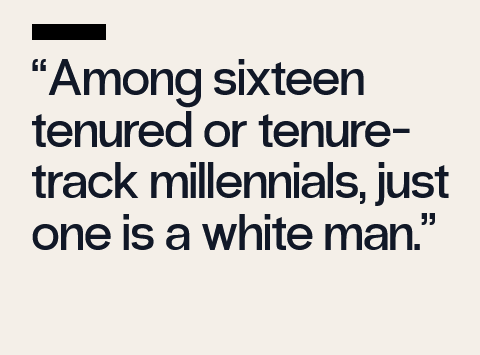
White men may still be 55 percent of Harvard’s Arts & Sciences faculty (down from 63 percent a decade ago), but this is a legacy of Boomer and Gen-X employment patterns. For tenure-track positions — the pipeline for future faculty — white men have gone from 49 percent in 2014 to 27 percent in 2024 (in the humanities, they’ve gone from 39 percent to 21 percent).
The strange rebirth of English patriotism
In The Conservative Woman, Niall McCrae discusses what he calls “a new crusade” as the downtrodden English rediscover — or in many cases, discover for the first time — patriotic feelings for their nation, and earn the scorn and contempt of the ruling class and their media fart-catchers:

“Union Jacks and crosses of St George” by Ben Sutherland is licensed under CC BY 2.0 
 .
.
A wave of patriotism swept across England last summer. Flags were tied to lampposts up and down the country, but while these displays had wide public support, the intelligentsia were troubled, particularly as the colours were often flown in areas of cultural diversity or on roads passing hotels accommodating illegal immigrants. This suggested provocation, rather than the use of national flags to celebrate sporting success.
Politicians and Guardian commentators were careful not to appear too negative, but they emphasised unity and inclusion over nationalistic fervour. The Union Jack was preferable to the St George’s Cross, because they associated the latter more with the far right (this is not accurate, as groups such as the National Front and BNP rallied under the Union Jack).
The Union Jack (properly termed “flag” as a jack is hoisted at sea), comprises the crosses of St George, St Andrew and St Patrick. It is perhaps the most impressive flag in the world, a classic design of great cultural impact. How globalists, the EU and Islamists would like to banish it!
The “Unite the Kingdom” march led by Tommy Robinson in September, which brought a million people to the streets of London, was a marvellous spectacle of patriotism. For the counter-Jihad movement, conflict in the Middle East is regarded as an existential struggle against militant Islam. Israeli flags are often waved towards pro-Palestine marchers, and the London rally gave several Zionists a platform at Whitehall. However, the vast majority of marchers were there for one country only – their own. This was truly a British event, with a roughly equal mix of Union and St George flags, alongside some Welsh dragons and Scottish saltires, and Irish tricolours too.
Significantly, there was another symbol prominently at the London march: the Christian cross. A poignant moment was at the ramparts of Westminster Bridge, where a fearless young man mounted the head of the stone lion and from that precarious pedestal raised in one hand the flag of St George, and in the other a wooden cross. (https://www.instagram.com/reel/DOpagGvkQk9/)
I first observed the resurgence of Christian faith at the huge protests against the Covid-19 regime. Several marchers bore crosses, or placards asserting the power of God over earthly evil. The Book of Revelation was quoted, and when the “vaccine” was launched it was cast as the “Mark of the Beast”.
Socially unacceptable they may have been, but now St George and Christian crosses are regularly appearing together in gatherings for patriotic or traditional causes. In his book Worth Dying For: The Power and Politics of Flags (2017), Tim Marshall observed that “with the rise of Islam in Europe, these symbols are likely to be increasingly used by the far right to try to define the continent as what they think it is, and in opposition to what they think it is not”. You can’t get a book released by a mainstream publisher without expressing such approved outlook, but Marshall is making the mistake of blaming patriots for the devaluing of their national flag; it is surely the subversive ideology of the progressive left that has taught generations that national pride is regressive and bigoted. Meanwhile “woke” warriors are not shy of waving the Pride rainbow, transgender stripes and the flag of Palestine. And the likes of Hope Not Hate had no complaint about huge fascist-style marches awash in the blue and yellow stars of the EU.
Brendan O’Neill on the Islamophobia racket
In the National Post, Brendan O’Neill criticizes Australian Prime Minister Anthony Albanese in particular, but he’s just the most recent exemplar of western politicians trying to blame society in general and “right wing extremists” in particular for the terrorist attacks by Islamic extremists:
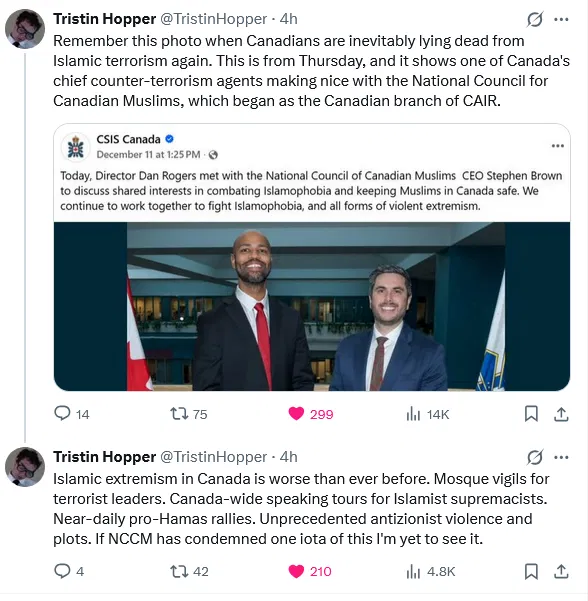
Australian Prime Minister Anthony Albanese spoke a total of 5,022 words in the day after the slaughter of Jews at Bondi Beach. And not one of those words was “Islam”. Or “Muslim”. Or even “Islamic extremism”.
He did talk about the “far right” though. Twice. We need to tackle “the rise of right-wing extremist groups”, he said.
What an odd thing to focus on the day after a father-and-son Islamofascist outfit had mown down 15 innocents, all while proudly displaying the black flag of ISIS.
To fret about the far right hours after suspected Islamic militants had carried out the worst slaughter of Jews in Australian history is cognitive dissonance of epic proportions.
It would be like turning up to the bloody aftermath of a KKK massacre and flat-out refusing to say the words “Klansmen”, “racist” or “white supremacist”. Well, we wouldn’t want to offend the pointed-hood community.
Some Australians were dumbfounded by the PM’s bullish refusal to name the ideology that fuelled this act of antisemitic savagery.
After all, at the time he was holding forth on the various threats to the Aussie way of life, officialdom had found the killers’ ISIS flag and other paraphernalia suggesting they had taken the knee to the death cult of radical Islam.
“What happened at Bondi was an act of radical Islamic terrorism”, thundered Sean Bell of the populist party One Nation. If the PM “cannot be honest” about the “radical Islamic ideology”, he said, “then he has no place leading the country”.
It’s hard to disagree. The first duty of a leader following the barbarous slaying of citizens is to tell the truth. If Albanese can’t even bring himself to mouth the words “Islamic extremism”, how’s he going to fight it?
The PM’s yellow-bellied dodging of the i-word was shocking but not surprising. Other Western leaders have behaved similarly in the wake of Islamist outrages. They have furiously thumbed their thesauruses for spins on the word “extremist” — fanatic, militant, evil — all so that they can avoid committing that most gauche faux pas in polite society: talking about the problems in Islam.
This is the dire handiwork of the Islamophobia industry. For years now, Islam has been ruthlessly ringfenced from free, frank discussion.
Mock Muhammad and you’ll be damned as “phobic”. Crack a joke about the Koran and you can expect a mob of fundamentalists at your front door. Say Islam has an extremism problem and the self-elected guardians of correct-think will drag you off for re-education.
We’ve witnessed the rehabilitation of medieval strictures against “blasphemy”. The end result is that even as women and children writhe in agony from the wounds inflicted on them by Islamist militants, still our leaders won’t say that i-word. It clogs in their throats. They dread cancellation more than they cherish truth.
[…]
After every attack, the same platitudes are trotted out. “Nothing to do with Islam”. “Islam is a religion of peace”. We’re gagged from naming the threat we face, from correctly identifying the men who are killing our fellow citizens.
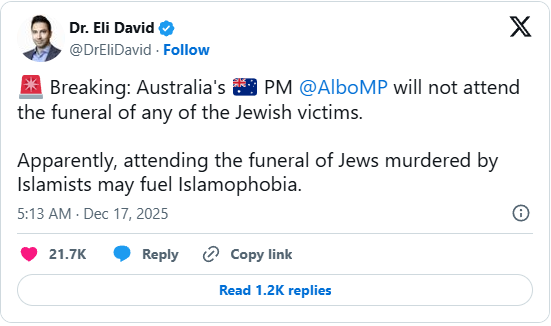
Believe them when they show you what they are, Oz edition:
In The Line, Ariella Kimmel thinks there are signs that at least some political figures are getting the right lessons out of the events of the last few years:
In the wake of the terrorist attack in Bondi Beach, it seems as if leaders are finally starting to realize the risk of allowing antisemitic extremism to run unchecked for years.
Calgary’s new mayor offered a powerful example of what this means in practice.
At Calgary City Hall’s Chanukah celebration, Mayor Jeromy Farkas delivered remarks that stood out not only for their eloquence, but for their accountability. He spoke plainly about antisemitism and acknowledged the very real fear that Jewish communities are living with. Most importantly, he made clear that civic leadership means showing up publicly, consistently, and without excuses.
In a room of just over a thousand, he declared “let me be absolutely crystal clear. There is no place for antisemitism in Calgary. Not on our streets, not in our schools or campuses, not at protests, not online, not hidden behind slogans, not excused as politics, because Jewish lives are not expendable. Jewish safety is not expendable.”
That moment was especially symbolic given Calgary’s recent past. Two years ago, then-Mayor Jyoti Gondek refused to attend a Chanukah event amid pressure and controversy. Farkas’ presence this week marked a break from that pattern. It signalled that someone, finally, was willing to take responsibility.
That is what leadership looks like.
The Bondi Beach attack should force a reckoning in Canada. If we want to avoid becoming the next headline, this country must do more than mourn; we must decide, clearly and concretely, that extremism has consequences and that antisemitism will not be indulged.
In Canada, politicians were quick to offer condolences. Statements flowed with the standard lines – “my thoughts are with the community”, “our government condemns all forms of hate”, “no one should be targeted for practicing their religion”. The words are familiar, and quite frankly hollow, because for the past two years, many of the same leaders issuing their thoughts and prayers have either ignored, excused, or actively engaged with movements that normalize hostility toward Jews.
Since October 7, Jewish Canadians have watched as public spaces became hostile territory. Synagogues require police protection, while Jewish schools are shot at and community centres are defaced. Rallies openly glorify terrorist groups, call for the destruction of Israel, and chant slogans that any reasonable person understands as genocidal, such as calls to “globalize the intifada”, “from the river to the sea Palestine will be free”, “there is only one solution, intifada revolution”, and “resistance is justified”.
What makes the current moment particularly dangerous is the gap between rhetoric and reality among leaders. Politicians speak of fighting hate while refusing to enforce existing laws against intimidation, mischief, and hate-motivated harassment. They speak of unity while legitimizing groups and movements that openly reject the safety of Jewish communities, even giving funding through government programs meant to combat antisemitism, to organizations that perpetrate it. They issue statements condemning violence abroad while tolerating the ideological conditions that make violence inevitable at home.


