Quotulatiousness

September 4, 2025

They can’t catch actual criminals, but they are quite capable of arresting social media users

Filed under: Britain, Government, Law, Liberty, Media, Politics, Technology — Tags: , , , — Nicholas @ 04:00

Andrew Doyle hopes that the farcical performance by British police in sending five armed officers to arrest Graham Linehan as he stepped off the plane will be a tipping point:

How many more controversies will it take? The arrest of comedy writer Graham Linehan by five armed police officers as he landed at Heathrow Airport has become an international news story because it so self-evidently tyrannical. The stress of the ordeal raised his blood pressure to an alarming degree and he was rushed to hospital. With the help of the Free Speech Union, Graham is now suing the Metropolitan Police. You can donate to his crowdfunder here.

It is reassuring to see that some action is being taken against such chilling state overreach, but when will our politicians follow suit? Many of us have been warning about this ongoing assault on liberty for many years, and at every watershed moment we’ve been led to believe that something will be done. Then, inevitably, the “blob” is activated and swallows up any potential for progress in its viscous and undulating folds.

So when Sir Mark Rowley, head of the Metropolitan Police, complains that the police are acting on unclear laws, and that the responsibility for the maltreatment of the likes of Graham lies with those in power, he’s overlooking the impact of the activist middlemen. Let’s not forget that the Home Office has twice instructed the College of Policing to stop the recording of “non-crime hate incidents” (NCHIs) and has been ignored. Or that the chairman of the College of Policing, Lord Herbert, said the solution to the complaints about NCHIs might be to rename them. As though the public’s concerns about this brazen authoritarianism might be assuaged with a touch of rebranding.

Rowley’s buck-passing is likewise inadequate. He claimed that Graham’s arrest was necessary because officers “had reasonable grounds to believe an offence had been committed”, which is palpably untrue. He said: “I don’t believe we should be policing toxic culture wars debates and officers are currently in an impossible position”. He also made clear that police would continue to behave in this way “unless the law and guidance is changed or clarified”.

But this is precisely the problem. At present, a quango called the College of Policing trains officers in England and Wales. In my article for UnHerd about Graham’s arrest (which you can read here) I make the case that the College of Policing has become woefully unfit for purpose due to activist capture. For a long time, agitators within the system have reinterpreted and fudged the actual law in favour of what they would like it to be. This has led to some police acting in potentially criminal ways. Most egregiously, there is clear evidence of systemic bias against gender-critical individuals within the police force, and a reluctance to apply identical standards to trans activists who routinely post threats of death and rape and are rarely investigated for it.

In the wake of the Linehan arrest, Tom Knighton wonders why the US isn’t treating the UK as it would any other tyranny where free speech and other civil liberties are denied to the people on a whim or a suspicion:

The United States has a history of dealing with tyrannical governments, who oppose tyrannical governments we like even less. We worked with Saddam Hussein, for example, because he was at war with Iran.

But we never stopped pretending these weren’t tyrants.

So, it’s time we start treating the UK just the same.

The latest incident was a well-known comedian from the UK being arrested over a couple of jokes.

    Something odd happened before I even boarded the flight in Arizona. When I handed over my passport at the gate, the official told me I didn’t have a seat and had to be re-ticketed. At the time, I thought it was just the sort of innocent snafu that makes air travel such a joy. But in hindsight, it was clear I’d been flagged. Someone, somewhere, probably wearing unconvincing make-up and his sister/wife’s/mum’s underwear, had made a phone call.

    The moment I stepped off the plane at Heathrow, five armed police officers were waiting. Not one, not two—five. They escorted me to a private area and told me I was under arrest for three tweets. In a country where paedophiles escape sentencing, where knife crime is out of control, where women are assaulted and harassed every time they gather to speak, the state had mobilised five armed officers to arrest a comedy writer for this tweet (and no, I promise you, I am not making this up.

    … and then, a follow up to that one.

    When I first saw the cops, I actually laughed. I couldn’t help myself. “Don’t tell me! You’ve been sent by trans activists” The officers gave no reaction and this was the theme throughout most of the day. Among the rank-and-file, there was a sort of polite bafflement. Entirely professional and even kind, but most had absolutely no idea what any of this was about.

While the officers were kind, they still arrested him. They arrested him because he made some jokes. He spent time in a jail cell, was interviewed by detectives, and was treated like a criminal because he made some jokes.

They waited for him at the airport with five officers, something that would be a clear indication to others that he was truly dangerous, over some jokes.

The first one wasn’t a great joke, really, but that wasn’t the issue. This wasn’t that it wasn’t as funny as it should have been, but that it was made at all.

September 3, 2025

Dad’s Army caricatures capture life in Britain today

Filed under: Britain, Bureaucracy, Humour, Media, WW2 — Tags: , , — Nicholas @ 05:00

At The Daily Skeptic, Guy de la Bédoyère wonders why everything in modern Britain emulates an episode of the 70s sitcom Dad’s Army:

Dad’s Army, a BBC sitcom that ran from 1968 to 1977, starring Arthur Lowe as Captain Mainwaring, John Le Mesurier as Sergeant Wilson, and Clive Dunn as Lance Corporal Jones.

There are plenty of natural laws, but here’s one unique to Britain:

    Every organisation, committee, scenario, initiative and government-backed and corporate project in Britain will inevitably degenerate into a scene from Dad’s Army.

That of course is the celebrated sitcom Dad’s Army, based on the world of Britain’s Home Guard in the Second World War, which ran for nine series in the 1970s. Every character is caricature, and sometimes not even as much as that.

Just think about it. Captain Mainwaring, the prickly bank manager and obsessed with status – the ultimate incompetent management figure, forever frustrated by his own paltry military service in the Great War and now strutting around like a dumpy cockerel as commanding officer of the platoon.

Sgt Wilson, a complacent, dozy and lazy member of the establishment, effortlessly imbued with a sense of privilege and world-weary detachment. Persistently given to undermining Mainwaring.

Lance-Corporal Jones, the panic-stricken jobsworth stifling initiative at every turn and floundering haplessly around to demolish every project with his matchless ability to overcomplicate anything and everything. He has a special skill for wasting inordinate amounts of time with ludicrously impenetrable explanations, usually based on fantasy.

Private Frazer, the miserable doom-laden pessimist and undertaker, forever raining down scorn and stirring up opposition and discontent in the ranks, his own ambitions in the platoon thwarted.

Private Walker, the skiving skimmer who dodged regular military service. Forever on the take but essentially harmless and even with some good characteristics.

Private Godfrey, the embodiment of the well-intentioned but largely hopeless pensioner whose presence relies usually on everyone else. Constantly called away to relieve himself.

Private Pike, the idiotic mummy’s body excused military service. Today he would have a certificate excusing him from any form of employment for anxiety, ADHD and anything else his mother or the system could come up with.

Then there’s the ARP Warden Hodges, whose sole purpose in life is feuding with Mainwaring, finding fault with the platoon’s men and triumphantly announcing their infractions. Hodges is the confrontational and dispute-loving trade union leader to Mainwaring’s shambolic management. His only mission in life is to create conflict and throw his weight about.

To these we can add various other characters, all comic figures (like the vicar and the verger) but essential props that amplify the authenticity.

The reason the sitcom lasted so long is very simple. Every single organisation in Britain is in home to some of or all these personality types, whether it’s the parish council, a local arts society, a corporation or the government.

Almost every problem the Home Guard platoon is confronted with results in bickering, chaos and wasted time, based mostly on posturing, obstinacy, incompetence, obsession with status and a lack of foresight, common sense and lateral thought. If the outcome is a good one, it’s invariably the result of chance.

Sounds familiar? It doesn’t matter what you think about the boats, climate change, the welfare state or the NHS. Every one of Britain’s current problems is being dealt with as if each was an episode of Dad’s Army.

Update, 5 September: Welcome, Instapundit readers! Please do have a look around at some of my other posts you may find of interest. I send out a daily summary of posts here through my Substackhttps://substack.com/@nicholasrusson that you can subscribe to if you’d like to be informed of new posts in the future.

“Once is happenstance. Twice is co-incidence” … but SIX?

Filed under: Germany, Media, Politics — Tags: , , — Nicholas @ 03:00

I depend on eugyppius to keep me up to date on German affairs, and despite the eyebrow-raising total of six AfD candidates dying unexpectedly, he doesn’t think it’s actually “enemy action” as Ian Fleming once wrote in Goldfinger, but it is statistically boggling:

I had plans to write about something else today, and I even have a half-finished post, but the story of the mysteriously dying AfD candidates is everywhere …

… and I feel compelled to address it.

The West German state of Nordrhein-Westfalen (NRW) is slated to hold municipal elections in just under two weeks, on 14 September. Eighteen million Germans scattered across thirty-one districts and 393 municipalities will elect councillors, board members, mayors and district administrators.

It’s important to understand the scale of these elections and the enormous numbers involved: Tens of thousands are presently running for office in NRW. The exact number isn’t certain, but it may be as great as 90,000. Most of these candidates are totally ordinary people. They are not professional politicians and they are not widely known outside their communities.

Four days ago, the German press began reporting on bureaucratic chaos stirred up by a series of unexpected deaths in late stages of the NRW campaign. Each of these deaths happened so late in the game that ballots had to be reprinted and the postal vote repeated. The German economist and social media personality Stefan Homburg picked up the story and called the deaths “statistically almost impossible“. AfD co-chair Alice Weidel retweeted Homburg’s suspicions, ultimately attracting the attention of Elon Musk.

Despite the widespread interest in this story, I really think it’s a nothingburger. We may be looking at an unusual cluster of AfD deaths in the upcoming elections, but we don’t know enough to say for sure how improbable this cluster is. All we can really say is that the deaths themselves are not unexplained and that their coincidence doesn’t look that improbable on its face.

September 1, 2025

“… these two [books] are ‘perfect bound’, which is a misleading name for a crappy technique”

Filed under: Books, Business, Media, Technology, Woodworking — Tags: , , — Nicholas @ 03:00

Chris Schwarz on the frustrations of a (physical) book reader with far too many modern printed books:

Dammit, Norton!

I don’t read much for pleasure these days. I spend about three hours a day reading manuscripts, draft blog entries, old woodworking texts, academic papers and contracts. When the workday is done, the last thing I want is someone else’s voice chattering in my head.

But I love books and have always been a voracious reader. So I keep a stack of books that I probe and pick at, like a 5-year-old forking through chop suey, looking for something to consume.

This month has been great. I’m in the middle of “The Overstory” by Richard Powers and “A Swim in a Pond in the Rain” by George Saunders. Both books were written with an exquisite pen, and I lose track of time when I’m reading them.

But both books also make me want to burn down the headquarters of Norton and Random House publishing. Because both books are made like dogshit.

Like most books these days, these two are “perfect bound”, which is a misleading name for a crappy technique. Like if we called a “butt joint” the “excellent end-grain joint,” or if we called miters the “super slanty joint”.

What’s perfect binding? Take a stack of individual sheets of paper, like the stack of pages you put in your printer. Slather some glue on one edge and press the goo into the pages. While the glue is still wet, slap the book’s cover to the glue on the spine. Trim the pages, sell the book and make an obscene amount of money.

I don’t know a binding technique that is crappier than perfect binding. Even loose-leaf pages in a Trapper Keeper are better because they can be repaired.

Perfect-bound books are – like a Ryobi drill – a product that has an expiration date. After two or three readings, the pages will start to fall out of the glue. You don’t even have to mistreat the binding for this to happen. The glue gets brittle, then you turn a page like a normal person and the leaves fall like it’s autumn.

Do not fool yourself and think that book publishers are suffering and need to cut corners in the manufacturing department. They aren’t. Book publishing is still one of the most profitable businesses, as far as margin is concerned. It’s not unusual for a publisher to have margins of 30 to 35 percent. (Note: Lost Art Press keeps a margin of about 15 percent – much lower because we pay more in royalties and pay a lot more for manufacturing.)

My paperback copy of “The Overstory” is the 23rd printing of the title since it was released in 2018. Norton is literally printing money at this point with the book. The book’s retail is $18.95. Manufacturing cost (at a plant in the United States): I’d guess is about $3.80.

Norton can do better. But it doesn’t have to. Customers are happy to pay $18.95 for an impermanent book.

August 31, 2025

Andrew Doyle’s The End of Woke

Filed under: Books, Britain, Media, Politics — Tags: , , — Nicholas @ 05:00

In The Critic, Titania McGrath reviews The End of Woke, and nobody should be surprised that it isn’t a rave review, although there is some raving:

Renowned grifter Andrew Doyle has written another “book” called The End of Woke. It’s the most repugnant piece of tripe ever to reach the printing press. It’s ignorant, ill-formed and offensive in the extreme. I have absolutely no intention of reading it.

Not content with his previous fascist manual Free Speech and Why It Matters, Doyle in his new book challenges ideological dogma on both the left and the right. It is laughable that he believes that anyone would be interested in such an approach. Imagine being so insecure in your belief-system that you would be open to persuasion and debate.

Doyle is a reactionary monster with a sub-zero IQ, one who is so unenlightened that he does not seem to realise that “liberal values” and “free speech” are Nazi dog-whistles. Having skim-read the blurb of The End of Woke, I’ve gleaned that Doyle supports outmoded and frankly immature notions such as “tolerance” and “liberty”. And he has a head like a cube (see above).

It was to be expected that bigots would approve of this book. The “comedian” Jimmy Carr called it “thought-provoking and entertaining”. The white male author Michael Shermer said it was “a magisterial read”. And that evil cisgender demon Julie Bindel wrote in The Critic that it was “the best work yet by the creator of genius parody Titania McGrath”.

Didn’t we once have “conflict of interest” rules for politicians?

Filed under: Business, Government, Media, Politics, USA — Tags: , , , , — Nicholas @ 03:00

It’s become a commonplace that politicians leave office vastly wealthier than they went in, far in excess of their official salaries. Once upon a time, even though it probably still happened, the fat cats managed to stay below the event horizon with their ill-gotten gains. Today, they no longer care if you find out that this or that senator has consistently beaten the market on their investments during their entire time in office. After all, what are you going to do about it, punks? Maybe something like this:

Paul and Nancy Pelosi, 16 February, 2022.
Detail of a photo by Amos Ben Gershom via Wikimedia Commons.

The original research was on how Senators seem to make 12% annually. That’s, erm, a lot.

Markets — something that always comes as a surprise to politicians — react:

    American lawmakers are so consistently successful that a flurry of new platforms and apps now compile filing data from US politicians as a key input in strategies for retail investors and even hedge funds.

    The number of people using these so-called “copy trading” strategies has exploded. Tens of thousands of Americans now follow and imitate trades made by members of Congress, and they are making millions of dollars in the process.

OK, what fun, eh?

Even more fun would be Megan McArdle’s suggestion, that the CongressThieves must announce that they intend to trade an hour before they do so that everyone else can front run them.

Because, you know, Ms. Pelosi:

    She beat every single hedge fund last year.

But there’s something even more fun:

    Dub launched in March 2024 as America’s first regulated brokerage to offer copy trading accounts to mimic politicians and star traders.

    “It’s been absolutely insane in terms of growth,” says Steven Wang, the founder and chief executive who dropped out of his freshman year at Harvard to build the platform. Today, it has 1.5 million users across America.

    Of the $100m or so invested across Dub, nearly $23m is in its Pelosi tracker account. Since its launch in early 2024, its paper gains are 172pc.

Stock prices do not move “because”. Interest rates change, profits go up, or down, or tariffs or … stock prices change because people buy and or sell more of them. That may be in reaction to those other things but the actual price movement is that buy and sell stuff.

Which means that if we copy Nancy’s trades — after she’s done them — then we’re making money for Nancy. Because we are piling in our weight of money into a position she already holds.

Which, when you think about it, is really pretty shitty. Sure, it’s nice to make money ourselves by trading upon that congressional information. But there is that very, very, heavy cost of making Ms. Pelosi even richer as a consequence.

August 30, 2025

Flagging hopes

Filed under: Britain, Media, Politics — Tags: , , , — Nicholas @ 05:00

The English have been told by the transnational elites who happen to use London as one of their bases of operations that pride in the nation is, at best, old fashioned and at worst, racist/sexist/homophobic hate embodied. You could easily imagine Keir Starmer quoting Justin Trudeau that “there is no core identity, no mainstream in Canada England” [and consequently that] “makes us the first post-national state”. I’m certain that’s very close to Starmer’s actual views, but it’s very far from the views of a lot of ordinary English people:

Suddenly flagging has become a big thing in England. Out of nowhere a social media driven grassroots movement of flaggers has emerged. Throughout England groups of newly emerging activist are hanging flag on lamp posts and painting red crosses on roundabouts.

Even in my sleepy town of Faversham, Kent the English flag of St. George could be seen one pole after another waving in the wind. One flagger tells me that “we want to make sure that our town becomes proud of its national heritage”. Another tells me, “raising the flag helps make us feel at home”,

There is little doubt the people supporting Operation Raise the Colours are not just in the business of confining their activities to one-off stunts. At the very least this grass roots movement is determined to challenge the nation’s local councils to value the English flag of St George and to cease being hostile to the flying of the Union Jack.

The movement of flaggers took off in Birmingham. Probably this movement would not have gained such prominence if it hadn’t been for the reaction of Birmingham’s Labour dominated Local Council to the sight of England’s flag flying of the city’s lamp post. The Council reacted by ordering the removal of the flags on the ground that they put the lives of pedestrians and motorists “at risk” despite being up to 25ft off the ground! It was evident to all that this Council applied a different standard of judgment in relation to the Palestinian flag, which are flown all over the City.

Birmingham’s flaggers, who call themselves the “Weoley Warriors” stated that their goal was to “show Birmingham and the rest of the country of how proud we are of our history, freedoms and achievements”. One local resident, Mrs Owens, a former police officer told the media; “I think there will be trouble, even riots if they take them down”. She added: “We are sick of having to apologise for being British. The flags have had such a positive impact on the community – people love them. There is nothing political about it.”

There is little doubt that Mrs Owens message has resonated with wide sections of the public. Supporters of the movement indicated that they were fed up with the situation where local councils were happy to fly the Palestinian and LGBTQ flags but not that of their nation. The movement of flaggers quickly spread from Birmingham to towns and cities throughout England. “Let’s bring back patriotism once and for all”, stated the Facebook page of Operation Raise the Colours, It urged members to post images of the assorted national flags of the four British nations “being raised around our great towns and cities”. In response groups individuals decided to form groups who took it upon themselves go out and do what they call “flagging” around their town.

There is also no doubt that the flaggers have provoked a hostile reaction from large sections of the British Elite, who regard the flaggers with contempt and never use an opportunity to issue warnings about the threat post by far-right conspirators lurking in the background. This alarmist rection was personified by Nick Ireland, the Liberal Democrat leader of Dorset Council who insisted that some residents found the sudden appearance St George’s and union flags “intimidating”. He added that it was “naïve” to suggest that these emblems had not been “hijacked” by some far-right groups.

German politicians in Cologne come up with a bold strategy … let’s see if it pays off for them

Filed under: Europe, Germany, Media, Politics — Tags: , , , — Nicholas @ 04:00

Whenever I think I’ve got a vague idea of what’s going on in German politics, eugyppius can be counted upon to show me I still don’t have the first clue:

“German flag” by fdecomite is licensed under CC BY 2.0 .

From BILD:

    Bizarre muzzling agreement in Cologne’s local election campaign!

    The CDU, SPD, Greens, FDP, Die Linke, and Volt have signed an agreement initiated by the Cologne Round Table for Integration to refrain from speaking negatively about migration during the election campaign …

    In consequence: the only relevant party in the Cologne campaign that will address the negative aspects of migration is the AfD.

That’s right:

Everybody from the rebranded ex-communists in Die Linke to the centre-right Christian Democratic Union have agreed to give Alternative für Deutschland a political monopoly over the most important issue of our era ahead of municipal elections in Cologne on 28 September.

Specifically, the dumbass signatories have agreed “to respect the diversity of our society”; “to promote … tolerance and peaceful coexistence among people of different origins, cultures, and religions”; “not to campaign at the expense of people with a migrant background”; “not to stir up prejudice” and “not to blame migrants and refugees for negative social developments such as unemployment or threats to domestic security”. They have done this because it makes them feel warm and fuzzy inside even though it is plainly and objectively retarded.

Should any signatory violate this agreement, the other signatories can cry to teacher by contacting designated “arbitrators”, in this case the chairman of the Cologne Catholic Committee or the superintendent of the Cologne Protestant Church Association. These people will then … I don’t know, have a sad and the tell the press about it, I guess.

Amusingly, the CDU already stand accused of violating the agreement for circulating flyers in which they critique state plans to establish a 500-spot refugee intake centre in Cologne. Their transgression has given the spokesman of the Cologne Round Table for Integration – the excessively named Wolfgang Uellenberg-van Dawen – occasion to publish the following fatwa press release […]

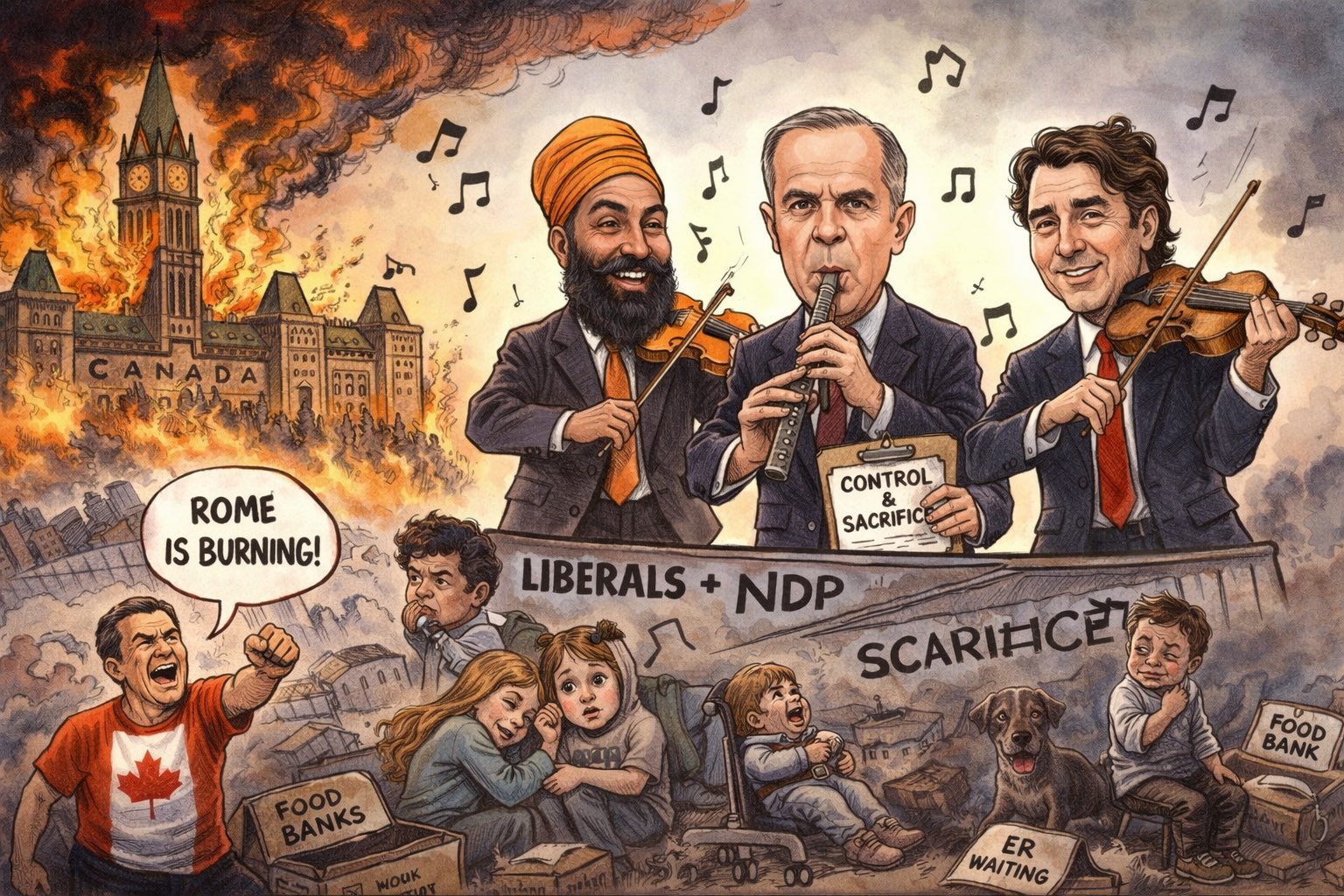
Canada’s economy is going the wrong way

Filed under: Cancon, Economics, Government, Media, Politics, USA — Tags: , , , — Nicholas @ 03:00

The latest figures show the US economy growing by 3.3% while Canada’s shrank by 1.6% in the same period. It’s bad news for Canadians, except those like Prime Minister Mark Carney who have the bulk of their investments in the United States (91% for Carney, according to various sources). On X, Dan Knight explains what is happening:

Canada’s economy just shrank. That’s the headline. In the second quarter of 2025, real GDP fell 0.4%. On a per-person basis, it was the same. Canadians are poorer than they were three months ago. That’s not speculation. That’s Statistics Canada’s official number.

So, here’s what happened. The government and its media allies spent the spring bragging that the Canadian economy “grew” in the first quarter of 2025. Real GDP was up half a percent. Sounds good, right? But if you read the fine print, if you look at the numbers it wasn’t real growth at all. It was panic.

Exporters rushed to push product into the United States before tariffs came down. Automakers. Machinery producers. Parts suppliers. They all jammed as much across the border as they could, knowing the window was closing. That sugar high showed up in the Q1 GDP number. It made the economy look like it was humming along.

Then the tariffs hit. And in the second quarter, the bottom fell out. Exports collapsed down 7.5% overall. Passenger cars and light trucks? Down nearly 25%. Machinery and equipment? Down 18.5%. Travel services? Down 11%. The result: GDP fell 0.4%. On a per-capita basis, it was exactly the same. Canadians are literally poorer than they were three months ago.

This is the story you’re not hearing: Q1 wasn’t proof of a healthy economy. It was proof of a desperate one. Businesses scrambling to get ahead of trade barriers, because they knew Ottawa wasn’t going to stop them. Q1 was fake growth, and Q2 was the crash.

Meanwhile, households are spending more, saving less, and wages are barely moving up just 0.2%, the slowest since 2016 outside of COVID. Corporate profits are falling. Government revenues are down since the carbon tax was lifted. And Ottawa’s answer? Spend more. Borrow more. Pretend it’s all fine.

So the question is simple: if this is what “growth” looks like under Mark Carney’s Liberal government front-loaded exports, collapsing investment, rising debt what does the next quarter look like?

On her Substack, Melissa Lantsman says that the economic situation in Canada is discouraging investors from putting money into Canadian companies:

You don’t need to be a foreign investor to see that putting your money into Canada is not a winning move.

Recently, Statistics Canada reported “strong foreign divestment in Canadian shares” across many sectors, including energy, mining, and manufacturing. At the same time, Canadian buyers also moved their money stateside, purchasing $13.4 billion of foreign securities in just one month.

If this were a small, short-term blip, it would be easy to dismiss it as market noise or an aberration. But that’s not the case: Statistics Canada found four consecutive months of net divestment from the Canadian economy, adding up to $62 billion in lost capital.

And that’s not to mention that every year since 2015 has seen more Canadian investment going abroad than foreign investment coming here. For those keeping track, this is the fastest rate of divestment in Canada since the Great Recession.

What does this all mean?

From an investor’s point of view, there’s no sugar-coating it. Canada is, simply put, an unattractive place to invest hard-earned cash. People making financial decisions for the future don’t have confidence in the Canadian economy to make them money.

From a government’s point of view, it should mean alarm bells ringing left, right, and centre. Lower investment in Canada translates into lower productivity, fewer employment opportunities, less government revenue, and a weaker Canadian dollar, leaving us all worse off.

But why is this happening in the first place?

According to the C.D. Howe Institute, the culprits are familiar: high taxes, regulatory barriers, policy uncertainty, and anti-growth mindsets that penalize success and demonize the private sector.

Anyone who has been paying attention for the last ten years knows that’s exactly what’s been happening. Nothing says “Welcome to Canada” to investors quite like a hike in the capital gains tax at the last minute, chaos at the CRA, multi-year project approval processes, and the highest deficits on record.

And anyone serious about fixing the problem would do the exact opposite of what the last government did. But when your new government is the same as the old one, it’s hard to believe Canadians will get the bold economic transformation this country desperately needs.

HBO’s Rome – Ep 9 “Utica” and Ep 10 “Triumph” – History and Story

Filed under: History, Media, Military — Tags: , , , , , , — Nicholas @ 02:00

Adrian Goldsworthy. Historian and Novelist
Published 26 Mar 2025

This time we look at Episode 9, which begins with the aftermath of the Battle of Thapsus in 46 BC and also Episode 10 which focuses on Caesar’s Triumph — one rather than the four he celebrated over the course of several weeks in 46 BC. There is less history and more character-driven elements in these two episodes, so to make the video the same sort of length as the others in the series, I have combined the two.

00:00 Episode 9 “Utica”
19:48 Episode 10 “Triumph”

August 29, 2025

Memories of Bournemouth

Filed under: Britain, History, Media — Tags: , , , , , — Nicholas @ 05:00

It’s nearly sixty years since my family emigrated, but I still have golden memories of the family trips to the seaside, although my family went to Scarborough, Whitby, and Redcar rather than the Bournemouth of Pimlico Journal‘s childhood:

“Harvester at Durley Chine” by David Lally is licensed under CC BY-SA 2.0 .

At every possible opportunity in the summer weekends of my childhood, my father would take our family down to the coast. Our route to the sea was normally through the medieval city of Salisbury, across the chalk downs of Hardy’s Wessex, and into the piney moors of the New Forest. The destination would nearly always be Bournemouth, the prim, stately model of the British seaside town, perched magisterially on Dorset’s sandstone cliffs, above a long golden strand lapped by the warm waves of the Channel.

Our favourite beach was at Durley Chine, where we could park (for free, greatly appealing to my father) among obscured mansions in the shade of thick-smelling conifers, and make our descent to the shore, where the chine gives way to the rows of huts that line the promenade, and a reassuringly lower-middle class Harvester restaurant. We would while away the hours on the sand until the sky was orange, my mother reading, my father swimming, and my brother and I playing whatever games we could devise, mostly involving the throwing of sand. The day would end with fish and chips under the pines, watching the sun sink over the jurassic cliffs past Poole harbour, the gateway to King Alfred’s stronghold at Wareham.

These were among the most precious times of my early life, and the sights and sounds and smells of that part of the world and the accompanying hazy, worriless bliss are cherished sensations. Though the beach is public, it was one of those places that felt special and individual to my family, as if we had somehow carved out our own summer fief on the crowded shore.

It was on Durley Chine beach, on 24 May 2024, that two innocent women, Amie Grey and Leanne Miles, were attacked by Nasen Saadi, a criminology student from Croydon of Iraqi and Thai heritage. Saadi murdered Grey and left Miles in critical condition, and was sentenced this year to thirty-nine years in prison for his crimes. The incident was part of an escalating pattern of violence, particularly sexual violence, in the Bournemouth area over the past few years, with the beach as the focal point, a pattern which had begun in July 2021 with the brutal rape of a 15-year-old girl by Gabriel Marinoaica, a young man from Walsall who dragged his victim into the sea to commit his attack. Another notable incident occurred eight months later. Afghan asylum seeker and convicted killer Lawangeen Abdulrahimzai (he had shot two fellow Afghans while living illegally in Serbia in 2018, before fleeing to Norway, where his asylum claim was rejected, then travelling to Britain and successfully claiming asylum by pretending to be an unaccompanied fourteen-year-old, despite being an adult) stabbed Thomas Roberts (a local man and qualified precision engineer who had recently applied to join the Royal Marines) to death outside a Subway in the city centre, in a dispute over an e-scooter.

The news stories become relentless from that point. Among many depravities are the sexual assault of a 17-year-old boy by a group of Asian males on 17 June 2023, accompanied the same day by an attempted assault on a 16-year-old girl outside the fish and chip shop on the seafront. A week later, two girls, aged just 10 and 11, who would have been in primary school at the time, were sexually assaulted while swimming in the sea. As far as I can tell, none of these crimes have yet been prosecuted.

Two months after the murder of Amie Grey, on 19 July 2024, a day of delirious warmth culminated in violent clashes between youths, many coming in from London, on the seafront — clashes which were filmed and circulated on social media. In the chaos, a teenage girl was sexually assaulted. Jessica Toale, the freshly-elected Labour MP for Bournemouth West, a seat which had been Tory since its creation in 1950, said after the events of 19 July that crime and anti-social behaviour had become a ‘huge issue’ in contrast to the safe Bournemouth she remembered as a girl, stating that ‘… parents had told [her] that they are concerned about letting their daughters go to the town’. These are almost reactionary words from a Labour MP, and reflective of the mood of anxiety and decline that seems to have enveloped the city, a mood founded on the series of despair-inducing events plaguing residents and visitors. On 30 June, disorder similar to that witnessed in July last year returned to the seafront, with police making arrests across the country in the aftermath.

A week later, on 6 July, a young woman was raped in a public toilet adjoining the beach. The police have charged Mohammed Abdullah, a Syrian asylum seeker living in West London, with the crime.

The dangers of joining the online hive mind of social media

Filed under: History, Media, Military, USA — Tags: , , , , , — Nicholas @ 03:00

At The Freeman, Nicole James discusses the experience of being immersed in a social media swarm or hive mind phenomenon:

Ever noticed how your social media feed doesn’t sound like “independent thought” so much as a stadium of people chanting, “Yaasss, queen!” in matching sequins? One minute you’re scrolling idly, the next you’ve been recruited into a sect with better lighting filters and the odd ironic dog meme. All it takes is clicking on one video of a dachshund in a raincoat, and suddenly you’ve been ordained High Priest of Sausage Dogs, condemned to a lifetime of puddle-splash reels and algorithmic sermonizing. That’s the hive mind. It’s the Internet’s favorite parlor trick, turning ordinary humans into synchronized swimmers thrashing about in a soup so murky it makes the Hudson on a hot July afternoon look like Perrier.

Bees and ants nailed this millennia ago: buzzing, working in lockstep, worshipping a terrifying queen—basically the Kardashians of the insect world. But instead of honey, humanity now churns out TikTok dances, Reddit debates about whether Die Hard was a Christmas movie (it wasn’t), and Facebook is where your uncle accidentally joins a cult.

Yet this collective buzz can tip into something darker. Collaboration can harden into groupthink, flattening individuality like a raccoon on the New Jersey Turnpike.

Cristina Dovan, a life coach based in the UK, calls the hive mind “group decision-making where individuals meld into one big throbbing consciousness”. Which sounds noble, and also like the worst hangover imaginable.

Collective intelligence can shine. Wikipedia (on a good day), Reddit’s problem-solving posters, Kaggle competitions, GitHub fixes. It’s a brainstorming session without the burnt office coffee and stale biscuits.

But history, and the Internet, remind us there’s a darker wing.

Psychologist Irving Janis, who coined “groupthink,” pointed to the Bay of Pigs invasion as Exhibit A.

Let’s return to 1961 where JFK is young, popular, and surrounded by Very Serious Men in suits. The CIA pitches a plan to topple Fidel Castro that went roughly like this:

  1. Train a ragtag bunch of Cuban exiles.
  2. Drop them on a swampy stretch of coastline actually called the Bay of Pigs (because nothing says “stealth” like announcing your arrival in Pork Bay).
  3. Hope the Cuban people spontaneously rise and overthrow Castro, preferably in a neat anti-communist conga line.

Everyone in the room knew it sounded dodgy. The beaches were wrong, the surprise was nonexistent, Castro’s army was enormous and very much awake. But instead of saying, “Excuse me, Mr. President, this is bananas”, the advisors all nodded along as if they were trapped in a corporate retreat exercise called Let’s Pretend We’re Bold Visionaries.

The result? A fiasco. Castro’s forces crushed the invaders in three days flat. America looked ridiculous, Kennedy was humiliated, and “Bay of Pigs” became shorthand for “the world’s worst team-building activity”. In short, a textbook case of groupthink, or as we’d call it today, “watching as your drunk mate climbs onto the shed roof, yells that he can backflip, and you cheer instead of calling an ambulance”.

August 27, 2025

In praise of the book

Filed under: Books, Media, Technology — Tags: , , , — Nicholas @ 05:00

Ted Gioia contemplates the glorious future of the book:

A decades-old bookmark from a Toronto Book City location (probably the store on the Danforth near Chester).

Can you imagine data storage that never needs an upgrade. Even better, there’s no subscription fee. And the system never crashes — there hasn’t been a single minute of down time in recorded history.

And there’s still more:

  • There are no terms of service.
  • No hidden fees.
  • No customer service bots to deal with.
  • No annoying follow-up spam emails and texts.
  • No privacy intrusions or surveillance of any sort.
  • No data incompatibility issues now or in the future.
  • No advertising or solicitations of any sort.

The list continues — no cookies, no credit cards, no come-ons, no conditions. None of that.

What a miracle!

I’m talking about my favorite handheld device, and I don’t need a cloud to hold its contents. Just a shelf.

You guessed it — I’m referring to books. They’re the greatest hard storage concept in human history, and nothing else comes close.

The book is the ultimate killer app.

People have been predicting the death of the book for decades. The Internet was going to make them obsolete. But somehow they survived.

The launch of the Kindle in 2007 posed a bigger threat. Even I was convinced — at least for a while. I bought a Kindle and tried it out, plunging with enthusiasm into the world of eBooks and digital storage.

But a month later, I’d returned to physical books. It was a better experience in every way.

It didn’t help when Amazon started deleting books from Kindles. Much to the customers’ surprise, they learned that they didn’t own the book they had bought — they were merely “purchasing a license to the content“.

Access can be terminated. And Amazon is the ultimate terminator.

That’s never happened to any physical book on my shelf. I own thousands of them, and nobody has ever revoked my access. I can also sell or give them to others, and they will retain rights in perpetuity.

You can’t do that with a Kindle. You’re not allowed to sell an eBook. You can’t even donate it to a library. Your license is restricted and non-transferable.

But transferability is how books and literary culture survive. Books are supposed to move without friction across generations and borders and boundaries. Some books have had dozens of owners over hundreds of years — creating a legacy unknown in the world of digital technologies.

Even more insidious, Amazon will update books on your Kindle — changing the text without the reader or author’s permission. That’s happened, for example, to books by Roald Dahl, R.L. Stine, Ian Fleming, and Agatha Christie. If somebody in a position of power decides that an author’s work is problematic, your e-book gets cleansed.

Operation Raise the Colours

Filed under: Britain, Liberty, Media, Politics — Tags: , , , , — Nicholas @ 03:00

Gawain Towler on the groundswell of quiet patriotic display in England, against the active attempts by local governments to suppress any and all flag-waving or even flag-flying by the plebs:

It was a seemingly innocuous tweet during the 2014 Rochester and Strood by-election that exposed a deep cultural rift. Emily Thornberry, then Labour’s shadow attorney general, a paragon of establishment elite thought, posted a photo of a terraced house in Strood adorned with multiple St George’s Cross flags, a white van parked outside.

No caption, just “Image from #Rochester”. To Thornberry, the image spoke for itself: a symbol of backward, flag-waving patriotism, the domain of the “white van man” she and her metropolitan peers presumably viewed with quiet derision. She expected her audience to share the contempt, to chuckle at the vulgarity of overt Englishness. But the backlash was ferocious. The public saw snobbery, a sneering dismissal of ordinary lives. Thornberry resigned from the shadow cabinet that day, rebuked by Ed Miliband for disrespecting hardworking families. I played a modest role in that storm, forwarding the tweet to Guido Fawkes and The Sun, which amplified the outrage and forced the reckoning.

That episode, now over a decade old, feels eerily prescient as I contemplate the “raising the flag” phenomenon sweeping Britain in recent weeks. What began as scattered acts of defiance has blossomed into a nationwide movement: St George’s Crosses and Union Jacks hoisted on lampposts, motorway bridges, and public spaces from Birmingham’s Shard End to Tower Hamlets in east London, Southampton to Brighton, and even Cannock. Roundabouts painted red and white, zebra crossings marked with the cross, symbols of England asserting themselves in the urban landscape. Last night I cycled through London’s Labour stronghold of Lambeth, and road markings have been transformed with the St George’s Cross, a quiet but bold reclamation in one of London’s most diverse boroughs. Dubbed “Operation Raise the Colours” by organisers (though it is hard to describe the phenomenon as organised), it has seen thousands of flags raised, with fundraising efforts like Birmingham’s £16,000 drive sustaining the effort. I support this gentle uprising, for it breathes life into symbols long marginalised. Yet I acknowledge the disquiet it stirs: in a polarised society, such displays can evoke unease, linked in some minds to far-right agitation or the riots of summer 2024, that and deeper darker memories of NF marches in the 1970s.

Why is this happening now? The timing aligns with the anniversary of last year’s Southport tragedy and ensuing unrest, where misinformation, both from the state and other bad actors, fuelled anti-immigration protests that spiralled into violence. Many participants frame it as a response to “two-tier policing”, swift crackdowns on native demonstrations while pro-Palestinian marches proceed with apparent leniency. It’s a broader reclamation of national pride amid economic stagnation, unchecked migration, and a sense of cultural dilution. For the overlooked, those Thornberry’s tweet mocked, this is a way to say, “We belong here”. and stronger yet, but uncontroversial in any other land than our own, “This is our land”.

It’s contemplative defiance: not riots, but ribbons of red and white asserting identity in a nation where Englishness often feels like an afterthought.

August 24, 2025

Much of our prosperity is based on trust, and we’re rapidly losing it

Ted Gioia foresees a precipitous fall in trust coming at us very soon, and I’m afraid he might be being too optimistic:

During the great purges of the 1930s, Stalin ordered the execution of a million people, including some of his closest associates. But it wasn’t enough to kill these victims — they also had to disappear from photographs.

In a famous case, Nikolai Yezhov got removed from his position next to Stalin in a photo taken by the Moscow Canal. This erasure alarmed many party elites because Yezhov, head of the secret police, had been one of the most feared men in the Soviet Union.

And now he got totally deleted.

Well, not totally. In those days of print media, original photos survived, and a paper trail made it difficult to erase history.

So this photo was later used to mock Stalin, and the pretensions of dictators. They can try to change reality, but that’s not possible.

Or is it? Maybe dictators now get the last laugh. Because in the last few months, reality has been defeated — totally, completely, unquestionably.

It is now possible to alter reality and every kind of historical record — and perhaps irrevocably. The technology for creating fake audio, video, and text has improved enormously in just the last few months. We will soon reach — or may have already reached — a tipping point where it’s impossible to tell the difference between truth and deception.

  • Can I tell the difference between a fake AI video and a real video? A few months ago, I would have said yes. But now I’m not so sure.
  • Can I tell the difference between fake AI music and human music? I still think I can discern a difference in complex genres, but this is a lot harder than it was just a few months ago.
  • Can I tell the difference between a fake AI book and a real book by a human author? I’m fairly confident I can do this for a book on a subject I know well, but if I’m operating outside my core expertise, I might fail.

At the current rate of technological advance, all reliable ways of validating truth will soon be gone. My best guess is that we have another 12 months to enjoy some degree of confidence in our shared sense of reality.

But what happens when it’s gone?

Back in 2023, I asserted that trust is the most scarce thing in society. But that was before all these tech deceptions came online. Trust will soon get even more scarce — or perhaps disappear completely from the public sphere.

This is not a small matter.

Most discussions of this issue focus on the technology. I believe that’s a mistake. The real turmoil will take place in social cohesion and individual psychology. They will both fracture in a world where our shared benchmarks of truth and actuality disappear.

We will be — already are — in desperate need of Robert Heinlein’s Fair Witnesses:

A Fair Witness is an individual trained to observe events and report exactly what is seen and heard, making no extrapolations or assumptions. While wearing the Fair Witness uniform of a white robe, they are presumed to be observing and opining in their professional capacity. Works that refer to the Fair Witness emphasize the profession’s impartiality, integrity, objectivity, and reliability.

An example from the book [Stranger in a Strange Land] illustrates the role of Fair Witness when Anne is asked what color a house is. She answers, “It’s white on this side.” The character Jubal then explains, “You see? It doesn’t occur to Anne to infer that the other side is white, too. All the King’s horses couldn’t force her to commit herself … unless she went there and looked – and even then she wouldn’t assume that it stayed white after she left.”

« Newer PostsOlder Posts »

Powered by WordPress