
The thing I always hated hearing from my grandfather was how modern music was terrible and not fit for civilized people. He was a man of his age and class, so he used colorful euphemisms to describe popular music. Even as a kid, I understood that every generation has their soundtrack. Maybe never having known anything but a world where pop culture dominated, this came naturally to me, while my grandfather still recalled an age before everyone had a radio and television. Maybe he knew things I couldn’t know.
Either way, I’ve always just assumed that once I passed my mid-20’s, pop music was no longer for me. Some stuff would be appealing, but most would be aimed at kids and strike me as simplistic and repetitive. There were some good bands in the 90’s that I liked, but most of it was not my thing. By the 2000’s, I was unable to name popular groups or the songs at the top of the charts. Today, I have not heard a single note from any song on the current top-40. On the other hand, I’m sure I’ve heard some version of all of it.
That may be why music sales have collapsed. A 15-year old can go on YouTube or Spotify and find fifty versions of the current pop hits, going back before their parents were born. They can also find stuff from previous eras that was remarkably well done and performed by people with real talent. Justin Timberlake may be very talented as a singer, but no one is confusing him with Frank Sinatra. It’s simply a lot easier for young people to see that pop music is just manufactured pap from Acme Global Corp.
“The Z Man”, “The Soundtrack Of This Age”, The Z Blog, 2018-03-15.
July 3, 2020
QotD: Pop music
July 2, 2020
Fixing Gettysburg: The First Day
Atun-Shei Films
Published 1 Jul 2020In this three-part series, I review a classic Ron Maxwell film about a little known historical event that no one talks about called the Battle of Gettysburg. I also present an abbreviated and oversimplified history of the battle, while simultaneously criticizing the movie for presenting an abbreviated and oversimplified history of the battle.
In this first episode, I discuss the first day of fighting on July 1, 1863 – including Buford’s cavalry, the Iron Brigade, the Railroad Cut, and John Burns.
Support Atun-Shei Films on Patreon ► https://www.patreon.com/atunsheifilms
Leave a Tip via Paypal ► https://www.paypal.me/atunsheifilms (Between now and October, all donations made here will go toward the production of The Sudbury Devil, our historical feature film)
#Gettysburg #CivilWar #VideoEssay
Watch our film ALIEN, BABY! free with Prime ► http://a.co/d/3QjqOWv
Reddit ► https://www.reddit.com/r/atunsheifilms
Twitter ► https://twitter.com/atun_shei
Instagram ► https://www.instagram.com/atunsheifilms
Merch ► https://atun-sheifilms.bandcamp.com~REFERENCES~
[1] “General John Buford’s Report of his Cavalry’s Action at Gettysburg” (2015). Iron Brigader https://ironbrigader.com/2015/06/22/g…
[2] W.C. Storrick: The Battle of Gettysburg (1931). J Horace McFarland Company, Page 11
[3] “The First Day at Gettysburg: Then and Now.” American Battlefield Trust https://www.battlefields.org/learn/ar…
[4] “Lt. Colonel Rufus Dawes Describes the Fighting of the 6th Wisconsin Infantry at Gettysburg” (2013). Iron Brigader https://ironbrigader.com/2013/06/13/l…
[5] “Civilian John Burns at the Battle of Gettysburg (2018)”. C-Span https://www.c-span.org/video/?447809-…
[5 1/2] Allen C. Redwood: “The Confederate in the Field”. Civil War Home https://www.civilwarhome.com/confeder…
[6] Codie Eash: “The Wounded Wisconsinite Who Witnessed Pickett’s Charge” (2018). National Museum of Civil War Medicine https://www.civilwarmed.org/reed/?fbc…
[7] Cooper Wingert: “The Confederate ‘Slave Hunt’ and the Gettysburg Campaign” (2020). Emerging Civil War https://emergingcivilwar.com/2020/05/…
July 1, 2020
Parler, pro and con
The latest social media challenger to Twitter has been getting a fair bit of attention over the last couple of weeks, as many British and American conservative Twitter users have announced they’ll be relocating to the newer service due to their concerns over Twitter’s progressive bias and very uneven-handed moderation. In The Critic, David Scullion points out that Parler may not be the dream social network for the unwoke:

The avowedly “unbiased” social media site based in Nevada has been around for two years but has rapidly gained traction amongst Trump supporters in the US, Brexit and Conservative supporters in the UK, and pro-monarchists in Saudi Arabia. (Yes really).
The raison d’être is free speech and in its “Declaration of Independence” Parler outlined the injustices, as they see it, of the existing big tech firms:
They manipulate their platform to hide information. They shadow ban, trick and deceive. They have become enablers, and often leaders, of the vicious cancel-culture mob who goose-step through our online communities and scream down those who dare to disagree.
The document ends by calling on users to “#Twexit to Parler” – i.e. leave Twitter and join them.
But will they succeed?
[…]
It seems like Parler’s popularity is a symptom of censorship in big tech, but building a rival “free speech” network has its own problems.
For a start, Parler will throw you to the wolves if they get sued over your posts.
Parler requires users to “agree to defend and indemnify Parler, as well as any of its officers, directors, employees, and agents, from and against any and all claims, actions, damages, obligations, losses, liabilities, costs or debt, and expenses (including but not limited to all attorneys fees) arising from or relating to your access to and use of the Services.”
And in order to use Parler, individuals must also forfeit their right to sue it in court or join a class-action claim. Instead they must settle disputes in arbitration.
It’s also worth pointing out that Twitter once branded itself as “the free speech wing of the free speech party” and said it took a “neutral” view of tweets posted by users because of the company’s founding principles. Those principles are now gone, gradually removed in response to a need to protect their bottom line.
June 29, 2020
Today on NeoNaziHuntingExpeditions, we track down Neo Nazi Bronies
In Quillette, Daniel Friedman examines the claims made in a recent Atlantic investigation into Nazis in the My Little Pony community (that is, adult fans of the show, not little girls … I think):

Image found by searching for “Neo Nazi Bronies”, listed URL – http://www.democraticunderground.com/1014960111
The evidence of this Nazi problem in the My Little Pony fandom is that, on a My Little Pony imageboard called Derpibooru, over 900 images were tagged as “racist,” and images mocking Black Lives Matter were upvoted by users while images supporting the movement were downvoted, even as the site’s administrators made a statement of support for the protests. After much controversy, the imageboard banned uploading images “created for no reason other than to incite controversy” and removed the 926 images tagged “racism” or “racist.” This move was extremely controversial within the Derpibooru community, many members of which oppose any moderation.
Atlantic reporter Kaitlyn Tiffany suggests that the strong free-speech norms of the Derpibooru boards stem from its origins on 4Chan, which Tiffany describes as “the largest den of chaos and toxic beliefs available on the Internet.” She describes the Brony community as being divided between those who “genuinely enjoy My Little Pony and the wholesome escapism it provides” and trolls who think it is “edgy and provocative to be an adult obsessed with cartoon ponies.” This frames the Derpibooru imageboard as a place where innocent cartoon fans are unknowingly subjected to subversive, racist memes and images that may send people down a rabbit hole of far-right content.
However, claims that a significant portion of the Brony community are Nazis, or that a significant amount of the content on Brony imageboards is right-wing propaganda or racist memes has to be put in the proper context. First of all, the 926 images tagged “racist” exist on a board that hosts over two million images. If you order all the site’s various tags by how many images fall within their categories, there are 12 full pages of other, more popular tags you have to scroll through to find the “racism” tag. One thousand two hundred and seventy-five images are tagged “politics” and include images both supporting and opposing Black Lives Matter. Discussion of these issues is a tiny fraction of one percent of the content on the My Little Pony imageboard.
By contrast, 315,867 images on the Derpibooru forum are tagged as sexually explicit, a further 127,414 images are tagged as sexually suggestive and 105,521 images are tagged as containing “questionable” sexual content. The truth is that Derpibooru’s lax moderation norms and anti-censorship culture don’t exist to protect objectionable political content; this imageboard is unmoderated because it is an enormous repository of fan-made My Little Pony pornography.
The Atlantic article fails to place the 926 racist images in the context of the larger scope of the two million images hosted by the Derpibooru board, because less than one-quarter of one percent of the site’s content is of a political nature. And the Atlantic article avoids mentioning the half-million pornographic images the site hosts, because doing so reveals that the community’s widespread opposition to content moderation on their imageboard is about protecting sexually explicit content rather than creating a space for hateful politics to flourish, and it further reveals that the Bronies are 500 times more interested in having sex with My Little Pony characters than they are in spreading racist pony memes.
The article creates an impression that the alt-Right is using seemingly-innocent cartoon fandoms as a Trojan horse to conceal and spread a sinister ideology, but the truth is that the only thing these guys are interested in hiding inside a horse is their dicks.
June 26, 2020
The rise of the Karenfinder General
Brendan O’Neill on the recent phenomena of the Karens and the anti-Karens:

The most important thing here is the question of where the Karenfinder Generals derive their power from. It comes from the insatiable appetite among identitarian reactionaries for mis-speakers or wrongthinkers they can ritualistically denounce and destroy. It is this warped social-media appetite for spectacles of shaming, for being part of a virtual mob that takes to task an allegedly evil person, that bolsters and empowers people like Karlos Dillard. It is reported that he has a strange obsession with Karens and he is even selling anti-Karen t-shirts through his Instagram page. This speaks to the extent to which Karen-shaming has become a kind of industry. There are memes, there is branded clothing, and there are of course the videos of exposed and shattered Karens which are watched and shared millions of times. Dillard was able to reduce Leah to a weeping wreck desperately trying to remain anonymous because of this broader, entrenched and increasingly misogynistic culture of seeking out white women to revile and tear down.
One of the great ironies of the witch-hunting of Karens is that the people doing the filming and public shaming are far more Karen-like than the women they humiliate. The Karen prejudice is built on a view of certain middle-class, often middle-aged, white women as uncouth and arrogant and given to complaining. They always want to “speak with the manager”. But no one wants to “speak with the manager” as gleefully as the Karenfinder Generals. Their entire mission is to report on “problematic” people to the managers of acceptable thought, to the bosses of correct-think: the new PC elites. Their thirst for tearing people down for doing or saying something wrong utterly overshadows the instinct to complain that any middle-class white woman might have.
Consider the recent Central Park incident in which a woman called Amy Cooper called the cops on a black man called Christian Cooper (no relation) and claimed that he was harassing her when in truth he was reprimanding her for letting her dog off its leash in a part of the park where you’re not meant to do that. Amy behaved badly in this incident. But as Robert A George argued in the New York Daily News: “[Christian] is the ‘Karen’ in this encounter, deciding to enforce park rules unilaterally and to punish ‘intransigence’ ruthlessly.” Amy Cooper’s life has been shattered by this Karen-shaming incident: she lost her job and her dog.
Or consider the case of Lisa Alexander, the CEO of a San Francisco-based cosmetics company who was recently filmed by a Filipino man after she asked him why he was writing “Black Lives Matter” on the wall outside a private residential property. Alexander may have been wrong to presume that this Filipino man couldn’t possibly live in one of these plush private residences, but she is polite, patient and not remotely racist during their encounter. At one point the man even suggests that she call the police and she looks shocked and says: “I don’t want to call the police.” And yet she was put online, shamed across the world, lost business as a result, and then issued a self-denouncing confession in which she accepts, essentially, that she is a witch. “I did not realise at the time that my actions were racist”, she said. “I am taking a hard look at the meaning behind white privilege and am committed to growing from this experience.”
It all gets more Salem-like by the day. Just as accused witches of old could never deny the accusations against them – denial often carried a greater penalty than confession – so Karens today must immediately confess to the sin of racism if they want any hope of at least partially saving their reputations and their futures. As in earlier outbreaks of witch-hunting, Karen-hunting puts women into a bind. If they deny the charge of racism, that is held up as proof of just how racist they are. If they confess to the charge of racism, that is of course also proof of their foul, evil minds, of their possession by the demon of race-hatred. Lisa Alexander’s confession of wickedness and promise to re-educate herself on the evils of white privilege sums up how religious the identitarian outlook has become. She is in essence on her knees begging for salvation, pleading for redemption, offering to do the intellectual penance of learning the horrible truth about her “white privilege” – that is, her sinful state, her fallen nature.
“Ghost Division” – Rommel’s 7th Panzer Division – Sabaton History 073 [Official]
Sabaton History
Published 25 Jun 2020In the night of 17 May 1940, confusing reports were reaching French High Command. They spoke of what was thought impossible: The German Army had broken through the Maginot Line in the north. Scattered and panicked soldiers spoke of a “Division Fantôme” – a Ghost Division! It was Generalmajor Erwin Rommel’s 7th Panzer Division that was wreaking havoc in the French rear. In an unauthorized push, Rommel had seized the opportunity to rush the French fortress garrisons by a surprise armor attack straight from the move. Now in open space and with the night sky illuminated by burning French tanks and trucks, it was crucial for the Ghost Division to exploit its tactical victory. Alone and cut off like an island in a sea of enemies, this was easier said than done.
Support Sabaton History on Patreon: https://www.patreon.com/sabatonhistory
Listen to “Ghost Division” on the album The Art of War:
CD: http://bit.ly/TheArtOfWarStore
Spotify: http://bit.ly/TheArtOfWarSpotify
Apple Music: http://bit.ly/TheArtOfWarAppleMusic
iTunes: http://bit.ly/TheArtOfWariTunes
Amazon: http://bit.ly/TheArtOfWarAmz
Google Play: http://bit.ly/TheArtOfWarGooglePlayWatch the Official Lyric Video of “Ghost Division” here:
https://www.youtube.com/watch?v=9FkYx…Listen to Sabaton on Spotify: http://smarturl.it/SabatonSpotify
Official Sabaton Merchandise Shop: http://bit.ly/SabatonOfficialShopHosted by: Indy Neidell
Written by: Markus Linke and Indy Neidell
Directed by: Astrid Deinhard and Wieke Kapteijns
Produced by: Pär Sundström, Astrid Deinhard and Spartacus Olsson
Creative Producer: Joram Appel
Community Manager: Maria Kyhle
Executive Producers: Pär Sundström, Joakim Broden, Tomas Sunmo, Indy Neidell, Astrid Deinhard, and Spartacus Olsson
Post-Production Director: Wieke Kapteijns
Edited by: Iryna Dulka
Sound Editing by: Marek Kaminski
Maps by: Eastory – https://www.youtube.com/c/eastoryArchive by: Reuters/Screenocean https://www.screenocean.com
Music by Sabaton.Colorizations:
– Dememorabilia – https://www.instagram.com/dememorabilia/Sources:
– Bundesarchiv, CC-BY-SA 3.0: Bild 146-1977-018-13A/Otto, Bild 101I-124-0219-20/Hinz, Bild 146-1972-045-02
– Narodowe Archiwum Cyfrowe
– chieftanruncrush from Freesound.org
– Food vector created by freepik – www.freepik.comAn OnLion Entertainment GmbH and Raging Beaver Publishing AB co-Production.
© Raging Beaver Publishing AB, 2019 – all rights reserved.

Progressive hate for nuclear power
In Quillette, Michael Shellenberger discusses the demands of some climate activists who also reject the best solutions to the problems they foresee:
For the last decade I have been obsessed with a question: Why are the people who are the most alarmist about environmental issues also opposed to all of the obvious solutions?
Those who raise the alarm about food shortages oppose expanding the use of chemical fertilizers, tractors, and GMOs. Those who raise the alarm about Amazon deforestation promote policies that fragment the forest. And those who raise the alarm about climate change oppose nuclear energy, the largest source of zero-emissions energy in developed nations. Why is that?
It is not an academic question for me. I have been a climate activist for 20 years and an energy expert for 10 of them. I was adamantly against nuclear energy until about a decade ago when it became clear renewables couldn’t replace fossil fuels. After educating myself about the facts, I came to support the technology.
Over the last five years, I have campaigned, as founder and president of my small and independent nonprofit research organization, Environmental Progress, to expand the use of nuclear energy. During that time our main opponents have not been climate skeptics or even the fossil fuel industry but rather other climate activists.
This is the case around the world. It is climate alarmist Democrats and Greens who are seeking to shut down nuclear plants in the US and Europe. Greta Thunberg last year condemned the technology as “extremely dangerous, expensive, & time-consuming,” which is false. And Green New Deal architect Rep. Alexandria Ocasio-Cortez (AOC) has advocated closing the Indian Point nuclear plant in New York, which is now being replaced with natural gas.
In nearly every situation around the world, support for nuclear energy from climate activists like Thunberg and AOC would make the difference between nuclear plants staying open or closing, and being built or not being built. Had Thunberg spoken out in defense of nuclear power she likely could have prevented two reactors in her home nation of Sweden from being closed. Had AOC advocated for Indian Point rather than condemned it as dangerous, it could likely keep operating, for at least 40 years longer.
That’s because the main problem facing nuclear energy is that it’s unpopular — and far more among progressives than conservatives, and far more among women than men. There are no good technical or economic reasons that nations from the US and Japan to Sweden and Germany are closing their nuclear plants. Center-left governments are closing them early in response to the demands of progressives and Greens — the very same people who are claiming climate change will kill billions of people.
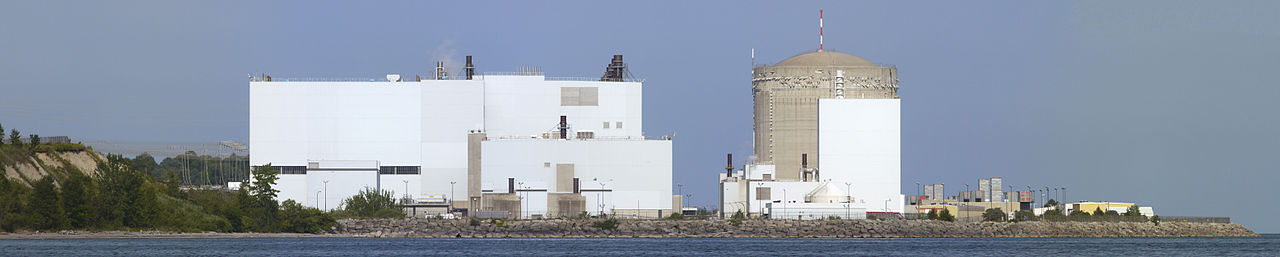
Darlington Nuclear Generating Station in Clarington, Ontario.
Photo by Óðinn via Wikimedia Commons.
Some prominent environmental groups have a pecuniary interest in replacing existing nuclear generating stations with natural gas and “renewable” energy sources, but money isn’t the only reason for the widespread opposition to nuclear power:
Sierra Club, NRDC, and EDF have worked to shut down nuclear plants and replace them with fossil fuels and a smattering of renewables since the 1970s. They have created detailed reports for policymakers, journalists, and the public purporting to show that neither nuclear plants nor fossil fuels are needed to meet electricity demand, thanks to energy efficiency and renewables. And yet, as we have seen, almost everywhere nuclear plants are closed, or not built, fossil fuels are burned instead.
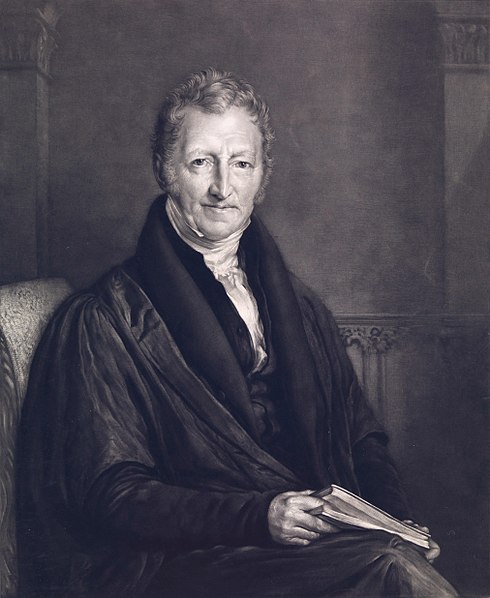
Thomas Malthus.
Portrait by John Linnell, 1834, via Wikimedia CommonsBut it’s not just about money. It’s also about ideology. Anti-nuclear groups have long had a deeply ideological motivation to kill off nuclear energy.
Policymakers, journalists, conservationists, and other educated elites in the ’50s and ’60s knew that nuclear was unlimited energy and that unlimited energy meant unlimited food and water.
We could use desalination to convert ocean water into freshwater. We could create fertilizer without fossil fuels, by harvesting nitrogen from the air, and hydrogen from water, and combining them. We could create transportation fuels without fossil fuels, by taking carbon dioxide out of the atmosphere to make artificial hydrocarbons, or by splitting water to make pure hydrogen gas.
Nuclear energy thus created a serious problem for Malthusians — followers of widely-debunked 18th-century economist, Thomas Robert Malthus — who argued that the world was on the brink of ecological collapse and resource scarcity. Nuclear energy not only meant infinite fertilizer, freshwater, and food but also zero pollution and a radically reduced environmental footprint.
In reaction, Malthusians attacked nuclear energy as dangerous, mostly by suggesting that it would lead to nuclear war, but also by spreading misinformation about nuclear “waste” — the tiny quantity of used fuel rods — and the rapidly decaying radiation that escapes from nuclear plants during their worst accidents.
There is a pattern: Malthusians raise the alarm about resource depletion or environmental problems and then attack the obvious technical solutions. In the late 1700s, Thomas Malthus had to reject birth control to predict overpopulation. In the 1960s, Malthusians had to claim fossil fuels were scarce to oppose the extension of fertilizers and industrial agriculture to poor nations and to raise the alarm over famine. And today, climate activists reject nuclear energy in order to declare a coming climate apocalypse.
June 25, 2020
What is the purpose of public art?
In his latest Age of Invention newsletter, Anton Howes engages with a topic that is in the headlines today as we find ourselves in the midst of an unexpected outbreak of iconoclasm:
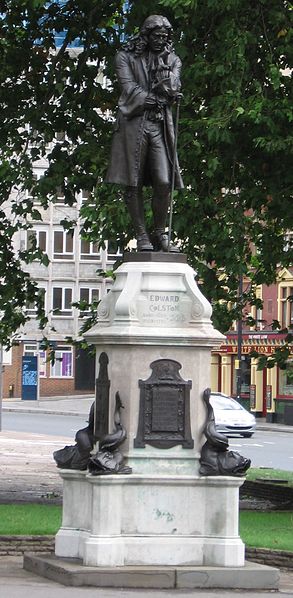
The John Cassidy (1860-1939) statue of Edward Colston, which stood in Bristol from 1895-2020 before being taken down and thrown into Bristol harbour during the protests after the death of George Floyd.
Photo by William Avery via Wikimedia Commons.
… public art in the eighteenth and nineteenth centuries used to be about inculcating virtue, which is something we seem to have forgotten. Public art was explicitly moralising, and not in the subversive way so often seen today, which leads us to question ourselves but rarely gives us answers. Back then, public art was instead meant to inspire. In painting, for example, the most prestigious and public-facing genre was history painting. History painting showed allegorical, mythological, and religious scenes, as well as those from actual history, in order to illustrate the exploits of the great and good, setting an example to us of integrity and public-spiritedness.
Importantly, the subjects of history paintings were taken from classical Greek or Roman history, or from mythology or religion, because such figures were generally uncontroversial — they could be upheld as paragons of virtue in a way that more recent and local historical figures could not. And the same went for statues, which became the main mediums of public art because the spaces available for history paintings were lacking. (The great room of the Society of Arts, by the way, has some of the few major history paintings in the country, all executed by the troubled self-proclaimed genius James Barry — the fastest riser in the Royal Academy’s history, and also, as far as I know, the only person to ever be expelled from it)
So, if some public statues have become controversial, that’s a clear sign of their failure. To the Victorians who put up the statue of slave trader Edward Colston in 1895, he must have seemed a distant and uncontroversial paragon of philanthropy. But today, he is mostly remembered for his murderous avarice. As such, he doesn’t deserve space on our streets or squares, for much the same reason that people in the eighteenth century avoided putting up statues of Oliver Cromwell — depending on your politics, he was either an ambitious and fanatical tyrant, or a selfless promoter of parliamentary liberties. Either way, it was the controversy itself that made him unsuitable: controversy got in the way of moral education. (Funnily enough, Cromwell seems to have got his public statues in the 1890s, too, just like Colston — maybe it was a low-point for the quality of history-teaching?)
I’m worried, however, that we’ve lost the self-confidence to replace them with statues that uncontroversially inculcate virtue (and in more than just a subversive or critical way). I suspect it take the delusions of grandeur of a James Barry to pull it off — someone who thought the history painter akin to a poet, like Shakespeare. But, as Tim Almond pointed out to me on twitter, perhaps we already do have such forms of virtue-promoting public art, and that all that has changed is the medium. Thus, rather than gazing upon statues or history paintings, we instead watch blockbuster superhero movies.
June 21, 2020
Jagmeet Singh’s social media moment in the sun
Most Canadians seem to have forgotten about federal NDP leader Jagmeet Singh, so this parliamentary kerfuffle — perfectly timed for maximum social media attention — is a great boost to his political visibility.
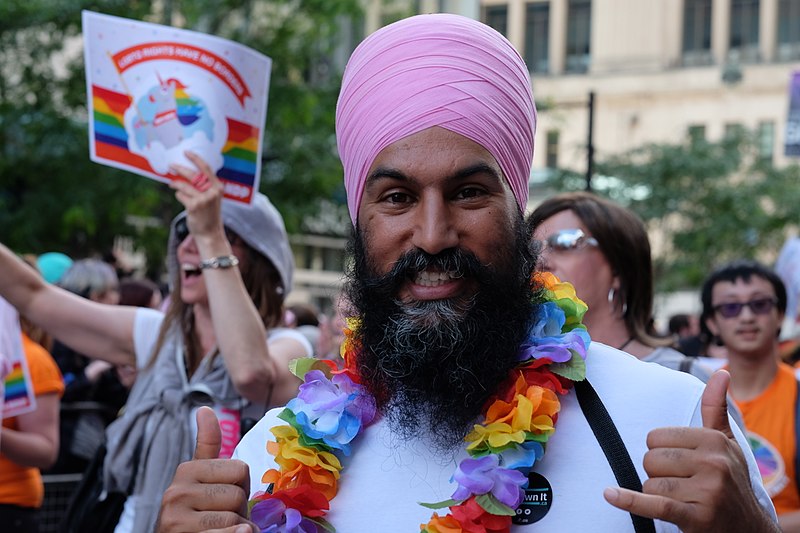
Federal NDP leader Jagmeet Singh taking part in a Pride Parade in June 2017 (during the leadership campaign).
Photo via Wikimedia.
In this woebegotten year of 2020, blessed is the politician who can stumble into a scandal perfectly tailored to the tyranny of Twitter.
As protests, riots, and rage make their mark across the world in the wake of the murder of George Floyd, NDP leader Jagmeet Singh got himself ejected from the House of Commons for calling Bloc MP Alain Therrien a “racist.”
It was an act of civil disobedience, well suited to the passions of the moment, that generated overwhelming support for Singh.
“Only in a racist country does a brown man get ejected from parliament for insisting that the denial of systemic racism is racist,” was a fairly typical, and popular, example on Twitter.
I’m not interested in disputing the point, but rather deconstructing it. So let’s start, for a moment, with the prim prohibitions on unparliamentary language.
In keeping with the long-standing “tradition of respect for the integrity of all Members,” elected officials are barred from using personal attacks, obscenities and insults while in the House of Commons.
And, yes, I’m mentioning this point mostly for the joy of listing off some of the language that has been deemed “unparliamentary” in the past, including, my favourite; “Honourable only by courtesy” (ruled against in 1880), “Coming into the world by accident,” (1886) and “The political sewer pipe from Carleton County” (1917).
Whatever else we can say about the state of our political culture, the quality of our insults has declined alarmingly.
There are a few examples in the parliamentary record of the term “racist” being used in the House. In several instances, the record can’t identify who said it. Or the subject of the insult failed to call a point of order on the matter.
June 19, 2020
“Hill 3234” – The Soviet-Afghan War – Sabaton History 072 [Official]
Sabaton History
Published 18 Jun 2020It happened during the last stage of the Soviet-Afghan War.
Already withdrawing its forces, Soviet High Command needed to display its might one last time by recapturing the vital Satukandav Pass. But to achieve that goal, the commanding heights surrounding the pass had to be held against continuous Mujahideen attacks.
In the Battle for Hill 3234, an outnumbered force of Soviet paratroopers held their own against relentless attacks from the Afghan rebels.
Support Sabaton History on Patreon: https://www.patreon.com/sabatonhistory
Listen to “Hill 3234” on the album The Last Stand here:
CD: http://bit.ly/TheLastStandStore
Spotify: http://bit.ly/TheLastStandSpotify
Apple Music: http://bit.ly/TheLastStandItunes
iTunes: http://bit.ly/TheLastStandItunes
Amazon: http://bit.ly/TheLastStandAmz
Google Play: http://bit.ly/TheLastStandGooglePlayWatch the Official Lyric Video of “Hill 3234” here:
https://www.youtube.com/watch?v=K1Xkp…Listen to Sabaton on Spotify: http://smarturl.it/SabatonSpotify
Official Sabaton Merchandise Shop: http://bit.ly/SabatonOfficialShopHosted by: Indy Neidell
Written by: Markus Linke and Indy Neidell
Directed by: Astrid Deinhard and Wieke Kapteijns
Produced by: Pär Sundström, Astrid Deinhard and Spartacus Olsson
Creative Producer: Joram Appel
Community Manager: Maria Kyhle
Executive Producers: Pär Sundström, Joakim Broden, Tomas Sunmo, Indy Neidell, Astrid Deinhard, and Spartacus Olsson
Post-Production Director: Wieke Kapteijns
Edited by: Iryna Dulka
Sound Editing by: Marek Kaminski
Maps by: Eastory – https://www.youtube.com/c/eastoryArchive by: Reuters/Screenocean https://www.screenocean.com
Music by Sabaton.Sources:
– Abramov Andrey, ALDOR46, Fdutil, P.Fisxo; from Wikimedia
– E.Kuvakin
– Erwin Franzen
– Archive of S.V. Rozhkova
– Photos of 350th airborne regiment, courtesy of the 5th airborne company trooper Sergey Novikov
– Archive of the 345th airborne parachute regiment
– Library of Congress, Geography and Map Division.An OnLion Entertainment GmbH and Raging Beaver Publishing AB co-Production.
© Raging Beaver Publishing AB, 2019 – all rights reserved.
From the comments:
Sabaton History
1 day ago
They were only 39
They were told to hold the line…I’m sure most of you know the rest of those lyrics. And after watching this episode of Sabaton History, you also know the real historical events behind those words.
What some of you might not know though, is the story of the guitar solo in Hill 3234. As usual when Joakim had written the song, he sent it out to the rest of the band. Much to his surprise though, this time Thobbe Englund – lead guitarist at the time – sent a file back within the hour. Thobbe had just plugged his guitar in and hit play. He was literally listening to Hill 3234 for the first time when the solo spontaneously popped into his head, and he recorded it on the spot. And to make this solo even more special: it is that very first recording Thobbe made that ended up on the album!
Not one single re-take.
Talk about a blessing from the Muses…

June 14, 2020
Healthcare is a provincial responsibility … thank goodness
Chris Selley reminds us that despite all the attention the media pays to every twitch of the federal government, it’s the provinces that are actually responsible for the healthcare systems in their territory:

Front view of Toronto General Hospital.
Photo via Wikimedia Commons.
Here in Canada, however, astonishing scenes continue. On Thursday the Toronto Transit Commission announced it intends to make masks mandatory for riders — no word of a lie — in three weeks, on July 2. That’s assuming the commission approves the measure … next Wednesday. TTC CEO Rick Leary was at pains to stress the rule would never be enforced.
Meanwhile Theresa Tam, Canada’s chief public health officer, could not appear more reluctant to endorse mask wearing unless she advised against wearing them altogether — which was, famously, her original position. On Wednesday, she unveiled a four-bullet-point plan for getting safely back to semi-normal under the moniker “out smart.” The word “masks” does not appear. Supplementary text only concedes they “can be used … when you can’t maintain physical distance of two metres.”
This is a strange qualification: The official federal advice stresses you shouldn’t touch your mask except to take it off at home and immediately wash your hands. You shouldn’t be taking it on and off while you’re out and about, when social distancing suddenly becomes impossible. But it’s not as strange as the qualification Tam offered on her Twitter account, where she offered a link to an instructional video but only “if it is safe for you to wear a non-medical mask or face covering (not everyone can).”
It is true that some people with asthma or severe allergies have trouble wearing masks. Presumably they know who they are, and would not risk suffocating themselves when mask-wearing isn’t even strongly recommended, let alone mandatory. Blind people will struggle to keep two metres’ distance from others. People with aquagenic urticaria can’t wash their hands with water. People without arms can’t cough into their sleeves. Those “out smart” recommendations aren’t qualified, because that would be silly — as is the qualification on masks.
I would be lying if I said I had any idea what the hell is going on. But this never-ending weirdness is doing us a favour, in a way. The fact is, we have been paying far too much attention to the feds throughout this ordeal. Canada’s COVID-19 experience was always much too different from region to region to justify everyone taking their cues from a single public health agency — let alone one that comprehensively botched something as simple as issuing self-isolation advice to returning foreign travellers.
Canada is a federation by design, not by accident, and thank goodness for that: Far better that most provinces’ authorities did a good job knocking down COVID-19 than that a single one screwed it up for the whole country. It’s something Liberals and New Democrats should bear in mind next time they find themselves demanding yet another “national strategy” in a provincial jurisdiction.
June 13, 2020
“1648” Pt. 2 – War and Disease – Sabaton History 071 [Official]
Sabaton History
Published 12 Jun 2020War and Plague. Just two horsemen of the apocalypse but never really far away from each other. Where armies march, disease usually follows. From the earliest records of time to modern day, epidemics and contagious diseases are the cause of uncountable deaths. Pandemics like the Spanish Flu or the Bubonic Plague killed millions of people around the world. To survive, mankind had resort to quarantines and plague houses, and put its trust to physicians and the evolution of modern medicine.
Support Sabaton History on Patreon: https://www.patreon.com/sabatonhistory
Listen to “1648” on the album Carolus Rex:
CD: http://bit.ly/CarolusRexStore
Spotify: http://bit.ly/CarolusRexSpotify
Apple Music: http://bit.ly/CarolusRexAppleMusic
iTunes: http://bit.ly/CarolusRexiTunes
Amazon: http://bit.ly/CarolusRexAmz
Google Play: http://bit.ly/CarolusRexGooglePlayListen to Sabaton on Spotify: http://smarturl.it/SabatonSpotify
Official Sabaton Merchandise Shop: http://bit.ly/SabatonOfficialShopHosted by: Indy Neidell
Written by: Markus Linke and Indy Neidell
Directed by: Astrid Deinhard and Wieke Kapteijns
Produced by: Pär Sundström, Astrid Deinhard and Spartacus Olsson
Creative Producer: Joram Appel
Community Manager: Maria Kyhle
Executive Producers: Pär Sundström, Joakim Broden, Tomas Sunmo, Indy Neidell, Astrid Deinhard, and Spartacus Olsson
Post-Production Director: Wieke Kapteijns
Edited by: Karolina Dołęga
Sound Editing by: Marek Kaminski
Maps by: Ryan Weatherby, Karolina DołęgaEastory YouTube Channel: https://www.youtube.com/channel/UCEly…
Archive by: Reuters/Screenocean https://www.screenocean.com
Music by Sabaton.Sources:
– Welcome Images
– National Library of Scotland
– IMW: Q 10378,
– National Museum of Health and Medicine
– National Archives
– Icons from The Noun Project by: Muhamad Ulum & Adrien CoquetAn OnLion Entertainment GmbH and Raging Beaver Publishing AB co-Production.
© Raging Beaver Publishing AB, 2019 – all rights reserved.

QotD: The liberal media
This is a universal principle. Everyone knows something about something, and is very backward on that which he knows. The one exception may be journalists, who know nothing about anything, and are therefore liberal all round.
David Warren, “I’ll be a Welshman”, Essays in Idleness, 2018-03-01.
June 12, 2020
An unwelcome return to the 1960s
David Warren reflects on how many parallels we’re seeing in the current year to the worst aspects of the 1960s:
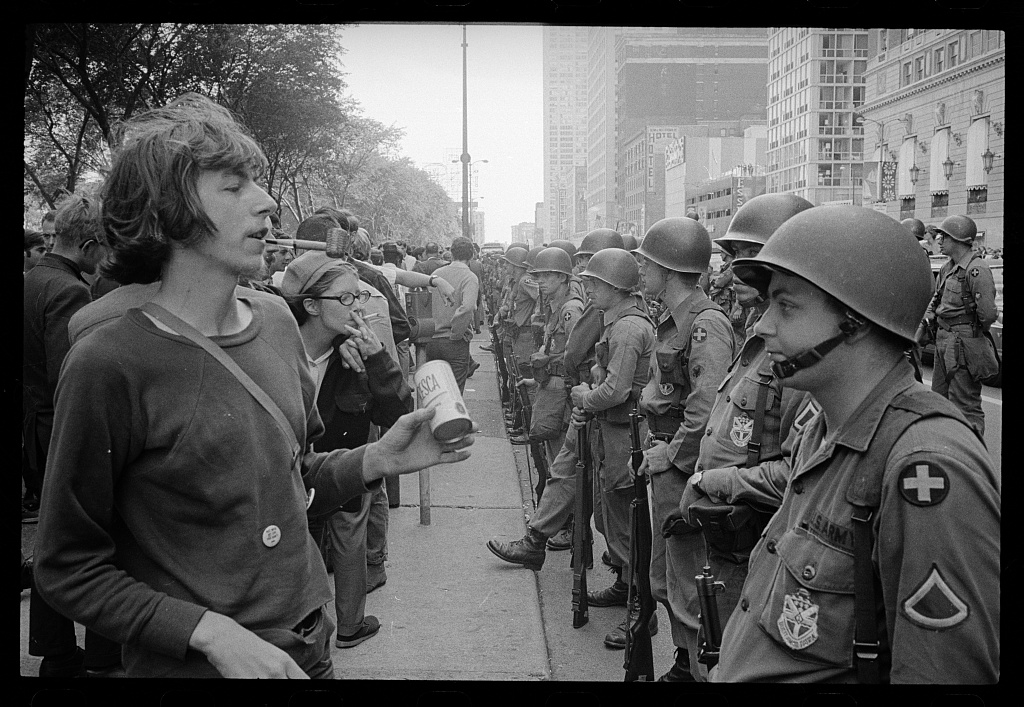
Young “hippie” standing in front of a row of National Guard soldiers, across the street from the Hilton Hotel at Grant Park, at the Democratic National Convention in Chicago, August 26, 1968. Photo by Warren K. Leffler for US News & World Report via Wikimedia Commons.
As an old Cold Warrior, and once “science kid,” whose childhood developed through the 1960s, there is nothing that ought to surprise me. We have Antifa today; we had the Weather Underground then. We have parallels to every event I witnessed through the idiot box of adolescence, and vice versa. Even the destruction of American cities by riots and crime isn’t new; nor the supine response of our liberal leaders. The obvious left bias of news and entertainment was the same then as now, only less shrieking. The replacement of flatfoot journalists, with malicious ideological clowns from the universities, then a work in progress, was by the end of the last century, complete. The poison spread, through all media of information. We’ve reached an Age of Unreason to match Robespierre’s, and seem now to be waiting for a Napoleon.
Charlatans are the handmaids of paganry. That the charlatans slide into violent insurrection, even against the better pagan customs, is not something historically new.
The alternative is improbable: another Age of Faith. This would necessarily include a subsidiary restoration of faith in science — in the modest belief that if we follow the facts where they lead, as opposed to where we want them to go, a lost perception of cosmological order will also be, willy-nilly, restored. “Modern science” — an unambiguously Christian construct — depends entirely on one assumption. It is, that a universe God created will make sense. Logic, or the principle of non-contradiction, will hold up, and where it doesn’t seem to be doing so, it is not God, but we, who have got it wrong.
By the inversion of “values,” at the present day, the sane views are labelled as “psycho.” The truth is not the true, but what we (or our masters) want to call true. This “truth” is “settled,” from one moment to another; and is not to be discovered, but imposed.
J.K. Rowling on her most recent “cancellation”
I know a lot of Harry Potter fans are upset with their formerly favourite author for her stance on transgenderism … or what they’ve heard about her stance … or what their friends have said about her stance … so J.K. Rowling has posted an essay on her own site explaining what happened and how she has been coping with being “cancelled” so many times:
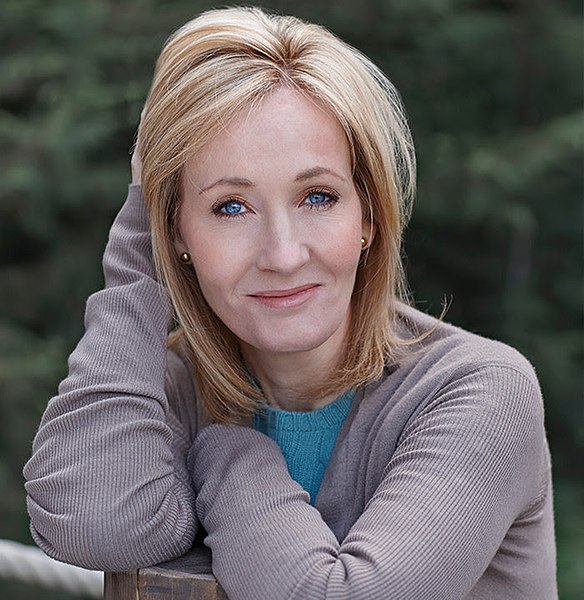
… as a much-banned author, I’m interested in freedom of speech and have publicly defended it, even unto Donald Trump.
The fourth is where things start to get truly personal. I’m concerned about the huge explosion in young women wishing to transition and also about the increasing numbers who seem to be detransitioning (returning to their original sex), because they regret taking steps that have, in some cases, altered their bodies irrevocably, and taken away their fertility. Some say they decided to transition after realising they were same-sex attracted, and that transitioning was partly driven by homophobia, either in society or in their families.
Most people probably aren’t aware – I certainly wasn’t, until I started researching this issue properly – that ten years ago, the majority of people wanting to transition to the opposite sex were male. That ratio has now reversed. The UK has experienced a 4400% increase in girls being referred for transitioning treatment. Autistic girls are hugely overrepresented in their numbers.
The same phenomenon has been seen in the US. In 2018, American physician and researcher Lisa Littman set out to explore it. In an interview, she said:
“Parents online were describing a very unusual pattern of transgender-identification where multiple friends and even entire friend groups became transgender-identified at the same time. I would have been remiss had I not considered social contagion and peer influences as potential factors.”
Littman mentioned Tumblr, Reddit, Instagram and YouTube as contributing factors to Rapid Onset Gender Dysphoria, where she believes that in the realm of transgender identification “youth have created particularly insular echo chambers.”
Her paper caused a furore. She was accused of bias and of spreading misinformation about transgender people, subjected to a tsunami of abuse and a concerted campaign to discredit both her and her work. The journal took the paper offline and re-reviewed it before republishing it. However, her career took a similar hit to that suffered by Maya Forstater. Lisa Littman had dared challenge one of the central tenets of trans activism, which is that a person’s gender identity is innate, like sexual orientation. Nobody, the activists insisted, could ever be persuaded into being trans.
The argument of many current trans activists is that if you don’t let a gender dysphoric teenager transition, they will kill themselves. In an article explaining why he resigned from the Tavistock (an NHS gender clinic in England) psychiatrist Marcus Evans stated that claims that children will kill themselves if not permitted to transition do not “align substantially with any robust data or studies in this area. Nor do they align with the cases I have encountered over decades as a psychotherapist.”
The writings of young trans men reveal a group of notably sensitive and clever people. The more of their accounts of gender dysphoria I’ve read, with their insightful descriptions of anxiety, dissociation, eating disorders, self-harm and self-hatred, the more I’ve wondered whether, if I’d been born 30 years later, I too might have tried to transition. The allure of escaping womanhood would have been huge. I struggled with severe OCD as a teenager. If I’d found community and sympathy online that I couldn’t find in my immediate environment, I believe I could have been persuaded to turn myself into the son my father had openly said he’d have preferred.
When I read about the theory of gender identity, I remember how mentally sexless I felt in youth. I remember Colette’s description of herself as a “mental hermaphrodite” and Simone de Beauvoir’s words: “It is perfectly natural for the future woman to feel indignant at the limitations posed upon her by her sex. The real question is not why she should reject them: the problem is rather to understand why she accepts them.”
As I didn’t have a realistic possibility of becoming a man back in the 1980s, it had to be books and music that got me through both my mental health issues and the sexualised scrutiny and judgement that sets so many girls to war against their bodies in their teens. Fortunately for me, I found my own sense of otherness, and my ambivalence about being a woman, reflected in the work of female writers and musicians who reassured me that, in spite of everything a sexist world tries to throw at the female-bodied, it’s fine not to feel pink, frilly and compliant inside your own head; it’s OK to feel confused, dark, both sexual and non-sexual, unsure of what or who you are.
I want to be very clear here: I know transition will be a solution for some gender dysphoric people, although I’m also aware through extensive research that studies have consistently shown that between 60-90% of gender dysphoric teens will grow out of their dysphoria. Again and again I’ve been told to “just meet some trans people.” I have: in addition to a few younger people, who were all adorable, I happen to know a self-described transsexual woman who’s older than I am and wonderful. Although she’s open about her past as a gay man, I’ve always found it hard to think of her as anything other than a woman, and I believe (and certainly hope) she’s completely happy to have transitioned. Being older, though, she went through a long and rigorous process of evaluation, psychotherapy and staged transformation. The current explosion of trans activism is urging a removal of almost all the robust systems through which candidates for sex reassignment were once required to pass. A man who intends to have no surgery and take no hormones may now secure himself a Gender Recognition Certificate and be a woman in the sight of the law. Many people aren’t aware of this.


