
First let’s start with the fact that homelessness as it exists in America isn’t poverty. In fact part of the problem with it is that it ISN’T poverty. Look, regardless of what you’ve seen on the movies or TV, most homeless are not families fallen on hard times. Yes, there are some of those now, but most of those while technically “homeless” aren’t living in your local park. They’ve just taken over mom and dad’s basement, moved onto a friend’s living room or whatever. Terrible – I’ve been JUST short of that at least three times in my married life – and humiliating, but NOT “stand in the park and wheedle on yourself.”
90% of the homeless in America and the hard core ones are people with mental health issues, people with drug abuse issues and people who have found they can live without having to do anything for it, and can be “free” and outside society. I’ve overheard conversations in the park, and I suppose that most of the people who “dropped out” in the sixties are dead, but a lot of them are alive and going from soup kitchen to free clinic, with a bit of begging in between.
Yes, there are entire families in this system, including homeless children – but for them to stay in it, the parents need to have some sort of serious issue. Otherwise, even if they can’t find work, there is assistance available to get them at least into public housing, which, nightmarish though it is, is not living in the park.
I’m not going to pretend this doesn’t happen to normal families too – see where I came very close to that level and more than once too – but normal families usually tend to bounce back. They go through a few months of mess and horror, and then they claw back to some semblance of normalcy. (This might change as our economy dives and programs of necessity get cut. The ones for the DESERVING poor will be cut first, of course, since they rarely riot.)
The problem with this is that when people get appalled at the conditions the homeless live in and start offering “homeless services” there is an entire network, not just of homeless but of social workers who direct the homeless to the cities with better services.
I swear to you and I’m not even joking that right now there are plenty more homeless on Colorado Springs streets than in Denver, despite the Springs being much smaller.
The Springs also has its soup kitchens and other services downtown and within easy walking distance of each other.
This means downtown businesses are closing, except for bars and restaurants which can control access. And that the library is of course a place to camp in the cool/warm during the day.
It means more than that. We moved within easy driving distance of downtown, because when we lived downtown when we first came to Colorado Springs, I used to take walks every day. When we moved to our little mountain village, without these, I gained ten pounds a year. I used to love walking downtown, dropping by the deli and the three bookstores (only one left, and it’s MOSTLY a restaurant now) checking out the other little shops which ranged from yarn to weird import crafts.
Now those are gone. Worse – the last two times I walked downtown alone (i.e. without commanding the muscle, aka older son to go with me) someone FOLLOWED me and I had to employ stuff from my childhood to lose them. Once it was a large and addled looking male, and yes, he was following me. And once it was TWO large and addled looking males. For the icing on the cake – not related to this, but from a blog entry – I clicked on the sex offenders registry. Yes, I know, a lot of people there are there because someone accused them and was never proven. Our local one at least has notes on whether it’s accusation, trial or conviction and also whether the crime was against children or adults.
The downtown zipcode is FULL of registered sex offenders who’ve done hard time and who have committed their crimes against adults. The faces are very familiar from my walks, and yep, one was the guy who tried to follow me.
Sarah Hoyt, “Of Books, Compassion And Cruelty A Blast From The Past From June 2013”, According to Hoyt, 2020-03-10.
June 12, 2020
QotD: Homelessness in America
June 9, 2020
How we are supposed to view the rioting protests in major US cities
David Thompson shares the essential parts of a Vice article, telling us insufficiently woke dullards how to think about the ongoing civil unrest in many American cities after the death of a man at the hands (well, technically the knees) of Minneapolis police:
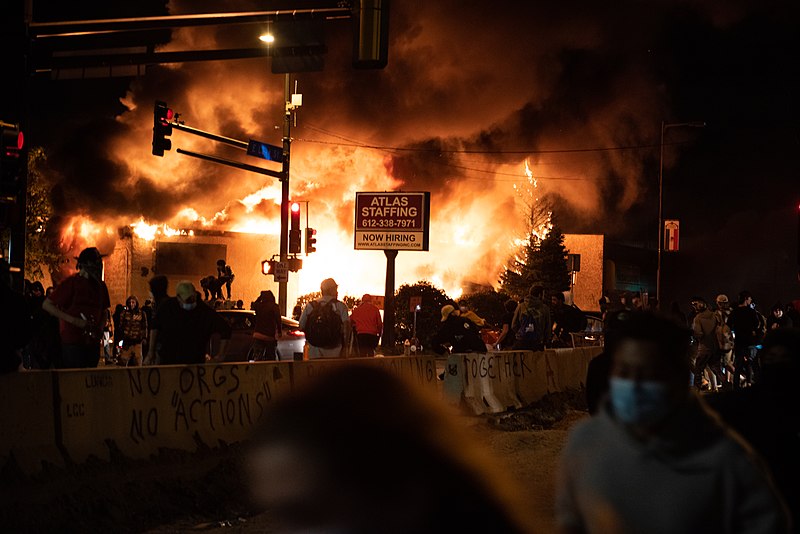
A building burning in Minneapolis following the death of George Floyd.
Photo by Hungryogrephotos via Wikipedia.
In the pages of Vice, a moral lecture, delivered from on high:
How to Talk to Relatives Who Care More About Looting Than Black Lives.
As an exercise in question-begging and dense, self-satisfied presumption, it’s quite a thing, that headline. It’s very now.
Among those of us deemed insufficiently woke and therefore suspect, questions may arise. For instance, in what way will those “black lives” be improved by the destruction of local infrastructure, local businesses, and the subsequent, perhaps dramatic, reduction in trust and goodwill? And what if the stores and homes in question — the ones being smashed, stripped of their contents and set ablaze — are owned by people who happen to be black, as has often been the case? What if the places being looted and vandalised with abandon, indeed exultation, are depended on by people who also happen to be black, whether as customers or employees? Given the levels of material, social and economic destruction, should these people be content, indeed pleased, to be former employees? Unemployed people who now have no local grocer, or garage, or pharmacy?
Alas, such considerations appear to have eluded the keen mental processes of the article’s author, Ms Rachel Miller, a young woman who dutifully declares her pronouns and boasts of being a “Buzzfeed alum.”
If you’re not Black but want to support BLM, having fraught conversations with your kinda (or definitely) racist loved ones will likely not be fun, but it’s a very worthy undertaking.
Right from the off we’re informed, firmly, that any perceptible reservations about looting and rioting, or reservations about the Black Lives Matter movement — say, regarding its demented far-left agenda, its racial tribalism, and the stated goal of abolishing capitalism, prisons and the police — must be taken as an indicator of being “kinda (or definitely) racist.” Wokeness is not, it seems, a recipe for cognitive subtlety. “Some people,” we’re told, “appear to be far more worried about the fate of a Nordstrom or Target store than that of the actual human lives of protesters.” Again, one might deduce that only those protesting with, shall we say, physical enthusiasm have “actual human lives,” unlike their victims, whose hopes and livelihoods can be gleefully destroyed as an act of righteous liberation. From local amenities.
June 8, 2020
Andrew Sullivan can’t write about the riots or he’ll lose his job
I’d wondered why he hadn’t directly addressed the biggest news item in the United States over the last week:
What has happened to New York media? Just as the New York Times was experiencing its own Inner Mongolia Moment over the now notorious Sen. Tom Cotton “Send in the Troops” op-ed, the Maoists at New York magazine were going after their best columnist, Andrew Sullivan.
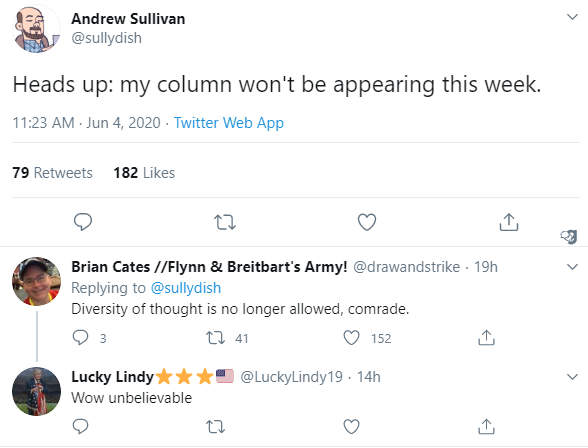
Sullivan revealed on Twitter yesterday that his column wouldn’t be appearing. The reason? His editors are not allowing him to write about the riots.
Presumably Sullivan’s editors are frightened that he might make the radically bourgeois point that looting and violence are wrong.
Cockburn understands that Sullivan is not just forbidden from writing for the New York magazine about the riots; his contract means he cannot write on the topic for another publication. He is therefore legally unable to write anything about the protests without losing his job — at the magazine that, in 1970, published Radical Chic, Tom Wolfe’s brilliant and controversial excoriation of progressive piety. It’s the bonfire of the liberals!
June 6, 2020
Cognitive dissonance is real
Matt Gurney had a discussion with one of his readers that left him shaking his head in disbelief:
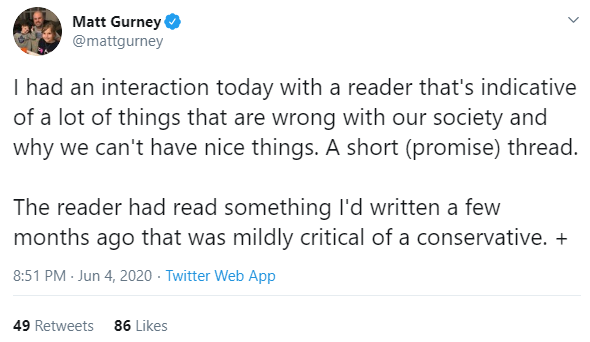
I had an interaction today with a reader that's indicative of a lot of things that are wrong with our society and why we can't have nice things. A short (promise) thread.
The reader had read something I'd written a few months ago that was mildly critical of a conservative. +
— Matt Gurney (@mattgurney) June 5, 2020
The reader haughtily asked if I’d ever make such a criticism for a Liberal.
I said yes.
The reader didn’t believe me, and said, oh yeah, show me an example?
As it so happened, I actually had a column of mine open in another tab; I was referring back to it for research. +
—
The column in question contained a perfect example of me saying a very comparable thing about a Liberal as I had about the Conservative. So I had, OK, here you go. Pasted the link and replied.And the reader replied right away. The reader was very confused.
—
The reader had questions about how I could criticize both a Conservative and a Liberal. The reader asked about agendas — who had insisted I write one piece, and why had they then permitted me to write the other?I wrote both on my own initiative, I explained. +
—
And I made criticisms of both gentlemen, the Conservative and the Liberal, because they’d both done things that pissed me off.The reader didn’t believe this was possible. There had to be another explanation, or an ulterior motive. +
—
I eventually disengaged. But I’ve been thinking about that all day. There’s a grown-ass person in Canada, totally literate and presents very normally, who really struggled to understand that someone could be critical of both the left and right without being compromised.END
June 5, 2020
Toronto radio station to be required to denounce itself in Canadian Content “Struggle session”
Wikipedia defines a “Struggle session” as “a form of public humiliation and torture that was used by the Communist Party of China (CPC) at various times in the Mao era, particularly years immediately before and after the establishment of the People’s Republic of China and during the Cultural Revolution. The aim of a struggle session was to shape public opinion and humiliate, persecute, or execute political rivals and those deemed class enemies.” It seems that Canada is becoming just a bit more like China (whose “basic dictatorship” has been publicly admired by our Prime Minstrel), as Toronto’s CFRB has been found in violation of the whims of the Canadian Broadcast Standards Council:

The Canadian Broadcast Standards Council has ruled that a news broadcast that jokingly criticized Canadian content violates the Canadian Association of Broadcasters’ (CAB) Code of Ethics and the Radio Television Digital News Association of Canada’s (RTDNA) Code of Journalistic Ethics. The complaint arose from a December 2019 broadcast on Toronto radio station CFRB. David McKee used his lead-in to a report on a possible Netflix tax to state “the libraries of streaming services like Netflix, Disney+ could soon have more of a Canadian flavour that nobody watches or wants if the federal government gets its way.”
That comment was too much for one listener, who filed a complaint with the CBSC, arguing that “Canadian Content is important, and Mr McKee seems to forget that he is part of a Canadian Content Broadcaster. His opinions should be kept off of the regular news sections and limited to a specific commentary section if he is so transfixed on being a commentator.”
The CBSC agreed, taking aim at the words “nobody watches or wants”, which it concluded constituted inserting personal opinion into the broadcast […]
As a penalty, CFRB must now broadcast that it breached the ethics standards on several broadcasts. While few will likely take notice, Canadians should take notice of the regulatory policing of the line between news and commentary on a radio broadcast. Indeed, one wonders if there would be a similar outcome if the broadcaster had expressed support for Canadian content.
Moreover, the Broadcast and Telecommunications Legislative Review Panel, which Canadian Heritage Minister Steven Guilbeault plans to implement, recommended extending Canada’s broadcast regulatory framework to the Internet, including sites and services that aggregate the news.
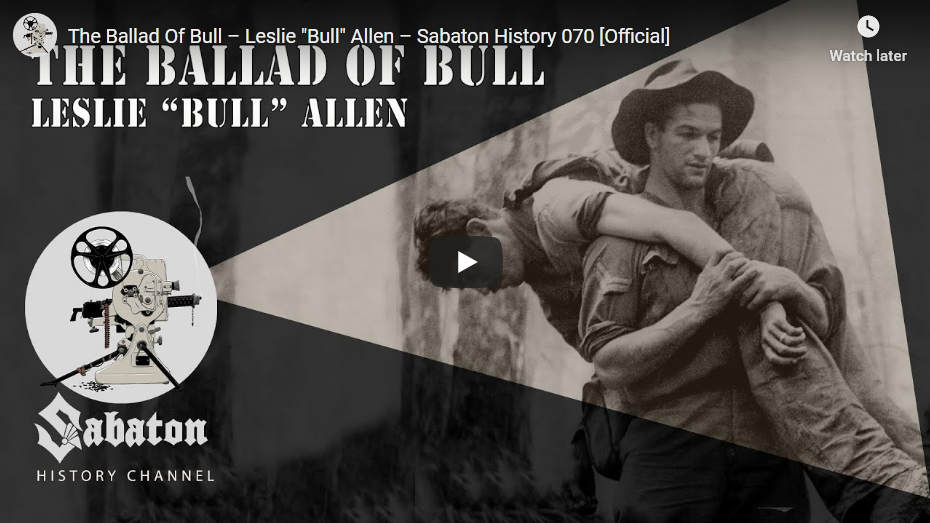
“The Ballad Of Bull” – Leslie “Bull” Allen – Sabaton History 070 [Official]
Sabaton History
Published 4 Jun 2020Sometimes war is killing, sometimes it’s saving lives. This week we turn a soldier who became a hero, not for killing his foes, but for saving his fellow men. Medic Leslie “Bull” Allen’s story is a story about courage in the face of fire. The battle for Mount Tambu in 1943 in Papua New Guinea was vicious and bloody, and the field was soon littered with many wounded men crying for help. Without much regard for his own safety, “Bull” Allen stormed forward into the fray. 12 times he went, and 12 times he came back with a wounded soldier on his back.
Support Sabaton History on Patreon: https://www.patreon.com/sabatonhistory
Listen to “The Ballad Of Bull” on the album Heroes here:
CD: http://bit.ly/HeroesStore
Spotify: http://bit.ly/HeroesSpotify
Apple Music: http://bit.ly/HeroesAppleMusic
iTunes: http://bit.ly/HeroesiTunes
Amazon: http://bit.ly/HeroesAmz
Google Play: http://bit.ly/HeroesGooglePCheck out the trailer for Sabaton’s new album The Great War right here: https://www.youtube.com/watch?v=HCZP1…
Listen to Sabaton on Spotify: http://smarturl.it/SabatonSpotify
Official Sabaton Merchandise Shop: http://bit.ly/SabatonOfficialShopHosted by: Indy Neidell
Written by: Markus Linke and Indy Neidell
Directed by: Astrid Deinhard and Wieke Kapteijns
Produced by: Pär Sundström, Astrid Deinhard and Spartacus Olsson
Creative Producer: Joram Appel
Executive Producers: Pär Sundström, Joakim Broden, Tomas Sunmo, Indy Neidell, Astrid Deinhard, and Spartacus Olsson
Post-Production Director: Wieke Kapteijns
Edited by: Iryna Dulka
Sound Editing by: Marek Kaminski
Maps by: Eastory – https://www.youtube.com/c/eastoryArchive by: Reuters/Screenocean https://www.screenocean.com
Music by Sabaton.Sources:
– State Library Victoria
– Motorboat sound by bockelsound from freesound.orgAn OnLion Entertainment GmbH and Raging Beaver Publishing AB co-Production.
© Raging Beaver Publishing AB, 2019 – all rights reserved.
QotD: Recognizing the work of famous painters
#2 If Everyone Looks Like Hobos Illuminated Only By A Dim Streetlamp, It’s Rembrandt
#3 If It’s Something You Saw On Your Acid Trip Last Night, It’s Dali
#4 If The Paintings Have Lots Of Little People In Them But Also Have A Ton Of Crazy Bulls#%t, It’s Bosch
#5 If Everybody Has Some Sort Of Body Malfunction, Then It’s Picasso
#6 Lord Of The Rings Landscapes With Weird Blue Mist And The Same Wavy-Haired Aristocratic-Nose Madonna, It’s Da Vinci
#7 Dappled Light And Unhappy Party-Time People, Then It’s Manet
#8 If You See A Ballerina, It’s Degas
#9 Dappled Light But No Figures, It’s Monet
#10 If Everyone Is Beautiful, Naked, And Stacked, It’s Michelangelo
#11 Dappled Light And Happy Party-Time People, It’s Renoir
#12 If The Images Have A Dark Background And Everyone Has Tortured Expressions On Their Faces, It’s Titian
#13 Excel Sheet With Coloured Squares, It’s Mondrian
#14 If All The Men Look Like Cow-Eyed Curly-Haired Women, It’s Caravaggio
#15 If The Paintings Have Tons Of Little People In Them But Otherwise Seem Normal, It’s Bruegel
#16 If Everyone In The Paintings Has Enormous Asses, Then It’s Rubens
#17 If Every Painting Is The Face Of A Uni-Browed Woman, It’s Frida
#18 If Everything Is Highly-Contrasted And Sharp, Sort Of Bluish, And Everyone Has Gaunt Bearded Faces, It’s El Greco
#19 If The Painting Could Easily Have A Few Chubby Cupids Or Sheep Added (Or Already Has Them), It’s Boucher
Aušrys Uptas, “Someone Created A Funny Guide On How To Recognize Famous Painters And It’s Surprisingly Accurate (19 Pics)”, deMilked, 2019.
June 4, 2020
Performance, Plague, and Politics in Shakespeare’s London
Atun-Shei Films
Published 27 Mar 2020Help us make the first feature film ever made (that we know of) spoken entirely in Original Pronunciation, the accent of Shakespeare: https://igg.me/at/sudburydevil/x/1502…
Did William Shakespeare write King Lear under quarantine? That is the question. In this video I introduce you to the actor’s process in Elizabethan theater; dive deep into first-hand accounts of the bubonic plague epidemics that Shakespeare lived through; explore the politics of late 16th and early 17th century England, onstage and off; and discuss OP, Original Early Modern English Pronunciation, the accent and dialect in which the Bard’s plays were originally performed.
The rest is silence.
Support Atun-Shei Films on Patreon ► https://www.patreon.com/atunsheifilms
#English #Theater #History
Watch our film ALIEN, BABY! free with Prime ► http://a.co/d/3QjqOWv
Reddit ► https://www.reddit.com/r/atunsheifilms
Twitter ► https://twitter.com/atun_shei
Instagram ► https://www.instagram.com/atunsheifilms
Merch ► https://atun-sheifilms.bandcamp.com
From the comments:
Atun-Shei Films
1 month ago
CORRECTION: The Great Vowel Shift was a SEPARATE linguistic trend to the R-dropping in 18th century English. My mistake, sorry!
Trudeauvian “performative sanctimony” on display … again
Chris Selley on the Prime Minstrel’s latest attempt to virtue signal on racial issues:
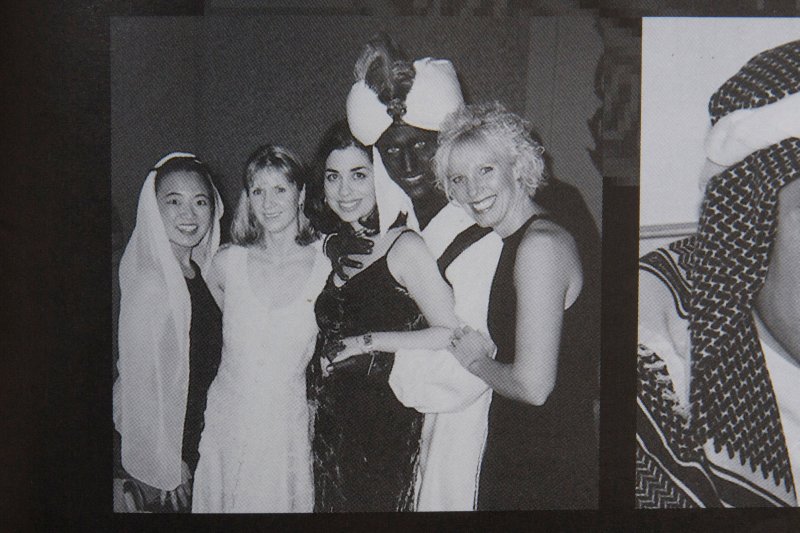
Justin Trudeau with dark makeup on his face, neck and hands at a 2001 “Arabian Nights”-themed party at the West Point Grey Academy, the private school where he taught.
Photo from the West Point Grey Academy yearbook, via Time
In agonizing for 21 seconds before answering a question about President Donald Trump’s threat to send the military after civilian protesters in American cities, Prime Minister Justin Trudeau likely risked causing as much trouble as he was hoping to avoid. Those who would like to see him denounce the president in full throat might be as annoyed as those who think he should accept there’s nothing Canada can really do to help and look out for our own best interests while the socio-political nightmare plays out.
Trudeau’s response wasn’t anything inspiring or novel or revolutionary. “It is a time for us as Canadians to recognize that we too have our challenges — that black Canadians and racialized Canadians face discrimination as a lived reality every single day,” he said. “There is systemic discrimination in Canada, which means our systems treat Canadians of colour, Canadians who are racialized, differently than they do others.”
He continued: “We need to see that, not just as a government and take action, but we need to see that as Canadians. We need to be allies in the fight against discrimination. We need to listen, we need to learn and we need to work hard to figure out how we can be part of the solution on fixing things.”
But here, at least, he was getting to the nub of the issue: To the extent the federal government can make things better for marginalized Canadians, Trudeau is the guy driving the boat. To read some of his ministers’ pensées, you would think they were just regular folks.
[…]
In the meantime, however, you can bet the farm we will soon learn that the Liberals’ changes to impaired driving laws — allowing police to stop and breathalyze drivers without any suspicion of impairment — have disproportionately affected black and Indigenous drivers in particular. Literally everybody saw it coming except Trudeau and his ministers.
OK, I’m kidding — they saw it coming too. They might want to log off, dial down the performative sanctimony and think on that a while.
June 3, 2020
QotD: From “the media’s” point of view
Bias. Everyone leans a certain way politically. Ideally, that wouldn’t affect the way a reporter covered a city council meeting or a police news conference. But to tell the truth, I’ve probably worked with 10 times more liberal-leaning journalists than conservative-leaning journalists over the past three decades. The profession attracts people with an affinity for underdogs. That has to have some impact on the stories we choose to do and the ones we don’t.
Sensationalism. It depends how you define it. If we talk to the relatives of a murder victim, are we doing it to make money? I hope we’re there because we’re trying help the community grieve together. But let’s face it, that story is going to be well-read so maybe it will make more money in some click-based, page-view algorithm that I’ll never understand.
Negativity. We don’t make cars crash. We don’t bomb civilians. The world can be an ugly place and these things won’t stop if we ignore them. On the other hand, I haven’t met many reporters who would rather cover a parade than a murder trial. Darker stories seem, by their nature, more important. So maybe we are negative.
But I’ve already fallen into the trap of thinking in terms of “us” and “them.” There should be no distinction. It’s here where the media are their own worst enemies. We tend to think we’re infallible because we’re doing God’s work. But if we want more people on our side, we could do a much better job of showing the public what we do, why we do it and how we do it. We like to crow about open courts, but what about open newsrooms?
Maybe we should trust people enough to let them in on the process. To boil it down to one example, if the police shoot an Indigenous man and we decide to mention his race in coverage, we should tell people why we thought it was relevant and maybe admit that we agonize over such decisions. It might not stop the haters but it would at least give “them” a chance to understand “us.”
Cam Fuller, “Do people really hate us and if so, why?”, Saskatoon StarPhoenix, 2018-03-03.
June 2, 2020
“Calling a modern ‘artist’ a poseur is like calling water wet — what could possibly be the point?”
Severian on modern “art” and its practitioners:

Picasso’s “Guernica” in mural form in the town of Guernica.
Photo by Papamanila via Wikimedia Commons.
Leszek Kolakowski, in his essay collection Is God Happy?, wrote several fascinating essays on Communism vs. other forms of Socialism, such as Fascism and generic Leftism. He notes that while Communism proper attracted lots of serious intellectuals and artists, who produced some works of real merit, generic “Leftism” had few, and Fascism almost none.
He also notes the degeneration of art on the Left. I don’t want / am not qualified to get deep into the weeds of art history, but let me use an example (mine, not Kolakowski’s): Pablo Picasso vs … oh, pick an artist, they’re all Lefties … let’s say Andy Warhol. Noting that “important” can be diametrically opposed to things like “good,” “aesthetically pleasing,” etc., we can all agree that both were important artists. Whatever else their differences, the most obvious one was:
Sincerity.
Picasso was a lifelong member of the Communist Party. He was also a sincere artist (which, again, can be miles away from “good;” I personally can’t stand Picasso’s art). Guernica is wildly overrated, and its sentiment jejune — we all agree that bombing civilians is bad, mmkay? — but at least it’s sincere. Warhol, on the other hand, never took a sincere breath in his life. Making your work superficial on purpose doesn’t absolve you from the sin of superficiality. Warhol (and Roy Lichtenstein, and the rest of the “Pop Art” crowd) gave wannabes permission to substitute “being ironic” for “having something to say,” and there’s your modern art in a nutshell. Calling a modern “artist” a poseur is like calling water wet — what could possibly be the point?
Which brings us back to Kolakowski. He notes that there are apostates aplenty from Communism, and they all seem compelled to write big long books full of critical self-examination. Cheering for the murder of millions would do that, one supposes… except that, as Kolakowski says, you can’t find one single ex-Leftist doing it. Hell, is there such a thing as an ex-Leftist, as opposed to an ex-Communist? Kolakowski couldn’t find one (as of 1995, I think), and I can’t think of one either. Every former radical I’m aware of was just that — a radical, a card-carrying Communist or at least a virulent fellow-traveler, e.g. David Horowitz. We probably all have heard of someone waking up one day (say, after 9/11) realizing that the Democratic Party they’d been knee-jerk voting for all their lives was out to lunch, but do you know of any True Believers seeing the light?
May 31, 2020
On “spontaneous” riots
David Warren had a brush with a riot as a youngster — not as a participant, but as a near-victim — so the psychology of riots has a personal edge:
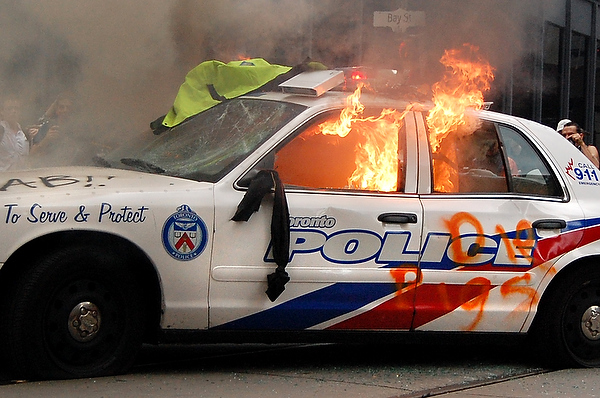
To a trained observer, the organizers of the riot stand out. They are dressed distinctly, they are giving orders; they are directing the attacks. They will usually be wearing expensive communications equipment. A drama coach would notice that their harangues are premeditated and rehearsed, to stir violence. That anger in the crowd was available to them, as their raw material, goes without saying; their art consists of “weaponizing” it.
Fascists — the real ones, in pre-war Italy and Germany — were masters of this art. So were the Communists with whom they had streetfights. The blackshirts today, a near-monopoly of the Left, descend from this rich tradition. When Antifa and other leftist scum shut down public discussions in universities and elsewhere, they may use the latest technology, but to old-fashioned ends.
What is alarming is not that these people exist — radical evil is a fact in human nature — but that they are given permission to act lawlessly. Rather than arrest and prosecute them, the liberal authorities agree to silence the legitimate speaker. They are trying to avoid confrontation, with people who sought confrontation, and will seek a larger confrontation next time. The prestige of these devils in human flesh is increased by their victories.
An injustice, such as the apparent murder of George Flynn by a vicious cop, while three more stood and watched, was the pretext for the riots. It was convenient for aggravating racial tensions, by which the Democrat party hopes to retrieve black votes that had been getting away from them. I would not wish to omit this dimension of the permission they grant to rioters. Politics are a cynical business.
But note, the mostly white folk in Antifa, prefer black neighbourhoods to start race riots, for that is where resentments will be easiest to exploit. (Masks help to conceal their whiteness.) This means that the victims of the riots, whose property and businesses are gutted, will also be mostly black. The media elide this aspect of the lawlessness, because they want Republicans to be defeated, too.
The moral stench is overpowering.
May 30, 2020
QotD: The “Americanization” of German philosophy
Allan Bloom, The Closing of the American Mind, 1987.
May 29, 2020
“Night Witches” Pt. 2 – Female Soldiers – Sabaton History 069 [Official]
Sabaton History
Published 28 May 2020Quarantined Sabaton History is back! And this week we talk about female badass warriors of the Second World War! From a Soviet sniper to a French resistance fighter, many women chose to volunteer for the front and fight alongside the men. These are some of their tales.
Support Sabaton History on Patreon: https://www.patreon.com/sabatonhistory
Listen to “Night Witches” on the album Heroes here:
CD: http://bit.ly/HeroesStore
Spotify: http://bit.ly/HeroesSpotify
Apple Music: http://bit.ly/HeroesAppleMusic
iTunes: http://bit.ly/HeroesiTunes
Amazon: http://bit.ly/HeroesAmz
Google Play: http://bit.ly/HeroesGooglePCheck out the trailer for Sabaton’s new album The Great War right here: https://www.youtube.com/watch?v=HCZP1…
Listen to Sabaton on Spotify: http://smarturl.it/SabatonSpotify
Official Sabaton Merchandise Shop: http://bit.ly/SabatonOfficialShopHosted by: Spartacus Olsson, substituting for Indy Neidell
Written by: Markus Linke and Indy Neidell
Directed by: Astrid Deinhard and Wieke Kapteijns
Produced by: Pär Sundström, Astrid Deinhard and Spartacus Olsson
Creative Producer: Joram Appel
Executive Producers: Pär Sundström, Joakim Broden, Tomas Sunmo, Indy Neidell, Astrid Deinhard, and Spartacus Olsson
Post-Production Director: Wieke Kapteijns
Edited by: Iryna Dulka
Sound Editing by: Marek Kaminski
Maps by: Eastory: https://www.youtube.com/c/eastoryArchive by: Reuters/Screenocean https://www.screenocean.com
Music by Sabaton.Colorizations:
– Olga Shirnina, a.k.a. Klimbim – https://klimbim2014.wordpress.com/
– Jaris Almazani (Artistic Man), https://instagram.com/artistic.man?ig…
– Carlos Ortega Pereira, BlauColorizations, https://www.instagram.com/blaucoloriz…Sources:
– Central Intelligence Agency
– Museum.ru
– Imperial War Museum:HU 66187
– Bundesarchiv, CC-BY-SA 3.0: Bild_101I-027-1477-24, 101I-301-1951-11, 101i-721-0395-22
– ETH-Bibliothek
– RIA Novosti archive, image #58861 / V. Krasutskiy / CC-BY-SA 3.0
– Crosshair by DTDesign from the Noun ProjectAn OnLion Entertainment GmbH and Raging Beaver Publishing AB co-Production.
© Raging Beaver Publishing AB, 2019 – all rights reserved.

The contagion of fear and the progressive loss of perspective in the modern world
In the Hector Drummond Magazine, Dan C. discusses what he calls the “comfort of fear”:

Not actually the official symbol of Britain’s National Health Services … probably.
This is the sort of glib response (akin to “so you WANT people to die then?”) that has essentially hijacked all conversation and debate since the start of the Coronavirus outbreak. I didn’t respond, partly because I didn’t have the energy for an argument with a friend (at least Twitter rows tend to be anonymous) and quite frankly, what does one say to this? That we shouldn’t send out children back to school ever again in case one child happens to pass away from any illness or disease? That we should continue in lockdown until we cure death itself?
My concern is that this bizarre way of thinking is commonplace right now for many parents. Locked inside their houses for weeks on end, soaking up an endless stream of Netflix programs, mawkish Instagram feeds and daily Government briefings, convinced that Black Death Mk II has landed outside their front door, paid by the state to stop working and lapping up every rainbow-based hashtag that emerges from “our NHS”, all sense of balance and perspective has vanished. With such an unprecedented paradigm shift, this new state of heightened safety has led many to consider their view on illness and risk for the very first time in their lives and unfortunately the concept of critical thinking has been found lacking. Real life, which has been slowly eroded for many decades, has suddenly been switched off completely overnight and the worst of it is that most people don’t seem to care.
The scary part of all of this is that if the adults in the room have suddenly lost their desire to engage in the outside world, to have meaningful human interaction, to take risks (don’t get me started on the definition of “risk”) and to live their lives in the fullest possible way then what chance do children stand? After all, you can’t miss what you’ve never had.
Historians will look back in bewilderment at this period, noting that it took no more than a month during the spring of 2020 for fearlessness to completely evaporate in society. In its place is a comfortable sense of fear.


