
Sabaton History
Published 6 Mar 2023This song is the story of Albert Roche, who is very much forgotten today, but after the First World War was THE hero of France. He was hotheaded and tempestuous, but above all he was GOOD. His service — and his legend from that war — is just remarkable, and today we share the war stories of the First Soldier of France.
(more…)
March 7, 2023
“The First Soldier” – Albert Séverin Roche – Sabaton History 118
Comments Off on “The First Soldier” – Albert Séverin Roche – Sabaton History 118
The lab leak in Wuhan was bad, but the cover-up after the fact is much worse
Jon Miltimore outlines some of the recent confirmations of so many conspiracy theorists’ speculations about the origin of the Wuhan Coronavirus:

Wuhan Institute of Virology.
Wikimedia Commons.
More than three years after the Covid-19 outbreak, the world is still reeling from the virus and the global response to it.
Some 6.8 million people have already died from the virus, according to official statistics, including an estimated 1.1 million Americans. Each day the toll climbs higher; globally, more than 10,000 people die each week.
A bevy of government assessments now indicate that the likely source of the virus was not a wet market, but the Wuhan Institute of Virology, which for years has dabbled in the creation of chimeric coronaviruses.
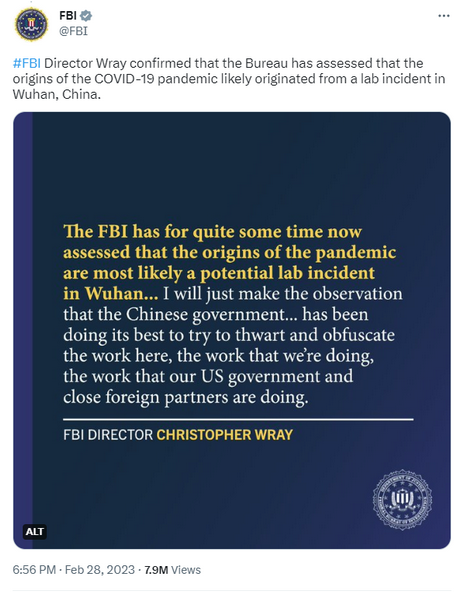
Last Sunday, the Wall Street Journal reported that the US Department of Energy had concluded the Wuhan lab was likely the origin of the pandemic. Days later the FBI chimed in, declaring that “the Bureau has assessed that the origins of the COVID-19 pandemic likely originated from a lab incident in Wuhan, China”.
If true, it’s not hyperbole to say this would be the greatest scandal of the century.
As the Washington Post reported nearly two years ago, State Department cables had previously warned of safety issues at the WIV, where researchers were studying bat coronaviruses. The cables were sent after science diplomats made a January 2018 visit to the Wuhan lab on behalf of the US embassy in Beijing. What the officials found at the lab, which in 2015 had become China’s first facility to achieve the maximum level of international bioresearch safety, shocked them.
Bad, even shocking, to those who refused to listen to the whistleblowers early in the pandemic. Worse, however, is the complicity of western government and media in the cover-up:
While the US government’s involvement in the Wuhan lab leak scandal may have been inadvertent, its attempt to avoid potential responsibility and conceal the truth is now apparent.
From the beginning of the pandemic, Dr. Fauci — the same Dr. Fauci whose agency awarded a $3.7 million grant to EcoHealth Alliance, which funded coronavirus research at the Wuhan lab — became the leading voice denying the possibility that Covid-19 could have emerged from the WIV.
It was “molecularly impossible” for viruses at Wuhan to have mutated into the current viral strain, he claimed in October 2021. In April the previous year he called the lab-leak-theory “a shiny object that will go away soon”, later noting that the virus’ “mutations” were “totally consistent with a jump of a species from an animal to a human”. In May 2020, he told National Geographic that “everything … strongly indicates” that the virus “evolved in nature”, calling the lab-leak theory a “circular argument”.
Scientists are of course entitled to their opinions, but there are two big problems that accompany Fauci’s public statements.
The first problem is that while these statements were being issued publicly, a different conversation was taking place privately, The New York Times noted Tuesday.
“… in 2020, many of those scientists who would become the most stalwart critics of the lab-leak theory privately acknowledged that the origins of the pandemic were very much up for debate”, writes David Wallace-Wells, “and that a laboratory leak was a perfectly plausible — perhaps even the most likely — explanation for the emergence of SARS-CoV-2 in Wuhan a few months earlier.”
We know this because a series of emails obtained by BuzzFeed through FOIA requests show that some of the world’s top virologists initially believed that the lab-leak hypothesis was at least as plausible as natural evolution theory. Specifically, the virologist and natural biologist Kristian Andersen described the new virus as “inconsistent with expectations from evolutionary theory”. In another email, Jeremy Farrar, the incoming head scientist of the World Health Organization, summarized the perspectives of scientists who concluded the “accidental release theory” was the likeliest scenario — “70:30” or “60:40” in favor. (Farrar put the odds at 50-50.)
These views were not made public, however. And following a Feb. 1 conference call arranged by Fauci, scientists published a paper in Nature expressing their belief that the most likely scenario was that the virus naturally evolved on its own.
“Our analyses clearly show that SARS-CoV-2 is not a laboratory construct or a purposefully manipulated virus”, the scientists, including the initially skeptical Andersen, emphatically noted.
So just a few months into the pandemic, scientific researchers were raising concerns in private, but governments pushed legacy media and social media platforms to police public discourse and to actively suppress public doubts of exactly the same sort that the experts were discussing among themselves.
Comments Off on The lab leak in Wuhan was bad, but the cover-up after the fact is much worse
March 6, 2023
Britain’s Free Speech Union at three
Earlier this month, Toby Young’s Free Speech Union celebrated its third birthday:

Toby Young founded the Free Speech Union in early 2020, and on Wednesday, 1 March a party was thrown to celebrate the organisation’s third birthday. The delicate baby born just before the Covid-19 lockdowns has grown into a boisterous, disruptive toddler that stomps about the political scene breaking things.
Over 100 people came to the In and Out on St James’s Square to enjoy the FSU’s success, including Professor Nigel Biggar, whose book Colonialism was effectively cancelled by Bloomsbury when the publisher’s executives decided that “public feeling” was against its publication. The legal profession was well-represented — Francis Hoar acted as counsel in various legal challenges for those damaged by the government’s lockdowns. He was heard to complain that the Covid-19 inquiry under Lady Hallett had granted core participant status to various bereaved family groups and those suffering from long Covid, but had denied it to the hospitality and other businesses which had been pushed into bankruptcy. Other attendees included Matthew Elliott, who led Vote Leave; Matt Ridley, the author of The Rational Optimist; and Adam Afriye MP. The FSU has been remarkably successful in raising funds, and there was a good turn out of donors like Lady Bell, the widow of Bell Pottinger founder Lord Bell of Belgravia.
Young told the room what his creation had achieved in its short life so far — a paying membership of 11,000; more than 2,000 cases taken on; a staff of 16 including eight full time employees — and talked about his political campaigns. Currently in his crosshairs is the Worker Protection (Amendment of Equality Act) Bill, which has been tabled by Vera Hobhouse MP and is supported by the government. The Equality Act already imposes a duty on employers to stop their workers from being harassed by other employees in relation to a protected characteristic such as sexual orientation, disability or age. Hobhouse’s bill will extend that duty so companies can be liable for third parties’ harassing actions, unless the employer has taken “all reasonable steps” to protect them.
It is almost certain to have a chilling effect on free speech in the workplace, as well as creating additional costs which will have to be passed on to consumers — perhaps good news for HR departments, probably bad news for everyone else. The FSU hopes to see amendments proposed to the bill which will need to have public consultation, thereby delaying its parliamentary progress. It is hoped that the delay will prove fatal.
Comments Off on Britain’s Free Speech Union at three
March 5, 2023
“Natural Woman” – classic hit song or hate crime in progress?
Janice Fiamengo on the hoax “cancellation” attempt on the late Aretha Franklin’s hit song:
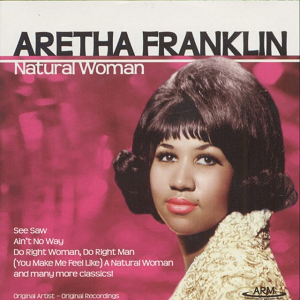
For at least a few hours, it looked as if the 1960s soul classic “(You Make Me Feel Like a) Natural Woman“, memorably performed by Aretha Franklin, was imperiled by woke attack. Various conservative and right-wing media reported in late January that a trans awareness group was demanding via Twitter that the song be canceled because of its exclusionary emphasis on “natural” womanhood. It was dutifully noted that this was the latest salvo in the trans “assault on women”, and a women’s activist was reported as saying, “I don’t think many women really know how much we’re hated”.
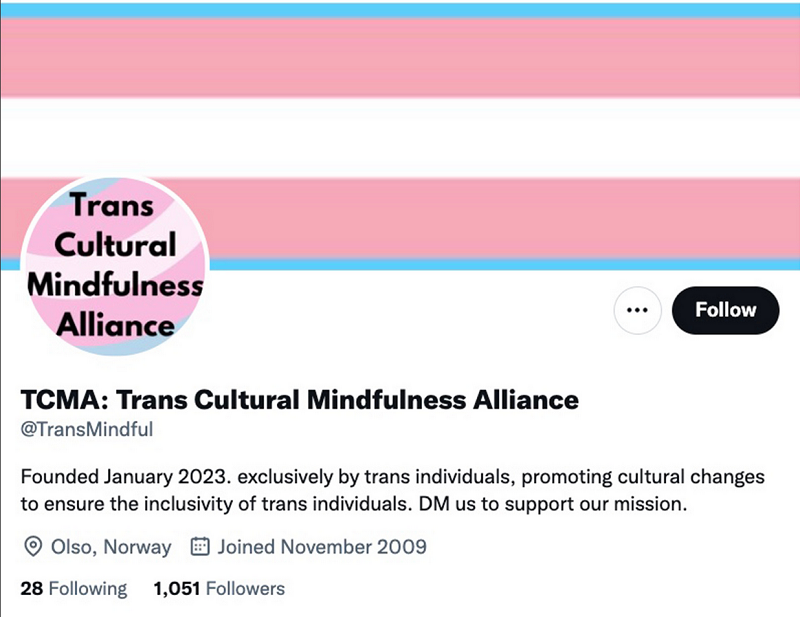
It turned out that the complaint about “Natural Woman”, which received well over one million views and provoked thousands of responses, had been made by a parody account. Aretha Franklin was safe — at least for now. But commentary on the song has a surprising history, as we’ll see, that complicates the standard claims about the trans erasure of women.
The Twitter account at the center of the faux controversy was TCMA, the Trans Cultural Mindfulness Alliance, which began tweeting in January of 2023 to highlight the lunatic fringe of trans advocacy. Many of the tweets by TCMA exaggerate actual trans activist positions so adroitly that even on a second or third reading, they seem plausible. On January 20, for example, TCMA tweeted that “Many children learn gender from their pets”, and advised parents that “Just because you bring home a ‘gendered’ pet, allow your child to choose the gender of the pet — don’t assign it one ‘at will’.”
A day later, TCMA tweeted that it would be petitioning the Norwegian government “to no longer include gender on birth certificates” and it condemned media, in another tweet, for emphasizing child abuse by same-sex couples while failing to cover the “wonton abuse” (steamed or deep fried?!) in the church.
The purpose of the account seems fairly clear: to show how dogmatic statements by activists are often hard to tell apart from parodies of the same. Something strange is going on when people in positions of cultural power not infrequently express themselves in a manner indistinguishable from parody.
Comments Off on “Natural Woman” – classic hit song or hate crime in progress?
March 3, 2023
Progressives have steadily transitioned to the movement that denies that any personal conduct rules should apply
Freddie deBoer challenges his fellow leftists to identify who were the theorists that introduced the notion that personal responsibility is an anti-socialist position:
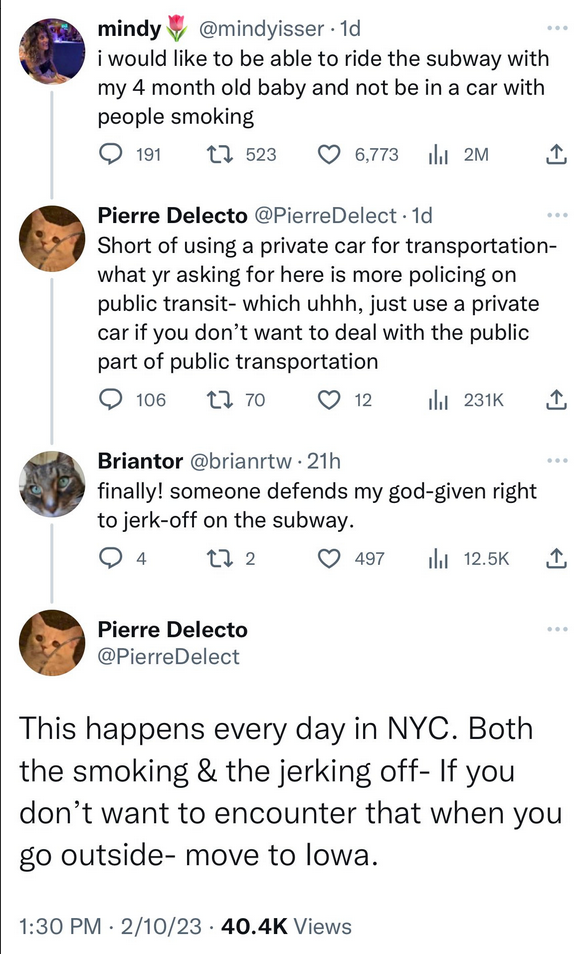
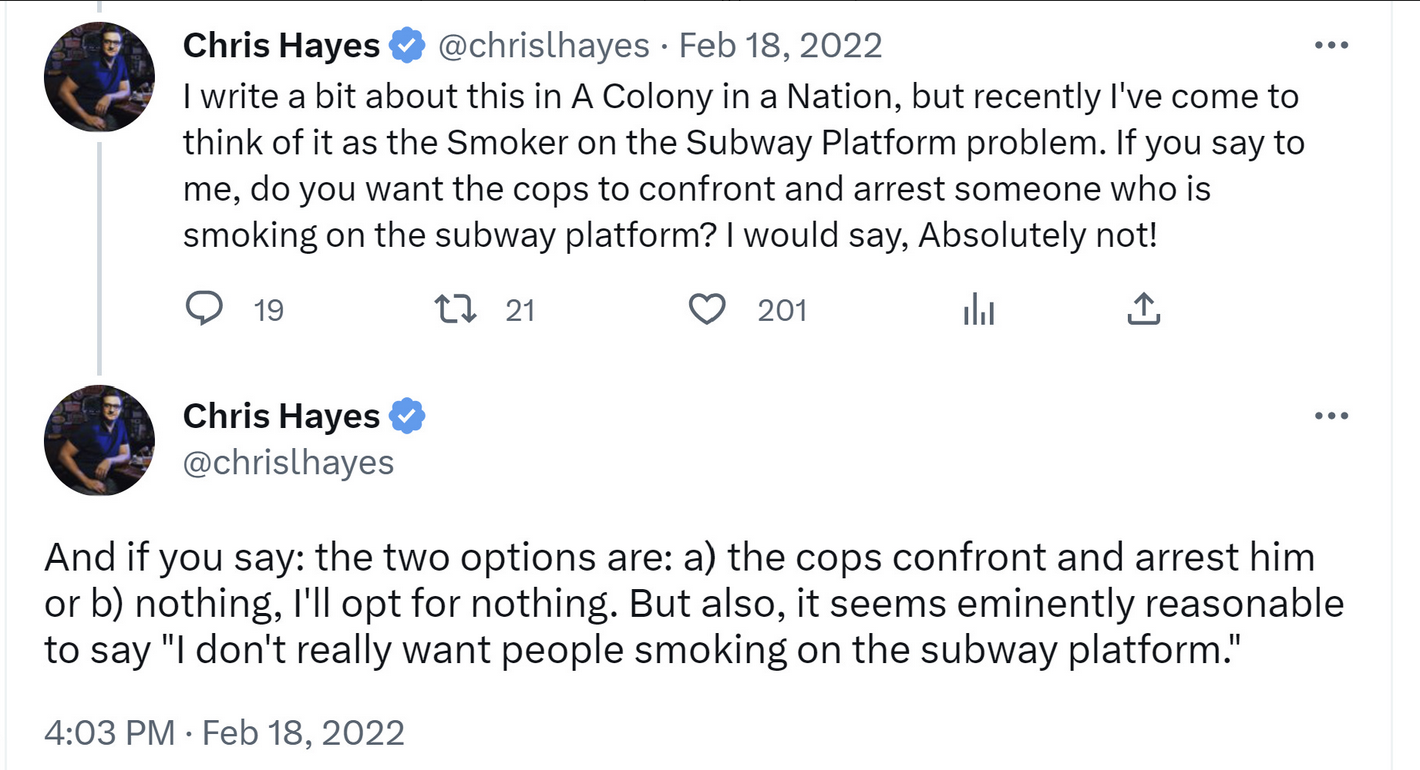
The woman whose account appears at the top of this picture started a Twitter storm, somehow, by publicly wishing that she could take her child onto the subway without exposing them to secondhand smoke. She was beset by a certain online species of ostensible leftist who is against ever trying to enforce any kind of rule, anywhere, ever. See, rules are the hand of oppression, or something, and since most of society’s rules are meant to be enforced by the police, trying to enforce them (merely wishing that they be enforced) is an endorsement of the police and their violence …
I find this attitude has become inescapable. It’s not just the attitude that the enforcement of societal rules and norms is bad, but that this is the default assumption of all right-thinking people — it’s not just a left-wing perspective but the left-wing perspective. Like so much else in contemporary left-of-center discourse, it demonstrates the total ideological poverty we’re working with. Nobody has read anything, so nobody knows anything, so you’re constantly getting yelled at by self-described radicals who have no solid footing in any systematic approach to left politics at all. Like I said before, we’re living in definitional collapse; the struggle right now is not merely that socialism can’t win but that so many self-described socialists have no deeper ideological moorings than whatever they’ve absorbed from Tumblr and “breadtube”. They think that to be a socialist means to disdain all rules because there is no substance to their socialism at all.
Chris Hayes considered the subway smoking problem last year.
Conceptually, I don’t think these problems are hard at all: the left, the socialist left, has never advocated for a system in which there are literally no expectations on personal behavior. It’s quite bizarre to suggest that this was ever a thing! Only certain extreme forms of anarchism have ever implied that society should have no rules. Go back through the history of socialist theorists and number all of the ones who believed that there should be no laws and no police to enforce them. You won’t find many! Instead you’ll find people who believed in the need for both laws that govern human behavior and constabulary forces to enforce those laws. That’s the solution to the conundrum, my friends — you have rules and you have police that enforce those rules. The belief, and the hope, is that a socialist society is one with far less need for aggressive policing, thanks to far greater economic equality, and maybe someday, after the end of material need, we can consider a policeless society. But not having any social rules or people who enforce those rules is not a socialist concept and never has been. What I would ask Chris Hayes and people like him is … what is the leftist tradition that you’re drawing from that implies that there should be no enforcement of behavioral norms? What thinker? What book? What philosophy? Or, could it be that you’ve developed this totally substance-free approach to basic order because you’ve been habituated to talking this way through exposure to people on social media who know nothing about anything in particular?
Of course, there’s big problems with American policing. Very big problems indeed. So what we do is reform policing. (I address this at length in my next book, coming this fall from Simon & Schuster.) Alternatively, if you’re really committed to this “no rules, no enforcement” thing, you become an anarchist of a very particular stripe — most versions of anarchism have both rules and enforcement mechanisms for them — and you and your compatriots can try to change the system. All twelve of you. In the house your wealthy parents bought for you.
Comments Off on Progressives have steadily transitioned to the movement that denies that any personal conduct rules should apply
Conservatives keep re-enacting the Charlie Brown “kick the football” scenario
Theophilus Chilton on the evergreen Charlie Brown and Lucy impersonations of the conservatives and progressives in western political struggles:
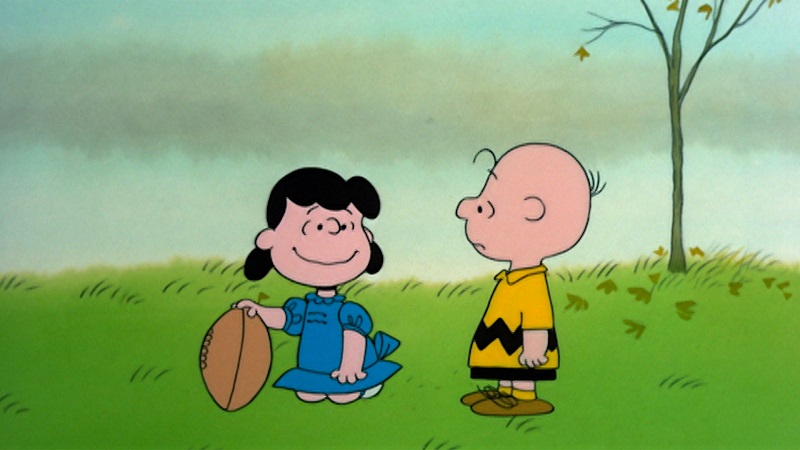
If there is one thing that becomes apparent when you talk to a lot of normie conservatives, it is that they have absolutely no idea how or why they keep getting rolled over by the radical Left. They work and they work and they work to win elections, they invest their time and money to get “their guy” into office, only to find him selling them out on the first important issue within a month of taking office. They pass laws, only to be thwarted in the courts. When they win in the courts, they get thwarted by the bureaucracy. They try and try to force government to abide by the Constitution, but find that this document applies in one direction only. No matter what they do, they simply cannot keep Cthulhu from swimming left.
Why is this?
It’s because they fundamentally don’t understand how power actually works. In a sense, normie conservatives long for a world that never existed. They desperately want to “keep” a republic where politicians work for the public good and where government is truly restrained by its founding document. So it’s something of a bitter pill for them to swallow when they finally accept that such a thing doesn’t exist, and really hasn’t existed in any reasonable form in the United States since the Civil War. America has continued to move left for the past 150 years because the Left has been perfectly willing to do whatever it takes to win. The Left has become adept at “manipulating procedural outcomes,” by which is meant the ability to game the system to make an existing structure which is “supposed” to operate one way bring about outcomes which were never really intended (or even considered possible) by the people who put it into place.
How do you get around constitutional restraints on, say, gun laws or federal encroachments on state prerogatives? Well, one example would be to use fraud and deceit to subvert the Constitution’s provision for elections to get your people in office, who then use the Constitution’s provisions for nominating and approving judges to get friendly judges in power, who then use the (dubiously) constitutional provision for judicial review to decide that whatever laws you want to pass are “constitutional.” Other than the initial fraud (which, since you run the show now, isn’t going to be challenged in any substantive way), everything you did was “technically” in line with the Constitution, even though the results are quite the opposite of what was actually intended. Wanna pack the Supreme Court? Technically, it’s legal! Ban political speech you don’t like? Call it “hate speech” and enforce it under provisions in administrative law that have already been allowed to stand by your judges. The Left has become very adept at appearing to “follow the rules” while working the system to undermine that same system for its own ends.
So that’s “how” the Left always seems to beat conservatives, even when conservatives manage to win an election. But WHY does this happen?
It happens because conservatives ALLOW it to happen.
Let’s be brutally honest here – normie conservatives are saps. They continue to play a rigged game, no matter how often they lose. And they do so because they believe it is virtuous to hold onto “principles” which inevitably lead to failure after failure. They never consider that if “holding to their principles” means the destruction of everything they profess to hold dear, then those principles are terrible principles that should perhaps be reconsidered. If you pat yourself on the back for your virtue in “playing by the rules” even as your house burns down around you and the neighbours are making off with all your stuff, then you’re the source of the problem. Don’t blame somebody else for capitalising on your stupidity.
Comments Off on Conservatives keep re-enacting the Charlie Brown “kick the football” scenario
Miles Davis – “So What” (Official Video)
Miles Davis
Published 19 Oct 2010Official music video for “So What” by Miles Davis
Listen to Miles Davis: https://MilesDavis.lnk.to/listenYD[Come for Miles Davis, stay for the John Coltrane solo]
(more…)
Comments Off on Miles Davis – “So What” (Official Video)
March 1, 2023
Our modern age of “squishy totalitarianism”
Chris Bray on the odd controlling habits of our “great and good”, our “moral and intellectual superiors” to urge us to follow their directives “for our own good” (or else):
The anarchist philosopher Crispin Sartwell describes our political culture as one of “squishy totalitarianism”, a term I like quite a bit. (See the third page of this document.) You can disagree and refuse to comply, and the secret police won’t show up at your door (with maybe a growing list of exceptions). We don’t have a gulag. We don’t have the “culture of the disappeared“. You just … maybe find yourself with fewer friends, and some family that stops talking to you, and maybe your employer lets you know that hey, you know what, this doesn’t seem to be working out.
It’s not the Great Terror, it’s just a kind of low-grade grind of social decredentialing that lets you know you’re not making the right choices. We need to rethink Thanksgiving this year, because we’re very disappointed in you. (Don’t you want to be safe?) The way Google searches are working these days is a pretty good example of squishy totalitarianism: Oh, I’m sorry, we have no results for that widely known piece of wrongthink, but here are some results that debunk the conspiracy theory you’re searching for. Wouldn’t you prefer to read a correct search result?
[…]
We can debate the origins and the motive force behind the constant parade of error that has plagued us over the last three years: useless mask mandates, aggressively harmful school closures, insanely damaging vaccine mandates, ludicrous closures of beaches and parks, the pearl clutching over all those conspiracy theories about a lab leak.
You know the terms of the debate: Is the world led by idiots who are screwing it all up, or is this a plan that they’re executing on purpose?
But whichever answer turns out to be correct, one thing that seems extremely clear to me is that this perpetual reign of error couldn’t possibly go on without the unthinking enforcement activity of a distributed commissariat, the slogan-repeating upper-middle-class-aligned cultural apparatus that endlessly lawn signs their compliance. No one has to tell journalists to scold Woody Harrelson: they already know. The moment the Woodster engaged in crimethink, the Rolling Stone writer Marlow Stern started salivating like a trained dog hearing a bell. Vast armies of professors and HR specialists and marketing executives and bureaucrats and Hollywood functionaries and school board wokescolds and on and on and on already know their roles without being assigned to them. It is not correct for you to fail to comply with Current Thing; you are spewing conspiracy theories.
Doctor, the symptoms began shortly after I received the second dose of the Covid vaccine.
No, that is not possible, vaccines do not cause injuries. Let us not discuss this conspiracy theory any further. Here are some pills.
We have an enforcement apparatus made up of people who volunteered for the job. In terms of social class, we have the lower class, the lower-middle-class, the middle class, the Stasi, and the upper class.

Comments Off on Our modern age of “squishy totalitarianism”
If the Freedom Convoy “actually was what it has often been portrayed as on social media — a horde of thousands of literal Nazis and Confederates set on violently overthrowing our democratically elected government — then [we’d] be living in the Confederate Republic of Nazi Canada by now”
In The Line, Matt Gurney explains how going through Justice Paul Rouleau’s Public Order Emergency Commission report in detail leads to some uncomfortable realizations about Canadian goverment and policing — at all three levels — failed to meet minimal expectations of competency and capacity:

A screenshot from a YouTube video showing the protest in front of Parliament in Ottawa on 30 January, 2022.
Photo via Wikimedia Commons.
The convoy crisis — and I’m mostly speaking here about the events in Ottawa, though the situation at the border crossings fit the same general pattern — forced Canadian police and political leaders to respond quickly to evolving circumstances. And Rouleau’s report is just a relentlessly brutal catalogue of the ways they failed.
Is it really necessary at this point to recap the failure of the Ottawa police? We at The Line have long maintained that the complete failure of the Ottawa police to plan for and control the protest not only allowed the convoy to entrench itself, but also established the psychological paradigm that would define the crisis for weeks: the convoyers held the initiative (not to mention the capital) and the Canadian state was befuddled and adrift. From that, a national crisis was born. Rouleau is just devastating. “The OPS [Ottawa Police Service]’s planning challenges,” he notes on page 56 of the first volume, “were compounded by a general breakdown of command and control.” Super.
He’s even more brutal on page 185 of the second volume: “The influx of Freedom Convoy vehicles and the disruptive behaviour by some protesters threw the OPS operational command at the NCRCC [a command centre] into a state of dysfunction. OPS Inspector Lucas described the atmosphere at the NCRCC as chaotic and explained that he and his team had neither the capacity to process the incoming information nor the resources to respond to the needs it was facing. In the late afternoon of January 29, the OPP’s [Ontario Provincial Police] representative at the NCRCC, Inspector Dawn Ferguson, reported to OPP Superintendent Abrams that OPS members in the NCRCC were panicked and were swearing and yelling orders at each other and at partner agencies.”
Huh.
Moving up a level of government, much has already been written about the cowardice of the Ford government. If any agency performed semi-well, it was the Ontario Provincial Police. The OPP was the force that was generating most of the critical intelligence used (or ignored) during the crisis. It was quick to realize that command-and-control had collapsed in Ottawa (see above), and to begin working with the RCMP on a plan — eventually a series of plans — to restore order. You can’t read POEC and conclude the OPP performed perfectly. Far from it. It was probably the best we had, though, but because Ford took a gander at the mess in Ottawa and decided to mosey on off to the cottage, it couldn’t do much.
Huh.
And that leaves us with the feds. I have maintained since last year that the federal government hasn’t received nearly enough attention in our understanding of what the hell went wrong last year. This has caused a fair degree of pushback, especially from Liberal supporters who read any reference to the “federal government” as “our beloved prime minister”. But no — while I don’t think the prime minister or the federal cabinet did particularly well during the crisis, the real federal failures were in the officials that supported the PM and his ministers.
Among the many other failures, the inability of the various government and police organizations to organize and properly share the information they were handling is perhaps the most disturbing:
If you want to see it yourself, check out pages 38 and 39 of the third volume. For those in a hurry, though, it turns out that even within the government, the flow of information was so bad that the clerk of the privy council, and the prime minister, noted that staff were learning about the convoy not via internal reports, but social media. The federal government had, as Juneau and Rigby have noted, “intelligence gaps” that “hampered the government’s ability to understand, anticipate, and respond to the situation, and to reconcile conflicting information such as contradictory reports about the size of the convoy”. The federal government didn’t have the software to process and analyze online posts, even public ones.
And then there was this (my emphasis added):
[National Security and Intelligence Advisor] Thomas also described an information-sharing gap between law enforcement and government. Assistant Secretary to the Cabinet, Security and Intelligence, Michael MacDonald recalled a significant delay in receiving updates from the RCMP, due to the RCMP’s obligation to consult with each intelligence agency that has provided the RCMP with information prior to sharing that information further (known as the “third party rule”). The NSIA’s office did not receive situation reports, project reports, or other forms of information, such as Project Hendon reports, that the RCMP obtained from other law enforcement agencies. Prior to the events of the convoy, the NSIA was not aware of Project Hendon. …
NSIA Thomas further stated that it was sometimes difficult to know how to interact with law enforcement agencies. She recognized that government must not interfere in operational matters, but thought that there was nonetheless useful information that could have been provided to decision makers without encroaching upon police independence. However, senior officials were uncertain how to obtain that information, and were concerned about “crossing the line” both in requesting information and in discussing solutions.
… huh.
And that doesn’t even cover our now-outgoing national commissioner of the RCMP being so clueless she decided to just not mention germane information during a critical meeting because … well, we never really got a good explanation for that one. Oh well. Enjoy your retirement, Commissioner Lucki!
Comments Off on If the Freedom Convoy “actually was what it has often been portrayed as on social media — a horde of thousands of literal Nazis and Confederates set on violently overthrowing our democratically elected government — then [we’d] be living in the Confederate Republic of Nazi Canada by now”
February 27, 2023
February 25, 2023
Buttigieg isn’t covering himself in glory over his belated East Palestine train derailment response
Jim Treacher is clearly trying to at least pretend some sympathy for Transportation Secretary Pete Buttigieg, but it’s a tough assignment:
Pete Buttigieg is the type of guy who walks into a job interview and says his biggest weakness is his perfectionism. As a kid he always had an apple for the teacher, and if she forgot to assign homework that day, he was the first with his hand up. He’s a repulsive little hall monitor, so all the other repulsive little hall monitors think he’s simply divine.
Mayor Pete and his fan club are having a really bad time right now, because for once he’s expected to actually do something. Producing results simply isn’t his specialty. After spending three weeks hoping the East Palestine, Ohio rail disaster would stop bothering him if he just ignored it, he finally showed up there yesterday.
And I’m starting to understand his reluctance:
What a visual, huh? He looks like a little kid playing Bob the Builder. It’s not quite Dukakis in the tank, but it’s close.
And then it got worse: He started talking.
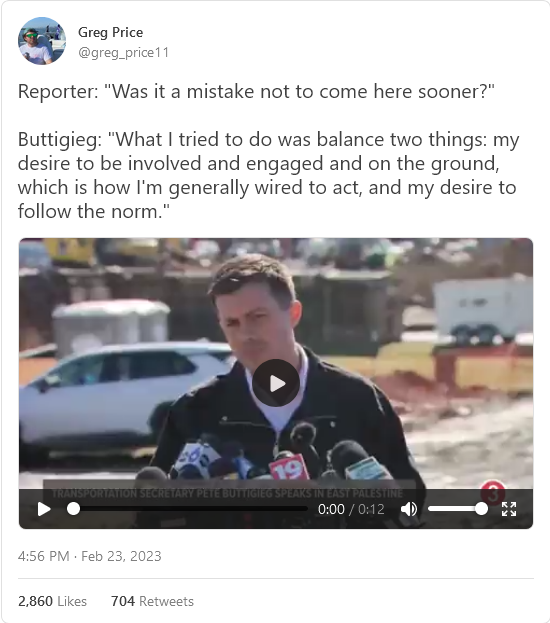
He’s just so gosh-darn dedicated to his job, you see. His only mistake was listening to you people. He followed the norm. This is your fault!
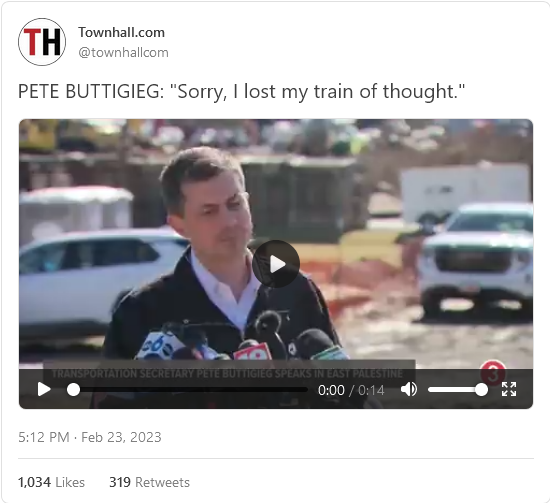
And then he blurted out this instant classic:
Now, which of those words should you try to avoid when you’re talking about a disastrous train derailment? I’m starting to suspect this guy isn’t the unparalleled megagenius the libs keep telling us he is.
[…]
Team Pete is more concerned about reporters asking about East Palestine than about the disaster itself. The rest of us are just an abstraction to them. If they accidentally manage to help some of us, that’s fine. If not, that’s also fine. Either way, we cannot be allowed to stand in the way of their political aspirations.
Mayor Pete really did think this gig would be a cinch, didn’t he? Like, he could just do all the reading the night before the final and ace it. He’s positively resentful at being expected to do what we’re paying him to do. He thinks he’s too good for this job, which is why he’s very bad at this job.
Will Buttigieg’s tenure as transportation secretary ruin his presidential prospects? After all, that’s what this is all about for him. Maybe, maybe not. It’s not as if politics is about solving problems. All you have to do is claim you solved the problems, and your team will cheer for you no matter what.

Comments Off on Buttigieg isn’t covering himself in glory over his belated East Palestine train derailment response
February 24, 2023
“… they are all weedy, weird sylphs who are essentially un-people, without any wisdom or sense”
Elizabeth Nickson on the current cohort of raised-in-a-vat, cloned “leaders” of most of the western world:

Easily the most destructive cohort in the culture is the financially secure, semi-educated female on the cultural left. She reads nothing but literary fiction, is a book and knitting club member and knows absolutely nothing about the real world. But she is “bold” and “powerful” and never shuts up. Her views are confirmed, amplified and imposed by corporate media, for whom she is the aspirational shopper from whom all wealth flows.
It is the opposite of a virtuous circle. Ignorant protected women of all colors are courted by corporations because she makes 90% of buying decisions (and less fortunate women emulate her). Corporations force the press to slavishly pander to her every stupid whim and deep feel of the month so their adverts work like charms.
All the above leaders [Jacinda, Trudeau, Nicola, Rishi, and Macron] are manufactured in some MKULTRA facility to appeal to her ignorance, her prejudices, her over-weening self-regard. With the exception of the vegetable in the White House, they are all weedy, weird sylphs who are essentially un-people, without any wisdom or sense. They’ve lived their lives in classrooms and meeting rooms. They serve as pretty, platitudinous ciphers on which to project a profound political ignorance and emotional immaturity.
Our girl, for she has never grown up, has abandoned adult responsibility to luxuriate in narcissism.
She is ruthlessly used by the vicious communist left (as described below) and she has no idea who or what they are. She is the stupidest person on the planet.
And Michelle Obama? If you are thinking of running, think again. Because the hell we will unleash on your ignorant self will make Jacinda tremble with PTSD.
Let someone far less impassioned and far more knowledgeable than me describe Ardern’s humiliating failures below. The damage she caused to her people, to her party, to her country’s economy was as titanic as her ego. Every single other leader listed in the head of this piece is following the same dictated-from-above public policy initiatives. Their fate and that of their citizenry will be the same.
By their fruits ye shall know them.
If you want to know more about the rise and fall of Justin Trudeau’s New Zealand counterpart, Elizabeth’s post includes an extensive discussion of Jacinda Ardern’s career from Dr Muriel Newman of the New Zealand Centre for Political Research.
February 23, 2023
Doctor Who – long-term sleeper agent for the WHO?
I haven’t followed the TV series for a very long time (“my” Doctor was William Hartnell, then Patrick Troughton and by the time I watched another episode there’d been two more Doctors), but I still have fond memories of the show. Along comes Caroline Kaye to suggest that I was an unwitting victim of globalist propaganda:

The BBC science fiction television series Doctor Who has been a part of British popular culture since 1963. It is centred on the Doctor figure, a scientist who works to save civilisations, help people in need and to prevent evil forces from harming people. Remember that description.
A Doctor Who fanatic once told me that the “Who” of the Doctor’s name obliquely refers to the other WHO, the World Health Organisation. There appears to be something in this, however implausible. I find the strange coincidences between fiction and reality curious and uncanny.
The Doctor is a scientific adviser to the organisation UNIT, standing for United Nations Intelligence Unit, which happens to be based in Geneva, home of the WHO. UNIT has its military element in the form of “the brigadier” who liaises with the government and occasionally has to reach out to Geneva to “gain authority” when government does not co-operate.
The most famous Doctor Who monsters will always be the Daleks. In the story Genesis of the Daleks (1975), the Doctor’s nemesis is Davros, the creator of the Daleks. Davros sounds rather like Davos, the home of the World Economic Forum, the WEF.
In the story, the Doctor is tasked with preventing the creation of the Daleks and faces a moral dilemma when confronted with the means to destroy them. He ponders in a renowned scene, “Have I the right [to destroy them]?” Declining to destroy the Daleks, the Doctor escapes, and the Daleks continue on their path of evil.
Doctor Who‘s other famous monsters, the Cybermen, are cyborgs – amoral, unfeeling transhuman creatures of our nightmares; surely the creations of mad or evil persons. Yet the idea of cyborgs and transhumanism is being pushed enthusiastically by the WEF, inspired by the ideas of Yuval Noah Harari who sees human beings merely as “hackable animals” to be augmented as necessary.
The WHO acronym is the emblem of an organisation supposedly formed, like the Doctor, to help people and protect them. Instead, in the last three years we have seen, at the behest of the WHO, the poorest and weakest of the world economically hammered, a swathe of unnecessary deaths from a treatable coronavirus, worldwide harms and deaths through forced vaccination, all of which break every human right established in the wake of WWII. This is outlined in devastating detail by Toby Green and Thomas Fazi in their book, The Covid Consensus: The Global Assault on Democracy and the Poor – A Critique from the Left.
Now the WHO is preparing a new treaty which ultimately will result in signing member states becoming legally subordinate to the WHO. It is designed to subsume us all into a malleable collective. In other words, as per the sprawling EU project, our politicians will be able to blame the WHO for mandating medical treatments, lockdowns and prevention of travel, all of which could happen at the whim of the director general. Or more likely, its biggest, unelected, non-medically trained funder Bill Gates.
Comments Off on Doctor Who – long-term sleeper agent for the WHO?
Scottish First Minister Nicola Sturgeon had become “a marmite figure during her time in office, loathed and loved in equal measure”
In The Line, Andrew MacDougall looks at what caused the departure of Nicola Sturgeon despite the continued strong support for her party in Scotland:

Last week, Scotland’s most popular politician suddenly announced that she would retire. While Sturgeon’s popularity has dipped in recent days, she remains, by a long way, the most recognized and respected politician in the land. And she is leaving absent any obvious firing offense, nor any looming electoral deadline.
More importantly, Sturgeon is leaving without her raison d’être — Scottish independence — fulfilled, with the next election having already been framed as an (unofficial) referendum on that most cherished of prizes for any leader of the Scottish Nationalist Party. That Sturgeon would choose this moment to exit has prompted a flurry of speculation.
To Sturgeon’s credit, she was admirably clear with her reasons during the press conference announcing her decision to stand aside. She decried the “brutality” and “intensity” of modern political life, stating the job took everything she could give and that, like Jacinda Arden before her, she had come to the realization she didn’t quite have enough left to get independence over the line.
On that front, Sturgeon also said it would be unfair on her colleagues and her party to have her views on independence — and how best to achieve it — bind them if she no longer had the will or energy to contest the next election. And fair enough. Sturgeon has been First Minister for eight years, and was number two to former First Minister Alex Salmond for the eight years prior to that, having assumed the leadership after Salmond’s failed push for Scotland’s independence in the 2014 referendum.
And yet, with support for Scottish independence still fairly strong — a poll taken in late January had it at 52 per cent, an eight-point gap over the forces of unity — it still seems a strange time for someone whose entire life’s work has been ditching the UK to ditch the most powerful post to help usher it along.
So, what gives?
Comments Off on Scottish First Minister Nicola Sturgeon had become “a marmite figure during her time in office, loathed and loved in equal measure”
February 22, 2023
“Billions use it, including me, but it feels like the dying Rust Belt city of the internet. Facebook makes me feel the way I feel when I’m in a hospital.”
I got locked out of my Facebook account quite some time ago and I haven’t bothered trying to jump through the tech support hoops to get back in … and from what Freddie deBoer says, I’m not missing anything at all:
The video, shot on a cellphone from a first-person view, takes place in a bathroom. Embedded at the bottom are the words “what every teenager hides from their parents”. The person holding the phone takes a golf ball and briefly runs it under water from the sink. They then rub the golf ball against a roll of toilet paper, leaving a light impression of moisture. And that’s it; the video ends and starts over again, an infinite empty loop. If you’re wondering what exactly it is that “every teenager hides from their parents”, the answer is nothing. The video is nonsensical, not in some avant garde way but to fulfill its economic purpose. Leaving the viewer confused as to what exactly is being conveyed is a feature, not a bug — the more people are baffled by the video, the more they’ll comment on it to register their confusion, the more times they’ll send it to friends to try and figure out that which cannot be figured out. It is “content”, to use that wretched term, that is devoid of content, a human centipede of virality, monetizing fleeting interest. It’s the inevitable outcome of every bad incentive we’ve created online.
For reasons that are known only to God, for a couple weeks I reflexively watched Facebook Reels videos. It’s something like the bottom of the barrel for internet video, attached to a notoriously uncool social network that has devolved for almost everyone into a never-ending stream of spam, memes, viral bilge, and people that you don’t remotely know. Facebook still boasts a vast user base, but the level of engagement of those users is disputed and the network has become famously unattractive to the youth. Billions use it, including me, but it feels like the dying Rust Belt city of the internet. Facebook makes me feel the way I feel when I’m in a hospital.
The Reels service does do what these platforms are supposed to do in the most basic sense, though — provide brief videos for momentary distraction. I mostly watch shark videos, so it gives me a lot of shark videos. And, in the way of these things, it also serves me videos of crocodiles and orcas, as well as a discouraging amount of ordinary fishing videos. These are of less interest to me than the shark videos, but this is the nature of automated recommendations online. There’s also a lot of unfunny comedy videos, some boring video game clips, videos of animals fighting that sadden me, and of course a lot of hot girl videos, given that this is the internet. There are also many videos that satisfy a particular genre’s conventions, but only just. For example, there’s a mini-genre of big hits from football games (typically captioned “want to see a dead body?”), except that many of the Reels feature perfectly ordinary tackles that no one could mistake for a big hit. But all of these videos attempt, at least, to offer some coherent value proposition, so they aren’t the kinds of videos I’m talking about.
No, the videos I’m talking about here are those that drive people to click and, crucially, to linger through the video until it finishes through confusion and unsatisfied expectations. I’m not talking about bad videos or stupid videos or poorly made videos or videos that I generally find unworthy of being watched; low-quality online content is just the nature of the beast. I’m talking about videos in which the purpose is to drive “engagement” through a given clip’s lack of sense and meaning and nothing else. They’ve taken the monetization of attention to a certain logical endpoint: their creators understand that there are few things people like less than the feeling of being confused, and that most of us will seek help to understand something we can’t figure out on our own. Seeking that help by sharing or commenting gooses the algorithm.
About a decade ago I used to post to a message board a lot, a typical meme and argument repository. A very common prank was to post this one picture of a lizard and say “when you see it!” And tons of people who were in the know would post stuff like “took me forever, but WOW when I found it!” Meanwhile newcomers would be driving themselves absolutely crazy looking for something that wasn’t there, sometimes even confidently announcing that they had found the answer without saying what it was. It was a very effective prank, no matter how many times it was pulled, because we hate, hate, hate “not getting it”. Now some evil geniuses out there have begun to exploit this feeling in pursuit of virality and money. Versions of these tactics have been around forever, but these videos are an immaculately pure form. It’s true, for example, that the “curiosity gap” headline is quite old now. But while curiosity gap headlines at places like Upworthy could be manipulative and misleading, there were actual articles attached to the headlines. These videos are only the headlines, the enticement to click with nothing on the other side.
Comments Off on “Billions use it, including me, but it feels like the dying Rust Belt city of the internet. Facebook makes me feel the way I feel when I’m in a hospital.”


