Quotulatiousness

March 20, 2023

“The New American Empire lasted, at most, twenty years, if one counts the two falls of Kabul as brackets”

Filed under: History, Media, Middle East, Military, Politics, USA — Tags: , , , , , , — Nicholas @ 03:00

Ed West on the brief — and largely unacknowledged by Americans — high-water mark of the 21st century’s biggest empire:

A Boeing CH-47 Chinook transport helicopter appears over the U.S. embassy compound in Kabul, 15 Aug 2021. Image from Twitter via libertyunyielding.com

This century has already seen its fair share of great delusions, society-changing disasters built on wishful thinking: you can loan mortgages to people who obviously can’t pay them back; you can cure pain with an opiate that won’t make people addicted; and now the unstoppable idea of equality of outcomes between races, a project doomed to failure and tragedy.

But none was perhaps so spectacularly disastrous as liberal imperialism. Twenty years ago, George W Bush sent the most powerful military the world had ever seen into the birthplace of Abraham to overthrow Saddam Hussein, and as Niall Ferguson wrote in the Wall Street Journal at the time: “the greatest empire of the modern times has come into existence without the American people even noticing”.

The New American Empire lasted, at most, twenty years, if one counts the two falls of Kabul as brackets. This was despite enormous technological supremacy, and genuine goodwill and benevolence among many of the state-builders.

The United States was “born liberal”, as historian Louis Hartz said, even if the crime wave of the late 20th century made that a dirty word, and the “New American Empire” would spread the benefits of liberalism to grateful beneficiaries around the world.

Yet what is so striking about the imperialists of the 21st century, compared to their forebears in the 19th, was just how little interest they seemed to show in the subject people. Their naivety about human nature, and their utopian belief that people around the world just wanted “freedom”, chimed with a lack of curiosity about humanity.

To think that people around the world might not be the same, that they might not want “freedom” nor have the social structure or culture that suited democracy, might be to venture into dangerous territory. To suggest that Iraq was incapable of democracy was insulting to Iraqis, since as the US president said ahead of the war: “There was a time when many said that the cultures of Japan and Germany were incapable of sustaining democratic values. Well, they were wrong. Some say the same of Iraq today. They are mistaken.”

Yet the defeated nations in 1945 had very old, well-established institutions and very strong national identities, something Iraq did not. The latter was extremely clannish, something no one seemed to consider. Sovereignty and strong institutions take generations to build, and cannot just be imposed by foreigners working on abstract principles like “democracy”.

Bush was not alone. That same year, John McCain had said: “There is not a history of clashes that are violent between Sunnis and Shias, so I think they can probably get along”. And on March 1, 2003, two weeks before the war started, Bill Kristol, editor of the Weekly Standard, had dismissed warnings about sectarian conflict: “We talk here about Shiites and Sunnis as if they’ve never lived together. Most Arab countries have Shiites and Sunnis, and a lot of them live perfectly well together.” On top of that, “Very few wars in American history were prepared better or more thoroughly than this one by this president.” He was totally wrong, while in contrast the American Conservative‘s pessimistic warnings about Iraq’s social fabric proved correct.

March 19, 2023

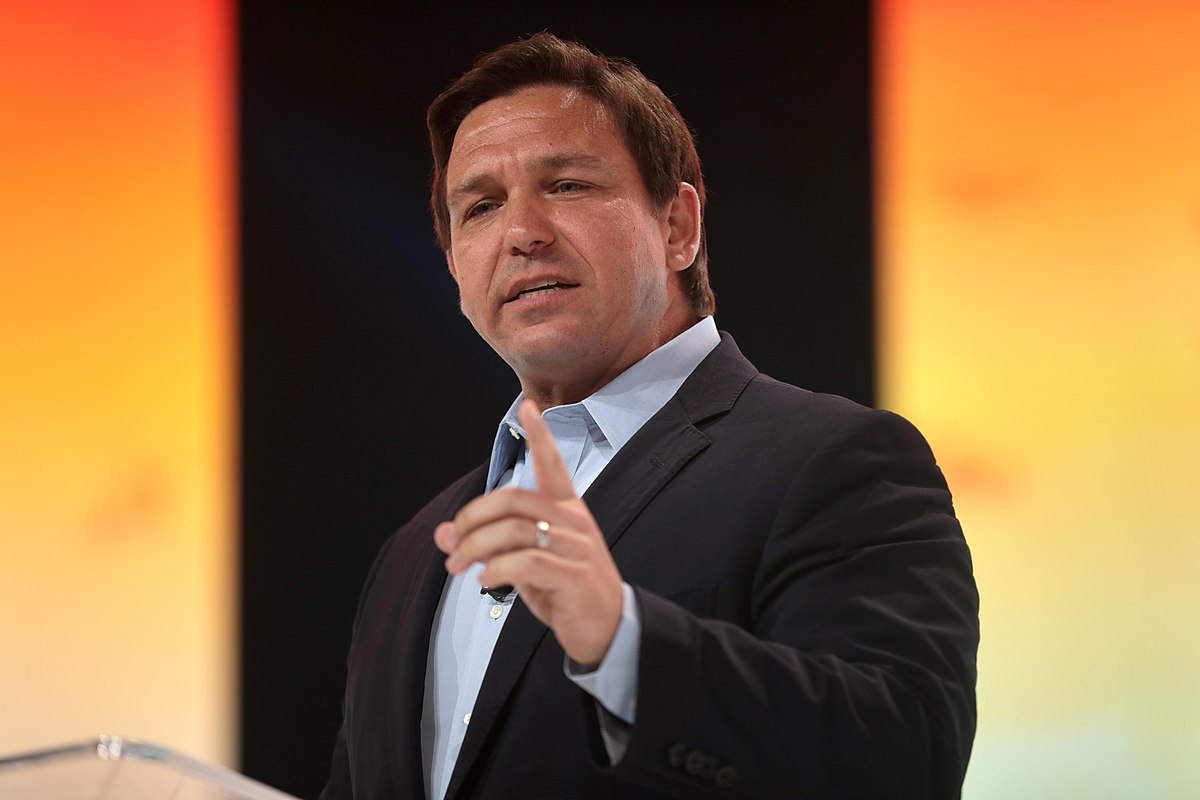
Ron DeSantis as an American Neville Chamberlain

Filed under: Media, Politics, USA — Tags: , , , , , — Nicholas @ 05:00

Andrew Sullivan points out the inanity of comparing Florida Governor and potential presidential candidate to former British PM Neville Chamberlain over DeSantis not including the idea of increasing support to Ukraine as “a new Munich”:

Governor Ron DeSantis speaking with attendees at the 2021 Student Action Summit hosted by Turning Point USA at the Tampa Convention Center in Tampa, Florida on 18 July, 2021.
Photo by Gage Skidmore via Wikimedia Commons.

For a written statement on foreign policy from a potential presidential candidate, it was, I suppose, a big deal. The salient sentence from Governor Ron DeSantis:

    While the U.S. has many vital national interests — securing our borders, addressing the crisis of readiness with our military, achieving energy security and independence, and checking the economic, cultural and military power of the Chinese Communist Party — becoming further entangled in a territorial dispute between Ukraine and Russia is not one of them.

It’s open to some interpretation. DeSantis says the Ukraine war is not in the “vital national interests” of the US, but is it maybe still in our general interests? Not clear. And he commits to no further entanglement, which could mean sticking with where we are now, but no more. Sure: no F-16s. But that’s also Biden’s position.

“Territorial dispute?” That set a lot of people off. But of course it’s undeniably, at some level, a border dispute. The entire post-Soviet settlement was a redrawing of national borders — and marked an extraordinarily rapid advance of Western arms and allies to the edge of Russia itself. In any kind of perspective, the current war has come at the end of that now-disputed settlement, and is indeed a debate over where Russia ends and Ukraine — which literally means “borderland” — begins. DeSantis didn’t blame Ukraine for its self-defense. He didn’t defend Putin. He merely proffered a different view of vital US national interests in the medium-term.

The gall!

The Blob declared another “Munich!” — an ancient neocon ritual — and declared the DeSantis candidacy all-but-over. Chris Christie called DeSantis “Neville Chamberlain“; Chuck Schumer asked, “I have to wonder what [DeSantis] would’ve thought if he was around in the 1930s”; Jenn Rubin called DeSantis “pro-Putin“; and the WSJ warned of a return to “isolationism in the 1930s”. This morning, the WaPo dusted down and wheeled out their perennial “appeasement!” editorial. And we got a French-Brooks double-whammy direct from 1983. Churchill envy never dies.

And I’m sorry. But I don’t get it. It is surely perfectly fine for a country to have two political parties that differ on foreign policy. In fact, it’s a critical advantage that democracies have over more rigid regimes: it helps us correct mistakes in time (and sometimes not), change personnel, and adjust to an always changing reality.

And in the 21st century, after the collapse of the imperial ideologies of the 20th, the role and reach of the United States is legitimately open to debate. It makes sense that one party would be more interventionist and one would be less so; it makes even more sense for the conservative party to be the one more skeptical of wars, small and large, and the unintended consequences they invariably entail.

That’s what’s happening — partly in reaction to the catastrophic, and bipartisan, hyper-interventionism of the first two decades of this century, and partly because of the rise of China. And it’s a good, normalizing thing. It will keep pressure on Biden not to escalate any further; and force us to think through the ugly compromises that will almost certainly confront us in the future. DeSantis’ position is pretty much where Obama was on Ukraine — and Obama was not some far-right fanatic. Money quote:

    The fact is that Ukraine, which is a non-NATO country, is going to be vulnerable to military domination by Russia no matter what we do. … We have to be very clear about what our core interests are and what we are willing to go to war for. And at the end of the day, there’s always going to be some ambiguity.

Replace “core” with “vital” and it’s DeSantis’ outrageous position. Yes, Putin miscalculated badly and invaded Ukraine, which means a new situation, and defense of Ukraine. But the core reality of America’s and Russia’s interests is unchanged. And Putin is not in command of a huge war economy and occupying the Sudetenland. He’s stuck in Eastern Ukraine, for Pete’s sake, and can barely move. China is maneuvering to counter and exploit our escalation. We need flexibility. What we absolutely do not need is some kind of shrill, bipartisan consensus on yet another war — and the usual McCarthyite smears of critics.

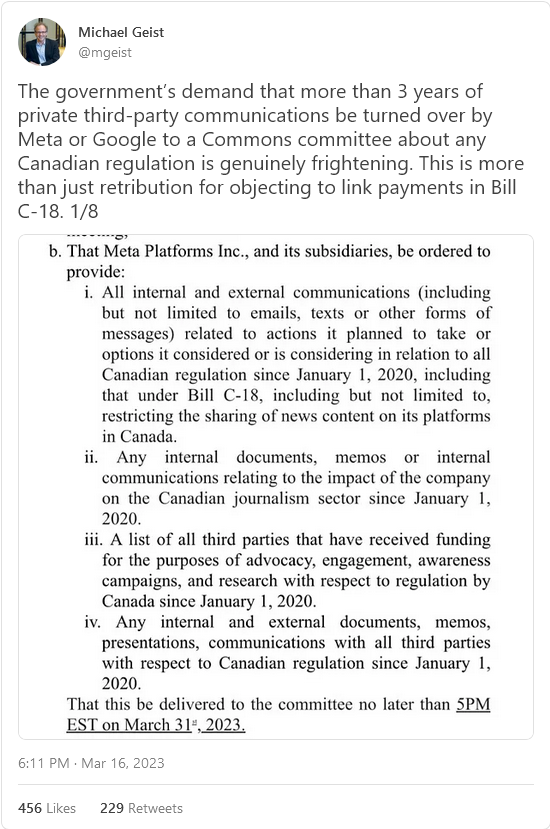
Disagree with the Canadian government’s attempt to take over significant parts of the internet? Get ready for administrative punishment, citizens!

Michael Geist, who often seems like the only person paying close attention to the Canadian government’s growing authoritarian attitudes to Canadians’ internet usage, shows the utter hypocrisy of the feds demanding access to a vast array of private and corporate information on a two-week deadline, when it can take literally years for them to respond to a request for access to government information:

Senator Joe McCarthy would be in awe of the Canadian government’s audacious power grab.
Library of Congress photo via Wikimedia Commons.

The government plans to introduce a motion next week requiring Google and Facebook to turn over years of private third-party communication involving any Canadian regulation. The move represents more than just a remarkable escalation of its battle against the two tech companies for opposing Bill C-18 and considering blocking news sharing or linking in light of demands for hundreds of millions in payments. The motion – to be introduced by the Parliamentary Secretary to the Minister of Canadian Heritage (yes, that guy) – calls for a series of hearings on what it describes as “current and ongoing use of intimidation and subversion tactics to avoid regulation in Canada”. In the context of Bill C-18, those tactics amount to little more than making the business choice that Heritage Minister Pablo Rodriguez made clear was a function of his bill: if you link to content, you fall within the scope of the law and must pay. If you don’t link, you are out of scope.

While the same committee initially blocked Facebook from even appearing on Bill C-18 (Liberal MP Anthony Housefather said he was ready for clause-by-clause review after just four hearings and no Facebook invitation), bringing the companies to committee to investigate the implications of their plans is a reasonable approach. But the motion isn’t just about calling executives before committee to answer questions from what will no doubt be a hostile group of MPs. The same motion sweeps in the private communications of thousands of Canadians, which is a stunning disregard for privacy and which could have a dangerous chilling effect on public participation. Indeed, the intent seems fairly clear: guilt by association for anyone who dares to communicate with these companies with an attempt to undermine critics by casting doubt on their motivations. Note that this approach is only aimed at those that criticize government legislation. There has been a painfully obvious lobbying campaign in support of the bill within some Canadian media outlets, but there are no efforts to uncover potential bias or funding for those that speak out in favour of Bill C-18, Bill C-11, or other digital policy initiatives.

It is hard to overstate the broad scope of the disclosure demands. Canadian digital creators concerned with Bill C-11 who wrote to Youtube would find their correspondence disclosed to the committee. So would researchers who sought access to data from Google or Facebook on issues such as police access to social media records or anti-hate groups who contacted Facebook regarding the government’s online harms proposal for automated reports to law enforcement. Privacy advocates focused on how Google administers the right to be forgotten in Canada would ironically find their correspondence disclosed as would independent media sites that wrote to Facebook about the implications of Bill C-18.

March 18, 2023

If not “woke”, then what should we call it?

Filed under: Media, Politics, USA — Tags: , , , — Nicholas @ 03:00

Freddie deBoer devoutly hopes for a proper term to use instead of the by-now highly pejorative term “woke”:

As I have said many times, I don’t like using the term “woke” myself, not without qualification or quotation marks. It’s too much of a culture war pinball and now deemed too pejorative to be useful. I much, much prefer the term “social justice politics” to refer to the school of politics that is typically referred to as woke, out of a desire to be neutral in terminology. However: there is such a school of politics, it’s absurd that so many people pretend not to know what woke means, and the problem could be easily solved if people who support woke politics would adopt a name for others to use. No to woke, no to identity politics, no to political correctness, fine: PICK SOMETHING. The fact that they steadfastly refuse to do so is a function of their feeling that they shouldn’t have to do politics like everyone else. But they do. And their resistance to doing politics is why, three years after a supposed “reckoning”, nothing has really changed. (If there’s no such thing as the social justice politics movement, who made the protests and unrest of 2020 happen? The fucking Democrats?)

The conceit is that “woke” has even shaggier or vaguer boundaries than “liberal”, “fascist”, “conservative”, or “moderate”. And I just don’t think that’s true.

“Woke” or “wokeness” refers to a school of social and cultural liberalism that has become the dominant discourse in left-of-center spaces in American intellectual life. It reflects trends and fashions that emerged over time from left activist and academic spaces and became mainstream, indeed hegemonic, among American progressives in the 2010s. “Wokeness” centers “the personal is political” at the heart of all politics and treats political action as inherently a matter of personal moral hygiene — woke isn’t something you do, it’s something you are. Correspondingly all of politics can be decomposed down to the right thoughts and right utterances of enlightened people. Persuasion and compromise are contrary to this vision of moral hygiene and thus are deprecated. Correct thoughts are enforced through a system of mutual surveillance, one which takes advantage of the affordances of internet technology to surveil and then punish. Since politics is not a matter of arriving at the least-bad alternative through an adversarial process but rather a matter of understanding and inhabiting an elevated moral station, there are no crises of conscience or necessary evils.

QotD: Experts outside their field of expertise

… just because someone is really smart and successful at A does not necessarily mean their opinion on B is worth squat. As always, as a consumer of opinions, caveat emptor should always be the watchwords.

The first time I really encountered this phenomenon (outside of obvious examples such as the political and economic opinions of Hollywood celebrities) was related to climate change. I don’t see them as often today, but for a while it used to be very common for letters to circulate in support of climate change science signed by hundreds or thousands of scientists.

The list of signatures was always impressive, but when you looked into it, there was a problem: few if any of the folks who signed had spent any time really looking at the details of climate science — they were busy happily studying subatomic particles or looking for dark energy in space. It turned out most of them had fallen for the climate alarmist marketing ploy that opposition to catastrophic man-made global warming theory was by people who were anti-science. And thus by signing the letter they weren’t saying they had looked into it all and confirmed the science looked good to them, they were merely saying they supported science.

When some of them looked into the details of climate science later, they were appalled. Many have reached the same general conclusions that I have, that CO2 is certainly causing some warming but the magnitude of that warming or in particular the magnitude and direction of its knock on effects like floods or droughts or tornadoes, is far from settled science.

So it is often the case that people who show strong support for ideas or people outside of their domain do so for reasons other than having made use of their expertise and experience to take a deep dive into the issues. Theranos is a great example from the business world. Elizabeth Holmes convinced a bunch of men (and they were mostly all men — women seemed to have more immunity to her BS) who were extraordinarily successful in their own domains (George Schultz, the Murdochs, Henry Kissinger, Larry Ellison) to become passionate believers in her vision. Which is fine, it was a lovely vision. But they spent zero time testing whether she could really do it, and worse, refused to countenance any reality checks about problems Theranos was facing because Holmes convinced them that critics were just bad-intentioned people representing nefarious interests who wanted her vision to fail.

Warren Meyer, “People Who Express Opinions Outside of their Domain Seldom Have Really Looked into it Much”, Coyote Blog, 2019-05-28.

March 15, 2023

Mining the moon would be “harmful” to indigenous people, say activists

Filed under: Media, Politics, Science, Space, USA — Tags: , , , — Nicholas @ 03:00

Among the many, many things that are said to be harmful to indigenous culture we’re now told to include any kind of Lunar exploitation as modern colonialism:

Artist’s conception of Helium-3 mining on the surface of the Moon.
Image from Inhabitat.com

Humans have boldly ventured beyond the Earth into space for more than half a century now. It’s a testament to the ambition of the modern world.

And today, humanity is still more ambitious. A new space race is underway between the US and China to mine the Moon for rare metals. NASA is even hoping to establish a long-term presence on the Moon and eventually send humans to Mars.

But it seems that some scientists-cum-activists, in hock to identity politics, want to rein in that ambition. Speaking ahead of a US conference on the ethics of space exploration, held by the American Association for the Advancement of Science (AAAS) last week, astrobiologist Dr Pamela Conrad told the Guardian that space exploration, particularly efforts to mine the Moon, is in danger of becoming an exercise in “colonialism” and “exploitation”. Conrad warned that “if something that’s not here [on Earth] is seen as a resource, just ripe to be exploited, then that [perpetuates] colonialism”.

Conrad’s fellow panellist at the conference, Dr Hilding Neilson, went even further. According to Neilson, a member of the Native American Mi’kmaq people, indigenous people have a deep connection with celestial bodies like the Moon. They therefore have a more profound and, by implication, superior “way of knowing” the Moon compared with those advocating space exploration. The latter merely see the Moon “as a dead object to be conquered”, Neilson says – meaning that those advocating space exploration are “essentially cheering on the history of colonialism”.

There are so many problems with this argument it’s difficult to know where to start. Both Conrad and Neilson appear to be using the specific and brutal practice of “colonialism” to describe – and demonise – humanity’s attempt to master nature in general. That’s a flawed enough approach to take to the history of our growing mastery of nature on Earth. But it’s even more flawed in the context of space.

After all, there’s one big difference between laying claim to the resources of other countries under colonialism and attempting to mine the Moon – nobody lives on the Moon! So no one would be “exploited” or “colonised” if humans were to mine it. Space exploration is therefore not the same as colonialism.

March 14, 2023

“Strangely, my friends have a more negative view of the feminist movement than I do”

Filed under: Books, Media, Politics, USA — Tags: , , , — Nicholas @ 05:00

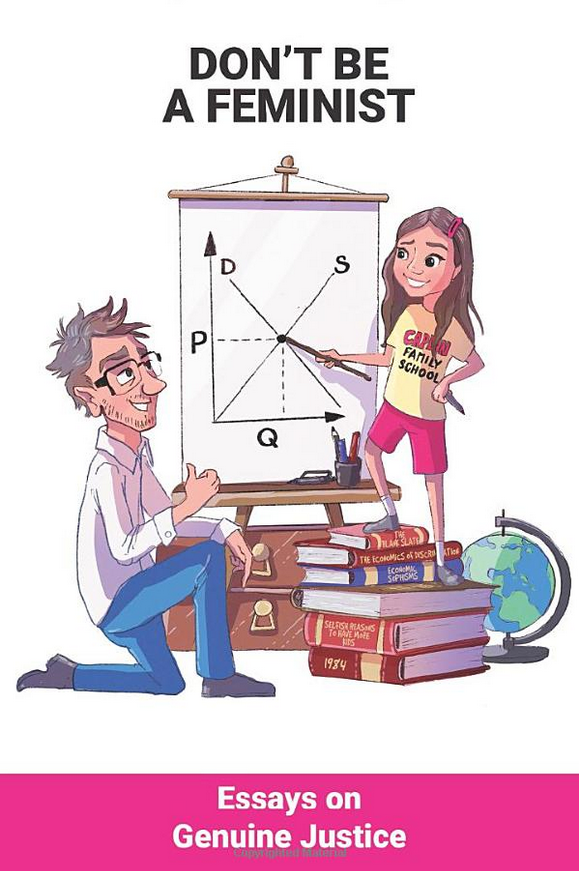
Bryan Caplan explains why he chooses to write the books he writes:

Almost by definition, writing controversial books tends to provoke negative emotional reactions. Anger above all. Anger which, in turn, inspires fear. And not without just cause; the sad story of Salman Rushdie sends shivers down the spine of almost any writer. If you write controversial books — or care about someone who does — you should be at least a little afraid of the anger your writing inspires.

[…]

In contrast, when I announced the imminent publication of Don’t Be a Feminist, the fear went through the roof. Several folks warned me of “career suicide”. Others told me that I had no idea what horrors awaited me. Friends staged mini-interventions on my behalf.

The underlying premise, naturally, was that the feminist movement is at once terribly powerful and horribly bad-tempered.

My best guess is that the warnings are overblown. Strangely, my friends have a more negative view of the feminist movement than I do. Whether my guess is right or wrong, though, all this intense, widespread fear really ought to trouble the feminist conscience.

If I said, “Hi” to one of my kids’ friends, and they responded by fleeing in terror, my reaction would be, “Did I do something to scare him?” I would ask my kids, “Why was he so afraid of me?” If such incidents started to repeat, I would be severely troubled. “I thought I came off as a friendly dad, but I guess I’m seen as an ogre.”

The same applies if I were a feminist, and I discovered that critics are literally afraid to criticize feminism. If only a few critics feared feminism, my question would be, “What did we do to scare them?” If I discovered that fear of feminism was widespread, a full soul-search would be in order. “I thought we came off as a friendly movement, but I guess we’re seen as ogres.”

And guess what? Fear of feminism plainly is widespread.

What, then, are feminists doing wrong? Above all, cultivating and expressing vastly too much anger. Sharing your angry feelings is an effective way to dominate the social world, but a terrible way to discover the truth or sincerely convince others. Maybe you don’t mean to scare others; maybe you’re just acting impulsively. Yet either way, the fear feminists inspire is all too real.

QotD: Facebook’s entire structure is designed to prevent information “going viral”

Filed under: Business, Media, Quotations, USA — Tags: , , , — Nicholas @ 01:00

Imagine that you came up with something amazing to share with people. Let’s pretend that you created the most amusing video in the world. Or came up with the funniest joke anyone has ever heard. Or maybe you have just experienced something remarkable that millions of people would want to know about. Or let’s assume you took a photograph that would blow people’s minds. Or perhaps you have just composed the catchiest tune ever.

You might think that social media is where to go to share this very cool thing, and watch it go viral. And, in fact, that happens on Twitter and a few other platforms. I’m not always right in forecasting which things I post will go viral, but a few times every year I will share something on Twitter that grabs people’s attention so much that it gets tens of thousands of retweets and likes. Millions of people might see it.

That’s what going viral is all about.

Now here’s the kicker. I put up that same item on my Facebook author’s page, and the company will actively work to prevent people from seeing it. And adding insult (a company specialty), they will send me an alert telling me: This post could go viral if you pay us money for promoting it.

At first glance, this just seems another way to maximize profits. And who can blame Mark Zuckerberg for wanting to get a few more dollars in his bank account? Let’s feel some pity for a guy who just lost $100 billion.

But the real devastating part of this story is that Facebook is actually preventing users from sharing the funniest joke in the world. Facebook actually hates seeing some videos go viral, even if they are the most amusing things on the web. Every day they work to prevent folks from seeing a mind-blowing photo — and many other things that can’t be monetized.

This can’t be good for the user experience. This can’t be what users want, or what they would tell the company in a focus group or via market research.

And it certainly can’t be good for business.

So I’m amused when I hear how Facebook is envious of TikTok, which has much superior user engagement. Well, duh. Of course TikTok has greater engagement — that’s because Facebook has put systems in place to prevent entertaining things from going viral. They are now scrambling to work around this tiny detail, but they won’t succeed.

I’ve reduced my Facebook posts by at least 70%, and this was the main reason. I can’t be the only person who has responded in this way.

It’s not in the company’s DNA to promote interesting things on its platform. That’s why I wasn’t surprised when Facebook’s recent attempt to imitate Substack collapsed in total failure. I knew that would happen on day one — because Facebook will never let writers go viral on the platform. Mr. Z. wants to get paid before anything goes viral, and that’s the exact opposite of Substack’s successful formula — which rewards the creator more than the platform.

When Facebook initially launched this touted publishing platform, somebody asked me what I thought about it. “Facebook has the power to give a writer access to millions of readers,” I replied, “but they will never let it happen. The entire internal structure of the company is designed to prevent this.”

The speed of the collapse, however, was surprising. Facebook announced the launch of Bulletin on June 29, 2021. Facebook announced the termination of Bulletin on October 4, 2022.

Even King Henry VIII’s wives lasted longer than that.

Ted Gioia, “How Web Platforms Collapse”, The Honest Broker, 2022-12-05.

March 13, 2023

People in high places like “Pryam Farll”

Filed under: Media, Politics, Russia, USA — Tags: , , , , , , — Nicholas @ 05:00

Elizabeth Nickson on the kakistocratic “elites” of the west and the dangerous policies they’ve been pushing:

How our leaders are seen by the people, their prey.

Around early Trump, a character calling himself Pryam Farll acquired a host of “friends” on Facebook among the most influential intellectual activist/writers on the right. He claimed to be a member of the Danish Royal Family, related to Prince Phillip, who spent Christmas at Sandringham, mentored Prince Harry and who read Putin’s email. He hated Putin with all his strength, claimed to be a General in US Intelligence, had worked in Reagan White House, and spent his time dropping into NATO, the EU, and Defence Departments in countries adjacent to Russia in the service of marshalling power against Putin, surrounding him with armies and bases and, as it turns out, bioweapons labs. He was also, tongue-in-cheek, “6’8″, devastatingly handsome and mind-blowingly rich”. He posted a dozen times a day, hilarious, way too bright, and substantive. Around the time that the first lie emerged about the Russia Hoax, which he claimed to have helped invent, he said he was in at the War Office in Romania, and to “start no trouble whilst he worked”.

Then he vanished.

And whether he was a genius kid in the basement or a mock-up by MI6 counter-intelligence meant to influence the influential, he serves as a type, the type that got us into this mess, where we are ghost-walking into nuclear conflict. The British since McKinder have had it out for the Russians and Russia-hate is baked into their intellectual class. Did the U.S. blow up Nordstream? Maybe, maybe not, but we very probably paid for it. More like MI6 and General Farll did the deed, and theirs is the ghastly world we now inhabit.

The early neo-cons promoted war as a way to get the “common” people “exhilarated and unified”. Get them off rock and roll, sex and shopping onto a spiritual crusade for “democracy”, they thought, demonstrating one of the aspects of this type: they didn’t have much fun in high school.

Iraq 1 and 2 were a result of this thinking. And now Ukraine. This crowd has spent almost a decade since Trump’s throwaway remark that maybe we should ally with Russia, stirring up hate. This entirely, entirely to cover for their thefts and crimes. And now they present us with another opportunity to be exhilarated and unified. Aren’t we just blessed?

If the Ukraine had signed and executed Minsk 2, we wouldn’t be in this mess. This was created by slender boy-men like Antony Blinken and little-girl-women like Samantha Power and Victoria Nuland, playing the Great Game without any notion of the actual effect of their ambitions on those they see as servile nothings, good for tax dollars like us, or foreign meatsuits to bomb to death. They have killed or wounded 500,000 Ukrainians in the last two years. Britain alone has issued 190,000 visas to terrified Ukrainians. Soros’s 2014 Color Revolution, where they installed a puppet over an actually elected Russian-friendly President, started the rush and ever since it’s all Pryam Farll angling for nuclear conflict.

[…]

Of course this is all centered around the intellectual fatuity of the Davos plan to enslave humanity in a technocratic prison because “climate change”. Russia under Putin is rapidly reclaiming its thousand year old culture, reintegrating the church, refusing the revolting ambi-sexual garbage of our culture. Davos couldn’t tolerate that. Plus Davos Man wants Russian resources, the vast wealth locked up in the steppes and Siberian wastes can power unimaginable wealth. So, they are willing to destroy the culture that created Tolstoy. No other literature approaches Russia’s in its prime, nor is there a more transcendent music. This is what Big Money and Davos want to bend to the west’s corrupt values? Imagine the arrogance it takes to decide to destroy a 1000 year old culture. And one that is nuclear-armed. And to do it with the bodies of Ukrainians.

They will spend eternity experiencing the pain of those families they ruined in service of their vanity. The sooner we get rid of them, the better.

When did the “elites” of the West become so bumbling and incompetent?

Filed under: Government, Media, Politics, USA — Tags: , , , , — Nicholas @ 03:00

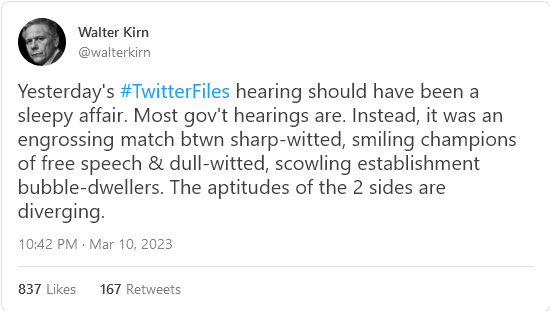
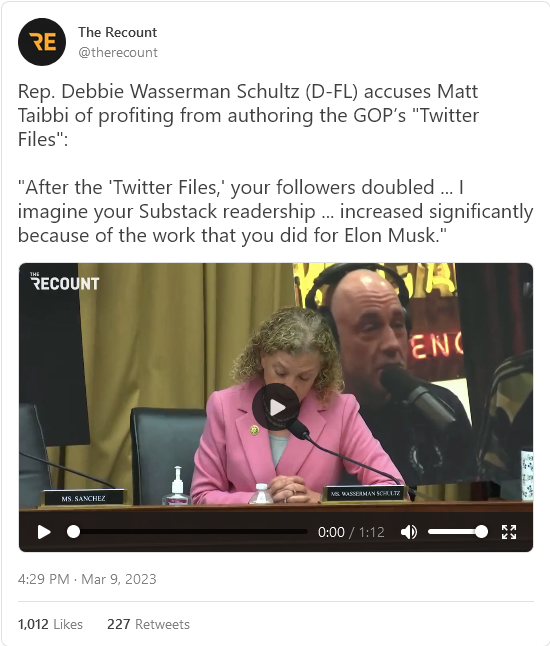
Chris Bray on the blatant decay of western political leadership on display at the #Twitterfiles hearing in Washington D.C.:

I should probably just go back to sleep for a decade, because Walter Kirn always has it covered:

I was trying to be clever about this yesterday, but it should be said plainly for the space aliens who eventually find the ruins of our former civilization and have to use the surviving digital evidence to report to their superiors on the collapse of the earth losers.

The most striking thing about the average member of the contemporary political class — the “elite”, and yes, I know — isn’t that they’re almost invariably wrong, or that they’re never interesting, or that they have no wisdom of any kind that ever shines through anything they do, ever. Instead, the most striking thing about the contemporary political class is that most of them can’t actually speak, in the sense that you ask them something and then they think and then words come out. Here, watch:

Even in the screenshot, her face is pointed downward at a piece of paper. She’s only ever reading. She’s looking at prepared questions and giving voice to a script, like a much dumber Anne Hathaway. And, yes, what the script says is idiotic — Matt Taibbi gets paid for his journalismz!!!!! (unlike members of Congress, who take a vow of poverty and work for free) — but the more interesting thing to me is that this person, in her fifty-trillionth term in Congress, can’t say what she thinks without reading it. Mr. Taibbi, it says on this piece of paper that you are a very bad person.

They don’t know anything. They don’t think anything. They have no ability, no insight, no value to offer. So they make our laws.

March 12, 2023

Jack Benny and Mel Blanc – The Man of a Thousand Voices | Carson Tonight Show

Filed under: History, Humour, Media, USA — Tags: , , — Nicholas @ 03:00

Johnny Carson
Published 18 Nov 2022

Original Airdate: 01/23/1974
(more…)

March 11, 2023

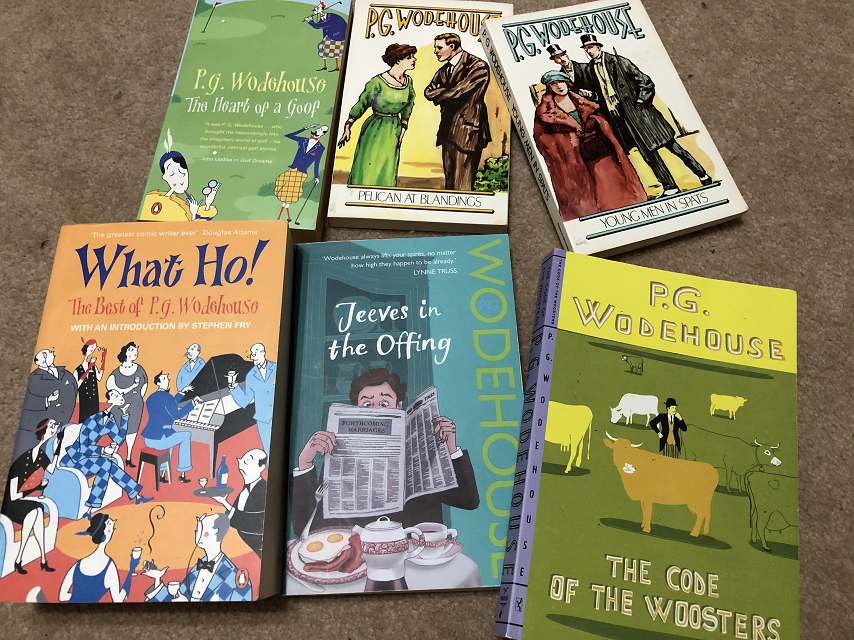
“… when people are sticking warning labels on P.G. Wodehouse, something is seriously wrong”

Filed under: Books, Britain, Media — Tags: , , , — Nicholas @ 03:00

In The Conservative Woman, Alan Ashworth stands aghast at the very notion of putting a content warning on an adaptation of a P.G. Wodehouse short story:

Dominic Sandbrook in the Mail on Sunday draws attention to BBC Radio 4 Extra and its latest repeat of an adaptation of P.G. Wodehouse’s Psmith in the City. It is preceded by an announcement that listeners should steel themselves for “some dated attitudes and language”.

You don’t say. The story was written well over a century ago, appearing first as a serial in The Captain magazine in 1908 and 1909 before being published as a book by A & C Black in 1910.

In it Psmith (the P is silent) and his old school friend Mike Jackson are reunited when they find themselves working for the New Asiatic Bank, a thinly disguised portrait of the Hongkong and Shanghai Bank (now HSBC) where Wodehouse himself endured a torrid spell before his writing career took off.

The two chums have several run-ins with management and Mike is eventually fired before Psmith solves all his problems and has him reinstated. Of course, as always in Wodehouse’s world, there is no sex, no angst, nothing to frighten the horses.

So why the BBC announcement? Sandbrook writes: “At first I wondered if this must be some mistake. Perhaps the warning had been transposed from some more dangerous programme, such as a stand-up show by Bernard Manning?

“But the warning was meant for Psmith. So what were these toxic and potentially traumatising attitudes? For the life of me, I still don’t really know.

“At one point, Psmith talks of going ‘out East’, where you have ‘a dozen native clerks under you, all looking up to you as the Last Word in magnificence’. But was that it? Did that merit a warning?

“As it happens, this radio adaptation was made in 2008. Did the actors realise they were participating in something steeped in sick imperialistic assumptions? I doubt it.

“Venturing into the cesspit of social media, I often find Left-wing pundits insisting there is no such thing as cancel culture and that the whole thing is an evil Tory myth.

“But when people are sticking warning labels on P G Wodehouse, something is seriously wrong. Indeed, you could hardly find a more ludicrous target, because he was one of most tolerant, generous-spirited writers imaginable. So generous-spirited that he’d probably have laughed this off. ‘I never was interested in politics,’ Wodehouse once remarked. ‘I’m quite unable to work up any kind of belligerent feeling.’

“Being cut from a meaner cloth, however, I do feel worked up about it. When I think of these finger-wagging commissars sitting in judgment on a writer who has given so much pleasure to so many readers, I feel like Bertie Wooster’s Aunt Agatha, gearing herself up before a titanic tirade.

“Do we really need a warning that P G Wodehouse is ‘dated’? What next? A lecture before Hamlet, to warn us that poisoning your wife or killing your uncle is now considered poor form? A warning before Roald Dahl or Ian Fleming?

“But, of course, Dahl and Fleming don’t need warnings now, for they have been posthumously updated.”

March 9, 2023

Want to feel more depressed? Spend more time with your smartphone

Filed under: Health, Media, Technology, USA — Tags: , , , , , — Nicholas @ 03:00

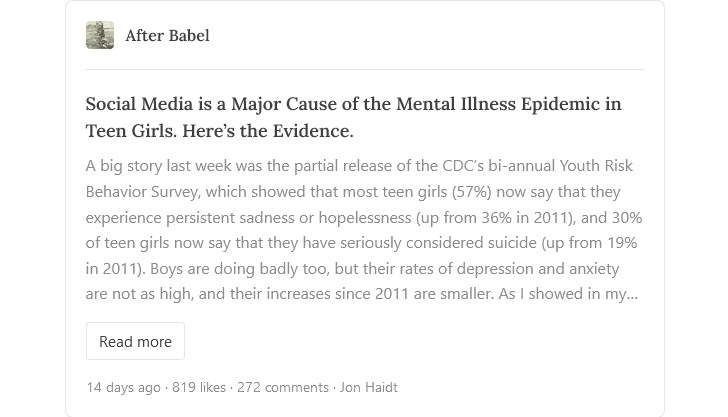
Freddie deBoer is convinced that much of the reason for widespread depression among teenagers can be traced directly to their obsessive devotion to the online world through their smartphones:

Are smartphones to blame for the mental health crisis among teens? The debate has picked up steam lately, in part because of the steady accumulation of evidence that they are indeed, at least partially. (As you know, I’m a believer.) Jonathan Haidt has done considerable work marshaling this evidence. But there’s an attendant question of how phones make kids miserable, if indeed they do. In this post I offer some plausible answers. This is mostly just speculation and I don’t know if the proffered explanations can be tested empirically.

I want to start by establishing a sort of meta-layer on which a lot of these problems rest. We might be inclined to say that these problems are inherently problems of the internet/online life/digital culture, rather than smartphones as such; you can be hurt by what I’m going to describe from a laptop as well as from a smartphone. And I think that’s right, except for one key difference: ubiquity. No matter how portable and light it is, you’re not reflexively checking your laptop on the subway platform or in the bathroom. The iPhone took all of the various pathologies of the internet, made it possible for them to be experienced repetitively and at zero cost morning and night, and dramatically scaled up the financial incentives for companies to exploit those pathologies for gain. You can certainly have an unhealthy relationship with the internet when it’s confined to your desktop. But phones make relentless conditioning and reflexive engagement a mass phenomenon.

The other overriding factor here is the fact that adolescents are still developing mentally, and thus are likely more susceptible to these problems.

Constant exposure to unachievable conditions. Back in my youth, you might watch an MTV show about how rich people lived, or leaf through a magazine like US Weekly, and be exposed to opulence and material excess. Or you might go on vacation and see how the other half lives if you took a tour of the Hollywood hills or whatever. You were perfectly well aware that rich people and their privileged lives existed. But then you turned off the show or you put down the magazine or your vacation ended, and unless you were born rich, you lived in an environment that of necessity was modest and real. Your friends might have lived in nice houses, but you didn’t see riches everywhere you looked, and your definition of what a hot girl looked like was mostly derived from the girls you went to school with. Your environment conditioned the scope of your desires.

Now, exposure to lifestyles that are completely unachievable is constant. Instagram is a machine for making you feel like whatever you’ve got isn’t enough. (That’s how it functions financially, through advertising idealized lives.) There are young people out there who have arranged their various feeds such that they’re always a few seconds away from seeing concerts they can’t attend, cars they can’t drive, houses they can’t live in, clothes they can’t wear, women they can’t fuck or whose bodies they can’t have, places they can’t travel to, food they can’t eat, and lives they can’t live. When I was young, if I wanted to see a picture of a Ferrari, I had to seek out a picture of a Ferrari. It was hard to see suggestive photos of intimidatingly hot women, which is why the Sports Illustrated swimsuit edition was a big deal. Mostly, the world around you was quotidian and its pleasures attainable. What can it be doing to these generations of young people, having completely unrealistic visions of what life is like being shoved into their brains all the time? How could their actual lives ever compare?

(Incidentally, I am thoroughly convinced that a majority of self-described incels are men who could find meaningful and fulfilling sexual and romantic success, both short-term and long, but who have developed such a wildly unrealistic idea about what actual human women look like that their standards are laughably high. And it’s easy to make fun of that, but I also think that the conditioning inherent to constantly looking at filtered and photoshopped pictures is powerful.)

March 8, 2023

Perhaps the Prime Minister ran out of glitterbomb distractions?

Filed under: Cancon, China, Government, Media, Politics — Tags: , , — Nicholas @ 05:00

In The Line, Matt Gurney speculates on why the federal government needed to be “punched in the face” for literally weeks before finally taking (some) action:

Let’s acknowledge something right at the top: no one really knows what the hell the prime minister proposed yesterday. Not in any specific policy sense, at any rate. But boy, did we ever learn something about how the Liberals are viewing this politically.

After weeks of bobbing and weaving and throwing out fistfuls of increasingly ridiculous chaff, Justin Trudeau has belatedly agreed to a series of actions to probe Chinese electoral interference in Canada. And maybe other interference? We don’t know. We do know it’ll involve NSICOP, which is an acronym in desperate need of an agreed-upon pronunciation, if Monday’s press conference was any guide. NSICOP is a joint House-Senate committee that reviews various matters relating to Canada’s national security and intelligence (read this on its website and you’ll know more than 99.9 per cent of Canadians do about NSICOP). There’s also going to be a splash of the National Security and Intelligence Review Agency (NSIRA), plus a special rapporteur. The special rapporteur will apparently be given broad powers and, should they recommend a full public inquiry, the PM will accept that.

Hell of an endorsement for someone who hasn’t been selected yet. It’s almost like the PM decided he had to make an announcement before he was ready to actually share many details about that announcement, for some reason. Like the announcement itself was the point. Weird, eh? Wonder what that was about. In any case, all we know is it’ll be an eminent Canadian.

Shoutout to all you eminent Canadians out there, I guess. Brush up those cover letters.

Winston Churchill frequently has this attributed to him: “You can depend upon the Americans to do the right thing. But only after they have exhausted every other possibility.” Our Canadian version might be that you can depend on Prime Minister Trudeau to do something, but only after he’s exhausted all of his glitterbombs on distracting public attention.

The way that the Liberals responded wasn’t shocking. They only have a few plays left in their playbook, and we’ve seen something just like this only a few weeks ago. (Which is why I’m wondering if they actually only have the single play left, come to think of it.) The Liberals have responded to the barrage of news stories over Chinese interference exactly the way they did over their controversial gun-control amendments from the fall. First, deny there’s a problem. Then accuse anyone saying there’s a problem of being Donald Trump 2.0 or somesuch. Then just cut right to the chase and call them racist. When that doesn’t work, wait a few days to see if the problem goes away. When it doesn’t — indeed, when it gets worse — that’s when you finally admit that you can’t just yell “DISINFORMING MAGA BIGOTS!” at people and watch as your problem magically evaporates.

With guns, after everything else failed, they withdrew the amendments (though I imagine they’ll try again, though probably with no better luck). With China interference, it was agreeing to some kind of process. All the unfilled blanks notwithstanding, even the fact that something is being agreed to shows a dawning of political reality in the PMO: ignoring this and hoping the leaks stop if you called enough people racist Trumpers wasn’t going to work. Clearly, sometime in the last few days, the PM and his staff reached the acceptance stage, and concluded that either they had to admit that there was enough here to warrant some kind of serious process, or they could just start randomly talking about abortion in the hopes that people fell for that.

No, no, wait. They tried that anyway.

It would be fascinating to know what specifically led to the mental breakthrough that enabled Monday’s announcement. Weeks of denials, evasions and counterattacks, a day of performatively fretting about abortion, and then, zap!, we’re getting an rapporteur — an eminent one! — and a process. Maybe they looked at some internal polling. Maybe they’re worried about a big scoop that’s yet to land. Or maybe they’re just tired of being on the defensive and figured that the proposals would stand a decent chance of smothering the issue to death with pillows stuffed with bureaucracy and abbreviations.

“By fostering intense family loyalties and strong nepotistic urges”, cousin marriage “makes the development of civil society more difficult”

Filed under: Media, Middle East, Military, Politics, USA — Tags: , , , , , , , — Nicholas @ 03:00

Ed West on what he calls the worst western foreign policy disaster since 1204, the Iraq quagmire:

Mohammed Saeed al-Sahhaf, better known in the West as “Baghdad Bob” or “Comical Ali”, Iraqi Minister of Information for President Saddam Hussein.

This month marks the 20th anniversary of the greatest western foreign policy disaster since the Fourth Crusade. It was the pre-eminent modern-day example of folly, driven by wishful thinking, utopianism and a lack of interest in history and how human societies differ. This was mostly carried out by good people, including our own Tony Blair, and promoted by thoughtful and humanitarian commentators who thought they were making the world a better place.

The White House regime which brought chaos and misery to Iraq were most of all entranced by The Weekly Standard, the now-defunct magazine most associated with neoconservative foreign policy. Had any of them read The American Conservative instead, they might have avoided the whole tragedy. In particular they ought have read Steve Sailer’s “The Cousin Marriage Conundrum“, printed in the run-up to the invasion and in which the author made a seemingly curious argument for why nation-building in Iraq would fail — its high rates of cousin marriage.

Pointing out that between 46 and 53 percent of Iraqis who married did so to first or second cousins, Sailer wrote that: “By fostering intense family loyalties and strong nepotistic urges”, cousin marriage “makes the development of civil society more difficult”. The neocon dream of jumpstarting democracy was therefore clearly doomed to failure.

Even those with a cursory knowledge of the country knew that Iraq was split between Sunni and Shia Arabs, as well as Kurds in the north, each group’s area of dominance roughly corresponding to three former Ottoman provinces. However, these were further subdivided into “smaller tribes, clans, and inbred extended families — each with their own alliances, rivals, and feuds”, in total about 150 tribes comprising some 2,000 clans.

Saddam’s politics were mired in blood, in both senses. He came from the al-Bu Nasir, a tribe comprising some 25,000 people based in the town of Tikrit, and his regime was filled with his relatives. His political career had begun in 1957 when the 20-year-old had joined the revolutionary Ba’ath (“Resurrection”) Party, following his uncle Kharaillah Tulfha, who had fought against the British in the Second World War. Tulfha would become his father-in-law, for Saddam also married his first cousin, although he later took a second wife. Family life wasn’t entirely harmonious, and the man who introduced that couple, Saddam’s food taster, was later stabbed to death by the dictator’s psychotic eldest son Uday at a party thrown by Egyptian president Hosni Mubarak.

The unfortunate food taster was an Assyrian Christian, and within Saddam’s regime religious minorities could rise high, as is often the case in empires, because they presented no threat. His foreign minister, Tariq Aziz, was also a Christian, his birth name being Mikhail Yuhanna.

The family was everything in Saddam’s Iraq. Mark Weiner wrote in The Rule of the Clan of countries governed by “clannism” that: “These societies possess the outward trappings of a modern state but are founded on informal patronage networks, especially those of kinship, and traditional ideals of patriarchal family authority. In nations pervaded by clannism, government is co-opted for purely factional purposes.” The inevitable result of clannism is kin-based corruption whereby resources, positions and other rewards are monopolised by family groups. In these societies, Weiner wrote, “the nuclear family, with its revolutionary, individuating power, has yet to replace the extended lineage group as the principle framework for kinship or household organisation”.

The Weekly Standard was called the in-flight magazine of Air Force One, but presumably there weren’t that many White House staffers reading the American Conservative at the time, a publication started by Pat Buchanan, the great Republican critic of neocon foreign policy. So the Coalition blundered into a disastrous invasion that cost hundreds of thousands of lives, wrecking Iraq and leaving many areas newly-divided along sectarian lines, while minorities like the Christians and Mandaeans were driven almost to extinction.

« Newer PostsOlder Posts »

Powered by WordPress