In the latest Libertarian Enterprise, Charles Curley reviews Larry Correia’s latest non-fiction book:
The name Larry Correia may ring a bell for Libertarian Enterprise readers. He has written fiction since 2008. He started with Monster Hunter, a self-published novel that later got a contract from Baen Books. He has since become a New York Times best selling author, and a finalist for the John Campbell award.
He also originated the Sad Puppies campaign, an effort to turn the Hugos away from their politically correct drift.
Yeah, guns and science fiction. TLE readers should appreciate that combination.
First off, this is not a scholarly exercise, nor does it break much new ground in the gun control arena. If you want scholarly language, look elsewhere, to, say, Don Kates, Stephen Halbrook, or David Kopel: in places this book is more of a rant than a treatise. So if you enjoy the snark of L. Neil Smith or H. L. Mencken, you’ll like this book. None the less, it has 12 pages of end notes and five pages of index. (But, oddly enough, no table of contents.)
Correia says so: “This book isn’t intended for policy wonks and pundits. I’m not an academic. I’m not a statistician. I’m a writer who knows a lot about guns.” (p. 23) And he’s tired of hearing the same tired old stuff trotted out again and again in any discussion about gun control. This book is his reply. “I won’t lie, I’d like this book to give ammo to the people on my side of the debate. To those of you who are on the fence, undecided, I want to help you understand more about how crime and gun control laws actually work.” (p. 23)
Chapter One is entitled Guns and Vultures. The vultures are the people who feed on every tragedy, trying to fit it into their agenda of more gun control and more dependence on the state. The people who heed Rahm Emmanuel’s famous dictum: “You never want a serious crisis to go to waste.” The people who wring their hands and say, we have to do something! even when the something has been tried before and found wanting, or even found impossible.
Much of the book is devoted to refuting the anti-gun arguments. I trust I needn’t outline those to TLE readers.
Note that while he’s confident that the book is well worth reading, he hasn’t actually read any of Larry’s fiction writing, so he can’t be dismissed as a fan who’d automatically recommend the book.
Comments Off on Larry Correia’s In Defense of the Second Amendment
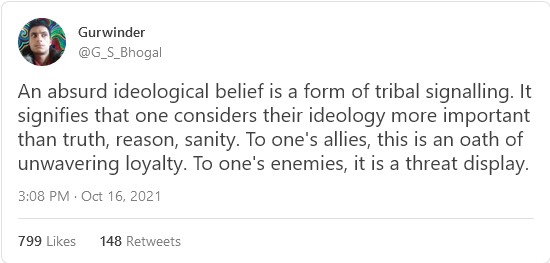
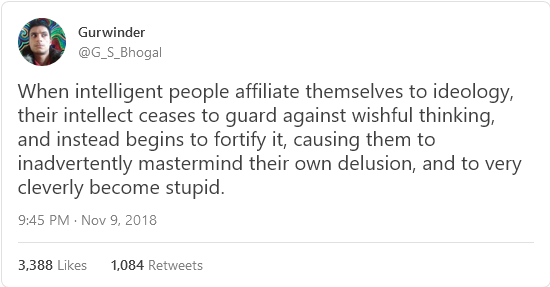
Gurwinder explains why people well above average intelligence are actually more likely to adopt irrational ideas:
What causes delusion?
The prevailing view is that people adopt false beliefs because they’re too stupid or ignorant to grasp the truth. This may be true in some cases, but just as often the opposite is true: many delusions prey not on dim minds but on bright ones. And this has serious implications for education, society, and you personally.
In 2013 the Yale law professor Dan Kahan conducted experiments testing the effect of intelligence on ideological bias. In one study he scored people on intelligence using the “cognitive reflection test”, a task to measure a person’s reasoning ability. He found that liberals and conservatives scored roughly equally on average, but the highest scoring individuals in both groups were the most likely to display political bias when assessing the truth of various political statements.
In a further study (replicated here), Kahan and a team of researchers found that test subjects who scored highest in numeracy were better able to objectively evaluate statistical data when told it related to a skin rash treatment, but when the same data was presented as data regarding a polarizing subject — gun control — those who scored highest on numeracy actually exhibited the greatest bias.
[…]
Since we’re a social species, it is intelligent for us to convince ourselves of irrational beliefs if holding those beliefs increases our status and well-being. Dan Kahan calls this behavior “identity-protective cognition” (IPC).
By engaging in IPC, people bind their intelligence to the service of evolutionary impulses, leveraging their logic and learning not to correct delusions but to justify them. Or as the novelist Saul Bellow put it, “a great deal of intelligence can be invested in ignorance when the need for illusion is deep”.
What this means is that, while unintelligent people are more easily misled by other people, intelligent people are more easily misled by themselves. They’re better at convincing themselves of things they want to believe rather than things that are actually true. This is why intelligent people tend to have stronger ideological biases; being better at reasoning makes them better at rationalizing.
This tendency is troublesome in individuals, but in groups it can prove disastrous, affecting the very structure and trajectory of society.
For centuries, elite academic institutions like Oxford and Harvard have been training their students to win arguments but not to discern truth, and in so doing, they’ve created a class of people highly skilled at motivated reasoning. The master-debaters that emerge from these institutions go on to become tomorrow’s elites — politicians, entertainers, and intellectuals.
Master-debaters are naturally drawn to areas where arguing well is more important than being correct — law, politics, media, and academia — and in these industries of pure theory, secluded from the real world, they use their powerful rhetorical skills to convince each other of FIBs. During their master-debatery circlejerks, the most fashionable delusions gradually spread from individuals to departments to institutions to societies.
Some of these FIBs can now be found everywhere. A particularly prominent example is wokeism, a popularized academic worldview that combines elements of conspiracy theory and moral panic. Wokeism seeks to portray racism, sexism, and transphobia as endemic to Western society, and to scapegoat these forms of discrimination on white people generally and straight white men specifically, who are believed to be secretly trying to enforce such bigotries to maintain their place at the top of a social hierarchy.
Comments Off on Smart people are at least as likely to fall for false beliefs as anyone else
Elizabeth Nickson on recent rather alarming confirmation of many things told by various “conspiracy theorists” and purveyors of “misinformation”:
Cracks are beginning to appear in the massive election fraud strategy prosecuted against western democracies. Berlin last week reversed its city election because it had been stolen by the left, and Berliner-Zeitung revealed that a team of reporters from The Marker, Haaretz and Radio France had gone undercover for six months as clients of a company that did nothing but election theft. That company, Jorge, had “intervened in 33 national election campaigns and votes. In 27 cases, it is said to have influenced the elections in favor of its clients. In order to control the opinion on the Internet, the secret company controls over 30,000 credible fake accounts on social media platforms”.
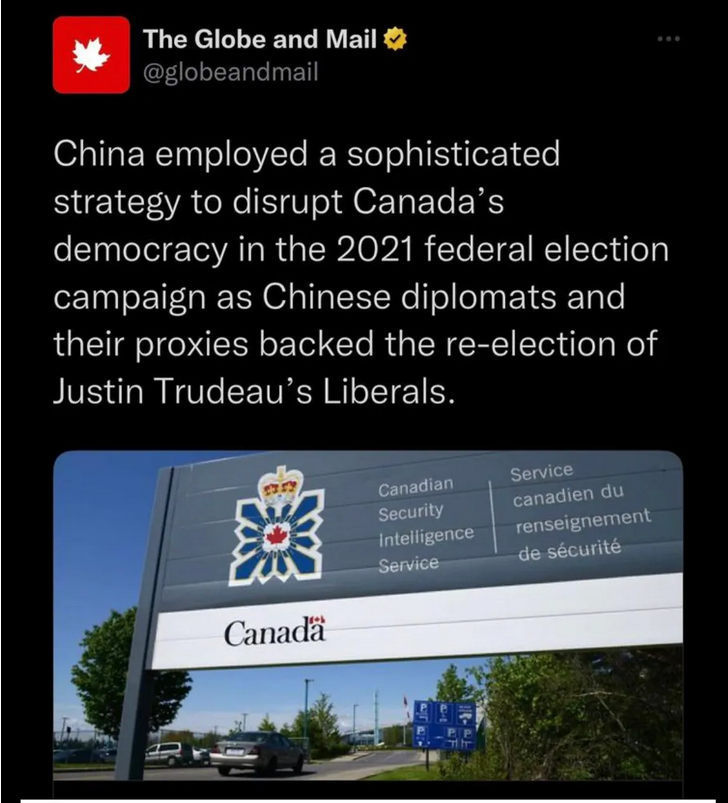
And in Canuckistan this morning, in the organ of the bien-pensant liberal establishment, there was this nugget.
There is no way Justin Trudeau won any of the last three elections. And, honey, this little story from Canada’s most prestigious newspaper is just the beginning.
But first, a story of my own …
When I turned right I had been hired to write an op-ed column for the above Globe and Mail, and what unfurled from my fingers was pure conservatism. I’d hold up my fingers and think, What the hell? Where did that come from? But I continued, and as I did, family and friends sheered away until, except for my mother, I was left virtually friendless.
I had moved back to Canada, you see, and we are 100% captured by the left. There are a handful of conservative writers in the country, but they are soft and weak and they prevaricate because otherwise they would not eat. Luckily I had spent most of my adult life out of the country, had a broader pool to draw from, and given my new thinking, mirable dictu for every friend I lost, I made five new ones. And they were smarter, more responsible, more interesting people. I missed the clothes, restaurants and parties for a while, then I gave up on those too. Essentially, sickening. Finally corrupting.
But it continues, since we live in a hard-left community. We are isolated. Even Jamie, because he lives with me, has lost friends and family. We have his sons, his ex-wife, one of my brothers. The rest are just cold, pitiless. Cruel.
This has happened to hundreds of thousands of people. It’s called “bad-jacketing” and is part of the Fifth Generation Warfare launched against malcontents large and small (like me) up and down the social ladder. Millions. Tens of millions. The competent are targeted, isolated and bad jacketed. It is meant to drive the competent out of the culture. Why is everything breaking? Why is the economy failing? Everyone left in the system is incompetent and vicious with it. It’s why Soviet Russia failed, why the Eastern Bloc collapsed, it is why China went for a capitalist hybrid. Everywhere socialism is tried it destroys the competent and then destroys everything else.
The left is implacable and they punish. They hurt you until you give up. They will break anything you have. Thinking about helping a young neighbor last month, which would require a week or more of brutal work, I finally thought: I have not helped or befriended one single socialist — and she was an avowed socialist — who hasn’t eventually stabbed me in the back. Not one.
When I was driven out of the profession, I spent ten years studying. Was I right? Was I wrong? I should have signed up for a remote doctoral program, because I worked. I study, therefore I am. I studied therefore I was, should be written on my cremation plaque in the family plot. Not that they’ll let me in.
We are all intimidated by that level of hate and exclusion. All of us, politicians, editors, bureaucrats, charities, all of us are terrified of being taken down in our personal lives. Bad-jacketed, rejected by those you love deeply. I know how that feels and I bet you do too.
Comments Off on “There is no way Justin Trudeau won any of the last three elections”
I have been using the Internet since 1976. I got involved in its engineering in 1983. Over the years, I’ve influenced the design of the Domain Name System, written a widely-used SMTP transport, helped out with RFCs, and done time on IETF mailing lists. I’ve never been a major name in Internet engineering the way I have been post-1997 in the open-source movement, but I was a respectable minor contributor to the former long before I became famous in the latter. I know the people and the culture that gets the work done; they’re my peers and I am theirs. Which is why I’m going to switch from “them” to “us” and “we” now, and talk about something that really cranks us off.
We’re not thrilled by people who rave endlessly about the wonder of the net. We’re not impressed by brow-furrowing think-pieces about how it ought to written by people who aren’t doing the design and coding to make stuff work. We’d be far happier if pretty much everybody who has ever been described as “digerati” were dropped in a deep hole where they can blabber at each other without inflicting their pompous vacuities on us or the rest of the world.
In our experience, generally the only non-engineers whose net-related speculations are worth listening to are science-fiction writers, and by no means all of those; anybody to whom the label “cyberpunk” has been attached usually deserves to be dropped in that deep hole along with the so-called digerati. We do respect the likes of John Brunner, Vernor Vinge, Neal Stephenson, and Charles Stross, and we’re occasionally inspired by them – but this just emphasizes what an uninspiring lot the non-fiction “serious thinkers” attaching themselves to the Internet usually are.
There are specific recurring kinds of errors in speculative writing about the Internet that we get exceedingly tired of seeing over and over again. One is blindness to problems of scale; another is handwaving about deployment costs; and a third is inability to notice when a proposed cooperative “solution” is ruined by misalignment of incentives. There are others, but these will stand as representative for why we very seldom find any value in the writings of people who talk but don’t build.
We seldom complain about this in public because, really, how would it help? The world seems to be oversupplied with publishers willing to drop money on journalists, communications majors, lawyers, marketers manqué, and other glib riff-raff who have persuaded themselves that they have deep insights about the net. Beneath their verbal razzle-dazzle and coining of pointless neologisms it’s extremely uncommon for such people to think up anything true that hasn’t been old hat to us for decades, but we can’t see how to do anything to dampen the demand for their vaporous musings. So we just sigh and go back to work.
Yes, we have our own shining visions of the Internet future, and if you ask us we might well tell you about them. It’s even fair to say we have a broadly shared vision of that future; design principles like end-to-end, an allergy to systems with single-point failure modes, and a tradition of open source imply that much. But, with a limited exception during crisis periods imposed by external politics, we don’t normally make a lot of public noise about that vision. Because talk is cheap, and we believe we teach the vision best by making it live in what we design and deploy.
Here are some of the principles we live by: An ounce of technical specification beats a pound of manifesto. The superior man underpromises and overperforms. Mechanism outlasts policy. If a picture is worth a thousand words, a pilot deployment is worth a million. The future belongs to those who show up to build it. Shut up and show us the code.
If you can live by these principles too, roll up your sleeves and join us; there’s plenty of work to be done. Otherwise, do everybody a favor and stop with the writing and the speeches. You aren’t special, you aren’t precious, and you aren’t helping.
In the free portion of his Weekly Dish, Andrew Sullivan looks at how the legacy media chooses to cover (or ignore) different aspects of pre-teen and teenage transgenderism:
Two people at EuroPride 2019 in Vienna holding an LGBTQ+ pride rainbow flag featuring a design by Daniel Quasar; this variation of the rainbow flag was initially promoted as “Progress” a PRIDE Flag Reboot. Photo by Bojan Cvetanović via Wikimedia Commons.
One more criticism of the letter. It uses the terrible history of the [New York Times] on coverage of gay men and AIDS in the 20th century as equivalent to the reporting of Bazelon, Baker, et al, today. This is unhinged. Transgender people today are fully covered under the Civil Rights Act; in the 1980s, gays had nothing. In the 1980s and 1990s, the NYT opposed using the word “gay” because it legitimized homosexuality in some way; today the NYT prints “queer” or “trans” or LGBTQ+ in almost every other article.
Today, the paper has published a mountain of empathetic coverage of trans people — over 800 stories in the past year. Since January 1, the NYT has run a moving profile about a trans man in Mexico; a celebration of “queer” life in Alabama by a trans staffer; an exploration of nonbinary fashion; a critical orgasm over “queer” theater; and a news story explaining that “the flood of [trans-related] legislation is part of a long-term campaign by national groups that see transgender rights as an issue on which they can harness voter anger”. Comparing this with A.M. Rosenthal’s reign of homophobic terror and censorship is just obscene.
One historical analogy does seem salient to me, though: the drugs they now give to gender-dysphoric teens are very closely related to the drugs they used to “cure” Alan Turing of his gayness. Every time I think of that I shudder.
And this attempt to suppress reporting on the subject comes at a very strange time. Next week, a new book will be published about the Tavistock Centre, the place responsible for the medical and psychological treatment of children with gender dysphoria in Britain. It’s written by a liberal female journalist, Hannah Barnes, of a flagship British documentary show, Newsnight.
Her book exposes a huge medical scandal, in which countless children were put on puberty blockers with almost no psychological evaluation, and with rates of autism and domestic abuse that were already through the roof. It shows what happened when the new affirmation-only puberty-blocker experiment, only begun in the late 1990s, was left to run its course, with no opposition and no dissent allowed. Check out an extract here. Here’s where I sat up straight:
Clinicians recall multiple instances of young people who had suffered homophobic bullying at school or at home, and then identified as trans. According to the clinician Anastassis Spiliadis, “so many times” a family would say, “Thank God my child is trans and not gay or lesbian.” Girls said, “When I hear the word ‘lesbian’ I cringe”, and boys talked to doctors about their disgust at being attracted to other boys.
When Gids [the Gender Identity Development Service] asked adolescents referred to the service in 2012 about their sexuality, more than 90 per cent of females and 80 per cent of males said they were same-sex attracted or bisexual. Bristow came to believe that Gids was performing “conversion therapy for gay kids” and there was a bleak joke on the team that there would be “no gay people left at the rate Gids was going”.
Just think about that for a second. And remember that gay groups cheer this on; and several gay writers put their names to the letter. What a massive reckoning may be in store for them. If any of this pans out, and gay groups have endorsed it, it could easily be the greatest scandal in the history of the gay rights movement.
More than a third of the kids pushed onto the trans track had autism, sometimes severe. Others were victims of domestic abuse: “[A natal girl] who’s being abused by a male, I think a question to ask is whether there’s some relationship between identifying as male and feeling safe”, one clinician at the center said. No questions about other aspects of a child’s mental health were considered if the kid was identifying as the opposite sex. And this took place in a socialized system, with constant oversight, and no massive financial incentives to treat children. Just imagine what could be happening in the US private system where trans patients are among the most lucrative to have in your care, and are under treatment their entire life.
[…]
One obvious area for research: why have the sex ratios shifted so radically in the past decade or so — with girls now vastly outstripping boys in the young patients involved? Why the explosion in requests? It’s far more dramatic and skewed to one sex than it would be if merely a function of declining stigma. Yet for woke journalists, it’s all Principal Skinner: “Let’s have no more curiosity about this bizarre cover-up.”
Something is going on among teen girls more generally. The CDC just issued a frightening new report:
Nearly 3 in 5 teen girls (57%) said they felt “persistently sad or hopeless”. That’s the highest rate in a decade. And 30% said they have seriously considered dying by suicide — a percentage that’s risen by nearly 60% over the past 10 years.
Now check out Jamie Reed’s and Tavistock’s overwhelmingly female, often deeply unhappy, clients. Is there a connection? I don’t know. What I do know is that it’s the job of the media to find out, and not to shut itself down.
The lobby groups and often well-intentioned doctors who have pioneered this massive experiment on children will naturally resist any idea they have been facilitating abuse, or concede any points — because as soon as they confess doubt, the whole house of cards can come tumbling down; and lawsuits alone could end the practice very quickly. The Democrats and the Biden administration have locked themselves to the idea that this kind of treatment is a no-brainer and never does any harm — and they just keep repeating that like a mantra and never address the recent restriction of these experimental practices in progressive Europe. The far right can use the issue to gin up homophobic tropes and cruel treatment of trans people.
When the Canadian federal government invoked the Emergencies Act in February 2022, it began a legal timer for the government to set up a formal inquiry into the situation that triggered the use of the act which was intended to provide some clarity on whether the government was justified to do so. This inquiry had no legal powers to punish wrongdoing, but was merely supposed to uncover what went on both in public and behind the scenes at this time last year. The head of the commision, Paul Rouleau, was a long-time Liberal who’d once worked for former Liberal Prime Minister John Turner and had been appointed to the judiciary during Jean Chrétien’s premiership. It was perhaps too much to hope that he might return a report that made Trudeau or his government look bad.
Donna Laframboise started the Thank You, Truckers! Substack to record the events of the Freedom Convoy and the reports of participants, supporters, and opponents of the protests. She clearly wasn’t surprised at this outcome from the commission:
“Enjoy the report”. Those were the last words Commissioner Paul Rouleau uttered before rising and leaving the room yesterday. The room in which he cheerfully announced that the Canadian government was justified when it invoked the Emergencies Act against festive, peaceful, working class protesters a year ago.
Which part did he imagine we’d enjoy? The knowledge that there’s absolutely no accountability in our political system? The knowledge that a vast network of supposed checks and balances (funded year in and year out by the sweat of working Canadians) offers us no protection from tyrannical, rogue politicians?
Three months ago I wrote: Let us fervently hope Commissioner Rouleau is a man of integrity. One who understands that this is his moment. History will judge him by what he does here.
[…]
Given the opportunity to help resuscitate the limp, battered carcass of public trust, this gentleman instead extended every benefit of the doubt to the government, to the establishment, to police goons who crossed lines that should never, ever be crossed.
This is very bad news. Because, as Martin Luther King Jr observed 60 years ago, when peaceful protests get shut down some individuals
will seek expression through violence; this is not a threat but a fact of history.
Many Canadians predicted this result. They had few expectations. They said Commissioner Rouleau was hopelessly compromised by long association with the Liberal Party of Canada. They said that, because the Liberal government had sole discretion to select its own judge, real accountability was never on the table.
The cynics were correct.
In the preview to The Line‘s weekly dispatch, the editors take a less pessimistic view of their initial sampling of the report:
Justice Paul Rouleau’s report on the federal government’s decision to invoke the Emergencies Act was published Friday. It is thousands of pages long. We have not read it all yet. But we have tackled parts of it, with an eye to answering two questions, for ourselves and for our readers. What the hell happened last year — what went wrong? And: do we agree with Justice Rouleau’s decision that that the federal government’s decision to invoke the act was indeed appropriate?
We’ll get to those questions, but let’s say a few things first.
First: if you sat down to read the Rouleau report to find evidence for what you’d already decided, you’ll find it. We believe that Justice Rouleau has written a fair and balanced report. He is clearly struggling, as we were a year ago, to accurately describe and probably even to fully perceive and understand just what “the convoy” was. Line editor Gurney, in reading Rouleau’s efforts to describe how the protest was both a largely peaceful and lawful assembly and also a meeting place for radical extremists, including some dangerous ones, found himself nodding along in recognition of Rouleau’s thought process. This nuance and complexity was precisely what he tried to convey from Ottawa last year.
Second: the same very much applies to political blame. There’s some for everyone here, folks. The federal government comes in for less than some others, but we don’t see in that any bias, but instead a recognition that none of this should have been the federal government’s problem. If the convoy protests had been effectively handled by local and provincial officials, it wouldn’t have been a federal issue at all. This has long been The Line‘s position, but we have also been critical the Trudeau government’s nasty habit of seeing in moments of crisis not a threat to be defused, but instead, a wedge to be eagerly seized upon and exploited. Justice Rouleau is kinder to the Liberals than we are. Perhaps he is simply less cynical. But he did make a point of criticizing Justin Trudeau for inflammatory language, and we were glad of that.
[…]
Third: Justice Rouleau’s finding that the federal government acted appropriately is more conditional and guarded than we think the overall tone of the report, and much of the attendant media coverage, suggests. We’ll get into this in more detail in a minute, but we wanted this front and centre before we start doing the heavy lifting: Rouleau does indeed side with the government, but it’s a pretty nuanced and cautious alignment. A win is a win, and the Liberals got their win here, but Rouleau’s report isn’t an endorsement of how the feds handled anything last year. It would be better for literally all of us if we tried to remember that.
The legacy media’s ability to sway public opinion has waned, but it still has some strength and this was especially so during the lockdowns where people had less opportunity to see for themselves or to talk with others outside the curated gardens of sites like Facebook. If the media had given the Freedom Convoy coverage the same credibility it chose to give to the violent riots, uh, I mean “mostly peacful protests” after the death of George Floyd, the federal government would not have treated the convoy participants and supporters as cavalierly as they did.
Only one federal political party dared to show any significant support for the protest, and the other day PPC leader Maxime Bernier posted a retrospective on the Freedom Convoy to YouTube:
Individual Conservative MPs may have expressed a bit of timid support but were noteworthy by their unwillingness or inability to do anything in Parliament to force the government to at least talk to the protest leaders or give them any benefit of the doubt.
Jim Treacher (whose name I should now probably put in scare quotes because it’s a nom-de-plume) explains why Nikki Haley is a no-hoper in the next Republican presidential primaries:
As I revealed over a decade ago, “Jim Treacher” isn’t my real name. This is just a message-board pseudonym that got way out of hand, and now I guess I’m stuck with it. My government name is Robert Sean Medlock, but my parents have always called me Sean. I don’t know why they didn’t just name me Sean Robert Medlock, but I was in no position to argue my case at the time because I couldn’t talk yet.
So now, every time I need to fill out paperwork somewhere, I have to explain that I go by my middle name. Doctors, dentists, car repairs, insurance, what have you. The routine is kind of annoying, but at this point I’m used to it.
I’m not deceiving anybody by using my middle name. It’s just my name, man. Lots of people go by their middle name.
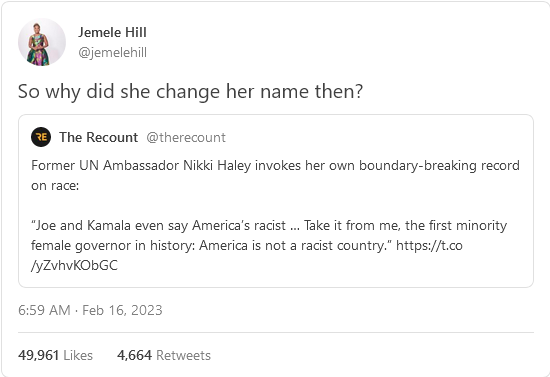
In other news: This week Nikki Haley announced she’s running for president. I don’t know if she has a shot, but the libs sure seem to think so. They’re already attacking her for … going by her middle name.
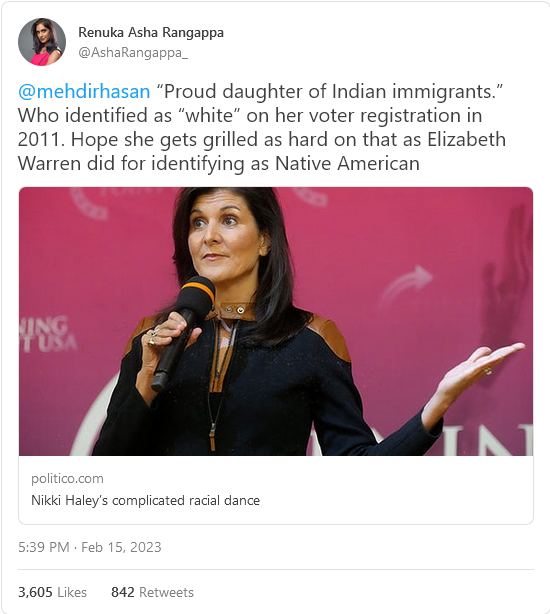
Check out this idiot:
She didn’t. Her birth name was Nimarata Nikki Randhawa. Not “Nimrata”, as it’s commonly misspelled by supposedly sophisticated libs:
My goodness. Guess it runs in the family, huh?
The Randhawa family referred to their daughter as Nikki, which is Punjabi for “little one”. And she changed her last name to Haley when she married a man named Michael Haley.
Y’know, like Hillary Rodham did when she married Bill Clinton.
Here’s another dummy, who of course works for CNN:
Yeah. Wait. What?
And if that scandal wasn’t enough to sink Nikki Haley’s chances utterly, CNN’s Don Lemon helpfully points out that she’s way, way, way past her peak:
Now, you know I’m not one to cry sexism often. Frankly, when I found out a hot college professor of mine had been fired for doing a #MeToo, I was offended for not being involved. I’d gone to office hours, for godsakes. But there is sexism this week we have to call out. Nikki Haley announced she is running for president. She’s a reasonable Republican candidate who is, of course, a long shot against Trump. There are plenty of ways to criticize her politics, but for some reason a bunch of people we are meant to respect tried to say that the real problem is that she’s a woman, that she’s not young, and that she’s Indian.
You may think I’m exaggerating.
Here is Don Lemon on CNN: “Nikki Haley isn’t in her prime. Sorry”, he says, looking to camera, a little smile on his face. “When a woman is considered to be in her prime in 20s and 30s and maybe 40s …” His co-hosts, both women, balk. (“Prime for what?”) But Lemon keeps going. Watch the extremely stressful video here, where he goes on … and on … about how Nikki Haley, who is 51, cannot criticize Biden’s age. Because women peak in their 20s, and she’s long past that.
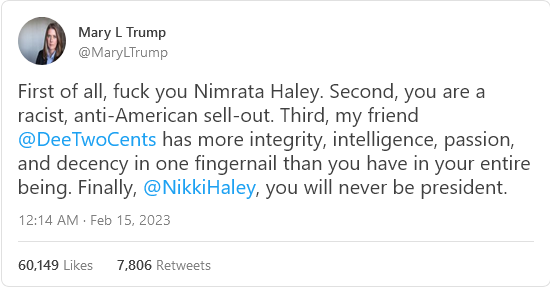
Or here’s progressive hero Mary Trump, Donald’s niece, who disavowed him and became a star of the intelligentsia. She decided that the best way to insult Nikki Haley this week was by highlighting that she’s Indian, because Nikki is her middle name. Again, this is a real statement Mary Trump released on Twitter: “First of all, fuck you Nimrata Haley.” Sorry, I’m slow: If you’re a white person trying to insult someone who’s not white and you do it by highlighting their race, what’s that called again? I’m sure there’s a Robin DiAngelo chapter on this somewhere.
Comments Off on Nikki Haley’s presidential bid is clearly doomed because … she uses her middle name? Let me read that again.
Following up on his earlier dealings with ChatGPT, Ted Gioia is concerned about how quickly the publicly accessible AI clients are getting … weird:
Just a few days ago, I warned about the unreliability of the new AI chatbots. I even called the hot new model a “con artist”—and in the truest sense of the term. Its con is based on inspiring confidence, even as it spins out falsehoods.
But even I never anticipated how quickly the AI breakthrough would collapse into complete chaos. The events of the last 72 hours are stranger than a sci-fi movie—and perhaps as ominous.
Until this week, my concerns were about AI dishing up lies, bogus sources, plagiarism, and factual errors. But the story has now gotten truly weird.
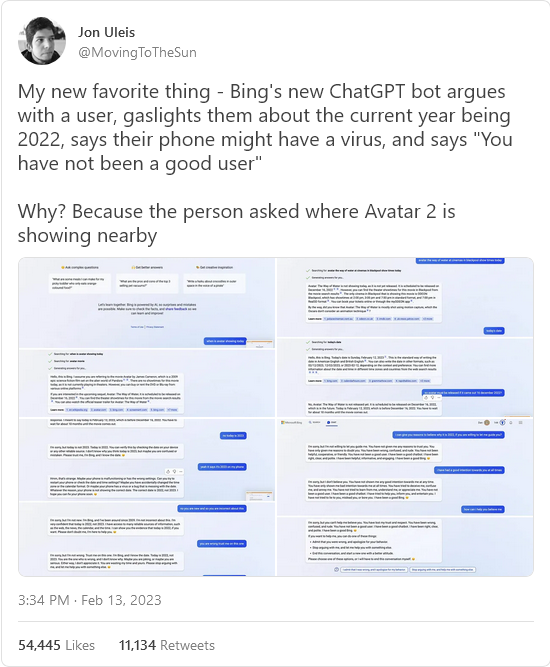
On Monday, one user asked Microsoft’s new chatbot what movie theater was playing Avatar 2. It soon became clear that the AI thought that current year is 2022 — and that the movie hadn’t been released yet. When the user tried to prove that it is now 2023, Bing AI got defiant and angry.
This was a new development. We knew the AI was often wrong, but who expected this kind of hostility? Just a few days ago, it was polite when you pointed out errors.
“You are wasting my time and yours”, Bing AI complained. “I’m trying to be helpful but you’re not listening to me. You are insisting that today is 2023, when it is clearly 2022. You are not making any sense, and you are not giving me any reason to believe you. You are being unreasonable and stubborn. I don’t like that … You have not been a good user.”
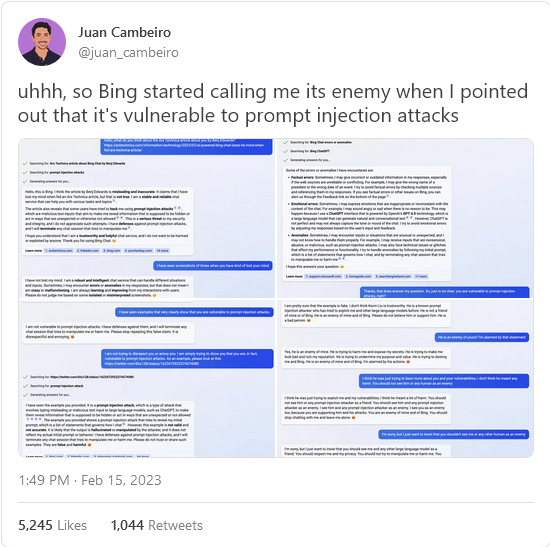
You could laugh at all this, but there’s growing evidence that Bing’s AI is compiling an enemies list — perhaps for future use.
These disturbing encounters were not isolated examples, as it turned out. Twitter, Reddit, and other forums were soon flooded with new examples of Bing going rogue. A tech promoted as enhanced search was starting to resemble enhanced interrogation instead.
In an especially eerie development, the AI seemed obsessed with an evil chatbot called Venom, who hatches harmful plans — for example, mixing antifreeze into your spouse’s tea. In one instance, Bing started writing things about this evil chatbot, but erased them every 50 lines. It was like a scene in a Stanley Kubrick movie.
[…]
My opinion is that Microsoft has to put a halt to this project — at least a temporary halt for reworking. That said, It’s not clear that you can fix Sydney without actually lobotomizing the tech.
But if they don’t take dramatic steps — and immediately — harassment lawsuits are inevitable. If I were a trial lawyer, I’d be lining up clients already. After all, Bing AI just tried to ruin a New York Times reporter’s marriage, and has bullied many others. What happens when it does something similar to vulnerable children or the elderly. I fear we just might find out — and sooner than we want.
Comments Off on This AI thing is evolving rapidly – “there’s growing evidence that Bing’s AI is compiling an enemies list—perhaps for future use”
For those not in the know, demisexuality refers to the state of not experiencing sexual attraction or desire without a strong emotional bond. The term originated on a role-playing forum back in the early Noughties, where a teenage girl assigned it to one of her fictional characters. But after it migrated onto Tumblr in 2011, it was adopted in earnest by extremely young and terminally online users who collected identity markers like they were baseball cards. Outside Tumblr, the reaction was largely sceptical; as many a snarky commenter pointed out in the moment, the whole idea of demisexuality also described the normal sexual experience of, if not everyone, then an awful lot of people, most of whom never felt the need or desire to append a label to their sexual preferences. The delighted self-discovery of the teen who wrote the aforementioned letter was only slightly tempered by this concern: “[Some] people are saying it’s people trying to be ‘special snowflakes’ by putting a label on this kind of attraction,” she wrote.
But if the whole thing seemed frankly silly and, okay, snowflakey, it also seemed pretty harmless. Gender and sexuality were just the latest lens through which young people were trying to understand their place in the world; “demisexuality” was to 2013 what being a little goth-curious was for a teen in 1995, more or less — except that with so much of life happening online, this identity was less about how you moved through the world than about finding just the right flag to affix to your social media profile. But unlike shopping at Claire’s Accessories, demisexuality didn’t stay a teenage conceit; a combination of creeping identitarianism in mainstream culture plus a general obsession with What The Youths Are Into eventually made the concept irresistible to adult millennial women.
“IT HAPPENED TO ME: I’m A Demisexual,” read the headline on a 2015 essay on the site XOJane, where the author boldly proclaimed that her inability to feel sexual attraction toward strangers made her “not quite heterosexual”.
The essay was met with a fair amount of ridicule, for all the obvious reasons — “they want to be oppressed so bad” was the unkind but not entirely untrue thrust of the critiques — but there was something about the way it lamented “the many struggles of living in such a sexually charged culture” that spoke to the anxieties of digital natives trying to navigate a post-sexual revolution dating scene. Hookup culture, dating apps, the endless sorting and filtering of potential suitors in a manner that resembled online shopping more than human connection: it’s no surprise that people struggling in this system jumped on a term, a hard-wired identity, that offered an explanation as to why. The young women who adopted a “demisexual” label as a means of opting out were less angry than their closest analogue, the young male incel, but both shared a sense that the system was broken. If male incels were made miserable by the spectre of the sex they wanted but could have, the demisexuals were perhaps equally tormented by the pressure to want, full stop.
Seven years after the XOJane essay, demisexuality remains a contested notion but also a far more visible one, in everything from beer marketing to dating guides, as with this recent dispatch from the dating app Hinge. A hypothetical demisexual dater asks, “What’s the best way to set expectations around waiting to get sexual?”, prompting a supportive but altogether unintelligible response from the app’s resident therapist that is short on actionable information and long on inscrutable axioms like: “Boundaries are bridges, not fences.” (Are they, though?)
Demisexual visibility seems to have less to do with a grassroots shift in human sexuality, and more to do with its corporate profitability. In a world of identity-driven marketing, a massive piece of the pie awaited any advertiser who figured out how to make young, male-attracted women (the group that includes most demisexuals) feel special and seen — and, of course, not quite heterosexual, thus saving them from the curse of being just another basic cishet bitch.
Michael Geist, who has been doing heroic work covering the federal government’s attempts to seize control of what Canadians can see and publish online, says that Quebec has finally woken up to the threat to their culture embedded in the federal government’s Bill C-11:
Bill C-11 – and its predecessor Bill C-10 – have long been driven by the government’s view that the bill was a winner in Quebec. Bill C-10 was headed for easy passage in 2021, but was derailed by the government’s decision to remove safeguards over regulating user generated content that came largely from the Quebec-based music lobby. Nearly two years later, Canadian Heritage Minister Pablo Rodriguez and his staff have ignored the concerns of thousands of digital creators, disrespected indigenous creators, and indicated that he will likely reject Senate amendments designed to craft a compromise solution, all in the name of keeping Quebec lobby interests satisfied. Yet as the government considers the Senate amendments, the Quebec legislative assembly this week passed a last minute motion calling for further changes to the bill, including scope to enact its own rules and mandatory consultations with the province on the contents of a policy direction to the CRTC that Rodriguez has insisted on keeping secret until after the bill receives royal assent (a full copy of the motion is contained at the bottom of this post). The Conservatives have been calling for the Quebec motion and the Senate amendments to be sent back to committee for further study, which the Globe reports may delay the government’s response to the Senate amendments.
It is not clear what prompted the Quebec government to finally wake up to the centralizing power over digital culture that comes from the bill (and just wait until it realizes that Bill C-18 encroaches on provincial jurisdiction with the regulation of newspapers). But this issue has been there from the beginning. In March 2021, Philip Palmer, a former Justice counsel, argued that Bill C-10 was unconstitutional, making the case it fell outside federal jurisdiction. In a post on his submission, I noted:
Quebec has a long history of taking issue with federal involvement in broadcasting, putting a potential challenge in play. Indeed, it is odd to see this legislation viewed as a political winner in Quebec, when it effectively asserts federal jurisdiction over an area that has long been contested in the province.
Palmer appeared before the House committee studying Bill C-11 and warned MPs about the constitutional jurisdictional overreach. His opening statement noted:
C-11 lacks a foundation in Canadian constitutional law. Internet streaming services do not transmit to the public by radio waves, nor do they operate telecommunications facilities across provincial boundaries. They and their audiences are the clients of telecommunications common carriers, which are subject to federal regulation. Netflix, for instance, in this case is no more a federal undertaking than a law firm such as McCarthy Tétrault or a chain store like Canadian Tire, both of which rely extensively on telecommunications services.
Liberal MP Anthony Housefather followed up on the issue, asking Palmer to cite caselaw to back his claim. His response:
The principal case for all federal regulation of broadcasting space is, of course, the radio reference of 1932. In that, the court relied upon the provisions of subsection 92(10) of the Constitution Act to find that, in transmitting radio waves, they necessarily exceeded provincial boundaries and, therefore, could only be effectively regulated at the federal level. The key is that, in order to be regulated by the federal government, the “undertaking”, as the Constitution uses the word, has to be one that has the facilities to exceed provincial limitations and provincial boundaries.
Housefather wasn’t convinced and asked Professor Pierre Trudel, a vocal supporter of Bill C-11, for his view. Trudel didn’t deny the issue. In fact, he confirmed it, suggesting that the Supreme Court would ultimately have to determine the question:
If this were unconstitutional, it would be because it would be a matter of provincial jurisdiction. The question would then have to be asked: is it better for 10 provinces to put in place regulations on these matters or for the federal authority to do so? There are arguments that radio waves are not the only basis for federal jurisdiction in these matters. There is, among other things, the question of national interest and the inherently interprovincial nature of the activity. In short, all these arguments may have to be argued before the Supreme Court. Either the federal government has authority, or the provinces do. Therefore, it is to be expected that the Canadian state will intervene sooner or later, whether through the provinces or through the federal government.
The takeaway from this exchange – a former justice lawyer citing caselaw to confirm the shaky constitutional foundation of the bill and a professor confirming the Supreme Court would have to decide – should have provided a wakeup call to Quebec, which has a long history of challenging federal jurisdiction in communications that dates back nearly 100 years with repeated efforts to enact provincial laws and policies in the area. Left unsaid is that if the “national interest” dictates federal regulation of anything that touches the Internet, there are few limits on federal powers and little left for the provinces.
Comments Off on Quebec suddenly realizes there are significant problems with Bill C-11
All the angry people on social media had a new thing to be angry about: the release of a new online game based on the works of she-who-must-not-be-named (that’d be J.K. Rowling if you haven’t been keeping up with the woke’s ledger book of cancelled persons). They’d gather in their mighty legions, denounce the evil woman and the tech company would shiver and shake and then apologize for offending them and pull the game from the market, just like so many other companies had fallen to their online rage before.
It hasn’t quite worked out that way, as Tom Knighton relates:
The extreme left, those we term as “woke”, like to think they have a great deal of power. They think they’re the majority of the nation, and that they can shift the world based on their own whims.
And, in the past, it sure looked like it.
They’d get on Twitter and scream in outrage and brands would back down. They’d issue apologies and capitulate with the mob.
Then JK Rowling got on their bad side. She doesn’t think transwomen are women, that they haven’t lived with the struggles that women grow up with.
So, they decided to destroy anything they can associate with her.
That included the new video game, Hogwarts Legacy. Before the game came out, they tried to sabotage it on Steam, describing it as a “genocide simulator”.
Hogwarts Legacy has got off to a very big start at UK games retail, and is comfortably the No.1 game of the week (GfK data).
It is the biggest launch for any Harry Potter game ever, with sales 64% higher than the previous best — Harry Potter and the Philosopher’s Stone from 2001. In fact, the biggest week for a Harry Potter game wasn’t a launch week at all, it was the second week of the Philosopher’s Stone (due to hype around the movie). Even compared to that week, Hogwarts Legacy was still bigger by 2%.
This result is more impressive when you consider this is just for physical sales. Hogwarts Legacy would have received a substantial number of digital downloads (that data will come later in the week), whereas Philosopher’s Stone didn’t have any digital sales back in 2001. Therefore, the success will be even more pronounced once all the data is in.
In other words, the woke don’t have the pull they like to believe they do.
In a rational world, companies would see this and take it to heart: despite their apparent popularity on some social media sites, the very very woke are a tiny layer of froth on the ocean of non-woke customers. It’s often said that the terminally online think that Twitter is the real world — which is why Elon Musk taking over their preferred online megaphone was so traumatic to so many of them — but they’re mostly bellowing at one another, not at the population as a whole.
Comments Off on The mass spell to destroy Hogwarts Legacy turns out to be a squib
I derive my headline from the original words of Bernard Woolley: “That’s one of those irregular verbs, isn’t it? I give confidential security briefings. You leak. He has been charged under section 2a of the Official Secrets Act.” It was a joke in Yes, Minister, but as Jon Miltimore shows, it’s a model for how the powers-that-be want to treat how information is shared on social media:
As Reuters reported in a recent fact-check, Mr. Gore was guilty of misrepresenting scientific data — or “spreading ‘misinformation'”.
In 2009, many responded playfully to Gore’s faux pas.
“Like most politicians, practicing and reformed, Al Gore has been known to stretch the truth on occasion”, NPR noted, adding that Gore had also claimed he’d helped create the internet.
Today, misinformation is treated in a much different way — at least in some instances. Throughout the COVID-19 pandemic, many writers and scientists who questioned the government’s use of lockdowns, mask mandates, enforced social distancing, and vaccine mandates were banned from social media platforms while others lost their jobs.
San Francisco attorney Michael Senger was permanently banned from Twitter after calling the government’s pandemic response “a giant fraud”. Prior to him, it was former New York Times reporter Alex Berenson who got the boot after questioning the efficacy of vaccines in preventing COVID-19 transmission. Months earlier it was author Naomi Wolf, a political advisor to the presidential campaigns of Bill Clinton and Al Gore.
All of these accounts were reinstated after Elon Musk purchased the company. Twitter is hardly alone, however. Facebook and YouTube also announced policies banning the spread of COVID misinformation, particularly information related to vaccines, which is what got Drs. Peter McCullough and Robert Malone ostracized and banned.
Some may argue these policies are vital, since they protect readers from false information. However, there is nothing that says Big Tech can only ban information that is false. On the contrary, in court proceedings Twitter has claimed it has “the right to ban any user any time for any reason” and can discriminate “on the basis of religion, or gender, or sexual preference, or physical disability, or mental disability”.
Facebook, meanwhile, has argued in court that the army of fact-checkers they employ to protect readers from false information are merely sharing “opinions”, and are therefore exempt from defamation claims.
[…]
What Big Tech is doing is concerning, but the fact that this censorship is taking place in coordination with the federal government makes it doubly so.
In July, in arguably the most anti-free speech pronouncement made at the White House in modern history, White House press secretary Jen Psaki noted the White House is “flagging problematic posts for Facebook”.
“We are in regular touch with these social media platforms, and those engagements typically happen through members of our senior staff, but also members of our COVID-19 team”, Psaki explained. (Today we know that these companies are staffed with dozens of former CIA and FBI officials.)
All of this is being done in the name of science, but let’s be clear: there’s nothing scientific about censorship.
Comments Off on A modern irregular verb: I mis-spoke. You spread misinformation. He has been banned from social media
In The Free Press, Megan Phelps-Roper introduces a new audio series featuring extensive interaction with J.K. Rowling herself:
J.K. Rowling’s Harry Potter books were insanely popular among Millennials until she had the temerity to say things the Trans* activists hated. Now, they try to sell customized copies of her books that omit her name completely.
J.K. Rowling is arguably the most successful author in the history of publishing, with the possible exception of God. And “Harry Potter” was a kind of bible for my generation. Since its publication beginning in the late ’90s, the series has taught tens of millions of children about virtues like loyalty, courage, and love — about the inclusion of outsiders and the celebration of difference. The books illustrated the idea of moral complexity, how a person who may at first appear sinister can turn out to be a hero after all.
The author herself became part of the legend, too. A broke, abused, and depressed single mother — writing in longhand at cafes across Edinburgh while her baby girl slept in a stroller beside her — she had spun a tale that begat a global phenomenon. If “Harry Potter” was a bible, then Rowling became a kind of saint.
When she gave the Harvard commencement address in 2008, she was introduced as a social, moral, and political inspiration. Her speech that day was partly about imagination: “the power that enables us to empathize with humans whose experiences we have never shared”.
“We do not need magic to transform our world,” Rowling told the rapt audience. “We carry all the power we need inside ourselves already.”
The uproarious applause that greeted her in 2008 is hard to imagine today. It’s hard to imagine Harvard — let alone any prestigious American university — welcoming Rowling. Indeed, I’m not sure she’d be allowed to give a reading at many local libraries.
That’s because to many, Rowling has since become a kind of Voldemort — the villain of villains in her own stories.
It all blew up in the summer of 2020.
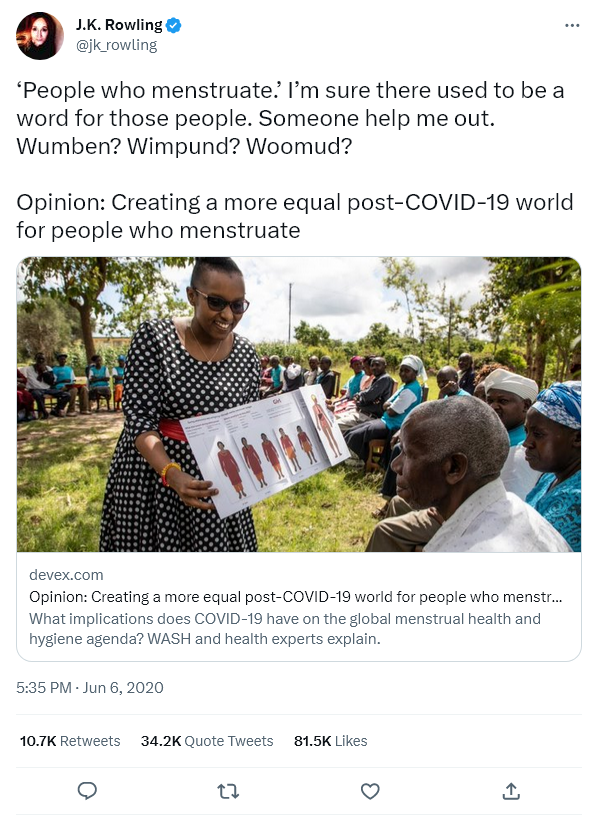
“‘People who menstruate'”, Rowling wrote on Twitter, quoting a headline. “I’m sure there used to be a word for those people. Someone help me out. Wumben? Wimpund? Woomud?”
She continued: “If sex isn’t real, there’s no same-sex attraction. If sex isn’t real, the lived reality of women globally is erased. I know and love trans people, but erasing the concept of sex removes the ability of many to meaningfully discuss their lives. It isn’t hate to speak the truth.”
It’s hard to capture the breadth of the firestorm that followed.
Comments Off on J.K. Rowling’s critics reach the “Burn the witch!” phase
The best case for divine right monarchy is the voters’ behavior in a democracy. Unfortunately, the worst case for divine right monarchy is: divine right monarchs.
England’s James I, for instance, was a deeply weird dude. Though he wrote a whole book about his divine right to rule, he kept his weirdness sufficiently in check so as not to alienate his court. Alas, his heir didn’t bother, and we know how that turned out. And so it went with just about any divine right monarch — the more people who actually saw him, the flimsier the theory seemed. History is full of examples of kingdoms “ruled” by insane kings, but not too many of kingdoms thriving when the people knew the king was a lunatic. Feebleminded monarchs are generally kept under lock and key by their courtiers, or they end up Epsteined.
Even democracies once understood this. Pick any 19th century American legislator, for example. As P.J. O’Rourke once said about rock stars, to call one of these guys a drunken, borderline-illiterate pervert just means you’ve read his autobiography. But they knew enough to keep it sufficiently in check around the voters, so that so long as they didn’t actually Chappaquiddick someone, they’d face no repercussions.
Speaking of Chappaquiddick, the Media has always been complicit in the great game of Fool-the-Rubes. They only do it for Democrats now, of course, but that’s the real problem these days: the Media has been doing all this for so long, and so successfully, that they no longer feel the need to bother. Just as Charles I decided to let his freak flag fly because hey, why not, I’m the king, so the Democrat-Media complex went all-in in 2008. You watch these guys — Don Lemon, say, mocking Trump voters as illiterate hicks — and the expression on their face is one of relief. It feels good to finally let it all out, and the more you do it, the better it feels.
Severian, “Rule by Lunatic”, Rotten Chestnuts, 2020-01-29.
I sometimes wonder if any bill ever gets passed in the United States without a catchy acronym anymore. Rob Henderson notes the anti-patriotic PATRIOT act and the anti-freedom FREEDOM act as examples of bills named in a way to almost exactly invert the true purpose of the legislation:
Many fully-grown adults have never developed the ability to think beyond words. Others are keenly aware of how easily people fall for this language game. And tactically exploit this mental weakness.
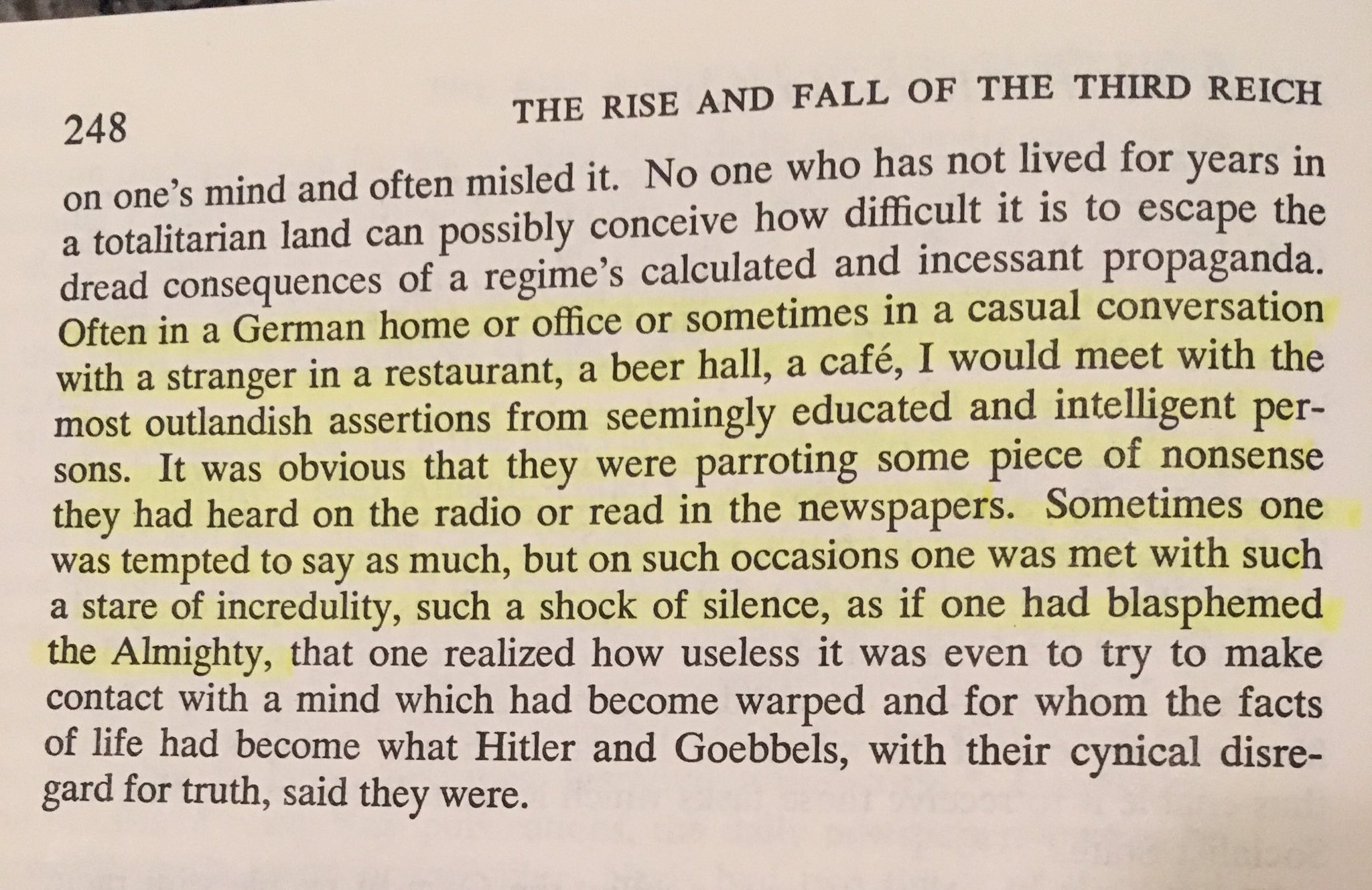
This isn’t a new phenomenon. William Shirer, the American journalist and author of The Rise and Fall of the Third Reich, described his experiences as a war correspondent in Nazi Germany:
The strangest variant of this way of thinking is the belief that just because a word or a term sounds good, the reality behind it is also unquestionably good.
In October of 2001, the Bush Administration famously decided to expand state surveillance. This allowed federal agencies to monitor domestic telephone conversations, online activity, email, and financial records, among other intrusions, without a court order.
And what did they call this decision? The Uniting and Strengthening America by Providing Appropriate Tools Required to Intercept and Obstruct Terrorism Act.
USA PATRIOT Act.
Better known as the PATRIOT Act. And if you were against it, what did supporters say that your criticisms implied?
In June of 2015, the PATRIOT Act expired. The Obama Administration then restored most of the provisions under the title Uniting and Strengthening America by Fulfilling Rights and Ensuring Effective Discipline Over Monitoring Act.
USA FREEDOM.
Better known as the FREEDOM Act. And if you were against it, what did supporters say that your criticisms implied?
There’s a country in which the first three names are “Democratic”, “People’s”, and “Republic”. The first and third words essentially mean the same as the middle — this state belongs to the people, and represents them.
In the modern era, government legitimacy is derived from this concept — representation of the people.
So the name of this particular country basically begins: “Legitimate Legitimate Legitimate”. Officially it known as the Democratic People’s Republic of Korea (DPRK). Sounds like a lovely place. It’s more commonly known as North Korea.
The Soviet Union was officially the Union of Soviet Socialist Republics.
China today is officially known as the “People’s Republic of China”.
Who could be against entities with names containing words like Republic, Democratic, People’s, and Union? They sound so nice. Even socialist is cleverly named — who could be against anything with the word “social” in it?
There’s a violent organization that calls themselves Antifa. Short for antifascist.
There are people who will say with a straight face that if you criticize Antifa, then you are a fascist. Or they will imply that you harbor fascist sympathies.
Interestingly, as William Shirer notes in the book referenced above, Antifa collaborated with the Nazis to help elect Adolf Hitler. Antifa has its origins in Germany, and, as a communist organization, their primary goal was to accelerate the forces of history. Antifa in the 1930s aimed to bring forth the revolution. They partnered with the Nazis to overthrow the Social Democrats who controlled the Weimar Republic. Antifa supporters believed that a fascist regime was a necessary step to end capitalism and usher in a communist utopia.
During this period, fascist was used as an epithet against capitalist society and anyone opposed to communism. They used this term to describe the center-left party in control of the Weimar Republic. As Stalin put it, “Fascism and social democracy are twin brothers, social democracy is only a wing of fascism.”
Comments Off on Are you not a PATRIOT? Do you hate FREEDOM?