
First, some caveats. This is really a discussion of oath-taking as it existed (and exists) around the Mediterranean and Europe. My understanding is that the basic principles are broadly cross-cultural, but I can’t claim the expertise in practices south of the Sahara or East of the Indus to make that claim with full confidence. I am mostly going to stick to what I know best: Greece, Rome and the European Middle Ages. Oath-taking in the pre-Islamic Near East seems to follow the same set of rules (note Bachvarova’s and Connolly’s articles in Horkos), but that is beyond my expertise, as is the Middle East post-Hijra.
Second, I should note that I’m drawing my definition of an oath from Alan Sommerstein’s excellent introduction in Horkos: The Oath in Greek Society (2007), edited by A. Sommerstein and J. Fletcher – one of the real “go-to” works on oath-taking in the ancient Mediterranean world. As I go, I’ll also use some medieval examples to hopefully convince you that the same basic principles apply to medieval oaths, especially the all-important oaths of fealty and homage.
(Pedantry note: now you may be saying, “wait, an introduction? Why use that?” As of when I last checked, there is no monograph (single author, single topic) treatment of oaths. Rather, Alan Sommerstein has co-authored a set of edited collections – Horkos (2007, with J. Fletcher), Oath and State (2013, with A. Bayliss) and Oaths and Swearing (2014, with I. Torrance). This can make Greek oaths a difficult topic to get a basic overview of, as opposed to a laundry list of the 101 ancient works you must read for examples. Discussions of Roman oaths are, if anything, even less welcoming to the beginner, because they intersect with the study of Roman law. I think the expectation has always been that the serious student of the classics would have read so many oaths in the process of learning Latin and Greek to develop a sort of instinct for the cultural institution. Nevertheless, Sommerstein’s introduction in Horkos presents my preferred definition of the structure of an oath.)
Alright – all of the quibbling out of the way: onward!
So what is an Oath? Is it the same as a Vow?
Ok, let’s start with definitions. In modern English, we often use oath and vow interchangeably, but they are not (usually) the same thing. Divine beings figure in both kinds of promises, but in different ways. In a vow, the god or gods in question are the recipients of the promise: you vow something to God (or a god). By contrast, an oath is made typically to a person and the role of the divine being in the whole affair is a bit more complex.
(Etymology digression: the word “oath” comes to us by way of Old English āþ (pronounced “ath” with a long ‘a’) and has close cousins in Dutch “Eed” and German “Eid”. The word vow comes from Latin (via Middle English, via French), from the word votum. A votum is specifically a gift to a god in exchange for some favor – the gift can be in the present tense or something promised in the future. By contrast, the Latin word for oath is ius (it has a few meanings) and to swear an oath is the verb iuro (thus the legal phrase “ius iurandum” – literally “the oath to be sworn”). This Latin distinction is preserved into the English usage, where “vow” retains its Latin meaning, and the word “oath” usurps the place of Latin ius (along with other words for specific kinds of oaths in Latin, e.g. sacramentum)).
In a vow, the participant promises something – either in the present or the future – to a god, typically in exchange for something. This is why we talk of an oath of fealty or homage (promises made to a human), but a monk’s vows. When a monk promises obedience, chastity and poverty, he is offering these things to God in exchange for grace, rather than to any mortal person. Those vows are not to the community (though it may be present), but to God (e.g. Benedict in his Rule notes that the vow “is done in the presence of God and his saints to impress on the novice that if he ever acts otherwise, he will surely be condemned by the one he mocks“. (RB 58.18)). Note that a physical thing given in a vow is called a votive (from that Latin root).
(More digressions: Why do we say “marriage vows” in English? Isn’t this a promise to another human being? I suspect this usage – functionally a “frozen” phrase – derives from the assumption that the vows are, in fact, not a promise to your better half, but to God to maintain. After all, the Latin Church held – and the Catholic Church still holds – that a marriage cannot be dissolved by the consent of both parties (unlike oaths, from which a person may be released with the consent of the recipient). The act of divine ratification makes God a party to the marriage, and thus the promise is to him. Thus a vow, and not an oath.)
So again, a vow is a promise to a divinity or other higher power (you can make vows to heroes and saints, for instance), whereas an oath is a promise to another human, which is somehow enforced, witnessed or guaranteed by that higher power.
An example of this important distinction being handled in a very awkward manner is the “oath” of the Night’s Watch in Game of Thrones (delivered in S1E7, but taken, short a few words, verbatim from the books). The recruits call out to … someone … (they never name who, which as we’ll see, is a problem) to “hear my words and bear witness to my vow”. Except it’s not clear to me that this is a vow, so much as an oath. The supernatural being you are vowing something to does not bear witness because they are the primary participant – they don’t witness the gift, they receive it.
I strongly suspect that Martin is riffing off of here are the religious military orders of the Middle Ages (who did frequently take vows), but if this is a vow, it raises serious questions. It is absolutely possible to vow a certain future behavior – to essentially make yourself the gift – but who are they vowing to? The tree? It may well be “the Old Gods” who are supposed to be both nameless and numerous (this is, forgive me, not how ancient paganism worked – am I going to have to write that post too?) and who witness things (such as the Pact, itself definitely an oath, through the trees), but if so, surely you would want to specify that. Societies that do votives – especially when there are many gods – are often quite concerned that gifts might go awry. You want to be very specific as to who, exactly, you are vowing something to.
This is all the more important given that (as in the books) the Night’s Watch oath may be sworn in a sept as well as to a Weirwood tree. It wouldn’t do to vow yourself to the wrong gods! More importantly, the interchangeability of the gods in question points very strongly to this being an oath. Gods tend to be very particular about the votives they will receive; one can imagine saying “swear by whatever gods you have here” but not “vow yourself to whatever gods you have here”. Who is to say the local gods take such gifts?
Moreover, while they pledge their lives, they aren’t receiving anything in return. Here I think the problem may be that we are so used to the theologically obvious request of Christian vows (salvation and the life after death) that it doesn’t occur to us that you would need to specify what you get for a vow. But the Old Gods don’t seem to be in a position to offer salvation. Votives to gods in polytheistic systems almost always follow the do ut des system (lit. “I give, that you might give”). Things are not offered just for the heck of it – something is sought in return. And if you want that thing, you need to say it. Jupiter is not going to try to figure it out on his own. If you are asking the Old Gods to protect you, or the wall, or mankind, you need to ask.
(Pliny the Elder puts it neatly declaring, “of course, either to sacrifice without prayer or to consult the gods without sacrifice is useless” (Nat. Hist. 28.3). Prayer here (Latin: precatio) really means “asking for something” – as in the sense of “I pray thee (or ‘prithee’) tell me what happened?” And to be clear, the connection of Christian religious practice to the do ut des formula of pre-Christian paganism is a complex theological question better addressed to a theologian or church historian.)
The scene makes more sense as an oath – the oath-takers are swearing to the rest of the Night’s Watch to keep these promises, with the Weirwood Trees (and through them, the Old Gods – although again, they should specify) acting as witnesses. As a vow, too much is up in the air and the idea that a military order would permit its members to vow themselves to this or that god at random is nonsense. For a vow, the recipient – the god – is paramount.
Bret Devereaux, “Collections: Oaths! How do they Work?”, A Collection of Unmitigated Pedantry, 2019-06-28.
February 13, 2023
QotD: Oaths in pre-modern cultures
February 12, 2023
JunkScientific American
The editors of Scientific American have been steadily injecting more political and progressive content into their traditional coverage of hard scientific topics:
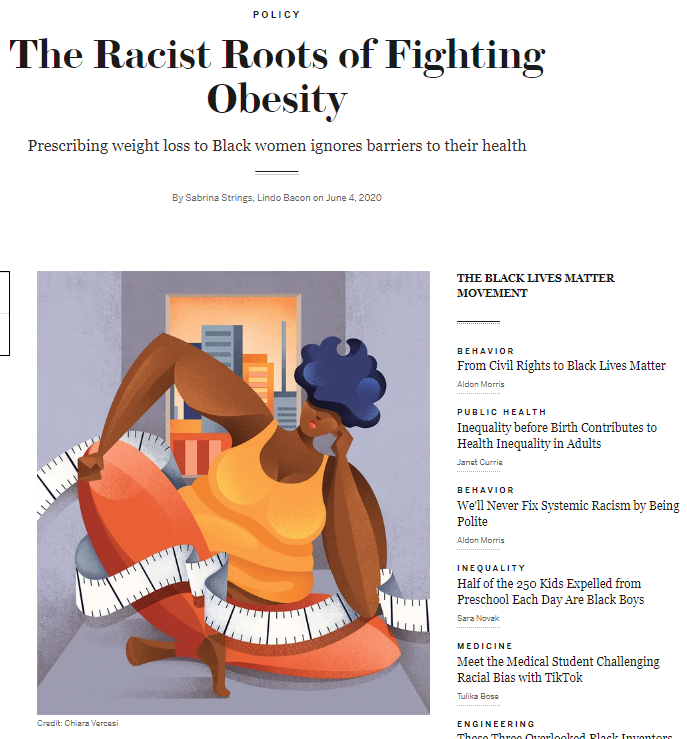
Scientific American magazine has been around since 1845, evolving into a reader-friendly purveyor of hard science, a respected, slightly intimidating denizen of supermarket checkout lines. But judging by the recent ridiculous trend of stories and editorials, it’s been wholly captured by the woke blob.
On the surface the monthly still does what it says on the label in providing long articles, short reviews, and cool photographs for an intelligent audience, with almost-comprehensible stories on the physics of black holes for science buffs, and stunning photos of deep-sea creatures for the rest of us.
But then there’s the ludicrously left-wing ideology that seeps into every issue. A NewsBusters perusal of the contents of each 2022 regular-release monthly issue revealed 34 stories grounded in liberal assumptions and beliefs, nearly three per issue. That’s even after skipping stories with liberal themes that were nonetheless science-based — for example, a cover story on melting glaciers in Antarctica wasn’t included.
Of course, the COVID pandemic in particular tugged the magazine toward government interventionism and the smug rule of health “experts”.
Some of the most bizarrely “woke” material is online-only, with a wider potential reach. The most notorious recent example is a January 6, 2023 opinion piece, cynically seizing on the on-field collapse of a Buffalo Bills player to label the NFL racist: “Damar Hamlin’s Collapse Highlights the Violence Black Men Experience in Football — The “terrifyingly ordinary” nature of football’s violence disproportionately affects Black men“. It’s written by Tracie Canada, who is, no surprise, an assistant professor of cultural anthropology.
So what’s the solution? Surely Canada wouldn’t recommend banning blacks from the National Football League for their own protection?
But plenty of bizarre pieces fill the print edition. Here’s a headline from the July 2020 issue of this purported science magazine: “The Racist Roots of Fighting Obesity“. Yet a June 2019 SA article argued that the nation’s “biggest health problem” was obesity. So is Scientific American, for being concerned about obesity, by its own bizarre standard racist as well?
QotD: The heyday of Victorian newspapers
Now, the principal quality or characteristic of the sellers of patent medicine has always been effrontery, that is to say the blatant insinuation of the false. Thomas Holloway’s innovation was to insinuate such falsehood on a mass or industrial scale. There was hardly a newspaper in which he did not place a weekly advertisement; moreover, he pioneered the advertisement that masquerades as news story. He would ensure that reports of miracle cures in faraway places, supposedly wrought by his pills and ointment, and written as matter-of-factly as possible, were placed in every newspaper, reports whose veracity no one could possibly check for himself, of course.
As Napoleon once said, repetition is the only rhetorical technique that really works — besides which hope and fear render people susceptible to effrontery. In Thomas Holloway’s time, the fear of illness was often, and the hope of cure rarely, justified; at least Holloway’s preparations were unlikely to do much harm (they contained aloe, myrrh, and saffron), unlike the prescriptions of the orthodox doctors of the time. They allowed for the possibility of natural recovery, whereas orthodox medicine often hurried its consumers into their graves. Nevertheless, the claims Holloway made for his ointment and pills were preposterous, and something is not curative just because it fails to kill.
Holloway made an immense fortune by his effrontery and founded a women’s college in the University of London on the proceeds.
Theodore Dalrymple, “The Way of Che”, Taki’s Magazine, 2017-10-28.
February 11, 2023
Americans tend to think other countries are just like America, but with weird accents and quaint clothing
Sarah Hoyt on the common problem Americans (and to a lesser extent, Canadians) have in trying to understand other nations even if they’ve done some international travel:
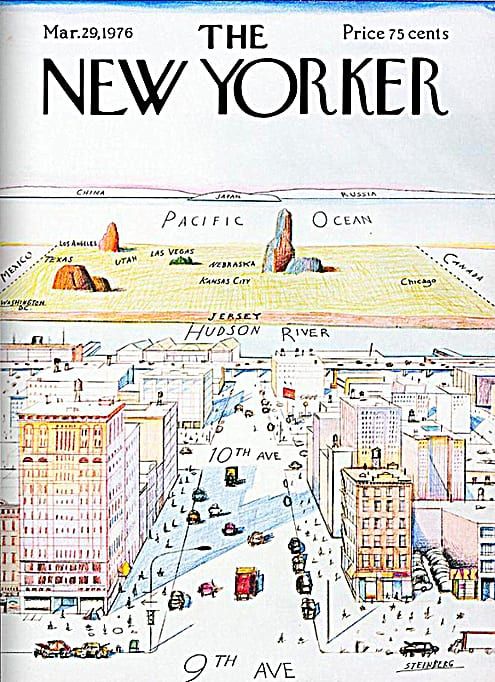
I also see every country, regardless of their history making the assumption that the modus operandi and motives of other cultures and organizations is exactly the same as theirs. I’ve now mentioned about a million times the idiots who went over as Human Shields to Iraq because “they can’t even provide drinking water for their people, how would they have missiles” thereby completely missing the fact that other countries — dictatorships at that — have different priorities than say the US or England, even. In the same way, Portugal assumes that every country is as fraught as corruption as they are. Which works fine for other Latin countries, but fails them when it comes to other places, because as corrupt as we are … yeah. It’s nowhere near there yet. Russia assumes everyone moves, breathes and thinks only about them, and that everyone’s intention is to threaten them or conquer them, because they are obsessed with their dreams of national glory, and they think they should rule the world. And the US by and large goes around like a large vaguely autistic child who really, really, really doesn’t understand how different it is from other nations, or if it does assumes it’s worse.
Look, it’s part of the reason our intelligence services are so sucky. To completely understand what other countries are doing and why, you have to know they have very different cultures. They’re not you. Most countries can sort of extrapolate other countries, but America is so different we suck at it. This is why we tend to think places like the USSR (Russia’s party mask) were totes super powers. Because for America to do and say the things they did and said, we’d have to be very sure of our power. But other countries aren’t America. So we go through the world acting like gullible giants.
In fact Americans have one of the weirder cultures in the world. It’s just not in your face weird as China (whose history reads like they should be extra-terrestrials.) It’s subtle and more in the mental furniture.
Because of this, and because we’re a continent-sized nation, born and bred Americans (as opposed to imports like me) read not just the rest of the world but history hilariously wrong. (The history part is because at least when I went through school here — one year — American schools suck at teaching history. It’s all names and dates, not “Why did France do that?” Yeah, probably not worse than the rest of the world, now that all the books have just-so Marxist explanations, but still stupid.)
I had friends in my writers’ group back when who were writing, say, ancient Egyptian families and couldn’t understand in most of them the teens wouldn’t be/act the same as American teens now. Heck, my dad’s generation in Portugal, less than 100 years ago weren’t “teens” really. Their equivalent was under ten. Because by 12 most of the boys in the village were apprenticed in the job they’d have for life. (And dad was in school, yes, but it was way tougher than even I had.) They didn’t have time. And even I — and you guys know my basic disposition — didn’t sass my parents as American teens do, because there was a deep “fund” of “respect the elders” in the culture. I still have trouble calling people older than I — even colleagues — by their first name.
And then there’s the hilarious — or sad — misunderstandings like the Human Shields mentioned above. It’s sad, because they will buy other countries at face value, but are willing to entertain their own country might be evil. Which is why we have a large contingent of open-mouth guppies who think that the US invented slavery. Even though places around the world still have slavery. Including China, where everyone is a slave, it’s the degree that varies, of course.
The problem is made worse — not better — by idiotic travel abroad.
To understand the differences in a country, you need to live with them, as one of them, for a while. You need to speak the language well enough you understand overheard conversations. Etc.
My experience coming over as an exchange student for 12th grade was about ideal. I lived with an American family, as one of their kids, and attended a school nowhere USA (okay, a suburb of Akron, Ohio) and yeah, I had slight celebrity status in the school — being one of three foreign exchange students — but not that much. So I got to experience the normal life of normal people in normal circumstances, which was an eye-opener.
I always wanted my kids to follow me in this experience, but you know, things got complicated around the time they were of age to do it. So they didn’t. They still have experienced life as an every day foreigner when we visit my parents. In fact the issue there is that they never get past the irritation “What do you mean we can’t do that” and towards “oh, it’s just different. Still sucky, but different.”
Going over for two weeks, with or without the guided tour, staying in nice hotels and associating only with people at your social level and not past the level of polite interaction does not enlarge the mind. Instead, it gives a false sense of knowing what the world is like. This is where we get the “socialists” who know it’s good, because look at all the magnificent buildings in Europe, and the fact everyone has time to sit in the coffee shop and socialize with friends. And look at all the amazing public transportation. And and and. If you lived there, or knew history, you’d know most of the buildings created by socialists in the 20th and 21st century are already crumbling. (Some start before being finished.) You’d know people sit around in coffee shops either because they are unemployed, they pretend to work and their boss pretends to pay them, or all of the above. And all of it is paid for in a significant reduction in lifestyle and just the general comfort of life. (Take it from me. Their lifestyle is two social economic levels down from us, for the same relative “income level.” So, you know, upper class is middle-middle class here.) And you’d know the frustration of waiting for the bus on a rainy, windy day, getting soaked, but the bus is late because all the bus drivers went out for a pint together. And suddenly there’s five of them in a row, but you’re already soaked and starting to cough. More importantly you’d know the public transport only works because everyone works in the city and lives in crowded suburbs, in stack-a-prole apartments, while the countryside is relatively empty. And the people who live there need to buy gas at ridiculous prices, so they can barely afford it.
February 10, 2023
QotD: Before Star Wars or the MCU there was … the Arthurian Narrative Universe
The situation is almost exactly the same as the Marvel Cinematic Universe. We have a major character named King Arthur, but he was linked to numerous spinoffs and sequels. The other heroes connected to him soon established their own brands — including Lancelot, Merlin, Gawain, Tristan, Percival, and many others. Readers who enjoyed one of the heroes, often became fans of others.
If you make a list, the Arthurian Narrative Universe (ANU) has more than fifty protagonists. Not all of them became major brands, but that’s no different from the movie business, where even Disney can’t keep every superhero on the payroll.
Even more to the point, these stories were business initiatives, expected to enrich their owners. It’s hardly a coincidence that the most influential collection of stories about King Arthur in English, Le Morte d’Arthur published in 1485, originated as a profit-making venture by the earliest commercial publisher in Britain.
William Caxton was not only the first person to set up a printing press in England, but also the first retailer of printed books in the country. He acquired the manuscript of Le Morte d’Arthur from Thomas Malory, the Stan Lee of his day, and turned it into the single most influential secular British book between the time of Chaucer and the rise of Shakespeare.
He didn’t do it because he loved English history. (The painful truth is that very little — in fact next to nothing — in the Arthurian tales comes from documented historical events.) He didn’t even publish the book because he loved a good story. Caxton wanted to make a buck — or a pound sterling, I ought to say. He had identified the right brand franchise, much like the Walt Disney Company in the current day, and would milk it for all it was worth.
But here’s the most amazing thing about his brand franchise: Arthurian stories had been circulating in manuscript for more than 300 years at this point. And many of the details in these narratives are much older than that, reaching back to accounts of knights who fought in the Crusades, if not earlier.
We can trace the story of Lancelot and his adulterous romance with Queen Guinevere at least back to 1180. The story of the knights’ quest for the Holy Grail dates at least back to 1190. The first mention of King Arthur is no later than 828 AD.
Stop and consider the implications. King Arthur was the most popular brand franchise in secular narratives when he was 650 years old!
Of course, it was absurd. Nobody undertook knightly adventures of this sort during the Renaissance, but storytellers pretended otherwise. Everything about these narratives was outdated, unrealistic, and repetitive — the people who read these tales didn’t own suits of armor or compete in jousting tournaments. Those things had disappeared from society. But the audience still wanted these stories, so the same plots and characters got recycled again and again.
Ted Gioia, “Don Quixote Tells Us How the Star Wars Franchise Ends”, The Honest Broker, 2022-11-09.
February 9, 2023
QotD: Collecting taxes, Medieval-style
(Note: for a more detailed primer on what this kind of apparatus can look like, check out Wayne Lee’s (@MilHist_Lee) talk “Reaping the Rewards: How the Governor, the Priest, the Taxman, and the Garrison Secure Victory in World History” here. He’s got some specific points he’s driving at, but the first half of the talk is a broad overview of the problems you face as a suddenly successful king. Also, the whole thing is fascinating.)
In a pre-modern society, this task – assembling and organizing the literate bureaucrats you need to run a state – is very difficult. Literacy is often very low, so the number of individuals with the necessary skills is minuscule. Training new literate bureaucrats is expensive, as is paying the ones you have, creating a catch-22 where the king has no money because he has no tax collectors and he has no tax collectors because he has no money. Looking at how states form is thus often a question of looking at how this low-administration equilibrium is broken. The administrators you need might be found in civic elites who are persuaded to do the job in exchange for power, or in a co-opted religious hierarchy of educated priests, for instance.
Vassalage represents another response to the problem, which is the attempt to – as much as possible – do without. Let’s specify terms: I am using “vassalage” here because it is specific in a way that the more commonly used “feudalism” is not. I am not (yet) referring to how peasants (in Westeros the “smallfolk”) interact with lords (which is better termed “manorialism” than as part of feudalism anyway), but rather how military aristocrats (knights, lords, etc) interact with each other.
So let us say you are a king who has suddenly come into a lot of land, probably by bloody conquest. You need to extract revenue from that land in order to pay for the armies you used to conquer it, but you don’t have a pile of literate bureaucrats to collect those taxes and no easy way to get some. By handing out that land to your military retainers as fiefs (they become your vassals), you can solve a bunch of problems at once. First, you pay off your military retainers for their service with something you have that is valuable (land). Second, by extracting certain promises (called “homage”) from them, you ensure that they will continue to fight for you. And third, you are partitioning your land into smaller and smaller chunks until you get them in chunks small enough to be administered directly, with only a very, very minimal bureaucratic apparatus. Your new vassals, of course, may do the same with their new land, further fragmenting the political system.
This is the system in Westeros, albeit after generations of inheritance (such that families, rather than individuals, serve as the chief political unit). The Westerosi term for a vassal is a “bannerman”. Greater military aristocrats with larger holding are lords, while lesser ones are landed knights. Landed knights often hold significant lands and a keep (fortified manner house), which would make them something more akin to European castellans or barons than, say, a 14th century English Knight Banneret (who is unlikely to have been given permission to fortify his home, known as a license to crenellate). What is missing from this system are the vast majority of knights, who would not have had any kind of fortified dwelling or castle, but would have instead been maintained as part of the household of some more senior member of the aristocracy. A handful of landless knights show up in Game of Thrones, but they should be by far the majority and make up most of the armies.
There’s one final missing ingredient here, which is castles, something Westeros has in abundance. Castles – in the absence of castle-breaking cannon – shift power downward in this system, because they allow vassals to effectively resist their lieges. That may not manifest in open rebellion so much as a refusal to go on campaign or supply troops. This is important, because it makes lieges as dependent on their vassals as vassals are on their lieges.
Bret Devereaux, “New Acquisitions: How It Wasn’t: Game of Thrones and the Middle Ages, Part III”, A Collection of Unmitigated Pedantry, 2019-06-12.
February 8, 2023
QotD: How do the “great works of art” become “great”?
That was what got him thinking.
Have you ever fallen for a novel and been amazed not to find it on lists of great books? Or walked around a sculpture renowned as a classic, struggling to see what the fuss is about? If so, you’ve probably pondered the question Cutting asked himself that day: how does a work of art come to be considered great?
The intuitive answer is that some works of art are just great: of intrinsically superior quality. The paintings that win prime spots in galleries, get taught in classes and reproduced in books are the ones that have proved their artistic value over time. If you can’t see they’re superior, that’s your problem. It’s an intimidatingly neat explanation. But some social scientists have been asking awkward questions of it, raising the possibility that artistic canons are little more than fossilised historical accidents.
Cutting, a professor at Cornell University, wondered if a psychological mechanism known as the “mere-exposure effect” played a role in deciding which paintings rise to the top of the cultural league. In a seminal 1968 experiment, people were shown a series of abstract shapes in rapid succession. Some shapes were repeated, but because they came and went so fast, the subjects didn’t notice. When asked which of these random shapes they found most pleasing, they chose ones that, unbeknown to them, had come around more than once. Even unconscious familiarity bred affection.
Back at Cornell, Cutting designed an experiment to test his hunch. Over a lecture course he regularly showed undergraduates works of Impressionism for two seconds at a time. Some of the paintings were canonical, included in art-history books. Others were lesser known but of comparable quality. These were exposed four times as often. Afterwards, the students preferred them to the canonical works, while a control group of students liked the canonical ones best. Cutting’s students had grown to like those paintings more simply because they had seen them more.
Cutting believes his experiment offers a clue as to how canons are formed. He points out that the most reproduced works of Impressionism today tend to have been bought by five or six wealthy and influential collectors in the late 19th century. The preferences of these men bestowed prestige on certain works, which made the works more likely to be hung in galleries and printed in anthologies. The kudos cascaded down the years, gaining momentum from mere exposure as it did so. The more people were exposed to, say, “Bal du Moulin de la Galette”, the more they liked it, and the more they liked it, the more it appeared in books, on posters and in big exhibitions. Meanwhile, academics and critics created sophisticated justifications for its pre-eminence. After all, it’s not just the masses who tend to rate what they see more often more highly. As contemporary artists like Warhol and Damien Hirst have grasped, critical acclaim is deeply entwined with publicity. “Scholars,” Cutting argues, “are no different from the public in the effects of mere exposure.”
Ian Leslie, “The Mona Lisa Effect”, The Ruffian, 2022-10-29 (originally published in Intelligent Life in 2014.
February 7, 2023
Disney – An Empire In Collapse
The Critical Drinker
Published 6 Feb 2023Disney isn’t looking too healthy these days, with massive financial losses, collapsing stock prices and internal power struggles threatening to tear the House of Mouse apart at the seams. How did this happen? Let’s find out.
(more…)
Big Sky fascism, according to the New York Times
In The Free Press, Walter Kirn expresses dismay to discover that he’s been living in a “quasi-fascist” state for 30 years and didn’t even notice until the Grey Lady informed him about it recently:

Just a few weeks back, I sat down with my morning coffee, opened up the paper and learned that I now live in a quasi-fascist state. It said so in the paper.
The paper wasn’t a local publication but one from a couple thousand miles away, the New York Times, whose glossy Sunday magazine included a lengthy, illustrated feature with the five-alarm headline How Montana Took a Hard Right Turn Toward Christian Nationalism. To illustrate the state’s alleged swerve toward neo-fascist theocratic rule — a dire development I’d somehow missed — the story included a scary gothic photo, heavily filtered to bring out its dark tones, of a ghostly white cross on a bare hillside reflected in a passing rearview mirror. It also included, of course, a Yellowstone reference and Kevin Costner’s name — right up top, where the search engines would see them.
Since moving to small-town Montana from New York City over 30 years ago, I’d lived through at least a couple of cycles of ominous national coverage of my state. Without going into the details, let me assure you that this article was bunk, as exaggerated as the photo.
But fiction is fact where Montana is concerned, particularly on the country’s coasts, where tales are told about the country’s interior that the country’s interior lacks the clout to counter, much as our guns lack the range to bring down aircraft. Despite our legendary swagger, Montanans are largely helpless against the country’s more powerful forces. The missiles on our prairies aren’t missiles we asked for, just missiles that formidable others wished to plant here. They make us a target, but we don’t control them.
Do I sound defensive? Perhaps I am.
I live in a state with zero big-league sports teams, not a single Fortune 500 corporation, and no national media influence to speak of — unless you count made-up shows about fake ranchers slugging it out in scripted brawls. I’m one of about a million residents, all of whom, no matter their circumstances, are up against the myth-making machines of cities and states of imperial wealth and numbers. And imperial attitudes, dare I say, which emerge in their basic, perennial story about us: those folks from the steppes and mountains are growing restless, including the ones who’ve just moved there to go skiing, who appear to be worse than the ones already living there, who we’ve always found unsettling enough.
When the spy balloon floated across America, the rest of the country got a taste, perhaps, of Montana’s stoic colonial impotence. For days, we could point, but we weren’t allowed to shoot — great-power diplomacy prevented it. Americans may think we’re tough, as Montanans may think they’re tough, but it seems that we’re tough in the way that actors in westerns are: only with the permission of the director, only symbolically. Down went the balloon on Saturday to much applause, but the spectacle was pure cinema by then, like a fistfight on Yellowstone that draws fake blood.
But at least we proud Montanans kept our honor. We spied the lurking villain, we called the sheriff, we warned our neighbors, we did what we could do. I suspect we’ll continue in this role, watchful vigilantes of the skies. There’s trouble afoot – you can feel it everywhere, particularly if you dwell near nuclear missiles, particularly if you live where there’s no cover — and someone has to stand lookout on the hill.
February 6, 2023
TikTok – threat and menace
At Wrong Side of History, Ed West linked to this post by Gurwinder on the TikTok threat to western civilization:

For thousands of years, humans sought to subjugate their enemies by inflicting pain, misery, and terror. They did this because these were the most paralyzing emotions they could consistently evoke; all it took was the slash of a sword or pull of a trigger.
But as our understanding of psychology has developed, so it has become easier to evoke other emotions in complete strangers. Advances in the understanding of positive reinforcement, driven mostly by people trying to get us to click on links, have now made it possible to consistently give people on the other side of the world dopamine hits at scale.
As such, pleasure is now a weapon; a way to incapacitate an enemy as surely as does pain. And the first pleasure-weapon of mass destruction may just be a little app on your phone called TikTok.
[…]
Other platforms, like Facebook and Twitter, use recommendation algorithms as features to enhance the core product. With TikTok, the recommendation algorithm is the core product. You don’t need to form a social network or list your interests for the platform to begin tailoring content to your desires, you just start watching, skipping any videos that don’t immediately draw your interest. Tiktok uses a proprietary algorithm, known simply as the For You algorithm, that uses machine learning to build a personality profile of you by training itself on your watch habits (and possibly your facial expressions.) Since a TikTok video is generally much shorter than, say, a YouTube video, the algorithm acquires training data from you at a much faster rate, allowing it to quickly zero in on you.
The result is a system that’s unsurpassed at figuring you out. And once it’s figured you out, it can then show you what it needs to in order to addict you.
Since the For You algorithm favors only the most instantly mesmerizing content, its constructive videos — such as “how to” guides and field journalism — tend to be relegated to the fringes in favor of tasty but malignant junk info. Many of the most popular TikTokers, such as Charli D’Amelio, Bella Poarch, and Addison Rae, do little more than vapidly dance and lip-sync.
Individually, such videos are harmless, but the algorithm doesn’t intend to show you just one. When it receives the signal that it’s got your attention, it doubles down on whatever it did to get it. This allows it to feed your obsessions, showing you hypnotic content again and again, reinforcing its imprint on your brain. This content can include promotion of self-harm and eating disorders, and uncritical encouragement of sex-reassignment surgery. There’s evidence that watching such content can cause mass psychogenic illness: researchers recently identified a new phenomenon where otherwise healthy young girls who watched clips of Tourette’s sufferers developed Tourette’s-like tics.
A more common way TikTok promotes irrational behavior is with viral trends and “challenges”, where people engage in a specific act of idiocy in the hope it’ll make them TikTok-famous. Acts include licking toilets, snorting suntan lotion, eating chicken cooked in NyQuil, and stealing cars. One challenge, known as “devious licks”, encourages kids to vandalize property, while the “blackout challenge”, in which kids purposefully choke themselves with household items, has even led to several deaths, including a little girl a few days ago.
The Chinese government — not wishing this kind of insanity spreading among their own people — have ensured that it’s only foreigners getting the full TikTok experience:
Last month FBI Director Chris Wray warned that TikTok is controlled by a Chinese government that could “use it for influence operations”. So how likely is it that one such influence operation might include addicting young Westerners to mind-numbing content to create a generation of nincompoops?
The first indication that the Chinese Communist Party is aware of TikTok’s malign influence on kids is that it’s forbidden access of the app to Chinese kids. The American tech ethicist Tristan Harris pointed out that the Chinese version of TikTok, Douyin, is a “spinach” version where kids don’t see twerkers and toilet-lickers but science experiments and educational videos. Furthermore, Douyin is only accessible to kids for 40 minutes per day, and it cannot be accessed between 10pm and 6am.
Has the CCP enforced such rules to protect its people from what it intends to inflict on the West? When one examines the philosophical doctrines behind the rules, it becomes clear that the CCP doesn’t just believe that apps like TikTok make people stupid, but that they destroy civilizations.
How We Make Our Videos (and what it costs)
World War Two
Published 5 Feb 2023We’re excited to finally answer all your questions about where Indy lives, how we produce the series, and how many of us there are in the TimeGhost Team!
(more…)
February 5, 2023
“[E]very story now assumes ‘white supremacy’ as the core truth of the world”
Andrew Sullivan on the state of the American legacy media in an age of young, woke reporters driving the narrative forward at the expense of any hint of objectivity:

Memphis police officers charged in the beating death of Tyre Nichols.
There are times when I actually feel some pity for the editors in mainstream media. In the last few years, pressured relentlessly by young, super-leftist staffers, they have slowly and then precipitously dropped the goal of objectivity and news in favor of subjectivity and narratives. The struggle against white supremacy has become too urgent for news that may not advance “social justice”. Here’s a glimpse of what the old guard is dealing with, in a leaked transcript of a NYT staff meeting in 2019. An early question from a NYT reporter was:
I’m wondering to what extent you think that the fact of racism and white supremacy being sort of the foundation of this country should play into our reporting. Just because it feels to me like it should be a starting point, you know? … I just feel like racism is in everything. It should be considered in our science reporting, in our culture reporting, in our national reporting. And so, to me, it’s less about the individual instances of racism, and sort of how we’re thinking about racism and white supremacy as the foundation of all of the systems in the country.
And, as you can see every day, this is what the NYT subsequently did. Distilled that year with The 1619 Project (now airing on Hulu!), everything was and is parsed through the lens of critical race/gender/queer theory — from birdwatching to knitting to “literally abolishing the police”. It’s their foundation.
The same ideological fervor swept over the WaPo, of course — right down to the racist birds! And this week, the former executive editor, Len Downie, a near-icon of the old school, published a report on journalism and found a broad consensus among his colleagues that, in the words of one editor-in-chief, “Objectivity has got to go!” So every story now assumes “white supremacy” as the core truth of the world.
So what happens when stories arrive which, on the face of it, seem to refute that entirely? Take three recent events: two mass killings of Asian-Americans within two days in California by an Asian-American (in Monterey Park) and a Chinese national (in Half Moon Bay); five black police officers in a majority-black police force with a black police chief all but lynched and murdered an innocent black man; and a trans woman was convicted of the rape of two other women with the use of her penis.
How on earth do these fit into the pre-arranged “white supremacy” template?
They can’t of course. They reflect a reality far more complex than the crude racial hierarchies beloved of actual white supremacists and woke activists alike. They show individual actors, with a range of possible motives, in unique moments that will always escape predictable narratives. Maybe racial prejudice is present; maybe not; or maybe mixed into a range of other possible factors. You work empirically from the ground up.
But if the facts don’t fit the narrative, you move on quickly to a story that will. So with the Asian-American massacres, after some initial excitement, the MSM lost interest as soon as a white man could not be blamed. (Contrast that with the days-long feeding frenzy over the Atlanta spa massacre, despite zero evidence of any anti-Asian motive from the white killer.) Or they try to force it into their narrative anyway.
“We need to find a couple of big-fish donors who want to see a bunch of vets going out and collecting digital Nazi scalps”
Chris Bray examines the cutting edge of anti-Nazi crusading:
So here’s the most important political story to appear in Rolling Stone since Sabrina Rubin Erdely earned early retirement:
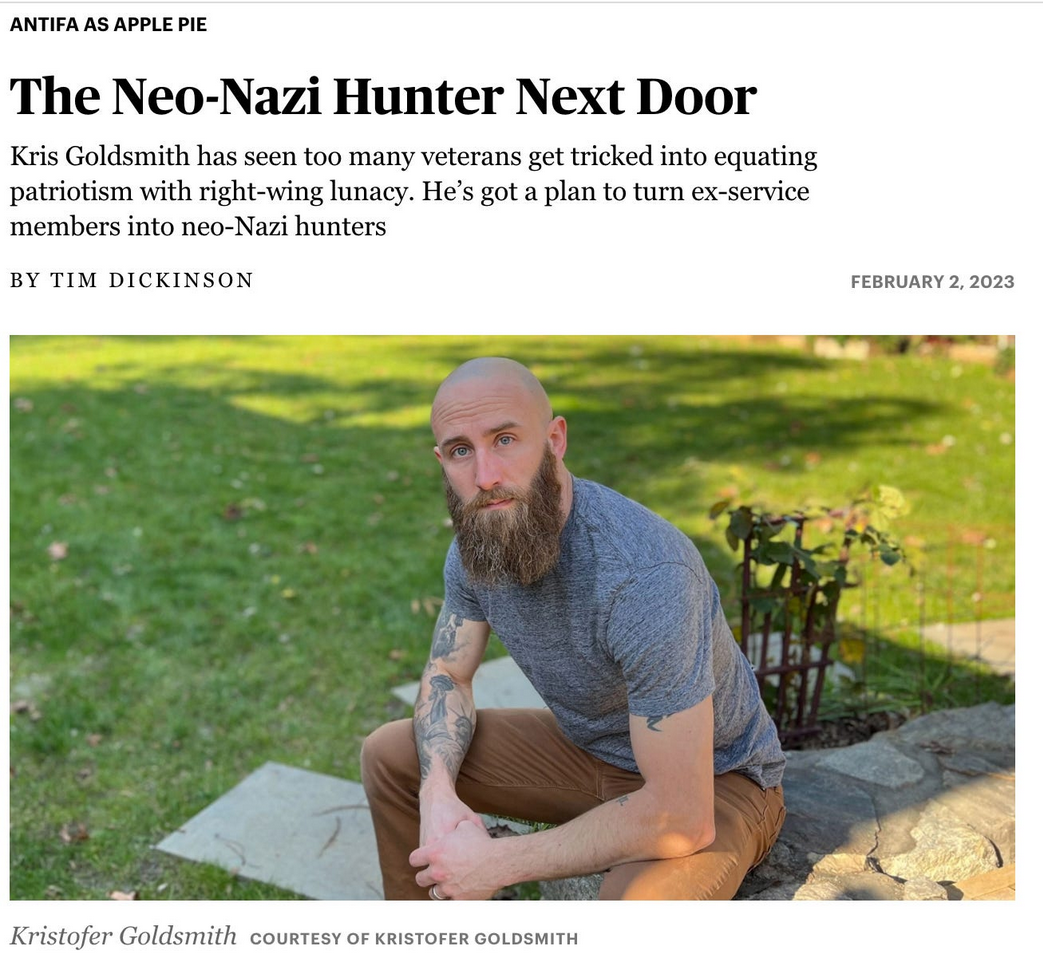
There’s a growing movement of American Nazis, you see, so military veterans are pulling on their boots to fight for their country again, hunting those Nazis and taking them out. But actually reading the story is, pardon me for a moment, a little like hammering a fucking spike into your brain. Every claim self-refutes; paragraph by paragraph, the story tells you X and Not X, side-by-side, with equal authority.
Start with the foundation of the claim. Goldsmith’s work, Rolling Stone explains, “centers on exposing the inner workings and public wrongdoing of neo-fascist groups through deep-dive intelligence reports that can give prosecutors the evidence they need go after the hatemongers in court.” Try to find a definition of “neo-fascist” in the story, though, and you fail. Fascism, it turns out, is being mean. It’s politics for the TikTok era: fascism is haters! Actual fascists thought they believed in the sacredness and centrality of the state, government as the highest form of human expression; the LARPers tracking fascists in 2023 think it means you didn’t contribute to WinBlue last month.
And so Goldsmith says he’s tracking “these people who would literally kill their fellow Americans to install a fascist dictator”, which would be a pretty dire confrontation. Then, making the claim concrete, Goldsmith gets to this description of the Patriot Front, his primary Nazi nemesis:
I have come to understand them as a unique threat against the people of the United States. While they’re a small group — they may have 200, 220 members at any given time — the thing that makes them so dangerous is the cult like atmosphere.
So the headline is a life-and-death struggle between the rising tide of American fascists who are preparing to kill us all and install their Hitler; the story is 200 people — maybe 220! — “at any given time”. Here, by the way, is a leaked Patriot Front training video, so you can see just how terrifyingly dangerous they are:
The only thing the Patriot Front threatens is the retail availability of your favorite product at Dunkin’ Donuts, but let’s go on.
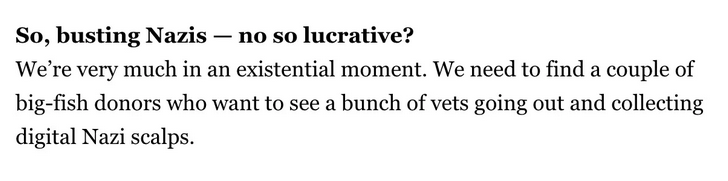
Standing across the battlefield from this terrifying group, the story reveals, Goldsmith & Co. now total a force of “two dozen volunteers”. Then comes this exchange, deep into the Q&A:
Rolling Stone has turned a cosplayers-on-cosplayers circle jerk into the Battle of the Bulge. Compare THE NAZI HUNTER NEXT DOOR to a living room’s worth of unpaid hobbyists who could really turn into something if someone would just, like, give us some money.
Now, the punchline: The NAZI HUNTER is very much having his big media moment, scoring a series of profiles since the start of the year. Here he is being interviewed by the New York Times (where his wife is an editor) in January, for example, under an intro that says he’s hunting “antigovernment” extremists who are fascist. We all remember how the original fascists were passionately anti-government, of course. Hitler, Franco, and Mussolini — big libertarians, all. Hardly wanted to have any government, so people could just hang loose and roll however they chose.
The tediousness of pumping all this sad-sackery into a big national story is exhausting, as is the news media in general. But we need the distraction of Nazis and insurrections, or we’d risk talking about things that are real.

February 4, 2023
“Ghost Riders In The Sky”
Audio Saurus
Published 30 Oct 2015Neil LeVang in 1961 on The Lawrence Welk Show.
February 3, 2023
A spectre is haunting Ontario politics: the spectre of [Shock! Horror!] American-style healthcare!
Everyone in Canada has heard alarming stories of people in the United States being presented with five- or six-figure bills for hospital care, and any hint that one of our provincial healthcare systems might move in that direction scares the pants off almost everyone. Politicians know this well, and salivate at the chance of deploying charges that their opponents favour “American-style” changes to our system because it’s a guaranteed vote-winner. None of it has to be true — very few Canadians know much about US systems aside from the horror stories — but it’s always effective.
In The Line, Harrison Ruess makes the sensible point that there are more healthcare systems in the western world than those of Canadian provinces and our closest neighbour:

Toronto General Hospital in 2005.
Photo via Wikimedia Commons.
First, to be emphatic on this point, we need to be realistic about where our system ranks globally.
It is truly bewildering to me the lengths that otherwise smart and empathetic Canadians will go to to defend the status-quo approach to health care in Canada. The results we get, versus the money we spend, is simply not brag-worthy. The argument that our system works great, if only we threw more money at it, doesn’t stand up to scrutiny.
Is our health care okay? Sure. Decent? Probably. Is it great? Hardly. Could we do better? Yes, much. Do we need to spend more? Maybe a tad, but not likely much, if any. To wit:
According to OECD data, on life expectancy Canada ranks 16th. On mortality rates from avoidable causes, we’re 23rd. On cancer survival rates we range from 13th down to 18th, depending on the cancer type. On the number of one-year-olds vaccinated for diphtheria, tetanus and pertussis, we rank an abysmal 37th (even the U.S. is higher here at 27th. Gulp.). One area where we do rank closer to the top is spending as a proportion of GDP, where we sit seventh.
World Health Organization (WHO) data wasn’t any more flattering, where Canada’s health care ranked 30th in overall performance despite being 10th in spending. The Commonwealth Fund ranks Canada 10th out of 11 in performance and 6th out of 11 in spending. In report after report Canadians aren’t getting the outcomes we need or want based on the money we’re spending on our current system.
Besides for reasons of nostalgia, why would anyone spend their energy defending these sorts of results? “We’re 16th! We’re 16th!” is hardly a chant you’d hear at a rally. It’s time to do better. And I get the feeling most people recognize this – certainly when you get onto Main Street.
Ipsos polling from December 2021 reported that 55 per cent of Canadians are “somewhat satisfied” with their health care, alongside 22 per cent that are “somewhat dissatisfied.” I.e. three quarters of Canadians find themselves in the middle of the road on the quality of our health care. This seems about right — mediocre support for mediocre health care. (The strongly satisfied and strongly dissatisfied were about even, at 12 per cent and 10 per cent respectively.)
But today Canadians are also, rightly, very worried. Leger polling in January 2023 showed that 86 per cent of Canadians are worried about the state of our health care.


