
Published on 3 Jul 2017
Encryption backdoors – breaking WhatsApp and iMessage’s security to let the government stop Bad Things – sounds like a reasonable idea. Here’s why it isn’t.
A transcript of this video’s available here: https://www.facebook.com/notes/tom-scott/why-the-government-shouldnt-break-whatsapp/1378434365572557/
August 12, 2017
Why The Government Shouldn’t Break WhatsApp
Comments Off on Why The Government Shouldn’t Break WhatsApp
August 11, 2017
Penn & Teller on Gun Control
Published on 11 Feb 2013
Penn and teller explain the 2nd amendment in very simple, easy to understand terms. Just the way it was written.
Comments Off on Penn & Teller on Gun Control
August 4, 2017
Harry Potter and the Economic Segregation of Muggles
Published on 3 Aug 2017
Harry Potter contains a ton of incredible lessons about society, authoritarianism, and the power of love and individualism in the face of people who would exclude others based on group identity. But something people don’t think about as much are some of the economic lessons that we can draw from a world segregated into wizards and muggles.
On this episode of Out of Frame, we take a look at what the world might look like if magic and non-magic people were actually allowed to trade and interact with each other without the Ministry of Magic obliviating and arresting people for it.
For a transcript of this episode and more engaging content, visit:
www.FEE.org
Comments Off on Harry Potter and the Economic Segregation of Muggles
August 1, 2017
Ontario adopts voluntary self-surveillance app from CARROT Insights
I often joke about how inexpensive it appears to be to “influence” politicians, but it’s only fair to point out that the voters those easily influenced politicians represent are even more easy to influence:

Ontario announced earlier this month that it will become the fourth Canadian government to fund a behavioral modification application that rewards users for making “good choices” in regards to health, finance, and the environment. The Carrot Rewards smartphone app, which will receive $1.5 million from the Ontario government, credits users’ accounts with points toward the reward program of their choice in exchange for reaching step goals, taking quizzes and surveys, and engaging in government-approved messages.
The app, funded by the Canadian federal government and developed by Toronto-based company CARROT Insights in 2015, is sponsored by a number of companies offering reward points for their services as an incentive to “learn” how to improve wellness and budget finances. According to CARROT Insights, “All offers are designed by sources you can trust like the BC Ministry of Health, Newfoundland and Labrador Government, the Heart and Stroke Foundation, the Canadian Diabetes Association, and YMCA.” Users can choose to receive rewards for companies including SCENE, Aeroplan, Petro-Canada, or More Rewards, a loyalty program that partners with other businesses.
It’ll be interesting if they share the uptake of this new smartphone app … just how many of us are willing to let the government track just about all of our actions in exchange for “rewards”.
In order to use the app, users are giving Carrot Insights and the federal government permission to “access and collect information from your mobile device, including but not limited to, geo-location data, accelerometer/gyroscope data, your mobile device’s camera, microphone, contacts, calendar and Bluetooth connectivity in order to operate additional functionalities of the Services.”
Founder and CEO of CARROT Insights Andreas Souvaliotis launched the app in 2015 “with a focus on health but the company and its partner governments quickly realized it was effective at modifying behavior in other areas as well,” according to CTV News.
July 28, 2017
13 Reasons Jeff Sessions is a @$#/!
Published on Jul 27, 2017
Jeff Sessions is on the ropes with Donald Trump. Good.
The president is pissed because Sessions recused himself from the investigation of Russian attempts to influence the 2016 election. But here are a baker’s dozen of reasons to hate the attorney general, including his obsession with restarting the war on pot, his call to jack up mandatory minimums, and his support for civil asset forfeiture. Then there’s his lack of interest in due process, willingness to subvert state’s rights when they conflict with his desired outcome, and desire to lengthen prison terms for non-violent criminals. Also, he might be some kind of statist elf.
—–
During Sessions’ confirmation hearings, Democrats claimed the former Alabama senator was unfit for office because he was a racist, charges that were never really substantiated. But Sessions’ voting record and policy agenda are more than enough to disqualify him from being the nation’s top law enforcement officer.Mostly Weekly is hosted by Andrew Heaton and written by Sarah Rose Siskind.
Edited by Austin Bragg and Sarah Rose Siskind.
Produced by Meredith and Austin Bragg.
Theme Song: Frozen by Surfer Blood.
Comments Off on 13 Reasons Jeff Sessions is a @$#/!
July 25, 2017
“‘Legal fiction’ sounds better than ‘lie’, but in this case the two terms are near synonyms”
The Instapundit Glenn Reynolds in USA Today on US Attorney General Jeff Sessions’ passion for civil asset forfeiture:
Attorney General Jeff Sessions wants to steal from you.
Oh, he doesn’t call it that. He calls it “civil forfeiture.” But what it is, is theft by law enforcement. Sessions should be ashamed. If I were president, he’d be fired.
Under “civil forfeiture,” law enforcement can take property from people under the legal fiction that the property itself is guilty of a crime. (“Legal fiction” sounds better than “lie,” but in this case the two terms are near synonyms.) It was originally sold as a tool for going after the assets of drug kingpins, but nowadays it seems to be used against a lot of ordinary Americans who just have things that law enforcement wants. It’s also a way for law enforcement agencies to maintain off-budget slush funds, thus escaping scrutiny.
As Drug Enforcement Agency agent Sean Waite told the Albuquerque Journal, “We don’t have to prove that the person is guilty. … It’s that the money is presumed to be guilty.”
“Presumed to be guilty.” Once in America, we had a presumption of innocence. But that was inconvenient to the powers that be.
As Tamara Keel said “Appointing Sessions was the opposite of ‘draining the swamp’; it was basically pumping in a whole bunch of vintage swamp water”
Comments Off on “‘Legal fiction’ sounds better than ‘lie’, but in this case the two terms are near synonyms”
July 22, 2017
Civil asset forfeiture is “an unconstitutional abuse of government power”
At the Hit & Run blog, Damon Root reports on at least one US Supreme Court justice’s strong views on civil asset forfeiture:
Attorney General Jeff Sessions announced this week that the Justice Department will increase the use of civil asset forfeiture, the practice that allows law enforcement officials to seize property from persons who have been neither charged with nor convicted of any crime. “Civil asset forfeiture is a key tool,” Sessions declared. “President Trump has directed this Department of Justice to reduce crime in this country, and we will use every lawful tool that we have to do that.”
But civil asset forfeiture is not a “lawful tool.” It is an unconstitutional abuse of government power. The Fifth Amendment forbids the government from depriving any person of life, liberty, or property without due process of law. Civil asset forfeiture turns that venerable principle on its head, allowing government agents to take what they want without the bother of bringing charges, presenting clear and convincing evidence, and obtaining a conviction in a court of law. It is the antithesis of due process.
By ordering the expansion of this unconstitutional practice, Sessions has placed himself on a collision course with Supreme Court Justice Clarence Thomas. As Thomas recently explained in a statement respecting the denial of certiorari in the case of Leonard v. Texas, not only has civil asset forfeiture “led to egregious and well-chronicled abuses” by law enforcement agencies around the country, but the practice is fundamentally incompatible with the Constitution.
As I described Sessions’ attitude in a post on Gab: “Asset forfeiture now, asset forfeiture tomorrow, asset forfeiture forever!” http://minx.cc:1080/?post=370736. The victims of asset forfeiture tend not to be the druglords or property tycoons … the majority are relatively poor and the asset being taken from them is often their primary financial possession. Druglords and tycoons can easily afford high-powered lawyers … poor people whose life savings have just been seized have no recourse at all in most states. As Senator Rand Paul said: “People who are victims of civil forfeiture are often poor, African American or Hispanic, and people who can’t afford an attorney to try to get the money that’s taken from them by the government”.
Megan McArdle points out that “civil asset forfeiture is […] almost the literal embodiment of that hoary old socialist proverb: ‘Property is theft’:”
Now, this may not seem unreasonable to you. Why should criminals be allowed to keep their ill-gotten gains? And fair enough, except for one small thing: They can take your stuff without charging or convicting you.
Law enforcement agencies have often been able to keep the seized assets for their own use, which has given them a keen interest in generating new civil asset forfeiture cases. As Justice Clarence Thomas remarked, while rebuking his colleagues for failing to hear a case on this topic, “this system — where police can seize property with limited judicial oversight and retain it for their own use — has led to egregious and well-chronicled abuses.” (And indeed, abuse is rampant.)
Because of those well-chronicled abuses, the Obama administration in 2015 ended what was known as the Equitable Sharing program, which allowed local law enforcement to seize assets and then transfer them to the federal government, with the federal government passing back part of the proceeds to the local department. This proved an excellent way to get around state laws, including those intended to funnel seized assets into state coffers. The Obama administration very sensibly decided that it didn’t want to help law enforcement become a sort of freelance tax authority, and shut this practice down.
Now Sessions has revived it. “How is this conservative?” demanded an earnest liberal of my acquaintance. And all I could reply was that that is a very good question.
Comments Off on Civil asset forfeiture is “an unconstitutional abuse of government power”
July 20, 2017
Deirdre McCloskey defines libertarianism as “Liberalism 1.0”
The introduction to her “Manifesto for a New American Liberalism, or How to Be a Humane Libertarian” [PDF] states:
I make the case for a new and humane American “libertarianism.”
Outside the United States libertarianism is still called plain “liberalism,” as in the usage of the president of France, Emmanuel Macron, with no “neo-” about it. That’s the L-word I’ll use here. The economist Daniel Klein calls it “Liberalism 1.0,” or, channeling the old C. S. Lewis book Mere Christianity on the minimum commitments of faith (1942-44, 1952), “mere Liberalism.” David Boaz of the Cato Institute wrote a lucid guide, Libertarianism — A Primer (1997), reshaped in 2015 as The Libertarian Mind. I wish David had called it The Liberal Mind.
In desperate summary for you Americans, Liberalism 1.0 is Democratic in social policy and Republican in economic policy and non-interventionist in foreign policy. It is in fact mainly against “policy,” which has to be performed, if there is to be a policy at all, through the government’s monopoly of violence. (To confirm this experimentally, try not paying your taxes; then try to escape from prison.) Liberals 1.0 believe that having little or no policy is a good policy.
That does not put the Liberals 1.0 anywhere along the conventional one-dimensional left-right line, stretching from a compelled right-conservative policy to a compelled left-”liberal” policy. The real liberals instead sit happily up on a second dimension, the non-policy apex of a triangle, so to speak, the base of which is the conventional axis of policy by violence. We Liberals 1.0 are neither conservatives nor socialists — both of whom believe, with the legal mind, as the liberal economist and political philosopher Friedrich Hayek put it in 1960, that “order [is] … the result of the continuous attention of authority.” Both conservatives and socialists, in other words, “lack the faith in the spontaneous forces of adjustment which makes the liberal accept changes without apprehension, even though he does not know how the necessary adaptations will be brought about.”
Liberals 1.0 don’t like violence. They are friends of the voluntary market order, as against the policy-heavy feudal order or bureaucratic order or military-industrial order. They are, as Hayek declared, “the party of life, the party that favors free growth and spontaneous evolution,” against the various parties of left and right which wish “to impose [by violence] upon the world a preconceived rational pattern.”
At root, then, Liberals 1.0 believe that people should not push other people around. As Boaz says at the outset of The Libertarian Mind, “In a sense, there have always been but two political philosophies: liberty and power.” Real, humane Liberals 1.0 […] believe that people should of course help and protect other people when we can. That is, humane liberals are very far from being against poor people. Nor are they ungenerous, or lacking in pity. Nor are they strictly pacifist, willing to surrender in the face of an invasion. But they believe that in achieving such goods as charity and security the polity should not turn carelessly to violence, at home or abroad, whether for leftish or rightish purposes, whether to help the poor or to police the world. We should depend chiefly on voluntary agreements, such as exchange-tested betterment, or treaties, or civil conversation, or the gift of grace, or a majority voting constrained by civil rights for the minority.
To use a surprising word, we liberals, whether plain 1.0 or humane, rely chiefly on a much-misunderstood “rhetoric,” despised by the hard men of the seventeenth century such as Bacon and Hobbes and Spinoza, but a practice anciently fitted to a democratic society. Liberalism is deeply rhetorical, the exploration (as Aristotle said) of the available means of non-violent persuasion. For example, it’s what I’m doing for you now. For you, understand, not to you. It’s a gift, not an imposition. (You’re welcome.)
QotD: Who was Epicurus?
Epicurus (341-270 B.C.) was a Greek philosopher who claimed the cosmos was eternal and merely material, made up of atoms and void. Yet, breaking with his predecessor Democritus, he considered the universe indeterminate. In the realm of ethics, Epicurus taught that the purpose of human life was the pursuit of happiness, which could be achieved by the measured study of the natural world and adherence to a prudent and temperate hedonism.
He counseled men not to fear their own death, saying,
Foolish, therefore, is the man who says that he fears death, not because it will pain when it comes, but because it pains in the prospect. Whatever causes no annoyance when it is present, causes only a groundless pain in the expectation. Death, therefore, the most awful of evils, is nothing to us, seeing that, when we are, death is not come, and, when death is come, we are not.
He considered friendship as the utmost means of securing wisdom, saying,
Friendship dances around the world, bidding us all to awaken to the recognition of happiness…The same conviction which inspires confidence that nothing we have to fear is eternal or even of long duration, also enables us to see that in the limited evils of this life nothing enhances our security so much as friendship.”
He advised men to avoid vain ambitions such as the pursuit of fame, exorbitant wealth, and political power for their own sake. Rather, he thought wise men would be “strong and self-sufficient” and “take pride in their own personal qualities not in those that depend on external circumstances.”
To Epicurus, pain is a natural evil, pleasure a natural good, with the ultimate pleasure being the absence of bodily pain and tranquility of the mind. From his Letter to Menoeceus:
When we say, then, that pleasure is the end and aim, we do not mean the pleasures of the prodigal or the pleasures of sensuality, as we are understood to do by some through ignorance, prejudice, or willful misrepresentation. By pleasure we mean the absence of pain in the body and of trouble in the soul. It is not an unbroken succession of drinking-bouts and of revelry, not sexual lust, not the enjoyment of the fish and other delicacies of a luxurious table, which produce a pleasant life; it is sober reasoning, searching out the grounds of every choice and avoidance, and banishing those beliefs through which the greatest tumults take possession of the soul.
Nevertheless, because Epicurus claimed the ultimate aim of happiness is to find pleasure – and not virtue or knowledge unto themselves – many of his contemporaries and later critics would uncharitably accuse him of advocating debauchery, one even saying he “vomited twice a day from over-indulgence,” and that his understanding of philosophy and life in general was wanting.
One might hear the very same smear today from mainstream American partisans in regard to libertarians, i.e. that liberty lovers are simply “pot-smoking republicans” or libertines who barely understand life and are too drunk on utopian dreams to see clearly. In this same vein, many reproached Epicurus (as they do of libertarians today) for his aloof stance on politics as apathetic and his notion of justice as too transactional.
“Natural justice is a pledge of reciprocal benefit,” writes Epicurus in his Principal Doctrines, “to prevent one man from harming or being harmed by another.” Elsewhere he writes, “We must free ourselves from the prison of public education and politics.”
Accordingly, Epicurus set up his own school, “The Garden,” where he offered philosophy to anyone, even women and slaves – an unheard of practice at the time, which many contemporary critics saw as proof of his penchant for depraved behavior. Why else would one invite women and slaves into one’s abode other than revelry? Was he actually going to talk to them about ideas?
Thankfully, we have Diogenes Laërtius to defend Epicurus from his detractors:
But these people are stark mad. For our philosopher has numerous witnesses to attest his unsurpassed goodwill to all men – his native land, which honored him with statues in bronze; his friends, so many in number that they could hardly be counted by whole cities, and indeed all who knew him, held fast as they were by the siren-charms of his doctrine…the Garden itself which, while nearly all the others have died out, continues for ever without interruption through numberless successions of one director after another; his gratitude to his parents, his generosity to his brothers, his gentleness to his servants, as evidenced by the terms of his will and by the fact that they were members of the Garden…and in general, his benevolence to all mankind. His piety towards the gods and his affection for his country no words can describe. He carried his modesty to such an excess that he did not even enter public life.
Joey Clark, “What Epicurus Can Teach Us about Freedom and Happiness”, Foundation for Economic Education, 2016-10-18.
Comments Off on QotD: Who was Epicurus?
July 18, 2017
Signs of the libertarian revolution
L. Neil Smith explains how some clearly libertarian trends are being misinterpreted in the latest Libertarian Enterprise:
… primarily as a result of the Internet turning human communications completely sideways, depriving those who have falsely believed they own us of their lofty perches, the 10,000-year-old Age of Authority is ending. Communication between human beings is now lateral, egalitarian, even Tweets from the President, and it doesn’t matter at all how much governments stomp their jackbooted feet or scream and shout. Their kind of social structure is doomed as humanity enters a new era.
One set of consequences of this change is examined, if a bit superficially, in a June article on Breitbart.com by one Liam Deacon, who informs us that a new study finds that “Traditional Views on Same Sex Marriage, Abortion, Pornography [and sex before marriage] in Britain [are] Rapidly Diminishing”. These are trends of the last four years, and to the extent they’ve also occurred long since in America — add in the legalization of marijuana and the increased tendency of individuals to arm themselves against crime and terrorism — it means that most academic and official analyses of socio-political events from, perhaps, the Tea Party Uprising of 2009. through the election of Donald Trump to the triumph of Brexit are dead wrong. We are not undergoing any merely conservative or populist (whatever that means) swing of the pendulum, but an all-out libertarian revolution. I think I know one when I see one: I’ve been doing my best to arrange one for my entire adult life.
According to the study, conducted in 2016, the latest edition of the “British Social Attitudes” survey, resistance from organized Christianity, even the Roman Catholic Church, which used to form a bulwark against social changes like this, is now crumbling, with 64 percent in favor of gay marriage, and 75 percent favoring pre-marital sex. Seventy percent of Catholics believe that abortion is within a woman’s rights. Pornography, too, is now approved by a majority.
Researchers somehow, irrationally, believe that these changes are in opposition to other events, such as “Brexit, Trump, and Le Pen” but they’re wrong. The object in all cases, is self-determination, which is the very heart of libertarianism. Increasingly, people — of all ages, the article observed with a note of amazement — are unwilling to accept dictation from once-respected leaders and traditional social, political, and economic structures. I’d like to believe this is because of the conspicuous failures of authority over the past century or so, but, entirely without condescending — most people are just too busy earning a living and living their lives for theories — I’m not certain that the average person’s thinking is that informed or organized.
More likely, the soap-opera of everyday living has taught them far better than the pompous pronouncements of the fat-heads in power. And for those of us who never believed in Authority, that’s very good news.
Comments Off on Signs of the libertarian revolution
QotD: Where progressives and libertarians agree
Actually, there are four other big areas where the two ideologies converge.
1. Immigration. Immigration restrictions deprive billions of basic liberties, impoverish the world, and do so on the backs of the global poor, most of whom are non-white.
2. Occupational licensing. Licensing laws bar tens of millions of people from switching to more lucrative and socially valuable occupations, all to benefit richer insiders at the expense of poorer outsiders.
3. War, especially the War on Terror. Since 2002, the U.S. has literally spent trillions fighting the quantitatively tiny problem of terrorism by waging non-stop wars in the Middle East. We don’t know what the Middle East would have looked like if the U.S. had stayed out, but it’s hard to believe it would be worse. And there’s no end in sight.
4. The criminal justice system, especially the War on Drugs. Hundreds of thousands of non-violent people, disproportionately poor and non-white, are in prison. Why? To stop willing consumers from doing what they want with their own bodies.
These four issues are so massive, you’d expect a staunch progressive/libertarian alliance would have been forged long ago. But of course it hasn’t. Why not? Some progressives flatly disagree with one or more of these policies; see Bernie contra open borders. But the bigger stumbling block is that progressives place far lower priority on these issues than libertarians. That includes war, unless the Republicans hold the White House.
Why not? I regretfully invoke my Simplistic Theory of Left and Right. The heart of the left isn’t helping the poor, or reducing inequality, or even minority rights. The heart of the left is being anti-market. With some honorable exceptions, very few leftists are capable of being excited about deregulation of any kind. And even the leftists who do get excited about well-targeted deregulation get far more excited about stamping out the hydra-headed evils of market.
Bryan Caplan, “Progressive/Libertarian: The Alliance That Isn’t”, Library of Economics and Liberty, 2017-06-22.
Comments Off on QotD: Where progressives and libertarians agree
July 15, 2017
The Scopes Trial in Dayton, Tennessee
As a long-time admirer of H.L. Mencken (since discovering Prejudices: A Selection in a used book store on Queen Street in the mid-1980s), I’ve always had an interest in the skullduggery around the “Scopes Monkey Trial” … and apparently so has Colby Cosh:
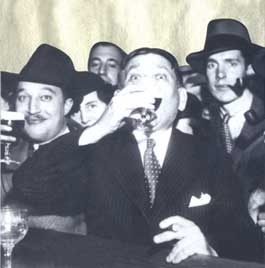
H.L Mencken celebrates the repeal of Prohibition, December 1933.
In a merely procedural sense, the Scopes Monkey Trial in Dayton, Tennessee, ended on July 21, 1925 with the conviction of biology teacher John T. Scopes on the charge of instructing students that “man has descended from a lower order of animals.” But of course the real Monkey Trial is eternal, winding its way anew through American life, decade after decade. The carefully staged publicity stunt in Tennessee was merely one occasion in a longer struggle over the nature of man and the limits of his knowledge. I know this is an old-fashioned romantic ACLU-liberal view of the matter, but I hold to it.
As I write this column, county officials in Dayton are unveiling a statute of Clarence Darrow, the garrulous, crooked lawyer who represented Team Enlightenment in the original 1925 contest between Darwinian evolution and the Scriptures. In 2005, the citizens of Dayton, where Monkey Trial tourism is now a crucial industry, erected a statue of William Jennings Bryan on the grounds of the immortal Rhea County courthouse. Bryan had been the chosen hero of evangelical Christianity in the trial, dying less than a week after its conclusion, and is the namesake of a local bible college, which paid for the statue.
[…]
I became a serious student of the Scopes Trial as an undergraduate. Like anybody else, I had seen the 1960 Hollywood rendering of the play about the trial, Inherit The Wind, which represents Bryan as an ignorant windbag, Darrow as a tired, patient figure of ostentatious nobility, and a thinly disguised H.L. Mencken as a cruel nihilist newspaperman. Today, I suppose I would regard Mencken as the real hero of the show. He was privy to the ACLU’s engineering of the trial as a publicity stunt, but he also always said that Tennessee was within its constitutional rights to forbid the teaching of evolution — to be, in his view, just as backward as its people wished.
Inherit The Wind makes its pseudo-Mencken a heartless guttersnipe mostly as a device for elevating a sympathetic Darrow even further. This is part of the movie’s major liberty with the events of the trial: it has Bryan drop dead in mid-rant at the moment of its culmination, instead of waiting a few days. What I discovered as a student was that, aside from this excusable concession to theatrical unity, the film probably deserves some kind of prize for general fidelity to historical events.
Comments Off on The Scopes Trial in Dayton, Tennessee
July 12, 2017
Someone at the NRA finally speaks out on the shooting death of Philando Castile
Radley Balko on the problems the NRA creates for itself by its reflexive support of the police, which weakens its efforts on upholding gun rights for ordinary Americans:
At long last, someone from the National Rifle Association has spoken up about Philando Castile. Sort of. During a CNN segment, NRA spokeswoman and pundit Dana Loesch said this:
I think it’s absolutely awful. It’s a terrible tragedy that could have been avoided. I don’t agree with every single decision that comes out from courtrooms of America. There are a lot of variables in this particular case, and there were a lot of things that I wish would have been done differently. Do I believe that Philando Castile deserved to lose his life over his [traffic] stop? I absolutely do not. I also think that this is why we have things like NRA Carry Guard, not only to reach out to the citizens to go over what to do during stops like this, but also to work with law enforcement so that they understand what citizens are experiencing when they go through stops like this.
As Jacob Sullum points out at Reason, this is pretty weak stuff. A law-abiding gun owner was shot and killed by a cop after doing everything he was supposed to do. It then took more than a year for anyone from the nation’s largest gun rights organization to comment, and when she did, she offered a vague, heavily qualified, quasi-criticism of the cop while implying not only that Castile contributed to his death but also that he might be alive if only he were carrying an NRA Carry Guard card.
This is about par for the course for the NRA. This is the group that claims to be the only thing preventing the government from obliterating the Second Amendment, yet they’re noticeably quiet about the people doing the most violence to the Second Amendment — the armed, badge-wearing government employees we call law enforcement officers. For all the NRA’s dire warnings about government gun confiscation, the real, tangible threat to gun-owning Americans today comes not from gun-grabbing bureaucrats but from door-bashing law enforcement officers who think they’re at war — who are too often trained to view the people they serve not as citizens with rights but as potential threats. Here, the NRA just doesn’t want to get involved.
[…]
In short, the NRA seems to think we’re at risk of creeping tyranny and abuse of power from all sectors of government except from the men and women armed, badged and entrusted with the power to kill. That’s a problem, because if armed agents who enforce the laws on the ground aren’t required to respect our rights, our rights don’t really exist.
The Supreme Court could rule the NRA’s way on the Castle Doctrine for the next 25 years, but if the police continue to kick down doors with impunity, law-abiding gun owners will be at risk, and the Second Amendment will be more of an empty gesture than a constitutional protection. The Supreme Court could rule the NRA’s way on conceal carry for the next 25 years, but if the organization keeps pushing the line that cops are at war, that the populace is dangerous, and that every citizen is a possible threat, the right to carry a gun in public will always be constrained by cops conditioned to see every weapon as a threat to their existence.
Finally, the Supreme Court could rule the NRA’s way and abolish all the state laws like those that ensnared Shaneen Allen, but as long as the NRA and its allies push rhetoric that makes white people (and white cops) see all crime with a black face, the right to bear arms for people who look like her — or who look like Philando Castile — exist only in theory.
Comments Off on Someone at the NRA finally speaks out on the shooting death of Philando Castile
July 10, 2017
“Jane Jacobs was fatal to conventional wisdom”
In Reason, Sam Staley reviews Vital Little Plans: The Short Works of Jane Jacobs, edited by Samuel Zipp and Nathan Storring, calling it “Jane Jacobs in her own words”:
In her books, articles, and activism, [Jacobs] destroyed the 20th century urban planning groupthink and laid out a radically different way of thinking about cities and society — one that rejected the prescriptive and centralized approach that dominated the planning profession, and one that instead highlighted how decentralized, market-driven decisions lay the foundation for vibrant and sustainable cities.
A journalist rather than an academic, Jacobs worked regular gigs at Iron Age and Architectural Forum and contributed to popular magazines such as Vogue and Harper’s. By the time she took a leave of absence from Architectural Forum to write what remains her most iconic book, The Death and Life of Great American Cities (1961), Jacobs was already starting to acquire a reputation as a fierce critic of conventional top-down planning.
She was not opposed to planning per se. Indeed, she believed small-scale plans were vital to cities’ sustenance. Neighborhood parks were essential to urban vitality, for example, and their location required planning to be successful. But to work, planning — and governance in general — needed to be devolved to the neighborhood level, moving away from large-scale systems that concentrate authority and power. Jacobs was thus an ardent critic of regional planning and regional government. Regionalizing, or “amalgamating,” made city government too far removed from the governed.
[…]
During the 1950s and ’60s, Jacobs used her position at Architectural Forum to examine urban development and redevelopment. Though the magazine championed modernist city planning, Jacobs emerged as one of modern planning’s chief critics during her stint there. Her journey from urban observer to planning critic began, as Zipp and Storring point out, as she examined how buildings, and then cities, worked rather than how they looked or were designed to function.
In the process, she started to develop her critique. “Philadelphia’s Redevelopment: A Progress Report” (July 1955) reviews the city’s redevelopment plans for 10,000 blighted acres. The city avoided large-scale slum clearing — what economist Martin Anderson would call “the federal bulldozer” a few years later — but still targeted large swaths of land for redevelopment using “a busybody concern with what private developers will be up to next.” (It wasn’t all bad, though: She lauded the city for incorporating some neighborhood features that reinforce such institutions as churches, schools, and playgrounds.) Another Forum column discusses the difference between “pavement pounders” — planners who walk around cities and neighborhoods to get a feel for the urban fabric and dynamic — and “Olympians,” those who plan based on maps and statistics. Her appreciation for small businesses as the glue that holds neighborhoods together comes out in “The Missing Link in City Redevelopment” (June 1956), where she laments the tendency to think of businesses merely as storefronts or spaces, not as enterprises that also serve as social centers and community anchors.
Comments Off on “Jane Jacobs was fatal to conventional wisdom”
QotD: The illusion of freedom in America
Being a citizen in the American corporate state is much like playing against a stacked deck: you’re always going to lose.
The game is rigged, and “we the people” keep getting dealt the same losing hand. Even so, most stay in the game, against all odds, trusting that their luck will change.
The problem, of course, is that luck will not save us. As I make clear in my book, Battlefield America: The War on the American People, the people dealing the cards — the politicians, the corporations, the judges, the prosecutors, the police, the bureaucrats, the military, the media, etc. — have only one prevailing concern, and that is to maintain their power and control over the citizenry, while milking us of our money and possessions.
It really doesn’t matter what you call them — Republicans, Democrats, the 1%, the elite, the controllers, the masterminds, the shadow government, the police state, the surveillance state, the military industrial complex — so long as you understand that while they are dealing the cards, the deck will always be stacked in their favor.
Incredibly, no matter how many times we see this played out, Americans continue to naively buy into the idea that politics matter, as if there really were a difference between the Republicans and Democrats (there’s not).
As if Barack Obama proved to be any different from George W. Bush (he has not). As if Hillary Clinton’s values are any different from Donald Trump’s (with both of them, money talks). As if when we elect a president, we’re getting someone who truly represents “we the people” rather than the corporate state (in fact, in the oligarchy that is the American police state, an elite group of wealthy donors is calling the shots).
Politics is a game, a joke, a hustle, a con, a distraction, a spectacle, a sport, and for many devout Americans, a religion.
In other words, it’s a sophisticated ruse aimed at keeping us divided and fighting over two parties whose priorities are exactly the same. It’s no secret that both parties support endless war, engage in out-of-control spending, ignore the citizenry’s basic rights, have no respect for the rule of law, are bought and paid for by Big Business, care most about their own power, and have a long record of expanding government and shrinking liberty.
Most of all, both parties enjoy an intimate, incestuous history with each other and with the moneyed elite that rule this country. Don’t be fooled by the smear campaigns and name-calling. They’re just useful tactics of the psychology of hate that has been proven to engage voters and increase voter turnout while keeping us at each other’s throats.
John W. Whitehead, “Don’t Be Fooled by the Political Game: The Illusion of Freedom in America”, Huffington Post, 2015-08-12.
Comments Off on QotD: The illusion of freedom in America


