
[Libertarians have] always been strong on analysis and criticism. We have our philosophers and economists and historians, and these are among the best. We aren’t wholly without our novelists and musicians and artists. There’s you. There’s Heinlein. There’s Rand. There are many others.
But we haven’t so far put cultural production at the top of our list of things to do. It’s been treated as barely even secondary to uncovering and explaining the workings of a natural order. So far as this has been the case, however, it’s been a big mistake. There’s little benefit in preaching to an audience that doesn’t understand why your message is important.
The socialist takeover of the English mind during the early 20th century was only in part the achievement of the Webbs and J.A. Hobson and E.H. Carr and Harold Laski and Douglas Jay, and all the others of their kind. They were important, and if they hadn’t written as they did, there would have been no takeover. But for every one who read these, there were tens or hundreds who read and were captured by Shaw and Wells and Galsworthy and Richard Llewellyn, among others. These were men who transmitted the socialist cases to a much wider audience.
Just as importantly, where they did not directly transmit, they helped bring about a change in the climate of opinion so that propositions that were rejected out of hand by most thoughtful men in the 1890s could become the received wisdom of the 1940s. They achieved a similar effect in the United States, and were supplemented there by writers like Howard Fast, and, of course, by the Hollywood film industry.
More recently in England, the effect of television soap operas like Eastenders has been immense and profound. Their writers have taken the dense and often incomprehensible writings of the neo-Marxists and presented them as a set of hidden assumptions that have transformed the English mind since 1980. No one can fully explain the Labour victory of 1997, or the ease with which law and administration were transformed even before them, without reference to popular culture.
Though I’ll say outright that she’s never been one of my favourites, there’s no doubt that Ayn Rand was a great novelist and a great libertarian. And there’s no doubt at all that her novels did more than anything else to revive libertarianism in America — and perhaps even in England. But what I’m talking about at the moment isn’t long didactic novels where characters speak for three pages about the evils of central banking. What I do believe we need is good, popular entertainment of our own creation that is based on our own assumptions.
I think the most significant objective propagandist of my lifetime for the libertarian and conservative cause in England was the historical novelist Patrick O’Brian. I’ve read all his historical novels, some more than once, and I don’t think he ever sets out an explicit case against the modern order of things. What he does instead is to create a world – that may once have existed largely as he describes I – that works on different assumptions from our own. If this world is often unattractive on account of its poverty and brutality, its settled emphasis on tradition and on personal freedom and responsibility has probably done more to spread the truth in England than the Adam Smith Institute and the Institute of Economic Ideas combined.
Sean Gabb, quoted in “Wayne John Sturgeon talks to Sean Gabb of the Libertarian Alliance”, Sean Gabb, 2013-08-26.
October 20, 2017
October 13, 2017
October 10, 2017
QotD: The base conditions for democratic society
The absolutely vital elements of a successful democratic component of government (note – component of a system, not the entire system): is that there be a literate population; a free and enquiring press; a well developed and just rule of law; and a tradition of give and take being acceptable to the society.
Tribal societies have none of these things. That is why democracies have consistently failed in African countries where tribalism is still the most important element. (In fact politics in some of these places is still largely a competition between which tribal groups served in the imperial militaries, versus which served in the imperial civil services. With very bloody competition between the two.) The fact that illiteracy is rampant; free presses almost non-existent; and the rule of law where judges are not beholden to tribal interests, or simply threats, doesn’t exist: makes democracy impossible to sustain.
Muslim culture has none of these things. A system where a woman’s evidence in court is one third of a man’s – and dhimmitude is recognized even if slavery officially isn’t – is unlikely to have these things. And for literacy, free press, or rule of law, see Africa, but doubled.
It is also possible to suggest that without a clear understanding of the logic of natural laws, you can’t have a democracy. The fact that Muslim scholarship specifically rejects natural law on the basis that Allah can cause anything, so there are no ‘natural laws’, means you cannot have these things. The reason the Muslim world lost its scientific supremacy of the 11th and 12th centuries relates specifically to their decision to turn their back on empirical evidence. Without that basic understanding, I do not believe democracy is possible. (In fact that basic approach helps explain why democracy is actually anathema to good Muslims, and why Boko Haram literally means ‘Western education is evil’!)
So the concept that an ‘Arab Spring’ could work in the Middle East is a sad indictment on the Western media and ‘intelligentsia’s’ failed understanding about how democracy works.
In fact the entire deluded Western project of attempting to impose ‘republics’ on tribal societies as part of post-colonialism, is an indictment on the western fantasy that republics are workable, let alone good things.
Let’s face it, no western republic, even in the most educated, literate, and rule of law-abiding parts of the Anglosphere, has survived a first century without a collapse and or bloody civil war. The most ‘successful’ Western republics have included the American (see above), French (see above), Weimar (heard of the popularly elected Adolf Hitler?), Italian (50 governments in 50 years), Greek (how’s that brilliant financial planning going?) and Polish (are they on their 3rd, 4th, or 5th?). Those are the good ones. 90% of all republics ever founded in Europe, South America, Asia, Africa, or the Middle East, have collapsed into dictatorship, civil war, mass murder, or ethnic cleansing, within 20 years of being set up.
And that’s what we thought would work in the Middle East?
Nigel Davies, “The ‘Arab Spring’, 1848, and the 30 Years War/s”, Rethinking History, 2015-09-19.
October 5, 2017
Out of Frame: The Real Life Wilson Fisk
Foundation for Economic Education
Published on 5 Oct 2017Wilson Fisk is one of the most terrifying villains in the Marvel universe. Good thing he’s just fictional, right? Wrong!
In this episode of Out of Frame, we explore the real-life Wilson Fisk, a central planner from America’s not so distant past.
Learn more about Robert Moses and his greatest nemesis, Jane Jacobs at FEE: https://fee.org/articles/jane-jacobs/
QotD: Legalizing drugs
It is not the business of the State to tell adults what to do with themselves, or how they interact with other consenting adults. Where drugs are concerned, any disadvantages in leaving people alone are greatly outweighed by the costs of the War on Drugs, which has reduced large parts of the world to violent chaos, and corrupted every law enforcement agency involved in fighting it, and been made an excuse for the destruction of due process rights in England and America.
Sean Gabb, quoted in “Wayne John Sturgeon talks to Sean Gabb of the Libertarian Alliance”, Sean Gabb, 2013-08-26.
October 1, 2017
Deirdre McCloskey on the rise of economic liberty
Samizdata‘s Johnathan Pearce linked to this Deirdre McCloskey article I hadn’t seen yet:
Since the rise during the late 1800s of socialism, New Liberalism, and Progressivism it has been conventional to scorn economic liberty as vulgar and optional — something only fat cats care about. But the original liberalism during the 1700s of Voltaire, Adam Smith, Tom Paine, and Mary Wollstonecraft recommended an economic liberty for rich and poor understood as not messing with other peoples’ stuff.
Indeed, economic liberty is the liberty about which most ordinary people care.
Adam Smith spoke of “the liberal plan of [social] equality, [economic] liberty, and [legal] justice.” It was a good idea, new in 1776. And in the next two centuries, the liberal idea proved to be astonishingly productive of good and rich people, formerly desperate and poor. Let’s not lose it.
Well into the 1800s most thinking people, such as Henry David Thoreau, were economic liberals. Thoreau around 1840 invented procedures for his father’s little factory making pencils, which elevated Thoreau and Son for a decade or so to the leading maker of pencils in America. He was a businessman as much as an environmentalist and civil disobeyer. When imports of high-quality pencils finally overtook the head start, Thoreau and Son graciously gave way, turning instead to making graphite for the printing of engravings.
That’s the economic liberal deal. You get to offer in the first act a betterment to customers, but you don’t get to arrange for protection later from competitors. After making your bundle in the first act, you suffer from competition in the second. Too bad.
In On Liberty (1859) the economist and philosopher John Stuart Mill declared that “society admits no right, either legal or moral, in the disappointed competitors to immunity from this kind of suffering; and feels called on to interfere only when means of success have been employed which it is contrary to the general interest to permit — namely, fraud or treachery, and force.” No protectionism. No economic nationalism. The customers, prominent among them the poor, are enabled in the first through third acts to buy better and cheaper pencils.
[…]
Indeed, economic liberty is the liberty about which most ordinary people care. True, liberty of speech, the press, assembly, petitioning the government, and voting for a new government are in the long run essential protections for all liberty, including the economic right to buy and sell. But the lofty liberties are cherished mainly by an educated minority. Most people — in the long run foolishly, true — don’t give a fig about liberty of speech, so long as they can open a shop when they want and drive to a job paying decent wages. A majority of Turks voted in favour of the rapid slide of Turkey after 2013 into neo-fascism under Erdoğan. Mussolini and Hitler won elections and were popular, while vigorously abridging liberties. Even a few communist governments have been elected — witness Venezuela under Chavez.
September 24, 2017
QotD: Libertarians and Conservatives
‘Who lost the libertarians?” It’s a question you hear a lot from conservatives of late. The reason should be obvious to anyone who has followed the conservative movement’s internecine intellectual frictions over the last decade — or decades. Self-described libertarians are a minority, even among the ranks of people one could properly describe as libertarian. On many, or even most, contentious public-policy issues — economics, gun rights, health care, free speech, regulation, constitutional interpretation — most support for the libertarian position actually comes from people who describe themselves as conservatives. In other words, conservatives tend to be libertarian, but libertarians tend not to be conservative.
And self-described libertarians are very keen on emphasizing that distinction. They justifiably point to the areas, many of them quite significant, where the bulk of libertarians depart from the conservative consensus: foreign policy, drugs, gay rights, etc. Of course, the demarcations between these different camps are not hard and clearly defined. Many conservatives now — and even more in the past — hold the same convictions as libertarians on foreign policy and drugs and, to a lesser extent, on issues such as gay rights. But as a generalization, libertarians want to have their own identity, separate and distinct from that of conservatism. They’re a bit like the Canadians you meet abroad who go to almost obsessive lengths to show everyone that they aren’t American.
Jonah Goldberg, “Fusionism, Sixty Years Later”, National Review, 2015-11-05.
September 19, 2017
Even in a progressive educational bubble, this isn’t correct
Holly Nicholas shared this photo, which is said to be from an Alberta school:
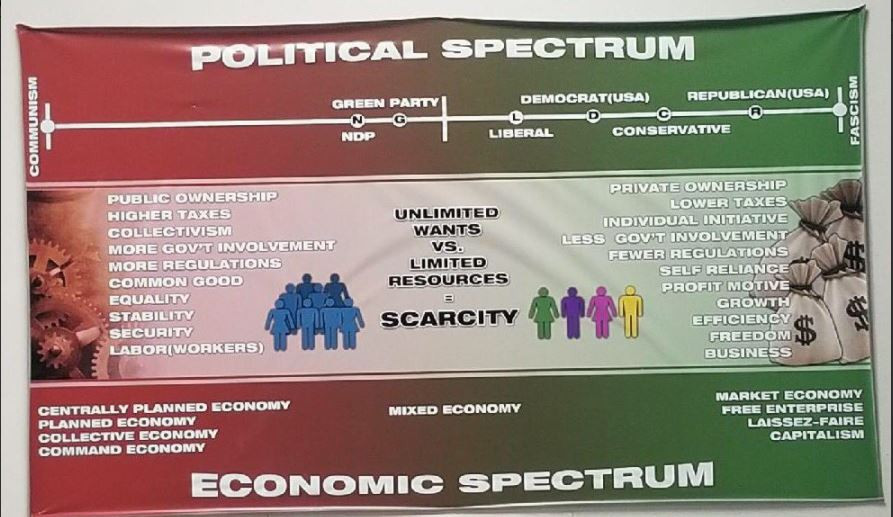
If this is indeed how public schools are presenting the political spectrum (and it’s unfortunately easy to believe that they do), the closest thing to a “centrist” party in Canada is the loony left Green Party … who somehow pip the NDP on the right. The far right end of the spectrum, Fascism, is graphically indicated to be all about “Market Economy, Free Enterprise, and Laissez-Faire Capitalism”, because as we all remember, Hitler and Mussolini were in no way fans of state intervention in the economy, right?
The graphic does, however, support certain shibboleths of the left including implying that libertarians (who are actually in favour of market economies, free enterprise, and laissez-faire capitalism) are in the same economic and political basket as actual fascists. Nice work, faceless agitprop graphic artist!
September 16, 2017
It’s “as if Justin Trudeau had just invented marijuana, and the stuff’s mystical properties are unfamiliar to every police officer in the land”
As the old joke had it, marijuana can cause paranoia, confusion, and total loss of reality in people who’ve never taken them. Canadian police organizations are desperate to keep legal marijuana from becoming a thing:
I cannot be the only one who feels the world is a little upside-down after Wednesday’s hearings on marijuana held by the House of Commons standing committee on health. The day’s proceedings were essentially broken into two parts. First, high-ranking Canadian police came before the committee to complain that they didn’t have the technical resources or the training to deal with legalized marijuana. They pleaded for the passage of the Liberals’ Cannabis Act to be delayed.
Then officials and scholars from the states of Colorado and Washington appeared to talk about their initial experiences with legalized marijuana. The contrast was remarkable. Canadian cops are behaving as if marijuana is a new problem for them—as if Justin Trudeau had just invented marijuana, and the stuff’s mystical properties are unfamiliar to every police officer in the land. The general thrust of the American testimony was not in conflict with the police demand to delay the legislation. Indeed, their major messages included going slow, getting it right, and learning from the history of the pot states. But none of the American witnesses, particularly the Washington and Colorado revenue bean-counters, showed any particular appetite for going back to the days of prohibition.
They could have come to Canada and said, “Oh, God, what are you crazy SOBs thinking?” There was little evidence of any such sentiment. I think it is safe to say that committee members who favour legalization, or who are anything other than implacably hostile to it, must have come away from the testimony broadly reassured.
Washington and Colorado have not descended into a nightmare of chaos because they have legalized “recreational marijuana.” By most social measures these states are about what they were before legalization. Youth use of pot is being watched closely, and it appears to be steady, possibly reduced. The states’ coffers have seen a modest benefit, and some of the money from pot taxation is made available for general drug education and abuse prevention—not just the more intensive outreach to young people about weed.
September 15, 2017
Will Google’s quasi-monopoly last as long as AOL’s did?
In the big picture, I’m concerned with Google’s current market power and their ability to quash online freedom of speech almost at will (if not directly, through pressure on other companies to co-operate, or else: “Nice little business you’ve got here, Mr. Forbes. It’d be a shame if something happened to its Google search results…”). Google is huge and has fingers in an unimaginable number of pies, but it is still subject to market forces, as was an earlier behemoth of the online world:
The film [You’ve Got Mail] was released in 1998. Amazon was founded in 1994 and had its IPO in 1997. It was about to crush big discount bookstores — does anyone still remember the other big chain, Borders? — and nobody had a clue. There isn’t a single mention in the film of Amazon or online sales.
But the Internet is mentioned. It’s right there in the title of the movie. You’ve Got Mail, for those who are old enough to remember, was a tagline for America Online, the largest Internet service provider in the dial-up era of the 1990s. For millennials, let me explain: we had to connect our computers to a phone line, and an internal modem would place a phone call to a local data center from which it could download information at impossibly slow speeds. […]
AOL is there in the film’s title, because that’s how our protagonists are communicating: by trading e-mails on their dial-up AOL connections.
AOL’s high point was its merger with Time Warner in 2000. It was all downhill, rapidly, from there. Dial-up was quickly surpassed by broadband, and as the Web developed, nobody needed a “Web portal” any more. Again, for younger readers, let me explain. When you managed to get to this exciting new thing called the World Wide Web, how did you know what sites to go to or how to access information? Before the Google search, before Facebook, before Twitter, you went to a Web portal, a launching off point that gathered links and directed you to various sources for news, entertainment, shopping, etc. These Web portals had a huge amount of influence — until they didn’t.
Now here’s the fun part. At the same time nobody was paying much attention to Amazon because Barnes and Noble was going to crush all competitors and control the book business, there was widespread panic about the unstoppable monopoly power of AOL.
AOL was going to gain a monopoly because of its death grip on instant messaging. The “computer editor” for The Guardian worried that this was putting AOL “on its way to world domination.” The AOL-Time Warner deal raised “concerns that its merger would create a media powerhouse that would level competitors, dominate the Internet, and control consumer choice.”
A Wired podcast talked about fears of a Sun-AOL monopoly, but they didn’t call that sort of thing a “podcast” yet because the iPod hadn’t been invented. The audio clip was an MP3 file, and they suggested you listen to it on a Sonique MP3 player from Lycos. The Sonique stopped being produced about a year later. Lycos was a major Web portal, and according to Wikipedia, it was “the most visited online destination in the world in 1999.” It was bought by a multinational conglomerate for $12.5 billion at the peak of the dot-com bubble.
Whatever is left of Lycos was last sold for $36 million in 2010, though that deal seems to have collapsed in acrimony later on. Sic transit gloria mundi.
September 12, 2017
Google doesn’t mind flexing its muscles now and again
Yet another instance of Google proving that someone erased the word “Don’t” from their company motto*:
Dear Editors,
You might be interested to learn, that your websites have been almost blacklisted by Google. “Almost blacklisted” means that Google search artificially downranks results from your websites to such extent that you lose 55% – 75% of possible visitors traffic from Google. This sitution [sic] is probably aggravated by secondary effects, because many users and webmasters see Google ranking as a signal of trust.
This result is reported in my paper published in WUWT. The findings are consistent with multiple prior results, showing Google left/liberal bias, and pro-Hillary skew of Google search in the elections.
I write to all of them to give you opportunity to discuss this matter among yourselves. Even if Google owes nothing to your publications, it certainly owes good faith to the users of its search.
* For all I know, Google’s original motto may already have gone down the memory hole: “Don’t be evil“.
September 2, 2017
August 24, 2017
Andrew Scheer’s latest missed opportunity to defend freedom of speech
Chris Selley is disappointed in federal Conservative leader Andrew Scheer’s dropping the ball on defending the right to free speech in Canada:
Last week, headlines proclaimed that the University of Toronto had “barred” from campus a right-wing “group” calling itself the Canadian Nationalist Party, which was planning to hold a rally there despite objections from activists. Asked if this violated the hypothetical Conservative policy, Team Scheer said no. “I respect the right for universities to determine which outside groups they give a platform to,” he told the National Post.
Quite right. In fact, according to U of T, the “party” — which may or may not be one fellow with a website — hadn’t even contacted the university about it. If some random Facebook user announces “Rager at Selley’s Saturday Night,” I have no obligation to stock the bar.
But in the aftermath of the violence in Charlottesville, a Scheer spokesperson went further. Scheer would work with universities “to prevent loopholes for events that risk violating Canadian law,” CBC reported. “(Scheer) is committed to working with the universities to ensure that any policy he brings forward does not become a platform for hate speech,” said the spokesperson.
Sorry, no. That’s hopeless. Any event can be “a platform for hate speech,” if an organizer or attendee decides to make it one. The key, within reason, is that they be given the chance. Team Scheer is all but explicitly endorsing prior restraint: Person X or Group Y might be too dangerous, too likely to utter “hate speech,” for a university to vouchsafe.
As soon as you endorse that idea over a universal defence of free speech up to some reasonable definable threshold — the Criminal Code, say — you’re emboldening precisely the censors Scheer claims to want to take on. Are BDS and Israeli Apartheid Week prima facie hate speech? Is the idea of a superior white race or male gender prima facie hate speech? People disagree; universities are supposed to be free venues for those disagreements.
Meanwhile, Scheer seems to have missed an opportunity to weigh in on a whopper of a free speech dereliction at Ryerson University last week. Citing an inability “to provide the necessary level of public safety for the event to go forward, particularly given the recent events in Charlottesville,” the Toronto university cancelled a discussion concerning … er … “The Stifling of Free Speech on University Campuses.” Activists had vowed to shut down the event; they managed it without even having to close their laptops. Ryerson hasn’t formally been a university for long. A politician who (for better or worse) thinks campus free speech is his business might reasonably propose it shouldn’t be going forward.
August 21, 2017
QotD: The (long-running) decline of written science fiction
The problem with the Rabbits is not that left-wing politics is dessicating and poisoning their fiction. While I have made the case elsewhere that SF is libertarian at its core, it nevertheless remains possible to write left-wing message SF that is readable, enjoyable, and of high quality – Iain Banks’s Culture novels leap to mind as recent examples, and we can refer back to vintage classics such as Pohl & Kornbluth’s The Space Merchants for confirmation. Nor, I think, is the failure of Rabbit fiction to engage most SF fans and potential fans mainly down to its politics; I think the Evil League is prone to overestimate the popular appeal of their particular positions here.
No, I judge that what is dessicating and poisoning the Rabbit version of SF is something distinct from left-wing political slant but co-morbid with it: colonization by English majors and the rise of literary status envy as a significant shaping force in the field.
This is a development that’s easy to mistake for a political one because of the accidental fact that most university humanities departments have, over the last sixty years or so, become extreme-left political monocultures. But, in the language of epidemiology, I believe the politics is a marker for the actual disease rather than the pathogen itself. And it’s no use to fight the marker organism rather than the actual pathogen.
Literary status envy is the condition of people who think that all genre fiction would be improved by adopting the devices and priorities of late 19th- and then 20th-century literary fiction. Such people prize the “novel of character” and stylistic sophistication above all else. They have almost no interest in ideas outside of esthetic theory and a very narrow range of socio-political criticism. They think competent characters and happy endings are jejune, unsophisticated, artistically uninteresting. They love them some angst.
People like this are toxic to SF, because the lit-fic agenda clashes badly with the deep norms of SF. Many honestly think they can fix science fiction by raising its standards of characterization and prose quality, but wind up doing tremendous iatrogenic damage because they don’t realize that fixating on those things (rather than the goals of affirming rational knowability and inducing a sense of conceptual breakthrough) produces not better SF but a bad imitation of literary fiction that is much worse SF.
Eric S. Raymond, “SF and the damaging effects of literary status envy”, Armed and Dangerous, 2014-07-30.
August 15, 2017
Cathy Young talks to James Damore
At Reason Cathy Young interviews former Google employee James Damore, who was fired after an internal memo he wrote criticizing the company’s diversity policies “went viral”:
James Damore, a former software engineer at Google, was suddenly propelled to fame after an internal memo he wrote criticizing diversity policies at the company leaked to the media. The document, sometimes labeled a “manifesto” (and, less kindly, a “screed” and a “rant”), asserted that the gender disparities in tech jobs are at least partly the result of innate differences between the sexes (primarily of women being more people-oriented and less attracted to such work) and that the diversity programs intended to boost the number of women at Google are counterproductive and possibly illegal.
While the document proposed alternative ways to make the workplace at Google more female-friendly, it was widely labeled “anti-diversity” and “anti-woman.” After 28-year-old Damore was identified as the author of the memo, he was fired for “perpetuating gender stereotypes.”
Since then, the controversy has raged unabated — perhaps unsurprisingly, since it touches on many hot-button, polarizing issues from gender equity in the workplace to freedom of speech. A few days ago, I wrote about the debate for USA Today. I interviewed Damore via Google Hangouts text chat on Friday. The transcript has been lightly edited for style, flow and clarity.
Cathy Young: All this must be a little overwhelming?
James Damore: Yes, especially since I tend to be pretty introverted.
CY: Did you think when you wrote the memo, that it could become public at all, let alone as such a huge story?
JD: No, definitely not, I was just trying to clarify my thoughts on Google’s culture and use it to slowly change some of our internal practices.
CY: You’ve mentioned in other interviews that you decided to write this memo after attending a staff meeting on diversity at Google.
JD: Yes, I decided to write my thoughts down after attending a particular “Diversity and Inclusion Summit,” although I had seen many of the problems in our culture for a while.
CY: Who was this summit for? All employees, or employees at a certain level?
JD: It was generally for high level employees in my organization that were interested in diversity efforts.
CY: Does Google have a lot of diversity events? Do any of them have mandatory attendance, or is it primarily for those interested in the issue?
JD: Google has many diversity events, including many during our weekly company-wide meeting (TGIF). They’ve also recently made “Unconscious Bias” training, which is ideologically similar, mandatory for those that want to evaluate promotions, all managers, and all new hires.
CY: You’ve mentioned that the summit that prompted the memo had some material that you found disturbing and offensive. I don’t know how specific you can be, but any examples?
JD: They outlined some of the practices where employees were being treated differently based on their gender or ethnicity at Google and during the hiring process. For example, there’s special treatment during the interviews (like more being given) and there are high priority queues for team matching after an employee gets hired. Also, there were calls to holding individual managers accountable for the “diversity” of their team, which would inevitably lead to managers using someone’s protected status (e.g. gender or ethnicity) during critical employment situations.


