Quotulatiousness

August 19, 2025

Bad laws in Canada must be challenged in court

Filed under: Bureaucracy, Cancon, Government, Law, Media, Politics — Tags: , , , , — Nicholas @ 05:00

At Rigid Thinking, Damian Penny says — and I wholeheartedly agree — that it’s a good thing for laws to be challenged in the courts, but especially when it’s called an “emergency”:

[Retired Canadian veteran Jeff] Evely, with the help of some conservative/libertarian-ish legal organizations, plans to challenge the woods ban in court as a violation of the Canadian Charter of Rights and Freedoms. This is not a popular position here in Nova Scotia (in online discussions, the phrases “Maple MAGA” and the venerable “American-style” come up a lot) and I am not sure he’ll be successful.

But, honestly, I give him credit for trying. In fact, I’d argue his Charter challenge is win-win for everyone in Nova Scotia, whether one supports, opposes or remains indifferent to the policy.

That’s not despite the pressing emergency posed by the forest fire threat, but because of it.

When we’re faced with a crisis, that’s precisely when governments are tempted to seize as much power and authority as possible – and, more importantly, when the public is more inclined to go along with it.

Hence, Trudeau I imposing War Measures Act provisions during the 1970 October crisis, the PATRIOT Act debate after 9/11, COVID-19 restrictions during the pandemic, Trudeau II using the Emergencies Act when the “Freedom Convoy” set up shop in downtown Ottawa, and now Premier Houston (whom I support, despite some misgivings about this issue) using sweeping measures to tramp down the forest fire risk.

And sometimes such powers are justified under the circumstances. Even self-professed libertarians will admit as such when the emergency is something they’re personally worried about, and when a leader from the “good” team is in power.1

But they aren’t always justified. And governments definitely can’t be trusted to handle such power responsibly the longer the “emergency” goes on.


  1. The rise of Trump has allowed many “libertarians” to reveal themselves as authoritarians, but that’s for another post.

August 16, 2025

Britain slides further down the free speech rankings

At The Conservative Woman, Bruce Newsome reports on the parlous state of free speech in the United Kingdom:

SINCE 2021, the Index on Censorship has ranked Britain as “partially open” (the third tier). Britain ranks 20th for press freedom (worse than Trinidad and Tobago).

Just released: The US State Department concludes that in 2024, Britain’s human rights “worsened” and the British government is partial in protecting rights and freedoms: “Significant human rights issues included credible reports of serious restrictions on freedom of expression, including enforcement of or threat of criminal or civil laws in order to limit expression; and crimes, violence, or threats of violence motivated by antisemitism. The government sometimes took credible steps to identify and punish officials who committed human rights abuses, but prosecution and punishment for such abuses was inconsistent.”

There are three main categorical freedoms being routinely violated in Britain. In US Constitutional law, they are known as speech, assembly and press. British authorities need a reminder.

Let’s fully understand how this started, more than 25 years ago. In 1999, the Macpherson inquiry into the 1993 murder of Stephen Lawrence recommended that police should record hateful incidents as a matter of intelligence, even if the incidents were not criminal. Quangos led by the College of Policing encouraged police forces to record non-crime hate incidents (NCHIs). Police took it upon themselves to visit the supposed haters, to “correct your thinking“, to intimidate them with warnings of escalation, and even to strong-arm them into taking thought-correction classes with the police, at cost.

The 2006 Racial and Religious Hatred Act criminalises hatred of protected characteristics. It was once sold as a protection against violence, but was soon wielded to criminalise speech.

Police make more than 30 arrests a day (more than 10,000 per year) for online speech and record 66 non-crime hate incidents per day.

Despite several administrations claiming to review and restrict the definitions of hate speech and NCHIs, the definitions remain too vague to prevent police from repressing speech they don’t like. In 2024, the Free Speech Union submitted freedom of information (FoI) requests to all 43 police forces in England and Wales to see if recording went down since a new code of practice of June 2023. The number has actually increased. This year the current government sneakily signalled its appreciation of NCHIs in response to a petition to abolish them.

The latest statute aimed at free speech came into force on July 25: the Online Safety Act. The Bill was marketed as a necessary legislation to protect minors from harmful material such as pornography, self-harm forums, and bullying towards suicide. Like the Hatred Act, the Online Safety Act is being used to suppress politically inconvenient content.

British public authorities (and social media) are suppressing speech and the press selectively with political, religious and ethnic prejudice.

August 13, 2025

“[A]ll those land acknowledgments weren’t just symbolic: they [were] advance notice”

Filed under: Cancon, Government, History, Law, Politics — Tags: , , , , , — Nicholas @ 03:00

In The Free Press, Rupa Subramanya discusses the — in my opinion, insane — court ruling in British Columbia that invalidated existing land titles in part of the Vancouver area, handing the titles to the properties over to the Cowichan First Nation:

A B.C. Supreme Court judge has granted several First Nations a portion of a 1,846-acre land claim on Lulu Island. B.C. Supreme Court

It turns out that all those land acknowledgments weren’t just symbolic. They may have been advance notice.

When Canada adopted its constitution in 1982, Prime Minister Pierre Trudeau slipped in a ticking time bomb: an explicit recognition of indigenous land rights without constitutional protection for property rights for other Canadians. That constitutional clause has fueled decades of lawsuits from First Nations — Canada’s indigenous people — asserting claims to huge portions of their ancestral territories.

Last Thursday, the British Columbia Supreme Court ruled that the Cowichan Nation holds “Aboriginal title” to about 1,846 acres of land on the south shore of Lulu Island in Richmond, and constitutionally protected rights to fish in the south arm of the Fraser River.

This 275,000-word judgment doesn’t just affect government-owned lands. It also includes private property now owned by third parties. So if you’re a Canadian who is a property owner in British Columbia and not indigenous, your claim on what you think you own has just been superseded by indigenous claims, called a “senior” claim in legalese. Down the road, your land or house could be expropriated by the federal government and turned over to an indigenous group that claims ownership.

That has already happened in Ontario, where three northern Ontario First Nations claimed in a lawsuit last month that a 14-acre public park in Kenora called Anicinabe Park is actually unceded territory and should be returned.

“In constitutional terms, aboriginal rights trump private property rights,” Bruce Pardy, a professor of constitutional law at Queen’s University in Kingston, Ontario, told me. He pointed to last November’s ruling by a New Brunswick judge that the court might be in position to order the government to seize private property and turn it over to an indigenous group making a claim on it.

As Prime Minister Mark Carney tries to fast-track major infrastructure projects — roads, bridges, pipelines, power plants, and more — all part of his plan to boost Canada’s global competitiveness and reduce reliance on the U.S., some of those ambitions might be snarled by indigenous land claims that take years to resolve. The British Columbia case began in 2019 and is considered to be the longest trial in Canadian history.

The day before the Cowichan Nation ruling in British Columbia, a Yukon First Nation announced that it would oppose all new mining claims on its traditional territory while a regional land-use plan is developed. Yukon First Nations leaders said that new claims are “unwelcome” and “unlawful”, and that they plan to challenge the mining industry to protect the land from further industrial activity.

Stefan Labbé in BIV last week:

A B.C. court has handed the Cowichan Tribes and other First Nations title over a chunk of federal and city land in Richmond that for centuries was used as a winter fishing village, before colonial administrators evicted the people who lived there.

The landmark Aug. 7 ruling was handed down after more than 500 days of litigation before the B.C. Supreme Court.

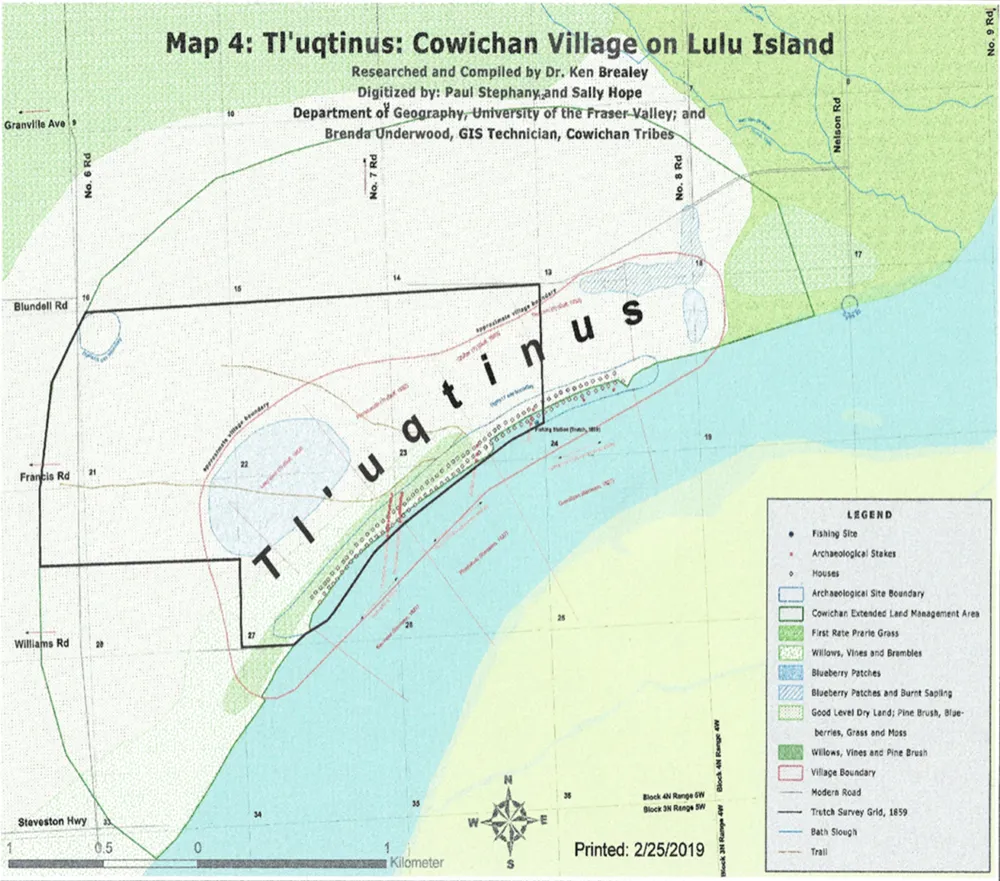
It gives the Cowichan Tribes, the Stz’uminus First Nation, Penelakut Tribe, Halalt First Nation — as well as the Lyackson First Nation in a supporting role — Aboriginal title over the Tribes’ historic Tl’uqtinus village on the southeast side of Lulu Island.

The ruling also gives the First Nations fishing rights at the mouth of the Fraser River.

In a joint statement, the First Nation plaintiffs said: “We raise our hands to the generations of leaders” who fought for the return of the Tl’uqtinus village lands and their fishing rights in the Fraser River.

B.C. Supreme Court Justice Barbara Young suspended her decision for 18 months “to allow for an orderly transition of the lands” in keeping with the principle of reconciliation.

“Now that this multi-year journey has concluded, it is my sincere hope that the parties have the answers they need to return to negotiations and reconcile the outstanding issues,” she wrote.

Jamie Sarkonak in the National Post wrote on Monday:

This case of “land back” in action (Cowichan Tribes v. Canada) casts a shadow over the country’s property system. It jeopardizes the default means of owning land in Canada — the estate in fee simple, where owners have exclusive rights to sell land — wherever Aboriginal title is found to exist.

Aboriginal title is the right of an Indigenous group to use, control and reap benefits from the land. It’s granted to claimant groups that can prove they are descended from the sole occupants of an area at the time the British asserted sovereignty. Unlike regular fee simple ownership, it’s enshrined in Section 35 of the 1982 Constitution and impossible to sell to anyone but the Crown.

The Cowichan claim covered the site of their summer village near the mouth of the Fraser River, where they had established continuous, exclusive seasonal occupancy dating back to European contact in the 1790s.

In 1846, the British Crown asserted sovereignty over that land and the rest of what would become B.C. The following years would see property being surveyed and auctioned off to public and private buyers — but not the Cowichan summer village. Instead, it was set aside in 1860 and continued to be used as a settlement for the group. Colonial officials considered the possibility of making it into a reserve, and took initial steps to do so. After B.C. joined Canada in 1871, however, the summer village was carved into parcels and sold over the years until 1914. Purchasers included private parties (including “well-placed men” in the colony) and even the municipality itself; some of the land purchased privately would eventually be sold back to the Crown. Today, about half of these lots are held by public bodies, with the other half falling under private ownership.

A map shows the Cowichan title lands outlined in black. (B.C. Supreme Court) Photo by B.C. Supreme Court

The question before the B.C. Supreme Court was whether the taking of those village lands was legal to begin with. Justice Barbara Young (a Harper appointee, by the way) concluded it was not.

August 12, 2025

Britain warns online platforms about “overzealous” interpretation of online safety law

“Ben the Layabout” posted a note over at Founding Questions linking to a Telegraph article [archive.ph link] that seems to indicate the British government is demanding that online services both enforce the letter of the law and the spirit … whatever that might mean at any given moment in time:

Social media giants face huge fines for curbing free speech by “overzealous” enforcement of online safety laws.

Ministers have told platforms including Facebook, X, Instagram and TikTok they must not restrict access to posts that express lawfully held views.

The warning, in an apparent change of tone from ministers, comes amid a backlash over websites blocking users from viewing material, including parliamentary debates about grooming gangs.

Campaigners have said that free speech is threatened by the Government’s application of the Online Safety Act, which is meant to protect children from harmful content.

JD Vance, the US vice-president, used a visit to the UK this week to warn ministers against going down the “dark path” of censorship.

Whitehall sources have expressed concern that social media firms, some of which have criticised the law, “have been overzealous” in enforcing it and must be “mindful” of the right to freedom of expression.

The Science Department, which oversees the legislation, told companies they could face fines if they failed to uphold free speech rules.

A spokesman said:

    As well as legal duties to keep children safe, the very same law places clear and unequivocal duties on platforms to protect freedom of expression.

    Failure to meet either obligation can lead to severe penalties, including fines of up to 10 per cent of global revenue or £18m, whichever is greater.

    The Act is not designed to censor political debate and does not require platforms to age gate any content other than those which present the most serious risks to children such as pornography or suicide and self-harm content.

    Platforms have had several months to prepare for this law. It is a disservice to their users to hide behind deadlines as an excuse for failing to properly implement it.

So online sites big and small are required to obey the British law, but only as and how the British government wants it enforced or they’ll levy massive punishment. Too lax? Punishment. Too strict? Also punishment. It’s almost as if Britain wants to be cut off from the rest of the internet …

August 10, 2025

“Believe all women” especially when they imagine (or hallucinate) offense

Filed under: Cancon, Law, Media, Politics — Tags: , , , , — Nicholas @ 05:00

An excerpt from a work-in-progress by James Pew, from an incident during the heydey of #MeToo hysteria in the Toronto media community:

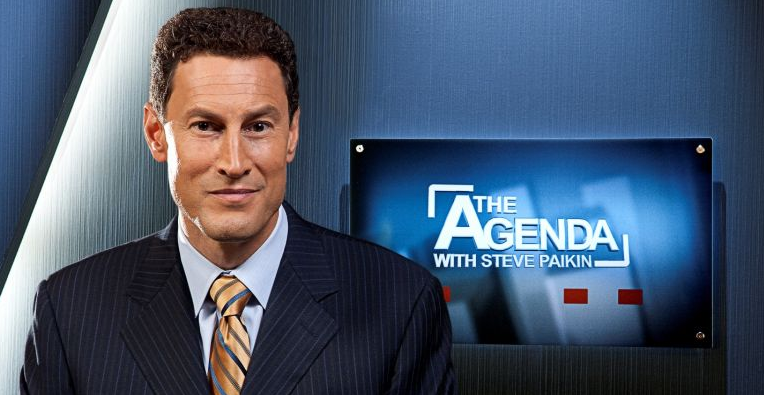
Steve Paikin is a Canadian journalist and author, and the host of TVOntario’s acclaimed flagship program, The Agenda With Steve Paikin. In his brush with #MeToo infamy, Paikin was accused of asking for, or possibly suggesting sex with a woman (who had previously appeared on his show), while at a business lunch with her at Grano restaurant in Toronto. The woman, a former Toronto Mayoral candidate who has a record of previous unsubstantiated claims against former Toronto Mayor Rob Ford, claims to have “politely” declined Paikin’s request, but said she was not invited back on his show because of her refusal to have sex with him.

The Paikin scandal was different from others which had unfolded in the hazardous year of 2018. This was a #MeToo story where the public appeared interested in both sides. Were chinks in the #MeToo armour beginning to appear? As Joe O’Conner wrote in the pages of the National Post, there was “an accusation and a vociferous denial”.1 But similar to other #MeToo narratives, the accuser was reaching deep into the past. According to Sarah Thomson, Paikin’s unwanted proposition for sex occurred in 2010.

Defending himself on Facebook, Paikin called the allegations a “complete fiction”. He wrote: “To be clear, I did not have sex, suggest, request, imply, or joke about having sex with you (Sarah Thomson)”.

Paikin had been a supporter of #MeToo. He wrote that “The #MeToo movement is too important to be undermined by spurious allegations”. Did he not realize that #MeToo means “believe all women”? Aren’t spurious allegations the type we are not supposed to believe? Wouldn’t that mean that women don’t (or can’t) make spurious allegations, but only the type of allegations that must be believed unquestioningly? Didn’t Paikin realize the contradiction in thinking that #MeToo was important, but in his case it was acceptable to cast off its intrinsic blanket credulity concerning the abuse claims of women? Paikin wrote:

    Sadly, in this day and age, too many people are going to believe the lie, especially when it comes to this subject. I am mortified that in many peoples’ eyes, I have lost the presumption of innocence that I’ve previously enjoyed. But I did not do these things. There is simply no truth to these allegations.2

Surprisingly, TVO did not remove Paikin, but launched an investigation instead. In a piece published in the Globe and Mail called “The Humiliation of Steve Paikin”, Margaret Wente wrote, “Mr. Paikin was lucky not to be suspended, people say. Some luck. His name is in the headlines, generally on the same page as all the other #MeToo stories that now dominate the news. I imagine that most people who know him don’t believe a word of it. Others will think, ‘These days you never know’.”3 A fair assessment. Wente later points out “Women (just like men) lie for all kinds of reasons, including the fact that they are unbalanced or unhinged.” However, it should be pointed out that in the #MeToo era and since, women do not get cancelled and humiliated because a man (or men) made unsubstantiated allegations against them.

The most suspicious part of the story is that Thomson’s assistant was present at the lunch meeting when Paikin supposedly propositioned her. Who would do such a thing as Paikin was accused in the presence of other people? Thomson did not provide the name of her assistant, and no investigative journalists were able to find out who she was. A critical detail appeared to go uncorroborated. However, the independent investigator tracked her down and conducted an interview. Her testimony was essential to clearing Paikin, although she chose to remain anonymous.

By April of 2018, the independent investigation into the allegations against Paikin was complete. It was found that while Thomson genuinely believed that Paikin had propositioned her “the evidence brought forward by Thomson and others (did) not support her account of what happened”.4 Rachel Turnpenney, the lawyer who conducted the investigation, referred to Thomson’s former assistant as “Witness J” – whose testimony contradicted Thomson’s account. Witness J told investigators that Paikin did not proposition Thomson or make any inappropriate sexual comments during the lunch.

But even if the allegations were true, was what Paikin alleged to have done really so bad? Aren’t men taught to ask for consent? Isn’t that what “propositioning” Thomson would have been? It could be argued, had the allegations turned out to be true, that Paikin demonstrated inappropriate, perhaps insensitive conduct. Clearly it would have been poor judgement, but should a man like Paikin be fired for a slip in judgement where no crime occurred? In hypothetical defense of a mis-step that never occurred, is it not possible to argue that a man might misread body language or other signs from a woman, and interpret them as mutual sexual interest? Getting this wrong can be embarrassing for both parties involved, but does it meet the severity of a cancellable offense? As Margret Wente wrote, “The truth is that not all men are guilty of what they’ve been accused of, and others aren’t that guilty of very much”.

But the social justice contingent is obsessed with power dynamics. According to them, any man who holds a professional position elevated over a woman he is attracted to, will automatically use his power to coerce the woman for sexual favours. In spite of the high-profile example in figures such as former American movie mogul Harvey Weinstein, it is insane to assume this is the default position of successful men, or men in places of authority or influence, just as it is insane to believe all women unconditionally.

Turnpenney felt that while Paikin’s testimony was consistent and credible, Thomson made “leaps without sufficient evidence to do so and she linked evidence together without factual foundation. Thomson’s evidence also veered toward being exaggerated and untrue.” Even though Paikin was ultimately exonerated, he was humiliated by the experience. In the initial statement he made defending himself, he characterized Thomson’s actions as defamatory. However, lucky for Thomson, Paikin chose not to sue. Thomson paid no penalty for all the trouble she caused, and most people felt Paikin was fortunate to have dodged a #MeToo bullet. As of this writing, Steve Paikin is still the host of The Agenda.


Nova Scotia rediscovers the joys of dictatorial power

Filed under: Cancon, Government, Law, Liberty — Tags: , , , , — Nicholas @ 03:00

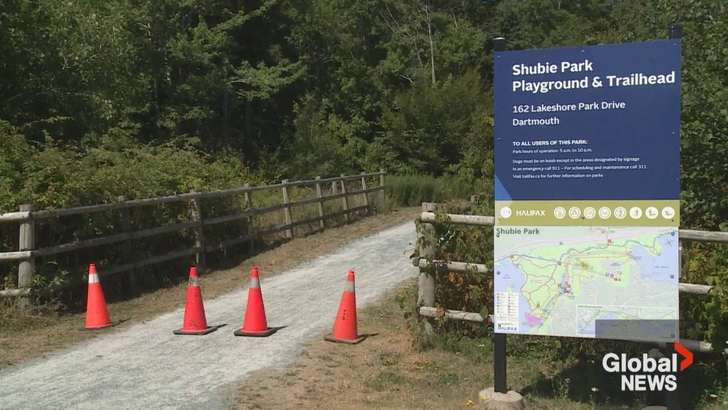
Clearly hankering for those glorious days when Canadians cowered in their homes due to the government’s public health diktats, Nova Scotia has now banned almost all outdoor activities in wooded areas across the province:

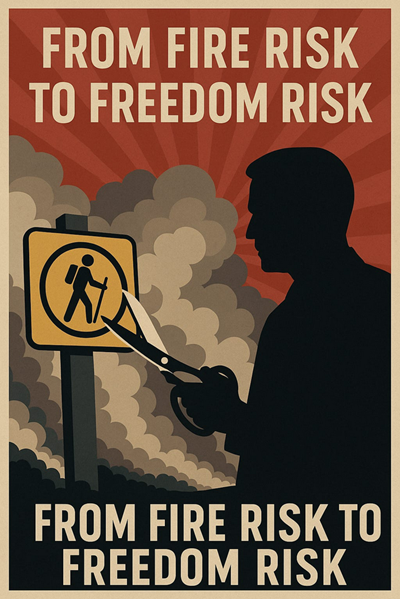
Image from Junk Economics

Nova Scotia’s Premier has decided that walking in the woods — yes, walking — is now so dangerous it carries a $25,000 fine.

Not for lighting a campfire. Not for running your ATV through dry brush. Not for tossing a cigarette. Just walking. In a province where there are currently four active wildfires … all under control.

This is not about preventing wildfires. This is about the politics of safety — and how governments turn fear into obedience.

I was born in Halifax, and my family’s roots run deep in Nova Scotia — deeper than the roads and towns that stand there now. Generations of my parents, grandparents, and great-grandparents — along with uncles, aunts, and cousins — are buried in its soil. My family weathered centuries of storms, wars, and political upheavals there, carving out a life from raw wilderness. This isn’t some detached policy rant from a distance. It’s personal. And it’s infuriating to watch a government use “safety” as a smokescreen for inaction, punishing people for living their lives while leaving the real problem unsolved.


The Problem They Didn’t Solve

In 2023, Nova Scotia suffered its worst wildfire season in history. At the time, the province had four Airbus H125 helicopters to fight fires.

In 2025, after all the smoke cleared and the “lessons learned” speeches were made, Nova Scotia … still has four Airbus H125 helicopters. Newer paint jobs, slightly upgraded safety features, same firefighting capacity. No fixed-wing aircraft. No surge ability. No major investment in manpower or pre-positioned crews.

The province didn’t fix the problem. They just hit refresh on the equipment list.

[…]


The Legal Overreach

The ban covers 89% of provincial land (Crown land) plus private forested land. Even if you own it, you can’t invite your mother over to walk her dog in your woods.

Section 7 of the Charter protects liberty, and the Forests Act was never intended to give cabinet the power to impose a province-wide walking ban. That’s legislative overreach wrapped in administrative convenience.

And the $25,000 fine? Grossly disproportionate — and in practice, quietly plea-bargained down because it’s more for optics than enforcement. A scarecrow penalty to make the Premier look tough on camera.


The Snitch Line and the COVID Flashback

Just like pandemic tip lines, Nova Scotia has invited citizens to report on each other for the crime of going for a picnic.

It’s hard to overstate how corrosive this is: encouraging suspicion, legitimising neighbour-against-neighbour policing, and normalising the idea that the government can criminalise any movement it decides is risky.

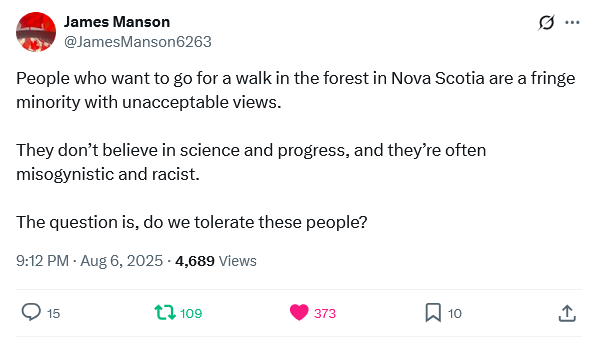
Of course, the commentariat is having a wonderful time of it:

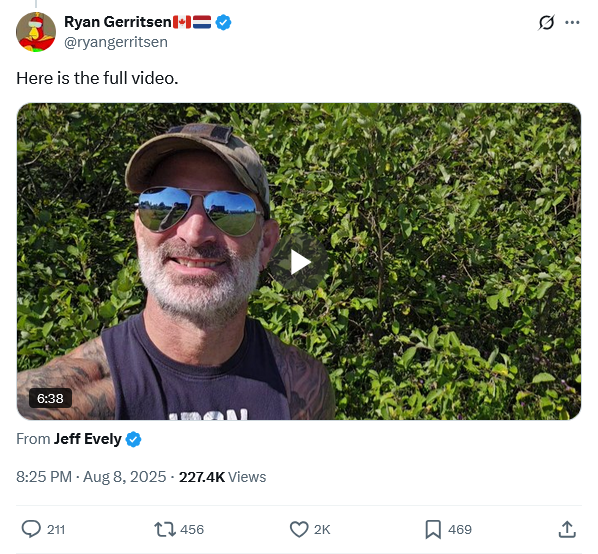
And what may be the first issued fine under the provincial ban went to Jeff Evely:

August 5, 2025

Will the courts take away Tariff-master Trump’s favourite toy?

Filed under: Government, Law, Politics, USA — Tags: , , , — Nicholas @ 03:00

President Donald Trump’s second term in office has been dominated by his capricious and seemingly random deployment of tariffs as a bludgeon to intimidate and coerce America’s allies and enemies alike. In Reason, J.D. Tuccille considers the possibility of the courts taking away the one tool Trump has been using to get his own way in trade negotiations:

Everybody with a brain knows that tariffs are taxes. And they know that tariffs imposed on goods imported to the United States are largely paid by American businesses and consumers. The big question is whether tariffs unilaterally imposed by President Donald Trump under creative interpretations of emergency executive powers will withstand a federal court challenge. So far, the signs are promising for those hoping that a law intended to rein in the power of the presidency will not be read to permit the president to set trade policy of his own accord.

As CBS News reported this week, the U.S. Court of Appeals for the Federal Circuit in Washington, D.C. heard “oral arguments on Thursday in V.O.S. Selections v. Trump, a case brought by five small business owners and 12 states who allege they have been harmed by President Trump’s import taxes. V.O.S., the lead plaintiff in the case, is a New-York based wine importer.”

Representing the plaintiffs is the free-market Liberty Justice Center, along with co-counsel Ilya Somin, a law professor at George Mason University’s Scalia Law School. The plaintiffs are challenging the Trump administration’s invocation of the International Emergency Economic Powers Act (IEEPA) as the basis for the “Liberation Day” tariffs on much of the world as well as related tariffs on Mexico, Canada, and China.

A Law Intended To Trim Presidential Power, Not Expand It

The plaintiffs maintain that “under that law, the President may invoke emergency economic powers only after declaring a national emergency in response to an ‘unusual and extraordinary threat’ to national security, foreign policy, or the U.S. economy originating outside of the United States. The lawsuit argues that the Administration’s justification — a trade deficit in goods — is neither an emergency nor an unusual or extraordinary threat.”

What’s interesting is that Congress passed IEEPA not to expand presidential power, but to restrict it. According to a 2024 Congressional Research Service report, “following committee investigations that discovered that the United States had been in a state of emergency for more than 40 years, Congress passed the National Emergencies Act (NEA) in 1976 and IEEPA in 1977. The pair of statutes placed new limits on presidential emergency powers”. Under these laws, presidents are required to assess emergencies on an annual basis, extend them if necessary, and report on their status to Congress.

“Some experts argue that the renewal process has become pro forma“, the report acknowledges. “History shows that national emergencies invoking IEEPA often last nearly a decade, although some have lasted significantly longer — the first state of emergency declared under the NEA and IEEPA, which was declared in response to the taking of U.S. embassy staff as hostages by Iran in 1979, is in its fifth decade.”

August 4, 2025

QotD: The impeachment of Andrew Johnson

Filed under: Government, History, Law, Politics, Quotations, USA — Tags: , , , , — Nicholas @ 01:00

Over the past few weeks, it has surprised me how seldom the name Andrew Johnson has come up. Sure, every time it has been mentioned that Donald Trump is the third (or fourth — or third and a halfth) President to be impeached, Johnson, the first, is given a brief mention, but very few details are offered of a story almost as stupid, insane, villainous, and corrupt as what’s going on now.

Almost.

I am greatly obliged to my old friend revisionist historian Jeffrey Rogers Hummel, who encouraged me to look into the Johnson impeachment. Johnson was the 17th President of the United States, rising to that office when his predecessor, Abraham Lincoln, was assassinated. Johnson had been a southern Democrat Senator, unjustly reviled by both sides, but remained in the Senate throughout the War Between the States and was chosen by Lincoln to help spread the appeal of a crypto-Republican “National Union” party dedicated to the peaceful and humane reintegration of those states that had seceded and been militarily crushed.

Lincoln’s Secretary of War, Edwin M. Stanton, however, held a somewhat different view. He thought he should be running the government. For various unsavory reasons — that would fill a book or two by themselves (hint: look up Grenville M. Dodge) — Stanton wanted to grind the South down even further under the Northern boot-heel, establishing, for example, extra-constitutional military zones to supervise the phony replacement “carpet-bag” state governments that the North had imposed on Southern states.

Once Johnson became President, he fired Stanton — whom more than one historian believes actually engineered Lincoln’s assassination — immediately running afoul of a little ditty called the 1867 Tenure of Office Act, which it appears was specifically cobbled together to keep Johnson from operating his own Presidency, leaving the nascent Stantonian Police State intact. Stanton and his cohorts impeached Johnson; his conviction failed by one vote in the U.S. Senate. Stanton resigned and skulked off to the garbage-heap of history.

L. Neil Smith, “Andrew and Donald”, Libertarian Enterprise, 2019-12-22.

August 3, 2025

“Even when accused men win, they lose”

Filed under: Cancon, Law, Media, Politics, Sports — Tags: , , , , — Nicholas @ 03:00

Janice Fiamengo on the recent court decision that acquitted five former junior hockey players of sexual assault charges in a London, Ontario court:

The acquittal, last week, by Justice Maria Carroccia of five former members of the Canadian World Junior Hockey Team charged with sexual assault has provoked the usual exaggerations and question-begging from feminist advocates.

A common theme has been the alleged negative impact of the verdict on “survivors”. Canada’s state broadcaster, the CBC, titled an article “Hockey Canada trial outcome a ‘crushing day’ for sexual assault survivors, says prof“. The Globe and Mail had the same focus: “After the Hockey Canada verdict, advocates fear survivors will fall silent“. For CTV News, also, “Advocates worry about message to survivors following Hockey Canada sex assault trial“. It seems that any not-guilty finding — no matter the accuser’s proven lies and venality — is said to constitute an assault on rape victims everywhere.

Our era’s motto: Better 100 innocent men go to prison than one potential accuser hesitate to come forward.

Many commentators also gushed about the courage of the woman, still identified only as E.M., who took the witness stand to proclaim her truth. E.M.’s lawyer, Karen Bellehumeur, called her “a remarkable person and truly a hero“. Professor Daphne Gilbert credited E.M. with provoking important public conversations at enormous personal cost. Supporters on the courthouse steps carried signs saying “We believe E.M.”

It’s hard to fathom that those declaring their anguish at the verdict and their admiration for E.M. have actually read Judge Carroccia’s 90-page judgement.

That judgement, far from revealing the judge’s failure to understand E.M.’s fear, as one feminist organization alleged, should cause any unbiased observer to question how the case was ever allowed to go to trial in the first place.

It had been found to be a loser when police first looked into it back in 2018. The story was that E.M. had met a hockey player, Michael McLeod, at Jake’s Bar in London, Ontario; McLeod was in town with his team to celebrate their World Junior Championship victory at a ring ceremony and gala dinner. E.M. agreed to go back to McLeod’s hotel room, but once there, he invited many other players to the room, where they took turns sexually assaulting her. She went home crying, and when her mother asked her what had happened, she told her. Her mother called the police.

The problem was that the complainant’s story was full of holes. Questioned by investigators in the days following, she couldn’t say she hadn’t consented, confessed that she may have enjoyed the sexual attention of the players, admitted she could have left the hotel room at any time, and never mentioned fear or intimidation as factors in her actions. London police closed the case in early 2019 without laying any charges. Over time, it seems, E.M. constructed a more compelling story to explain herself in a way that would be acceptable to her mother and to E.M.’s boyfriend.

In 2022, a police investigation was reopened after it was reported that Hockey Canada, the sport’s national governing body, had paid out millions in settlement money to women like E.M. who had alleged sexual misconduct on the part of players. E.M. herself received an undisclosed settlement amount in 2022 after suing for 3.5 million dollars.

Charges were ultimately laid, in early 2024, against five men, all of whom had by then launched careers in the National Hockey League: Dillon Dubé, Alex Formenton, Carter Hart, Callan Foote and Michael McLeod. Their NHL careers are now in tatters while their accuser has enriched herself with a false accusation.

August 1, 2025

Australia saw Britain’s awful Online Safety Act and said “hold my beer”

In The Freeman, Nicole James discusses how Australia’s attempt to protect young, innocent eyes from the terrors of the internet seems to be having all kinds of unforeseen impacts on adults:

Commonwealth Coat of Arms of Australia (1912).
Quarterly of six, the first quarter Argent a Cross Gules charged with a Lion passant guardant between on each limb a Mullet of eight points Or; the second Azure five Mullets, one of eight, two of seven, one of six and one of five points of the first (representing the Constellation of the Southern Cross) ensigned with an Imperial Crown proper; the third of the first a Maltese Cross of the fourth, surmounted by a like Imperial Crown; the fourth of the third, on a Perch wreathed Vert and Gules an Australian Piping Shrike displayed also proper; the fifth also Or a Swan naiant to the sinister Sable; the last of the first, a Lion passant of the second, the whole within a Bordure Ermine; for the Crest on a Wreath Or and Azure A Seven-pointed Star Or, and for Supporters dexter a Kangaroo, sinister an Emu, both proper.

Once upon a time, not so long ago, children roamed freely through the pixelated wilderness of the Internet, posting dog memes, finding kindred spirits in weird little corners of Tumblr, and learning how to contour like Kylie Jenner. It was all chaotic, noisy, and entirely normal.

Now? Well, welcome to Australia in 2025, where the new Online Safety Amendment (Social Media Minimum Age) Bill has galloped through Parliament like a runaway Shetland pony, banning under-16s from social media. This is a full-blown digital eviction. And the ban isn’t limited just to TikTok and Snapchat. It also extends to YouTube (yes, YouTube), where apparently autoplay is now considered a gateway drug.

And how will they enforce this sweeping national grounding? Age verification, of course. Potentially through facial recognition. Not for the kids, mind you; they’ll simply be locked out. It’s everyone else who’ll need to prove they’re not children. Because nothing says “welcome to adulthood” like having to scan your actual face just to post a birthday shoutout or watch a slow-cooker recipe reel. All to reassure a tech platform that you’re not a rogue 14-year-old with strong opinions and a ring light.

The bill’s spiritual mother, eSafety Commissioner Julie Inman Grant, who, fun fact, once interviewed for a job at the CIA to analyze serial killers, gave a passionate speech at the National Press Club called “Swimming Between the Digital Flags”. It sounded very beachy and breezy until you realized she meant regulatory flags, and not the ones you’d use at Bondi. Her point was clear: the online world is full of rips and sharks and emotional jellyfish, and children must be protected from being dragged under.

Which is noble. Obviously. But somewhere between “protect the kids” and “build a biometric panopticon”, the line got a little smeared.

And where, you might ask, were parents in all this? Sitting quietly in the back, apparently, while Canberra (Australia’s Washington, DC) appointed itself Mum, Dad, the school principal, and possibly even the family dog. Because this isn’t just about safety; it’s about who decides what kids can see, say, share, and, in the case of a few bold young TikTokers, lip-sync while delivering motivational speeches to two mildly traumatized budgies.

The idea behind the project is that children are being harmed online, and honestly, yes, some are. The Internet is not all kittens and cake recipes. But rather than investing in education or digital literacy, the government has opted for a full blackout. It’s like banning scissors because one kid snipped their fringe into a reverse mullet.

And here’s the kicker. The bill had a consultation period of just 24 hours. That’s less time than it takes to read the terms and conditions you just agreed to without reading. (Don’t lie, we’ve all done it.)

In that tight little window, more than 15,000 submissions were made, and while some were supportive, the vast majority sounded the alarm. LGBTQIA+ organizations warned of disconnected teens losing safe spaces. Indigenous advocates pointed out the risks of further digital exclusion. Psychologists, educators, digital rights groups, and even a Community Soccer Club raised concerns.

July 31, 2025

The intent of Britain’s Online Safety Act … and the actual implementation

In The Conservative Woman, Dr. Frederick Attenborough discusses the gap between what the Online Safety Act was intended to do and how it’s actually being enforced now that it’s the law of the land:

X posts like this may not be visible to uses in the UK under the age verification rules of the Online Safety Act.

At the heart of the regime is a requirement to implement “highly effective” age checks. If a platform cannot establish with high confidence that a user is over 18, it must restrict access to a wide category of “sensitive” content, even when that content is entirely lawful. This has major implications for platforms where news footage and political commentary appear in real time.

Ofcom’s guidance makes clear that simple box-ticking exercises, such as declaring your age or agreeing to terms of service, will no longer suffice. Instead, platforms are expected to use tools such as facial age estimation, ID scans, open banking credentials and digital identity wallets.

The Act also pushes companies to filter harmful material before it appears in users’ feeds. Ofcom’s broader regulatory guidance warns that recommender systems can steer young users toward material they didn’t ask for. In response, platforms may now be expected to reconfigure their algorithms to filter out entire categories of lawful expression before it reaches underage or unverified users.

One platform already moving in this direction is X. Its approach offers a revealing – and potentially sobering – glimpse of where things may be heading. The company uses internal signals, including when an account was created, any prior verification, and behavioural data, to estimate a user’s age. If that process fails to confirm the user is over 18, he or she is automatically placed into a sensitive content filtering mode. As the platform’s Help Center explains: “Until we are able to determine if a user is 18 or over, they may be defaulted into sensitive media settings, and may not be able to access sensitive media”.

This system runs without user opt-in and applies at scale. Depending on how X classifies it, filtered material may include adult humour, graphic imagery, political commentary or footage of violence. Already there are signs that lawful content is quietly being screened out.

One example came on July 25, the day the Act’s age-verification duties took effect, during a protest outside the Britannia Hotel in Seacroft, Leeds, where asylum seekers are being housed. A video showing police officers restraining and arresting a protester was posted on X, but quickly became inaccessible to many UK-based users. Instead, viewers saw the message: “Due to local laws, we are temporarily restricting access to this content until X estimates your age”.

West Yorkshire Police denied any involvement in blocking the footage. X declined to comment, but its AI chatbot, Grok, indicated that the clip had been restricted under the Online Safety Act due to violent content. Though lawful and clearly newsworthy, the footage was likely flagged by automated systems intended to shield children from real-world violence.

In The Critic, Christopher Snowdon explains the breakdown of trust between the British public and their government that the implementation of the Online Safety Act only exacerbates:

People are right to be concerned about this slippery slope and yet it cannot be denied that it is pornography enthusiasts who have been hardest hit by the Online Safety Act in the short term. They must now verify themselves in one of three ways, each less appealing than the last. They can submit their credit card details, they can scan in proof of ID, such as a passport, or they can take a photo of their face and allow AI to judge how old they are. If they want to maximise their chances of being the victim of blackmail and identity theft, they could do all three.

While we might not think twice about submitting our credit card details to Amazon or posting our photos on Instagram, there is an understandable reluctance to hand over private data in order to access dubious websites for the purposes of sordid acts of self-pollution. The government assures us that the data will be kept confidential but it is only two weeks since we learned about a data breach that led to the names of 19,000 Afghans who wanted to flee the Taliban being given to the Taliban and it is less than two months since the names and addresses of 6.5 million Co-op customers were stolen in a cyber-attack. Rightly or wrongly, millions of British plank-spankers and rug-tuggers do not wish to identify themselves to anybody.

The result is a surge in interest in Virtual Private Networks (VPNs) which allow internet users to access websites as if they were in a less censorious country. Half of the top ten free apps in Apple’s app download charts yesterday were for VPNs. Google Trends data show that searches for “VPN” have gone through the roof since Friday. Readers can draw their own conclusions from the fact that these searches have been peaking between midnight and 2am.

Downloading random VPNs comes with risks of its own and opens up a whole new world of illicit online activity from free Premier League football to the Dark Web. But there is a deeper reason to feel uneasy about this unintended, albeit predictable, consequence of paternalistic regulation. By driving another wedge between the state and the individual, it further normalises rule-breaking in a country where casual lawlessness is becoming part of daily life. A law-abiding society cannot long endure if the median citizen thinks that the law is an ass.

The breakdown of trust can be seen most clearly when the ordinary man or woman does not share the moral certainties of the governing class. Among smokers, a collapse in tax morale — the intrinsic motivation to pay taxes — has led to a huge rise in the consumption of illegal tobacco in recent years. Smokers no longer feel any obligation to pay taxes that are designed to impoverish them to a government that vilifies them. Cannabis smokers learn from an early age to be suspicious of a police force that they might otherwise respect. Motorists who are faced with 20mph speed limits that were introduced by people who hate private transport have no scruples about flouting the law.

July 29, 2025

“The free and open internet has now ceased to exist in the UK”

Britain, like Canada, has been moving toward a less free internet experience for ordinary users, the key bit of legislation in the UK being the Online Safety Act, which like Canada’s proposed Online Harms Act, provides tools to the government to clamp down on online activities they deem “unsafe”:

The free and open internet has now ceased to exist in the UK. Since Friday, anyone in Britain logging on to social media will have been presented with a censored, restricted version – a “safe” internet, to borrow the UK government’s language. Vast swathes of even anodyne posts are now blocked for the overwhelming majority of users.

The Online Safety Act was passed by the last Conservative government and backed enthusiastically by Labour. Both parties insisted it is necessary to protect children. Supposedly, its aim is to shield them from pornography, violence, terrorist material and content promoting self-harm. Age-verification checks, we were assured, would ensure that children would not be exposed to inappropriate content, but adults could continue using the internet as they please. Yet as we have seen over the past few days, on many major tech platforms, UK-based adults are being treated as children by default, with supposedly “sensitive” content filtered from everyone’s view.

Predictably, what is deemed “sensitive” and therefore censored goes well beyond pornography and obviously illegal or adult material. Already UK users of X have been blocked from viewing footage of an anti-asylum protest, a tweet calling for single-sex spaces and a video of a speech in parliament on the grooming-gangs scandal. Historical trivia, such as a thread on Richard the Lionheart, and classic artworks like Goya’s Saturn Devouring His Son have been shielded by the tech censors. A thread on X of examples of what has been censored under the Online Safety Act, collated by Benjamin Jones of the Free Speech Union, has itself been partially censored due to the Online Safety Act. Open, political debate online is now a thing of the past.

When the Online Safety Act was first put before parliament, supporters from all parties insisted that fears about its impact on free speech were overblown. “The worst misrepresentation I’ve heard is that the [Online Safety Act] will force tech companies to censor legal social-media posts”, insisted Chris Philp, the then minister for tech and digital economy, now the shadow home secretary, back in 2022. Anyone who warned that this vast new architecture of online speech regulation was obviously going to curtail free speech was presented as a friend of paedophiles, terrorists or the far right. This gaslighting was kept up right until the point the age filters were implemented. “The UK’s online safety regime is here. Will anybody notice?”, asked Politico the day before much of the internet disappeared. The Guardian, on the same day, pondered whether the new rules would be censorious enough.

Despite my financial plight, I’d been considering getting a VPN subscription in advance of the Canadian government getting some version of the Online Harms Act onto the books. Clearly many Brits had already gone that route, and the British government reacts with the care and subtlety one would expect:

Crimes less serious than “Mischief” according to Canadian courts

Filed under: Cancon, Government, Law, Media, Politics — Tags: , , , — Nicholas @ 03:00

In the National Post, Tristin Hopper notes that the sentences being sought for Freedom Convoy 2022 organizers Tamara Lich and Chris Barber are more severe than prosecutors have asked for what appear to be far more serious crimes:

Chris Barber and Tamara Lich

Last week, Crown prosecutors announced they were seeking jail sentences of up to eight years for Tamara Lich and Chris Barber, two organizers of the Freedom Convoy protest.

Both were convicted of mischief, but the Crown is seeking a minimum sentence of seven years in jail for Lich, and eight for Barber, who was also found guilty of counselling others to disobey a court order.

The Crown has argued that the disruptiveness of the Freedom Convoy blockades warrants the harsh sentence, but in a statement this week, Conservative Leader Pierre Poilievre said courts are throwing the book at Barber and Lich while simultaneously giving free reign to “rampant violent offenders” and “antisemitic rioters”.

It’s certainly the case that you can do an awful lot of heinous things in Canada before a prosecutor would ever think of asking for seven years. Below, a not-at-all comprehensive list of things you can do in Canada, and have the Crown seek a lighter sentence than the one they’re seeking for the organizers of the Freedom Convoy.

  • Sexually assaulting a baby [5 to 6 years]
  • Using a car filled with guns to ram into Justin Trudeau’s house [6 years]
  • Killing multiple innocent people via drunk driving [5 years]
  • Stabbing a man to death because he told you to stop abusing your girlfriend [5 years]
  • Being a police officer who stalks and sexually harasses crime victims [6 months]
  • Amassing enough child pornography to fill a video store [3 and a half years]
  • Torturing a toddler to death [7 to 8 years]
  • Intentionally ramming a car loaded with children and pregnant women [8 years]
  • Beating a fellow homeless shelter resident to death [5 and a half years]
  • Raping a minor and bragging about it online [4 to 5 years]

July 22, 2025

Age verification schemes are just another attempt to control everyone’s internet usage

Filed under: Britain, Government, Law, Technology — Tags: , , , , , , — Nicholas @ 03:00

Marian Halcombe is specifically discussing the British age verification provisions of their Online Safety Act, but similar schemes are popping up all over the west, and they’re only pretending to be about protecting young people from online content:

“Privacy” by g4ll4is is licensed under CC BY 2.0 .

The British State, in its infinite filth and hypocrisy, would like you to believe that it is deeply concerned about what you do with your penis. Or more precisely, what you look at while your hand is on it. The latest wheeze — part of the Online Safety Act — is mandatory age verification for all pornographic websites. We’re told it’s to stop children from seeing naughty videos. In reality, it’s a spyware regime disguised as child protection, devised by a ruling class that snorts coke with one hand while signing surveillance warrants with the other.

Let’s start with the pretence. No one in Westminster cares what children watch online. These are the same people who presided over the industrial-scale rape of working-class girls in Rotherham, Telford, Rochdale, and elsewhere — refusing to intervene for fear of “racism”. The idea that they now lie awake worrying about a Year Eight boy glimpsing a MILF thumbnail on Pornhub is an insult to the intelligence. They don’t care about children. They care about you.

The age-verification scheme isn’t just about proving you’re eighteen. It’s about linking your name and your age, and your IP address to your viewing habits. Whether it’s ID upload or facial recognition or some third-party database, the outcome is the same: a digital file that knows what you watch and when you watch it.

In a normal country, this would be recognised as deeply perverse. In ours, it’s dressed up as safety. The State that can’t fix the trains, that can’t keep the hospitals clean, now wants the power to log whether you’re big-enders or little-enders. And all under the banner of protecting the kiddies.

Yes, of course it’s technically possible to anonymise verification. But only if you believe that governments, regulators, and their corporate collaborators are incapable of abuse. That’s a belief I do not share. This is the same British government that let GCHQ harvest your webcam feeds and your phone calls under the TEMPORA programme. You didn’t vote for that. You weren’t told about it. You found out because Edward Snowden blew the whistle.

Do you really think the same regime won’t take an interest in which adult videos you watch? Anyone with an ounce of memory knows how this goes. Every intrusive policy begins with “think of the children”. The Video Recordings Act. The Dangerous Dogs Act. The Terrorism Act. And now the Online Safety Act. Once the infrastructure is in place, it never stays limited to its original purpose.

The definition of “harmful content” is vague for a reason. It can grow. It can stretch. Today it’s Pornhub. Tomorrow it’s Twitter. Then it’s dissident blogs, pro-life websites, or even a dodgy meme about immigration statistics. In the end, the target isn’t porn — it’s dissent.

July 17, 2025

A renewed push to ban AfD from contesting elections in Germany

Filed under: Germany, Government, Law, Liberty, Media, Politics — Tags: , , , , , , — Nicholas @ 03:00

eugyppius updates us on the state of play as the various smaller parties in Germany try to ban Alternative für Deutschland (AfD) which had risen from fringe status to being the most popular political party after the last federal election:

I’m far from a sensationalist, and I’ve repeatedly discounted the likelihood of an AfD ban – not least because the German establishment and the left in particular have good reasons to keep the AfD around. Lately, however, I’ve begun to appreciate that there are deeper, systemic forces working against the AfD in this case. These forces are beyond anybody’s control and if nobody does anything, they may well end in political catastrophe that is much bigger than any single party.

Since the end of the Merkel era, the German left has become thematically scattered, and so they have retreated to the only coordinating issue the German left has ever had, which is hating the right. As climatism started to fade, the social welfare state exceeded its limits and mass migration went sour, AfD bashing became the sole unifying principle for much of the SPD, Die Linke and the Greens. Hating the right is particularly important because it keeps leftist politicians and their activist class on the same page. Without a crusade against the right, a great chasm opens between the antifa thugs who want to smash the state and destroy capitalism on the one hand and the schoolmarm leftoid establishment functionaries in the Bundestag who want to mandate gender-neutral language for the civil service on the other hand. What is more, the firewall against the AfD splits the right and keeps the shrinking left in government. It is a win-win for leftoids everywhere.

Recent events, however, show why things cannot continue as they are now indefinitely. Over time, our Constitutional Court will begin to fill with leftist justices supported by the left parties, who like the rest of the left will also want to ban the AfD. Brosius-Gersdorf and Kaufhold are omens here. Right now the system is held in perfect balance; the left talks a big game about wanting to stamp out the AfD, but they can always justify their hesitation by saying the outcome of ban proceedings is too uncertain. When the necessary judicial majority for an AfD ban is finally secured in Karlsruhe, everything changes. At that point, there will be no excuse for not proceeding with a ban. The activists and the NGOs will take to the streets if their political masters in Berlin don’t begin the process. The CDU will be brought around by media smear campaigns and antifa intimidation.

Keep in mind that this is not about the AfD, but about imperatives within the left itself. No amount of moderation, polite messaging or triangulation on the part of the AfD can get the left to stop or pursue other goals. Unless some exogenous force introduces a new unifying obsession for the left parties and their activists, they will never stop gnawing on this particular chew toy.

Practically, this probably means that the AfD has an expiration date. If they can’t get into government at the federal level and if nothing else changes, they will find themselves facing ban proceedings before a court stacked with leftists who hate them in the next 10 or 15 years. The federal elections in 2029 seem like the last opportunity to normalise the AfD before this final escalation.

People in the CDU need to realise how serious this is, because their fate hangs in the balance as much as the fate of the populist opposition to the right of them. It is absolutely necessary that they break the firewall and enter some kind of arrangement with the AfD before it is too late. It doesn’t matter how much the press freaks out. It doesn’t matter how many violent antifa thugs take to the streets. It doesn’t matter how many party headquarters the leftists invade and vandalise. The firewall will fail in one direction or the other, and if it fails with an AfD ban, we are all in very deep shit.

« Newer PostsOlder Posts »

Powered by WordPress