Quotulatiousness

June 1, 2022

Trudeau’s new gun control plans will do nothing to reduce criminal use of firearms … and he doesn’t care

The proposed new rules will impose costs on legal gun owners and restrict their access to certain firearms, and almost certainly do nothing at all to reduce the headline-grabbing crimes that supposedly prompted the new rules in the first place:

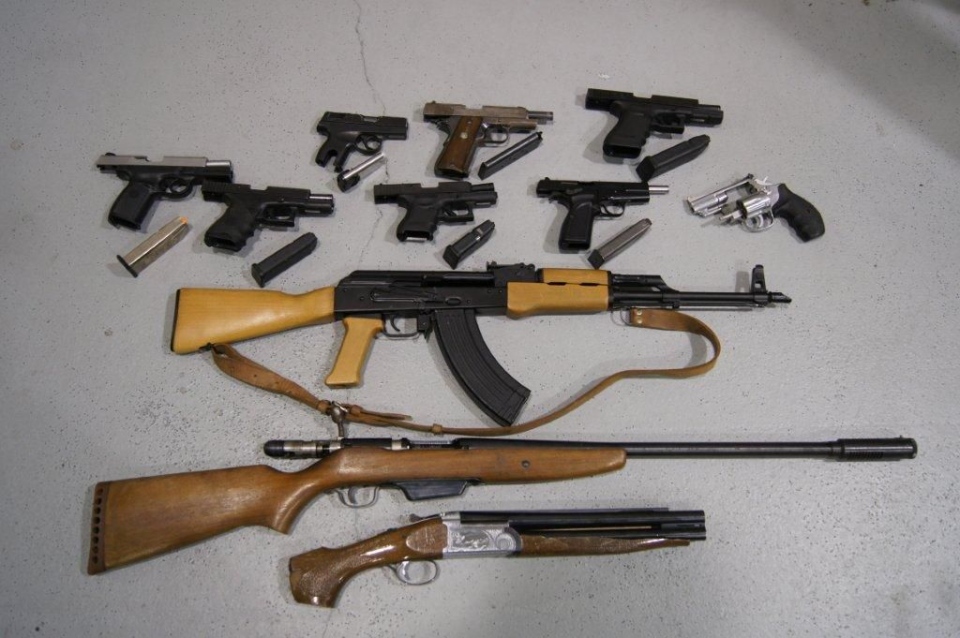
A 2018 Toronto Police Services publicity photo of guns seized in a recent operation.

In my 15 years or so of writing about firearms policy, here’s been a constant problem: gun policy is complicated, the broader public doesn’t know much about it, and it’s hard (impossible?) to make any coherent arguments without laying out the context, both of the specific proposals and the broader background. Working through what was announced yesterday, and how this clarifies a worrying shift in how the Liberals approach gun control, is going to be a bit of a process.

Get comfy.

As of Tuesday morning, we are short a lot of details, because the Liberals chose to make their high-publicity announcement before they provided any technical briefings. (We’ll come back to that later.) At first glance, it seems that lot of what the Liberals announced is stuff they’d either already committed to do or, in fact, already exists. (The Liberals?! Re-announcing stuff? Well, I never!) There is currently confusion about the ammunition magazine capacity limit — most non-gunnies won’t know the difference between an internal magazine and a detachable one, but it’s a huge difference, and the proposed legislation is unhelpfully vague. So stay tuned. But the actual centrepiece of the proposal, I have to admit, made me burst out laughing. On Twitter, I called it “peak Liberal”. It really is a pretty perfect example of what’s wrong with how the Liberals govern, but why they’re great at politics.

One of the jokes about Justin Trudeau when he entered politics was that he’d be much better suited to playing the role of political leader on TV than he would in real life. Several years later, the joke is on the Canadian voter because that’s turned out to be exactly the case: Trudeau loves posturing and pontificating for the cameras, and early in his first term as prime minister he became notorious for “unplanned” photo ops (despite being constantly accompanied by at least one staff photographer/videographer everywhere he went). I think this is one of the reasons the Liberals have been justly mocked for constantly re-announcing policies and programs — it looks good on camera.

The big reveal was a “freeze” on handgun sales in Canada, and their importation. Existing owners can keep theirs. It’s not clear exactly when this will go in effect, so I imagine gun stores across the land are going to set sales records in the next few days. Once in place, the sale or transfer of a handgun — from either a store to an individual or between individuals — will be eliminated. Again, “frozen”, as the Liberals call it.

At the most basic level, new government policies are intended to solve a problem: you see something that’s wrong with the status quo, and you try to enact a policy to improve it. Parties tend to wrap their policies in lots of rhetorical flourishes, but if you tune out what the politicians are saying and look at what they’re doing, you can get a decent sense of what their actual goal is. And there’s been an interesting shift in what the Liberals have been doing with gun control these last few years. Monday’s announcement is perhaps the ultimate example of this yet, the purest form of the new normal we’ve yet seen.

The Liberals are making a series of announcements that won’t actually change, at all, how safe Canadians are from gun violence. The announcements do get a lot of attention, though. Because, clearly, getting the attention is itself the goal. The public-safety talking points are just the PR frosting on top of what is an entirely political exercise. Why else make the announcement before you give the press the technical briefings? The sequence tells you all you need to know.

Trudeau’s general governing style might best be described as “provocatively performative”. If you think of him just portraying what he thinks a Prime Minister should look like, much of his performance makes more sense. As I joked on social media the other day “It’s about time Trudeau took decisive steps to crush these MAGA-hatted, gun-toting, pickup-truck-driving rednecks who keep coming into Toronto and gunning down innocent drug dealers, pimps, and aspiring rap artists who were just turning their lives around! ” It’s a theatrical performance on the political stage … but unfortunately ordinary Canadians are going to be forced to put up with his playing up to the urban and suburban voting galleries.

Note that while the government is puffing its collective chest for this “tough on guns” announcement, they are also pushing a bill in Parliament that would reduce or eliminate many “mandatory minimum penalties” for things like smuggling firearms into the country. This is apparently intended to address the “overincarceration rate” of First Nations and other “marginalized Canadians”. So, on the one hand, they’re planning to penalize legal gun owners and on the other hand, they’ll reduce the penalties that can be imposed on criminals who smuggle illegal weapons into the country. That only makes sense if it’s all a theatrical performance.

May 25, 2022

“What is a reasonable general concern?”

Filed under: Bureaucracy, Cancon, Government, Law, Liberty — Tags: , , , — Nicholas @ 05:00

In The Line, Paula Simons has a concern that I think is quite reasonable:

What is a reasonable general concern?

That’s not a rhetorical question. I really don’t know the answer. I’m not sure anyone else does, either.

And that’s exactly the problem with Bill S-7, a new piece of government legislation, which amends both the Customs Act and the Preclearance Act.

Bill S-7 set a new standard to allow border services officers to search through our cellphones, laptops, tablets, Apple Watches and other personal computers. If the bill passes, it will allow officers who feel a “reasonable general concern” to search through the emails, documents, texts, instant messages, photos or videos stored on our digital devices, to look for evidence that we may have violated customs regulations.

Reasonable general concern. Or, as it says in the French-language draft of the bill, “des préoccupations générales raisonnables“.

It’s an absolutely novel legal threshold. That phrase, be it in English or French, doesn’t appear anywhere else in Canadian criminal or civil law. It’s not a standard borrowed from any other country. It’s a brand new legal test to authorize an invasive search of your most private personal records and correspondence.

A reasonable concern, one might intuit, is a lower standard than a reasonable suspicion, because a concern is less grave, less specific, than a suspicion.

But a general concern? A general preoccupation?

That sounds even more vague, more subjective, than a good old-fashioned hunch or inkling.

It seems counter-intuitive, to put it mildly, to create a lower, broader standard to search our private data on our private devices than to search our conventional mail, or our suitcases, or our car trunks. Yet that is exactly what Bill S-7 does.

How did we get here? The answer is an ironic one.

Back in 2020, the Alberta Court of Appeal ruled unanimously that portions of the Customs Act were unconstitutional.

The court found the act violated the protection against unreasonable search and seizure, because it allowed for what the court called “suspicion-less and unlimited” searches of our personal digital devices.

That violation, held the court, could not be saved by section 1 of the Charter, because it allowed unfettered and unrestricted access to people’s most personal and intimate information, and because it allowed the state almost unlimited latitude to dig around in the what the court called our “biographical core of identity”.

May 19, 2022

QotD: “Rules of engagement” for home intruder drills

Filed under: Law, Liberty, Quotations, USA — Tags: , , — Nicholas @ 01:00

To very loosely paraphrase a big city major crimes detective of my acquaintance who has investigated more than a few of these sorts of incidents, most of the time someone is in your house, it’s because they think you aren’t. (I mean, unless you live the sort of life where you have targeted assassination squads after you, and I’m afraid that that sort of thing is way, way outside of my lane.)

Lying silently in wait in the dark for someone to shoot is practically a recipe for starring in a Claude Werner blog post. Your house is not a free-fire zone, and you are not laying ambushes for Charlie on the Ho Chi Minh trail.

Even if it is a bad guy and not a family member, pet, or drunk neighbor, ensconcing oneself in a safe position, dialing 911, and loudly announcing that you have a gun and have called the cops is likely to save money for carpet cleaning bills and legal fees.

A friend quipped “What, and no advice to drag the body inside?”, which was funny, but … y’know what? I got to thinking about that, and this is even worse advice than that.

Jes’ drag ’em inna house” is something that most non-dumb people who have watched some TV police procedurals can suss out for themselves as bad advice. It trips the BS detectors of all but the most inept.

But this? This sounds like plausible advice because it sounds like how “bad guy in the house” scenarios play out in Hollywood. The bad guy is never a tweaker who’s after a watch and some jewelry and who bolts when they realize the homeowner is there and armed. (It’s also never the homeowner’s husband home a day early from a business trip.) It’s always some elite killer team or serial murderer who’s there specifically to get the homeowner. And why wouldn’t you want to hide and ambush those guys?

Tamara Keel, “Rules of Engagement”, View From The Porch, 2019-03-27.

May 9, 2022

Canada has no abortion law on the books: this is extremely convenient for the federal Liberals

Filed under: Cancon, Government, Health, Law, Media, Politics, USA — Tags: , , , — Nicholas @ 05:00

In the free-to-cheapskate-freeloading readers portion of The Line‘s weekly dispatch, the editors explain why we should expect exactly zero change to Canadian law on the abortion issue regardless of what happens in the United States in the wake of a leaked US Supreme Court draft decision that has agitated and carbonated the debate there all over again:

Parliament Hill in Ottawa.
Photo by S Nameirakpam via Wikimedia Commons.

… given the extent to which Canadian media and politics has become thoroughly Americanized in the past few years, it was inevitable that the draft ruling immediately took over the front pages of our national papers and became the dominant topic of debate in the House of Commons. And while we are loath to contribute to what we see as a very unhelpful trend, there are some Canada-relevant aspects of this that at least one of your editors thinks are worth discussing.

The first is the obvious glee with which the Liberal party greeted the leak. Of course they all acted appalled, with a parade of cabinet ministers taking to Twitter to talk about the “concerning” news out of the U.S. and to make it clear that they would never allow anything like this to happen in Canada.

But for all their bluster, the Liberals long ago perfected a curious little two-step here. On the one hand, they never tire of asserting that the debate over abortion is “settled”, and that the pro-choice position is and will always be the law of the land. Yet on the other hand, Liberals are constantly acting as if we’re just one private member’s bill away from Canada becoming the Republic of Gilead. But as Chris Selley pointed out in a recent column, if abortion rights are so fragile and tenuous, why haven’t the Liberals done anything about it? Perhaps the imminent overthrow of Roe v. Wade in the U.S. might provide the government with the perfect occasion to finally put abortion rights on Canada on a proper legislative footing. Or, at the very least, define and defend the status quo.

That will never happen, for two reasons.

The first reason the Liberals won’t move to do something has to do with a philosophical equivocation at the heart of Canada’s pro-choice movement. In some guises, the pro-choice position is framed as a harm reduction policy, not completely dissimilar to needle exchange programs or safe injection sites for drug users. That is, while we may legitimately debate and disagree over the moral worth of the activity itself, there is no question that it is something that is going to happen regardless. Given that, the best thing for the state to do is make sure that the circumstances under which it takes place are as safe and accessible as possible, while withholding moral judgment.

But there’s another position, which holds that abortion is akin to a victimless crime: the fetus simply deserves no moral standing, so getting an abortion is no more morally controversial than getting your appendix removed.

The advantage to the status quo is that it allows the government, as well as pro-choice supporters, to remain formally agnostic on this question. There is no law, so the law needs to take no position. But any attempt to put a legal framework around abortion would probably require that the fetus be given some status at some point in development. And that opens a huge can of worms, not least for someone like Justin Trudeau who, at times, has claimed to be personally opposed to abortion but a pro-choice practicing Catholic. Why would he be against abortion personally, unless he believed that it was, at some level, wrong?

This brings us to our second point. In his column, Selley called on Trudeau to “grow up” and defend the status quo on its principles. But why would he do that? The Liberals benefit enormously from the status quo, including the lack of clarity around it. Abortion is legal (in the sense that there is nothing in the criminal code forbidding it), and reasonably accessible, depending on which part of the country you live in. But it’s also tenuous, which means the Liberals get to spend a good part of every election campaign wedging the ever-loving crap out of the Conservatives, whose benches are chock full of people who are anti-abortion, or at least, anti-the-status-quo on abortion.

Given how successful this strategy has been, there is no reason for the Liberals to change it, since for them the tenuous status of abortion is a feature of the current regime, not a bug.

Military Civics: The Many Armies of the United States

Filed under: History, Law, Military, USA — Tags: , , , , — Nicholas @ 02:00

The Chieftain
Published 19 Dec 2020

There are just shy of a hundred official land component military organizations in the United States of America, each with their own unique legal structure and chain of command. In this video, I try to break down the details for you. It also seems to have taken several days for someone to observe I have the branches in the wrong sequence, Marines go before Navy.

Improved-Computer-And-Scout Car Fund:
Patreon: https://www.patreon.com/The_Chieftain
Direct Paypal https://paypal.me/thechieftainshat
Subscribestar: https://www.subscribestar.com/the_chi…

May 8, 2022

“… a majority of ‘pro-lifers’ are women, not men. So [Kamala] Harris is effectively saying: how dare women be allowed a voice in this debate?”

Filed under: Health, Law, Media, Politics, USA — Tags: , , , , — Nicholas @ 05:00

Andrew Sullivan comments on the leak of a draft US Supreme Court decision that would strike down Roe vs. Wade and the over-the-top reactions on social media from progressives:

Panorama of the west facade of United States Supreme Court Building at dusk in Washington, D.C., 10 October, 2011.
Photo by Joe Ravi via Wikimedia Commons.

To say that a leaked draft of a Supreme Court ruling prompted an elite meltdown would be a gross understatement. This was a culture war 9/11. “I have typed and deleted a great many comments,” Roxane Gay tweeted. “What do you say when nine people can dictate what happens to your body? It’s ridiculous and hateful.” The Atlantic‘s Adam Serwer, always the subtle one, announced that the court had abolished the entire 20th century. Yep: no more suffrage for women! Jim Crow now!

Taking the arguments of abortion opponents seriously was never an option: “Stripping women of their humanity and rights isn’t a consequence of the ‘pro-life’ agenda, it’s the entire point,” declared Jessica Valenti. Rebecca Traister confessed: “My teeth have been chattering uncontrollably for an hour. Bodies/minds are so weird. Like, not euphemistically — actually chattering. Audibly. And full shaking body. Though otherwise wholly, rationally, well and truly expecting it.”

Going further, freshly-minted critical gender theorist, Jennifer Rubin, argued that any restriction on abortion rights is a violation of secularism: “The right-wing justices and their supporters appear ready to reject one of the Founders’ core principles: that religion shall not be imposed by government edict.” Kurt Andersen went old school and worried about a papist cabal: “It really is kind of remarkable that only one in five Americans call themselves Catholic, but of the Supreme Court majority apparently about to permit abortion to be outlawed, all but one are Catholic and that one was raised Catholic.” Then there’s Vox‘s Ian Millhiser: “Seriously, shout out to whoever the hero was within the Supreme Court who said ‘fuck it! Let’s burn this place down.'” Fuck it! I’ll do it live!

Kamala Harris also found her voice:

    Those Republican leaders who are trying to weaponize the use of the law against women. Well we say, “How dare they?” How dare they tell a woman what she can do and cannot do with her own body? How dare they? How dare they try to stop her from determining her own future? How dare they try to deny women their rights and their freedoms?

The premise here is that all women support abortion rights. But there is no serious gender gap on this question. In fact, a majority of “pro-lifers” are women, not men. So Harris is effectively saying: how dare women be allowed a voice in this debate?

Within minutes of the SCOTUS leak, moreover, we were told it means that before long, interracial marriages will be banned … in a country where 94 percent support them! Imagine Clarence Thomas divorcing himself by jurisprudence. Here’s Traister again: “Voting rights were gutted in 2013. Marriage equality. Griswold. Loving. Don’t ever listen to anyone who tells you such fears are silly or overblown.” Actually, listen to them — if you can hear them over Traister’s permanent rage-tantrum.

What strikes me about all of this is not the emotive hyperbole — that’s par for the course in a country where every discourse is now dialed to eleven. What strikes me most in these takes is the underlying contempt for and suspicion of the democratic process — from many of the same people who insist they want to save it. How dare voters have a say on abortion rights! The issue — which divides the country today as much as it has for decades — is one that apparently cannot ever be put up for a vote. On this question, Democrats really do seem to believe that seven men alone should make that decision — once, in 1973. Women today, including one on SCOTUS? Not so much.

April 29, 2022

QotD: The Rooftop Koreans

Filed under: Law, Liberty, Military, Quotations, USA — Tags: , , , , — Nicholas @ 01:00

We should all be ready to do our duty as American citizens and, when duty calls, each of us should embrace our inner Rooftop Korean.

The year was 1992, 27 years ago right about now, and the city was Los Angeles. Several police officers who got into a videotaped brawl with a petty criminal named Rodney King were acquitted of beating him up. The city exploded. It was chaos.

I was a first-year law student, back a year from the Gulf War, and I had just joined the California Army National Guard. My unit was the 3rd Battalion, 160th Infantry, and we got called up early the first night and were on the streets for three long weeks. Making it even more delightful was the fact that the unit was in Inglewood, which was pretty much on fire. They burned most everything around, except our armory – that would have gone badly for them – and the Astro Burger.

My battalion commander grabbed then-First Lieutenant Schlichter, and we went all over the city in his humvee as he led his deployed and dispersed troops. Our soldiers came, in large part, from the areas most effected by the riots, and they were notably unpleasant to the thugs and criminals who quickly discovered our guys had no patience for nonsense. One dummy discovered that the hard way when he tried to run over some Guard soldiers from another battalion; he had a closed casket funeral.

The city went insane. Order simply ceased to exist. It was Lord of the Flies. I remember a cop totally breaking down because everything was completely out of control.

But I had a M16A1 – a real assault rifle – and I had a bunch of buddies with M16A1s. The regular folks … not so much. The decent people of LA were terrified, and with good reason. See, the dirty little secret of civilization is that it’s designed to maintain order when 99.9% of folks are orderly. But, say, if just 2% of folks stop playing by the rules … uh oh. Say LA’s population was 15 million in 1992 … that’s 300,000 bad guys. There were maybe 20,000 cops in all the area agencies then, plus 20,000 National Guard soldiers and airman, plus another 10,000 active soldiers and Marines the feds brought in. Law enforcement is based on the concept that most people will behave and that the crooks will be overwhelmed by sheer numbers of officers. But in the LA riots, law enforcement was massively outnumbered. Imposing order took time.

And until then, our citizens were on their own, at the mercy of the mob. Betting that the cavalry was going to come save you was a losing bet.

LA’s Korean shopkeepers knew that. They operated many small businesses in some of the least fashionable areas of Los Angeles, and they were already widely hated by activists, being scapegoated for problems and pathologies that long pre-dated their immigration to Southern California. So, they became targets for the mobs.

Bad decision by the mobs.

See, most of these Koreans had done their mandatory service in the Republic of Korea’s Army. Those ROK soldiers are the real deal – the Norks are not a theoretical threat and the South Korean army does not spend a lot of time talking about feelings. They were some solid dudes. So, when the local dirtbags showed up for some casual looting, they noticed the rooftops were lined with hardcore guys packing some serious heat, including the kind of scary rifles that the Democrats want to ban.

The Rooftop Koreans.

It did not take long for the bad guys to realize that the Rooftop Koreans were not playing games – they were playing for keeps. The mob went away in search of softer targets.

There’s a lesson there.

Kurt Schlichter, “Be A Rooftop Korean”, Townhall.com, 2019-05-02.

April 11, 2022

Ours is a fundamentally unserious culture, two examples

Filed under: Education, Government, Law, Media, Politics, USA — Tags: , , , , , — Nicholas @ 03:00

Chris Bray provides some examples of just how decayed western culture has become in our headlong flight toward total unseriousness:

In Europe this month to lead the diplomatic response to a war, the Vice-President of the United States responded to a question about refugees by giggling and cackling and babbling in typical form:

And then the “fact-checkers” at Reuters explained that she actually didn’t giggle and cackle and babble, because, okay, she did cackle and giggle and babble, but she didn’t cackle and giggle and babble specifically about the refugees, so it doesn’t count: “It is clear from viewing the longer video in context that Harris and Duda laughed at the awkwardness of not knowing who should speak first. There is no evidence that Harris was laughing at the refugees or the crisis in Ukraine.” The question was about refugees, and she laughed — she laughed a lot — right after the question, but Reuters apparently called no tagbacks before the play, so no points accrue.

So we have an awkward and ineffective playactor who occupies the position of a political leader, but lacks the stature or ability to go along with it, and we have journalists who labor to protect people in powerful political positions from the possibility that people will notice who they really are and what they really do. We have political leaders who aren’t political leaders, and journalists who aren’t journalists: the form without the substance.

Meanwhile, a recent debate on the topic of free speech at Yale Law School — the nation’s top-ranked law school, which produces presidents and Supreme Court justices — began with law students screaming abuse (“I’ll fight you, bitch”) at one of the panelists, before walking out as a group and continuing to shout and pound on the walls of the adjacent hallway.

Now: The students were angry at the panelist, the bitch they wanted to fight, because she’s an anti-trans social conservative, and couldn’t you just die? But the thing that law students are learning to do is be lawyers — advocates for a position in a formalized exchange of competing views, in controversies that play out in open court. They’re training at the profession of making an argument. The point of sitting through an argument made by a person whose views you despise is that you can learn about something you want to fight against; you can see what the enemy says, and how she says it, and so do a part of the work of preparing yourself to advance a different position. So we have law students, people training for a debate-and-exchange-centered profession, who don’t want to hear things they don’t agree with. It’s like a minor league baseball player saying he refuses to touch a baseball, because baseballs offend him, but anyway, when are you assholes sending me up to the major leagues? We have people who want to occupy the profession of the law without preparing for the substance of professional engagement with competing positions: the form without the substance.

(Doing what journalists do, now, the fact-checkers explain that none of this puts points on the anti-free-speech scoreboard: “The students made their point at the very start of the event and walked out before the conversation began.” It is precisely the point that 1.) law students 2.) walked out before the conversation began. In ten years, oral argument before the Supreme Court will be that Woke lawyers stand up and scream I’M NOT GONNA LISTEN TO THIS SHIT, YOU ASSHOLES at the justices, then storm out and descend into a long round of day-drinking while waiting for the court to rule in their favor, because oh my god they CAN’T EVEN.)

March 14, 2022

QotD: Crime and (lenient) punishment

A few years ago, an eminent British criminologist said, or admitted, that criminology was a century-old conspiracy to deny that punishment had any effect whatever on criminal behavior.

And certainly, no intellectual ever earned kudos from his peers by arguing that punishment was necessary, let alone that current punishments were too lenient. In general, the more lenient he was in theory, and the more willing to forgive wrongs done to others, the better person he was thought by his peers to be.

In a way, this was understandable. The history of punishment is so sown with sadism and cruelty that it is hardly surprising that decent people don’t want to be associated with it.

Often, horrific punishments were carried out in public, half as deterrence and half as entertainment. Clearly, they failed to result in a law-abiding society, from which it was concluded that what counted in the deterrence of crime was not severity of punishment but the swiftness and certainty of detection.

While the latter are important, however, they are obviously not sufficient. It is not the prospect of detection that causes people to refrain from parking in prohibited places, but that of the fine after detection.

This is so obvious that it would not be worth mentioning, had not so much intellectual effort gone into the denial of the efficacy of punishment as such. Despite this effort, I doubt whether anyone, in his innermost being, has ever really doubted the efficacy of, or necessity for, punishment.

In Britain, leniency has co-existed with a very large prison population. This is not as contradictory as it sounds: for the fact is that something must eventually be done with repeat offenders, who do not take previous leniency as a sign of mercy and an invitation to reform but as a sign of weakness and an invitation to recidivism. Instead of nipping growth in the bud, the British system fertilises the plant.

Theodore Dalrymple, “Our Leniency, and the Necessity of Punishing Crime”, The Iconoclast, 2021-11-29.

March 11, 2022

Donate money to a legal, peaceful protest and be deprived of your rights on a governmental whim. Welcome to Canada!

Filed under: Cancon, Government, Law, Liberty — Tags: , , , , , — Nicholas @ 05:00

In First Things, Craig A. Carter recaps the events of February here in Canada after the government suddenly decided to treat non-violent protests as existential threats to the regime:

A Toronto Sun editorial cartoon by Andy Donato during Pierre Trudeau’s efforts to pass the Canadian Charter of Rights and Freedoms. You can certainly see where Justin Trudeau learned his approach to human rights.

Last month, Canadian Prime Minister Justin Trudeau’s cabinet used special powers under the Emergencies Act to freeze the bank accounts of Canadian citizens who supported Freedom Convoy protests against vaccine mandates. The government partnered with banks and other businesses to “de-bank” Canadians, circumventing due process and normalizing a dangerous, undemocratic policy. Canada has since revoked the Emergencies Act and instructed banks to unfreeze the targeted bank accounts, but this action set a dangerous precedent.

On February 22, the House of Commons Finance Committee questioned Department of Finance Assistant Deputy Minister Isabelle Jacques about the details of these financial measures. The government revealed that more than 206 accounts were frozen. Exactly how many “more” was not indicated. Trudeau revoked the Emergencies Act on February 23. But we still do not know how many accounts were frozen. No judicial review is permitted of the actions of banks under the Emergencies Act.

The government targeted not only protest participants, but also those who merely donated to the protesters. A reporter asked Jacques if a person who donated to a crowdfunding platform with no further involvement in protests could have their bank account frozen. The answer was “Yes.” Some people were punished without being formally charged with a crime at all.

In some cases, the right to a trial and the presumption of innocence were discarded. The Royal Canadian Mountain Police (RCMP) has stated that they provided the names of Freedom Convoy donors to financial institutions. The RCMP claimed that these individuals were major influencers in the protests or truck drivers who refused to leave the area. This might be the case, but we have no way of knowing for sure. Normally, when the RCMP conducts an investigation, they charge an individual with a specific crime and then give evidence to the Crown prosecutor, who decides if the person should be tried in court. If the person is found guilty after trial, then the judge sentences the person, and the sentence is carried out. However, in this situation, the whole process was reversed. The RCMP determined guilt and imposed a punishment before conducting a proper trial for explicit charges. And because this was done under the Emergencies Act, citizens do not have the ability to sue the bank or the RCMP for mistakes — cases of mistaken identity, for example. There was no incentive against carelessness.

There has also been controversy over whose accounts were frozen. The Globe and Mail reports that the RCMP told the House of Commons Finance Committee on March 7 that a “small number” of additional accounts were frozen under the Emergencies Act based on the banks’ own “risk-based” reviews and were not on a list of names provided by the RCMP.

February 24, 2022

I guess the “emergency” is technically over, question mark?

Filed under: Cancon, Law, Politics — Tags: , , , , — Nicholas @ 05:00

My original headline for this piece was

I can’t believe I’m writing this, but we need to depend on Canada’s Senate to turn down Trudeau’s Emergencies Act

Fortunately, perhaps because Mr. Trudeau realized he might lose the vote in the Senate, he announced earlier today that the government will relinquish the powers granted under the Emergencies Act. The province of Ontario is also rescinding the state of emergency. This makes much of what follows less immediately relevant, but I’m too lazy to delete it I feel it still has some informational value to offer:

I’ve never had much faith in our Senate — and given that most Prime Ministerial appointments to the upper house are given as rewards to former political backroom organizers, bagmen, and the occasional prominent citizen, the role of the Senate in daily life is virtually nil. Now, thanks to a provision of the Emergencies Act, our last chance of prying the undemocratic emergency powers Trudeau has claimed is to have the Senate vote against the use of the act. This is not how the upper house normally operates.

“In the east wing of the Centre Block is the Senate chamber, in which are the thrones for the Canadian monarch and her consort, or for the federal viceroy and his or her consort, and from which either the sovereign or the governor general gives the Speech from the Throne and grants Royal Assent to bills passed by parliament. The senators themselves sit in the chamber, arranged so that those belonging to the governing party are to the right of the Speaker of the Senate and the opposition to the speaker’s left. The overall colour in the Senate chamber is red, seen in the upholstery, carpeting, and draperies, and reflecting the colour scheme of the House of Lords in the United Kingdom.”
Photo and description by Saffron Blaze via Wikimedia Commons.

Even as it enables the government to take such far-reaching actions, the Emergencies Act provides safeguards against abuse. One such safety valve is that the government’s declaration of an emergency has to be approved, in short order, by both the House of Commons and the Senate in order to continue in force. In the Act’s words, “If a motion for confirmation of a declaration of emergency is negatived by either House of Parliament, the declaration, to the extent that it has not previously expired or been revoked, is revoked effective on the day of the negative vote.”

The House of Commons approved the motion to confirm the government’s declaration of emergency on Monday. It is up to the Senate to consider it now. And so, it may be useful to review the principles that govern the role of this much misunderstood and often maligned institution.

The Senate is not a deus ex machina that can rescue us from bad government. The suggestion, put forward by some of the “freedom convoy” leaders, that a constitutional chimera made up of the Senate and the governor general could oust the federal government and redress whatever grievances they came to air was arrant nonsense. For the most part, the Senate’s role in the government of Canada is very limited, and rightly so.

Senators are not elected and, as a result, lack the legitimacy to oppose the will of the House of Commons, whose members (the MPs) are, and the cabinet, led by the prime minister, which is responsible to the House of Commons. When the cabinet proposes that a law should be enacted, and the House of Commons agrees, constitutional propriety (a “constitutional convention”, in the jargon) dictates that the Senate’s role is limited to, at most, making suggestions for improving this law while respecting its general principle.

[…]

Will the Senate act independently? I do not know; I am just a boring law professor, and this question is above my pay grade. But I would like to conclude with an observation about how either answer to this question should make us reflect on the attitude the current prime minister and his predecessor have taken to the Senate.

If the Senate defeats Mr. Trudeau’s government, it will be in part because he cut his ties with what used to be the Liberal caucus there, releasing existing Liberal senators and new appointees to act with greater independence (though, in fairness, senators were always somewhat more independent-minded than MPs; not having to get re-elected does that to one). What may have seen a cost-free symbolic gesture might yet turn out to have been quite consequential.

Conversely, if the Senate ends up siding with the government, this will in part be because there are fewer Conservative senators than one might have expected. The reason for that is that Stephen Harper simply stopped appointing senators, in a fit of pique over the failure of Senate reform plans. That was a dereliction of constitutional duty ― the prime minister must fill Senate vacancies as they arise. And now, if not Mr. Harper himself, then at least many of his erstwhile supporters may come to regret that he did not.

February 18, 2022

QotD: Historical legal context of marriage

Filed under: History, Law, Liberty, Quotations — Tags: , , — Nicholas @ 01:00

The law of servitude in marriage is a monstrous contradiction to all the principles of the modern world, and to all the experience through which those principles have been slowly and painfully worked out. It is the sole case, now that negro slavery has been abolished, in which a human being in the plenitude of every faculty is delivered up to the tender mercies of another human being, in the hope forsooth that this other will use the power solely for the good of the person subjected to it. Marriage is the only actual bondage known to our law. There remain no legal slaves, except the mistress of every house.

John Stuart Mill, The Subjection of Women, 1869.

January 30, 2022

Engineer’s Delight: Stemple 76/45 Becomes the Stemple Takedown Gun

Forgotten Weapons
Published 17 Sep 2021

http://www.patreon.com/ForgottenWeapons

https://www.floatplane.com/channel/Fo…

Cool Forgotten Weapons merch! http://shop.forgottenweapons.com

The saga of how the original Stemple 76/45 became the Stemple Takedown Gun is a fantastic story of engineering design choices.

Essentially, John Stemple began by building a rather crude copy of the Swedish K in .45 ACP in the mid 1980s, called the Stemple 76/45. He produced and registered 2,000 transferrable receivers for the gun (pre-1986), but only built them slowly, a few at a time. In the late 1980s he faced criminal charges from ATF, and transferred the receivers to a friend while he (successfully) fought the charges. When he went to get the receivers back, his friend refused, and the two entered into a nearly decade-long legal battle over them.

By the time Stemple eventually won the case, he recovered about 900 transferrable tubes. By this time (circa 2000) these tube receivers were much more valuable than when he first made them, as the machine gun registry was closed in 1986 and new ones can no longer be made. At this point, Stemple reached out to Brian Poling (BRP Corp) to act as a subcontractor to make the parts for the Stemple 76/45. But Poling had a better idea …

Poling’s thought was to instead design a new gun that would be much more desirable as a recreational gun than the 76/45. He envisioned something controllable, low recoil, and using large drum magazines. Such a gun would be a lot more fun at the range than the MACs and Uzis that tended to dominate the submachine gun market at the time. In addition, Poling’s gun would be designed specifically to protect the irreplaceable registered receiver tubes from wear or damage. The result was the STG-76 — the Stemple Takedown Gun.

In order to remain legal, the STG-76 had to leave the original 76/45 receiver tube cutouts unmodified, so as not to change the configuration of the receiver itself. Poling designed a replaceable internal trunnion and slip-over magazine well, allowing multiple different calibers and magazine configurations. The internals were closely based on the Finnish kp31 Suomi, for which parts kits became readily available in the early 2000s. This also facilitated the use of Suomi 71-round drum magazines. The original STF-76 design also included a bipod for easy shooting, and a grip and stock from an HK91 or CETME Model C for comfortable handling (instead of the terrible metal strut stocks common to most budget SMGs).

Several other interesting configurations would follow (stay tuned for those videos), and the guns remain available brand new to this day. The original supply of receivers is sufficient for production until about 2023 …

Contact:
Forgotten Weapons
6281 N. Oracle 36270
Tucson, AZ 85740

January 28, 2022

QotD: The Myth of Spartan Equality

Filed under: Europe, Greece, History, Law, Quotations — Tags: , , , , — Nicholas @ 01:00

This idea – the degree of equality and cohesion – is what I prefer to call the Myth of Spartan Equality, and it’s going to be our target today.

Where does this idea come from? Well, it comes from the same pro-Spartan sources we discussed last time. Plutarch claims that Lycurgus‘ decision to banish money from Sparta essentially removed greed by making all of the Spartans equal (Plut. Lyc. 9.1-4) – or equally poor – though we should note that Plutarch is writing 900 years after Lycurgus (again, probably not a real person) was supposed to have lived. Xenophon notes approvingly that Lycurgus forbade the Spartans from engaging in productive business of any kind, making them thus unable to accumulate wealth (Xen. Lac. 7.1-6). Land was supposed to be distributed equally to each full Spartan citizen – the spartiates or homoioi (we’ll define these terms in a second) in equal plots called kleroi.

This idea – the Myth of Spartan Equality – is perhaps the single “biggest idea” in the conception of the Spartan state, rivaled only by the myth of Spartan military excellence (don’t worry, we’ll get there!). There is something deeply appealing, at a bedrock emotional level, to the idea of a perfectly equal society like that. And that myth of equality has prompted all sorts of thinkers from all sorts of eras (Rousseau, most famously) – including our own – to be willing to look past Sparta’s many, many failings.

And on the face of it, it does sound like a very equal society – practically a collectivist utopia. It is a pleasant vision. Unfortunately, it is also a lie.

[…] every Greek polis had a three-level layer-cake of status: the citizen body, free non-citizens (like foreigners), and non-free persons (slaves). You could – and the Greeks did – divide that top group by wealth and birth and so on, but we’ll get to that a bit later in this post and the next. For now, let’s stick with the three-level layer cake. Sparta follows this scheme neatly.

At the top were the Spartiates, the full-citizen male Spartans. According to Herodotus there were once 8,000 of these (Hdt. 7.234.2); supposedly 9,000 based on the initial number of equal land plots (kleroi) handed out (Plut. Lyc. 8.3 – or rather than saying “handed out” we might say “seized”). Of course these are tallies of Spartiate males, but women could be of citizen stock (but not citizens themselves) and we ought to imagine an equal number of spartiate women at any given time. For a child to be born into the citizen class (and thus eligible for the agoge and future full citizenship), he had to have a citizen father and a citizen mother. We’ll deal with the bastards a bit further down. Also, the spartiates were often also called the homoioi, sometimes translated as “peers” but literally meaning something like “the equals”. As we’ll see, that equality is notional at best, but this ideal of citizen equality was something Sparta advertised about itself.

[…]

But the final word on if we should consider the helots fully non-free is in their sanctity of person: they had none, at all, whatsoever. Every year, in autumn by ritual, the five Spartan magistrates known as the ephors declared war between Sparta and the helots – Sparta essentially declares war on part of itself – so that any spartiate might kill any helot without legal or religious repercussions (Plut. Lyc. 28.4; note also Hdt. 4.146.2). Isocrates – admittedly a decidedly anti-Spartan voice – notes that it was a religious, if not legal, infraction to kill slaves everywhere in Greece except Sparta (Isoc. 12.181). As a matter of Athenian law, killing a slave was still murder (the same is true in Roman law). One assumes these rules were often ignored by slave-holders of course – we know that many such laws in the American South were routinely flouted. Slavery is, after all, a brutal and inhuman institution by its very nature. The absence of any taboo – legal or religious – against the killing of helots marks the institution as uncommonly brutal not merely by Greek standards, but by world-historical standards.

We may safely conclude that the helots were not only enslaved persons, but that of all slaves, they had some of the fewest protections – effectively none, not even protections in-name-only.

Bret Devereaux, “Collections: This. Isn’t. Sparta. Part II: Spartan Equality”, A Collection of Unmitigated Pedantry, 2019-08-23.

January 26, 2022

“Last year, we’re told, was the ‘deadliest’ year for transgender people since records began”

Filed under: Britain, Health, Law — Tags: , , , — Nicholas @ 05:00

Tish Still, parent of a child who identifies as transgender, was worried about the “epidemic” of trans murder victims:

Facts always matter — but they take on a particular importance when they’re being used to claim that your child could be murdered. So I decided to delve into the research used to inform these claims. For me, it was personal.

The Government doesn’t publish data on the number of transgender people in the UK, though in 2018 it “tentatively” estimated that the figure stood between “approximately 200,000-500,000”. What proportion of that number must have been killed to warrant today’s warnings of trans murder epidemic? 10? 100? 1,000?

To find out, I analysed data collected by the trans-led organisation Transgender Europe, which has received more than a million dollars from the Arcus Foundation, who are based in the US and take a keen interest in transgender issues. As well as donating almost $150,000 to Stonewall, in 2015 the Arcus Foundation handed $312,000 to Transgender Europe specifically to supply reliable global data on transgender murders. The website it created provides an interactive map and links to documents naming the transgender victims.

Looking at Transgender Europe’s list of cases, it became clear — to my relief — that the total murders reported for the United Kingdom since 2008 amounted to 11. This translates as a murder rate of around 0.165%.

Now, that is still significantly higher than the murder rate for the UK as a whole: the ONS reports that the homicide rate in the UK for the year ending March 2020 was 11.7 per million people, rising to 17 per million among men. But look a bit closer at the list of trans murder victims, and that figure of 11 becomes increasingly suspect.

For instance, two of the listed victims, Vikki Thompson and Jacqueline Cowdry, appear to have been erroneously included. Thompson died by suicide while incarcerated in HMP Leeds, while Cowdry’s death was ultimately ruled as non-suspicious. This reduces the total to nine unlawful deaths, all of whom were born male. (By contrast, the number of homicides committed by transgender people between 2008 and 2017 was 12.) For context, the number of women killed by men during the same period was 1800. So much for our alleged “cis-privilege”.

Searching for more information led me to the work of Karen Ingala-Smith, who founded the Counting Dead Women project in 2012 after she realised that there was no central record of the extent of femicide here in the UK; thanks to her, a list of murdered women is read out in the House of Commons each year to imprint the rate of femicide on the minds our political class. Ingala-Smith’s tireless work focusses on female victims of, predominantly, male violence, though she made an exception to highlight the discrepancy between the mass hysteria about transgender victims of homicide compared to the treatment of woman-killing as mere background noise. (There is still no equivalent to the Trans Day of Remembrance for the much greater number of women killed by male violence.)

Crucially, her research sheds a vital spotlight on the nine remaining victims identified by the Trans Murder Monitoring report. Reading it, two things become clear. The first is that it is not entirely certain that all the victims themselves identified with the label “transgender”. The second is that the motives behind these crimes are more complex than straightforward “transphobia”.

« Newer PostsOlder Posts »

Powered by WordPress