
In a free-enterprise, private-property system, a corporate executive is an employee of the owners of the business. He has direct responsibility to his employers. That responsibility is to conduct the business in accordance with their desires, which generally will be to make as much money as possible while conforming to their basic rules of the society, both those embodied in law and those embodied in ethical custom. Of course, in some cases his employers may have a different objective. A group of persons might establish a corporation for an eleemosynary purpose — for example, a hospital or a school. The manager of such a corporation will not have money profit as his objectives but the rendering of certain services.
In either case, the key point is that, in his capacity as a corporate executive, the manager is the agent of the individuals who own the corporation or establish the eleemosynary institution, and his primary responsibility is to them.
Needless to say, this does not mean that it is easy to judge how well he is performing his task. But at least the criterion of performance is straight-forward, and the persons among whom a voluntary contractual arrangement exists are clearly defined.
Of course, the corporate executive is also a person in his own right. As a person, he may have many other responsibilities that he recognizes or assumes voluntarily — to his family, his conscience, his feelings of charity, his church, his clubs, his city, his country. He may feel impelled by these responsibilities to devote part of his income to causes he regards as worthy, to refuse to work for particular corporations, even to leave his job, for example, to join his country’s armed forces. If we wish, we may refer to some of these responsibilities as “social responsibilities.” But in these respects he is acting as a principal, not an agent; he is spending his own money or time or energy, not the money of his employers or the time or energy he has contracted to devote to their purposes. If these are “social responsibilities,” they are the social responsibilities of individuals, not business. What does it mean to say that the corporate executive has a “social responsibility” in his capacity as businessman? If this statement is not pure rhetoric, it must mean that he is to act in some way that is not in the interest of his employers. For example, that he is to refrain from increasing the price of the product in order to contribute to the social objective of preventing inflation, even though a price increase would be in the best interests of the corporation. Or that he is to make expenditures on reducing pollution beyond the amount that is in the best interests of the corporation or that is required by law in order to contribute to the social objective of improving the environment. Or that, at the expense of corporate profits, he is to hire “hardcore” unemployed instead of better qualified available workmen to contribute to the social objective of reducing poverty.
In each of these cases, the corporate executive would be spending someone else’s money for a general social interest. Insofar as his actions in accord with his “social responsibility” reduce returns to stockholders, he is spending their money. Insofar as his actions raise the price to customers, he is spending the customers’ money. Insofar as his actions lower the wages of some employees, he is spending their money.
Milton Friedman, “The Social Responsibility of Business is to Increase its Profits”, New York Times, 1970-09-13.
August 21, 2022
QotD: The “social responsibility” of the corporate executive
August 18, 2022
MAID in Canada
In The Critic, Ben Woodfinden discusses the maple-flavoured slippery slope we’re gaining speed on: what’s known as “Medical Assistance In Dying (MAID)”:

Toronto General Hospital in 2005.
Photo via Wikimedia Commons.
Canada is widely seen as one of the world’s most progressive nations in the world, “leading the way” (depending on where you stand) on a variety of social issues. But in recent months, Canada has been garnering some less than savoury international attention because of the dark side of one of its recent progressive accomplishments, namely the assisted suicide regime that has been created since the Supreme Court struck down prohibitions on assisted suicide in 2015. The tragic situation that has developed in Canada offers a warning to Britain and other countries considering going down a similar path, both to be cautious about opening the assisted suicide floodgates and about empowering judges to decide whether such things should be allowed.
When Canada’s enlightened judicial philsopher kings and queens overturned criminal prohibitions on assisted suicide in Carter v. Canada, they overturned their own precedent. In 1993 a majority of the Supreme Court found that the criminal code provisions that prohibited assisted suicide did not ultimately violate the Canadian Charter. In 2015 the Court changed its mind. The law didn’t change, of course, but the court decided that “the matrix of legislative and social facts” surrounding the case had changed. Thus the interpretation of constitutional rights must change with them.
Plenty of the same people who were outraged that the United States Supreme Court would overturn precedent on seminal abortion decisions, seemingly had no problem with the overturning of precedent in this Canadian case. This is because implicit in the view of rights and judicial review that many progressives hold, is that it is perfectly acceptable to overturn precedent in the name of expanding or establishing some newly discovered right — but once this is done, the debate is settled and there can be no reasonable dissent or change of heart. History, it seems, only marches in one direction.
An important part of the Carter decision, where the court determined that relevant social facts had changed, was essentially a blithe dismissal of exactly what has come to pass in Canada less than a decade after the decision. The court rejected the concern that once assisted suicide was allowed in some rare cases, there would be a “slippery slope” from helping terminally ill people end their lives, to a system in which vulnerable people like the disabled were caught in a euthanising net.
Evidence presented in the case by a medical expert from Belgium that this might be possible, was dismissed by the court because “the permissive regime in Belgium is the product of a very different medico-legal culture”. Unlike those barbaric Belgians, enlightened Canada could avoid sliding down this slippery slope in which safeguards are easily gotten around. They would avoid the creeping expansion of eligibility by setting up a “carefully regulated scheme” that would keep its application narrow and exceptional.
Spoiler: No. No, we didn’t.
August 16, 2022
“Penguin Random House is a vampire corporation”
Belatedly, as I was away for the weekend, here’s something from the latest SHuSH newsletter on the Random Penguin court case:

At the beginning of the millennium, Random House (pre-Penguin) had revenues of $2.3 billion (all US figures) and a profit margin of 9 per cent. At the end of the aughts, it had revenues of 2.3 billion and a profit margin of 9 per cent. It was the biggest publishing company on the planet but it had ceased to grow.
Growth matters, especially to Random House’s parent company, Bertelsmann SE, a public company. People buy shares in publicly listed companies because they believe the entity will grow and produce larger profits in the future, making the share price rise and the investor happy. That is the whole game for public companies.
When an asset at a public company does not contribute to growth it is dead weight. It needs to be fixed or jettisoned.
Bertelsmann decided to fix Random House. In 2012, it struck the richest deal in book publishing history, acquiring 53 per cent of Penguin Books, which it then merged with Random House to make the biggest publisher even bigger.
It was said at the time that the two publishers, with combined revenues of $3.9 billion, would be able to share costs, attract better talent, take more risks, offer new products, develop new markets, and otherwise innovate. Together they would have the scale to stand up to bookselling chains like Barnes & Noble and the massive digital players, Amazon and Apple.
It was a lot of hype, of course. Random House had its pick of talent, all the size it needed to negotiate with Barnes & Noble, and it would never be in the same league as Amazon. Markus Dohle, CEO of Penguin Random House, is lucky to get a mid-level account manager on the phone at Amazon.
But the deal went ahead and expectations for the new Penguin Random House were sky high. They had to be. Bertelsmann’s purchase price valued Penguin at $3.5 billion, or more than twenty times its annual profits of $171 million. Penguin Random House would have to be far more than the sum of its parts to justify that price.
Over the next several years, Bertelsmann doubled down on its bet, scooping up the remaining 47 per cent of Penguin in two separate transactions to eventually own it outright.
Did any of the anticipated magic happen?
The first full year of a combined Penguin Random House was 2014. Revenues were about $4 billion, and that’s where they’ve been ever since (leaving aside a nice bump in 2019, the year of Michelle Obama). Profits are up, which might be considered a good sign. But they didn’t grow as a result of the combined firm’s increased scale, new competitive muscle, better talent, new markets, new products, or innovations. As far as I can tell, the improved profitability was achieved the old-fashioned way: the payroll shrunk from a high of 12,800 to 10,800. Also, e-books and audiobooks improved the profitability of all publishers. And the Obamas each knocked one out of the park.
The point is that seven years down the road, Penguin Random House remained exactly the sum of its parts, minus 2000 workers. The acquisition was a big-time bust. Most of the $3.5 billion purchase price was wasted.
July 6, 2022
“The Great Charter of the Liberties” was signed on June 15, 1215 at Runnymede
Ed West on the connections between England’s Magna Carta and the American system (at least before the “Imperial Presidency” and the modern administrative state overwhelmed the Republic’s traditional division of powers):
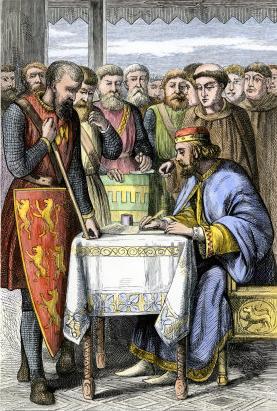
King John signs Magna Carta on June 15, 1215 at Runnymede; coloured wood engraving, 19th century.
Original artist unknown, held by the Granger Collection, New York. Image via Wikimedia Commons.
England does not really go in for national monuments, and when it does they are often eccentric. There is no great shrine to Alfred the Great, for example, the great founder of our nation, but we do have, right in the middle of London, a large marble memorial to the animals that gave their lives in the fight against fascism. And Runnymede, which you could say is the birthplace of English liberty, would be a deserted lay-by were it not for the Americans.
Beside the Thames, some 10 miles outside London’s western suburbs, this place “between Windsor and Staines”, as it is called in the original document, is a rather subdued spot, with the sound of constant traffic close by. Once there you might not know it was such a momentous place were it not for an enclosure with a small Romanesque circus, paid for by the American Association of Lawyers in 1957.
American lawyers are possibly not the most beloved group on earth, but it would be an awful world without them, and for that we must thank the men who on June 15, 1215 forced the king of England to agree to a document, “The Great Charter of the Liberties”.
Although John went back on the agreement almost immediately, and the country fell into civil war, by the end of the century Magna Carta had been written into English law; today, 800 years later, it is considered the most important legal document in history. As the great 18th-century statesman William Pitt the Elder put it, Magna Carta is “the Bible of the English Constitution”.
It was also, perhaps more importantly to the world, a huge influence on the United States. That is why today the doors to America’s Supreme Court feature eight panels showing great moments in legal history, one with an angry-looking King John facing a baron in 1215.
Magna Carta failed as a peace treaty, but after John’s death in 1216 the charter was reissued the following year, an act of desperation by the guardians of the new boy king Henry III. In 1300 his son Edward I reconfirmed the Charter when there was further discontent among the aristocracy; the monarch may have been lying to everyone in doing so, but he at least helped establish the precedent that kings were supposed to pretend to be bound by rules.
From then on Parliament often reaffirmed Magna Carta to the monarch, with 40 such announcements by 1400. Clause 39 heavily influenced the so-called “six statutes” of Edward III, which declared, among other things, that “no man, of whatever estate or condition he may be … could be dispossessed, imprisoned, or executed without due process of law”, the first time that phrase was used.
Magna Carta was last issued in 1423 and then barely referenced in the later 15th or 16th centuries, with the country going through periods of dynastic fighting followed by Tudor despotism and religious conflict. By Elizabeth I’s time, Magna Carta was so little cared about that Shakespeare’s play King John didn’t even mention it.
July 4, 2022
A first, tentative step to reining back the juggernaut that is the modern administrative state
Brad Polumbo has words of praise for US Supreme Court Justice Neil Gorsuch:
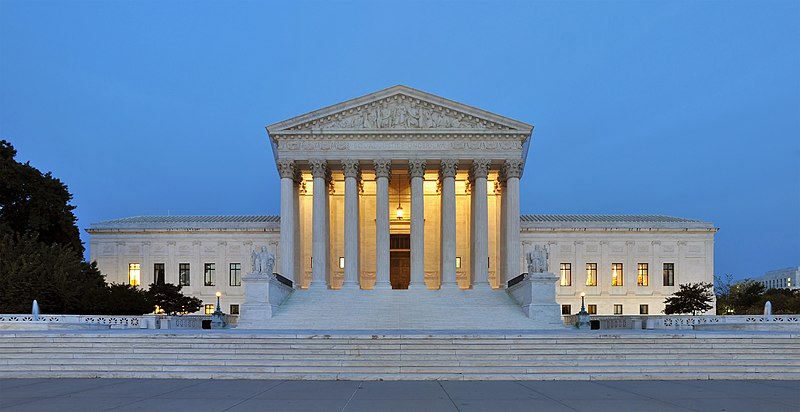
Panorama of the west facade of United States Supreme Court Building at dusk in Washington, D.C., 10 October, 2011.
Photo by Joe Ravi via Wikimedia Commons.
“Vesting federal legislative power in Congress [rather than bureaucrats]”, Gorsuch writes, “is vital because the framers believed that a republic — a thing of the people — would be more likely to enact just laws than a regime administered by a ruling class of largely unaccountable ‘ministers’.”
But what about those, like dissenting Justice Elena Kagan, who say that federal bureaucrats need wide latitude because Congress is failing to, in their view, adequately address climate change?
“Admittedly, lawmaking under our Constitution can be difficult,” Gorsuch acknowledges. “But that is nothing particular to our time nor any accident.”
“The framers believed that the power to make new laws regulating private conduct was a grave one that could, if not properly checked, pose a serious threat to individual liberty …” he said. “As a result, the framers deliberately sought to make lawmaking difficult by insisting that two houses of Congress must agree to any new law and the President must concur or a legislative supermajority must override his veto.”
With an empowered, unelected bureaucracy, “agencies could churn out new laws more or less at whim”, Gorsuch adds. “Intrusions on liberty would not be difficult and rare, but easy and profuse.”
This isn’t hypothetical speculation — it’s exactly what we’ve seen under the status quo.
For a glaring example, just consider the Centers for Disease Control’s pandemic-era “eviction moratorium”. The federal agency unilaterally declared that evictions nationwide were prohibited in many circumstances by citing an old statute that gave the CDC director the ability to order in specific places “such measures to prevent such spread of the diseases as he/she deems reasonably necessary, including inspection, fumigation, disinfection, sanitation, pest extermination, and destruction of animals or articles believed to be sources of infection.”
They went from that to a nationwide “eviction moratorium”. Stretch, much?
That’s right: Unelected government officials effectively commandeered the nation’s rental market, which caused tremendous dysfunction, trampled over property rights, and sabotaged the supply of rental housing. (For which prices are now surging. Shocker!) And, it was years before the courts finally stopped them and struck down the “moratorium”.
July 3, 2022
More evidence produced against RCMP Commissioner … how long can she hang on now?
In the free-to-cheapskates cut-down edition of The Line‘s weekly dispatch, the editors look at another confirmation that RCMP Commissioner Brenda Lucki really ought to resign, and soon:

Another document has been released that addresses the controversial teleconference between Lucki and local commanders and officials in Nova Scotia on April 28, 2020. This document is an email (which has been published by the Mass Casualty Commission in full), written by Lia Scanlan, a civilian who was working with the Nova Scotia RCMP as a communications advisor. She was a participant in the teleconference that is the source of the controversy. In an email sent to Lucki in 2021, well after the events in question but well before the recent controversy erupted, Scanlan harshly criticized Lucki’s conduct.
The bulk of Scanlan’s email relates to Lucki’s insensitivity to the officers and civilian staff in Nova Scotia in the aftermath of the shooting. (Lucki, for her part, has already acknowledged that she behaved badly in the meeting and regrets it.) What’s interesting for the purposes of the broader story, however, is that Scanlan’s email repeats the primary allegation contained in the earlier explosive document: that Lucki told the local commanders and officials that she was under political pressure to accelerate the release of information about the crime prior to a forthcoming gun-control announcement by the Trudeau Liberal government.
Specifically, Scanlan wrote: “Eventually, you informed us of the pressures and conversation with Minister Blair, which we clearly understood was related to the upcoming passing of the gun legislation. and there it was. I remember a feeling of disgust as I realized this was the catalyst for the conversation and perhaps a justification for what you were saying about us.”
This is interesting for two big reasons. The first is obvious: it is verification, from a new source also present at the controversial meeting, of the primary allegation that has been made against Lucki, and which she has not explicitly denied, though she has now put out two vague statements denying any intention to interfere. The second interesting thing is that one of the immediate lines of defence that miraculously sprung into being last week — just kidding, these were clearly PMO talking points — was that criticisms of Lucki’s conduct simply reflected the old-guard, all-male club mentality of the RCMP seeing an opportunity to put a hatchet into the uppity lady boss they’ve been saddled with by the Trudeau government.
Your Line editors weren’t born yesterday. We’re sure there’s plenty of good ole boys in the RCMP who do indeed feel exactly that way about Lucki. Scanlan, though, doesn’t reflect that. She’s a young woman, and a civilian. Further, even if the allegations were 100 per cent coming from an old-boys club, that doesn’t mean the allegations aren’t true. There have been many, many examples of pissed-off, agenda-driven people with axes to grind striking back at their rivals and opponents by … telling the truth about them.
As we said last week, Lucki is probably finished. If she doesn’t have the good judgment to resign, she should be fired. We don’t honestly know if this problem goes any higher up the chain of command than her. That’s why we repeat what we said last week: we need an investigation into this.
We will note that the government’s tone has slightly changed this week. It’s hard to read too much into government statements. And we want to be careful to avoid simply projecting our own views onto bland bureaucratese. But it does seem to us that the government’s position has evolved slightly, from “There’s no truth to these allegations and we stand by the commissioner” to something more akin to, “Hey, if she did this, it wasn’t because we asked her to. Don’t blame us!”
Commissioner Lucki? That sound you hear is the big red bus you will soon be thrown under pulling up to the curb you are standing beside. Don’t say we didn’t warn you.
June 30, 2022
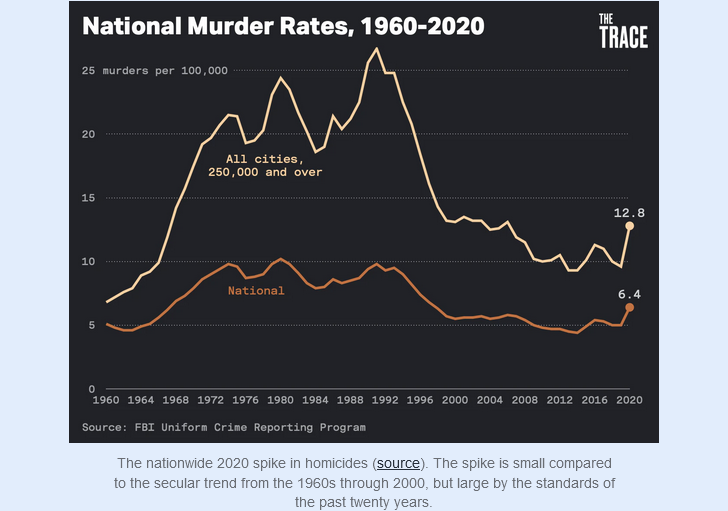
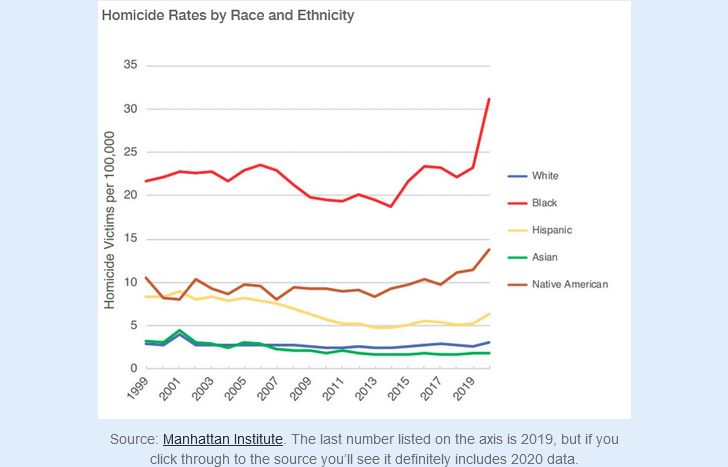
2020’s spike in homicides in the United States
At Astral Codex Ten, Scott Alexander looks at the rapid rise in murders across the United States in early 2020, and considers the common explanation for the phenomenon:
In my review of San Fransicko, I mentioned that it was hard to separate the effect of San Francisco’s local policies from the general 2020 spike in homicides, which I attributed to the Black Lives Matter protests and subsequent police pullback.
Several people in the comments questioned my attribution, saying that they’d read news articles saying the homicide spike was because of the pandemic, or that nobody knew what was causing the spike. I agree there are many articles like that, but I disagree with them. Here’s why:
Timing
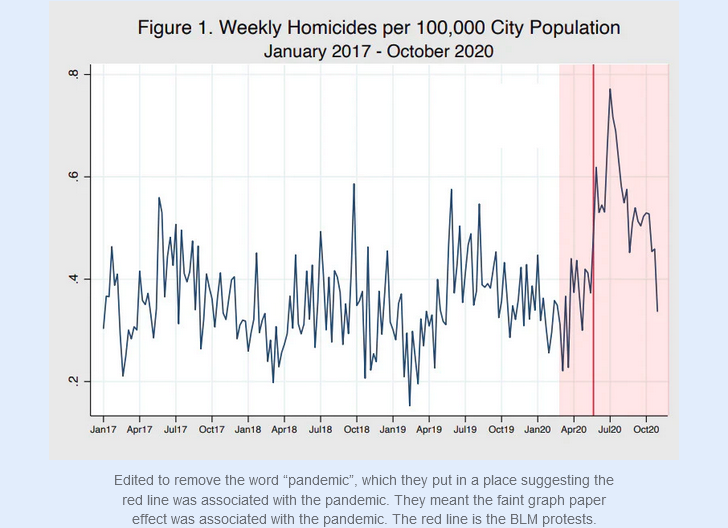
When exactly did the spike start? The nation shut down for the pandemic in mid-March 2020, but the BLM protests didn’t start until after George Floyd’s death in late May 2020. So did the homicide spike start in March, or May?
Let’s check in with the Council on Criminal Justice:
It very clearly started in late May, not mid-March. The months of March, April, and early May had the same number of homicides as usual.
[…]
Police Pullback
My specific claim is that the protests caused police to do less policing in predominantly black areas. This could be because of any of:
- Police interpreted the protests as a demand for less policing, and complied.
- Police felt angry and disrespected after the protests, and decided to police less in order to show everybody how much they needed them.
- Police worried they would be punished so severely for any fatal mistake that they made during policing that they were less willing to take the risk.
- The “Defund The Police” movement actually resulted in police being defunded, either of literal funds or political capital, and that made it harder for them to police.
I don’t want to speculate on which of these factors was most decisive, only to say that at least one of them must be true, and that police did in fact pull back.
[…]
Victims
Who is being targeted in these extra murders?
The 2020 homicide spike primarily targeted blacks.
(there also seems to be a much smaller spike for Native Americans, but there are so few Natives that I think this might be random, or unrelated).
Most violent crime is within a racial community, and there was no corresponding rise in hate crimes the way I would expect if this was whites targeting blacks, so I think the perpetrators were most likely also black. This was a rise in the level of violence within black communities.
A priori there’s no reason to expect lockdowns and “cabin fever” to hit blacks much harder than every other ethnic group. But there are lots of reasons to expect that the Black Lives Matter protests would cause police to pull back from black communities in particular. I think this is independent evidence that the homicide spike was because of the protests and not the pandemic.
June 23, 2022
Lucki will need to be lucky to keep her job as RCMP Commissioner
In The Line, Stephen Maher covers the active collusion between the Commissioner of the RCMP, Brenda Lucki, and the Liberals in Ottawa to use the tragedy in Nova Scotia that took so many lives to push for further federal gun control measures:
It is bitterly ironic that the first female commissioner of the Royal Canadian Mounted Police may have to resign for pushing the force to be more open, but it is hard to imagine that Brenda Lucki will be able to maintain public confidence after evidence presented Tuesday in the inquiry into the Nova Scotia mass shooting.
On April 28, 2020, 10 days after a killer went on a shooting and arson rampage that left 22 innocent people dead in rural Nova Scotia, Supt. Darren Campbell gave a news conference in which he declined to reveal what kind of firearms the killer used because investigators in Canada and the United States were still trying to find out how the killer came to have them.
After the news conference, Lucki summoned Campbell to a conference call where she chewed him out for holding that information back, as the Halifax Examiner reported.
“The Commissioner said she had promised the Minister of Public Safety and the Prime Minister’s Office that the RCMP (we) would release this information”, Campbell’s notes say. “I tried to explain there was no intent to disrespect anyone however we could not release this information at this time. The Commissioner then said that we didn’t understand, that this was tied to pending gun control legislation that would make officers and the public safer. She was very upset and at one point Deputy Commissioner (Brian) Brennan tried to get things calmed down but that had little effect. Some in the room were reduced to tears and emotional over this belittling reprimand.”
If this is accurate — and a statement from Lucki late Tuesday did not contradict it, reading in part that “I regret the way I approached the meeting and the impact it had on those in attendance” — then it is hard to see how Lucki can stay in her job. Further, the jobs of then-public safety minister Bill Blair and Prime Minister Justin Trudeau are also in jeopardy.
[…]
Trudeau and Blair are in the vote-seeking business, but Lucki is not supposed to be. If Campbell’s notes are accurate, she was confused about that, which is worrying.
We don’t know how much pressure the Liberals were applying. They clearly wanted to make a big splash with their gun announcement, and it would have had more impact if they had been able to say that they were banning the very guns used by the killer.
Pierre Poilievre has called for an emergency committee meeting to look into the matter, and that seems like a good idea. If Lucki was clumsily freelancing, seeking to curry favour with her bosses, she needs to go. If Blair and Trudeau were putting the muscle on her to release politically helpful information even at the risk of damaging an investigation, they need to go. Either way, we need to find out.
June 20, 2022
Criminal justice reform
At Time Well Spent, an interview with Charles Fain Lehman that considers the divergence between “what everyone knows” (based on how or if the media reports on an issue) and reality in the criminal justice system:

“Tombstone Courthouse State Historic Park” by August Rode is licensed under CC BY-NC-SA 2.0


I want to really dive into your work at City Journal and elsewhere because you’ve produced some of the most informative and sensible material on crime and crime policy I’ve found online, but before that I’m wondering: where does your interest in crime reporting come from, and what inspires you to keep going in the wake of what seems like a pro-crime movement capturing our newsrooms, elite colleges, and preeminent government institutions? You were the first person to support my interest in converting to Judaism as a black dude (as I mentioned in our dms), and so I have to ask also if Jewish culture centralizes the importance of issues of public safety in some way? Let’s get into it.
In some senses, my interest in crime is just a product of my natural contrarianism — I am rarely satisfied with the popular explanation. When I first started out as a reporter (at the Washington Free Beacon), I focused on domestic policy broadly, which I still do to some extent. I have a fluency with numbers, and so my first intuition was to dig into publicly available data. What I regularly found was that data about the criminal justice system simply did not align with the account of reality pushed by the criminal justice reform movement. Books like The New Jim Crow and documentaries like Thirteen give the impression that most people are in prison for marijuana possession on trumped up mandatory minima, all at the behest of the private prison-industrial complex. In reality, the majority of offenders are in prison for murder, marijuana possession is barely an asterisk in prison populations, mandatory minima explain little of the growth in prison populations, and few prisoners are held in private prisons at all. So I began to develop the sense that perhaps the story popular with people, even conservatives, my age was not precisely up to snuff.
The other issue that I think started me down the road to my “tough on crime” stances today was learning about death penalty abolitionism. I wrote a long essay (unfortunately never published) about the death of Clayton Lockett, who was executed in Oklahoma with a drug called midazolam, which lead to a fairly horrible death. What became apparent to me in researching the piece is that Oklahoma only used midazolam because anti-death-penalty activists had lobbied pharmaceutical firms to stop selling more reliable drugs, namely pentobarbital and thiopental, to states, forcing them to switch to less reliable methods. This sort of unintended consequence is actually a common theme across abolitionist activism. For example, in 2019 the Supreme Court blocked the execution of Vernon Madison, a 68-year-old man whose lawyers argued that dementia rendered him incompetent for execution. But of course, Madison only developed dementia because he’d been awaiting execution for literal decades, since he murdered a police officer in 1985.
These may seem like fairly specific issues, but I think they can allow us to identify a common theme with the progressive current in criminal justice reform, namely a belief that “justice” is primarily a concern of the accused — protecting his rights, defending him against the state, etc. Values like due process are, of course, important. But our discourse obfuscates entirely the basic fact that most criminals have committed heinous acts, and that the first responsibility of justice is to redress those harms through punishment. I am motivated, in other words, by a basic belief that justice matters, and that many reformers, in their zeal for fairness or equity or whatever, actively undermine the pursuit thereof.
I don’t think this is consciously a Jewish attitude, which is to say I don’t think I came to this sentiment because I was taught at some point that this is what Jews believed. That said, I tend to think the view that one of the ways that Judaism is distinguished from Christianity is the primacy of justice in the former, compared to the primacy of mercy in the latter. To the Christian, everyone is a sinner, and so the differences between me and the death row prisoner are ontologically trivial. (A view like this I think motivates someone like the Atlantic‘s Liz Bruenig, whom I credit as one of the few honest death penalty opponents, even as I disagree with her.) Judaism, by contrast, is fundamentally a religion of law: God says that these things ought to be done, and to live well is to do them. Of course, Judaism thinks a great deal about the balance of justice and mercy — the Talmud blunts the Torah‘s death penalties, for example. But Judaism always proceeds from the view that there are laws which should be respected, and that violating those laws requires consequences. So in that regard, I suspect that my views are inflected by Judaism. And indeed, coming around to those views I think helped me to think more about Judaism, too.
June 19, 2022
Why Hate Speech Laws Backfire
ReasonTV
Published 26 Feb 2022Here’s a brutal irony about regulating hate speech: Such laws often end up hurting the very people they are supposed to protect.
——————
Follow us on Twitter: https://twitter.com/reasonReason is the planet’s leading source of news, politics, and culture from a libertarian perspective. Go to reason.com for a point of view you won’t get from legacy media and old left-right opinion magazines.
—————-
That’s one of the central lessons in Jacob Mchangama’s important new book, Free Speech: A History from Socrates to Social Media. Mchangama heads up the Danish think tank Justitia. He’s worried about a proposal that would make hate speech a crime under European Union (EU) law and give bureaucrats in Brussels sweeping powers to prosecute people spewing venom at religious and ethnic minorities, members of the LGBT+ community, women, and others.Europe’s history with such laws argues against them. In the 1920s, Germany’s Weimar Republic strictly regulated the press and invoked emergency powers to crack down on Nazi speech. It censored and prosecuted the editor of the anti-Semitic Nazi paper Der Stürmer, Julius Streicher, who used his trial as a platform for spreading his views and his imprisonment as a way of turning himself into a martyr and his cause into a crusade. When the Nazis took power in the early ’30s, Mchangama stresses, they expanded existing laws and precedents to shut down dissent and freedom of assembly.
Contemporary scholarship suggests that there can be a “backlash effect” when governments shut down speech, leading otherwise moderate people to embrace fringe beliefs. Mchangama points to a 2017 study published in the European Journal of Political Research that concluded extremism in Western Europe was fueled in part by “extensive public repression of radical right actors and opinions.”
In 1965, the United Kingdom passed a law banning “incitement to racial hatred,” but one of the very first people prosecuted under it was a black Briton who called whites “vicious and nasty people” in a speech. More recently, Mchangama notes that radical feminists in England “have been charged with offending LGBT+ people because they insist there are biological differences between the sexes. In France, ‘an LGBT+ rights organization was fined for calling an opponent of same-sex marriage a ‘homophobe.'”
“Once the principle of free speech is abandoned,” warns Mchangama, “any minority can end up being targeted rather than protected by laws against hatred and offense.”
That’s what happened in Canada in the 1990s after the Supreme Court there ruled that words and images that “degrade” women should be banned. The decision was based in part on the legal theories of feminist author Andrea Dworkin, whose books on why pornography should be banned were briefly seized by Canadian customs agents under the laws she helped to inspire.
First Amendment rights are still popular in the United States, with 91 percent of us in a recent survey agreeing that “protecting free speech is an important part of American democracy.” But 60 percent of us also said that the government should prohibit people from sharing a racist or bigoted idea.
Hearing hateful words and ideas outrages and discomforts most of us, but Mchangama’s history of free speech underscores that state suppression can grant those words and ideas more power and influence. And that the best antidote to hate in a free and open society is not to hide from it but to openly—and persuasively—confront it.
Listen to my Reason Interview podcast with Jacob Mchangama at https://reason.com/podcast/2022/02/16….
Written by Nick Gillespie. Edited by Regan Taylor.
June 15, 2022
“Privacy” seems to be an archaic concept that doesn’t matter to the Canadian government
Michael Geist wonders why the Canadian government doesn’t seem to care at all about the privacy of Canadians:



Over the past several weeks, there have been several important privacy developments in Canada including troubling privacy practices at well-known organizations such as the CBC and Tim Hortons, a call from business organizations for privacy reform, the nomination of a new privacy commissioner with little privacy experience, and a decision by a Senate committee to effectively overrule the government on border privacy rules. These developments raise the puzzling question of why the federal government – led by Innovation, Science and Industry Minister François-Philippe Champagne, Public Safety Minister Marco Mendicino, and Canadian Heritage Minister Pablo Rodriguez – are so indifferent to privacy, at best treating it as a low priority issue and at worst proposing dangerous measures or seemingly hoping to cash in on weak privacy laws in order to fund other policy priorities.
The privacy alarm bells have been ringing for weeks. For example, the Globe and Mail recently featured an important story on children’s privacy, working with Human Rights Watch and other media organizations to examine the privacy practices of dozens of online education platforms. The preliminary data suggests some major concerns in Canada, most notably with the CBC, whose CBC Kids platform is said to be “one of the most egregious cases in Canada and really all around the world”. The CBC responded that it “complies with relevant Canadian laws and regulations with regard to online privacy, and follows industry practices in audience analytics and privacy protection”. Yet that is the problem: Canada’s privacy laws are universally regarded as outdated and weak, thereby enabling privacy invasive practices with no consequences. Soon after, the Privacy Commissioner of Canada released findings in an investigation involving the Tim Hortons app tracking location data. First identified by then-National Post reporter James McLeod, the commissioner found privacy violations, yet Canadian privacy law does not include penalties for these violations.
Despite the obvious need for privacy reform – outgoing Privacy Commissioner of Canada Daniel Therrien reiterated the necessity for reform in his final speech as commissioner and business groups have made a similar call for privacy reform – the government seems indifferent to the issue. The nomination of Philippe Dufresne as the new privacy commissioner is a case in point. I don’t know Mr. Dufresne and I’m hoping that he proves to be a great commissioner. He certainly said many of the right things in his appearance before committee yesterday. However, the government’s choice is instructive. In choosing someone with no obvious privacy experience, the government sided instead with government managerial experience. Good managerial experience is valuable, but a career spent within government is not a training ground for pushing the policy envelope, pressuring governments to reform the law, and demanding that the private sector comply with it. The Dufresne choice signals that the government may be more comfortable with a well-managed agent of Parliament than with an agent of change.
June 11, 2022
As federal minister of public safety, it’s Marco Mendicino’s job to lie to Canadians
At least, the headline is my interpretation of Matt Gurney‘s somewhat more cautious and measured assessment of the minister’s recent performance:
To celebrate World Press Freedom Day last month, Prime Minister Justin Trudeau said some wonderful things about the importance of truth.
“In the age of disinformation and misinformation,” the statement read, “independent, fact-based reporting is vital. We must all come together to support the work of journalists and double down in the fight against disinformation.”
Stirring stuff. But does the prime minister, his government and the Liberals’ many supporters think any of that actually applies to them?
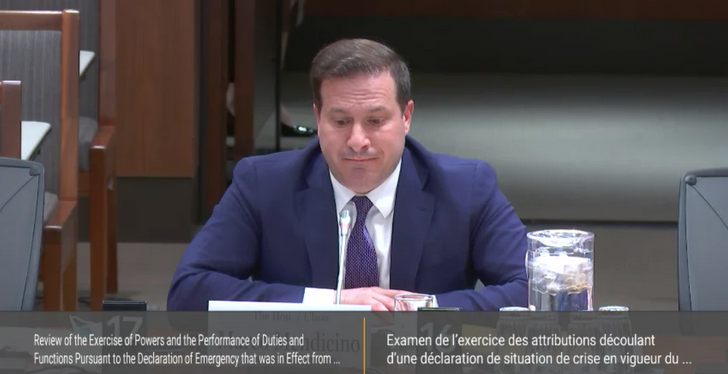
Marco Mendicino is the federal minister of public safety — a tough job in challenging times. But I’ve come to the unsettling conclusion that Minister Mendicino is not being honest with Canadians.
On the issue of gun control, I’m sorry to say he’s simply lying.
Last week here at The Line, I analyzed the Liberals’ proposed Bill C-21, a package of gun-control measures. My views on this file differ sharply from the government’s. But I’d have hoped that we could at least agree that honesty should be central to the government’s proposals and publicity.
No dice. Last weekend, on CTV’s Question Period, the minister said this: “Bill C-21 doesn’t target law-abiding gun owners, it targets handgun violence, it targets organized crime … I have enormous respect for law-abiding gun owners …”
Well, let’s just go have a gander at the minister’s own webpage, eh? The Public Safety Ministry summarized the proposed legal and regulatory changes. There are 13 specific proposed changes to the Firearms Act. Two are “internal” to the government itself and don’t directly bear on gun owners, law-abiding or otherwise. One targets firearms-related marketing, another is exemptions for “elite sports shooters”. The remaining nine are entirely aimed at the “law-abiding gun owners” the minister insists aren’t being targeted. The page also notes that the government will also be changing regulations (separately from the proposed bill) relating to the safe storage of firearms and ammunition magazine limits … again, aimed entirely and solely at law-abiding gun owners. Indeed, along with some entirely process-focused Criminal Code proposals, there’s only one — one — proposed change that actually focuses on gun smuggling, which is widely believed by law enforcement to be the primary driver of firearms homicides in Canada. (Other planned changes are too vague to be properly analyzed in this context, but could plausibly be aimed at smuggling or blackmarket sales.)
But do the math. One clear mention of smuggling, at least 11 that only affect licensed owners. Denying this is dishonest, full stop.
Let’s be clear: the minister is entirely within his rights to argue that the proposed measures targeting lawful owners are necessary, appropriate and reasonable. These are legitimate debates. What is not up for debate is that the majority of these proposals exclusively target and/or affect law-abiding gun owners. There’s no ambiguity here. The meaning and purpose of C-21 is clear.
June 6, 2022
Very convenient – “Only the cabinet can invoke the Emergencies Act, and if only the cabinet can be privy to the information that informs that decision, only the cabinet can judge whether the cabinet got it right”
In the free-to-cheapskates portion of The Line‘s weekly dispatch, the editors discuss the lack of evidence that the federal government was actually justified in its invokation of the Emergencies Act in February to break up the Freedom Convoy 2022 protests in Ottawa:

A screenshot from a YouTube video showing the protest in front of Parliament in Ottawa on 30 January, 2022.
Photo via Wikimedia Commons.
Your Line editors always understood that the situation in Ottawa (and at the borders) was indeed a crisis. We never doubted that. It was a very serious challenge that required a very serious response. But we have never seen the case for invoking the Emergencies Act. Under the law, which is very clear, a public-order emergency can only be invoked when the emergency cannot be met under existing laws. We really don’t know what, if anything, convinced Prime Minister Justin Trudeau and his cabinet that we had reached that point.
We have always been reasonable about this. The government may well be in possession of classified information that is not publicly known that convinced them, in good faith, that that condition had been met.
The problem is, they’re asking us to take it on their say-so. The position of the federal government thus far, as regards the inquiries and parliamentary reviews that are automatically triggered by invoking the act, is that they will not necessarily disclose all of the information that was known to the cabinet, and they may treat internal discussions as protected by cabinet confidentiality. This is setting up a perfect little loop of zero accountability. Only the cabinet can invoke the Emergencies Act, and if only the cabinet can be privy to the information that informs that decision, only the cabinet can judge whether the cabinet got it right.
You see the problem, right? As noted above, maybe they know something we don’t, and acted reasonably. Or maybe, under enormous political pressure, the PM whipped out the Emergencies Act to show us how big it is. That would be entirely within his character.
Do we think that’s what happened? We don’t know. Can we rule it out? No.
One of the only things the feds have yet said about their decision to invoke the Emergencies Act was that they did it because the police said it was necessary. But [former Ottawa Police Chief Peter] Sloly now says he never asked for it. The interim chief who succeeded him has said the same. The RCMP has said they did not ask for it. Who does that leave?
Maybe it was the OPP. Maybe it was one of the police agencies that patrols parliament itself. We don’t know. They just want us to take their word for it.
We’re sorry, but we don’t. The Emergencies Act is far too powerful to ever be invoked by a government on the basis of, “Trust us”. That’s not how things work in a democracy. And it should alarm all Canadians that the Liberals seem not to realize this, or are at least hoping that you don’t.
June 3, 2022
Proof of how far public trust in legacy media has fallen
At The Last Ditch, Tom finds the social media coverage of the Johnny Depp-Amber Heard trial unimpressive, but notes that many people are consciously choosing to get their “news” this way rather than depend on the offerings of the legacy media:

Celebrity gossip is not my thing. This case has been particularly unedifying. In a rational world, people would now pay less attention to the opinions of play actors, having seen what shallow, narcissistic souls (and I speak as a devoted theatre person who admires their professional skills) they often are.
What has been interesting about the trial is the MSM vs Social Media aspect of it. Wounded journos bemoan the fact that people have followed the trial – not through the lens of their analysis and opinion – but via such odd channels as TikTok. I understand their point of view. They are professionals and would like people to trust them. However, they just don’t seem to understand the role they played in losing that trust. They would do better to work hard to win it back, rather than insult the customers they’ve so clearly lost. The intense social media interest in a defamation trial shows the demand for coverage is there. Perhaps they should begin to think about how best to meet it? No-one (as the Remain campaign has still not learned) was ever insulted or abused into agreement. It’s just bad advocacy.
I have watched a couple of the videos of which they complain out of curiosity. They consisted of people I had never heard of pointing fingers and raising eyebrows in the corner of a screen showing video from the court. Every so often they’d point downwards to a “subscribe” button. Having practised law myself, I was just as unimpressed as the journalists with this approach to court reporting. Unlike the journalists, I recognised that their customers’ preference for it is a profound critique of the MSM. Just how much trust have you lost, dear journalists, that people trust these clowns more?
June 1, 2022
Trudeau’s new gun control plans will do nothing to reduce criminal use of firearms … and he doesn’t care
The proposed new rules will impose costs on legal gun owners and restrict their access to certain firearms, and almost certainly do nothing at all to reduce the headline-grabbing crimes that supposedly prompted the new rules in the first place:

A 2018 Toronto Police Services publicity photo of guns seized in a recent operation.
In my 15 years or so of writing about firearms policy, here’s been a constant problem: gun policy is complicated, the broader public doesn’t know much about it, and it’s hard (impossible?) to make any coherent arguments without laying out the context, both of the specific proposals and the broader background. Working through what was announced yesterday, and how this clarifies a worrying shift in how the Liberals approach gun control, is going to be a bit of a process.
Get comfy.
As of Tuesday morning, we are short a lot of details, because the Liberals chose to make their high-publicity announcement before they provided any technical briefings. (We’ll come back to that later.) At first glance, it seems that lot of what the Liberals announced is stuff they’d either already committed to do or, in fact, already exists. (The Liberals?! Re-announcing stuff? Well, I never!) There is currently confusion about the ammunition magazine capacity limit — most non-gunnies won’t know the difference between an internal magazine and a detachable one, but it’s a huge difference, and the proposed legislation is unhelpfully vague. So stay tuned. But the actual centrepiece of the proposal, I have to admit, made me burst out laughing. On Twitter, I called it “peak Liberal”. It really is a pretty perfect example of what’s wrong with how the Liberals govern, but why they’re great at politics.
One of the jokes about Justin Trudeau when he entered politics was that he’d be much better suited to playing the role of political leader on TV than he would in real life. Several years later, the joke is on the Canadian voter because that’s turned out to be exactly the case: Trudeau loves posturing and pontificating for the cameras, and early in his first term as prime minister he became notorious for “unplanned” photo ops (despite being constantly accompanied by at least one staff photographer/videographer everywhere he went). I think this is one of the reasons the Liberals have been justly mocked for constantly re-announcing policies and programs — it looks good on camera.
The big reveal was a “freeze” on handgun sales in Canada, and their importation. Existing owners can keep theirs. It’s not clear exactly when this will go in effect, so I imagine gun stores across the land are going to set sales records in the next few days. Once in place, the sale or transfer of a handgun — from either a store to an individual or between individuals — will be eliminated. Again, “frozen”, as the Liberals call it.
At the most basic level, new government policies are intended to solve a problem: you see something that’s wrong with the status quo, and you try to enact a policy to improve it. Parties tend to wrap their policies in lots of rhetorical flourishes, but if you tune out what the politicians are saying and look at what they’re doing, you can get a decent sense of what their actual goal is. And there’s been an interesting shift in what the Liberals have been doing with gun control these last few years. Monday’s announcement is perhaps the ultimate example of this yet, the purest form of the new normal we’ve yet seen.
The Liberals are making a series of announcements that won’t actually change, at all, how safe Canadians are from gun violence. The announcements do get a lot of attention, though. Because, clearly, getting the attention is itself the goal. The public-safety talking points are just the PR frosting on top of what is an entirely political exercise. Why else make the announcement before you give the press the technical briefings? The sequence tells you all you need to know.
Trudeau’s general governing style might best be described as “provocatively performative”. If you think of him just portraying what he thinks a Prime Minister should look like, much of his performance makes more sense. As I joked on social media the other day “It’s about time Trudeau took decisive steps to crush these MAGA-hatted, gun-toting, pickup-truck-driving rednecks who keep coming into Toronto and gunning down innocent drug dealers, pimps, and aspiring rap artists who were just turning their lives around! ” It’s a theatrical performance on the political stage … but unfortunately ordinary Canadians are going to be forced to put up with his playing up to the urban and suburban voting galleries.
Note that while the government is puffing its collective chest for this “tough on guns” announcement, they are also pushing a bill in Parliament that would reduce or eliminate many “mandatory minimum penalties” for things like smuggling firearms into the country. This is apparently intended to address the “overincarceration rate” of First Nations and other “marginalized Canadians”. So, on the one hand, they’re planning to penalize legal gun owners and on the other hand, they’ll reduce the penalties that can be imposed on criminals who smuggle illegal weapons into the country. That only makes sense if it’s all a theatrical performance.


