
Quotulatiousness

October 19, 2010

The less-visible effects of workplace demographic changes

Filed under: Economics, History, USA — Tags: , , , , , , — Nicholas @ 12:12

Monty points out that we’ve passed a significant equilibrium point in employment statistics:

Women are vital to the American workforce, and have been since at least the 1940’s, but this recession may have shifted the balance of economic power decisively to women. Men have been the traditional household “breadwinners”, with the wife’s income being seen as augmenting the male’s income, but this recession has hit men disproportionately harder than women. Women are far more likely to work in industries (like services and healthcare) that are more insulated from the downturn, whereas men are far more likely to work in the hard-hit trades and manufacturing sectors. Women also have many more protections — both regulatory and social/cultural — than men do. There are many deep ramifications to this change — the impact of long-term male unemployment on the family; the loss of status, power and prestige that goes with being unemployed; the male self-image and value to society. (Studies of unemployed men during the Great Depression are not happy reading — many of the chronically unemployed males left their families rather than assume a lower status in the family, and were also far more likely to be dictatorial and violent towards their wives and children.)

Social support agencies are not well-equipped to deal with this change, and it will continue to disrupt “normal” life for years to come, unless the economy is allowed to right itself — yet another excellent reason to tell the politicians to stop meddling.

Another valuable observation from the same post:

This is a point I’ve made many times: the economic demographic most impacted by immigrant labor are teens. Low-end “starter” jobs tend to be low-skill, low-paying, part-time jobs, and adult immigrants are often favored over teens for these jobs by employers (they often have families to support, are considered more reliable, etc.). This means that the teen labor-participation percentage has fallen from 50% in 1970 to 25% today. (And even 25% is probably too high.) When faced with this lack of job opportunities, teens often opt to go back to school — but this in turn saddles them with a lot of debt for (in many cases) not much gain. For many teens, it’s simply a way of deferring adulthood, not a way to gain additional skills or knowledge. (I had my first paying job at 14; my first “real” W2 job at 16. I worked nearly full-time all the way through college, and worked full-time during the summers. I wonder how rare this is now?) Another interesting aspect to the immigrant/teen issue: the language barrier. If you’re a teen who doesn’t speak Spanish, just try and get a landscaping or construction job in the Southwest. The same goes for many fast-food crews and oil-change/tire-repair places. Still, we’re not the only ones with immigrant troubles.

Another side to the increasing longevity of western culture is the delayed start to “adult” life: now that a college diploma or university degree has about the same relevance that a high school diploma did a generation ago, young folks are entering the workforce several years later than earlier generations. This delays family formation, children, home-buying, and all the other aspects of independent-from-the-parents life.

No wonder so many of the “rules” no longer seem to apply with so many things changing.
October 16, 2010

The 21st anniversary of the NFL’s biggest trade

Filed under: Football, History — Tags: , , — Nicholas @ 12:17

Remember the Herschel Walker trade? Where the Vikings gave up just about everything to obtain a top-flight running back? It was such a big trade that Minnesotans joked that the NHL’s North Stars moving to Dallas was the final part of the deal (“joked” in the gallows humour style). The trade happened 21 years ago, and it gutted the Vikings for at least five years:

[T]he Vikings of 1989 vintage believed they were a running back away from being a Super Bowl contender. The Cowboys, under first-year owner Jerry Jones, were going nowhere. Yet, they had a marketable star named Herschel Walker who, as it would turn out, could fetch a king’s ransom in trade. The Vikings had nine Pro Bowlers on their roster — even though guys like Wade Wilson, while a Pro Bowl selection, weren’t really Pro Bowlers in the truest sense of the word — and all that was missing was a big-play guy who could make a difference.

What followed was the NFL equivalent to a burglary. The trade cost the Vikings five live bodies (RB Darrin Nelson, CB Issiac Holt, DE Alex Stewart and LBs Jesse Solomon and David Howard) and three first-round, three second-round and two third-round picks in return. It hamstrung the Vikings organization for five years and turned Dallas from a joke to the kingpin of the NFL. Walker, although talented, wasn’t anywhere close to being worth what the Vikings gave up to get him. That trade transformed the Cowboys from a 1-15 team to a Super Bowl champ and set the Vikings back for years, denying them the top draft choices that could re-stock their own shelves.

For all their bravado and claims to be “America’s Team,” the Cowboys’ rise to the top of the NFL in the early 1990s was a direct result of the Walker trade. They were more Minnesota’s team, or at least Minnesota’s former players and draft picks, than anything.

The trade was so big that I still find it incredible that the Vikings ownership were willing to give up so much for a single player, no matter how talented. They gambled that Walker was the missing ingredient to a SuperBowl team, and lost . . . big.

The Wikipedia entry for Walker includes this information:

In 1989, at the height of his NFL career, the Cowboys traded Walker to the Minnesota Vikings for a total of five players (LB Jesse Solomon, DB Issiac Holt, RB Darrin Nelson, LB David Howard, DE Alex Stewart) and six draft picks (which led to Emmitt Smith, Russell Maryland, Kevin Smith, and Darren Woodson). This was judged to be one of the turning points in the rise of the Cowboys to the top echelon of the NFL. Nicknamed the “HWT” (Herschel Walker Trade), Walker’s trade was widely perceived as an exceptionally poor move considering what the Vikings had to give up in order to get him, and remains one of the most frequently vilified roster moves of the team’s history. The Vikings coaches reluctantly accepted Walker after the trade and never totally used the tool they had been given. Scout.com says, “Walker was never used properly by the coaching brain trust.” “Herschel the Turkey,” a mocking “honor” given out by the Star Tribune newspaper to particularly inept or disgraceful Minnesota sports personalities, is named for him.

Walker played for the Vikings for two and a half years, never amassing 1,000 rushing yards in a season. His rights were then acquired by the Philadelphia Eagles, and, subsequently, the New York Giants. Eventually, he was re-acquired by the Cowboys, where he was used not only as a running back but as a flanker and other offensive positions as well. In addition to running and catching passes, Walker was also often used to return kickoffs throughout his career.

[. . .]

While Herschel Walker’s NFL career was certainly notable, it was also a disappointment from the standpoint that he never played on a championship team. High expectations were placed on him due to his extraordinary college career and the dollar amount of his trade to the Minnesota Vikings. Many of those expectations were never realized. The move to Minnesota was the turning point in his NFL tenure. In 2008, the trade was selected by SI.com as the number one worst sports trade of all time. It was also the subject of an episode of ESPN Classic’s The Top 5 Reasons You Can’t Blame…

October 7, 2010

Breaking: Historians confess they invented “ancient Greeks”

Filed under: Europe, Greece, History, Humour, Media — Tags: , — Nicholas @ 12:41

As many had suspected for years, the entire history of ancient Greece was fabricated by historians:

A group of leading historians held a press conference Monday at the National Geographic Society to announce they had “entirely fabricated” ancient Greece, a culture long thought to be the intellectual basis of Western civilization.

The group acknowledged that the idea of a sophisticated, flourishing society existing in Greece more than two millennia ago was a complete fiction created by a team of some two dozen historians, anthropologists, and classicists who worked nonstop between 1971 and 1974 to forge “Greek” documents and artifacts.

“Honestly, we never meant for things to go this far,” said Professor Gene Haddlebury, who has offered to resign his position as chair of Hellenic Studies at Georgetown University. “We were young and trying to advance our careers, so we just started making things up: Homer, Aristotle, Socrates, Hippocrates, the lever and fulcrum, rhetoric, ethics, all the different kinds of columns — everything.”

[. . .]

According to Haddlebury, the idea of inventing a wholly fraudulent ancient culture came about when he and other scholars realized they had no idea what had actually happened in Europe during the 800-year period before the Christian era.

I’m glad that they’ve finally come clean on this huge historical fraud. Especially The Iliad, which “was a bitch to write, by the way” but “it seemed to catch on.”

October 1, 2010

You think you’re struggling with the burden of old debts?

Filed under: Economics, Europe, Germany, History, WW1 — Tags: — Nicholas @ 09:07

Consider the case of Imperial Germany:

First World War officially ends
The First World War will officially end on Sunday, 92 years after the guns fell silent, when Germany pays off the last chunk of reparations imposed on it by the Allies.

The final payment of £59.5 million, writes off the crippling debt that was the price for one world war and laid the foundations for another.

Germany was forced to pay the reparations at the Treaty of Versailles in 1919 as compensation to the war-ravaged nations of Belgium and France and to pay the Allies some of the costs of waging what was then the bloodiest conflict in history, leaving nearly ten million soldiers dead.

H/T to Jon, my former virtual landlord, for the link.

September 28, 2010

Britain in the 70’s

Filed under: Books, Britain, Economics, History — Tags: , , , — Nicholas @ 07:38

A review of Dominic Sandbrook’s State of Emergency: The Way We Were. Britain, 1970–1974 sounds interesting:

As prime ministers, Edward Heath and Gordon Brown had quite a lot in common. Both were monstrously self-centred, permanently grumpy and capable of astonishing rudeness. Both of their relatively short-lived premierships ended in humiliating failure. In a recent poll of academics on Britain’s best and worst prime ministers since the second world war, Heath came ninth out of twelve and Mr Brown tenth. But that is where the similarities end. Whereas Mr Brown was largely the author of his own misfortunes (the banking crash apart), Heath, as Dominic Sandbrook reminds us in his splendidly readable new history of Britain during the four years from 1970, was faced with a set of problems whose intractability and nastiness would have overwhelmed even a far more gifted politician.

Heath both appals Mr Sandbrook and elicits his sympathy. Tory mythology still insists that many of Heath’s difficulties arose from his U-turn when he abandoned the free-market ideas with which he entered office and embraced an already discredited and peculiarly British form of corporatism the moment the going got rough. The truth is that although Heath had tried to present himself as the champion of ruthless neoliberalism, he was always at heart a “one nation” Tory with little appetite for the kind of confrontation his successor as Conservative Party leader, Margaret Thatcher, relished. His burning desire was to modernise Britain and to arrest its economic decline through efficiency, pragmatic problem-solving and, above all, by joining the European Community.

My family left Britain in 1967, which was a good time to go: the economy was still in post-war recovery, but opportunities abroad were still open to British workers. My first visit back was in 1979, which was a terrible shock to my system. I’d left, as a child, before the strikes-every-day era began, and my memories of the place were still golden-hued and happy. Going back to grey, dismal, cold, smelly, strike-bound Britain left me with a case of depression that lasted a long time. It didn’t help that the occasion of the visit was to attend my grandfather’s funeral: it was rather like the land itself had died and the only remaining activity was a form of national decomposition.

Some readers will find the way the author flits about tiresome, but given that he was born only in 1974 his almost pitch-perfect ability to recreate the mood and atmospherics of the time is remarkable. He does not lose sight of the fact that although the 1970s are now seen as a nadir in Britain’s post-war fortunes, for the majority of people it was nonetheless a time of growing affluence, widening horizons and personal liberation. Many of the positive developments that are associated with the supposedly wonderful 1960s did not gain traction until a decade later. Viewed from a distance, Britain in the 1970s looks ghastly — angry, decaying, on the skids. But that is not the whole story.

Mr Sandbrook compares this turbulent period with the four years between 1910 and 1914 described by George Dangerfield in “The Strange Death of Liberal England”. As he says: “Dangerfield’s story was one of political ferment and economic turmoil, of challenges to the moral order and rebellions against traditional gender roles, of Utopian socialism and Irish sectarianism — all rooted, like the challenges of the early 1970s, in profound historical trends that no government could possibly control.” Thankfully, the discontent of the 1970s did not end in world war, but continued, mostly unresolved, until the arrival of Lady Thatcher in 1979. That may pose a problem for Mr Sandbrook’s next book, which will be an account of the second half of the decade. In many ways it was more of the same, but without a central character as oddly compelling and sad as Heath.

I’m even more interested — in a grim sort of way — in the next book. It’ll be interesting to read an account of that time from a different perspective than my brief mid-winter visit provided.

September 25, 2010

Irony, Polish style

Filed under: Europe, History, WW2 — Tags: , , — Nicholas @ 13:17

By way of Jon Henke’s twitter feed, the most ironic story so far this year:

Two Polish neo-Nazis who were childhood sweethearts and later became skinheads have discovered what for them is a shocking family secret: They’re actually Jewish.

Pawel and Ola, identified only by their first names, are the subject of a CNN documentary about Poles rediscovering their Jewish roots generations after their ancestors hid their religious identities to escape persecution during World War II.

A few years ago, Ola found out from Warsaw’s Jewish Historical Institute that both she and her husband are technically Jews. “It was unbelievable — it turned out that we had Jewish roots. It was a shock,” she said.

September 23, 2010

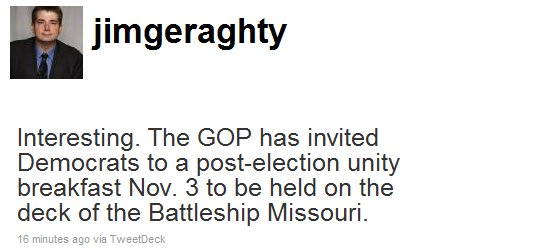
Not that they’re getting too confident, or anything

Filed under: History, Humour, Politics, USA — Tags: — Nicholas @ 16:11

Tweet of the day, from Jim Geraghty:

September 22, 2010

Civ V review

Filed under: Gaming, History, Technology — Tags: — Nicholas @ 07:55

No, not by me . . . my copy hasn’t arrived yet. It’s from the Guardian:

Fans of Sid Meir’s seminal strategy game tend to be purists — one reason why 2008’s Civilization Revolution was so panned by some for slimming down the formula in just about every respect.

Yet for all its limitations, the console version addressed many of the problems that the old PC franchise had ignored for too long, and the proof is here for all to see. Civilization V returns to Civ IV‘s epic scale but combines it with CivRev‘s emphasis on simplicity and clarity. As a result, this is probably the best (or at least the most user friendly) version of the game since the original and certainly the best-equipped for the now-obligatory multiplayer mode.

The first thing PC owners will notice is the interface. Heavily influenced by CivRev, it’s a thing of minimalist beauty designed to display information clearly and succinctly. This also has the effect of allowing pride of place to the new-look World Map, which is now a thing of shimmering beauty as your empire develops into a tableau of fields, factories and road networks. Zooming in and out is smoother than before and it makes the game annoyingly easy to keep playing.

If nothing else, it should keep me occupied until Guild Wars 2 is released.

Update: Just got an email from Amazon.ca, providing me with a bonus code for the “Cradle of Civilization Map Pack”. I ordered this long enough ago that I don’t even remember what this might be (or, more likely, it was added after I pre-ordered).

Update, the second (at 23:15): Yep, my copy arrived tonight. While I was in town for an appointment. Can anyone explain why they bother to ship you a DVD-ROM when you have to download the game through Steam anyway? Because it’s peak time somewhere in North America, I’ve been downloading for over half an hour and just got to 47%. At this rate, I’ll maybe get half an hour of gaming before I turn into a pumpkin . . .

September 15, 2010

The real results of Turkey’s referendum

Filed under: Europe, Government, History, Middle East, Politics — Tags: , , — Nicholas @ 07:50

Austin Bay is still hopeful for a secular Turkish government, but the results of the recent referendum don’t encourage quite as much hope:

Turkey’s leading political organizations both portray the choice between them as “either us or darkness.” This rhetorical demonization is typical of successful democracies. Ataturk deserves credit for establishing a democratic structure that survived his death in 1938 by 72 years.

Turkey’s actual circumstances, however, are much more complex and murky. Start with the referendum’s irony. The constitution had many undemocratic articles and was in fact imposed by the military after a coup in 1980. The European Union ruled that many of these elements did not meet EU membership standards. Thus the ironic situation of an Islamist political party promoting constitutional changes in order to meet Western European democratic standards. Aligning Turkey with Europe was one of Kemal Ataturk’s long-term goals.

Yet the judicial reforms approved this week may be an anti-democratic trap door, for they give the AKP the ability to limit systemic checks and balances on executive power. The AKP can pack the courts. The judiciary has protected the Turkish military. The AKP distrusts the military because it fears a coup, and with good reason. The military sees itself as the protector of the secular state and a bulwark against Muslim fundamentalist usurpation.

September 13, 2010

QotD: An alternate history we might have suffered

Thought experiment: imagine an Internet in which email and web addresses were centrally issued by government agencies, with heavy procedural requirements and no mobility — even, at a plausible extreme, political patronage footballs. What kind of society do you suppose eventually issues from that?

I was there in 1983 when a tiny group called the IETF prevented this from happening. I had a personal hand in preventing it and yes, I knew what the stakes were. Even then. So did everyone else in the room.

Thought experiment: imagine a future in which everybody takes for granted that all software outside a few toy projects in academia will be closed source controlled by managerial elites, computers are unhackable sealed boxes, communications protocols are opaque and locked down, and any use of computer-assisted technology requires layers of permissions that (in effect) mean digital information flow is utterly controlled by those with political and legal master keys. What kind of society do you suppose eventually issues from that?

Remember Trusted Computing and Palladium and crypto-export restrictions? RMS and Linus Torvalds and John Gilmore and I and a few score other hackers aborted that future before it was born, by using our leverage as engineers and mentors of engineers to change the ground of debate.

[. . .]

Did we bend the trajectory of society? Yes. Yes, I think we did. It wasn’t a given that we’d get a future in which any random person could have a website and a blog, you know. It wasn’t even given that we’d have an Internet that anyone could hook up to without permission. And I’m pretty sure that if the political class had understood the implications of what we were actually doing, they’d have insisted on more centralized control. ~For the public good and the children, don’t you know.~

So, yes, sometimes very tiny groups can change society in visibly large ways on a short timescale. I’ve been there when it was done; once or twice I’ve been the instrument of change myself.

Eric S. Raymond, “Engineering history”, Armed and Dangerous, 2010-09-12

September 11, 2010

Nine years on

Filed under: History, USA — Tags: , , — Nicholas @ 00:04

Video by James Lileks.

But every so often — every week, really — I remember the event in some odd echo of the emotions I felt on September 11. It might be the closing credit music of a BBC comedy, or an old movie about New York, or driving past a building designed by the architect of the WTC, or just standing in the spot where I stood when I saw the towers fall. Or more: for God’s sake, the Gallery of Regrettable Food’s publication date was 9/11; half the time I look at the book on the shelf I recall being in the shower, thinking of the interviews I had lined up, turning off the water and hearing Peter Jennings on the radio, wondering why they were replaying tape of the 91 attack on the towers. I remember what Natalie was doing — a happy toddler, she was digging through her box of toys and handing me a phone with a smile as bright as the best tomorrow you could imagine. I remember Jasper on his back, whining, unsure. I remember these things because I picked up my camera and filmed them, because this was a day unlike any other. Today I answered the phone in the same spot where I stood when I called my Washington bureau, told them I’d be rewriting the column — obviously — and wished them well. They were four blocks from the White House. Impossible not to imagine the Fail-Safe squeal on the other end of the line.

On the Hewitt show tonight I started talking about 9/11, and my mouth overran my head, because somewhere down there is a core of anger that hasn’t diminished a joule. This doesn’t mean anything, by itself — anger is an emotion that believes its justification is self-evident by its very existence. Passion is not an argument; rage is not a plan. But as the years go by I find myself as furious now as I was furious then — and no less unmanned by the sight of the planes and the plumes. Once a year I watch the thing I cobbled together from the footage I Tivo’d, and the day is bright and real and true again.

Update: How Twitter can be almost poetry. Disturbing, yet moving.

September 6, 2010

The start of the Blitz, 1940

Filed under: Britain, Germany, History, Military, WW2 — Tags: , — Nicholas @ 09:44

September, 1940: the start of the Blitz:

The London Blitz started quietly. Less than 100 incidents reported by the London Fire Brigade up to 5pm on September 7, 1940. Only a few weeks after the British victory in the Battle of Britain, what came then must have been a terrible shock for Londoners. You can read the original Guardian archive report of the night here.

At 5.30pm, some 348 German bombers escorted by 617 fighters pounded London until 6.00pm. Guided by the flames, a second group attacked with more incendiary bombs two hours later, lasting into the next day.

Note, that link to the Guardian archive is a bit badly behaved: it resized my browser window.

Update: Rare colour footage of the Blitz.

September 2, 2010

The local jousting scene

Filed under: Cancon, History, Sports — Tags: — Nicholas @ 09:44

Some people think I’m strange for my renaissance fencing interests, but at least I don’t combine my odd combat tastes with horseback riding like Jordan and Stephanie do!

If not the founder, at least a notable contributor

Filed under: Books, History, Media, Politics, WW1 — Tags: , , , — Nicholas @ 08:59

John Pilger pays “tribute” to one of the more persuasive contributors to both militarism and commercialism of the 20th century:

Edward Bernays, the American nephew of Sigmund Freud, is said to have invented modern propaganda. During the first world war, he was one of a group of influential liberals who mounted a secret government campaign to persuade reluctant Americans to send an army to the bloodbath in Europe. In his book, Propaganda, published in 1928, Bernays wrote that the “intelligent manipulation of the organized habits and opinions of the masses was an important element in democratic society” and that the manipulators “constitute an invisible government which is the true ruling power in our country.” Instead of propaganda, he coined the euphemism “public relations.”

The American tobacco industry hired Bernays to convince women they should smoke in public. By associating smoking with women’s liberation, he made cigarettes “torches of freedom.” In 1954, he conjured a communist menace in Guatemala as an excuse for overthrowing the democratically-elected government, whose social reforms were threatening the United Fruit company’s monopoly of the banana trade. He called it a “liberation.”

Bernays was no rabid right-winger. He was an elitist liberal who believed that “engineering public consent” was for the greater good. This was achieved by the creation of “false realities” which then became “news events.”

Propaganda definitely existed before Bernays, but he may have been the one who codified and systematized the “science”.

September 1, 2010

T.R. Fehrenbach’s This Kind of War

Filed under: Asia, Books, History, Military, USA — Tags: , — Nicholas @ 12:01

Austin Bay recommends a book first published in 1963 as still being the best single-volume history of the Korean War (and I agree):

June 25 marked the 60th anniversary of North Korea’s premeditated attack on South Korea. The attack, which scattered South Korea’s weak and disorganized defense forces, began a vicious two and a half months of combat. The North Koreans would smash the ill-starred U.S. 24th Division’s Task Force Smith, then shove remnant South Korean troops and U.S. reinforcements into the Pusan Perimeter, at the southern tip of the peninsula.

In the weeks since June 25, I’ve re-read T.R. Fehrenbach’s “This Kind of War,” still the premier Korean War history. (Clay Blair’s “The Forgotten War” is also an excellent book.) Published in 1963 and reissued in 2000, “This Kind of War” is lyric history, delivering analysis in elegant, honest prose. Fehrenbach is also a decorated Korean War veteran, a man in touch with the emotions as well as the facts.

“This kind of war,” Fehrenbach writes, “is dirty business first to last.” Fehrenbach’s commentary on those first battles of July and August 1950 depicts the confusion of initial defeat and retreat, as well as the courage and intellect required to stem the onslaught. His chapter on the Inchon landing of September 1950 — the American amphibious counter-stroke — is incisive. Its 60th anniversary is two weeks away.

I think I first saw This Kind of War recommended by Jim Dunnigan, many years ago, but the Korean War has never been a major historical interest of mine. When I did get around to reading the book, it certainly opened my eyes. As Bay points out, the work is still topical because the war has never officially ended (as the sinking of the ROKS Cheonan amply demonstrated).

« Newer PostsOlder Posts »

Powered by WordPress


