Quotulatiousness

July 2, 2012

Hoist a craft-brewed beer to thank Jimmy Carter for saving America’s brewing tradition

Filed under: Business, Government, History, USA — Tags: , , , , — Nicholas @ 10:35

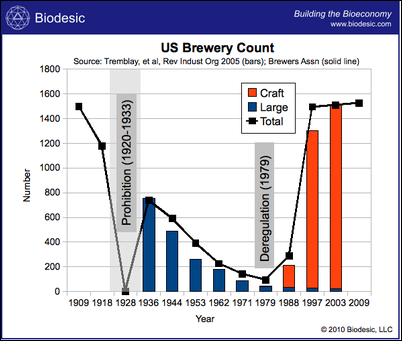
Jimmy Carter will have to go a long time before his reputation recovers from his four years in office, but along with beginning to deregulate the air travel, freight railroad, and trucking industries, he also deserves credit for triggering the revival of the American craft brewing tradition. This is from an article in The New Republic, published in 2010:

If you’re a fan of craft beer and microbreweries as opposed to say Bud Light or Coors, you should say a little thank you to Jimmy Carter. Carter could very well be the hero of International Beer Day.

To make a long story short, prohibition led to the dismantling of many small breweries around the nation. When prohibition was lifted, government tightly regulated the market, and small scale producers were essentially shut out of the beer market altogether. Regulations imposed at the time greatly benefited the large beer makers. In 1979, Carter deregulated the beer industry, opening back up to craft brewers. As the chart below illustrates, this had a really amazing effect on the beer industry:

H/T to The Whited Sepulchre for the link.

July 1, 2012

“Canada was born in debt”

Filed under: Cancon, Economics, Government, History, Railways — Tags: , , — Nicholas @ 11:08

At the Worthwhile Canadian Initiative blog, Livio Di Matteo explains one of the less mentioned but urgent reasons behind confederation in 1867:

The trials and tribulations of the European Union, its debt crisis and the Euro and the suggestion that part of the solution lies in a stronger fiscal union reminds me of the forces behind the drive for Canadian confederation in the mid-nineteenth century. Canadians are usually taught in school that major forces driving Confederation were the potential threat of territorial aggrandizement by the United States in the wake of the Civil War or the need for a larger market given Britain’s move to free trade and the end of Reciprocity with the Americans or the desire to generate the economic resources to build a railway to the west so that it could serve as an investment frontier.

One factor that receives very little mention is the fact that the prior to 1867 the colonies of British North America were heavily in debt and faced a fiscal crisis of their own. The solution to the colonial debt crisis that Confederation allowed was the creation of the federal government that was given strong revenue raising powers and assumed provincial debts and thereby stabilized the public credit. Public debt charges in 1867 already accounted for 29 percent of federal budgetary expenditure and by 1880 had only been whittled down to about 24 percent. Canada was born in debt.

Canada was created with a large debt as the provincial and local levels of government had invested heavily in transportation infrastructure — canals and railways in particular. In 1850, there were only about 66 miles of track in operation but by 1860 about 2000 miles of track had been built in eastern Canada. The total cost of building these railways in British North America up to 1867 was 145.8 million dollars the bulk of which was for the Province of Canada — Ontario and Quebec. By way of comparison, Canada’s GDP in 1870 has been estimated at about 383 million dollars.

[. . .]

Confederation was designed to fix a massive debt problem. Creation of a new political entity — the dominion government — would allow for the current debt burden to be serviced and for more credit to be obtained on foreign markets to fund the railway projects of the late 19th century — the CPR, Canadian Northern, etc… Confederation was a solution to the debt crisis but required a form of government that reduced sovereignty for the member units in order to stabilize the public credit. In the Canadian case, as acrimonious as the discussions were, the process was facilitated by the fact that the member units were all British colonies with similar institutions.

H.L. Mencken’s New Dictionary turns 70

Filed under: Books, History, Humour, Media, Quotations, USA — Tags: , , , , — Nicholas @ 10:52

Terry Teachout celebrates the 70th anniversary of the original publication of H.L. Mencken’s New Dictionary of Quotations on Historical Principles From Ancient and Modern Sources:

The “New Dictionary” was a byproduct of its prolific editor’s fanatically industrious journalistic career. For years Mencken maintained a card file of quotations “that, for one reason or another, interested me and seemed worth remembering, but that, also for one reason or another, were not in the existing quotation-books.” In 1932 he decided to turn it into a book. When the “New Dictionary” finally saw print a decade later, Time praised it as “one of the rare books that deserve the well-worn phrase ‘Here at last.'”

Painstakingly organized and cross-referenced by subject, with each entry arranged in chronological order by date of original publication, the “New Dictionary” is formidably wide-ranging. Indeed, the only major writer missing from its index is Mencken himself. (“I thought it would be unseemly to quote myself,” he told a curious reporter. “I leave that to the intelligence of posterity.”) Its 1,347 pages abound with such innocent-sounding rubrics as “Civilization,” “Flag, American,” “Hell,” “Hypocrisy,” “Old and New” and “Science and Religion.” At first glance you might mistake it for a cornucopia of the world’s wisdom—but don’t let appearances fool you. The fathomlessly cynical Mencken wisely warned his readers in the preface that the “New Dictionary” was aimed at “readers whose general tastes and ideas approximate my own…. The Congressman hunting for platitudes to embellish his eulogy upon a fallen colleague will find relatively little to his purpose.”

He wasn’t kidding. Look up “Evolution,” for example, and you’ll find this 1925 statement by the Bible-thumping evangelist Billy Sunday: “If a minister believes and teaches evolution, he is a stinking skunk, a hypocrite, and a liar.” Look up “Critic” and you’ll be confronted with a rich catalog of ripe insults, among them this passage from Samuel Coleridge’s “Modern Critics”: “All enmity, all envy, they disclaim, / Disinterested thieves of our good name: / Cool, sober murderers of their neighbor’s fame.” Or check out “Irish,” under which can be found no less than a page of invidious comments, including a sideswipe from, of all people, Gerard Manley Hopkins: “The ambition of the Irish is to say a thing as everybody says it, only louder.”

Teachout is the author of a brilliant biography of Mencken: The Sceptic: A Life of H.L. Mencken, which I happen to be re-reading at the moment. For more on Mencken himself, the wikipedia entry is here.

June 30, 2012

The cruellest month in Newfoundland is July

Filed under: Cancon, Economics, History, Military, WW1 — Tags: , — Nicholas @ 10:43

Rex Murphy in the National Post on the worst month in Newfoundland’s calendar:

T.S. Eliot did not write for Newfoundlanders. April is not the cruelest month. For us, it’s July. Both the first and second day of July are marked indelibly in the province’s common memory, the first perhaps the saddest day in the historic calendar, the second as the day of the most fundamental change in the essential makeup of the province.

The greatest tragedy in Newfoundland’s history occurred on July 1, 1916 the opening day of the Battle of the Somne, when nearly 800 men from the 1st Newfoundland Regiment went “over the top” at Beaumont Hammel, only to suffer close to 700 casualties within less than half an hour. It was a virtual annihilation of the entire Regiment. The shockwaves from Beaumont Hammel went through every town and village, city and outport of the time. There was not a place unmarked with grief. To this day, the memory of Beaumont Hammel commands deep respect and notice.

A different kind of event, one not drawn from conflict or war, marks the second day of the month. Just 20 years ago, for the very first time since the late 15th century and the arrival of the Europeans and John Cabot to the fish-crowded waters off Newfoundland, catching cod-fish was declared illegal. The fishery, that great and traditional fishery of Newfoundland, was shut down for the first time in nearly 500 years.

It’s been 20 years since the fishery was closed, and there’s still no sign that it will be re-opening any time soon.

June 26, 2012

Poland’s uneasy WW2 history

Filed under: Books, Europe, Germany, History, Media, WW2 — Tags: , , — Nicholas @ 09:39

Poles are being told unwelcome things about the country’s experiences under Nazi rule. The most recent upheavals have been triggered by the publication of a new book by Jan T. Gross:

Its title, Golden Harvest, stems from a cover photograph that purportedly shows Polish peasants who have been digging through remains of victims killed at Treblinka, where 800,000 Jews were gassed and cremated, to find gold or valuable stones neglected by the Nazis.

From there, Mr. Gross narrates events beyond the barbed wire of Nazi death camps. He describes Poles hunting Jews down, extorting money from them, massacring them, and profiting by taking over their jobs and property. Some 3.3 million Jews lived in Poland before the war began, and about 90 percent had perished by its end.

“There was a sense of satisfaction that was quite widespread that they are being eliminated from Polish economic and social life,” Mr. Gross says in a phone interview from Kraków, where he is teaching a summer course for Princeton students. “When given the opportunity, a large number of Poles participated in victimization of Jews.”

[. . .]

The white-haired, New York-based writer, 64, enjoys a level of notoriety in his native country that lacks any analogue among American historians. When word gets out that he is publishing a new book, anxiety spreads about what dirty laundry he will expose this time. His writing gets discussed on prime-time TV.

Mr. Gross “polarizes public opinion probably more than anyone else outside of the political world,” says Jan Grabowski, a Holocaust historian who splits his time between the University of Ottawa and Poland.

His books have struck such a nerve because they cut against the national narrative that Poland is exclusively a victim of history, not a victimizer.

Railway engineering, 1947 style

Filed under: Britain, History, Railways, Technology — Tags: , , — Nicholas @ 00:03

London, Midland & Scottish Railway documentary that shows the relaying of St. Pancras Junction with prefabricated trackwork, along with the associated changes to the signalling system.

What struck me while watching this was the ages of most of the track crew: I’d have expected them to be a bunch of teens-to-early 20’s guys, but there are a lot of old gaffers still doing the heavy lifting here. Oh, and of course the work clothes: caps, hats, jackets, and braces. Not a hard hat or much in the way of obvious safety gear in sight. They may or may not have been better men in those days, but they earned their aches and pains honestly.

H/T to Roger Henry for the link, who pointed out “This will get your pulses racing. Also makes you realize that working on the railroad was for real men. Mechanisation has come a looong way since then.”.

June 23, 2012

The Turing inquest verdict of suicide may not have been consistent with the evidence

Filed under: Britain, History, Law — Tags: , , — Nicholas @ 08:46

Brilliant mathematician Alan Turing died in an apparent suicide after undergoing chemical castration, but the inquest seems to have rushed to a conclusion:

At a conference in Oxford on Saturday, Turing expert Prof Jack Copeland will question the evidence that was presented at the 1954 inquest.

He believes the evidence would not today be accepted as sufficient to establish a suicide verdict.

Indeed, he argues, Turing’s death may equally probably have been an accident.

[. . .]

The motive for suicide is easy to imagine. In 1952, after he had reported a petty burglary, Turing found himself being investigated for “acts of gross indecency” after he revealed he had had a male lover in his house.

Faced with the prospect of imprisonment, and perhaps with it the loss of the mathematics post he held at Manchester University, which gave him access to one of the world’s only computers, Turing accepted the alternative of “chemical castration” — hormone treatment that was supposed to suppress his sexual urges.

It is often repeated that the chemicals caused him to grow breasts, though Turing is only known to have mentioned this once.

[. . .]

In his authoritative biography, Andrew Hodges suggests that the experiment was a ruse to disguise suicide, a scenario Turing had apparently mentioned to a friend in the past.

But Jack Copeland argues the evidence should be taken at face value — that an accidental death is certainly consistent with all the currently known circumstances.

The problem, he complains, is that the investigation was conducted so poorly that even murder cannot be ruled out. An “open verdict”, recognising this degree of ignorance, would be his preferred position.

None of this excuses the treatment of Turing during his final years, says Prof Copeland.

June 22, 2012

The War of 1812 “remains the Jan Brady of American conflicts”

Filed under: Cancon, History, Military, USA — Tags: , , , , , — Nicholas @ 11:03

In The Atlantic, Adam Chandler explains why the War of 1812 is an also-ran in the American war popularity contest:

Of the many holes in the American national memory, the War of 1812 may be the most gaping. The war that gave America its national anthem, birthed Uncle Sam, and anointed four future presidents as war heroes remains the Jan Brady of American conflicts for good reason: not only was it book-ended by two vastly more significant wars, but its causes weren’t sexy, its conclusions were muddy, and its most famous battle took place after peace was declared. And so 1812 remains the only American war known by its date. (Even Congress refused to establish a bicentennial commission, leaving the commemorations up to the states.)

But as history buffs, state and local governments, and (doubtlessly) some zealous reenactors begin the mark the conflict that started on this date in 1812, there is much that modern-day Americans can learn from this clumsy moment in the nation’s childhood.

[. . .]

Congress finally declared war on Britain, with impeccably bad timing: Just a few days earlier, the British foreign minister had decided to rescind the policy towards American trade that had caused all of the hullabaloo to begin with. But word did not reach America in time, and ill-equipped U.S. forces fecklessly staggered into Canada to show the British not to mess with American trade (and to possibly snag some of Canada’s sweet farm land). Aided by a confederacy of Native Americans, Canada mostly repelled the invasion and won a large number of battles.

The most ridiculous moment of all featured the United States surrendering the entire city of Detroit without firing a shot in defense. “It was the most colossal screw-up of the war,” Alan Taylor, the Pulitzer Prize-winning historian explained in an interview. “And it comes at the worst possible time in the first major invasion. The Madison administration was counting on winning a quick victory in invading Upper Canada from the western end via Detroit to render the war popular. And instead, he got a catastrophic defeat.”

However, most Americans, if they remember it at all, recall the scene that inspired the writing of the national anthem or the (technically post-war) battle at New Orleans:

“All of those are events that come in the last months of the war when the British were mounting a counterattack against the United States.” Taylor explained. “They are all events that lead Americans to think they were on the defensive in the war and that the British were the aggressor. What’s lost sight of is that the United States declared the war and conducted the first two years of the war primarily as an invasion of Canada. And so Americans don’t remember the battles in Canada because they went so badly for the United States.”

June 19, 2012

Robert Fulford: 1963-74 was a period where “everything connects in a web of deceit, paranoia and distorted ambition”

Filed under: Government, History, Media, Politics, USA — Tags: , , , , , — Nicholas @ 09:03

An interesting article by Robert Fulford in the National Post, discussing the time between the assassination of John F. Kennedy and the resignation of Richard Nixon. I was too young to pay any attention to politics in those days, and I only started being aware of how weird it was through reading Hunter S. Thompson’s political writings of the time — and I still think it’s a great encapsulation of the bottled insanity of the US political system of that era.

For 11 years, 1963 to 1974, tragedy and shame were the most persistent themes of American politics. That period has never been given a name, but after four decades it feels like a distinct unit in history. From the death of John Kennedy to the resignation of Richard Nixon, everything connects in a web of deceit, paranoia and distorted ambition.

[. . .]

Even after ultimate power fell into Johnson’s hands, it left him squirming in frustration and rage. He was triumphant for a brief moment, pushing through Congress laws that opened society to black Americans. But he felt surrounded by enemies. Although he asked Kennedy’s men to stay on, he never trusted them. When Malvolio leaves the stage he threatens, “I’ll be revenged on the whole pack of you.” That was how Johnson felt about Bobby Kennedy. Caro is especially good on the bitter 15-year struggle that consumed these two men, both smart but both hopelessly lacking in self-awareness.

Johnson’s second downfall, the swiftly increasing Vietnam war, was also America’s tragedy, a fruitless enterprise that cost many lives and wrecked American confidence in Washington. As Caro now says, “Everyone thinks distrust of government started under Nixon. That’s not true. It started under Johnson.” On Vietnam he lied so consistently that Americans ceased to believe anything he said. Journalists spoke euphemistically of his “credibility gap.” Trust in the political class never 
returned.

With Johnson so dishonoured that he couldn’t run for re-election in 1968, Nixon succeeded him. He brought with him a style darker and more paranoid even than Johnson’s. In covering up a break-in by his party’s operatives at the Watergate complex, he revealed that everything said about him by his worst enemies was true.

[. . .]

From beginning to end, Schlesinger despised Nixon. In 1962, when Nixon brought out his self-revealing memoir, Six Crises, demonstrating that his main interest in life was judging how others saw him, Schlesinger wrote in his diary “I do not see how his political career can survive this book.” Schlesinger, while he served power-mad leaders, didn’t understand them. He couldn’t imagine that just six years later, in 1968, Nixon’s furious ambition would make him president and then get him re-elected to a second term, the one he failed to complete because Watergate made him the first American president ever to resign in disgrace, a fate even worse than Johnson’s.

Schlesinger’s book provides an accompaniment to this heartbreaking era of shame. It never fails to remind us that, no matter what theories the historians construct, the course of history is usually shaped by a few frail, frightened and often deeply damaged human beings.

June 18, 2012

There, but for the grace of God …

Filed under: Britain, Europe, France, History, Humour — Tags: — Nicholas @ 15:55

June 17, 2012

“For the weekend, I’ll have to be a turncoat”

Filed under: Cancon, History, Military, USA — Tags: , , , — Nicholas @ 09:43

For some obscure reason (hint: because they didn’t win) American re-enactors are much less fond of War of 1812 re-enactments than Canadians:

When the first big battle of the War of 1812 is re-enacted this fall, the U.S. 1st Artillery regiment will mount an ear-splitting barrage. The Yanks will point their cannons at British redcoats across the Niagara River in Canada. They will wear blue. They will curse King George.

Unlike 200 years ago, they will all be Canadians.

Many Americans aren’t that into the War of 1812 — not like Canadians, anyway — so the latter often play the former in re-enactments along the international border here.

“For the weekend, I’ll have to be a turncoat,” says John Sek, 60, an English-born Canadian who will play a U.S. Army gunnery captain in the Battle of Queenston Heights. “There isn’t the same interest in the war on your side.”

To grossly generalize: Canadians, whose forebears helped repulse several U.S. invasions in 1812, regard the war that began 200 years ago Monday as a crucible of national identity. For them, its bicentennial is a big deal.

Royal Navy submarine wreck discovered in the Dardanelles

Filed under: Britain, History, Middle East, Military, WW1 — Tags: , , , — Nicholas @ 09:26

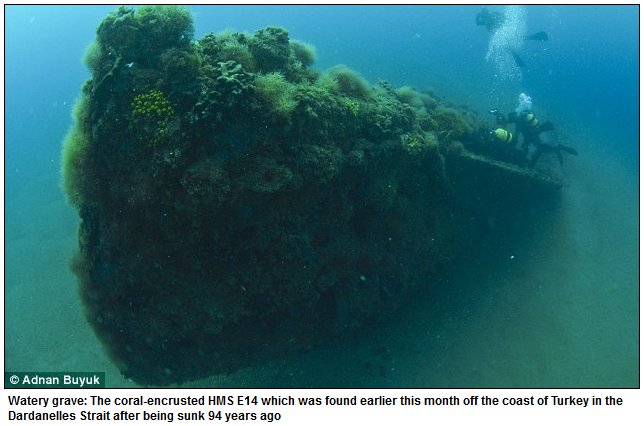
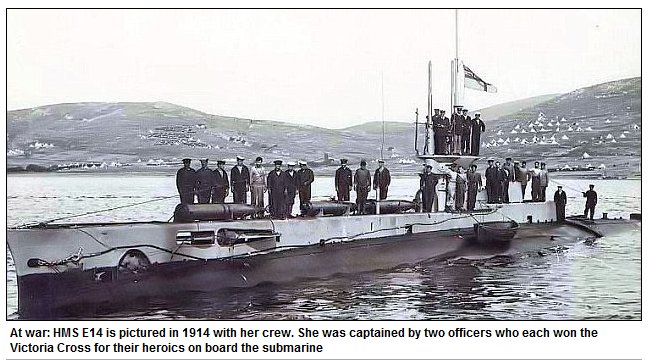
What appears to be the wreck of the E14 has been located just 800 feet offshore in the Straits of the Dardanelles:

Its precise location in the eastern Mediterranean remained a mystery until this month when a Turkish marine engineer and a diver detected it on the seabed off the town of Kumkale – just 800ft from the beach.

The wreck was discovered by marine expert Selçuk Kolay and film-making diver Savas Karakas, who had spent three years trying to find it.

After studying documents at the national Archives in Kew, west London, and surveying Turkish defences, they scanned an unusual object from a boat on the surface.

But they could not establish what it was because it was near the mouth of the straits — a sensitive military area where diving was forbidden.

It took two years to get permission from the military before their team were able to dive to the wreck and confirm it was the E14 earlier this month.

The only justifications for armed intervention

Filed under: Government, History, Military, Politics — Tags: , , , , , — Nicholas @ 00:12

George Jonas on the arguments being trotted out for military intervention in Syria and other hotspots:

Repeating for the record what I’ve written many times before, I think only three things justify resorting to arms: (A) self-defence, (B) treaty obligations, and (C) defending vital national interests, defined as interests that properly mandated governments on reasonable grounds honestly believe cannot be safeguarded or secured in other ways.

As far as I can see, nothing compels or even excuses belligerency except national defence obligations. Humanitarian components are icing on the cake. “Responsibility to protect” strikes me a slogan of liberal imperialism; the battle cry of post-modern civilization’s missionaries, the casus belli of self-appointed knights errant with an unquenchable thirst for running the world. Disguised as academics, adventurers, mercenaries, bureaucrats, bien-pensants and do-gooders, these 21st-century Don Quixotes consider themselves the new global aristocracy. They’re the enlightened ones, expecting to become the anointed ones before long, and rule as functionaries of various supranational bodies — governmental, non-governmental, or merely mental — in what no doubt many believe is humanity’s best interest.

[. . .]

Anyway, my main point was that the West’s moment of going off the rails in foreign policy didn’t come in the turbulent and error-prone 1960s, but in the seemingly level-headed 1950s, under the presidency of the popular wartime commander “Ike” Eisenhower. Instead of letting America’s allies, Britain, France and Israel, finish the job Egypt’s military dictator, Colonel Nasser, started when he arbitrarily nationalized the Suez Canal in 1956, Eisenhower’s America, aided by Lester B. Pearson’s Canada, rescued the aggressive nationalist. As Westerners, Eisenhower and Pearson may have expected credit; what they got was contempt.

“Weren’t they allies? Westerners are people whose enmity is preferable to their friendship,” was how a Libyan I interviewed commented some years later. I don’t think we learned much since.

June 16, 2012

Peter Oborne on Enoch Powell, a “monster” with integrity

Filed under: Britain, Europe, History, Politics — Tags: , , , , — Nicholas @ 10:36

In the Telegraph, Peter Oborne outlines the career of British parliamentarian Enoch Powell:

For years, Enoch Powell has been a monstrous figure in British politics. Even the mention of his name has been enough to invite damnation by association. Before the last election, David Cameron forced Nigel Hastilow to stand down as Conservative candidate for Halesowen after he praised Powell for being “right” about immigration.

[. . .]

With not one word changed, Powell’s speeches on Lords reform, some delivered half a century ago, could be delivered today. This is because his analysis was not dependent on day-to-day events and a transient national mood. His approach was based on first principles, extraordinary learning and a rigorous understanding of the British constitution.

It was this intellectual clarity which caused him to oppose British entry to what was then known as the Common Market. At the start of 1971, during the final stage of negotiations, Powell took himself round Europe speaking in Turin (in Italian), Frankfurt (in German) and Lyon (in French). As he remarked: “There is no more ignorant vulgarity than to treat language as an impediment to intercourse, which education, habit, travel, trade, abolish and then remove.” He used these speeches to warn his French, Italian and German audiences that the British tradition of national sovereignty and parliamentary democracy was incompatible with European economic and political union.

[. . .]

But now we must come to Enoch Powell’s notorious speeches on immigration, which have defined his posthumous reputation and established his pariah status. He challenged the culture of denial that surrounded the subject even then, predicting that the immigrant community would rise much faster than official statistics suggested. His claims were denounced as alarmist and irresponsible, even by The Daily Telegraph. As Tom Bower shows in a well-researched and fair-minded essay, Powell’s projections turned out to be much nearer the truth than the official ones.

[. . .]

The case for the defence goes like this: at the time immigration was surrounded by a culture of silence, and Powell was doing no more than bravely voicing the concerns (and using the language) of his constituents. He was no racist, as even opponents like Michael Foot acknowledged, and as his stance over the Hola Camp suggests. And let’s not forget that Powell, who had a brilliant war, risked his life for five years in the fight against fascism. But I am certain that the Conservative Party was right to drive him out for his remarks, which had the malign effect that no mainstream politician dared raise the issue of immigration for a generation.

For some, this single episode has been enough to damn his memory, and that can be understood. But Enoch Powell was a man of extraordinary integrity. He walked alone. To quote the late Daily Telegraph commentator TE Utley, doing his best to stand up for Powell in the wake of the notorious “rivers of blood” speech of April 1968: “He does not believe that politics is a hand-to-mouth affair, a succession of expedients to meet unforeseen and unforeseeable circumstances.”

Update, 19 June: In the Telegraph, Brendan O’Neill points out that modern anti-racists actually have more in common with Powell than they may realize:

What was the key prejudice in Enoch Powell’s infamous 1968 speech, which everyone is talking about again following Powell’s 100th birthday? It wasn’t actually hatred of immigrants, whom Powell believed to be ambitious, ferociously so. Rather it was fear of native Britons. It was fear of what white Brits, or what Powell referred to as the “ordinary working man”, might do if more and more foreigners turned up in their towns.

Indeed, Powell explicitly argued that “the sense of alarm and resentment lies not with the immigrant population but with those among whom they have come”. It was these people, he said, these “ordinary Englishmen”, who posed a threat to the social order, since their anti-immigrant anger had become so intense that to introduce more immigrants would be to “risk throwing a match in to gunpowder”. In short, “ordinary working men” were a powder-keg of unpredictable emotions whom the state should try its best not to antagonise. Or as Powell put it, “The supreme function of statesmanship is to provide against preventable evils”, including the evil of “ordinary working men” having their “alarm and resentment” further stirred up.

Even Powell’s most notorious line — “like the Roman, I seem to see the River Tiber foaming with much blood” — was a prediction not of immigrant behaviour but of native British violence against immigrants. Powell said native Brits, “for reasons which they could not comprehend” (presumably because they were a bit dim), were feeling dangerously like “strangers in their own country”.

Explosion 1812: “one of the biggest explosions that had ever been witnessed in North America”

Filed under: Cancon, History, Media, Military, USA — Tags: , , , — Nicholas @ 10:22

I may have to make some time to watch TV tomorrow:

This month’s 200th anniversary of the start of the War of 1812 will be marked with a colossal bang: the television premiere of Explosion 1812, a new documentary that argues the intentional detonation of Upper Canada’s main ammunition supply at present-day Toronto in April 1813 — described as “one of the biggest explosions that had ever been witnessed in North America” — is a greatly underappreciated moment in history that was key to thwarting the U.S. conquest of Canada.

The two-hour, Canadian-made film — to be aired by History Television on June 17, the eve of the bicentennial of the formal U.S. declaration of war on June 18, 1812 — recounts how retreating British-Canadian troops at Fort York blew up the colony’s “grand magazine” along the Lake Ontario shore as American forces closed in on Upper Canada’s capital on April 27, 1813.

[. . .]

U.S. soldiers outraged at what they considered an act of extreme treachery — even a war crime because of their comrades’ fatal proximity to the explosion — went on a vengeful rampage in the captured capital, terrorizing the civilian population and pillaging residents’ property.Ê

Those actions, in turn, prompted a similar assault on Washington, D.C., in 1814, when the U.S. capital was stormed by British and Canadian troops who set fire to the White House.

Among the U.S. casualties at York was the famed commander of the invasion force, Gen. Zebulon Pike, an early explorer of the American West whose death — his chest crushed by falling rock from the blasted armoury — would be exploited to rally patriotic sentiment in the U.S. for the duration of the war.

« Newer PostsOlder Posts »

Powered by WordPress