Quotulatiousness

October 11, 2014

WW2 Japanese balloon bomb discovered in British Columbia

Filed under: Cancon, History, Japan, Weapons, WW2 — Tags: — Nicholas @ 12:05

Wayne Moore on the recently discovered remnants of a unique Japanese weapon that was used to bomb the North American mainland during World War 2:
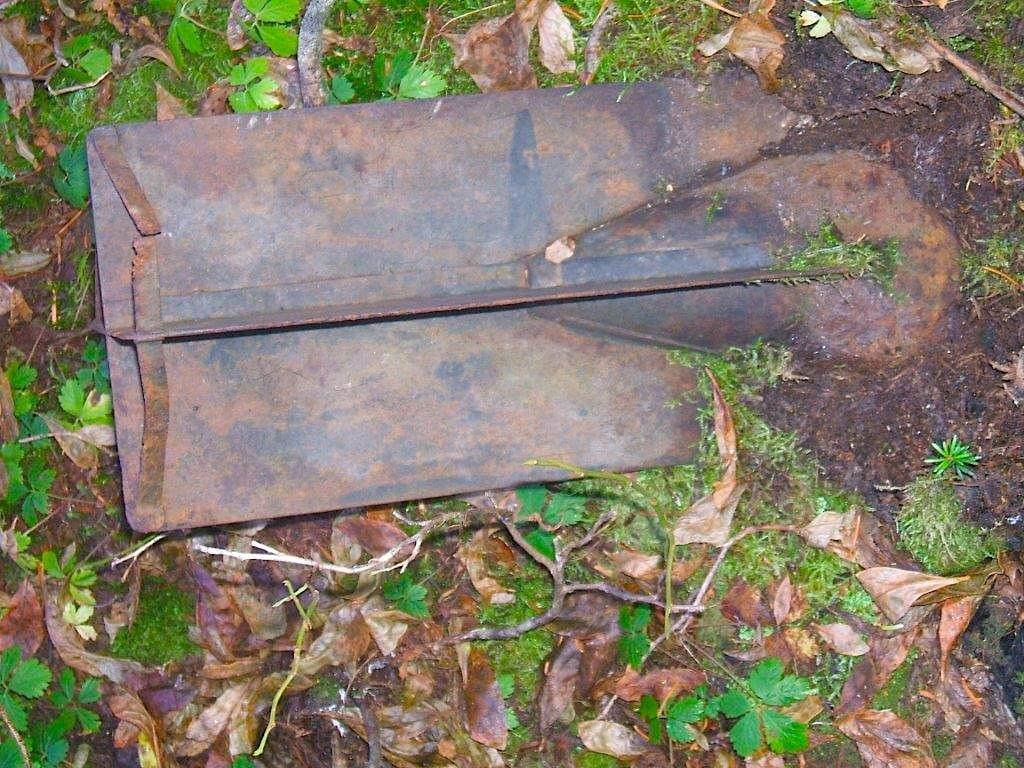
Remains of Japanese balloon bomb in BC

Seven decades after thousands of “balloon bombs” were let loose by the Imperial Japanese Army to wreak havoc on their enemies across the Pacific, two forestry workers found one half-buried in the mountains of eastern British Columbia.

A navy bomb disposal team was called and arrived at the site Friday in the Monashee Mountains near Lumby, B.C.

“They confirmed without a doubt that it is a Japanese balloon bomb,” said RCMP Cpl. Henry Proce.

Japanese balloon bomb illustration“This thing has been in the dirt for 70 years …. There was still some metal debris in the area (but) nothing left of the balloon itself.”

The forestry workers found the device Wednesday and reported it to RCMP on Thursday.

Proce, a bit of a history buff himself, accompanied the men to the remote area and agreed that the piece appeared to be a military relic.

The area was cordoned off and police contacted the bomb disposal unit at Maritime Forces Pacific.

It was a big bomb, Proce said. A half-metre of metal casing was under the dirt in addition to approximately 15 to 20 centimetres sticking out of the ground.

“It would have been far too dangerous to move it,” Proce said. “They put some C4 on either side of this thing and they blew it to smithereens.”

October 8, 2014

Russia’s oldest warship being moved to shipyard for restoration work

Filed under: History, Military, Russia, WW1 — Tags: , , , , — Nicholas @ 08:56

From the Wikipedia page:

Aurora (Russian: Авро́ра, tr. Avrora; IPA: [ɐˈvrorə]) is a 1900 Russian protected cruiser, currently preserved as a museum ship in St. Petersburg. Aurora was one of three Pallada-class cruisers, built in St. Petersburg for service in the Pacific Far East. All three ships of this class served during the Russo-Japanese War. The Aurora survived the Battle of Tsushima and was interned under U.S. protection in the Philippines, eventually returned to the Baltic Fleet. The second ship, Pallada, was sunk by the Japanese at Port Arthur in 1904. The third ship, Diana, was interned in Saigon after the Battle of the Yellow Sea. One of the first incidents of the October Revolution in Russia took place on the cruiser Aurora.

[…]

During World War I Aurora operated in the Baltic Sea performing patrols and shore bombardment tasks. In 1915, her armament was changed to fourteen 152 mm (6 in) guns. At the end of 1916, she was moved to Petrograd (the renamed St Petersburg) for a major repair. The city was brimming with revolutionary ferment and part of her crew joined the 1917 February Revolution. A revolutionary committee was created on the ship, with Aleksandr Belyshev elected as captain. Most of the crew joined the Bolsheviks, who were preparing for a Communist revolution.

At 9.45 p.m on 25 October 1917 (O.S.) a blank shot from her forecastle gun signaled the start of the assault on the Winter Palace, which was to be the beginning of the October Revolution. In summer 1918, she was relocated to Kronstadt and placed into reserve.

October 5, 2014

QotD: “What happened to France?”

Filed under: Europe, Food, France, History, Quotations — Tags: , — Nicholas @ 00:01

Here we should pause and ask an important question: What happened to France? To that savoir faire? And to French culture? To the country that we all loved enough to make allowances to put up with the casual hauteur and the studied rudeness? Because, after all, this was la belle France, and they could teach us a thing or two. They had something worth sharing.

But when was that? When was the last time you enjoyed, say, a contemporary French film? How many must-see French actors are there? Their most famous actor has now taken out Russian citizenship (and moved to Belgium). Name a living French painter worth the wall space. Name a great French musician. A novelist, apart from Michel Houellebecq — and the French hate him. Their vaunted cuisine has become a moribund tourist performance. Unable to change, terrified of innovation, France has become the Bourbons, who famously forgot nothing and learned nothing.

The language that committees of old academics protect, like maids fussing over a cabinet of bone china, has been ransacked, seduced, and impregnated with bastard usages by movies, pop music, the Internet, and the global need to speak English. And now even some French universities have begun teaching science and computing classes in English, because no one wants to come to France to study them in French.

The pre-eminence of French culture has evaporated, before our very eyes, within a generation. The fear that innovation might damage or detract from their weighty heritage has left it like an angry child, with its eyes closed and its hands over its ears, la-la-la-ing “Je ne regrette rien.” French civilization went from the brilliant clamor of the streets to the musty hush of the museum. Instead of creating, they have dusting.

A. A. Gill, Liberté! Egalité! Fatigué!“, Vanity Fair, 2014-04

October 3, 2014

Tour the only surviving WW2 Royal Navy destroyer with Google Maps

Filed under: Britain, History, Military — Tags: , , — Nicholas @ 00:02

This is rather cool:

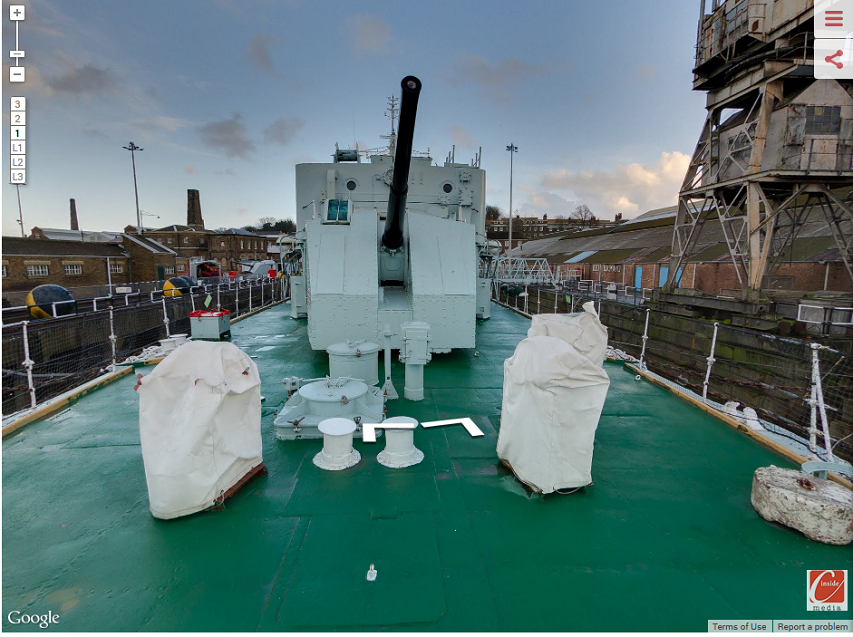
HMS Cavalier virtual tour (via Google Maps)

HMS Cavalier virtual tour (via Google Maps)

CInsideMedia has done it again with exclusive access to the Royal Navy destroyer HMS Cavalier at the Historic Dockyard, Chatham.

The class C/A destroyer celebrated her 70th anniversary on 5th April 2014, having served during World War II and then subsequently being refitted in 1957 to remove the mid-ship torpedoes and replacing them with anti-submarine squid mortars.

Following on from the massive success of CInsideMedia’s Google Maps Business View tour of HMS Ocelot, The Historic Dockyard Chatham is making it possible for anyone in the world to ‘virtually visit’ this National Destroyer Memorial and last surviving Royal Navy Second World War Destroyer.

Over two days of exclusive access, the CInsideMedia team were guided around the destroyer by the Dockyard’s Scott Belcher (Duty Manager: Visitor Operations, Security and Health and Safety) and Chris Tutt (Marketing).

The team captured over 350 panoramas meticulously capturing almost every deck of the 363 ft, 1.7 ton former Arctic Convoy vessel, including the gear room and engine room which are normally only accessible on special request due to Health & Safety and limited accessibility.

September 30, 2014

Implementing libertarian principles in practical politics

Filed under: History, Liberty, Politics, USA — Tags: , , , , — Nicholas @ 09:33

P.J. O’Rourke talks to Senator Rand Paul:

The Senator smiled and shrugged. “I never really felt like it was a problem explaining libertarian principles in practical politics. Republicans are champions of economic liberty. Democrats are champions of personal liberty. Bring the two back together.”

The Senator said, “The problem is mostly how people characterize libertarianism. But that’s changing. Libertarian has gone from being something scary to something people like as a label for themselves.”

He said, “There are different ways to get where we want to go.” And gave an example of going nowhere. “Nothing good has come out of the war on drugs.”

“What’s a different way?” I asked.

“I like the unenumerated powers.”

The powers not delegated to the United States by the Constitution, nor prohibited by it to the states, are reserved to the states respectively, or to the people. The Tenth Right in the Bill of Rights keeps us from having just nine rights.

“In The Federalist Papers,” I said, “Hamilton argued against the Bill of Rights on the grounds that government even mentioning rights like free speech implied government had some power over those rights.”

“But it’s a good thing we did write them down,” the Senator said, “otherwise we’d have nothing left.”

Senator Paul asked, not quite rhetorically, “Is this the ‘Libertarian Moment’? If so, it probably won’t come from a third party. Probably it will come from within a party.”

“From within the Democratic Party?” He didn’t seem to think it was inconceivable. “In New Hampshire,” he said, “even Democrats are against state income and sales taxes.”

But he didn’t seem to think it was likely either. “Republicans are an ideological coalition,” he said. “Democrats are a coalition of ideologies. The only thing Democrats agree on is income redistribution.”

Sen. Paul said, “Republicans have tradition on their side. It’s the American revolution versus the French Revolution.”

This was a switch – a flip-flop if you will – from Thomas Paine’s radical liberty de facto to Edmund Burke’s traditional liberty de jure. But I don’t fault the Senator. No friend of liberty can avoid the tumble back and forth between Burke and Paine.

“Tradition is a good thing,” the Senator said. “Ninety percent of Americans don’t break the law, not because there’s a law against it, but because they have a tradition of conscience. Republicans are traditional. But tradition can be boring. Libertarianism spices things up. Republicans have to either adapt, evolve, or die. They either have to water [down] their message — or extend liberty.”

September 29, 2014

When I started fencing, I was told there was no math…

Filed under: History — Tags: , — Nicholas @ 14:13

John Turner sent me a link to this short article in Slate‘s “The Vault” column, discussing the mathematical side of fencing:

Girard Thibault’s Académie de l’Espée (1628) puts the art of wielding the sword on mathematical foundations. For Thibault, a Dutch fencing master from the early seventeenth century, geometrical rules determined each and every aspect of fencing. For example, the length of your rapier’s blade should never exceed the distance between your feet and the navel, and your movements in a fight should always be along the lines of a circle whose diameter is equal to your height.

The rest of his manual, geared towards gentlemanly readers who took up fencing as a noble sport, is filled with similar geometrical arguments about the choreography of swordsmanship. Thibault’s work belongs to the same tradition that produced Leonardo’s renowned Vitruvian Man.

"Human proportions and their relationship to swordsmanship." Engraving by J. Gelle. By Girard Thibault. (Click to see full-sized image.)

“Human proportions and their relationship to swordsmanship.” Engraving by J. Gelle. By Girard Thibault. (Click to see full-sized image.)

QotD: Presidential elections and personal attacks

Filed under: History, Humour, Politics, Quotations, USA — Tags: , , — Nicholas @ 00:01

In the hotly contested election of 1828, supporters of John Quincy Adams called Andrew Jackson a “slave-trading, gambling, brawling murderer.” Mac McClelland, Ten Most Awesome
Presidential Mudslinging Moves Ever, Mother Jones, (October 31, 2008).11
Jackson’s supporters responded by accusing Adams of having premarital sex with his wife and playing the role of a pimp in securing a prostitute for Czar Alexander I. Id.

During Thomas Jefferson’s presidency, James T. Callender, a pamphleteer and “scandalmonger,”
alleged that Jefferson had fathered numerous children with his slave Sally Hemings.12
Callender’s allegations would feature prominently in the election of 1804, but it wasn’t until
nearly two centuries later that the allegations were substantially confirmed.13

More recently, we’ve had discussions of draft-dodging, Swift Boats, and lying about birthplaces14 — not to mention the assorted infidelities that are a political staple.

11. Available at http://www.motherjones.com/mojo/2008/10/ten-most-awesome-presidential-mudslinging-moves-ever.
12. Monticello.org, James Callender, http://www.monticello.org/site/research-and-collections/james-callender.
13. Monticello.org, Thomas Jefferson and Sally Hemings: A Brief Account, http://www.monticello.org/site/plantation-and-slavery/thomas-jefferson-and-sally-hemings-brief-account.
14. While President Obama isn’t from Kenya, he is a Keynesian — so you can see where the confusion arises.

Ilya Shapiro and P.J. O’Rourke, BRIEF OF AMICI CURIAE CATO INSTITUTE AND P.J. O’ROURKE IN SUPPORT OF PETITIONERS, Susan B. Anthony List v. Driehaus [PDF], 2014-02-28

September 28, 2014

The “Live Bait Squadron” in the Broad Fourteens

Filed under: Britain, History, Military, WW1 — Tags: , , — Nicholas @ 12:20

Antoine Vanner recounts the tragic story of the sinking of three Royal Navy armoured cruisers (HMS Aboukir, HMS Hogue, and HMS Cressy) early in the First World War:

Despite this “wake up call” regarding vulnerability of warships at low speed the Royal Navy initiated a patrol of the northern entrance of the English Channel with five obsolete Cressy class armoured cruisers. This group was known as “Cruiser Force C” and the patrol area they were assigned to was in the shallow waters off the Dutch coast known as the “Broad Fourteens”. The logic of maintaining a patrol in the area was unassailable as a fast German raiding force of destroyers could wreak havoc on British maritime supply lines between the English Coast and Northern France should they enter the Channel. Though destroyers and light cruisers would have been more suited to the task it was believed that destroyers would be unable to maintain the patrol in bad weather and insufficient modern light cruisers were available. The solution was to deploy old armoured cruisers which had at least got the necessary station-keeping capability. This was perhaps their only positive attribute.

The vulnerability of these cruisers was recognised by many senior officers, not only because of their obsolescence but because of their manning. Taken hastily from reserve – which meant they had been unmanned and poorly, if at all, maintained – on outbreak of war they were quickly overhauled and put back in service. Originally capable of 21 knots they now found it hard to make 15. Crews were in short supply, leading the ships to be manned by reservists, many middle-aged, many of them pensioners, who had not previously served or exercised together as units. In addition, nine naval cadets, some as young as 15, were allocated to each ship, being taken directly from the Royal Naval College. The general view of Cruiser Force C’s fighting potential was summed up in the nickname it quickly acquired – the “Live Bait Squadron”.

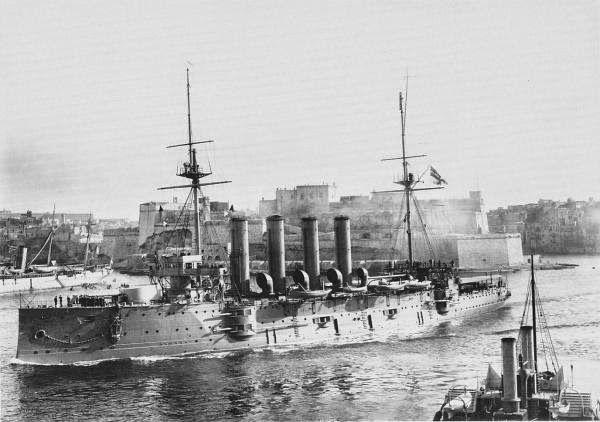
HMS Aboukir at Malta - note 6" weapons in casemates along sides

HMS Aboukir at Malta – note 6″ weapons in casemates along sides

Britain’s armoured cruisers can be fairly described as the most unsuccessful and unfortunate type of warship ever employed by the Royal Navy. The 34 vessels of this type that were in service at the outbreak of war had entered service between 1902 and 1908 – they were not old ships. Of these 34, a total of 13 were to be lost in the next four years. Intended to form part of the battle fleet, they had been rendered obsolete by the advent of the almost equally-disastrous battle-cruiser concept. The earlier classes – the six ships of the Cressy class being the oldest – had very limited offensive capability, especially in rough weather. They were large – and expensive – ships and they needed large crews.

[…]

At dawn on September 22nd U-9 surfaced to find the storm over, the sea calm but for a slow swell. Smoke was seen on the horizon and the U-9’s engines were immediately shut down to get rid of their exhaust plume. A quick appraisal led Weddingen to order diving but he continues to observe through his periscope. Three vessels were approaching – the Aboukir, Cressy and Hogue – and Weddingen steered on his electric motors towards the central vessel, Aboukir.

Undetected, U-9 came within 600 yards of Aboukir’s port bow before firing a torpedo. As this was still running Weddingen took his craft down to 50 feet, then heard “a dull thud, followed by a shrill-toned crash”. Cheering erupted on U-9.

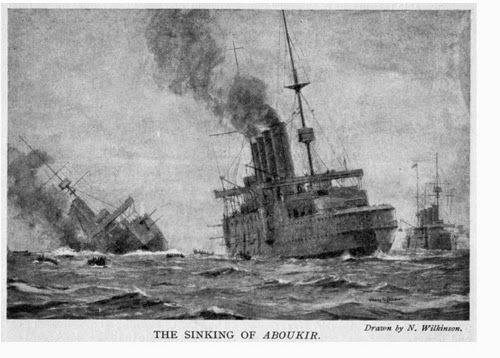
Aboukir sinking - as depicted by the famous British maritime painter Norman Wilkinson the Hogue dropping boats to pick up survivors

Aboukir sinking – as depicted by the famous British maritime painter Norman Wilkinson
the Hogue dropping boats to pick up survivors

September 25, 2014

Roll of Honour at the Tower of London, 24 September, 2014

Filed under: Britain, History, Personal, WW1 — Nicholas @ 08:57

Roll of Honour at the Tower of London

Roll of Honour 24 September 2014

Private William Penman who died in 1915 at Le Touret (25 years old) was Elizabeth’s great uncle. Private Walter Porteous who died in 1917 at Passchendaele (18 years old) was my great uncle.

Dear Sir/Madam,

Thank you for submitting a name for the Roll of Honour at the Tower of London. We are delighted to confirm that your nomination will be included at the ceremony on the 24th of September.

The list of 180 names will be read from the poppy-filled Tower moat at sunset, starting at 7:25pm (19.25). The names will be read the order in which they were submitted and validated.

We regret we are unable to make changes to the reading lists.

At the end of the reading, which will take about 20-30 minutes, an Army bugler will play the Last Post.

If you would like to watch, you can get a good view from the area in front of the Tower ticket desks on Tower Hill.

We will be filming the ceremony and posting the video online. This site is currently under construction, we will let you know when it goes live.

We are also adding the lists of names being read each night at http://rollofhonour.tumblr.com/ so that they can be seen and remembered from anywhere in the world.

September 23, 2014

HMCS Bonaventure (CVL 22) – Majestic Class Aircraft Carrier

Filed under: Cancon, History, Military — Tags: , , — Nicholas @ 12:00

Published on 14 Apr 2013

HMCS Bonaventure (CVL 22) was a Majestic class aircraft carrier. She served in the Royal Canadian Navy and Canadian Forces Maritime Command from 1957 to 1970 and was the third and the last aircraft carrier to serve Canada. The ship was laid down for the British Royal Navy as HMS Powerful in November 1943. At the end of World War II, work on the ship was suspended in 1946. At the time of purchase, it was decided to incorporate new aircraft carrier technologies into the design. Bonaventure never saw action during her career having only peripheral, non-combat roles. However, she was involved in major NATO fleet-at-sea patrol during the Cuban Missile Crisis. – https://en.wikipedia.org/wiki/HMCS_Bonaventure (CVL_22)

“Arab civilization … is all but gone”

Filed under: History, Middle East, Politics — Tags: , , , — Nicholas @ 11:14

In Politico, Hisham Melhem explains why the Middle East is in the current state of chaos:

With his decision to use force against the violent extremists of the Islamic State, President Obama is doing more than to knowingly enter a quagmire. He is doing more than play with the fates of two half-broken countries — Iraq and Syria — whose societies were gutted long before the Americans appeared on the horizon. Obama is stepping once again — and with understandably great reluctance — into the chaos of an entire civilization that has broken down.

Arab civilization, such as we knew it, is all but gone. The Arab world today is more violent, unstable, fragmented and driven by extremism — the extremism of the rulers and those in opposition — than at any time since the collapse of the Ottoman Empire a century ago. Every hope of modern Arab history has been betrayed. The promise of political empowerment, the return of politics, the restoration of human dignity heralded by the season of Arab uprisings in their early heydays — all has given way to civil wars, ethnic, sectarian and regional divisions and the reassertion of absolutism, both in its military and atavistic forms. With the dubious exception of the antiquated monarchies and emirates of the Gulf — which for the moment are holding out against the tide of chaos — and possibly Tunisia, there is no recognizable legitimacy left in the Arab world.

Is it any surprise that, like the vermin that take over a ruined city, the heirs to this self-destroyed civilization should be the nihilistic thugs of the Islamic State? And that there is no one else who can clean up the vast mess we Arabs have made of our world but the Americans and Western countries?

September 21, 2014

Dramatic Footage of British Troops Preparing for Operation Market Garden

Filed under: Britain, History, Military, WW2 — Tags: , , — Nicholas @ 11:00

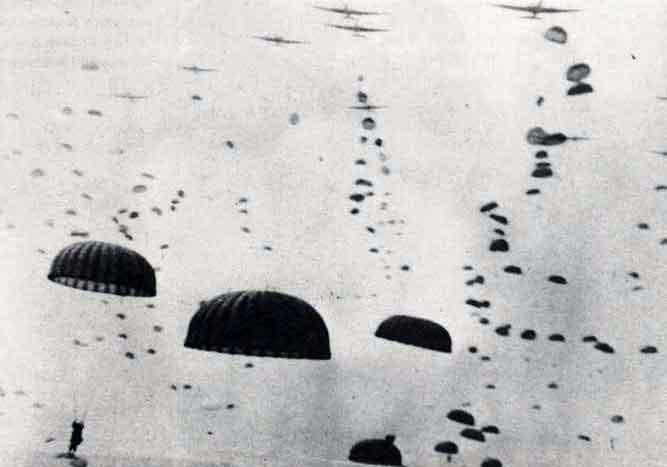
Nearly ten minutes of both British and German footage of the launch of Operation Market — the airborne assault on the Netherlands by British and American troops in September, 1944 (Operation Garden was the corresponding ground attack by Montgomery’s troops to reach the landings by one British and two American airborne divisions.

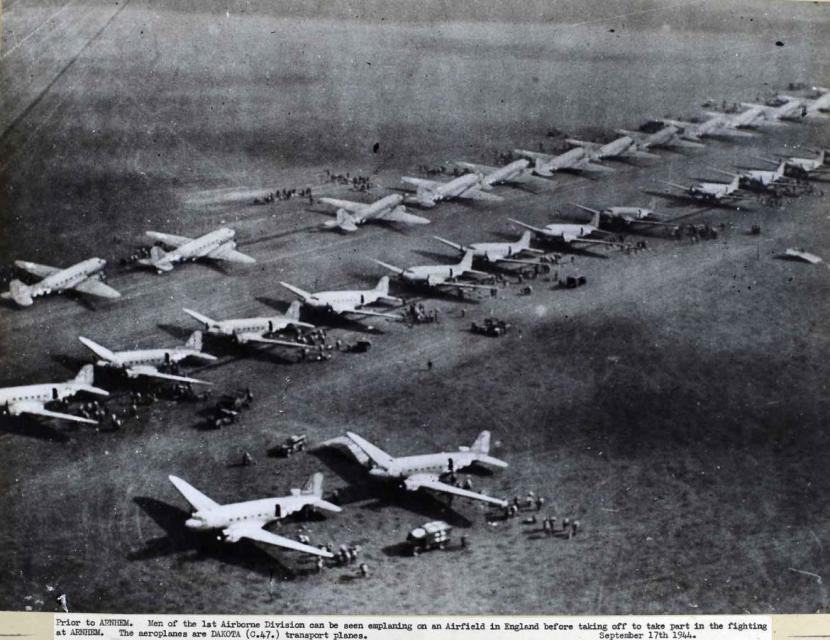
Rows-of-Dakota-Aircraft-prior-to-take-off-for-Arnhem,-Sept-17th-1944_0

Paratroopers descend enmasse at the DZs near Arnhem, September 1944 Uploaded by: Mac Magreehan. (via Forces.TV)

Paratroopers descend enmasse at the DZs near Arnhem, September 1944 Uploaded by Mac Magreehan. (via Forces.TV)

More photos of the operation can be viewed at Forces.TV.

The Roosevelts and the foundation of the Imperial Presidency

Amity Shlaes on the recent Ken Burns documentary on Teddy Roosevelt, FDR, and Eleanor Roosevelt:

“He is at once God and their intimate friend,” wrote journalist Martha Gellhorn back in the 1930s of President Franklin Roosevelt. The quote comes from The Roosevelts, the new Ken Burns documentary that PBS airs this month. But the term “documentary” doesn’t do The Roosevelts justice. “Extravaganza” is more like it: In not one but 14 lavish hours, the series covers two great presidents, Theodore Roosevelt, who served in the first decade of the last century, and Franklin Roosevelt, who led our nation through the Great Depression and to victory in World War II. In his use of the plural, Burns correctly includes a third Roosevelt: Eleanor, who as first lady also affected policy, along with her spouse.

[…]

Absent, however, from the compelling footage is any display of the negative consequences of Rooseveltian action. The premise of Theodore Roosevelt’s trustbusting was that business was too strong. The opposite turned out to be true when, bullied by TR, the railroads promptly collapsed in the Panic of 1907. In the end it fell to TR’s very target, J. P. Morgan, to organize the rescue on Wall Street.

The documentary also neglects to mention that the economy of the early 1920s proved likewise fragile — casualty, in part, to President Woodrow Wilson’s fortification of TR’s progressive policies. Presidents Warren Harding and Calvin Coolidge poured their own energy into halting the expansion of an imperial presidency and sustaining the authority of the states. This endeavor, anti-progressive, also won approbation: In 1920, the Harding-Coolidge ticket beat Cox-Roosevelt. The result of the Harding-Coolidge style of presidency was genuine and enormous prosperity. The 1920s saw the arrival of automobiles, indoor toilets, and the very radios that FDR would later use so effectively to his advantage. Joblessness dropped; the number of new patents soared. TR had enjoyed adulation, but so did his mirror opposite, the refrainer Coolidge.

When it comes to the 1930s, such twisting of the record becomes outright distortion. By his own stated goal, that of putting people to work, Roosevelt failed. Joblessness remained above 10 percent for most of the decade. The stock market did not come back. By some measures, real output passed 1929 levels monetarily in the mid 1930s only to fall back into a steep depression within the Depression. As George Will comments, “the best of the New Deal programs was Franklin Roosevelt’s smile.” The recovery might have come sooner had the smile been the only New Deal policy.

So great is Burns’s emphasis on the Roosevelt dynasty that William Howard Taft, Woodrow Wilson, Warren Harding, Calvin Coolidge, and Herbert Hoover come away as mere seat warmers in the White House. Especially puzzling is the neglect of TR’s progressive heirs, Taft and Wilson, who, after all, set the stage for FDR. This omission can be explained only by Burns’s desire to cement the reign of the Roosevelts. On the surface, the series’ penchant for grandees might seem benign, like the breathless coverage of Princess Kate’s third trimester in People magazine. In this country, elevating presidential families is a common habit of television producers; the Kennedys as dynasty have enjoyed their share of airtime. Still, Burns does go further than the others, ennobling the Roosevelts as if they were true monarchs, gods almost, as in Martha Gellhorn’s above mentioned line. Burns equates progressive policy with the family that promulgates it. And when Burns enthrones the Roosevelts, he also enthrones their unkingly doctrine, progressivism.

September 19, 2014

When Royal Navy submarines fly the “Jolly Roger”

Filed under: Britain, Germany, History, Military, WW1 — Tags: , , — Nicholas @ 09:06

Ali Kefford on the origins of a colourful naval tradition:

Members of the crew of HMS Utmost with their "Jolly Roger" success flag, photographed alongside HMS Forth in Holy Loch, on their return from a year's service in the Mediterranean, 6 February 1942. (via Wikipedia)

Members of the crew of HMS Utmost with their “Jolly Roger” success flag, photographed alongside HMS Forth in Holy Loch, on their return from a year’s service in the Mediterranean, 6 February 1942. (via Wikipedia)

Sir Arthur Wilson was infamous within the Royal Navy for being an admiral with a tetchy temper. His nickname – Old ’Ard ’Art – was a bad joke about his uncaring nature.

Yet a verbal broadside he delivered in 1901 was to spawn one of the Submarine Service’s most loved and deeply ingrained traditions – the flying of the Jolly Roger flag to mark the victorious return from a successful patrol.

Wilson, later a hugely unpopular First Sea Lord, is said to have blasted the innovation of submarines, dubbing the covert way they operated as “underhand, unfair and damned un-English”.

He even went so far as to say: “They’ll never be any use in war and I’ll tell you why. I’m going to get the First Lord to announce that we intend to treat all submarines as pirate vessels in wartime and that we’ll hang all the crews.”

[…]

One hundred years ago this week, shortly after the start of the Great War, British submarine HMS E9 despatched two torpedoes at close range at Germany’s SMS Hela in a skirmish off Heligoland.

Its commanding officer, Lieutenant Commander Max Horton, had to dive immediately to avoid return fire, so he did not see the cruiser sink.

But the 13-year-old Silent Service had notched up its very first kill, confirming the deadly effectiveness of sneaking around in the deep then launching a surprise attack on an enemy.

Horton, recalling Admiral Wilson’s words, told his signaller to sew a piratical Jolly Roger flag, which flew proudly from his boat’s periscope as she sailed into Harwich, Essex.

A naval tradition was born, as the skull and crossbones went on to be the Royal Navy Submarine Service’s official emblem.

The tradition continues to today:

September 18, 2014

Forensic report on the death of Richard III

Filed under: Britain, History — Tags: , — Nicholas @ 07:55

BBC News has the details:

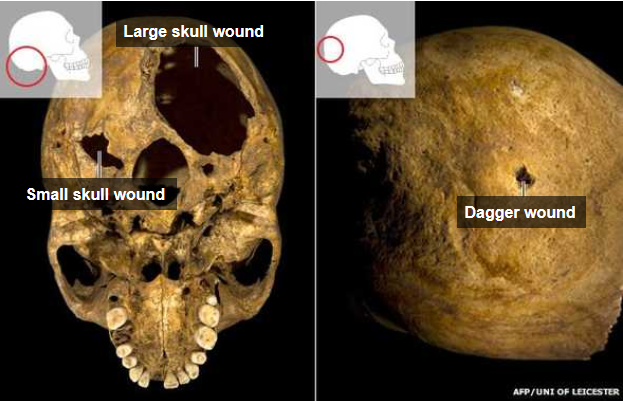
Richard III death wounds

Sarah Hainsworth, study author and professor of materials engineering, said: “Richard’s injuries represent a sustained attack or an attack by several assailants with weapons from the later medieval period.

“Wounds to the skull suggest he was not wearing a helmet, and the absence of defensive wounds on his arms and hands indicate he was still armoured at the time of his death.”

Guy Rutty, from the East Midlands pathology unit, said the two fatal injuries to the skull were likely to have been caused by a sword, a staff weapon such as halberd or bill, or the tip of an edged weapon.

He said: “Richard’s head injuries are consistent with some near-contemporary accounts of the battle, which suggest Richard abandoned his horse after it became stuck in a mire and was killed while fighting his enemies.”

« Newer PostsOlder Posts »

Powered by WordPress