
The euphoria of the New Elizabethan Age was all the more striking when set against the backdrop of the deprivation and austerity of the immediate post-war years. For many people, things had actually got worse after the war. The shortages — of food, of fuel, of housing — were such that on the first anniversary of VE Day, as Susan Cooper later recalled, “the mood of the British was one not of festivity but of bleak resignation, with a faint rebelliousness at the restrictions and looming crises that hung over them like a fog.” “We won the war,” one housewife was quoted as saying. “Why is it so much worse?” The winter of 1947 was the coldest of the century: there were shortages, and strikes, and everyone shivered; and in the spring the floods struck, closing down the London Underground, washing away the crops of thirty-one counties and pouring into thousands of homes. By the following year, rationing had fallen well below the wartime level. The average adult in 1948 was entitled to a weekly allowance of thirteen ounces of meat, one-and-a-half ounces of cheese, six ounces of butter, one ounce of cooking fat, eight ounces of sugar, two pints of milk and one egg. Even dried egg, which had been a staple of meals in wartime, had disappeared from the shops. Children at the beginning of the 1950s still wondered what their parents meant when the reminisced about eating oranges, pineapples, and chocolate; they bathed in a few inches of water, and wore cheap, threadbare clothes with “Utility” labels. It was just as well that the British prided themselves on their ability to form an orderly queue; they had plenty of opportunities to prove it. Not until July 1954 did food rationing finally come to an end.
Austerity left its mark, and many people who had scrimped and saved through the post-war years found it hard to accept the attitudes of their juniors during the long boom that followed. As one housewife later commented: “It makes you very careful and appreciate what you have got. You don’t take things for granted.” Caution, thrift, and the virtues of “making do” had become so ingrained during the long years of rationing that many people never forgot them and forever told each other, “Waste not, want not”, or reminded themselves to put things aside “for a rainy day”, or complained that their children and grandchildren did not “know the value of money.”
Dominic Sandbrook, Never Had It So Good: A history of Britain from Suez to the Beatles, 2005.
January 9, 2015
QotD: Britain in the “New Elizabethan Age” of the 1950s
January 8, 2015
QotD: England on the eve of the First World War
Until August 1914 a sensible, law-abiding Englishman could pass through life and hardly notice the existence of the state, beyond the post office and the policeman. He could live where he liked and as he liked. He had no official number or identity card. He could travel abroad or lave his country for ever without a passport of any sort of official permission. He could exchange his money for any other currency without restriction or limit. He could buy goods from any country in the world on the same terms as he bought goods at home. For that matter, a foreigner could spend his life in this country without permit and without informing the police. Unlike the countries of the European continent, the state did not require its citizens to perform military service. An Englishman could enlist, if he chose, in the regular army, the navy, or the territorials. He could also ignore, if he chose, the demands of national defence. Substantial householders were occasionally called on for jury service. Otherwise, only those helped the state who wished to do so. The Englishman paid taxes on a modest scale: nearly ₤200 million in 1913-14, or rather less than 8 per cent of the national income. The state intervened to prevent the citizen from eating adulterated food or contracting certain infectious diseases. It imposed safety rules in factories, and prevented women, and adult males in some industries, from working excessive hours. The state saw to it that children received education up to the age of thirteen. Since 1 January 1909, it provided a meagre pension for the needy over the age of seventy. Since 1913, it helped to insure certain classes of workers against sickness and unemployment. This tendency towards more state action was increasing. Expenditure on the social services had roughly doubled since the Liberals took office in 1905. Still, broadly speaking, the state acted only to help those who could not help themselves. It left the adult citizen alone.
All this was changed by the impact of the Great War1. The mass of the people became, for the first time, active citizens. Their lives were shaped by orders from above; they were required to serve the state instead of pursuing exclusively their own affairs. Five million men entered the armed forces, many of them (though a minority) under compulsion. The Englishman’s food was limited, and its quality changed, by government order.
His freedom of movement was restricted; his conditions of work prescribed. Some industries were reduced or closed, other artificially fostered. The publication of news was fettered. Street lights were dimmed. The sacred freedom of drinking was tampered with: licensed hours were cut down, and the beer watered by order. The very time on the clocks was changed. From 1916 onwards, every Englishman got up an hour earlier in summer than he would otherwise have done, thanks to an act of parliament. The state established a hold over its citizens which, though relaxed in peacetime, was never to be removed and which the second World war was again to increase. The history of the English state and of the English people merged for the first time.
1 In contemporary parlance, the war of 1914-18 was always, not surprisingly, the Great War. It did not need the war of 1939-45 to change it into the first World War. Repington devised the phrase at the time of the armistice, “to prevent the millennian folk from forgetting that the history of the world is the history of war.” Repington, The First World War, ii. 291.
A.J.P. Taylor, English History 1914-1945, 1965.
January 5, 2015
The role of price controls in the decline of the Roman empire
The latest issue of Libertarian Enterprise included this selection from Ludwig von Mises’ Human Action on how government restrictions on prices and trade contributed to the downfall of the western empire:
Knowledge of the effects of government interference with market prices makes us comprehend the economic causes of a momentous historical event, the decline of ancient civilization.
It may be left undecided whether or not it is correct to call the economic organization of the Roman Empire capitalism. At any rate it is certain that the Roman Empire in the second century, the age of the Antonines, the “good” emperors, had reached a high stage of the social division of labor and of interregional commerce. Several metropolitan centers, a considerable number of middle-sized towns, and many small towns were the seats of a refined civilization. The inhabitants of these urban agglomerations were supplied with food and raw materials not only from the neighboring rural districts, but also from distant provinces. A part of these provisions flowed into the cities as revenue of their wealthy residents who owned landed property. But a considerable part was bought in exchange for the rural population’s purchases of the products of the city-dwellers’ processing activities. There was an extensive trade between the various regions of the vast empire. Not only in the processing industries, but also in agriculture there was a tendency toward further specialization. The various parts of the empire were no longer economically self-sufficient. They were interdependent.
What brought about the decline of the empire and the decay of its civilization was the disintegration of this economic interconnectedness, not the barbarian invasions. The alien aggressors merely took advantage of an opportunity which the internal weakness of the empire offered to them. From a military point of view the tribes which invaded the empire in the fourth and fifth centuries were not more formidable than the armies which the legions had easily defeated in earlier times. But the empire had changed. Its economic and social structure was already medieval.
The freedom that Rome granted to commerce and trade had always been restricted. With regard to the marketing of cereals and other vital necessities it was even more restricted than with regard to other commodities. It was deemed unfair and immoral to ask for grain, oil, and wine, the staples of these ages, more than the customary prices, and the municipal authorities were quick to check what they considered profiteering. Thus the evolution of an efficient wholesale trade in these commodities was prevented. The policy of the annona, which was tantamount to a nationalization or municipalization of the grain trade, aimed at filling the gaps. But its effects were rather unsatisfactory. Grain was scarce in the urban agglomerations, and the agriculturists complained about the unremunerativeness of grain growing. The interference of the authorities upset the adjustment of supply to the rising demand. The showdown came when in the political troubles of the third and fourth centuries the emperors resorted to currency debasement. With the system of maximum prices the practice of debasement completely paralyzed both the production and the marketing of the vital foodstuffs and disintegrated society’s economic organization. The more eagerness the authorities displayed in enforcing the maximum prices, the more desperate became the conditions of the urban masses dependent on the purchase of food. Commerce in grain and other necessities vanished altogether. To avoid starving, people deserted the cities, settled on the countryside, and tried to grow grain, oil, wine, and other necessities for themselves. On the other hand, the owners of the big estates restricted their excess production of cereals and began to produce in their farmhouses — the villae — the products of handicraft which they needed. For their big-scale farming, which was already seriously jeopardized because of the inefficiency of slave labor, lost its rationality completely when the opportunity to sell at remunerative prices disappeared. As the owner of the estate could no longer sell in the cities, he could no longer patronize the urban artisans either. He was forced to look for a substitute to meet his needs by employing handicraftsmen on his own account in his villa. He discontinued big-scale farming and became a landlord receiving rents from tenants or sharecroppers. These coloni were either freed slaves or urban proletarians who settled in the villages and turned to tilling the soil. A tendency toward the establishment of autarky of each landlord’s estate emerged. The economic function of the cities, of commerce, trade, and urban handicrafts, shrank. Italy and the provinces of the empire returned to a less advanced state of the social division of labor. The highly developed economic structure of ancient civilization retrograded to what is now known as the manorial organization of the Middle Ages.
The emperors were alarmed with that outcome which undermined the financial and military power of their government. But their counteraction was futile as it did not affect the root of the evil. The compulsion and coercion to which they resorted could not reverse the trend toward social disintegration which, on the contrary, was caused precisely by too much compulsion and coercion. No Roman was aware of the fact that the process was induced by the government’s interference with prices and by currency debasement. It was vain for the emperors to promulgate laws against the city-dweller who relicta civitate rus habitare maluerit [deserted the cities, preferring to live in the country]. The system of the leiturgia, the public services to be rendered by the wealthy citizens, only accelerated the retrogression of the division of labor. The laws concerning the special obligations of the shipowners, the navicularii, were no more successful in checking the decline of navigation than the laws concerning grain dealing in checking the shrinkage in the cities’ supply of agricultural products.
The marvelous civilization of antiquity perished because it did not adjust its moral code and its legal system to the requirements of the market economy. A social order is doomed if the actions which its normal functioning requires are rejected by the standards of morality, are declared illegal by the laws of the country, and are prosecuted as criminal by the courts and the police. The Roman Empire crumbled to dust because it lacked the spirit of liberalism and free enterprise. The policy of interventionism and its political corollary, the Führer principle, decomposed the mighty empire as they will by necessity always disintegrate and destroy any social entity.
From: Ludwig von Mises, Human Action: A Treatise on Economics, vol. 3 (LF ed.) [1996], Chapter 30. Online at http://oll.libertyfund.org/titles/1895#lf3843-03_head_036, the Online Library of Liberty, A collection of scholarly works about individual liberty and free markets.
January 2, 2015
The Ottoman Disaster – The Battle of Sarikamish I THE GREAT WAR Week 23
Published on 1 Jan 2015
The Champagne offensive is still going on the Western Front without any side gaining a decisive advantage. In the Caucasus, Enver Pasha is showing how far he’s willing to go to achieve his goals. Against his military advisors’ recommendations, he decides to send more and more troops to Sarikamish. Without supplies and with temperatures constantly below -20 degrees, thousands of them freeze to death before even reaching the frontline. When the Russians finally encircle the Ottoman Troops, defeat is inevitable.
QotD: The co-ordination problem of pure Marxism
… it is interesting to analyze Marx as groping toward something game theoretic. This comes across to me in some of his discussions of labor. Marx thinks all value is labor. Yes, capital is nice, but in a sense it is only “crystallized labor” – the fact that a capitalist owns a factory only means that at some other point he got laborers to build a factory for him. So labor does everything, but it gets only a tiny share of the gains produced. This is because capitalists are oppressing the laborers. Once laborers realize what’s up, they can choose to labor in such a way as to give themselves the full gains of their labor.
I think here that he is thinking of coordination as something that happens instantly in the absence of any obstacle to coordination, and the obstacle to coordination is the capitalists and the “false consciousness” they produce. Remove the capitalists, and the workers – who represent the full productive power of humanity – can direct that productive power to however it is most useful. In my language, Marx simply assumed the invisible nation, thought that the result of perfect negotiation by ideal game theoretic agents with 100% cooperation under a veil of ignorance – would also be the result of real negotiation in the real world, as long as there were no capitalists involved. Maybe this idea – of gradually approaching the invisible nation – is what stood in for the World-Spirit in his dialecticalism. Maybe in 1870, this sort of thinking was excusable.
If capitalists are to be thought of as anything other than parasites, part of the explanation of their contribution has to involve coordination. If Marx didn’t understand that coordination is just as hard to produce as linen or armaments or whatever, if he thought you could just assume it, then capitalists seem useless and getting rid of all previous forms of government so that insta-coordination can solve everything seems like a pretty swell idea.
If you admit that, capitalists having disappeared, there’s still going to be competition, positive and negative sum games, free rider problems, tragedies of the commons, and all the rest, then you’ve got to invent a system that solves all of those issues better than capitalism does. That seems to be the real challenge Marxist intellectuals should be setting themselves, and I hope to eventually discover some who have good answers to it. But at least from the little I learned from Singer, I see no reason to believe Marx had the clarity of thought to even understand the question.
Scott Alexander, “Book Review: Singer on Marx”, Slate Star Codex, 2014-09-13.
January 1, 2015
QotD: Henry Ford and the doubled wages – the real story
In 1913, turnover reached an unbelievable 370 percent, and Ford hired more than 50,000 people to maintain an average labor force of about 13,600. When profits swelled, he paid well for labor, creating an uproar when he doubled the basic wage to $5.00 a day, which triggered a virtual stampede of job seekers. Paying higher wages for labor was not altruistic in Ford’s eyes. Moreover, it wasn’t simply that Ford was trying to pay his workers “enough to buy back the product,” although he did preach a high-wage doctrine after the stock market crash in 1929. Rather, paying relatively high wages was, for Ford, a matter of smart business. He regarded well-paid skilled workers as important as high-grade material. By paying workers well, he effectively lowered his costs because higher wages reduced turnover and the need for constant training of new hires. (At the time, the newspapers saw Ford’s wage increase as an extraordinary gesture of goodwill.)
Mark Spitznagel, The Dao of Capital: Austrian Investing in a Distorted World, 2013.
December 30, 2014
How did so many episodes of Doctor Who go missing?
At Samizdata, Patrick Crozier explains how the cost of a new technology and the union work rules of the 1960s led to so many great (and not-so-great) British TV shows being lost to posterity:
Something like two fifths of the Doctor Who episodes produced before 1970 are “missing” from the BBC archive. Although it is now 20 years since I found out about it, I still find it difficult to believe that such an act of cultural vandalism was allowed to take place. But it was.
So why are so many missing? In Wiped! Richard Molesworth describes the whole sorry tale in exhaustive (and some times exhausting) detail. It begins with Doctor Whos being recorded on videotape. In the 1960s videotape was a new technology and as such, expensive. Broadcasters were understandably keen to re-use the tapes whenever they could.
Another factor in this was the deal that the BBC had made with the actors’ union Equity. Younger readers may be unfamiliar with this but in the 1960s and 1970s unions were extraordinarily powerful. The deal between Equity and the BBC meant that an episode could only be repeated for two years and after that only with Equity’s specific permission. So, you’d have a situation where after 2 years you would have videotapes that effectively could not be broadcast and an engineering department banging on the door demanding they be allowed to wipe them. As a consequence every single inch of 1960s Doctor Who was wiped. It was far from alone. Episodes of Top of the Pops, the Likely Lads, Not only but also…, Z-Cars, Til death us do part and many others met a similar fate.
In the interests of fairness I should point out that when it came to wiping TV programmes the BBC was far from the only offender. There is almost nothing left of the first season of the Avengers for instance. Or Sexton Blake. About half of the highly-rated Callan (played by Edward Woodward) is also missing. However, all the Saints and Danger Mans are still with us. Meanwhile, my understanding is that most American TV, even from the 1950s still exists.
And compounding the problem … even when the BBC wanted to get rid of old episodes of TV shows, they still held the copyrights:
One thing that particularly sticks in my craw is the fact that even after the BBC did everything in its power to destroy these episodes it still has copyright to them. This has some very peculiar effects as I shall explain.
As I said, many episodes no longer exist as films or tapes. But all the audios exist (recorded off-air by fans), as do the scripts and a large number of photographs, otherwise known as “tele-snaps”. Over the years a cottage industry has grown up assembling these disparate elements into what are known as “reconstructions”. Now, they’re not very good and they are really only for the dedicated fan – people like me in other words – but right now they are the best we’ve got. Sadly, these too are affected by BBC copyright. For many years they were only available on videotape and on a non-profit basis. The producers were wary of annoying the BBC. And then one day someone (quite reasonably you’d think) decided to start putting them up on YouTube. Oh dear, the BBC really didn’t like that. Not only did they force YouTube to take a whole load of them down but seem to have closed down the reconstruction business temporarily if not permanently. Bastards.
December 29, 2014
Western states and the female franchise
An interesting story from Maggie McNeill, discussing the career of Lou Graham, Seattle’s most famous madam:
As Thaddeus Russell explains in A Renegade History of the United States, the reason so many western states gave women the right to vote long before the eastern ones (or the country in general) had absolutely nothing to do with high-minded egalitarianism and everything to do with pragmatism and arse-kissing. You see, frontier populations are always disproportionately male because they tend to lack the sort of amenities “good” women tend to want. Accordingly, frontier towns fill up with lonely young men desperate for female company and usually possessed of money drawn from whatever industry the town is built on (whether that be mining, trapping, trade or whatever). Naturally, whores arrive to capitalize on this and so the minority of frontier populations which are female are usually made up largely of working girls. These ladies soon amass a disproportionate share of the wealth, and madams tend to become fabulously wealthy; in order to win their favor (the better to secure donations and investment in civic projects), city fathers all over the western US granted them suffrage. Seattle did this on November 23rd, 1883 and almost immediately regretted it; by the time the city had actually granted suffrage, the whores had been outnumbered by recently-arrived “good” women, who immediately repaid the “bad” sisters who had won the vote for them by electing “progressive” prohibitionists to enact new laws (and vigorously enforce old ones) restricting saloons, brothels, gambling and other “vices”. The result, naturally, was a dramatic loss of tax and license revenue, and by the time women’s suffrage was revoked by judicial fiat in 1887-88 the city’s finances were in shambles.
Talk about your unintended consequences!
QotD: Austria-Hungary and the national minorities
How these challenges were met varied between the two Imperial halves. The Hungarians dealt with the nationalities problem mainly by behaving as if it didn’t exist. The kingdom’s electoral franchise extended to only 6 per cent of the population because it was pegged to a property qualification that favoured the Magyars, who made up the bulk of the wealthier strata of the population. The result was that Magyar deputies, though they represented only 48.1 per cent of the population, controlled over 90 per cent of the parliamentary seats. The 3 million Romanians of Transylvania, the largest of the kingdom’s national minorities, comprised 15.4 per cent of the population, but held only five of the Hungarian parliament’s 400-odd seats. From the late 1870s, moreover, the Hungarian government pursued a campaign of aggressive ‘Magyarization’. Education laws imposed the use of the Magyar language on all state and faith schools, even those catering to children of kindergarten age. Teachers were required to be fluent in Magyar and could be dismissed if they were found to be ‘hostile to the [Hungarian] state’. This degradation of language rights was underwritten by harsh measures against ethnic minority activists. Serbs from the Vojvodina in the south of the kingdom, Slovaks from the northern counties and Romanians from the Grand Duchy of Transylvania did occasionally collaborate in pursuit of minority objectives, but with little effect, since they could muster only a small number of mandates.
In Cisleithania [the German Austrian half of the empire], by contrast, successive administrations tampered endlessly with the system in order to accommodate minority demands. Franchise reforms in 1882 and 1907 (when virtually universal male suffrage was introduced) went some way towards levelling the political playing field. But these democratizing measures merely heightened the potential for national conflict, especially over the sensitive question of language use in public institutions such as schools, courts and administrative bodies.
Christopher Clark, The Sleepwalkers: How Europe Went To War In 1914, 2012.
December 28, 2014
Edward Luttwak on Napoleon’s modernization of European law
In the London Review of Books, Edward Luttwak starts his review of Britain against Napoleon: The Organisation of Victory, 1793-1815 by Roger Knight by contrasting British and European views of Napoleon’s legacy:
I can recall few heated arguments with my father, but I remember very well our Napoleon quarrel. After two years at a British boarding school, I had learned a fair amount of English and just about enough history to mention Wellington and Waterloo as we were approaching Brussels on a drive from Milan. To my great surprise, my father burst out with a vehement attack on ‘the English’ for having selfishly destroyed Napoleon’s empire. Wherever it had advanced in Europe, modernity had advanced with it, sweeping away myriad expressions of obscurantism and hereditary privilege, emancipating the Jews and all manner of serfs, allowing freedom of, and from, religion, and offering opportunities for advancement for the talented regardless of their origins. I do not recall his actual words, and he would hardly have put it as I have here, but that was certainly his meaning, and I remember his equal-opportunity quotation: ‘Every French soldier carries a field-marshal’s baton in his knapsack.’ I also remember his explanation of the reason he accused the English of being ‘selfish’: Great Britain was already on its way to liberty and did not need Napoleon, but Europe did, and Britain took him away.
In other words, for Jozef Luttwak of Milano, formerly of Arad, Transylvania, as for many others on the Continent (and not only the French), all the wars of Napoleon, all his victories, counted for little in evaluating the man and his deeds. What counted was the progressive moderniser, the law-giver of the Code Napoléon of 1804, actually the Code civil des Français, which was really a civil code for Europeans, since Napoleon’s empire français extended across the Low Countries to Jutland and into northwest Italy, and took in the ex-Papal States and Dalmatia (as Illyria), adding up to a good part of Western Europe. Nor was Napoleon’s Code as ephemeral as his victories. It endures as the core of civil law not only in France but in its former European possessions, and their former possessions too, encompassing ex-French Africa, all of Latin America and the Philippines by way of Spain, and Indonesia by way of the Netherlands, as well as Quebec and Louisiana.
Even that list understates the influence of the code, and therefore of Napoleon the moderniser. Its text conveyed three powerfully innovative principles whose influence transcended by far its actual legal application, and which no restoration could undo: clarity, so that all could know their rights if they could read, without the recondite expertise of jurists steeped in customary law, with its hundreds of exemptions, privileges and eccentricities; secularism, which inter alia replaced parishes with municipalities, thereby introducing civil marriage, part of an entirely new form of individual and civic existence; and the right to individual ownership of property – which untied the immobilised holders of communal property – and employment free from servile obligations.
It mattered greatly that these revolutionary principles were proclaimed by Napoleon, already a conservative and commanding figure – unlike the revolutionaries of 1789, who could not give an aura of authority to their Declaration of the Rights of Man and of the Citizen, which was itself soon challenged by the more egalitarian 1793 version, with both anyhow rejected by the upholders of privilege. In Napoleon’s vassal states (the Confederation of the Rhine, the Kingdoms of Spain, Italy and Naples, and the Grand Duchy of Warsaw), even where the code was not promulgated it was imitated, as was its drastically new style. Just as the florid convolutions and encrustations of rococo had been replaced by the linear elegance of the empire style, the thickets of customary law that Montesquieu had praised as barriers to despotism – as indeed they were, but only for privileged jurists – were replaced by the utterly systematic code, whose descending hierarchy of books, titles, chapters and sections that devolved into 2281 numbered paragraphs was itself infused with the new spirit of modernity. For Europeans of a liberal disposition, the code was a call to modernise not merely the law but society in its entirety – an impulse that would persist for decades.
December 27, 2014
Who should have been the allied commanders on D-Day?
Nigel Davies ventures into alternatives again, this time looking at who were the best allied generals for the D-Day invasion (for the record, he’s quite right about the best Canadian corps commander):
The truth is that any successful high command should maximise the chances of success of any campaign by choosing the ‘best fit’ for the job.
But that is not how generals were chosen for D Day.
(I would love to start with divisional commanders, but there are way too many, so for space I will start with Corps and Army commanders, and work up to the top).
The outstanding Canadian of the campaign for instance was Guy Simonds. Described by many as the best Allied Corps commander in France, and credited with re-invigorating the Canadian Army HQ when he filled in while his less successful superior Harry Crerar was sick, Simonds was undoubtedly the standout Canadian officer in both Italy and France.Lieutenant General Guy Simonds, commander of the 2nd Canadian Corps.
He was however, the youngest Canadian division, corps or army commander, and the speed of his promotions pushed him past many superiors. He was also described as ‘cold and uninspiring’ even by those who called him ‘innovative and hard driving’. It can be taken as a two edged sword that Montgomery thought he was excellent (presumably implying Montgomery like qualities?) But his promotions seemed more related to ability than cronyism, and his achievements were undoubted.
Should he have been the Canadian Army commander instead of Crerar? Yes. Arguments against were mainly his lack of seniority, and lack of experience. but no Canadian had more experience, and lack of seniority was no bar in most of the other Allied armies.
It comes down to the simple fact that the Allied cause would have been better served by having Simonds in charge of Canadian forces than Crerar.
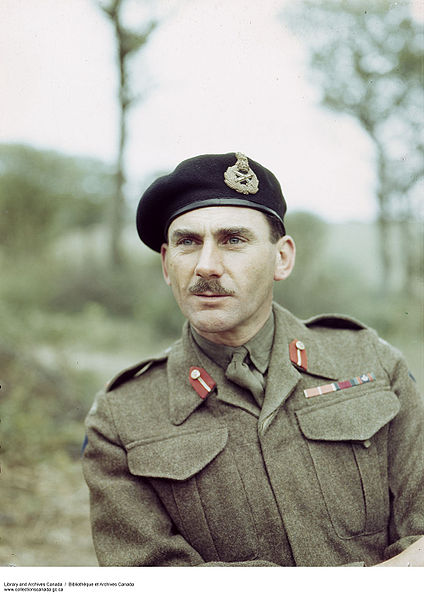
Simonds was a brilliant corps commander and (at least) a very good army commander, but he had one fatal flaw: he was no politician. Harry Crerar was a very “political” general, and played the political game with far greater talent than any other Canadian general. That got him into his role as army commander and his political skills kept him there despite the better “military” options available.
ESR on the origins of open source theory
Eric S. Raymond acknowledges the strong influence of evolutionary psychology on the development of open source theory:
Yesterday I realized, quite a few years after I should have, that I have never identified in public where I got the seed of the idea that I developed into the modern economic theory of open-source software – that is, how open-source “altruism” could be explained as an emergent result of selfish incentives felt by individuals. So here is some credit where credit is due.
Now, in general it should be obvious that I owed a huge debt to thinkers in the classical-liberal tradition, from Adam Smith down to F. A. Hayek and Ayn Rand. The really clueful might also notice some connection to Robert Trivers’s theory of reciprocal altruism under natural selection and Robert Axelrod’s work on tit-for-tat interactions and the evolution of cooperation.
These were all significant; they gave me the conceptual toolkit I could apply successfully once I’d had my initial insight. But there’s a missing piece – where my initial breakthrough insight came from, the moment when I realized I could apply all those tools.
The seed was in the seminal 1992 anthology The Adapted Mind: Evolutionary Psychology and the Generation of Culture. That was full of brilliant work; it laid the foundations of evolutionary psychology and is still worth a read.
(I note as an interesting aside that reading science fiction did an excellent job of preparing me for the central ideas of evolutionary psychology. What we might call “hard adaptationism” – the search for explanations of social behavior in evolution under selection – has been a central theme in SF since the 1940s, well before even the first wave of academic sociobiological thinking in the early 1970s and, I suspect, strongly influencing that wave. It is implicit in, as a leading example, much of Robert Heinlein’s work.)
The specific paper that changed my life was this one: Two Nonhuman Primate Models for the Evolution of Human Food Sharing: Chimpanzees and Callitrichids by W.C. McGrew and Anna T.C. Feistner.
In it, the authors explained food sharing as a hedge against variance. Basically, foods that can be gathered reliably were not shared; high-value food that could only be obtained unreliably was shared.
The authors went on to observe that in human hunter-gatherer cultures a similar pattern obtains: gathered foods (for which the calorie/nutrient value is a smooth function of effort invested) are not typically shared, whereas hunted foods (high variance of outcome in relation to effort) are shared. Reciprocal altruism is a hedge against uncertainty of outcomes.
The Railroad Signal – New York Central Railroad Educational Documentary 1948
Uploaded on 30 Nov 2011
New York Central Railroad Educational Documentary from 1948 that gives an overview of railroad signals and related safe working infrastructure used by trains, as well as the ongoing improvements to the signalling systems due to technological advances.
The film was released as part of the NYC’s “Running the Railroad” series, and features many examples of different signalling systems in use by the New York Central Railroad, as well as lots of scenes of passenger and freight trains. .
December 26, 2014
The First Battle of Champagne – Dying In Caucasus Snow I THE GREAT WAR Week 22
Published on 25 Dec 2014
Right before Christmas the allied powers begin the Champagne offensive, which will last several months. In the snow and the mud, and under horrible living conditions not only the soldiers suffer. The images of a war fought with honour and glory are finally over as even the white flag is used for ambushes. Far away in the mountains of the Caucasian, Russia and the Ottoman Empire are fighting a grim battle, too, in which many soldiers die during interminable marches in the snow wearing summer uniforms.
December 25, 2014
A Sign Of Friendship In The Midst Of War I THE CHRISTMAS TRUCE 1914
Published on 24 Dec 2014
Initially, everyone believed that this war would be over by Christmas, but on Christmas Eve 1914, soldiers were still facing each other in France, Belgium, throughout Eastern Europe, and all of the other theatres of war. But instead of shooting at each other, quite a few soldiers decided to sing and celebrate this night with their enemies. This happened in many places on the Western Front, and the commanding officers were not happy about it. In future, they would see to it that it did not happen again.


