Quotulatiousness

January 25, 2015

Prescribing modern drugs for Richard III

Filed under: Britain, Health, History, Science — Tags: , , , — Nicholas @ 02:00

In Richard Lehman’s BMJ journal review, there was an amusing bit of interest to Ricardians:

King Richard III of England was 32 when he died at Bosworth and then famously suffered the indignity of being buried in a Leicester car park. I think I probably drew your attention to this account of his post-mortem examination when it appeared online last September. Had Richard III been spared avoidable mortality in the form of a bashed-in skull and a spear through his spine, he would probably have needed a walking frame by the age of 70. He was never in the best shape:

I, that am curtail’d of this faire Proportion,
Cheated of Feature by dissembling Nature,
Deform’d, unfinish’d, sent before my time
Into this breathing World, scarse halfe made up,
And that so lamely and unfashionable,
That dogges bark at me, as I halt by them.

(from The Tragedy of Richard the Third: with the Landing of Earle Richmond , and the Battell of Boʃworth Field by Wm Shakespeare c.1592, First Folio text 1623)

With his nasty scoliosis and his habit of moving around castles with smoky rooms and no hand rails on the stairs, Richard III would have needed an OT assessment and a dosset box containing all the drugs which are now compulsory for elderly people in the UK:

simvastatin 40mg to add 2 days to life and cause muscle aches
tramadol 50mg to fail to ease pain & cause dependency, falls, confusion
naproxen 500mg to cause GI bleeds and fluid retention
furosemide 20mg to reduce fluid retention due to naproxen
omeprazole 20mg to prevent GI bleeds, encourage C diff
senna 7.5mg to counter tramadol constipation
citalopram 20mg to cause serotonin syndrome with tramadol
trazodone 50mg for agitation due to serotonin, to worsen it & cause falls
gababentin MR 800mg to see if it will help pain
paracetamol 500mg because it hasn’t helped the pain
tamsulosin 400mcg for nocturia due to age and furosemide
lisinopril 5mg for “grade 2 CKD” due to furosemide & naproxen
Seretide inhaler for low FEV1 due to scoliosis
etc.

My kingdom for a bit of horse-sense.

January 24, 2015

QotD: General Elphinstone in Afghanistan, 1842

Filed under: Asia, Books, Britain, History, Military, Quotations — Tags: , , , — Nicholas @ 01:00

But looking back I can say that, all unwittingly, Kabul and the army were right to regard Elphy’s arrival as an incident of the greatest significance. It opened a chapter: it was a prelude to events that rang round the world. Elphy, ably assisted by McNaghten, was about to reach the peak of his career; he was going to produce the most shameful, ridiculous disaster in British military history.

No doubt Thomas Hughes would find it significant that in such a disaster I would emerge with fame, honour, and distinction — all quite unworthily acquired. But you, having followed my progress so far, won’t be surprised at all.

Let me say that when I talk of disasters I speak with authority. I have served at Balaclava, Cawnpore, and Little Big Horn. Name the biggest born fools who wore uniform in the nineteenth century — Cardigan, Sale, Custer, Raglan, Lucan — I knew them all. Think of all the conceivable misfortunes that can arise from combinations of folly, cowardice, and sheer bad luck, and I’ll give you chapter and verse. But I still state unhesitatingly, that for pure, vacillating stupidity, for superb incompetence to command, for ignorance combined with bad judgement — in short, for the true talent for catastrophe — Elphy Bey stood alone. Others abide our question, but Elphy outshines them all as the greatest military idiot of our own or any other day.

Only he could have permitted the First Afghan War and let it develop to such a ruinous defeat. It was not easy: he started with a good army, a secure position, some excellent officers, a disorganized enemy, and repeated opportunities to save the situation. But Elphy, with the touch of true genius, swept aside these obstacles with unerring precision, and out of order wrought complete chaos. We shall not, with luck, look upon his like again.

George MacDonald Fraser, Flashman, 1969.

January 23, 2015

Zeppelins Over England – New Inventions For The Modern War I THE GREAT WAR Week 26

Filed under: Europe, France, Germany, History, Military, WW1 — Tags: , , , — Nicholas @ 03:00

Published on 22 Jan 2015

For a decisive advantage on the Western Front, the military commanders of both sides are trying to use technological advances. And so this week, German Zeppelins are flying their first air raids on English towns. Winston Churchill is outlining his ideas for what would later become the tank. Meanwhile at the Western Front, the soldier Adolf Hitler is thinking about how this war is going to continue.

January 21, 2015

QotD: Teddy Roosevelt and the rise of the Progressives

Filed under: History, Politics, Quotations, USA — Tags: , , , — Nicholas @ 01:00

When, after a generation of that sort of compromising, the so-called Progressive party was organized and he [Theodore Roosevelt] seized the leadership of it from the Westerners who had founded it, he performed a feat of wholesale englutination that must forever hold a high place upon the roll of political prodigies. That is to say, he swallowed at one gigantic gulp, and out of the same herculean jug, the most amazing mixture of social, political and economic perunas ever got down by one hero, however valiant, however athirst — a cocktail made up of all the elixirs hawked among the boobery in his time, from woman suffrage to the direct primary, and from the initiative and referendum to the short ballot, and from prohibition to public ownership, and from trust-busting to the recall of judges.

This homeric achievement made him the head of the most tatterdemalion party ever seen in American politics — a party composed of such incompatible ingredients and hung together so loosely that it began to disintegrate the moment it was born. In part it was made up of mere disordered enthusiasts — believers in anything and everything, pathetic victims of the credulity complex, habitual followers of jitney messiahs, incurable hopers and snufflers. But in part it was also made up of rice converts like Roosevelt himself — men eager for office, disappointed by the old parties, and now quite willing to accept any aid that half-idiot doctrinaires could give them. I have no doubt that Roosevelt himself, carried away by the emotional storms of the moment and especially by the quasi-religious monkey-shines that marked the first Progressive convention, gradually convinced himself that at least some of the doctrinaires, in the midst of all their imbecility, yet preached a few ideas that were workable, and perhaps even sound. But at bottom he was against them, and not only in the matter of their specific sure cures, but also in the larger matter of their childish faith in the wisdom and virtue of the plain people. Roosevelt, for all his fluent mastery of democratic counter-words, democratic gestures and all the rest of the armamentarium of the mob-master, had no such faith in his heart of hearts. He didn’t believe in democracy; he believed simply in government. His remedy for all the great pangs and longings of existence was not a dispersion of authority, but a hard concentration of authority. He was not in favor of unlimited experiment; he was in favor of a rigid control from above, a despotism of inspired prophets and policemen. He was not for democracy as his followers understood democracy, and as it actually is and must be; he was for a paternalism of the true Bismarckian pattern, almost of the Napoleonic or Ludendorffian pattern — a paternalism concerning itself with all things, from the regulation of coal-mining and meat-packing to the regulation of spelling and marital rights. His instincts were always those of the property-owning Tory, not those of the romantic Liberal. All the fundamental objects of Liberalism — free speech, unhampered enterprise, the least possible governmental interference — were abhorrent to him. Even when, for campaign purposes, he came to terms with the Liberals his thoughts always ranged far afield. When he tackled the trusts the thing that he had in his mind’s eye was not the restoration of competition but the subordination of all private trusts to one great national trust, with himself at its head. And when he attacked the courts it was not because they put their own prejudice before the law but because they refused to put his prejudices before the law.

In all his career no one ever heard him make an argument for the rights of the citizen; his eloquence was always expended in expounding the duties of the citizen. I have before me a speech in which he pleaded for “a spirit of kindly justice toward every man and woman,” but that seems to be as far as he ever got in that direction — and it was the gratuitous justice of the absolute monarch that he apparently had in mind, not the autonomous and inalienable justice of a free society. The duties of the citizen, as he understood them, related not only to acts, but also to thoughts. There was, to his mind, a simple body of primary doctrine, and dissent from it was the foulest of crimes. No man could have been more bitter against opponents, or more unfair to them, or more ungenerous.

H.L. Mencken, “Roosevelt: An Autopsy”, Prejudices, part 2, 1920.

January 20, 2015

Recap: The First Six Months I THE GREAT WAR

Filed under: Europe, France, Germany, History, Military, Russia, WW1 — Tags: , , — Nicholas @ 04:00

Published on 19 Jan 2015

World War 1 broke out in summer 1914, a little over 100 years ago. Our channel is following the historic events week by week. For everyone who recently joined this channel: this recap is specially for you! Catch up with the last six months, hence the first six months of the war. Between the assassination of Franz Ferdinand, the Battle of the Marne and the Christmas Truce, hundreds of thousands of soldiers had to die. This is modern war.

January 19, 2015

QotD: Austria becomes Austria-Hungary

Filed under: Europe, Government, History, Quotations — Tags: , , — Nicholas @ 01:00

Shaken by military defeat, the neo-absolutist Austrian Empire metamorphosed into the Austro-Hungarian Empire. Under the Compromise hammered out in 1867 power was shared out between the two dominant nationalities, the Germans in the west and the Hungarians in the east. What emerged was a unique polity, like an egg with two yolks, in which the Kingdom of Hungary and a territory centred on the Austrian lands and often called Cisleithania (meaning ‘the lands on this side of the River Leithe’) lived side by side within the translucent envelope of a Habsburg dual monarchy. Each of the two entities had its own parliament, but there was no common prime minister and no common cabinet. Only foreign affairs, defence and defence-related aspects of finance were handled by ‘joint ministers’ who were answerable directly to the Emperor. Matters of interest to the empire as a whole could not be discussed in common parliamentary session, because to do so would have implied that the Kingdom of Hungary was merely the subordinate part of some larger imperial entity. Instead, an exchange of views had to take place between the ‘delegations’, groups of thirty delegates from each parliament, who met alternately in Vienna and Budapest.

The dualist compromise had many enemies at the time and has had many critics since. In the eyes of hardline Magyar nationalists, it was a sell-out that denied the Hungarians the full national independence that was their due. Some claimed that Austria was still exploiting the Kingdom of Hungary as an agrarian colony. Vienna’s refusal to relinquish control over the armed forces and create a separate and equal Hungarian army was especially contentious — a constitutional crisis over this question paralyzed the empire’s political life in 1905. On the other hand, Austrian Germans argued that the Hungarians were freeloading on the more advanced economy of the Austrian lands, and ought to pay a higher share of the empire’s running costs. Conflict was programmed into the system, because the Compromise required that the two imperial ‘halves’ renegotiate every ten years the customs union by which revenues and taxation were shared out between them. The demands of the Hungarians became bolder with every review of the union. And there was little in the Compromise to recommend it to the political elites of the other national minorities, who had in effect been placed under the tutelage of the two ‘master races’. The first post-Compromise Hungarian prime minister, Gyula Andrássy, captured this aspect of the settlement when he commented to his Austrian counterpart: ‘You look after your Slavs and we’ll look after ours.’ The last decades before the outbreak of war were increasingly dominated by the struggle for national rights among the empire’s eleven official nationalities – Germans, Hungarians, Czechs, Slovaks, Slovenes, Croats, Serbs, Romanians, Ruthenians, Poles, and Italians.

Christopher Clark, The Sleepwalkers: How Europe Went To War In 1914, 2012.

January 18, 2015

The [f]utility of mass demonstrations

Filed under: History, Middle East, Politics, USA — Tags: , , , , — Nicholas @ 10:30

David Warren had a short essay get out of hand on him the other day:

Everything is coming out of Egypt these days, just like in the Bible. The Paris demonstrations were a throwback not only to the grand gatherings of a century ago, when the masses in each European capital were demanding war, but also to the recent “Arab spring,” when the masses in Egypt and every Middle Eastern capital were demanding “democracy.” Mobs often get what they want. The best that can be said for the Jesuischarlies, is they haven’t a clew what they want, beyond making an emotional display of their own vaunted goodness.

And yet, large demonstrations are expressions of despair. They bring momentary relief in a false exhilaration: the idea that something can be done, by men; something that will not cost them vastly more than they are now paying. Verily, it is the counsel of despair. I don’t think I can provide any example from history in which mass political demonstrations did any good; only examples when they did not end as badly as they could have.

I hardly expect agreement on this point, especially on non-violent demonstrations that affirm some simple moral point, such as the wrongness of racial prejudice, or of the slaughter of unborn children. But these must necessarily politicize something which should be above politics, and cannot help bringing an element of intimidation into what must finally be communicated cor ad cor. Pressure politics change everything, such that even when the cause is indisputably elevated — the American civil rights marches of the 1960s are a good example — the effect is dubious. What came out in that case was not simply the destruction of an evil, but its replacement with new evils: welfare provisions which undermined the black family, the poison of race quotas and “reverse discrimination,” the canting and excuse-making and radical posturing that has wreaked more aggregate damage to black people — both spiritual and material — than the wicked humiliations they suffered before. (Read Thomas Sowell.)

“Be careful what you wish for.” Be mindful of what comes with that wish. Be careful whom you ask to deliver it.

January 16, 2015

Onwards! – The Western Front Of Early 1915 – THE GREAT WAR Week 25

Filed under: France, Germany, History, Military, WW1 — Tags: — Nicholas @ 05:00

Published on 15 Jan 2015

French general Joseph Joffre is stuck in a dilemma: the Champagne offensive has been going on for weeks now — without any expected results. Should he dig in and tolerate the enemy on French soil? Or should his soldiers continue to run up against the impenetrable German defences? Meanwhile, South African troops attack German South West Africa and in London, Winston Churchill’s plan for an invasion of the Dardanelles has been approved.

January 14, 2015

What Was The Bloodiest Battle Of World War 1? – OUT OF THE TRENCHES #6

Filed under: Europe, Germany, History, Military, WW1 — Tags: , , — Nicholas @ 04:00

Published on 12 Jan 2015

“Indy is answering your questions again. In this episode of OUT OF THE TRENCHES he is explaining how airplanes got armed with machine guns and what was the bloodiest battle of WW1.

January 13, 2015

QotD: The high-water mark of European colonialism

Filed under: Britain, Europe, History, Quotations — Tags: — Nicholas @ 01:00

… by the close of the century, eight Western European powers — Britain, France, Germany, Italy, Spain, Portugal, Belgium and the Netherlands — together in extent slightly under 1,000,000 square miles, had within a generation added some 11,000,000 square miles of foreign territories to their homelands; and area three and a half times the size of the United States, and rather more than one-fifth of the land surface of the globe! So extensive a conquest had no equal since the invasions of the Mongols in the thirteenth century, and no previous conquest had been so rapid and bloodless since the age of Alexander the Great. Like his, it was destined to be followed by the wars of its Diadochi [Alexander’s successors].

J.F.C. Fuller, The Conduct of War, 1789-1961, 1961.

January 12, 2015

Virginia Postrel on “the power of seemingly trivial inventions to utterly transform our notion of ‘normal’ life”

Filed under: Business, Food, History, Technology — Tags: , , — Nicholas @ 04:00

In The Weekly Standard, Virginia Postrel reviews Packaged Pleasures by Gary S. Cross and Robert N. Proctor:

Toward the end of the nineteenth century, a host of often ignored technologies transformed human sensual experience, changing how we eat, drink, see, hear, and feel in ways we still benefit (and suffer) from today. Modern people learned how to capture and intensify sensuality, to preserve it, and to make it portable, durable, and accessible across great reaches of social class and physical space.

Eating canned peaches in the winter, buying a chocolate bar at the corner newsstand, hearing an opera in your living room, and immortalizing baby’s first steps in a snapshot all marked a radical shift in human experience. Replacing scarcity with abundance and capturing the previously ephemeral — these mundane pleasures defied nature as surely as did horseless carriages.

It’s a keen insight and a valuable reminder of the power of seemingly trivial inventions to utterly transform our notion of “normal” life. Cross and Proctor carry their theme through chapters on cigarettes, mass-market sweets (candy, soda, ice cream), recorded sound, photographs and movies, and amusement parks. The somewhat eccentric selection reflects the authors’ scholarly backgrounds. In his previous work, Cross, a historian at Penn State, has focused primarily on childhood and leisure, which presumably explains the amusement parks. Proctor, a historian of science at Stanford, has written extensively on tobacco and cancer, including in his Golden Holocaust: Origins of the Cigarette Catastrophe and the Case for Abolition (2012).

The authors are at their best when showing how incremental improvements cumulate to create dramatic technological and cultural changes. They start with the packaging itself. “Industrial containerization,” they write, “made it possible to distribute foods throughout the globe; think only of what it would be like to live in a world without tin cans, cardboard cartons, and bottled drinks.” The “tubularization” represented by cylinders such as cigarettes, tin cans, and soda bottles (not to mention lipsticks and bullet shells) transformed manufacturing and marketing as well as distribution, giving producers easily fillable containers that could be labeled, branded, and advertised.

Historians unduly slight packaging technologies, the authors suggest, because “tubing the natural world” developed so gradually. Although the metal can dates back to 1810, it took nearly a century of refinements in stamping, folding, and soldering to achieve the design that changed the world: the “sanitary can,” which used crimped double seams and no interior solder to create an airtight seal. This was the design, Cross and Proctor write, that “allowed a wide range of tinned food to reach urban populations, especially as rival processors introduced ever-cheaper and more attractive foodstuffs festooned with colorful labels and catchy brand names.”

QotD: The Soviet Union’s incredibly successful ideological warfare

Filed under: History, Media, Politics, Quotations, USA — Tags: , , , , , , — Nicholas @ 01:00

The Soviets consciously followed the Gramscian prescription; they pursued a war of position, subverting the “leading elements” of society through their agents of influence. (See, for example, Stephen Koch’s Double Lives: Stalin, Willi Munzenberg and the Seduction of the Intellectuals; summary by Koch here) This worked exactly as expected; their memes seeped into Western popular culture and are repeated endlessly in (for example) the products of Hollywood.

Indeed, the index of Soviet success is that most of us no longer think of these memes as Communist propaganda. It takes a significant amount of digging and rethinking and remembering, even for a lifelong anti-Communist like myself, to realize that there was a time (within the lifetime of my parents) when all of these ideas would have seemed alien, absurd, and repulsive to most people — at best, the beliefs of a nutty left-wing fringe, and at worst instruments of deliberate subversion intended to destroy the American way of life.

Koch shows us that the worst-case scenario was, as it turns out now, the correct one; these ideas, like the “race bomb” rumor, really were instruments deliberately designed to destroy the American way of life. Another index of their success is that most members of the bicoastal elite can no longer speak of “the American way of life” without deprecation, irony, or an automatic and half-conscious genuflection towards the altar of political correctness. In this and other ways, the corrosive effects of Stalin’s meme war have come to utterly pervade our culture.

The most paranoid and xenophobic conservatives of the Cold War were, painful though this is to admit, the closest to the truth in estimating the magnitude and subtlety of Soviet subversion. Liberal anticommunists (like myself in the 1970s) thought we were being judicious and fair-minded when we dismissed half of the Right’s complaint as crude blather. We were wrong; the Rosenbergs and Alger Hiss really were guilty, the Hollywood Ten really were Stalinist tools, and all of Joseph McCarthy’s rants about “Communists in the State Department” were essentially true. The Venona transcripts and other new material leave no room for reasonable doubt on this score.

While the espionage apparatus of the Soviet Union didn’t outlast it, their memetic weapons did. These memes are now coming near to crippling our culture’s response to Islamic terrorism.

In this context, Jeff Goldstein has written eloquently about perhaps the most long-term dangerous of these memes — the idea that rights inhere not in sovereign individuals but identity groups, and that every identity group (except the “ruling class”) has the right to suppress criticism of itself through political means up to and including violence.

Mark Brittingham (aka WildMonk) has written an excellent essay on the roots of this doctrine in Rousseau and the post-Enlightenment Romantics. It has elsewhere been analyzed and labeled as transnational progressivism. The Soviets didn’t invent it, but they promoted it heavily in a deliberate — and appallingly successful — attempt to weaken the Lockean, individualist tradition that underlies classical liberalism and the U.S. Constitution. The reduction of Western politics to a bitter war for government favor between ascriptive identity groups is exactly the outcome the Soviets wanted and worked hard to arrange.

Call it what you will — various other commentators have favored ‘volk-Marxism’ or ‘postmodern leftism’. I’ve called it suicidalism. It was designed to paralyze the West against one enemy, but it’s now being used against us by another. It is no accident that Osama bin Laden so often sounds like he’s reading from back issues of Z magazine, and no accident that both constantly echo the hoariest old cliches of Soviet propaganda in the 1930s and ’40s.

Another consequence of Stalin’s meme war is that today’s left-wing antiwar demonstrators wear kaffiyehs without any sense of how grotesque it is for ostensible Marxists to cuddle up to religious absolutists who want to restore the power relations of the 7th century CE. In Stalin’s hands, even Marxism itself was hollowed out to serve as a memetic weapon — it became increasingly nihilist, hatred-focused and destructive. The postmodern left is now defined not by what it’s for but by what it’s against: classical-liberal individualism, free markets, dead white males, America, and the idea of objective reality itself.

Eric S. Raymond, “Gramscian damage”, Armed and Dangerous, 2006-02-11.

January 11, 2015

Sport fencing no longer teaches swordsmanship – HEMA does

Filed under: History, Sports — Tags: , , — Nicholas @ 11:19

I’ve given (shorter and less detailed) variants of this argument many times. I agree with pretty much everything he says here:

I started to learn sport fencing (or “Olympic-style”) as a child in England. My parents were both long-time fencers, so one of my earliest memories is from around age three or four, standing in our tiny backyard, trying to learn basic parries with a foil. My father had been experimenting with bringing in a form of rapier and dagger at his fencing club, but there were no reasonable simulation rapiers on the market in those days, so the default equipment was a sabre and a broken-off foil as a dagger. Let’s just say that the idea was very popular in the club, but the implementation failed to energize many because the equipment wasn’t all that close to representative: the weapons were far too light and any attempt to use historical methods was doomed because the swordplay lacked the momentum of full-sized/full-weight rapiers. Things that worked fantastically well with the modern weapons would get you deader than dead using proper historical weaponry.

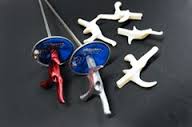
Orthopedic foil and epee gripsI gave up sport fencing as a hobby around the time that orthopedic grips and electrical scoring came in … as the man says in the video above, it became too much like electric tag and too little like historical swordplay. Instead of being relatively straight or slightly curved, orthopedic grips looked rather like what would happen if you squeezed a ball of soft coloured clay in your hand. I hated the feel of them, but other fencers at my club loved them. The electrical scoring system of the day required each fencer to wear an over-jacket covering the valid target area, and trail along a cable attached to the back of the over-jacket. The matching foil had a socket on the inside of the guard for attaching the cable to the other side of the scoring circuit. When the tip of the foil hit the conductive surface of the opponent’s over-jacket, the circuit was completed and a point would be scored.

It was clumsy and awkward, and didn’t feel much like a swordfight. I pretty much gave up the foil and switched to sabre, for they didn’t yet have a working electric system for sabre fighting, so you didn’t need to get hooked up to the machine just to fight a bout. When they got that little problem fixed, I’d already given up sport fencing.

The SCA finally adopted rapier fencing and the Historical European Martial Arts (HEMA) movement arrived well after I’d given up sport fencing, and I’ve enjoyed the SCA’s rapier combat quite a bit (although I tend to go inactive for a year or two, then go back for a similar length of time … I may not improve that way, but it’s still fun). More serious fencers and those interested in a wider range of styles end up joining HEMA organizations, where I’m told they take things much more seriously. I can’t say from personal experience, as I only visited a Toronto HEMA group once and most of the members there were working on much earlier styles of swordplay (like longsword) than I was interested in at the time.

H/T to Brendan McKenna for the link to the video.

6th century Sicilian shipwreck yields 39 ingots of orichalcum

Filed under: Europe, Greece, History, Italy — Tags: , , , — Nicholas @ 03:00

I’d only ever encountered mentions of orichalcum as a rare metal in Guild Wars 2, but it was a real thing, and an underwater archaeology team found 39 ingots of orichalcum just off the coast of Sicily near Gela:

Gleaming cast metal called orichalcum, which was said by Ancient Greeks to be found in Atlantis, has been recovered from a ship that sunk 2,600 years ago off the coast of Sicily.

The lumps of metal were arriving to Gela in southern Sicily, possibly coming from Greece or Asia Minor. The ship that was carrying them was likely caught in a storm and sunk just when it was about to enter the port.

“The wreck dates to the first half of the sixth century,” Sebastiano Tusa, Sicily’s superintendent of the Sea Office, told Discovery News. “It was found about 1,000 feet from Gela’s coast at a depth of 10 feet.”

He noted that the 39 ingots found on the sandy sea floor represent a unique finding.

“Nothing similar has ever been found,” Tusa said. “We knew orichalcum from ancient texts and a few ornamental objects.”

Indeed orichalcum has long been considered a mysterious metal, its composition and origin widely debated.

According to the ancient Greeks, it was invented by Cadmus, a Greek-Phoenician mythological character. The fourth century B.C. Greek philosopher Plato made orichalcum a legendary metal when he mentioned it in the Critias dialogue.

January 9, 2015

In Dire Straits – Russia on Austro-Hungary’s Doorstep I THE GREAT WAR Week 24

Filed under: Europe, History, Military, Russia, WW1 — Tags: , , — Nicholas @ 05:00

Published on 8 Jan 2015

The Austro-Hungarian army resembles a better militia after six months into the war. After defeats against Serbia and Russia and still under siege in Galicia, the forces are in dire straits. Many casualties, especially among the officers, mean that an effective warfare is impossible. And all this while the Russians are close to entering the Hungarian plains. On another front, the Russians are winning the battle of Sarikamish which ends in a disaster for the Ottoman Empire. On the Western Front, each side still tries to gain a decisive advantage.

« Newer PostsOlder Posts »

Powered by WordPress