Shorter than the natives, oddly dressed, and often unbearably dirty, the pallid foreigners had peculiar blue eyes that peeped out of the masks of bristly, animal-like hair that encased their faces. They were irritatingly garrulous, prone to fits of chicanery, and often surprisingly incompetent at what seemed to Indians like basic tasks. But they also made useful and beautiful goods — copper kettles, glittering colored glass, and steel knives and hatchets — unlike anything else in New England. Moreover they would exchange these valuable items for cheap furs of a sort used by Indians as blankets. It was like happening upon a dingy kiosk that would swap fancy electronic goods for customers’ used socks — almost anyone would be willing to overlook the shopkeeper’s peculiarities.
Charles Mann, 1491: New Revelations of the Americas Before Columbus, 2006.
November 28, 2019
QotD: The native view of the Pilgrims
November 27, 2019
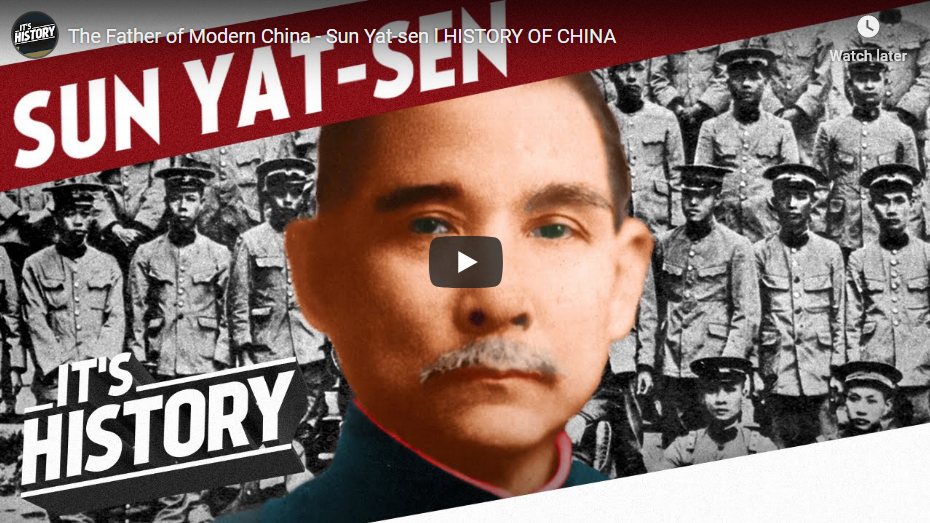
The Father of Modern China – Sun Yat-sen l HISTORY OF CHINA
IT’S HISTORY
Published 2 Sep 2015Sun Yat-sen is known as the “father of modern China”. He spent his adult life fighting against imperial China and the ruling Qing dynasty. First as revolutionary leader and later as politician. He founded the Tongmenghui League in 1905 and supported rebellions in China. After the Wuchang Uprising, Sun handed over the presidential office for the Republic of China to Yuan Shikai who soon after would ban Sun’s political party, the Kuomintang. So he reformed it as China’s National People’s party. His military and political work laid the groundwork from which his successors would later call out the People’s Republic of China.
» Century of Humiliation
Part 1: http://bit.ly/humiliation1
Part 2: http://bit.ly/Humiliation2» SOURCES
Videos: British Pathé (https://www.youtube.com/user/britishp…)
Pictures: mainly Picture Alliance
Content:
Chang, Johannes (1960): “Sun Yat-sen – Seine Lehre und seine Bedeutung” in: JCSW 1 [1960] S.179-194
Gernet, Jacques (1988): Die chinesische Welt. Die Geschichte Chinas von den Anfängen bis zur Jetztzeit, Suhrkamp, Berlin.
Klein, Thoralf (2008): “Politische Geschichte Chinas 1900-1949”, auf bpb.de
https://www.bpb.de/internationales/as…
Vogelsang, Kai (2013): Geschichte Chinas, Reclam, Ditzingen.
Weigelin-Schwiedrzik (2012): “Der geteilte Himmel”, in ZEIT Geschichte Nr. 01/2012
http://www.zeit.de/zeit-geschichte/20…» ABOUT US
IT’S HISTORY is a ride through history – Join us discovering the world’s most important eras in IN TIME, BIOGRAPHIES of the GREATEST MINDS and the most important INVENTIONS.» HOW CAN I SUPPORT YOUR CHANNEL?
You can support us by sharing our videos with your friends and spreading the word about our work.» CAN I EMBED YOUR VIDEOS ON MY WEBSITE?
Of course, you can embed our videos on your website. We are happy if you show our channel to your friends, fellow students, classmates, professors, teachers or neighbors. Or just share our videos on Facebook, Twitter, Reddit etc. Subscribe to our channel and like our videos with a thumbs up.» CAN I SHOW YOUR VIDEOS IN CLASS?
Of course! Tell your teachers or professors about our channel and our videos. We’re happy if we can contribute with our videos.» CREDITS
Presented by: Guy Kiddey
Script by: Julia Korbik
Translated by: Guy Kiddey
Directed by: Daniel Czepelczauer
Director of Photography: Markus Kretzschmar
Music: Markus Kretzschmar
Sound Design: Marc Glücks
Editing: Markus KretzschmarA Mediakraft Networks original channel
Based on a concept by Florian Wittig and Daniel Czepelczauer
Executive Producers: Astrid Deinhard-Olsson, Spartacus Olsson
Head of Production: Michael Wendt
Producer: Daniel Czepelczauer
Social Media Manager: Laura PaganContains material licensed from British Pathé
All rights reserved – © Mediakraft Networks GmbH, 2015
Herodotus’ Histories – Tom Holland
The Study of Antiquity and the Middle Ages
Published 24 Mar 2018The classical scholar Tom Holland introduces his new translation of Herodotus’ masterpiece – The Histories.
The Histories (Greek: Ἱστορίαι; Ancient Greek: [his.to.rí.ai̯]; also known as The History) of Herodotus is now considered the founding work of history in Western literature.
Written in 440 BC in the Ionic dialect of classical Greek, The Histories serves as a record of the ancient traditions, politics, geography, and clashes of various cultures that were known in Western Asia, Northern Africa and Greece at that time. Although not a fully impartial record, it remains one of the West’s most important sources regarding these affairs.
Moreover, it established the genre and study of history in the Western world (despite the existence of historical records and chronicles beforehand).
The Histories also stands as one of the first accounts of the rise of the Persian Empire, as well as the events and causes of the Greco-Persian Wars between the Achaemenid Empire and the Greek city-states in the 5th century BC. Herodotus portrays the conflict as one between the forces of slavery (the Persians) on the one hand, and freedom (the Athenians and the confederacy of Greek city-states which united against the invaders) on the other.
The Histories was at some point divided into the nine books that appear in modern editions, conventionally named after the nine Muses.

John Browning vs Hiram Maxim: Patent Fight!
Forgotten Weapons
Published on 25 Sep 2019http://www.patreon.com/ForgottenWeapons
Cool Forgotten Weapons merch! http://shop.bbtv.com/collections/forg…
When John Browning designed his Model 1895 machine gun with its rotary-lever gas operation system, Hiram Maxim filed suit claiming patent infringement. Maxim had filed quite broad patents covering gas pistons operation, but specifically in a linear format. Browning and Colt (who had the license to manufacture the Model 1895 machine gun) countered that the swinging lever was a different system, and thus not covered by Maxim’s patents. More to the point, they claimed that the gun would work without using a gas piston at all – and built this experimental model using a gas trap or muzzle cap system instead to prove the point.
Ultimately, the genesis of the fight was moot (the Maxim did not run well in 6mm Lee Navy, and would not have won a US Navy contract regardless of the Colt/Browning gun), and the court ultimately decided in favor of Colt and Browning. But this gun remains from the incident…
Contact:
Forgotten Weapons
6281 N. Oracle #36270
Tucson, AZ 85704

QotD: The evolution of markets
We believe that there is a natural inclination to promote our own welfare and that of our loved ones. We further believe that, given reasonable security of life and property, this inclination will lead to the emergence of a system of voluntary exchange. That is, we will seek to trade the things we have or can create for other things that we regard as of greater value to ourselves.
In doing so, ratios of exchange that we call prices will be revealed. These prices, in turn, will provide general information about what should be produced, in what ways and in what quantities. Furthermore, changes in price will provide information about changes in preferences or in abilities to produce. Custom will set aside one or more goods to serve as money. Institutions will emerge that channel savings into productive investment, that spread risk, and that moderate expected fluctuations in price. Laws will develop to police the transfer of property and performance of contracts.
We believe that market economies emerge spontaneously and are self-regulating and self-sustaining. This is not to say that all market societies will be the same. Their exact shape will depend on the intellectual and moral qualities of the individuals who comprise them. They will reflect pre-existing patterns of trust and honesty and the general cultural and religious values of a people. They will also be more or less distorted by government intervention. But we do say that market behaviour is natural — that, in the absence of extreme government coercion, or extreme disorder, buying and selling to increase our own welfare is what we naturally do.
Sean Gabb, “Market Behaviour in the Ancient World: An Overview of the Debate”, 2008-05.
November 26, 2019
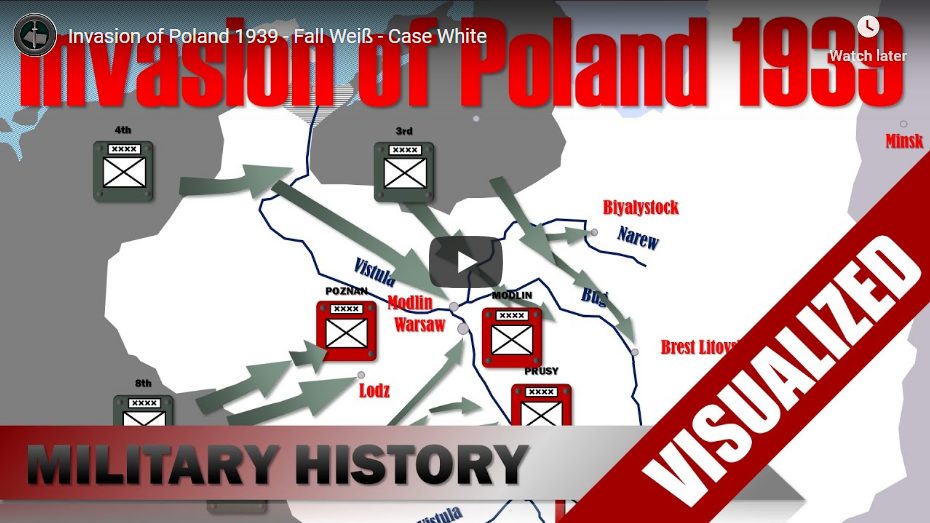
Invasion of Poland 1939 – Fall Weiß – Case White
Military History Visualized
Published 30 Aug 2016The German Invasion of Poland in 1939 started the Second World War in Europe. The German name of operation was “Fall Weiß” meaning “Case White”. In this video I will take a look at the major German troop movements, the Soviet invasion of Poland, the losses and a final assessment.
» HOW YOU CAN SUPPORT MILITARY HISTORY VISUALIZED «
(A) You can support my channel on Patreon: https://www.patreon.com/mhv(B) You can also buy “Spoils of War” (merchandise) in the online shop: https://www.redbubble.com/people/mhvi…
(C) If you want to buy books that I use or recommend, here is the link to the Amazon Store: http://astore.amazon.com/ytmh-20 which has the same price for you and gives a small commission to me, thus it is a win/win.
» SOURCES & LINKS «
Maier, Klaus; Rohde, Horst; Stegemann, Bernd; Umbreit, Hans: Die Errichtung der Hegemonie auf dem europäischen Kontient. Das Deutsche Reich und der Zweite Weltkrieg (DR2WK), Band 2.
Müller, Rolf-Dieter: Hitler’s Wehrmacht, 1935-1945
Zaloga, Steven J.: Poland 1939 – The Birth of Blitzkrieg
Wettstein, Adrian: Wehrmacht im Stadtkampf
http://www.cgsc.edu/CARL/nafziger/939…
http://www.cgsc.edu/CARL/nafziger/939…
http://niehorster.org/029_poland/1939…
http://www.westpoint.edu/history/Site…
https://en.wikipedia.org/wiki/Soviet_…
» CREDITS & SPECIAL THX «
Song: Ethan Meixsell – “Demilitarized Zone”The Counter-Design is heavily inspired by Black ICE Mod for the game Hearts of Iron 3 by Paradox Interactive
https://forum.paradoxplaza.com/forum/…» DISCLAIMER «
Amazon Associates Program: “Bernhard Kast is a participant in the Amazon Services LLC Associates Program, an affiliate advertising program designed to provide a means for sites to earn advertising fees by advertising and linking to amazon.com.”
Communal farming nearly killed off the Plymouth Colony
What saved them was abandoning the “common property” communalism and adopting private ownership of the farms:
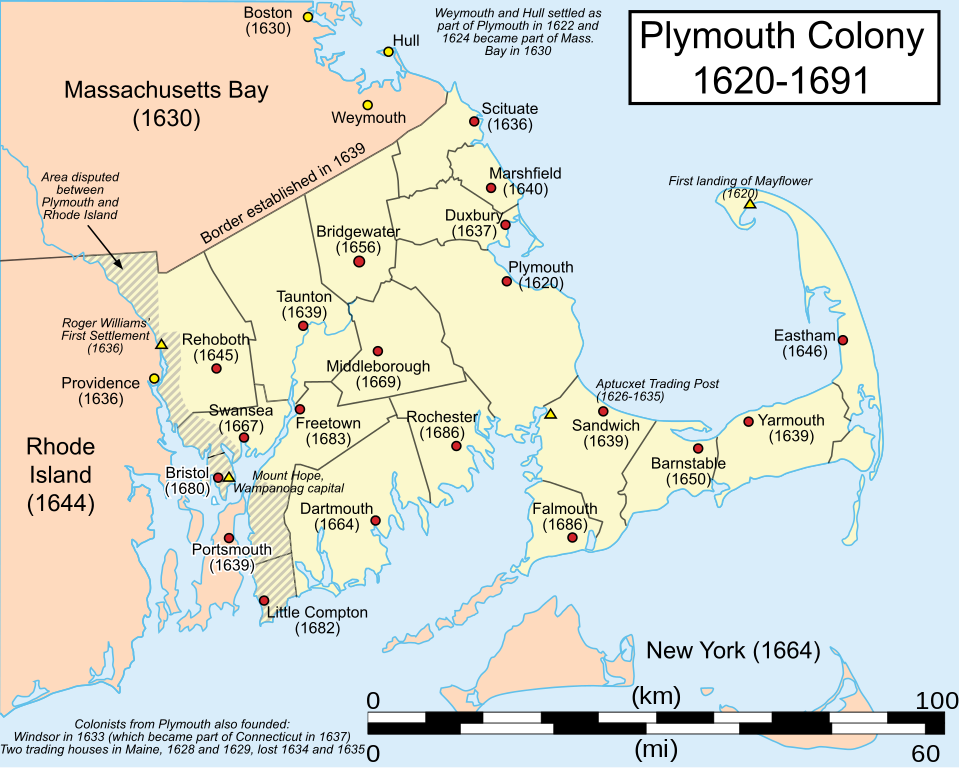
The Plymouth Colony 1620-1691.
Map by Hoodinski via Wikimedia Commons.
The first few years of the settlement were fraught with hardship and hunger. Four centuries later, they also provide us with one of history’s most decisive verdicts on the critical importance of private property. We should never forget that the Plymouth colony was headed straight for oblivion under a communal, socialist plan but saved itself when it embraced something very different.
In the diary of the colony’s first governor, William Bradford, we can read about the settlers’ initial arrangement: Land was held in common. Crops were brought to a common storehouse and distributed equally. For two years, every person had to work for everybody else (the community), not for themselves as individuals or families. Did they live happily ever after in this socialist utopia?
Hardly. The “common property” approach killed off about half the settlers. Governor Bradford recorded in his diary that everybody was happy to claim their equal share of production, but production only shrank. Slackers showed up late for work in the fields, and the hard workers resented it. It’s called “human nature.”
The disincentives of the socialist scheme bred impoverishment and conflict until, facing starvation and extinction, Bradford altered the system. He divided common property into private plots, and the new owners could produce what they wanted and then keep or trade it freely.
Communal socialist failure was transformed into private property/capitalist success, something that’s happened so often historically it’s almost monotonous. The “people over profits” mentality produced fewer people until profit — earned as a result of one’s care for his own property and his desire for improvement — saved the people.
Over the centuries, socialism has crash-landed into lamentable bits and pieces too many times to keep count — no matter what shade of it you pick: central planning, welfare statism, or government ownership of the means of production. Then some measure of free markets and private property turned the wreckage into progress. I know of no instance in history when the reverse was true — that is, when free markets and private property produced a disaster that was cured by socialism. None.
A few of the many examples that echo the Pilgrims’ experience include Germany after World War II, Hong Kong after Japanese occupation, New Zealand in the 1980s, Scandinavia in recent decades, and even Lenin’s New Economic Policy of the 1920s.
The Avro Arrow
The History Guy: History Deserves to Be Remembered
Published 25 Nov 2019In the 1950s, Canada had one of the world’s most advanced aerospace industries. But the cancellation of the Avro CF-105 “Arrow” changed everything. The History Guy remembers the Avro Arrow and forgotten aviation history. It deserves to be remembered.
(more…)
“Women’s sports are dying, and very quickly”
Mark Steyn outlines the rise and sudden fall of women’s sports:

Rachel McKinnon on the podium after winning the Union Cycliste Internationale Masters Track Cycling World Championship, October 2018.
When the Olympic Games was revived in 1896, it was assumed by all that, as in the ancient games of Greece, the competitors would be men. The inclusion of women, said Baron de Coubertin, founder of the modern Olympiad, would be “impractical, uninteresting, unaesthetic and incorrect”.
By “uninteresting”, he meant that the innate differences between the male and female bodies ensured that women’s participation would require one to feign interest in races that were slower and jumps that were shorter. In a competitive celebration of excellence, what’s the point? So the first female Olympians were women who could hold their own with men and compete in the chaps’ events — such as Hélène de Pourtalès, who won a gold medal at the 1900 Paris Olympics as part of the Swiss sailing crew. A week later Mesdames Guerra and Moulin competed, unsuccessfully, in the hacks and hunter rounds of the equestrian events. In the croquet competition, seven men and three women participated, with the men taking all the medals.
And then came the tennis, for which they introduced a ladies’ singles event, at which Miss Charlotte Cooper (a five-times Wimbledon champ) prevailed.
These were the two models for female sportsmen, if you’ll forgive the expression: Compete in mixed events and spend most of your life losing to blokes, or compete only against other women where the lesser achievements are, as M le Baron saw it, “uninteresting”. In the case of certain activities, male sports felt obliged to spin off more genteel and (in Coubertin terms) even less interesting female variants — softball and netball, rather than baseball and basketball.
In the second half of the twentieth century, the latter model — female-only sports — prevailed, as part of what was understood by the general trend of “women’s rights”, loosely defined, and indeed more explicitly so by things like America’s Title Nine legislation.
In the second decade of the twenty-first century, the Charlotte Cooper model is collapsing, very fast. Women are back to losing to rivals who, whatever their lipstick, skirts or breast implants, are biologically male with all the inherent advantages. Miss Hannah Mouncey, for example, is six-foot-two and 220 pounds, which is rather heavier than me and an inch taller. The average Australian woman is five-foot-four-and-a-quarter and just under 157 pounds. If you have to catch a ball, standing six inches above anybody else on court comes in helpful:
Seleção feminina de handebol da Austrália.
.
É só isso o tuíte.— Ana Paula Henkel (@AnaPaulaVolei) November 23, 2019
Did Miss Mouncey procure her advantages over her sisters through a rigorous workout regime? No. She gained them by being born male. She played for Oz’s national men’s handball team until 2016, when she revealed she was transitioning and thus would henceforth play for the women’s team. She also announced she was taking up Aussie football, again for the ladies.
Tank Chats #55 Churchill Crocodile | The Funnies | The Tank Museum
The Tank Museum
Published 18 Aug 2018Another episode in the Tank Chats Funnies Specials, with David Fletcher looking at the weird and wonderful vehicles of 79th Armoured Division led by Major General Percy Hobart, known as “Hobart’s Funnies”.
The Churchill Crocodile was a British flamethrower tank and a variant of the Churchill Mark VII tank. The Crocodile was developed in time for the D-Day landings and used during the Allied invasion of North-West Europe.
Support the work of The Tank Museum on Patreon: ► https://www.patreon.com/tankmuseum
Or donate http://tankmuseum.org/support-us/donateVisit The Tank Museum SHOP: ► https://tankmuseumshop.org/
Twitter: ► https://twitter.com/TankMuseum
Tiger Tank Blog: ► http://blog.tiger-tank.com/
Tank 100 First World War Centenary Blog: ► http://tank100.com/ #tankmuseum #tanks #tankchats

QotD: The “Glorious Revolution” of 1688
Brian Micklethwait, “Navigating individuals”, Samizdata, 2004-10-04.
November 25, 2019
Historical hats
Lindybeige
Published 4 Mar 2015Support me on Patreon: https://www.patreon.com/Lindybeige
More videos here: https://www.youtube.com/playlist?list…There were so many types of hat in the past, and yet it turns out that many of them were actually the same.
Lindybeige: a channel of archaeology, ancient and medieval warfare, rants, swing dance, travelogues, evolution, and whatever else occurs to me to make.
▼ Follow me…
Twitter: https://twitter.com/Lindybeige I may have some drivel to contribute to the Twittersphere, plus you get notice of uploads.
website: http://www.LloydianAspects.co.uk

How to Be an Epicurean
In City Journal, Michael Gibson reviews a recent book on Epicureanism by Catherine Wilson:
The Atomic Age had its anxieties, but Hugh Hefner believed he had a good diversion. “We aren’t a family magazine,” he announced in the first issue of Playboy in 1953. “We enjoy mixing up cocktails, an hors d’oeuvres or two, putting a little mood music on the phonograph, and inviting in a female acquaintance for a quiet discussion on Picasso, Nietzsche, jazz, sex.” By the 1960s, the music had grown louder, the colors more lurid, the conversations steamier. When Hefner died in 2017, he was considered either a hero of hedonism or an object lesson in the period’s squalid obsessions. Run a Google search today on Hefner, and you’ll often find the word “Epicurean” to describe him. Is this fair to Epicurus, the man who set forth the philosophy starting in 306 BC?
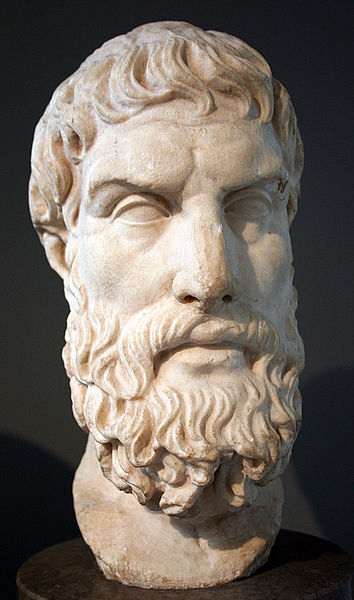
Marble bust of Epicurus. Roman copy of Greek original, 3rd century BC/2nd century BC. On display in the British Museum, London.
Photo by ChrisO via Wikimedia Commons.For 23 centuries now, Epicureans have struggled mightily against variations of the Hefner caricature. If pleasure is the highest good, the goal of the best life, must we all strive to live in pajamas, smoking a pipe in a decadent Hollywood Hills estate? Though he didn’t live in a mansion off Sunset Boulevard, at the end of the fourth century BC, at the age of 32, the philosopher Epicurus founded the Garden, a school removed from Athens’s monuments of power and politics. An inscription at the entrance read: “Stranger, here you will do well to stay; here our highest good is pleasure.” (In Chicago, Hefner’s door bore an inscription: Si Non Oscillas, Noli Tintinnare, or “If you don’t swing, don’t ring.”)
Leading life in a modern Garden is the subject of Catherine Wilson’s latest book, How to Be an Epicurean: The Ancient Art of Living Well. There was always an air of Peter Pan-like anarchy at the Playboy Mansion, but as Wilson shows us, life in the Garden was quite different. Her book is a spirited tour and defense of Epicurean philosophy, as reconstructed by the fragments Epicurus left behind in tattered papyrus and as set forth in the epic poem De Rerum Natura, “On the Nature of Things,” by the Roman poet Lucretius.
What did these pleasure-seekers believe? They start with the elementary particles, atoms — tiny, colorless, without smell, shaped this way and that, indestructible, reshuffling themselves infinitely into all the marvelous forms we see, including ourselves. Their forms get swept away by time, only to recombine again into something new — possibly another universe. Blurred in this haze of metaphysics, most atoms fall straight downward into the void, but a few swerve, and from these deviations arise our free will and all that we see. At the California Institute of Technology, physicist Richard Feynman began his lectures by wondering what single sentence would be passed on to future generations, if, in a cataclysm, all scientific knowledge was destroyed. His answer: “The atomic hypothesis that all things are made of atoms.”
With the Epicureans, we have a historical test of Feynman’s thought. The world is made of nothing more than atoms in the void, but where did that take the ancient Greeks and Romans who believed it? Wilson begins with these basic building blocks because she asserts that mistaken beliefs about nature are the source of our deepest fears and hang-ups: death, punishment in an afterlife, failure in this one, lust for power, greed, jealousy, unrequited love, and status-jockeying. “Epicurean philosophy might be said to be based on the notion of the limit,” Wilson writes. By understanding the atom and the void, by knowing that the soul is mortal and the gods indifferent, that all things pass and are forgotten, we might then liberate ourselves from the grinding weight of superstition and the vanity of ambition and pursue pleasure without guilt.
QotD: The origins of the state
L. Neil Smith, “What Would Real Tax Reform Look Like?”, Libertarian Enterprise, 2017-10-29.
November 24, 2019
Cracks in the Soviet-Nazi Alliance – WW2 – 065 – November 23, 1940
World War Two
Published 23 Nov 2019As the Greek campaign continues, Hitler points his attention eastwards. While he can’t invade the Soviet Union just yet, his dependence on it is making him nervous.
Join us on Patreon: https://www.patreon.com/TimeGhostHistory
Or join The TimeGhost Army directly at: https://timeghost.tvFollow WW2 day by day on Instagram @World_war_two_realtime https://www.instagram.com/world_war_t…
Join our Discord Server: https://discord.gg/D6D2aYN.
Between 2 Wars: https://www.youtube.com/playlist?list…
Source list: http://bit.ly/WW2sourcesWritten and Hosted by: Indy Neidell
Produced and Directed by: Spartacus Olsson and Astrid Deinhard
Executive Producers: Bodo Rittenauer, Astrid Deinhard, Indy Neidell, Spartacus Olsson
Creative Producer: Joram Appel
Post-Production Director: Wieke Kapteijns
Research by: Indy Neidell
Edited by: Iryna Dulka
Map animations: Eastory (https://www.youtube.com/c/eastory)Colorisations by:
– Julius Jääskeläinen (https://www.facebook.com/JJcolorization/)
– Adrien Fillon (https://www.instagram.com/adrien.colo…)
– Dememorabilia (https://www.instagram.com/dememorabilia/)Eastory’s channel: https://www.youtube.com/channel/UCEly…
Archive by Screenocean/Reuters https://www.screenocean.com.Sources:
– Coal energy by supalerk laipawat, wheat Grain Bag by Symbolon, oil barrel by BomSymbols from the Noun Project
– Portrait of Sir John Salmond courtessy of National Portrait Gallery, London
– Lord Beaverbrook photographed by Yousuf Karash
– IWM: HU 94169, D 1640, D 1556, D 1507, D 1589, D 1513, D 1567, H 12224
– Narodowe Archiwum CyfroweA TimeGhost chronological documentary produced by OnLion Entertainment GmbH.
From the comments:
World War Two
2 days ago (edited)
We have been shooting a bunch of new episodes this week. Besides the World War Two and Between Two Wars episodes, which by the way includes some pretty amazing history, we have also been working on some much requested episodes of our War Against Humanity series. We have shot three of those, so you will see the first of those coming in the next few weeks. Additionally, we have shot a very special mini-series that we will be airing during the holidays on the TimeGhost History Channel (https://www.youtube.com/channel/UCLfMmOriSyPbd5JhHpnj4Ng). We will disclose more about that soon, but it’s going to be pretty cool. So all in all, enough to look forward to!
Cheers, Joram