
The trick to this is not only to give [the people] a fake history. Every tinpot dictator does that. The trick is to give them a fake history starting in kindergarten, that is painted in primary hues and comic-book complexity. There are good guys (the oligarchs who would design society to be more fair) and bad guys (usually capitalists and greedy, they want to “exploit” everyone, which only works if you believe in fixed pie economics and that everyone gets a share at birth, an economic idea so stupid you have to be indoctrinated from birth to believe it.) And everything is explained by “laws” and top down action. Though this history talks about mass movements, and “the people” they don’t actually take THE PEOPLE into account, not with any depth and complexity. The people in this narrative, the entire culture, in fact, is moldable, like butter to the sculpting knife of the powerful.
Societies don’t work that way. Culture doesn’t work that way. In fact culture is so persistent, so stubborn, it leads people to think it’s genetic. (It’s not. A baby taken at birth to another culture will not behave as his culture of origin.) It changes, sure, through invasions and take overs, but so slowly that bits of older cultures and ideas stay embedded in the new culture. It has been noted that the communist rulers of Russia partook a good bit of the Tsarist regime, because the culture of the people was the same and that came through. (They just dialed up the atrocities and lowered the functionality because their ideology was dysfunctional. They blame their failure on Russia itself, but considering how communism does around the world, I’ll say to the extent countries survive it’s because of the underlying culture.)
Sarah Hoyt, “A Generation With No Past”, According to Hoyt, 2017-10-19.
November 24, 2019
QotD: The persistence of culture
November 23, 2019
Sir Charles Trevelyan, head of the Irish relief efforts during the potato famine, and creator of the modern civil service
By happenstance, after posting the OSP video on the history of Ireland, a post at Samizdata covered one of the questions I had from OSP’s summary, specifically that the famine was worsened by British “laissez-faire mercantilism”. Mercantilism is rather different from any kind of laissez-faire system, so it was puzzling to hear Blue link them together as though they were the same thing. Of course, I live in a province currently governed by the Progressive Conservative party, so it’s not like I’m unable to process oxymorons as they go by…
Anyway, this post by Paul Marks looks at the man in charge of the relief efforts:
Part of the story of Sir Charles Trevelyan is fairly well known and accurately told. Charles Trevelyan was head of the relief efforts in Ireland under Russell’s government in the late 1840s – on his watch about a million Irish people died and millions more fled the country. But rather than being punished, or even dismissed in disgrace, Trevelyan was granted honours, made a Knight Commander of the Order of the Bath (KCB) and later made a Baronet, not bad for the son of the Cornishman clergyman. He went on to the create the modern British Civil Service – which dominates modern life in in the United Kingdom.
Charles Edward Trevelyan (contemporary lithograph). This appeared in one of the volumes of “The drawing-room portrait gallery of eminent personages principally from photographs by Mayall, many in Her Majesty’s private collection, and from the studios of the most celebrated photographers in the Kingdom / engraved on steel, under the direction of D.J. Pound; with memoirs by the most able authors”. Many libraries own copies.
Public domain, via Wikimedia.With Sir Edwin Chadwick (the early 19th century follower of Jeremy Bentham who wrote many reports on local and national problems in Britain – with the recommended solution always being more local or central government officials, spending and regulations), Sir Charles Trevelyan could well be described as one of the key creators of modern government. If, for example, one wonders why General Douglas Haig was not dismissed in disgrace after July 1st 1916, the first day of the Battle of the Somme when twenty thousand British soldiers were killed and thirty thousand wounded for no real gain (the only officers being sent home in disgrace being those officers who had saved some of them men by ordering them stop attacking – against the orders of General Haig), then the case of Sir Charles Trevelyan is key – the results of his decisions were awful, but his paperwork was always perfect (as was the paperwork of Haig and his staff). The United Kingdom had ceased to be a society that always judged someone on their success or failure in their task – it had become, at least partly, a bureaucratic society where people were judged on their words and their paperwork. A General, in order to be great, did not need to win battles or capture important cities – what they needed to do was write official reports in the correct administrative manner, and a famine relief administrator did not have to actually save the population he was in charge of saving – what he had to do was follow (and, in the case of Sir Charles, actually invent) the correct administrative procedures.
But here is where the story gets strange – every source I have ever seen in my life, has described Sir Charles Trevelyan as a supporter of “Laissez Faire” (French for, basically, “leave alone”) “non-interventionist” “minimal government” and his policies are described in like manner. […]

Which probably explains why Blue used the term in the previous video. Then these “laissez-faire” policies are summarized, which leads to this:
None of the above is anything to do with “laissez faire” it is, basically, the opposite. Reality is being inverted by the claim that a laissez faire policy was followed in Ireland. A possible counter argument to all this would go as follows – “Sir Charles Trevelyan was a supporter of laissez faire – he did not follow laissez faire in the case of Ireland, but because he was so famous for rolling back the state elsewhere (whilst spawning the modern Civil Service) – it was assumed that he must have done so in the case of Ireland“, but does even that argument stand up? I do not believe it does. Certainly Sir Charles Trevelyan could talk in a pro free market way (just as General Haig could talk about military tactics – and sound every inch the “educated soldier”), but what did he actually do when he was NOT in Ireland?
I cannot think of any aspect of government in the bigger island of the then UK (Britain) that Sir Charles Trevelyan rolled back. And in India (no surprise – the man was part of “the Raj”) he is most associated with government road building (although at least the roads went to actual places in India – they were not “from nowhere to nowhere”) and other government “infrastructure”, and also with the spread of government schools in India. Trevelyan was passionately devoted to the spread of government schools in India – this may be a noble aim, but it is not exactly a roll-back-the-state aim. Still less a “radical”, “fanatical” devotion to “laissez faire“.
History Summarized: Ireland
Overly Sarcastic Productions
Published 22 Nov 2019Get 3 months of Audible for just $6.95 a month — that’s more than half off the regular price. Choose 1 audiobook and 2 Audible Originals absolutely free. Visit http://www.audible.com/overlysarcastic or text “
overlysarcastic” to 500 500.While the rest of Europe was flailing aimlessly through the Dark Ages, Ireland was both preserving the ancient world and setting the stage for the Medieval Period. Then England showed up.
Sources & Further Reading:
How the Irish Saved Civilization: https://www.audible.com/pd/How-the-Ir…
Modern Ireland: 1600 — 1972 by R.F. FosterMusic from https://filmmusic.io
“Marked”, “Traveler”, “God Rest Ye Merry Celtishmen” by Kevin MacLeod (https://incompetech.com)
License: CC BY (http://creativecommons.org/licenses/b…)Our content is intended for teenage audiences and up.
DISCORD: https://discord.gg/sS5K4R3
PATREON: https://www.Patreon.com/OSP
MERCH LINKS: https://www.redbubble.com/people/OSPY…
OUR WEBSITE: https://www.OverlySarcasticProductions.com
Find us on Twitter https://www.Twitter.com/OSPYouTube
Find us on Reddit https://www.Reddit.com/r/OSP/
Quick Look at a 37mm Maxim “Pompom” Automatic Cannon
Forgotten Weapons
Published 21 Sep 2019http://www.patreon.com/ForgottenWeapons
Cool Forgotten Weapons merch! http://shop.bbtv.com/collections/forg…
This Vickers, Sons & Maxim 37mm MkIII “Pompom” is on display at the Canadian War Museum in Ottawa. The MkIII pattern is quite scarce, with less than one hundred ever made. It is built around the 37 x 124mm cartridge, firing a 1.25 pound explosive or armor piercing projectile. This one (or one of the same model) was mounted on the CGS Canada, a coastal patrol vessel built by VSM in 1904 for the Canadian Fisheries service. Firing fully automatically at 300 rounds/minute, the “pompom” (so named for the sound of its firing) was capable of tremendous firepower, although few ever saw much use in combat. Only the Boers made much use of them as land artillery, and by WW1 most were relegated to antiaircraft use.
Contact:
Forgotten Weapons
6281 N. Oracle #36270
Tucson, AZ 85704

November 22, 2019
The Far Right French Revolution | BETWEEN 2 WARS I 1934 Part 4 of 4
TimeGhost History
Published 21 Nov 2019In February 1934, France threatens to go down the same political rabbit hole as Germany: anti-Semitic Fascism, but the French extremists are not quite as well organized as the Nazis.
Join us on Patreon: https://www.patreon.com/TimeGhostHistory
Hosted by: Indy Neidell
Written by: Francis van Berkel & Spartacus Olsson
Directed by: Spartacus Olsson and Astrid Deinhard
Executive Producers: Bodo Rittenauer, Astrid Deinhard, Indy Neidell, Spartacus Olsson
Creative Producer: Joram Appel
Post-Production Director: Wieke Kapteijns
Research by: Francis van Berkel
Edited by: Daniel Weiss
Sound design: Marek KamińskiColorizations: Klimbim/Olga Shirnina: https://klimbim2014.wordpress.com
Daniel Weiss, Oleg M, Dememorabilia, Julius Jääskeläinen, Adrien Fillon.A TimeGhost chronological documentary produced by OnLion Entertainment GmbH.
From the comments:
TimeGhost History
52 minutes ago
We now get to some fascinating stuff that is less known outside of France. The events in 1934 will not create a new Fascist state, but they will have deep impact on how France deals with WW2. The February crisis influences military policy, the civilian response, and the way both right wing and left wing political parties deal with the German invasion and occupation. In the next couple of weeks we will come out with a War Against Humanity episode on the WW2 channel about the beginning of French collaboration and resistance — this episode provides essential background to how that plays out in 1940.

“Inmate 4859” – Witold Pilecki – Sabaton History 042 [Official]
Sabaton History
Published 21 Nov 2019Join Indy and Joakim as they dive into the out-of-life story of Witold Pilecki during the Second World War, that has made for this awesome song.
Support Sabaton History on Patreon: https://www.patreon.com/sabatonhistory
Listen to Heroes (where Inmate 4859 is featured):
CD: http://bit.ly/HeroesStore
Spotify: http://bit.ly/HeroesSpotify
Apple Music: http://bit.ly/HeroesAppleMusic
iTunes: http://bit.ly/HeroesiTunes
Amazon: http://bit.ly/HeroesAmz
Google Play: http://bit.ly/HeroesGooglePListen to Sabaton on Spotify: http://smarturl.it/SabatonSpotify
Official Sabaton Merchandise Shop: http://bit.ly/SabatonOfficialShopHosted by: Indy Neidell
Written by: Markus Linke and Indy Neidell
Directed by: Astrid Deinhard and Wieke Kapteijns
Produced by: Pär Sundström, Astrid Deinhard and Spartacus Olsson
Creative Producer: Joram Appel
Executive Producers: Pär Sundström, Joakim Broden, Tomas Sunmo, Indy Neidell, Astrid Deinhard, and Spartacus Olsson
Post-Production Director: Wieke Kapteijns
Edited by: Iryna Dulka
Sound Editing by: Marek KaminskiEastory YouTube Channel: https://www.youtube.com/channel/UCEly…
Archive by: Reuters/Screenocean https://www.screenocean.com
Music by Sabaton.An OnLion Entertainment GmbH and Raging Beaver Publishing AB co-Production.
© Raging Beaver Publishing AB, 2019 – all rights reserved.
From the comments:
Sabaton History
23 hours ago (edited)
Witold Pilecki is one of those larger-than-life characters, and listen to Joakim and Indy talk about this amazing song as well as the historical background behind it. Now thanks to all of you we have ben able to film the history part of this in a new studio which is both bigger and better. This is 100% thanks to the Patrons whose generous contributions made this possible. Do you want to be a part of this as well? Make sure to support us on Patreon: https://www.patreon.com/sabatonhistory
Cheers, The Sabaton History Team
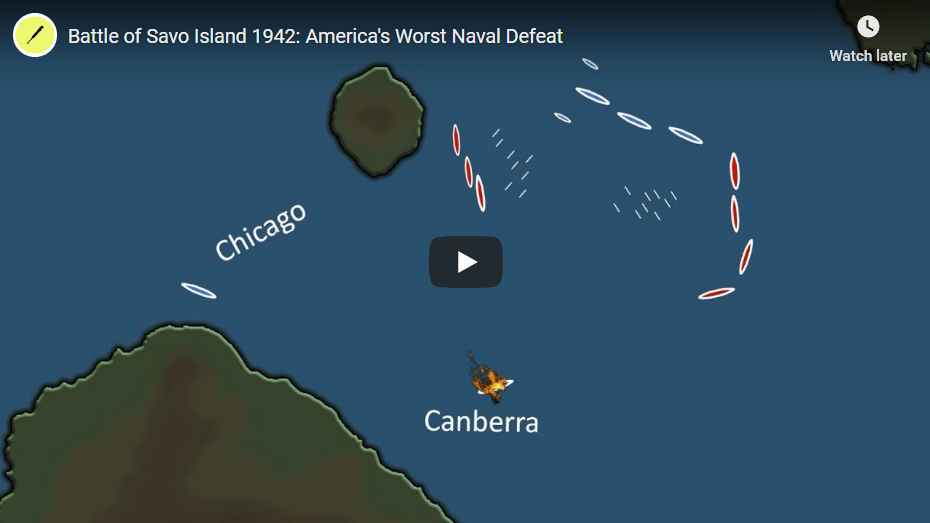
Battle of Savo Island 1942: America’s Worst Naval Defeat
Montemayor
Published 26 Aug 2017(Animated Map) – WARNING: lower the volume if you are using headphones. sorry for the audio.
I do not own the rights to the songs or images. This video is purely for educational purposes.
No copyright intended, all image rights go to:
-Wikipedia Commons
https://commons.wikimedia.org/wiki/Ba…-Naval History Heritage and Command
https://www.history.navy.mil/-Portrait of Richmond K. Turner
https://www.ibiblio.org/hyperwar/Onli…–USS Jarvis
http://www.navsource.org/Images contained on this site that are donated from private sources are © copyrighted by the respective owner. Images credited to the National Archives (NA, NARA); Naval History & Heritage Command (NHHC), formerly Naval Historical Center (NHC); and U.S. Navy (USN) are believed to be in the public domain. Some images credited to the United States Naval Institute (USNI) are from © copyrighted collections, the rest are believed to be in the public domain.
All songs by Ross Budgen https://www.youtube.com/channel/UCQKG…
-“Welcome to Chaos”
-“House Lannister Theme” – Game of Thrones Season 4 (Original composition)
-“Run”
-“Parallel”Sources-
Hammel, E. (2017, March 6). “First Battle of Savo Island: The U.S. Navy’s Worst Defeat”. Retrieved August 25, 2017, from http://warfarehistorynetwork.com/dail…
Hornfischer, J. D. (2011). Neptunes Inferno: the U.S. Navy at Guadalcanal. New York: Bantam Books.
Newcomb, R. F., & Newcomb, R. F. (2002). The Battle of Savo Island. New York: H. Holt.
Stille, M. (2013). The Naval Battles for Guadalcanal 1942 (Vol. 225). Oxford, UK: Osprey Publishing.
Toll, I. W. (2016). The Conquering Tide: war in the Pacific Islands, 1942-1944. New York: W.W. Norton & Company.
USMC Casualty list taken from:
https://www.ibiblio.org/hyperwar/USMC…
November 21, 2019
Battle of Sedan: How did Prussia Win The Franco-Prussian War? | Animated History
The Armchair Historian
Published 16 Feb 2018The Battle of Sedan. How did Prussia Win the Franco-Prussian War?
Our Website: https://www.thearmchairhistorian.com/
Our Twitter:
@ArmchairHistOur Discord:
https://discord.gg/Ppb2cUdSources:
http://1.bp.blogspot.com/-Q9vpKOSgFHs…
https://www.britannica.com/event/Batt…
https://www.thoughtco.com/franco-prus…
https://www.warhistoryonline.com/hist…
https://www.military-history.us/2011/…100 Decisive Battles by: Paul K. Davis
50 Battles That Changed the World by: William WeirMusic: “Danse Macabre” by Kevin MacLeod is licensed under a Creative Commons Attribution license (https://creativecommons.org/licenses/…)
Source: http://incompetech.com/music/royalty-…
Artist: http://incompetech.com/
QotD: Honour
Honor has got a bad rep lately. It’s been dragged through the mud, and its garments are draggled. Association of its names with such egregious ideas as “honor killings” has done it no good.
It’s particularly unjust since honor killings are more shame-killings. I grew up in a culture that still shows a lot of Arab influence, (well, they were there almost as long as the Romans, you know?) and I almost understand honor killings – if I squint and look sideways. I was, after all, raised in a village (so like Miss Marple I’ve seen all there is to see of human wickedness.) Of course Portuguese – at least civilized ones – don’t honor-kill their daughters. But we had a case in the village where a father shaved his daughter’s head because she was talking to a strange boy. And even with my family’s rather odd behavior, since we were all readers and a fair number of us engaged in creative work, I came across that “how could you talk to him when you were alone in the house? What will people think? You have shamed us all.” I came across it more than once, because I have trouble wrapping my mind across the nonsensical. And to me – particularly when this started, when I was about eight – seeing a little friend who happened to be a boy was no different from seeing a little friend who happened to be a girl.
But the overwrought minds of village spinsters and old women looked at this the way “enlightened” militant “feminists” do. Like the one who accused my nine year old of sexual harassment for touching a girl’s behind while trying to get her attention. (He didn’t fondle her. He reached through a crowd and poked her, to ask if she wanted to play a space exploration game.) If you’re a male you have lust and evil on your mind, and any woman allowing you near has lost her virtue. (They must live MUCH more interesting lives than I do.)
Anyway, honor viewed that way is more what the public thinks of you and what you allow the public to know. You can lose your honor through all sorts of stupid things that have nothing to do with what is in your heart and mind. You can be “disgraced” the way a regency maiden was disgraced because she tripped in public and fell across a gentleman, and didn’t immediately faint or whatever. (Well, at least in regency romances. I believe true society had more leniency. I mean, even in the village, even with my eccentric behavior and the fact I wore shorts outside the house – oh, the humanity! – only half the people considered me a slut.)
Sarah Hoyt, “An Affair of Honor a blast from the past from April 24 2012”, According to Hoyt, 2017-10-11.
November 20, 2019
The Sinking of the Royal Oak
Eoin MacFreeman
Published 19 Sep 2014STV and History channel documentary to coincide with the 70th anniversary of the sinking of HMS Royal Oak at Scapa Flow in Scotland. With harrowing eye witness accounts from survivors. Narrated by oor Alex Norton. We will remember them.
On 14 October 1939, Royal Oak was anchored at Scapa Flow in the Orkney Islands, Scotland, when she was torpedoed by the German submarine U-47. Of Royal Oak‘s complement of 1,234 men and boys, 833 were killed that night or died later of their wounds. The loss of the old ship – the first of the five Royal Navy battleships and battlecruisers sunk in the Second World War – did little to affect the numerical superiority enjoyed by the British navy and its allies, but the sinking had considerable effect on wartime morale. The raid made an immediate celebrity and war hero out of the U-boat commander, Günther Prien, who became the first German submarine officer to be awarded the Knight’s Cross of the Iron Cross. Before the sinking of Royal Oak, the Royal Navy had considered the naval base at Scapa Flow impregnable to submarine attack, and U-47‘s raid demonstrated that the German navy was capable of bringing the war to British home waters. The shock resulted in rapid changes to dockland security and the construction of the Churchill Barriers around Scapa Flow.
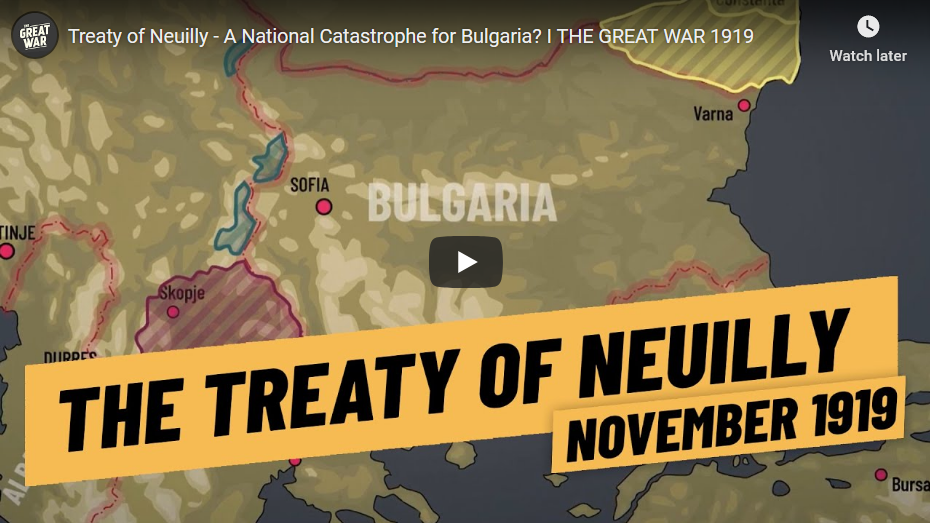
Treaty of Neuilly – A National Catastrophe for Bulgaria? I THE GREAT WAR 1919
The Great War
Published 19 Nov 2019SPONSORED: Install Raid for Free ✅ IOS: http://bit.ly/334B7Yl ✅ ANDROID: http://bit.ly/341srDB
Start with💰50K silver and get a Free Epic Champion 💥 on day 7 of “New Player Rewards” program**Ads like this support the production of our channel and keep it free to watch for everyone
» SUPPORT THE CHANNEL
Patreon: https://www.patreon.com/thegreatwar
Merchandise: https://shop.spreadshirt.de/thegreatwar/» SOURCES
Borodziej, Wlodzimierz and Maciej Gorny. Der Vergessene Weltkrieg. Europas Osten 1912-1923. Band II – Nationen 1917-1923 (wbg Theiss, 2018).
Ganev, P. “The relations between Bulgaria and the FYR of Macedonia in the context of EU integration,” Master Thesis, 2014.
Gerwarth, Robert. The Vanquished. Why the First World War Failed to End, 1917-1923 (Penguin, 2017).
Khristov, Khristo. “Bulgaria, the Balkans, and the Peace of 1919,” in Pastor, Peter, ed. Revolutions and Interventions in Hungary and its Neighbor States, 1918-1919 (New York: Columbia University Press, 1988).
Lampe, John. “Stamboliiski’s Bulgaria and Revolutionary Change, 1918-1923,” in Pastor, Peter, ed. Revolutions and Interventions in Hungary and its Neighbor States, 1918-1919 (New York: Columbia University Press, 1988).
Leonhard, Jörn. Der überforderte Frieden. Versailles und die Welt 1918-1923 (CH Beck, 2018).
Macmillan, Margaret. The Peacemakers: Six Months that Changed the World (London: John Murray, 2001).
Mihaylovski, Stoyan. “On the Treaty of Neuilly,” in Напред (Forward). Originally published November 4th, 1919. Republished on November 27th, 2018. Retrieved via Dir.bg.
Minkov, Stefan Marinov: “Neuilly-sur-Seine, Treaty of”, in: 1914-1918-online. International Encyclopedia of the First World War, ed. by Ute Daniel, Peter Gatrell, Oliver Janz, Heather Jones, Jennifer Keene, Alan Kramer, and Bill Nasson, issued by Freie Universität Berlin, Berlin 2017-02-20.
Pantev, Andrei. “The Border Line Between Sympathy and Support: the United States and the Bulgarian Territorial Question at the Paris Peace Conference in 1919,” in Southeastern Europe, 8, pts 1-2 (1981): 171-197.
Ristović, Milan: “Occupation during and after the War (South East Europe)”, in: 1914-1918-online. International Encyclopedia of the First World War, ed. by Ute Daniel, Peter Gatrell, Oliver Janz, Heather Jones, Jennifer Keene, Alan Kramer, and Bill Nasson, issued by Freie Universität Berlin, Berlin 2014-10-08.
Toshev, Stefan. Pobedeni bez da badem biti (Beaten without being defeated), 1924.
Vazov, Vladimir. Zhivotopisni belejki (Lifetime notes). Re-published by Bulgarian History “BI 93 OOD”, 2018.
Yotov, Petko et al. Bulgaria in the First World War (1915-1918), a short encyclopedia (2014).
Documentary film: Българският политик Теодор Теодоров – държавник от първа величина, ISTORIYA.BG, 03.12.2018
Съюз на македонските емигрантски организации в България – “Memoir presented to the governments of the United States of America, of Great Britain and Ireland, of France, of Italy and of Japan”, София, 1919 година (http://strumski.com/biblioteka/?id=1830)»CREDITS
Presented by: Jesse Alexander
Written by: Jesse Alexander
Director: Toni Steller & Florian Wittig
Director of Photography: Toni Steller
Sound: Toni Steller
Editing: Toni Steller
Mixing, Mastering & Sound Design: http://above-zero.com
Maps: Daniel Kogosov (https://www.patreon.com/Zalezsky)
Research by: Jesse Alexander
Fact checking: Florian WittigChannel Design: Alexander Clark
Original Logo: David van StepholdA Mediakraft Networks Original Channel
Contains licensed material by getty images
All rights reserved – Real Time History GmbH 2019
Sterling Meets Owen: The Australian F1 Submachine Gun
Forgotten Weapons
Published on 20 Sep 2019http://www.patreon.com/ForgottenWeapons
Cool Forgotten Weapons merch! http://shop.bbtv.com/collections/forg…
The Australian Owen submachine gun was once of the best overall SMG designs of the Second World War, and when Australia decided to replace them in the 1960s, the new F1 design had big shoes to fill. The basic configuration of the top-mounted magazine remained, but coupled with elements of the Sterling SMG. The F1 used a simple sheet metal tube receiver with elements welded on, and a typical open bolt, blowback operating system. The unique rear system of separating the recoil spring from the main receiver body in the Owen was not included, instead using a basic open tube and large diameter mainspring. The sights are curiously still mounted to the right side of the gun, with a thin folding rear sight and a front sight affixed to the magazine well. These simplifications did have the effect of lightening the F1 compared to the Owen, which is a nice improvement. The F1 was manufactured from 1962 until 1973, with a total of about 25,000 made. It served in Vietnam and through the 1990s, when replaced by a variant of the F88 Austeyr. All reports are that it was a perfectly adequate submachine gun, but it did not earn the affection of troops like the Owen had.
Contact:
Forgotten Weapons
6281 N. Oracle #36270
Tucson, AZ 85704

November 19, 2019
Overly Sarcastic Podcast: Blue Talks Machiavelli!
Overly Sarcastic Productions
Published 23 Apr 2016Damn, YouTube, back at it again with the Podcast.
From the man who brings you outdated memes and crude photoshops comes the second episode of the Overly Sarcastic Podcast. Today, Blue talks through Machiavelli’s two most famous works, and how they work together more than you might initially think.
This episode has slightly different visuals because the blue orb from last time charges by the minute. Comment below if you have a preference for visuals in future OSPodcasts and let us know if you have any topics you’d like Blue to discuss.

Hercules – The Quest for Phat Loot! – Extra Mythology – #1
Extra Credits
Published 18 Nov 2019Hercules (or Herakles in the Greek) needed to atone for killing his entire family so the gods did what the gods do best and gave him a quest: serve his cousin for 12 years. Shouldn’t be too difficult. But his cousin was a terrible DM and created 10 impossible tasks for Hercules to complete. This first part covers the first five of the Herculian tasks (and some of the sick treasures Hercules uncovers along the way)
Join the Extra Mythology Patreon! https://www.patreon.com/extramythology

The “Carbuncle Cup” is good, but we need mandatory demolition because name-and-shame hasn’t worked
I like the cut of Peter Franklin‘s jib:
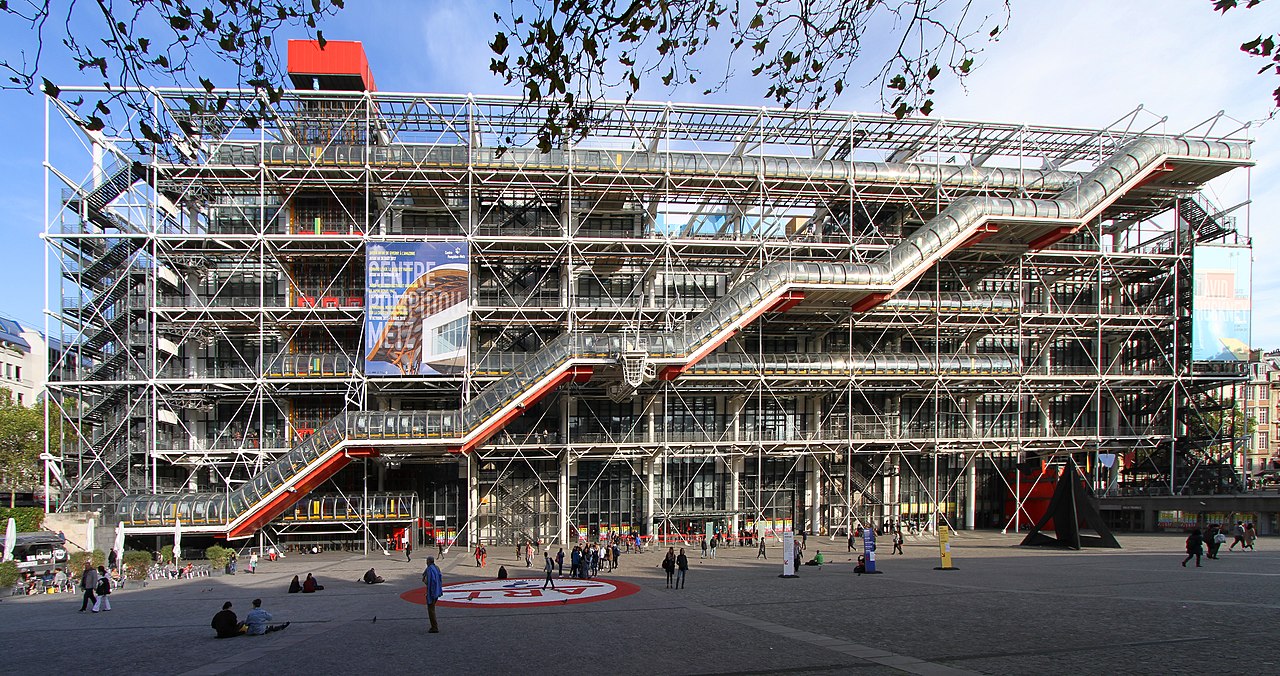
Centre Georges-Pompidou (no, this isn’t an under construction image … it’s from 2017)
Gerd Eichmann photo via Wikimedia Commons.
The Nobels, the Oscars, Pipe Smoker of the Year: glittering prizes all, but I prefer the Carbuncle Cup, which is awarded annually to the “the ugliest building in the United Kingdom completed in the last 12 months”.
Organised by the magazine Building Design, it has (in my aesthetic judgement) produced a worthy shortlist and a worthy winner every year since its inception in 2006.
But there’s a big problem with the prize — not its subjectivity, but the fact that the winning buildings still exist. Indeed, buildings like them are still being built. Name-and-shame is not working.
There’s an argument to be made that things are getting worse. We’ve swapped the horrendous, but interesting, brutalism of the post-war period for the offensively bland spreadsheet architecture of the 21st century. In an age in which Jane Jacobs has won the intellectual battle against Robert Moses, we really ought to know better. Yet we continue to fill up our towns and cities with inhumane, alienating architecture.

Philharmonie at the Parc de la Villette, Paris.
Photo by Zairon via Wikimedia Commons.
It might seem paradoxical, but to end the cycle of destruction, we need to accelerate it. Every year, there should be a public vote to choose the worst new building in the land. The winner wouldn’t get a cup, but a wrecking ball. Yes, that’s right, it would be physically demolished — immediately and without compensation. Indeed, the owner would be required to foot the bill for the building’s de-construction (though they would have the option of suing the architect and the planning authority).
This would concentrate minds wonderfully. Instead of competing among themselves to épater les bourgeois, starchitects would need to design with due regard to the common good. Meanwhile, developers whose sole objective is to squeeze as much profitable square footage into any site they can get their hands on, would have to contend with the possibility of financial (as well as literal) ruin. The planners would come under immense pressure to do a better job too. At the cost of sacrificing one new building, development across the land would be greatly improved.

Cumbernauld Shopping Centre, voted as Britain’s most hated building.
Photo by Ed Webster via Wikimedia Commons.
H/T to Colby Cosh for the link.


