TimeGhost History
Published 6 Jul 2020The year before Soviet Premier Nikita Khrushchev places nuclear missiles on Cuba, the Soviets blow up the biggest atomic bomb ever detonated. If it blew up over Paris, millions would die.
Join us on Patreon: https://www.patreon.com/TimeGhostHistory
Try Nukemap here: https://nuclearsecrecy.com/nukemap/
Hosted by: Indy Neidell
Written by: Spartacus Olsson
Director: Astrid Deinhard
Producers: Astrid Deinhard and Spartacus Olsson
Executive Producers: Astrid Deinhard, Indy Neidell, Spartacus Olsson, Bodo Rittenauer
Creative Producer: Joram Appel
Post-Production Director: Wieke Kapteijns
Research by: Spartacus Olsson
Edited by: Daniel Weiss
Sound design: Marek KaminskiColorizations:
– Carlos Ortega Pereira (BlauColorizations) – https://www.instagram.com/blaucoloriz…Sources:
RIA Novosti archive, image #35173, image #793499.
https://flickr.com/photos/102221463@N…From the Noun Project:
Mountain – By Harold Weaver
Mushroom Cloud – By yanti, ID
destroyed house – by Gan Khoon Lay
Hospital – By Hare Krishna, IN
Fire Station – By Florian Maier
School – David
Church – by Karla Design
Paris – By Vonn WeisenbergerSoundtracks from Epidemic Sound:
– “Cold Eyes” – Elliot Holmes
– “Scope” – Got Happy
– “Juvenile Delinquent” – Elliot Holmes
– “Moving to Disturbia” – Experia
– “Zoot Suit” – Elliot Holmes
– “From the Depths” – Walt Adams
– “Car Chase in Virginia” – White BonesArchive by Screenocean/Reuters https://www.screenocean.com.
A TimeGhost chronological documentary produced by OnLion Entertainment GmbH.
July 7, 2020
If Paris Was Nuked | The Cuban Missile Crisis | Day 00
QotD: The first invasion of Britain
Before about 2500 BC, ancient Albion was inhabited largely by farmers tracing back to the Fertile Crescent. Suddenly, steppe barbarians, bearing the Bell Beaker culture, arrived, and almost immediately most of the old Britons died off.
Since then, 90 percent of subsequent skeletons in England reflect the DNA of the steppe invaders.
What happened to most of England’s earlier inhabitants? One of the less violent scenarios is that the steppe migrants introduced bubonic plague.
In general, “migration” and “mixture” tend in Reich’s book to serve as euphemisms for genocide of the native males and rape of the native females. Reich lists numerous examples from around the world where genetic data show that newcomers enslaved or murdered the local men and turned their women into concubines.
Fortunately, for the past 4,500 years, “ancient Britons harbored a blend of ancestries very similar to that of present-day Britons.” The Roman conquest didn’t leave much of a genetic mark, and the later Anglo-Saxon, Danish, and Norman invaders were genetically similar enough to earlier Britons that geneticists have only recently begun to disentangle them.
After 1066, the island race enjoyed a long halcyon era without new invaders raping and pillaging. But all good things evidently have to come to an end. As Benjamin Schwarz has pointed out, “In fact, Britain today receives more immigrants in a single year than it did in the entire period from 1066 to 1950.”
Steve Sailer, “Reich’s Laboratory”, Taki’s Magazine, 2018-03-28.
July 6, 2020
Sober Sailors – Rum Rations In The Navy: Grog
Townsends
Published 24 Feb 2020Visit Our Website! ➧ http://www.townsends.us/ ➧➧
Help support the channel with Patreon ➧ https://www.patreon.com/townsend ➧➧
Instagram ➧ townsends_official
July 5, 2020
History Summarized: Colonial India
Overly Sarcastic Productions
Published 4 Jul 2020Start your free trial at http://squarespace.com/overlysarcastic and use code
OVERLYSARCASTICto get 10% off your first purchase.Indian History has always been a story of peoples coming and going, but the subcontinent’s modern history takes that up to 11, with the arrival of Central Asian Mughals and boatloads of Europeans. See how India transforms from Medieval to Modern in this final act of our History of India.
SOURCES & Further Reading: The Discovery of India by Jawaharlal Nehru, A History of India by Michael H. Fisher (a lecture series by The Great Courses).
This video was edited by Sophia Ricciardi AKA “Indigo”. https://www.sophiakricci.com/
Our content is intended for teenage audiences and up.Special thanks to Varda Alighieri for coaching me through my (hopefully serviceable) pronunciations!
PATREON: https://www.Patreon.com/OSP
MERCH LINKS: https://www.redbubble.com/people/OSPY…
OUR WEBSITE: https://www.OverlySarcasticProductions.com
Find us on Twitter https://www.Twitter.com/OSPYouTube
Find us on Reddit https://www.Reddit.com/r/OSP/
Light, Mobile, and Deadly: the French Mle 1937 25mm Puteaux AT Gun
Forgotten Weapons
Published 20 Mar 2020http://www.patreon.com/ForgottenWeapons
https://www.floatplane.com/channel/Fo…
Cool Forgotten Weapons merch! http://shop.bbtv.com/collections/forg…
After World War One, the French military set up a program to modernize all of its weaponry, and that included a replacement for the Mle 1916 light infantry cannon. An anti-tank gun had not been necessary during the Great War, as Germany never fielded tanks in substantial numbers — but as a pioneer of the modern tank, the French recognized the need for a good AT gun. Taking a lesson from World War One, they wanted a light gun that was flexible and mobile, easily moved around the battlefield and easily concealed from enemy fire. A 25mm cartridge was specified, and both the Hotchkiss company and the Puteaux arsenal created guns to use it. Both were adopted into service, with the Hotchkiss Mle 1934 being a bit heavier and the Puteaux Mle 1937 being a bit lighter, at only about 600 pounds. The Puteaux gun was quite small, easily moved by a horse or virtually any motorized vehicle. It had a long barrel and the 25mm AP projectile had a muzzle velocity of about 3150 fps, making it quite effective on the light and medium tanks of the 1930s. It was also remarkably accurate, and the long barrel and flash hider gave it a very small firing signature. Aiming was done with either a 4x magnified optic or a set of backup iron sights.
A total of 1285 of these guns were made before the armistice of June 1940, and they served ably in the Battle of France. A few were also used by the British before Dunkirk, and after the armistice they were used by German forces in limited numbers, and also supplied to Spain and Finland as military aid (this particular one has a Finnish property tag on it).
Thanks to DriveTanks.com in Uvalde Texas for giving me access to film this Puteaux cannon for you!
Contact:
Forgotten Weapons
6281 N. Oracle #36270
Tucson, AZ 85740
QotD: Gandhi and sanitation
It should be plain by now that there is much in the Hindu culture that is distasteful to the Western mind, and consequently is largely unknown in the West — not because Hindus do not go on and on about these subjects, but because a Western squeamishness usually prevents these preoccupations from reaching print (not to mention film). When Gandhi attended his first Indian National Congress he was most distressed at seeing the Hindus — not laborers but high-caste Hindus, civic leaders — defecating all over the place, as if to pay attention to where the feces fell was somehow unclean. (For, as V.S. Naipaul puts it, in a twisted Hindu way it is unclean to clean. It is unclean even to notice. “It was the business of the sweepers to remove excrement, and until the sweepers came, people were content to live in the midst of their own excrement.”) Gandhi exhorted Indians endlessly on the subject, saying that sanitation was the first need of India, but he retained an obvious obsession with excreta, gleefully designing latrines and latrine drills for all hands at the ashram, and, all in all, what with giving and taking enemas, and his public bowel movements, and his deep concern with everyone else’s bowel movements (much correspondence), and endless dietary experiments as a function of bowel movements, he devoted a rather large share of his life to the matter. Despite his constant campaigning for sanitation, it is hard to believe that Gandhi was not permanently marked by what Arthur Koestler terms the Hindu “morbid infatuation with filth,” and what V.S. Naipaul goes as far as to call the Indian “deification of filth.”
Richard Grenier, “The Gandhi Nobody Knows”, Commentary, 1983-03-01.
July 4, 2020
Fixing Gettysburg: The Third Day
Atun-Shei Films
Published 3 Jul 2020In this three-part series, I review a classic Ron Maxwell film about a little known historical event that no one talks about called the Battle of Gettysburg. I also present an abbreviated and oversimplified history of the battle, while simultaneously criticizing the movie for presenting an abbreviated and oversimplified history of the battle.
In the third episode, I discuss the third day of fighting on July 3, 1863 – including the morning scrap on Culp’s Hill, East Cavalry Field, and Pickett’s Charge.
Support Atun-Shei Films on Patreon ► https://www.patreon.com/atunsheifilms
Leave a Tip via Paypal ► https://www.paypal.me/atunsheifilms (Between now and October, all donations made here will go toward the production of The Sudbury Devil, our historical feature film)
#Gettysburg #CivilWar #VideoEssay
Watch our film ALIEN, BABY! free with Prime ► http://a.co/d/3QjqOWv
Reddit ► https://www.reddit.com/r/atunsheifilms
Twitter ► https://twitter.com/atun_shei
Instagram ► https://www.instagram.com/atunsheifilms
Merch ► https://atun-sheifilms.bandcamp.com~REFERENCES~
[1] Frederick Tilberg, Scott Hartwig, John Heiser: Gettysburg National Military Park Handbook (2013). Historic Map and Print Company, Page 49
[2] James Longstreet: From Manassas to Appomattox, Da Capo Edition (1992). Da Capo Press, Page 392
[3] “Haskell’s Account of the Battle of Gettysburg”. Bartleby: Great Books Online https://www.bartleby.com/43/3504.html
[4] “East Cavalry Battlefield – Ranger John Nicholas” (2014). GettysburgNPS https://youtu.be/AfwBOOFFlXQ
The birth of the steam age
In the latest installment of his Age of Invention newsletter, Anton Howes explores the very early steam age in England:
Why was the steam engine invented in England? An awful lot hinges on this question, because the answer often depends on our broader theories of what caused the British Industrial Revolution as a whole. And while I never tire of saying that Britain’s acceleration of innovation was about much, much more than just the “poster boy” industries of cotton, iron, and coal, the economy’s transition to burning fossil fuels was still an unprecedented and remarkable event. Before the rise of coal, land traditionally had to be devoted to either fuel, food, or clothing: typically forest for firewood, fields for grain, and pastures for wool-bearing sheep. By 1800, however, English coal was providing fuel each year equivalent to 11 million acres of forest — an area that would have taken up a third of the country’s entire surface area, and which was many times larger than its actual forest. By digging downward for coal, Britain effectively increased its breadth.
And coal found new uses, too. It had traditionally just been one among many different fuels that could be used to heat homes, alongside turf, gorse, firewood, charcoal, and even cow dung. When such fuels were used for industry, they were generally confined to the direct application of heat, such as in baking bricks, evaporating seawater to extract salt, firing the forges for blacksmiths, and heating the furnaces for glass-makers. Over the course of the seventeenth century, however, coal had increasingly become the fuel of choice for both heating homes and for industry. Despite its drawbacks — it was sooty, smelly, and unhealthy — in places like London it remained cheap while the price of other fuels like firewood steadily increased. More and more industries were adapted to burning it. It took decades of tinkering and experimentation, for example, to reliable use coal in the smelting of iron.
Yet with the invention of the steam engine, the industrial uses of coal multiplied further. Although the earliest steam engines generally just sucked the water out of flooded mines, by the 1780s they were turning machinery too. By the 1830s, steam engines were having a noticeable impact on British economic growth, and had been applied to locomotion. Steam boats, steam carriages, steam trains, and steam ships proliferated and began to shrink the world. Rather than just a source of heat, coal became a substitute for the motive power of water, wind, and muscle.
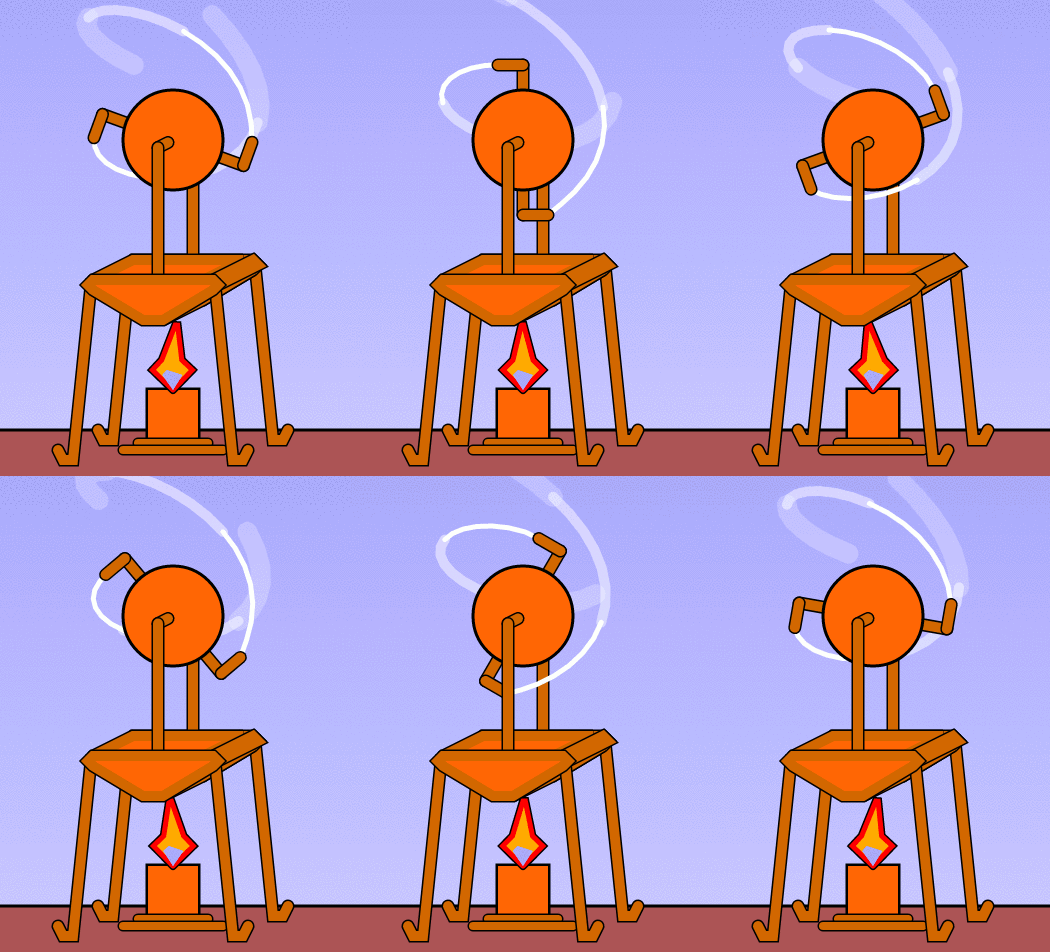
So where did this revolutionary invention come from? There were, of course, ancient forms of steam-powered devices, such as the “aeolipile”. Described by Hero of Alexandria in the 1st century, the aeolipile consisted of a hollow ball with nozzles, configured in such a way that the steam passing into the ball and exiting through the nozzles would cause the ball to spin. But this was more like a steam turbine than a steam engine. It could not do a whole lot of lifting. The key breakthroughs came later, in the late seventeenth and early eighteenth centuries, and instead exploited vacuums. In a steam engine the main force was applied, not by the steam itself pushing a piston, but by the steam within the cylinder being doused in cold water, causing it to rapidly condense. The resulting partial vacuum meant that the weight of the air — the atmospheric pressure — did the real lifting work. The steam was not there to push, but to be condensed and thus pull. It saw its first practical applications in the 1700s thanks to the work of a Devon ironmonger, Thomas Newcomen.
Science was important here. Newcomen’s engine could never have been conceived had it not been for the basic and not at all obvious observation that the air weighed something. It then required decades of experimentation with air pumps, barometers, and even gunpowder, before it was realised that a vacuum could rapidly be created through the condensation of steam rather than by trying to suck the air out with a pump. And it was still more decades before this observation was reliably applied to exerting force. An important factor in the creation of the steam engine was thus that there was a sufficiently large and well-organised group of people experimenting with the very nature of air, sharing their observations with one another and publishing — a group of people who, in England, formalised their socialising and correspondence in the early 1660s with the creation of the Royal Society.
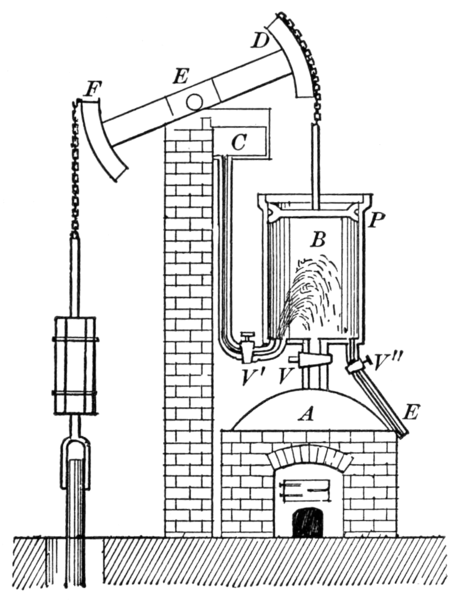
Newcomen’s Atmospheric Steam Engine. The steam was generated in the boiler A. The piston P moved in a cylinder B. When the valve V was opened, the steam pushed up the piston. At the top of the stroke, the valve was closed, the valve V’ was opened, and a jet of cold water from the tank C was injected into the cylinder, thus condensing the steam and reducing the pressure under the piston. The atmospheric pressure above then pushed the piston down again.
Original illustration from Practical Physics for Secondary Schools. Fundamental principles and applications to daily life, by Newton Henry Black and Harvey Nathaniel Davis, 1913, via Wikimedia Commons.

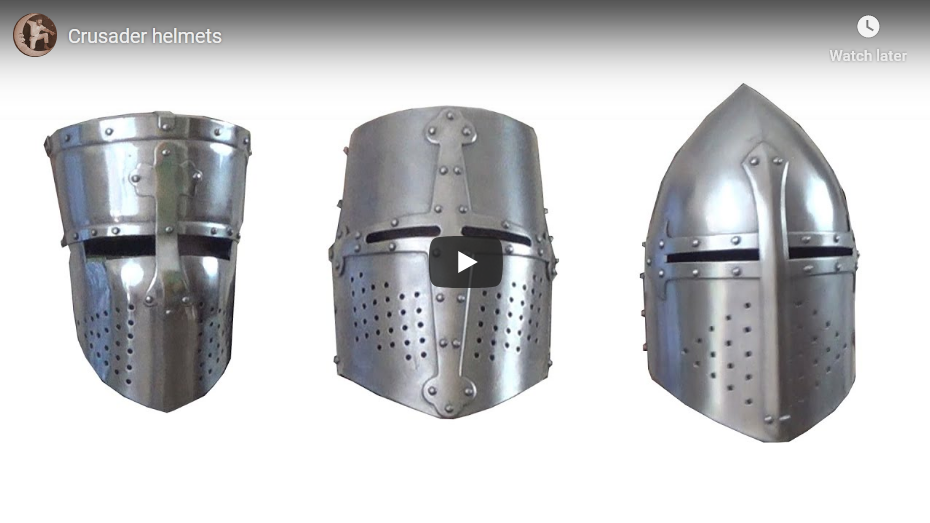
Crusader helmets
Lindybeige
Published 4 Sep 2014Here I show you three common styles of crusader helmet, and I comment upon them.
Thanks to Dr David Tetard for the loan of his helmets. These particular ones were bought here:
www.getdressedforbattle.co.uk
http://www.kovexars.cz/index.php (HL 007 and 103)Lindybeige: a channel of archaeology, ancient and medieval warfare, rants, swing dance, travelogues, evolution, and whatever else occurs to me to make.
▼ Follow me…
Twitter: https://twitter.com/Lindybeige I may have some drivel to contribute to the Twittersphere, plus you get notice of uploads.
website: www.LloydianAspects.co.uk
July 3, 2020
Fixing Gettysburg: The Second Day
Atun-Shei Films
Published 2 Jul 2020In this three-part series, I review a classic Ron Maxwell film about a little known historical event that no one talks about called the Battle of Gettysburg. I also present an abbreviated and oversimplified history of the battle, while simultaneously criticizing the movie for presenting an abbreviated and oversimplified history of the battle.
In the second episode, I discuss the first day of fighting on July 2, 1863 – including Dan Sickles’ shenanigans on the left, the 20th Maine on Little Round Top, the 1st Minnesota, and the night battle on Culp’s Hill.
Support Atun-Shei Films on Patreon ► https://www.patreon.com/atunsheifilms
Leave a Tip via Paypal ► https://www.paypal.me/atunsheifilms (Between now and October, all donations made here will go toward the production of The Sudbury Devil, our historical feature film)
#Gettysburg #CivilWar #VideoEssay
Watch our film ALIEN, BABY! free with Prime ► http://a.co/d/3QjqOWv
Reddit ► https://www.reddit.com/r/atunsheifilms
Twitter ► https://twitter.com/atun_shei
Instagram ► https://www.instagram.com/atunsheifilms
Merch ► https://atun-sheifilms.bandcamp.com~REFERENCES~
[1] Stephen W. Sears: “General Longstreet and the Lost Cause” (2005). American Heritage Magazine https://www.americanheritage.com/gene…
[2] W.C. Storrick: The Battle of Gettysburg (1931). J Horace McFarland Company, Page 26
[3] Frederick Tilberg, Scott Hartwig, John Heiser: Gettysburg National Military Park Handbook (2013). Historic Map and Print Company, Page 31-32
[4] Storrick, Page 27
[5] William B. Styple: Generals in Bronze (2005). Belle Grove Publishing Company, Page 222
[6] “The 1st Minnesota Infantry at Gettysburg” (2014). Iron Brigader https://ironbrigader.com/2014/01/03/1…
[7] Storrick, Page 29-30
[8] Tilberg, Hartwig, Heiser, Page 45
“Nuclear Attack” – Atomic Bombings – Sabaton History 074 [Official]
Sabaton History
Published 2 Jul 2020At 0815 on 6 August 1945, the first atomic bomb, nicknamed “Little Boy”, was dropped out of the B-29 Enola Gay and descended towards the Japanese city of Hiroshima. 43 seconds later, the city was engulfed in a flashing bright light and a shockwave of unimaginable heat and deadly pressure. From the hypocenter of the resulting mushroom-cloud, a blue-green fireball burned and blinded the city and its inhabitants with unprecedented power. 140,000 people were killed in the first few moments. Tens of thousands would die from wounds and radiation. The age of atomic warfare had begun.
Support Sabaton History on Patreon: https://www.patreon.com/sabatonhistory
Listen to “Nuclear Attack” on the album Attero Dominatus
CD: http://bit.ly/AtteroDominatusStore
Spotify: http://bit.ly/AtteroDominatusSpotify
Apple Music: http://bit.ly/AtteroDominatusAppleMusic
iTunes: http://bit.ly/AtteroDominatusiTunes
Amazon: http://bit.ly/AtteroDominatusAmzn
Google Play: http://bit.ly/AtteroDominatusGooglePlayListen to Sabaton on Spotify: http://smarturl.it/SabatonSpotify
Official Sabaton Merchandise Shop: http://bit.ly/SabatonOfficialShopHosted by: Indy Neidell
Written by: Markus Linke and Indy Neidell
Directed by: Astrid Deinhard and Wieke Kapteijns
Produced by: Pär Sundström, Astrid Deinhard and Spartacus Olsson
Creative Producer: Joram Appel
Community Manager: Maria Kyhle
Executive Producers: Pär Sundström, Joakim Broden, Tomas Sunmo, Indy Neidell, Astrid Deinhard, and Spartacus Olsson
Post-Production Director: Wieke Kapteijns
Edited by: Iryna Dulka
Sound Editing by: Marek Kaminski
Maps by: Eastory – https://www.youtube.com/c/eastoryArchive by: Reuters/Screenocean https://www.screenocean.com
Music by Sabaton.Colorizations:
– Dememorabilia – https://www.instagram.com/dememorabilia/Sources:
– U.S. Department of Energy
– Bomb icon by P Thanga Vignesh from the Noun Project
– bockelsound from freesound.org
– Vilna Gaon State Jewish MuseumAn OnLion Entertainment GmbH and Raging Beaver Publishing AB co-Production.
© Raging Beaver Publishing AB, 2019 – all rights reserved.
From the comments:
Sabaton History
2 days agoAugust 6, 1945. On this fateful Monday morning our world changed forever.
Nuclear weapons were now a reality, destruction on a whole new level a possibility. International power dynamics, foreign politics and conflict handling would never be the same once this new kind of weapon of mass destruction had entered the scene. The threat of potentially world-ending nuclear war, the fear that the men in power would push “the red button”, would hang over people like a dark cloud from this day on. The Nuclear Age had begun.
If you’re interested in how politics developed during The Nuclear Age, you can explore that in the day-by-day coverage of The Cuban Missile Crisis over on TimeGhost History. The first introduction, “USA Starts the Atomic Arms Race”, is already up and you can watch it right here: https://youtu.be/zEXjoBe5ZdI
The History of: The British 1942 Battle Jerkin & Skeleton Battle Jerkin | Uniform History
Uniform History
Published 24 Mar 2020The start of another two parter, in this one we cover the British Battle Jerkin family as it helped inspire the US Normandy Assault Vest’s creation.
Music by: https://www.juliancrowhurst.com/