Quotulatiousness

December 18, 2020

When Movies Were Magic (3D glasses recommended)

Filed under: France, History, Media, Technology, USA — Tags: , , , — Nicholas @ 02:00

Atun-Shei Films
Published 8 Sep 2020

A brief history of early motion picture technology and artistry, from the magic lantern to Georges Méliès. Presented in glorious 3-D!!!

To fully enjoy this video, you will need a pair of red/blue anaglyph 3-D glasses. They can be acquired cheaply at a number of online vendors, and you can even make them at home by coloring sheets of clear plastic with permanent markers: https://www.wikihow.com/Make-Your-Own…

Support Atun-Shei Films on Patreon ► https://www.patreon.com/atunsheifilms

Leave a Tip via Paypal ► https://www.paypal.me/atunsheifilms (All donations made here will go toward the production of The Sudbury Devil, our historical feature film)

Buy Merch ► https://www.teespring.com/stores/atun…

#FilmHistory #MagicLantern #3D

Reddit ► https://www.reddit.com/r/atunsheifilms
Twitter ► https://twitter.com/atun_shei

~REFERENCES~

[1] William Godwin. Lives of the Necromancers (1834). Project Gutenberg https://www.gutenberg.org/cache/epub/…

[2] Paul Clee. Before Hollywood: From Shadow Play to the Silver Screen (2005). Houghton Mifflin, Page 12-21

[3] Chris Bennett. “The Psychedelic Phantasmagoria Shows of the 18th Century” (2018). Cannabis Culture https://www.cannabisculture.com/conte…

[4] Clee, Page 39-47

[5] Clee, Page 84-85

[6] “Dissolving View Magic Lantern Slides.” Magic Lantern World https://magiclanternist.com/2016/09/2…

[7] “A Color Photograph Pioneer Comes to Light” (2018). The European Synchrotron https://www.esrf.eu/home/news/general…

[8] Clee, Page 83

[9] Clee, Page 85-95

[10] “Freeze Frame: Eadweard Muybridge’s Photography of Motion” (2000). National Museum of American History https://americanhistory.si.edu/muybri…

[11] “Sallie Garner at a Gallop.” IMDB https://www.imdb.com/title/tt2221420/…

[12] Laurent Mannoni. “Etienne-Jules Marey: French Physiologist and Chronophotographer.” Who’s Who of Victorian Cinema https://www.victorian-cinema.net/marey

[13] Clee, Page 107-109

[14] Harald Sack. “The Kinetoscope and Edison’s Wrong Way to Invent the Cinema” (2020). SciHi Blog http://scihi.org/kinetoscope-edison/

[15] Clee, Page 127

[16] Clee, Page 139-141

[17] James Travers. “Georges Méliés Biography: Life and Films” (2017). FrenchFilms.org http://www.frenchfilms.org/biography/…

[18] Clee, Page 158-159

December 17, 2020

Henry Ford and the Mass Marketing of Hatred | BETWEEN 2 WARS: ZEITGEIST! | E.07 – Spring 1920

TimeGhost History
Published 16 Dec 2020

Racist conspiracies are on the rise in America. But other hysterias are also lessening. Will there be a return to normalcy?

Join us on Patreon: https://www.patreon.com/TimeGhostHistory

Hosted by: Indy Neidell
Written by: Indy Neidell and Francis van Berkel
Director: Astrid Deinhard
Producers: Astrid Deinhard and Spartacus Olsson
Executive Producers: Astrid Deinhard, Indy Neidell, Spartacus Olsson, Bodo Rittenauer
Creative Producer: Maria Kyhle
Post-Production Director: Wieke Kapteijns
Research by: Indy Neidell and Francis van Berkel
Image Research by: Daniel Weiss
Edited by: Daniel Weiss
Sound design: Marek Kamiński

Colorizations:
Daniel Weiss – https://www.facebook.com/TheYankeeCol…
Spartacus Olsson
Mikolaj Uchman

Sources:
Some images from the Library of Congress
Portrait from Bibliotheque Nationale Francaise

From the Noun Project:
– agreement by Vectors Point
– film camera by Chanut is Industries, TH
– cowboy man by Adrien Coquet
– Protest by Juan Pablo Bravo
– Immigrants by Luis Prado
– pair figure skating by Andrei Yushchenko
– singles figure skating by Andrei Yushchenko
– Letter by Mochammad Kafi
– speech by Juan Pablo Bravo, CL
– universe by Icongeek26
– Arrow by IconTrack
– Galaxy By Victoruler

Soundtracks from Epidemic Sound
– One More for the Road – Golden Age Radio
– “First Responders” – Skrya
– “Guilty Shadows 4” – Andreas Jamsheree
– “Slow Discovery” – Cobby Costa
– “Try and Catch Us Now” – David Celeste
– “The Inspector 4” – Johannes Bornlöf
– “Deviation In Time” – Johannes Bornlof
– “Disciples of Sun Tzu” – Christian Andersen

Archive by Screenocean/Reuters https://www.screenocean.com.

A TimeGhost chronological documentary produced by OnLion Entertainment GmbH.

Fallen Flag — the Ann Arbor Railroad

Filed under: History, Railways, USA — Tags: , , , , , — Nicholas @ 03:00

This month’s Classic Trains featured fallen flag is the Michigan-based Ann Arbor Railroad which operated rail services from Toledo, Ohio to Elberta and Frankfort, Michigan, along with lake ferry service across Lake Michigan to Manitowoc and Kewaunee, Wisconsin and Menominee and Manistique in Michigan’s Upper Peninsula. Robert I. Warrick provides an outline of the history of the line:

Ann Arbor No. 1, built in 1892 by Craig Shipbuilding Co. in Toledo, Ohio. She was destroyed in a fire on March 7, 1910 at Manitowoc, Wisconsin.
Photo from Bowling Green State University via Wikimedia Commons.

The Ann Arbor Railroad was as much a steamship line as a railroad. Built from Toledo, Ohio, northwest to Frankfort, Mich., it existed for one reason — to move freight in car ferries across Lake Michigan to bypass Chicago. From 1910 to 1968, “the Annie” operated 320 car ferry route-miles versus 292 miles of railroad. AA was at the forefront of car ferry design and innovation, from the first wooden-hulled vessels to the most advanced car ferry to ever sail Lake Michigan.

During the 1940s, up to six ferries made the round trip from Boat Landing, as AA called its yard in Elberta on the south side of Frankfort harbor, to two Wisconsin and two Michigan Upper Peninsula ports. The boats ran year-round on a tight schedule, timed to match with three pairs of scheduled Toledo freights, where AA interchanged with five trunk lines. Well-kept 2-8-2s powered those short, fast trains across AA’s rolling profile until 1950, when Alco FA2s took over.

[…]

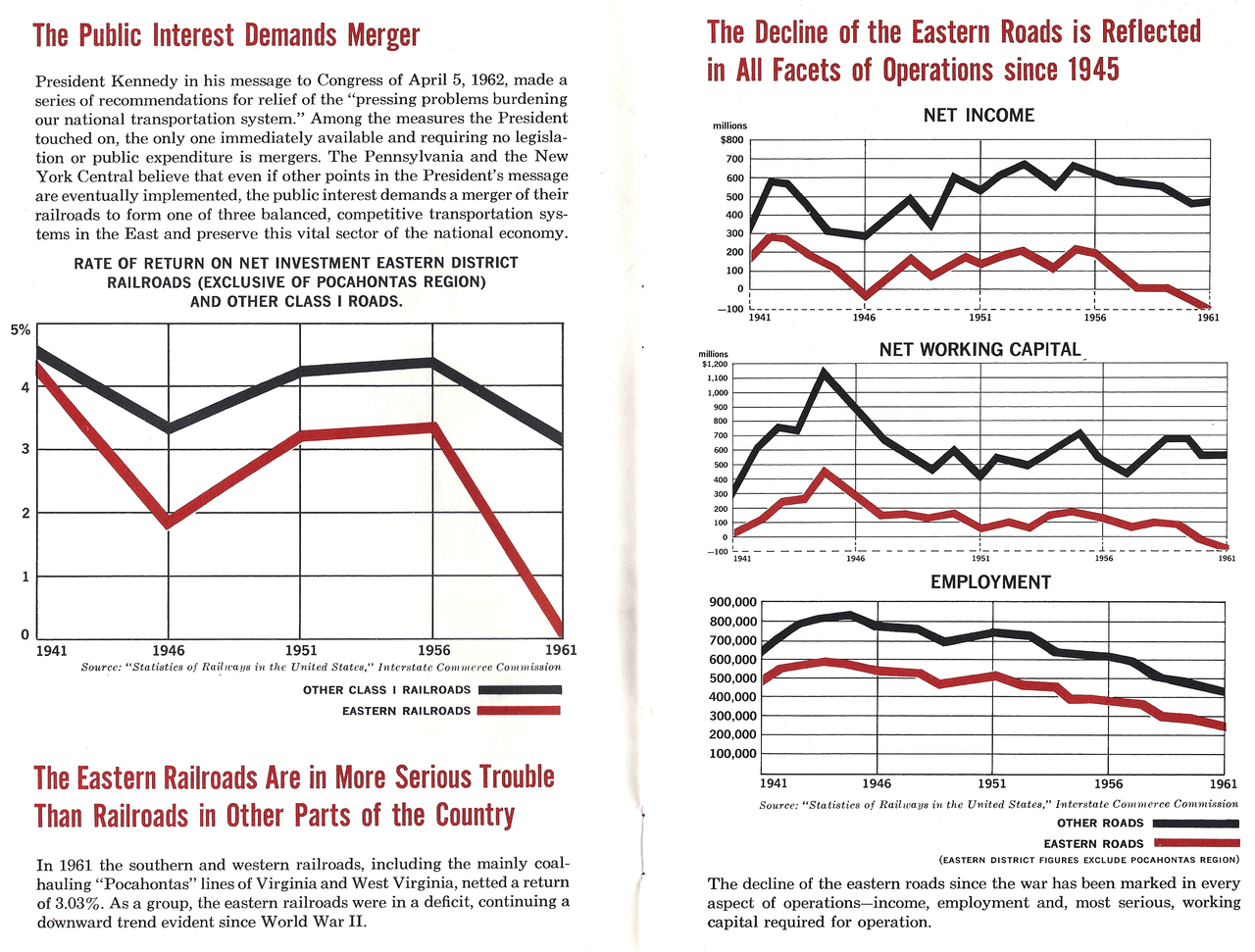
The Eastern mergers of the 1960s ultimately doomed the old Ann Arbor. As planning for Penn Central went on, the Norfolk & Western merged with Wabash, Nickel Plate, and two smaller roads in 1964. N&W wanted no part of the Ann Arbor and its costly ferries, so AA was foisted off on DT&I, which was profitable by the 1960s.

With ICC approval, DT&I took over the Ann Arbor on August 31, 1963, and soon replaced the tired FA2s with 10 GP35s, riding on Alco trucks and painted in DT&I orange with large “Ann Arbor” lettering. DT&I’s GPs often mixed with the Annie’s.

DT&I had ferry Wabash refitted, changed her name to City of Green Bay, and loaned AA $2.5 million to rebuild Ann Arbor No. 7. The railroad renamed No. 7 Viking, lengthened it, installed four EMD 2,500 h.p. 567 diesels. But even with the bigger boats, capacity remained an issue as car sizes increased. AA was losing money. First the ferry route to Manistique, Mich. (and AA subsidiary Manistique & Lake Superior), was discontinued, then the one to Menominee, Mich.

Ann Arbor’s fate was sealed. A firm was hired to liquidate Pennsylvania Company assets, including AA and DT&I. Ann Arbor defaulted on the loan for the Viking on November 1, 1972, and filed for bankruptcy on October 15, 1973, leading to AA’s inclusion with other bankrupts in the Regional Rail Reorganization Act of 1973 that resulted in Conrail.

Merrill Breechloading Conversion of the 1841 Mississippi Rifle

Filed under: History, Military, USA, Weapons — Tags: , , , , , — Nicholas @ 02:00

Forgotten Weapons
Published 9 Sep 2020

http://www.patreon.com/ForgottenWeapons

https://www.floatplane.com/channel/Fo…

Cool Forgotten Weapons merch! http://shop.bbtv.com/collections/forg…

James Merrill of Baltimore had his hand in several Civil War era firearms — rifles built from scratch, conversions of the Jenks carbines, and also conversions of 1841 Mississippi rifles done by the Harpers Ferry Arsenal. Merrill’s conversion involved a knee-joint type lever which could be opened to allow loading of a rifle from the breech. The system was relatively simple, and it was one of three (the others were the Lindner and Montstorm) made in small numbers for testing by Harpers Ferry. It appears that 300 Merrill conversions were done, 100 each of the 1841 Mississippi Rifle, 1842 musket, and 1847 musketoon.

Contact:
Forgotten Weapons
6281 N. Oracle #36270
Tucson, AZ 85740

December 16, 2020

The NKVD: from Pen-Pushers to Communist Hit Squads – WW2 Special

World War Two
Published 15 Dec 2020

The NKVD started out as your regular old Ministry of the Interior. But over time, they grew out to a hugely influential and highly lethal weapon for some of the Soviet Union’s leaders.

Join us on Patreon: https://www.patreon.com/TimeGhostHistory
Or join The TimeGhost Army directly at: https://timeghost.tv

Follow WW2 day by day on Instagram @ww2_day_by_day – https://www.instagram.com/ww2_day_by_day
Between 2 Wars: https://www.youtube.com/playlist?list…
Source list: http://bit.ly/WW2sources

Hosted by: Spartacus Olsson
Written by: Joram Appel and Spartacus Olsson
Director: Astrid Deinhard
Producers: Astrid Deinhard and Spartacus Olsson
Executive Producers: Astrid Deinhard, Indy Neidell, Spartacus Olsson, Bodo Rittenauer
Creative Producer: Maria Kyhle
Post-Production Director: Wieke Kapteijns
Research by: Joram Appel
Edited by: Miki Cackowski
Sound design: Marek Kamiński
Map animations: Eastory (https://www.youtube.com/c/eastory)

Colorizations by:
Klimbim – https://www.flickr.com/photos/2215569…
Mikołaj Uchman
Julius Jääskeläinen – https://www.facebook.com/JJcolorization/
Dememorabilia – https://www.instagram.com/dememorabilia/

Sources:
Picture of Lavrentiy Beria in court, courtesy of Фотограф – Ист.доки https://commons.wikimedia.org/wiki/Fi…
Yad Vashem 1019-2, 143EO1, 55AO6
IWM HU 106212
USHMM
I.M. Bondarenko
from the Noun Project: border police by IcoLabs, fire building by dDara, Police by Cuputo, Skull by Muhamad Ulum

Soundtracks from the Epidemic Sound:
Reynard Seidel – “Deflection”
Johannes Bornlof – “Deviation In Time”
Farrell Wooten – “Blunt Object”
Andreas Jamsheree – “Guilty Shadows 4”
Fluow – “Endlessness”
Johannes Bornlof – “The Inspector 4”
Gunnar Johnsen – “Not Safe Yet”

Archive by Screenocean/Reuters https://www.screenocean.com.

A TimeGhost chronological documentary produced by OnLion Entertainment GmbH.

From the comments:

World War Two
2 hours ago
We have been talking about the NKVD a lot in our War Against Humanity episodes and in several Between Two Wars episodes. If you found this video to be interesting, I can highly recommend you try our B2W episode on the Great Terror and Military Purges in 1938. It provides some crucial context that we couldn’t expand on in this special episode. You can find it right here: https://youtu.be/MNnK0LAoyMo
Cheers,
Joram

Other videos about the NKVD we mentioned in this special are:
– War Against Humanity episode covering the Katyn Massacre: https://youtu.be/gd5YhhNcC44
– War Against Humanity episode covering the Great Prison Massacre: https://youtu.be/kykPusygzOw
– Biography episode on Richard Sorge: https://youtu.be/fn9NyRfbSOo

Storm in the Labrador Sea

Filed under: History, Technology — Tags: , , , , , — Nicholas @ 02:00

Draken Harald Hårfagre
Published 20 Aug 2016

8 minutes with the amazing Draken Viking Ship. This is the film we showed in our exhibition tent on the festivals around the Great Lakes, filmed between Greenland and Newfoundland on the crossing of the North Atlantic Ocean.

QotD: Distorting the history of America’s “Gilded Age”

Filed under: Economics, Education, Government, History, USA — Tags: , , , , — Nicholas @ 01:00

We study history to learn from it. If we can discover what worked and what didn’t work, we can use this knowledge wisely to create a better future. Studying the triumph of American industry, for example, is important because it is the story of how the United States became the world’s leading economic power. The years when this happened, from 1865 to the early 1900s, saw the U.S. encourage entrepreneurs indirectly by limiting government. Slavery was abolished and so was the income tax. Federal spending was slashed and federal budgets had surpluses almost every year in the late 1800s. In other words, the federal government created more freedom and a stable marketplace in which entrepreneurs could operate.

To some extent, during the late 1800s — a period historians call the “Gilded Age” — American politicians learned from the past. They had dabbled in federal subsidies from steamships to transcontinental railroads, and those experiments dismally failed. Politicians then turned to free markets as a better strategy for economic development. The world-dominating achievements of Cornelius Vanderbilt, James J. Hill, John D. Rockefeller, and Charles Schwab validated America’s unprecedented limited government. And when politicians sometimes veered off course later with government interventions for tariffs, high income taxes, anti-trust laws, and an effort to run a steel plant to make armor for war — the results again often hindered American economic progress. Free markets worked well; government intervention usually failed.

Why is it, then, that for so many years, most historians have been teaching the opposite lesson? They have made no distinction between political entrepreneurs, who tried to succeed through federal aid, and market entrepreneurs, who avoided subsidies and sought to create better products at lower prices. Instead, most historians have preached that many, if not all, entrepreneurs were “robber barons”. They did not enrich the U.S. with their investments; instead, they bilked the public and corrupted political and economic life in America. Therefore, government intervention in the economy was needed to save the country from these greedy businessmen.

Burton W. Folsum, “How the Myth of the ‘Robber Barons’ Began — and Why It Persists”, Foundation for Economic Education, 2018-09-21.

December 15, 2020

Experimental Pre-WWI Ross .30-06 Machine Gun

Filed under: Cancon, History, Military, Weapons — Tags: , , , , — Nicholas @ 04:00

Forgotten Weapons
Published 14 Dec 2020

http://www.patreon.com/ForgottenWeapons

https://www.floatplane.com/channel/Fo…

Cool Forgotten Weapons merch! http://shop.bbtv.com/collections/forg…

In August 1913, the British War Office wrote to Sir Charles Ross requesting a sample automatic rifle for trials in the UK. Ross was able to submit a prototype in May 1914, which was tested at Enfield — but only fired 308 rounds before the test ended, suggesting that something important probably broke. The gun was a very strange looking contraption, whose Ross MkIII lineage is visible only in the bolt and front of the receiver forging. A long stroke gas pistol was added, and the action flipped upside-down. A large 25-round magazine was fitted, along with a thumbhole style stock that looks very similar to the grip of a Lewis gun. In addition to one example tested at Enfield in .303 caliber, one other model was send to the US for testing, chambered for .30-06. That is the gun we are looking at today, which came to the Canadian War Museum from the collection stored at Fort Knox in the 1970s and 80s.

Thanks to the Canadian War Museum for providing me access to film this extremely unusual Ross for you!

Home

Contact:
Forgotten Weapons
6281 N. Oracle #36270
Tucson, AZ 85740

Port wine

Filed under: Britain, Europe, History, Wine — Tags: , , — Nicholas @ 03:00

In The Critic, Henry Jeffreys considers how Port became so popular in Britain:

Before there were package holidays, there was port. This was the way British people shivering on their cold wet island could get a bit of sunshine. It’s a miracle drink, preserving the heat of the Douro valley in liquid form for decades ready to be uncorked and spread cheer. And don’t we need cheer more than ever at the moment? According to Adrian Bridge, CEO of Taylor’s, British port sales were booming during lockdown.

Our love affair with port goes back a long way but the funny thing is that when wines from Portugal began to arrive in large quantities in the 17th century, people hated it. Port was a necessity because Bordeaux, the traditional wine of choice, had become expensive due to the high duty put on it from Cromwell’s time onwards. Early port was a rough sort of wine, often transported down to the city of Oporto in pig skins and adulterated with brandy and elderberries. A poem from 1693 by Richard Ames captures the mood of the times: “But fetch us a pint of any sort, Navarre, Galicia, anything but Port.” The Scots in particular were not impressed. After the Act of Union, wine drinking took on political connotations with Jacobites drinking claret and Hanoverians port. This antipathy to port still persists: a few years back, I sat next to a Scottish woman at dinner who complained that the English only drank port to thumb their noses at Napoleon.

It took a long time before port became the sweet smooth consistent wine that we know and love today. In fact, until 1820 it would usually have been dry. The vintage that year was so hot that the grapes contained more sugar than the yeasts could deal with, so brandy was added while the wines were still fermenting. It was such a success in Britain that this became the model for how port was made in future. Not everyone was keen, however. Baron Forrester, the man who first mapped the course of the Douro river, was still complaining about the new-fangled sweet port right into the 1850s. The current winemaker at Taylor’s, David Guimaraens, reckoned this year’s heatwave had more than a little in common with the 1820 vintage.

Port really is perfectly designed to deal with this heat. Even with modern temperature-controlled fermentation it can be difficult making balanced dry wine with such ripe grapes whereas adding brandy during the fermentation preserves the fresh fruit flavour. Furthermore, heavier wines can be blended with lighter vintages to make tawny ports which are aged for years in wood with oxygen contact. Tawnies were traditionally enjoyed more by the Portuguese but they’re becoming increasingly popular over here. They’re mellow, pale and nutty from oxygen contact, quite different to vintage wines. The great thing is they are ready to drink, no ageing or decanting needed, and an open bottle will last for months. In fact, wood-aged ports are practically indestructible, I’ve had examples from 1937 and 1863 that were both fresh and vigorous.

Grapes with the right balance can go into vintage releases, though a declared vintage from 2020 does look unlikely. The discovery of how well port aged in bottles was probably an accident. A well-off individual would buy a pipe of port (around 500 litres) and have it bottled and corked. It was discovered that after years in bottle, something sublime happened to the fiery tannic wine. A vintage from a declared year will need at least 20 years. Happily, for the impatient among us, ready to drink vintage ports aren’t terribly expensive when you compare with the price of say, mature Bordeaux or Burgundy.

History Summarized: Spread of Christianity

Overly Sarcastic Productions
Published 10 Jan 2017

Things I learned when making this video: 1) when your script goes beyond 4 single-spaced pages, you’re heading into the danger zone 2) Gregorian Chants are awesome and you should totally listen to them, 3) editing always takes longer than you’d hope 4) self care is huffing frankincense for breakfast lunch and dinner and single-handedly sacking a levantine city!

Have a question about something I mentioned, or maybe something I might have left out? Leave it down below and I’ll do my best to respond!

PATREON: https://www.patreon.com/OSP

MERCH LINKS:
Shirts – https://overlysarcasticproducts.threa…
All the other stuff – http://www.cafepress.com/OverlySarcas…

Find us on Twitter @OSPYouTube!
twitter.com/OSPyoutube

December 14, 2020

Hall Model 1819: A Rifle to Change the Industrial World

Forgotten Weapons
Published 7 Sep 2020

http://www.patreon.com/ForgottenWeapons

https://www.floatplane.com/channel/Fo…

Cool Forgotten Weapons merch! http://shop.bbtv.com/collections/forg…

John Hall designed the first breechloading rifle to be used by the United States military, and the first breechloader issued in substantial numbers by any military worldwide. His carbines would later be the first percussion arms adopted by any military force. Hall developed a breechloading flintlock rifle in 1811, had it tested by the military in 1818, and formally adopted as a specialty arm in 1819.

Hall’s contribution actually goes well beyond having a novel and advanced rifle design. He would be the first person to devise a system of machine tools capable of producing interchangeable parts without hand fitting, and this advance would be the foundation of the American system of manufacturing that would revolutionize industry worldwide. Hall did this work at the Harpers Ferry Arsenal, where he worked from 1819 until his death in 1841.

I plan to expand on the details of a variety of Hall rifle models in future videos, and today is meant to be an introduction to the system. Because it was never a primary arm in time of major war, Hall is much less well recognized than he should be among those interested in small arms history.

Contact:
Forgotten Weapons
6281 N. Oracle #36270
Tucson, AZ 85740

December 13, 2020

Hitler Declares War on the USA and the Jews – WW2 – 120 – December 12, 1941

World War Two
Published 12 Dec 2020

The Japanese launch attacks all over Southeast Asia and the Pacific, and launch a preemptive surprise attack on the American Pacific Fleet at Pearl Harbor. The war is suddenly much larger. In the USSR, the Germans find themselves now heavily on the defensive after the failure to take Moscow, while in North Africa, Erwin Rommel decides he must withdraw out of Cyrenaica to await reinforcements.

Join us on Patreon: https://www.patreon.com/TimeGhostHistory
Or join The TimeGhost Army directly at: https://timeghost.tv

Follow WW2 day by day on Instagram @ww2_day_by_day – https://www.instagram.com/ww2_day_by_day
Between 2 Wars: https://www.youtube.com/playlist?list…
Source list: http://bit.ly/WW2sources

Written and Hosted by: Indy Neidell
Director: Astrid Deinhard
Producers: Astrid Deinhard and Spartacus Olsson
Executive Producers: Astrid Deinhard, Indy Neidell, Spartacus Olsson, Bodo Rittenauer
Creative Producer: Maria Kyhle
Post-Production Director: Wieke Kapteijns
Research by: Indy Neidell
Edited by: Miki Cackowski
Sound design: Marek Kamiński
Map animations: Eastory (https://www.youtube.com/c/eastory)

Colorizations by:
Daniel Weiss
Adrien Fillon – https://www.instagram.com/adrien.colo…
Mikołaj Uchman
Carlos Ortega Pereira, BlauColorizations – https://www.instagram.com/blaucolorizations
Klimbim – https://www.flickr.com/photos/2215569…
Julius Jääskeläinen – https://www.facebook.com/JJcolorization/
Jaris Almazani (Artistic Man) – https://instagram.com/artistic.man?ig…

Sources:
IWM HU 56120, K 1385, HU 675, TR153, HU 81216, WPN 298
NARA
Bundesarchiv
Narodowe Archiwum Cyfrowe
Picture of a victim of starvation during the siege of Leningrad, courtesy of George Shuklin
Picture of Alfred Godwin-Austen, courtesy of Berserker276 https://commons.wikimedia.org/wiki/Fi…
Picture of Harold Cole, courtesy of Cumbria County Archives

Soundtracks from the Epidemic Sound:
Phoenix Tail – “At the Front”
Johannes Bornlof – “Deviation In Time”
Johan Hynynen – “Dark Beginning”
Rannar Sillard – “March Of The Brave 4”
Jo Wandrini – “To War!”
Reynard Seidel – “Deflection”
Wendel Scherer – “Defeated”
Johannes Bornlof – “Death And Glory 3”
Johannes Bornlof – “The Inspector 4”
Hakan Eriksson – “Epic Adventure Theme 3”
Skrya – “First Responders”
Bonnie Grace – “Imperious”

Archive by Screenocean/Reuters https://www.screenocean.com.

A TimeGhost chronological documentary produced by OnLion Entertainment GmbH.

From the comments:

World War Two
2 days ago (edited)
Five days ago, we covered the Japanese attacks on Pearl Harbor minute by minute in real time over five hours. If you missed that, then check out episode one right here, you’ll love it: https://www.youtube.com/watch?v=Joh2BXPsrXs&t=4s

NOTE: An error snuck through our controls regarding the Japanese casualties at Wake, we are working with YouTube to have it fixed before the video goes public. We apologize for this inconvenience.

Japan attacked a whole variety of places that day, launching massive offensives all over SE Asia and the Pacific. I’ll be covering them here weekly, of course, but for even more coverage, check out our day by day Instagram coverage of the war: https://www.instagram.com/ww2_day_by_day

How the Romans Stole Silk Production Secrets from China

Filed under: China, Economics, History — Tags: , , , , , — Nicholas @ 02:00

Kings and Generals
Published 31 Jan 2019

Go to https://www.wix.com/KingsAndGenerals to get started on your website today!
Check out our new website at http://kingsandgenerals.org

Silk production was one of the biggest secrets of China and one of the most lucrative industries of the age. So it is not a surprise that the Roman emperor Justinian was eager to learn this secret. In this video we will discuss the start of the silk production, its importance and the story of how Justinian managed one of the first industrial thefts in history

Support us on Patreon: http://www.patreon.com/KingsandGenerals or Paypal: http://paypal.me/kingsandgenerals

Check out our Merch Store: teespring.com/stores/kingsandgenerals

We are grateful to our patrons and youtube members, who made this video possible: https://drive.google.com/open?id=1Xa-…

The video was made by our friend Cogito

This video was narrated by Officially Devin (https://www.youtube.com/user/Official…)

✔ Merch store ► teespring.com/stores/kingsandgenerals
✔ Podcast ► Google Play: http://bit.ly/2QDF7y0 iTunes: https://apple.co/2QTuMNG
✔ Twitter ► https://twitter.com/KingsGenerals
✔ Instagram ► http://www.instagram.com/Kings_Generals

Production Music courtesy of Epidemic Sound: http://www.epidemicsound.com
#Documentary #Justinian #Silk

December 12, 2020

Pearl Harbor and the Global War Against Humanity – WAH 024 – December 1941, Part 1

Filed under: Europe, Germany, History, Japan, Military, USA, WW2 — Tags: , , , — Nicholas @ 04:00

World War Two
Published 11 Dec 2020

December 1941 marks the shift to a new chapter in the War Against Humanity. New fronts open up, exposing millions more to the horrors of war. Other developments continue their path of continuous escalation.

Join us on Patreon: https://www.patreon.com/TimeGhostHistory
Or join The TimeGhost Army directly at: https://timeghost.tv

Follow WW2 day by day on Instagram @ww2_day_by_day – https://www.instagram.com/ww2_day_by_day
Between 2 Wars: https://www.youtube.com/playlist?list…
Source list: http://bit.ly/WW2sources

Hosted by: Spartacus Olsson
Written by: Joram Appel
Director: Astrid Deinhard
Producers: Astrid Deinhard and Spartacus Olsson
Executive Producers: Astrid Deinhard, Indy Neidell, Spartacus Olsson, Bodo Rittenauer
Creative Producer: Maria Kyhle
Post-Production Director: Wieke Kapteijns
Research by: Joram Appel
Edited by: Karolina Dołęga
Sound design: Marek Kamiński

Colorized by:
– Daniel Weiss
– Julius Jääskeläinen – https://www.facebook.com/JJcolorization/
– Carlos Ortega Pereira, BlauColorizations – https://www.instagram.com/blaucolorizations
– Jaris Almazani (Artistic Man) – https://instagram.com/artistic.man?ig…
– Mikołaj Uchman
– Klimbim
– Spartacus Olsson

Sources:
– Yad Vashem: 76CO9, 3150-122, J3065-2, 85DO1, 1427 83, 1007_31,
– Narodowe Archiwum Cyfrowe
– National Archive NARA
– Library of Congress
– Bundesarchiv
– Berlin Gestapo Museum
– United States Holocaust Museum

Soundtracks from epidemic sounds:
– “Guilty Shadows 4” – Andreas Jamsheree
– “For the Many STEMS INSTRUMENTS” – Jon Bjork
– “Remembrance” – Fabien Tell
– “Not Safe Yet” – Gunnar Johnsen
– “London” – Howard Harper-Barnes
– “Moving to Disturbia” – Experia

Archive by Screenocean/Reuters https://www.screenocean.com.

A TimeGhost chronological documentary produced by OnLion Entertainment GmbH.

From the comments:

World War Two
3 hours ago
Before we get comments about the countries currently participating in World War Two: in December 1941 there are more countries that are still neutral than we list here, but that won’t last, or as Sparty said these are the ones that will REMAIN neutral. They are without a doubt not at war, not occupied, and not in a state of war. All the other ones are – more or less. Mongolia? Has been in a de-facto state of war with Japan since the Manchurian incident. Ethiopia and Iraq? Both occupied, or at least on the lines of contested territory. The South and North American states? They will mostly enter the war later – but we’d argue that already now the Panama declaration ties them to each other to an extent that the fate of the “neutrals” has been complicated by the countries joining the war in December ’41. Now that you know our reasoning behind this, we encourage you to offer any alternative or additional thoughts on this in the comments.

“Canada’s party system has long been an outlier that has baffled political scientists”

Filed under: Cancon, Environment, History, Politics — Tags: — Nicholas @ 03:00

Ben Woodfinden emerges from a pre-winter hibernation to mull on how environmental issues intersect with regional and linguistic issues in a uniquely Canadian way that does not match how these issues play out in other countries:

“2019 Canadian federal election – VOTE” by Indrid__Cold is licensed under CC BY-SA 2.0

… if you want to understand how democratic politics work, you have to begin with the premise that voters and electoral coalitions are made up of individuals with overlapping and complicated political identities, not just rationalistic voters who need to be convinced with some charts and data.

These identities and value divides coalesce and become the basis of the political cleavages around which competition in democratic regimes is built. There are many classic accounts of party system formation in political science, the one I think most plausible and still useful is the now classic account of cleavage politics posited by the political scientists Seymour Martin Lipset and Stein Rokkan.

This now classic account of the formation of party systems in Western Europe argues that long existing social conflicts and divides that existed prior to the gradually universal extension of voting across Western Europe helped to structure political competition. Specifically, industrialization and nation building generated four major cleavages that structured political conflict and party systems going forward: territorial cleavages defined by a centre-periphery divide, religious cleavages defined by a church versus state divide, an urban-rural cleavage, and a labour-capital cleavage.

Canada’s party system has long been an outlier that has baffled political scientists who study these things. If you’re looking for a good comprehensive overview of the history of the Canadian party system I’d recommend this recent book by Richard Johnston. Since the 1930’s Canada has defied what is perhaps the single most generalizable finding in comparative politics: Duverger’s Law. Canada also defies many of the expectations of the cleavage theory of party formation. But Canadian politics can still be broadly understood in terms of cleavages, albeit idiosyncratic Canadian cleavages (regional and linguistic cleavages especially).

I won’t bog you down with too much academic explanation. There is an enormous body of literature that builds on, tests, and modifies the cleavage thesis. Much of the talk in recent decades has been about an “unfreezing” of the traditional cleavages that have dominated party politics in western democracies, and the reorganizing of politics around new cleavages.

As traditional industrial, class, and religious cleavages have declined new cleavages have emerged and politics has been playing a catch up game. These new cleavages coalesce around educational, geographic, gendered, and age divides. This realignment, which has been in the making for decades has become the dominant political narrative since 2016, and as I’ve written in the newsletter recently these divides exist in Canada just as they do in Europe and America.

But the realignments these new cleavages produce often require singular events or defining figures to fully emerge. In the United Kingdom, the 2016 referendum produced a realignment because it scrambled the existing partisan and political arrangements so much that it gave rise to a hyper-polarized culture war around a remain/leave divide that people reoriented their own politics around this divide.

« Newer PostsOlder Posts »

Powered by WordPress