Quotulatiousness

May 25, 2021

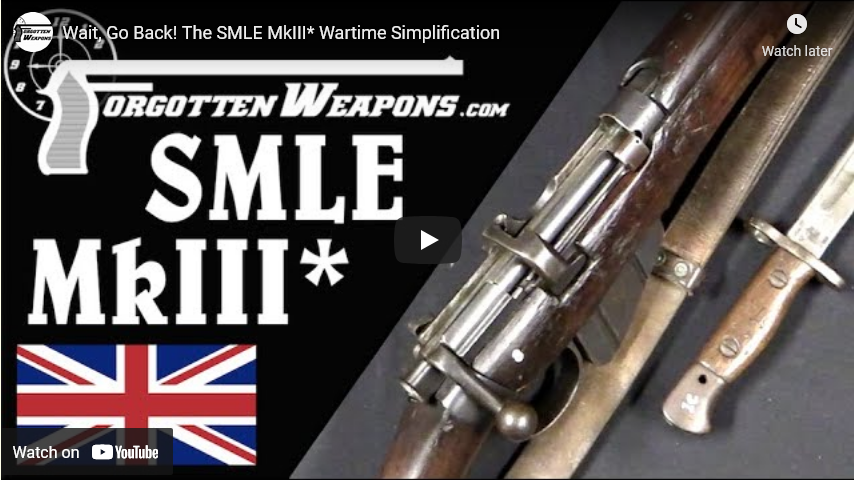
Wait, Go Back! The SMLE MkIII* Wartime Simplification

Filed under: Britain, History, Military, Weapons, WW1 — Tags: , , , — Nicholas @ 02:00

Forgotten Weapons
Published 10 Feb 2021

http://www.patreon.com/ForgottenWeapons​

https://www.floatplane.com/channel/Fo…​

Cool Forgotten Weapons merch! http://shop.bbtv.com/collections/forg…​

The British entered World War One with a technically excellent rifle, with lots of bells and whistles. By 1916, the war was taking a previously unimaginable toll on the industrial capacity of the Empire and rifle production had to be economized. This led to the adoption of the MkIII* pattern of the Lee Enfield, to reduce cost and speed up production. The MkIII* omitted the windage adjustments on the rear sight, the front and rear volley sight elements, and the magazine cutoff. Around the same time, stock discs stopped being stamped with unit information (to avoid giving military intelligence of troop distribution when rifles were captured) and eventually deleted entirely.

The Pattern 1907 bayonet was also changed, although this does not coincide with the MkIII* rifle. In 1913, the British decided to delete the quillon from the standard bayonet. A great many bayonet with quillons were already in service, and those would be used in World War One, although many were modified in the field to cut off the quillons to avoid them hanging up on barbed wire or other obstacles.

Contact:
Forgotten Weapons
6281 N. Oracle #36270​
Tucson, AZ 85740

May 24, 2021

History Buffs: Midway Part One

Filed under: China, History, Japan, Media, Military, Pacific, Russia, USA, WW2 — Tags: , , , , , — Nicholas @ 04:00

History Buffs
Published 21 May 2021

Thank you guys so much for your patience. Quarantine has made somethings difficult and I know its been a while but it’s finally here! I hope you enjoy it!

You can join Nebula today and get Curiosity Stream at 26% off for a year! Click on the link below

http://curiositystream.com/historybuffs
Part Two of this review will be out next Friday on the 28th of May!

● Follow us on Twitter: https://twitter.com/HistoryBuffs_

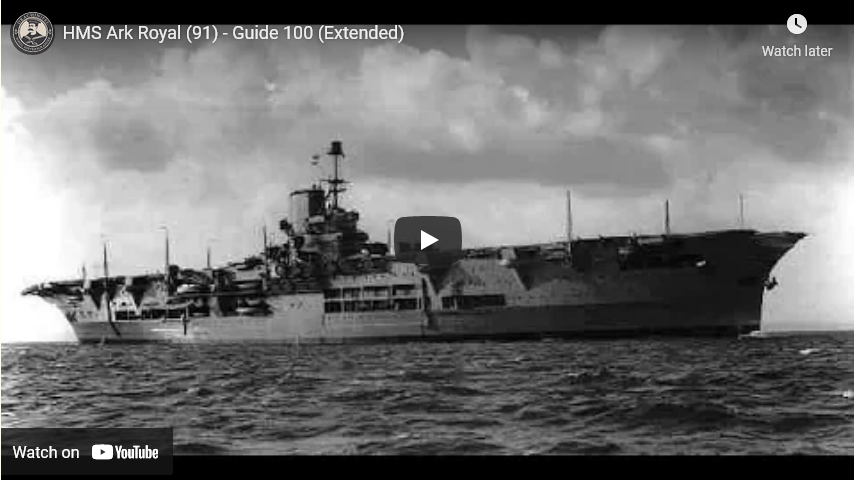
HMS Ark Royal (91) – Guide 100 (Extended)

Filed under: Britain, History, Military, WW2 — Tags: , , — Nicholas @ 02:00

Drachinifel
Published 15 Dec 2018

HMS Ark Royal, an aircraft carrier of the Royal Navy, is today’s subject.

Want to support the channel? – https://www.patreon.com/Drachinifel​

Want to talk about ships? https://discord.gg/TYu88mt

May 23, 2021

AF is short of fresh water – WW2 – 143 – May 23, 1942

Filed under: Britain, Germany, History, Japan, Military, Pacific, Russia, USA, WW2 — Tags: , , , , , — Nicholas @ 04:00

World War Two
Published 22 May 2021

Soviet Foreign Minister Molotov arrives in London to meet with Churchill, but at home in the USSR the Germans have launched an instantly successful offensive. In North Africa and Malta the British are building up, unaware that Erwin Rommel is just about to strike, and an American ruse discovers secret Japanese attack plans.
(more…)

Peter Zeihan’s geographic-based perspective on world history

Filed under: Books, Economics, History — Tags: , , , — Nicholas @ 03:00

In another of the reader-contributed book reviews for Scott Alexander’s Astral Codex Ten, a look at The Accidental Superpower: The Next Generation of American Preeminence and the Coming Global Disorder by Peter Zeihan:

Zeihan’s primary models are influenced by his geographic-based perspective on how our world works. As he puts it in the introduction, “Geopolitics is the study of how place [rivers, mountains, etc.] impacts … everything.” Early chapters discuss what he calls the balance of transport, which is roughly easy transport within a country (for economic development and forming political and cultural ties) and hard transport from outside of it (for defense). These transport issues are inherently tied to geography. What’s the best way to move things? Water-based transportation is extremely cheap. Think 17 cents per container mile vs. $2.40 for semis on an American highway, with a more extreme disparity for other countries, trade between continents, and populations in hard-to-access places. On the defensive side of that equation, geographic features on borders such as deserts, mountains, and oceans get Zeihan’s attention.

He uses ancient Egypt to illustrate a great balance of transport. The reliable water and rich soil of the Nile’s floodplains created near-perfect farming conditions, and the Nile itself allowed easy travel and trade throughout the valley. Combined with impenetrable desert borders, this geography “was one of the few places in the world where there was enough water to survive, and enough security to thrive.” Because of that, the “geography nearly guaranteed that the Egyptians would be on the road to civilization.” He gives us a quick run through Egyptian history to tell a story of that road, beginning with the settlement of the area about eight thousand years ago, consolidation into a single kingdom more than five thousand years ago, and then stagnation as the increasingly centralized government devoted more labor to monument building rather than technological progress, eventually being conquered by seafaring people seeking to rule the Mediterranean.

*****

To escape our pre-civilization/hunter-gatherer days – Zeihan refers to this as “when life sucked” – the mechanism that he identifies is basically a typical economist’s story. Sedentary agriculture as invented by the Egyptians and other ancient cultures became a transformative technology, letting populations grow and devote labor and resources to non-farming purposes. From this, we got specialization, increased production, trade (particularly where there was easy transportation – population centers were always near water) and capital formation in a self-reinforcing cycle. For thousands of years after this transformative technology was introduced, incremental improvements in agriculture and other areas followed, but “a robust, secure, and sustainable food supply” was the base of any civilization.

This cycle accelerated when we harnessed a couple of new packages of technologies over the last six-hundred years. He lumps the source of much progress together with the terms deepwater navigation and industrialization. The first is everything needed to sail the seas, from shipbuilding capabilities to compasses to weapons. Industrialization is exactly what you’re thinking of. He simplifies it as the combination of labor and capital with higher-output energy sources like oil and coal to put productivity on steroids.

Zeihan gives us a story of the Ottoman Empire entering a prolonged decline as deepwater navigation technologies took off in the fourteenth century. These technologies enabled the European powers (first Portugal and Spain, and then England) to capture increasing shares of trade with Asia, dropping prices in Europe and depriving the Ottomans of much of the income to which they had grown accustomed. Most significantly, they turned “the ocean from a death sentence to a sort of giant river.” Trade became global, but it was still mostly among people with nearby water-based transportation.

Industrialization technologies changed that. Steam and coal brought power to mining and transportation, and along with interchangeable parts, improved manufacturing. Chemical breakthroughs led to fertilizers (improving crop yields), and with more transportation options, more land was brought into cultivation. Improvements in cements in the 1820s enabled larger buildings and infrastructure. These technologies continually improved the productivity cycle that began with agriculture.

Zeihan concludes a chapter on America with the “nuts and bolts” of how countries rule the world. “The balance of transport determines wealth and security. Deepwater navigation determines reach. Industrialization determines economic muscle tone. And the three combined shape everything from exposure to durability to economic cycles to outlook.” As we’ll see shortly, he really likes America’s position on all of these factors. But first, we need to understand the other analytical tool that informs Zeihan’s model.

Where is Scandinavia?

Filed under: Europe, History — Tags: , , , , , , — Nicholas @ 02:00

CGP Grey
Published 25 Mar 2015

Grey Merch: https://cgpgrey.com/merch​

Grey on Twitter: https://twitter.com/cgpgrey

May 22, 2021

QotD: King Edward I

Filed under: Britain, History, Humour, Quotations — Tags: , , , — Nicholas @ 01:00

Long before Henry III had died (of a surfeit of Barons, Bonifaces, etc.) Edward I had taken advantage of the general confusion and of the death of Simon de Montfort (probably of a surfeit of Vergers) to become King before his reign had begun.

Edward I was thus a strong King, and one of the first things he did was to make a strong arrangement about the Law Courts. Hitherto there had been a number of Benches there, on all of which a confused official called the Justinian had tried to sit. Edward had them all amalgamated into one large Bench called the King’s Bench, and sat on it himself.

Edward I, who had already (in his Saladin days) piously decimated several thousand Turks at Nazareth, now felt so strong that he decided to Hammer the Scots, who accordingly now come right into History.

The childless Scotch King Alexander the Great had trotted over a cliff and was thus dead; so the Scots asked Edward to tell them who was King of Scotland, and Edward said that a Balliol man ought to be. Delighted with this decision the Scots crossed the Border and ravaged Cumberland with savage ferocity; in reply to which Edward also crossed the Border and, carrying off the Sacred Scone of Scotland on which the Scottish Kings had been crowned for centuries, buried it with great solemnity in Westminster Abbey.

This was, of course, a Good Thing for the Scots because it was the cause of William the Wallace (not to be confused with Robert Bruce), who immediately defeated the English at Cambuskenneth (Scotch for Stirling) and invaded England with ferocious savagery. In answer to this Edward captured the Bruce and had him horribly executed with savage ferocity. Soon after, Edward died of suffocation at a place called Burrowin-the-Sands and was succeeded by his worthless son Edward II.

W.C. Sellar & R.J. Yeatman, 1066 And All That, 1930.

May 21, 2021

Life Inside a Japanese PoW Camp – WW2 Special

Filed under: Britain, History, Japan, Military, Pacific, USA, WW2 — Tags: , , , , — Nicholas @ 04:00

World War Two
Published 20 May 2021

The inhuman, torturous, and deadly Japanese PoW Camps famous from Bridge over the River Kwai, Merry Christmas Mr. Lawrence, Empire of the Sun, and more recently Unbroken are a world of abuse and mistreatment managed by willfully incompetent and sadistically brutal men.
(more…)

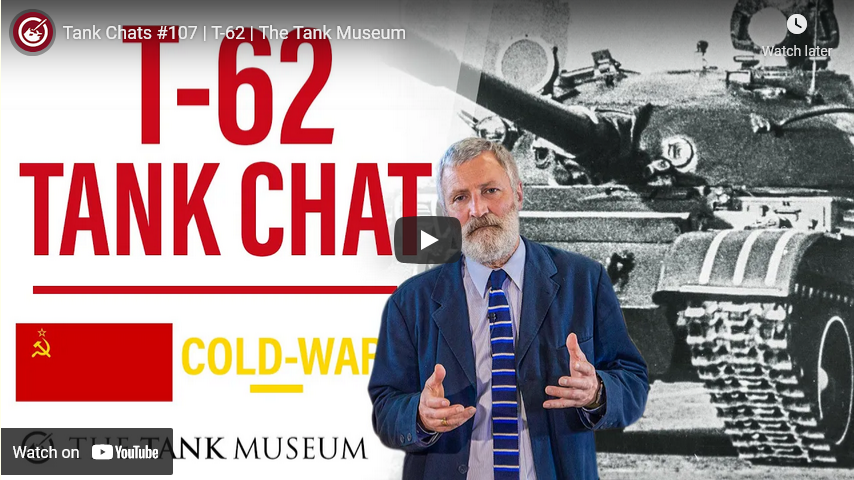
Tank Chats #107 | T-62 | The Tank Museum

Filed under: History, Military, Russia, Weapons — Tags: , , , , — Nicholas @ 02:00

The Tank Museum
Published 9 Oct 2020

Here The Tank Museum’s Curator David Willey discusses the Soviet T-62, including its development and service life. Introduced in 1962, it was a further evolution of the T-55 series, which David discussed in Tank Chat #104.

Support the work of The Tank Museum on Patreon: ► https://www.patreon.com/tankmuseum
Visit The Tank Museum SHOP & become a Friend: ► tankmuseumshop.org

Twitter: ► https://twitter.com/TankMuseum
Instagram: ► https://www.instagram.com/tankmuseum/
#tankmuseum #tanks

May 20, 2021

The Birth Control Movement and Eugenics – A Curious Link | B2W: ZEITGEIST! I E.18 – Winter 1923

Filed under: Books, Britain, Europe, Greece, Health, History, Law, Media — Tags: , , , , , — Nicholas @ 04:00

TimeGhost History
Published 19 May 2021

In the winter of 1923, a controversial activist takes a Catholic doctor to trial for libel. The proceedings capture a much bigger moment in the history of the interwar period: the controversial — but inherent — link between birth control and eugenics.
(more…)

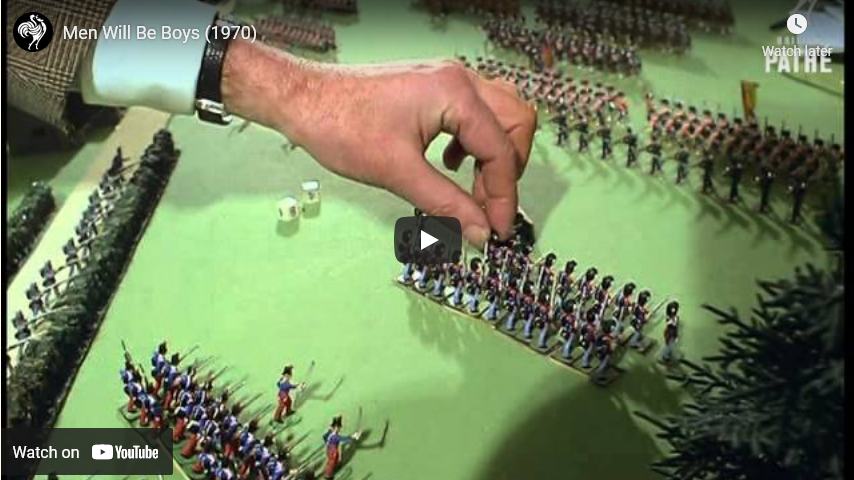
Men Will Be Boys (1970)

Filed under: Britain, Gaming, History, Railways — Tags: , , , — Nicholas @ 02:00

British Pathé
Published 13 Apr 2014

Men will be boys. Various locations.

M/S men round lake with boats. C/U man in lake with waders with model boat. C/U another man with model boat. Man lighting boiler. C/U engine working. M/S as model of paddle boat moves through water. M/S paddle boat on water. In foreground a swan. C/U another model boat going through water. M/S pan scale model of Hitler’s yacht. M/S men playing with model cars on race track. C/U cars going round race track. C/U men’s hands on controls. C/U men looking at cars go past. L/S of cars going round race track.

L/S men playing war games with model soldiers. on large table. C/U as man moves soldiers out of line laying them on ground. M/S man moves horses forward. C/U hand placing cannon into position. C/U hand places horse troops in position. M/S lines of soldier. Hand places another in position. M/S of troops being moved.

M/S Mr Victor Martin and wife go through gate by railway crossing dressed up in their uniforms, carrying lamps etc. M/S as they make their way to their signal boxes. C/U railway notice ‘By Midland Railway’. Pa off notice to show Mr Martin approaching his signal box. M/S Martin going into signal box. M/S Mrs Martin going into signal box. C/U Mrs Martin going into signal box. C/U interior. Mr Martin hanging up his jacket inside signal box. He then sits at the controls. C/U signal controls working. C/U of Mr Martin operating signals. Camera zooms back and we see train going past him along track. C/U model train over track. C/U Mrs Martin working in her signal box.

M/S Mrs Martin working signal controls. C/U Mrs Martin. M/S showing trains going over track. C/U trains moving. Camera zooms out to show tracks . C/U trains moving. C/U looking along tunnel showing trains moving. C/U exterior. Signals working. Then camera pans to show where the trains run on an enclosed section out in the open. C/U goods train and passenger train moving. M/S Interior. Trains going over track and Mr Martin at controls.
FILM ID:2241.18

A VIDEO FROM BRITISH PATHÉ. EXPLORE OUR ONLINE CHANNEL, BRITISH PATHÉ TV. IT’S FULL OF GREAT DOCUMENTARIES, FASCINATING INTERVIEWS, AND CLASSIC MOVIES. http://www.britishpathe.tv/​

FOR LICENSING ENQUIRIES VISIT http://www.britishpathe.com/​

British Pathé also represents the Reuters historical collection, which includes more than 136,000 items from the news agencies Gaumont Graphic (1910-1932), Empire News Bulletin (1926-1930), British Paramount (1931-1957), and Gaumont British (1934-1959), as well as Visnews content from 1957 to the end of 1984. All footage can be viewed on the British Pathé website. https://www.britishpathe.com/

May 19, 2021

Racism of the US Army – Fighting for Freedom? – WW2 Special

Filed under: History, Military, USA, WW2 — Tags: , , , — Nicholas @ 04:00

World War Two
Published 18 May 2021

While the US was fighting for freedom and liberty across the globe, their home country and armies are still deeply segregated, causing minority groups in the USA to fight not one but two wars.
(more…)

Why Did We Stop Wearing Hats?

Filed under: Europe, History, USA — Tags: , , , — Nicholas @ 02:00

Karolina Żebrowska
Published 28 Apr 2020

should we bring hats back? what do you think?
_____________
My Instagram: https://bit.ly/2Qo9rrI​
My nudes: https://bit.ly/2UHHY6N​
My merch: bit.ly/2CCq5jE

May 18, 2021

What is Maskirovka? Russian Military Deception #Military101

Filed under: History, Media, Military, Russia — Tags: , , , , — Nicholas @ 04:00

Military History Visualized
Published 5 May 2017

A short introduction into Russian Military Deception — called Maskirovka. “Maskirovka is most simply defined as a set of processes designed to mislead, confuse, and interfere with accurate data collection regarding all areas of Soviet plans, objectives, and strengths or weaknesses.” (Smith, Charles L.: “Soviet Maskirovka“, in: Airpower Journal – Spring 1988)

Military History Visualized provides a series of short narrative and visual presentations like documentaries based on academic literature or sometimes primary sources. Videos are intended as introduction to military history, but also contain a lot of details for history buffs. Since the aim is to keep the episodes short and comprehensive some details are often cut.

» HOW YOU CAN SUPPORT MILITARY HISTORY VISUALIZED «
(A) You can support my channel on Patreon: https://www.patreon.com/join/mhv

(B) You can also buy “Spoils of War” (merchandise) in the online shop: https://www.redbubble.com/people/mhvi…

» SOCIAL MEDIA LINKS «
twitter: https://twitter.com/MilHiVisualized
tumblr: http://militaryhistoryvisualized.tumb…

» SOURCES «

Maier, Morgan: A Little Masquerade: Russia’s Evolving Employment of Maskirovka
http://cgsc.contentdm.oclc.org/cdm/si…

Smith, Charles L.: “Soviet Maskirovko“, in: Airpower Journal – Spring 1988
http://www.airpower.maxwell.af.mil/ai…

Lindley-French, Julian: NATO: Countering Strategic Maskirovka. Canadian Defence & Foreign Affairs Institute. (2015)

Glantz: The Red Mask: The Nature and Legacy of Soviet Military Deception in the Second World War

https://en.wikipedia.org/wiki/Russian…

Keating, Kenneth: The Soviet System of Camouflage
http://www.dtic.mil/dtic/tr/fulltext/…

Krueger, Daniel: Maskirovka – What’s in it for us?
http://www.dtic.mil/dtic/tr/fulltext/…

» TOOL CHAIN «
PowerPoint 2016, Word, Excel, Tile Mill, QGIS, Processing 3, Adobe Illustrator, Adobe Premiere, Adobe Audition, Adobe Photoshop, Adobe After Effects, Adobe Animate.

» CREDITS & SPECIAL THX «
Song: Ethan Meixsell – “Demilitarized Zone”

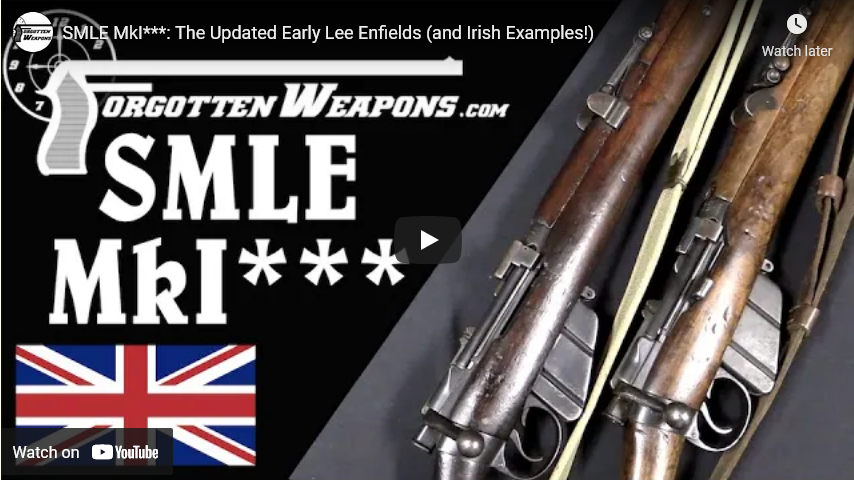
SMLE MkI***: The Updated Early Lee Enfields (and Irish Examples!)

Filed under: Britain, History, Military, Weapons, WW1 — Tags: , , , , — Nicholas @ 02:00

Forgotten Weapons
Published 3 Feb 2021

http://www.patreon.com/ForgottenWeapons​

https://www.floatplane.com/channel/Fo…​

Cool Forgotten Weapons merch! http://shop.bbtv.com/collections/forg…​

When the British adopted a new high-velocity spitzer bullet for the .303 cartridge, they had to update their rifles to use it. Specifically, the sights had to be recalibrated for the flatter trajectory of the new MkVII ammunition. In addition, the sight picture was changed from a barleycorn front and V-notch rear to the more precise square front post and rear U-notch.

These rifles are quite scarce, but several thousand were brought into the US in the early 1960s as surplus from Ireland. These Irish examples all had new serial numbers applied when the were sent to Ireland by the British in the 1920s, and they are in two different batches (one in MkI*** configuration, and one with the MkIII rear sight). We will take a look at both patterns today as well, so you can see the difference between the much more available Irish type and the pure British version.

Contact:
Forgotten Weapons
6281 N. Oracle #36270​
Tucson, AZ 85740

« Newer Posts — Older Posts »

Powered by WordPress