
seangabb
Published Jul 17, 2024This eighth lecture in the course covers the Hellenistic Age of Greece — from the death of Alexander in 323 BC to about the death of Cleopatra in 30 BC.
(more…)
November 29, 2024
Greek History and Civilization, Part 8 – The Hellenistic Age
Comments Off on Greek History and Civilization, Part 8 – The Hellenistic Age
November 28, 2024
Town-class destroyers – Guide 400
Drachinifel
Published Aug 3, 2024The Town class destroyers, old Wickes, Clemson and Cadwell class vessels of the US Navy, transferred to the British Royal Navy and others, are today’s subject.
(more…)
Comments Off on Town-class destroyers – Guide 400
QotD: The trace italienne in fortification design
Now I should note that the initial response in Italy to the shocking appearance of effective siege artillery was not to immediately devise an almost entirely new system of fortifications from first principles, but rather – as you might imagine – to hastily retrofit old fortresses. But […] we’re going to focus on the eventual new system of fortresses which emerge, with the first mature examples appearing around the first decades of the 1500s in Italy. This system of European gunpowder fort that spreads throughout much of Europe and into the by-this-point expanding European imperial holdings abroad (albeit more unevenly there) goes by a few names: “bastion” fort (functional, for reasons we’ll get to in a moment), “star fort” (marvelously descriptive), and the trace italienne or “the Italian line”. since that was where it was from.
Since the goal remains preventing an enemy from entering a place, be that a city or a fortress, the first step has to be to develop a wall that can’t simply be demolished by artillery in a good afternoon or two. The solution that is come upon ends up looking a lot like those Chinese rammed earth walls: earthworks are very good at absorbing the impact of cannon balls (which, remember, are at this point just that: stone and metal balls; they do not explode yet): small air pockets absorb some of the energy of impact and dirt doesn’t shatter, it just displaces (and not very far: again, no high explosive shells, so nothing to blow up the earthwork). Facing an earthwork mound with stonework lets the earth absorb the impacts while giving your wall a good, climb-resistant face.
So you have your form: a stonework or brick-faced wall that is backed up by essentially a thick earthen berm like the Roman agger. Now you want to make sure incoming cannon balls aren’t striking it dead on: you want to literally play the angles. Inclining the wall slightly makes its construction easier and the end result more stable (because earthworks tend not to stand straight up) and gives you an non-perpendicular angle of impact from cannon when they’re firing at very short range (and thus at very low trajectory), which is when they are most dangerous since that’s when they’ll have the most energy in impact. Ideally, you’ll want more angles than this, but we’ll get to that in a moment.
Because we now have a problem: escalade. Remember escalade?
Earthworks need to be wide at the base to support a meaningful amount of height, tall-and-thin isn’t an option. Which means that in building these cannon resistant walls, for a given amount of labor and resources and a given wall circuit, we’re going to end up with substantially lower walls. We can enhance their relative height with a ditch several out in front (and we will), but that doesn’t change the fact that our walls are lower and also that they now incline backwards slightly, which makes them easier to scale or get ladders on. But obviously we can’t achieved much if we’ve rendered our walls safe from bombardment only to have them taken by escalade. We need some way to stop people just climbing over the wall.
The solution here is firepower. Whereas a castle was designed under the assumption the enemy would reach the foot of the wall (and then have their escalade defeated), if our defenders can develop enough fire, both against approaching enemies and also against any enemy that reaches the wall, they can prohibit escalade. And good news: gunpowder has, by this point, delivered much more lethal anti-personnel weapons, in the form of lighter cannon but also in the form of muskets and arquebuses. At close range, those weapons were powerful enough to defeat any shield or armor a man could carry, meaning that enemies at close range trying to approach the wall, set up ladders and scale would be extremely vulnerable: in practice, if you could get enough muskets and small cannon firing at them, they wouldn’t even be able to make the attempt.
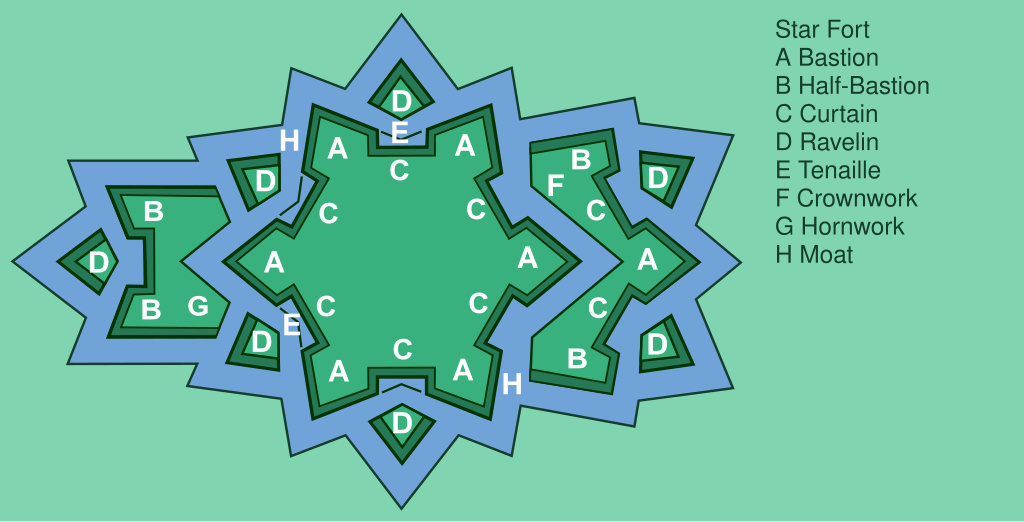
But the old projecting tower of the castle, you will recall, was designed to allow only a handful of defenders fire down any given section of wall; we still want that good enfilade fire effect, but we need a lot more space to get enough muskets up there to develop that fire. The solution: the bastion. A bastion was an often diamond or triangular-shaped projection from the wall of the fort, which provided a longer stretch of protected wall which could fire down the length of the curtain wall. It consists of two “flanks” which meet the curtain wall and are perpendicular to it, allowing fire along the wall; the “faces” (also two) then face outward, away from the fort to direct fire at distant besiegers. When places at the corners of forts, this setup tends to produce outward-spiked diamonds, while a bastion set along a flat face of curtain wall tends to resemble an irregular pentagon (“home plate”) shape [Wiki]. The added benefit for these angles? From the enemy siege lines, they present an oblique profile to enemy artillery, making the bastions quite hard to batter down with cannon, since shots will tend to ricochet off of the slanted line.
In the simplest trace italienne forts [Wiki], this is all you will need: four or five thick-and-low curtain walls to make the shape, plus a bastion at each corner (also thick-and-low, sometimes hollow, sometimes all at the height of the wall-walk), with a dry moat (read: big ditch) running the perimeter to slow down attackers, increase the effective height of the wall and shield the base of the curtain wall from artillery fire.
But why stay simple, there’s so much more we can do! First of all, our enemy, we assume, have cannon. Probably lots of cannon. And while our walls are now cannon resistant, they’re not cannon immune; pound on them long enough and there will be a breach. Of course collapsing a bastion is both hard (because it is angled) and doesn’t produce a breach, but the curtain walls both have to run perpendicular to the enemy’s firing position (because they have to enclose something) and if breached will allow access to the fort. We have to protect them! Of course one option is to protect them with fire, which is why our bastions have faces; note above how while the flanks of the bastions are designed for small arms, the faces are built with cannon in mind: this is for counter-battery fire against a besieger, to silence his cannon and protect the curtain wall. But our besieger wouldn’t be here if they didn’t think they could decisively outshoot our defensive guns.
But we can protect the curtain further, and further complicate the attack with outworks [Wiki], effectively little mini-bastions projecting off of the main wall which both provide advanced firing positions (which do not provide access to the fort and so which can be safely abandoned if necessary) and physically obstruct the curtain wall itself from enemy fire. The most basic of these was a ravelin (also called a “demi-lune”), which was essentially a “flying” bastion – a triangular earthwork set out from the walls. Ravelins are almost always hollow (that is, the walls only face away from the fort), so that if attackers were to seize a ravelin, they’d have no cover from fire coming from the main bastions and the curtain wall.
And now, unlike the Modern Major-General, you know what is meant by a ravelin … but are you still, in matters vegetable, animal and mineral, the very model of a modern Major-General?
But we can take this even further (can you tell I just love these damn forts?). A big part of our defense is developing fire from our bastions with our own cannon to force back enemy artillery. But our bastions are potentially vulnerable themselves; our ravelins cover their flanks, but the bastion faces could be battered down. We need some way to prevent the enemy from aiming effective fire at the base of our bastion. The solution? A crownwork. Essentially a super-ravelin, the crownwork contains a full bastion at its center (but lower than our main bastion, so we can fire over it), along with two half-bastions (called, wait for it, “demi-bastions”) to provide a ton of enfilade fire along the curtain wall, physically shielding our bastion from fire and giving us a forward fighting position we can use to protect our big guns up in the bastion. A smaller version of the crownwork, called a hornwork can also be used: this is just the two half-bastions with the full bastion removed, often used to shield ravelins (so you have a hornwork shielding a ravelin shielding the curtain wall shielding the fort). For good measure, we can connect these outworks to the main fort with removable little wooden bridges so we can easily move from the main fort out to the outworks, but if the enemy takes an outwork, we can quickly cut it off and – because the outworks are all made hollow – shoot down the attackers who cannot take cover within the hollow shape.
An ideal form of a bastion fortress to show each kind of common work and outwork.
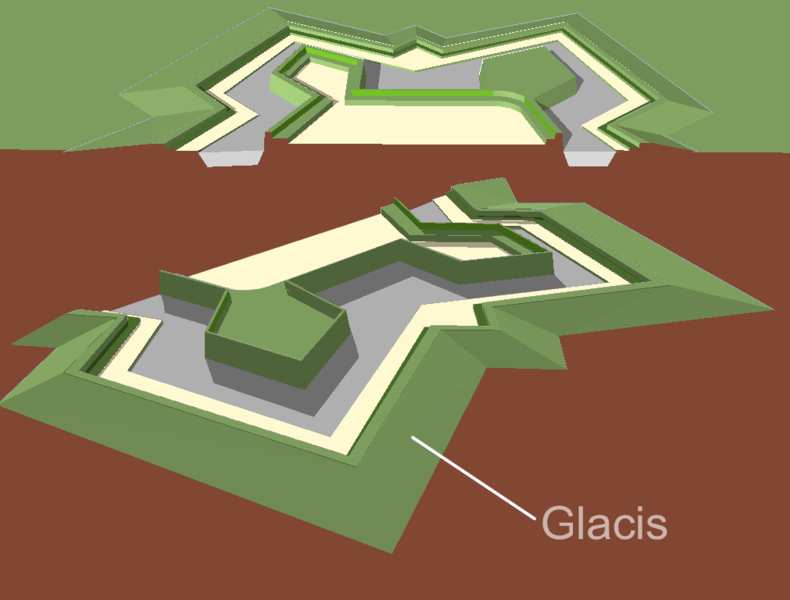
Drawing by Francis Lima via Wikimedia Commons.We can also do some work with the moat. By adding an earthwork directly in front of it, which arcs slightly uphill, called a glacis, we can both put the enemy at an angle where shots from our wall will run parallel to the ground, thus exposing the attackers further as they advance, and create a position for our own troops to come out of the fort and fire from further forward, by having them crouch in the moat behind the glacis. Indeed, having prepared, covered forward positions (which are designed to be entirely open to the fort) for firing from at defenders is extremely handy, so we could even put such firing positions – set up in these same, carefully mathematically calculated angle shapes, but much lower to the ground – out in front of the glacis; these get all sorts of names: a counterguard or couvreface if they’re a simple triangle-shape, a redan if they have something closer to a shallow bastion shape, and a flèche if they have a sharper, more pronounced face. Thus as an enemy advances, defending skirmishers can first fire from the redans and flèches, before falling back to fire from the glacis while the main garrison fires over their heads into the enemy from the bastions and outworks themselves.
A diagram showing a glacis supporting a pair of bastions, one hollow, one not.
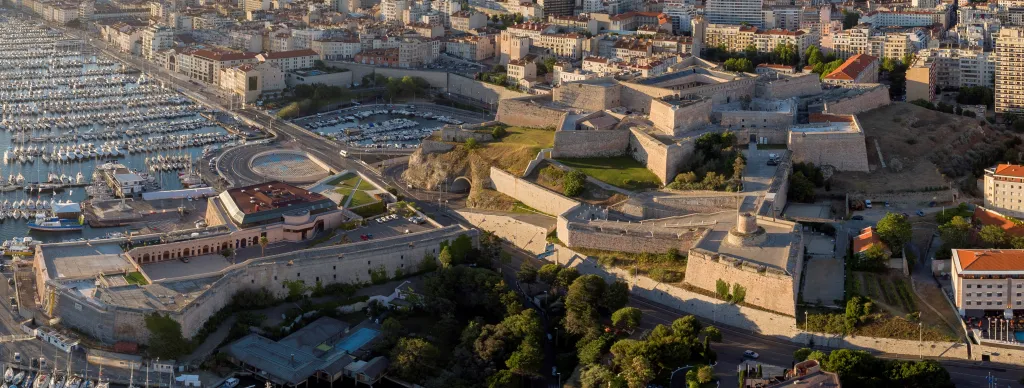
Diagram by Arch via Wikimedia Commons.At the same time, a bastion fortress complex might connect multiple complete circuits. In some cases, an entire bastion fort might be placed within the first, merely elevated above it (the term for this is a “cavalier“) so that both could fire, one over the other. Alternately, when entire cities were enclosed in these fortification systems (and that was common along the fracture zones between the emerging European great powers), something as large as a city might require an extensive fortress system, with bastions and outworks running the whole perimeter of the city, sometimes with nearly complete bastion fortresses placed within the network as citadels.
Fort Saint-Nicolas, which dominates the Old Port of Marseille. The fort forms part of a system with the low outwork you see here and also an older refitted castle, Fort Saint-Jean, on the other side of the harbor.
Photo via Wikimedia Commons.All of this geometry needed to be carefully laid out to ensure that all lines of approach were covered with as much fire as possible and that there were no blindspots along the wall. That in turn meant that the designers of these fortresses needed to be careful with their layout: the spacing, angles and lines all needed to be right, which required quite a lot of math and geometry to manage. Combined with the increasing importance of ballistics for calculating artillery trajectories, this led to an increasing emphasis on mathematics in the “science of warfare”, to the point that some military theorists began to argue (particularly as one pushes into the Enlightenment with its emphasis on the power of reason, logic and empirical investigation to answer all questions) that military affairs could be reduced to pure calculation, a “hard science” as it were, a point which Clausewitz (drink!) goes out of his way to dismiss (as does Ardant du Picq in Battle Studies, but at substantially greater length). But it isn’t hard to see how, in the heady centuries between 1500 and 1800 how the rapid way that science had revolutionized war and reduced activities once governed by tradition and habit to exercises in geometry, one might look forward and assume that trend would continue until the whole affair of war could be reduced to a set of theorems and postulates. It cannot be, of course – the problem is the human element (though the military training of those centuries worked hard to try to turn men into “mechanical soldiers” who could be expected to perform their role with the same neat mathmatical precision of a trace italienne ravelin). Nevertheless this tension – between the science of war and its art – was not new (it dates back at least as far as Hellenistic military manuals) nor is it yet settled.
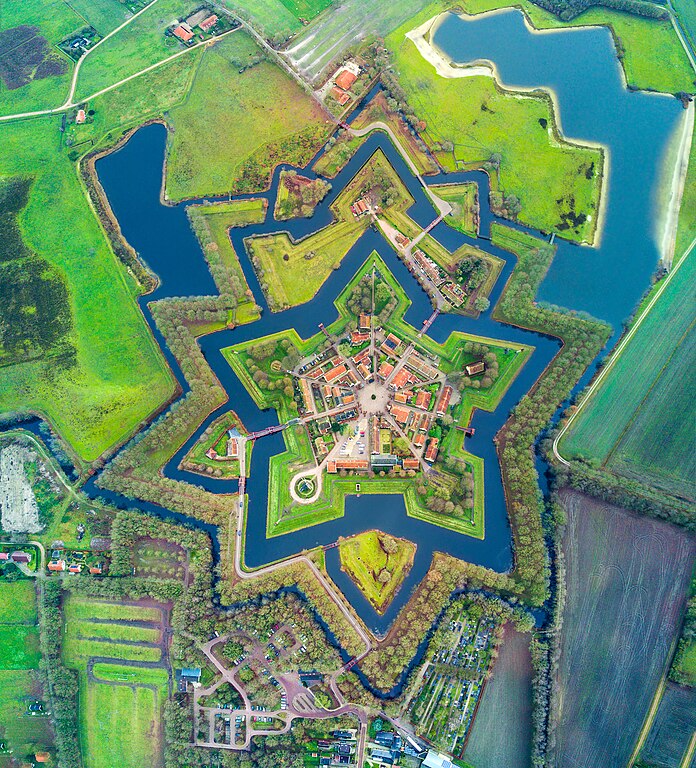
An aerial view of the Bourtange Fortress in Groningen, Netherlands. Built in 1593, the fort has been restored to its 1750s configuration, seen here.
Photo by Dack9 via Wikimedia Commons.But coming back to our fancy forts, of course such fortresses required larger and larger garrisons to fire all of the muskets and cannon that their firepower oriented defense plans required. Fortunately for the fortress designers, state capacity in Europe was rising rapidly and so larger and larger armies were ready to hand. That causes all sorts of other knock on effects we’re not directly concerned with here (but see the bibliography at the top). For us, the more immediate problem is, well, now we’ve built one of these things … how on earth does one besiege it?
Bret Devereaux, “Collections: Fortification, Part IV: French Guns and Italian Lines”, A Collection of Unmitigated Pedantry, 2021-12-17.
Comments Off on QotD: The trace italienne in fortification design
November 27, 2024
The Korean War 023 – The Eagle Versus the Dragon – November 26, 1950
The Korean War by Indy Neidell
Published 26 Nov 2024Thanksgiving 1950 comes and goes in the snowy north of Korea, and Eighth Army’s push to the Yalu River begins the following day. It soon becomes apparent, though, that the Communist Chinese are ready and waiting for them, in numbers greater than anyone on the UN side have predicted. After weeks of preamble and preparation, the two forces finally collide in full strength.
Chapters
00:00 Intro
00:51 Recap
01:16 X Corps
03:14 Turkey Time
05:50 The US Offensive
09:05 The Second Phase Offensive
12:39 East Flank Disaster
15:27 Summary
15:47 Conclusion
(more…)
Comments Off on The Korean War 023 – The Eagle Versus the Dragon – November 26, 1950
The Deadly Job of Royal Food Taster
Tasting History with Max Miller
Published Jul 23, 2024Sautéed mushrooms in a honey, long pepper, and garum glaze
City/Region: Rome
Time Period: 1st CenturyFood tasters checking for poison aren’t around so much anymore, but it was an important job for thousands of years. But what happens when the food taster is the one adding in the poison?
Emperor Claudius found this out the hard way when he supposedly ate some of his favorite mushrooms, and then became the victim of a double-poisoning by his taster and his physician.
We can’t know for sure what Emperor Claudius’s favorite mushroom dish was, but I wouldn’t be surprised if it was this. I don’t care for the texture of mushrooms, but the flavor is excellent. The sweetness from the honey, spiciness from the long pepper, and the earthiness of the mushrooms combine for a complex dish that is delicious.
Another Method for Mushrooms
Place the chopped stalks in a clean pan, adding pepper, lovage, and a little honey. Mix with garum. Add a little oil.
— Apicius de re coquinaria, 1st century
Comments Off on The Deadly Job of Royal Food Taster
QotD: The Great Library and its competitors
The Ptolemies were not the only successors to Alexander who built a Mouseion with a library; their Seleucid rivals in Syria also built one in Antioch in the reigns of Antiochus IX Eusebes (114-95 BC) or Antiochus X Philopater (95-92 BC). Roman aristocrats and rulers also included the establishment of substantial libraries as part of their civic service. Julius Caesar had intended to establish a library next to the Forum in Rome but this was ultimately achieved after his death by Gaius Asinius Pollio (75 BC – 4 AD), a soldier, politician and scholar who retired to a life of study after the tumults of the Civil Wars. Augustus established the Palatine Library in the Temple of Apollo and founded another one in the Portus Octaviae, next to the Theatre of Marcellus at the southern end of the Field of Mars. Vespasian established one in the Temple of Peace in 70 AD, but probably the largest of the Roman libraries was that of Trajan in his new forum beside the famous column that celebrates his Dacian wars. As mentioned above, this large building probably contained around 20,000 scrolls and had two main chambers – one for Greek and the other for Latin authors. Trajan’s library also seems to have established a design and layout that would be the model for libraries for centuries: a hall with desks and tables for readers with books in niches or shelves around the walls and on a mezzanine level. Libraries also came to be established in Roman bath complexes, with a very large one at the Baths of Caracalla and another at the Baths of Diocletian.
Several of these libraries were substantial. The Library of Celsus at Ephesus was built in c. 117 AD by the son of Tiberius Julius Celsus Polemaeanus in honour of his father, who had been a senator and consul in Rome, and its reconstructed facade is one of the major archaeological features of the site today. It was said to be the third largest library in the ancient world, surpassed only by the great libraries of Pergamon and Alexandria. The Great Library of Pergamon was established by the Attalid rulers of that city state and it was the true rival of the library of the Alexandrian Mouseion. It is said that the Ptolemies were so threatened by its size and the reputation of its scholars that they banned the export of papyrus to Pergamon, causing the Attalids to commission the invention of parchment as a substitute, though this is most likely a legend. What is absolutely clear, however, is that the idea that the Great Library of Alexandria was unique, whether in nature or even in size, is nonsense.
The weird idea that the loss of the Great Library was some kind of singular disaster is at least partially due to the fact that none of the various other great libraries of the ancient world are known to casual readers, so it may be easy for them to assume it was somehow unique. It also seems to stem, again, from the emphasis in popular sources on the mythical immense size of its collection which, as discussed above, is based on a naive acceptance of varied and wildly exaggerated sources. Finally, it seems to stem in no small part from (yet again) Sagan’s influential but fanciful picture of the institution as a distinctively secular hub of scientific research and, by implication, technological innovation.
Tim O’Neill, “The Great Myths 5: The Destruction Of The Great Library Of Alexandria”, History for Atheists, 2017-07-02.
Comments Off on QotD: The Great Library and its competitors
November 26, 2024
Orwell is more relevant now than at any time since his death
I’m delighted to find that Andrew Doyle shares my preference for Orwell the essayist over Orwell the novelist:
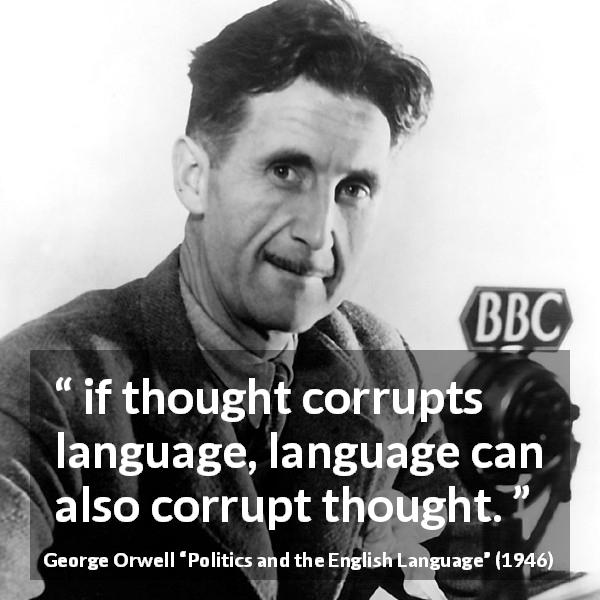
It is not without justification that Animal Farm (1945) and Nineteen Eighty-Four (1949) have become the keystones of George Orwell’s legacy. Personally, I’ve always favoured his essays, more often quoted than read in full. I recently wrote an article about his essays for the Washington Post, focusing on their relevance to today’s febrile political climate. You can read the article here. I would draw particular attention to the multitude of comments from left-wing readers who are apparently outraged at my argument (actually, Orwell’s argument) that authoritarianism is not specific to any one political tribe. They seem oddly determined to prove the point.
Orwell is unrivalled on the topic of the human instinct for oppressive behaviour, but his essays are far more wide-ranging than that. In these little masterworks, one senses a great thinker testing his own theses, forever fluctuating, refining his views in the very act of writing. The essays span the last two decades of his life, offering us the most direct possible insight into this unique mind.
[…]
I find Orwell’s disquisitions on literature to be among his most rewarding. “All art is propaganda”, he declares in his extended piece on Charles Dickens (1940) [link]. This conviction, flawed as is it, accounts for his determination to focus less on Dickens’s literary merits and more on his class consciousness, which is found wanting. Even better is Orwell’s rebuttal to Tolstoy’s strangely literal-minded reading of Shakespeare (1947’s “Lear, Tolstoy and the Fool” [link]), which is so rhetorically deft that it seems to settle the matter for good.
Another impressive essay, “Inside the Whale” (1940) [link], opens with a glowing assessment of Henry Miller’s Tropic of Cancer (1935) but soon broadens its range to cover many contemporary novelists and their approach to social commentary. The title is a reference to Miller’s remarks on the Biblical tale of Jonah, suggesting that life inside the whale has much to recommend it. Orwell puts it this way:
There you are, in the dark, cushioned space that exactly fits you, with yards of blubber between yourself and reality, able to keep up an attitude of the completest indifference, no matter what happens.
Orwell invites us to imagine that the whale is transparent, and so writers of Miller’s ilk may snuggle contentedly within, observing without interacting, recording snapshots of the world as it bounces by. This kind of inaction is anathema to Orwell, whose every written word seems to be driving towards the enactment of social change.
Orwell’s essays often serve as a cudgel to batter his detractors. He dislikes homosexuals, or those “fashionable pansies” who lack the masculine vigour to take up arms in defence of their country. He displays a similar lack of patience for the imperialistic middle-class “Blimps” and the anti-patriotic left-wing intelligentsia, or indeed anyone who adheres slavishly to any given political ideology. His work bears much of the stamp of the old left; that mix of social conservatism and economic leftism that we see most powerfully expressed in his 1941 essay “The Lion and the Unicorn” [link]. Bad writing is also a recurring bugbear; Orwell’s loathing of cliché and “ready-made metaphors” is one of the reasons his own prose style is so effervescent.
[…]
When Orwell pessimistically refers to “the remaining years of free speech”, one cannot help but be reminded of the increasingly authoritarian tendencies of today’s British government. He expresses irritation that more writers are not wielding their pens in the service of improving society. His own work, by contrast, is what he would term “constructive”, profoundly moral, and purposefully crafted in the hope of actuating real-world change. While other writers resigned themselves to a life inside the whale, Orwell was determined to cut his way out.
Comments Off on Orwell is more relevant now than at any time since his death
The ghost airport of Nicosia: Rare glimpse inside the abandoned 1974 battleground
Forces News
Published Jul 20, 2024Nicosia International Airport was once a busy hub full of holidaymakers but since the Cyprus conflict of 1974, it has been frozen in time.
Today, the disused airport resembles a ghost town as it sits abandoned in the 180km buffer zone dividing the Republic of Cyprus and the Turkish-occupied north.
On the 50th anniversary of the conflict, Forces News goes inside the eerie airport and learns how it became the site of a major battle.
(more…)
Comments Off on The ghost airport of Nicosia: Rare glimpse inside the abandoned 1974 battleground
November 25, 2024
Looking toward the first order effects of 47
At Postcards From Barsoom, John Carter is delighted that his pessimistic election forecast turned out to be wrong and considers what the incoming Trump administration will be doing in the short-term:
There are obvious parallels between the 2024 election, the 2016 election, and the Brexit vote, all of which are a bit awkward for elite theory maximalists. Their position, taken to its extreme, seems to be that only the elite can actually do things, that all political phenomena are ultimately a consequence of elite machinations. Which makes elite theory in many ways the highbrow version of conspiracy theory, the main difference being that they talk about the Cathedral’s systems of power instead of the Illuminati, the Freemasons, and smoky backrooms. And yet, the elite clearly don’t always get their way. In the case of Brexit, the elite were absolutely unanimous in their support for Remain … and the elite lost. Similarly in the case of the 2016 US election. Elite preferences carry an enormous amount of weight; it’s generally much better for a cause to have elite support than suffer elite opposition. But elites are not actually decisive. They can be beaten.
It’s obviously much too early to judge the 47th US presidency, which hasn’t started yet. Cynics expect a repeat of 2016: just as Trump’s promises to drain the swamp and build the wall came to, if not nothing, then very little, so will his promises to deport them all, replace the income tax with tariffs, reign in the universities by going after their accreditation and endowments, drain the swamp for real this time, and so on prove to be so much hot air. So far all we know are Trump’s cabinet picks and other appointments, which suggest that this cynicism might be premature. […]
The new Trump admin shows every sign of gearing up for a Dark MAGA rampage through the Beltway.
If you’re curious about where Dark MAGA came from, why yes it was memed into reality. Aristophanes
tells the wild saga: from in-joke to shitcoin to the hat on Elon Musk’s head.They aren’t going to just drain the swamp. They’re going to drain it, dry it, soak it in gasoline, and set it on fire. They are going to purge the US government of the useless, the incompetent, the subversive, and the criminal. At least, that seems to be the intention … and given the way the rats are scrambling to escape the ship before it sinks, the regime’s minions, at least, seem to think that plan has a good chance of succeeding. […]
Of course, a lot could happen between now and January. The Democrats might find some convoluted legal pathway to deprive The Insurrectionist of the Oval Office, as Tree of Woe suggested, which of course would initiate a constitutional crisis and probably a civil war. They could assassinate him, which would also probably start a civil war, and which is probably why Trump has been holed up in Mar-a-Lago since the election. Either of these outcomes would probably place JD Vance in the presidency, which is probably much worse for the regime than Trump: Vance is marine corps combat vet who reads Curtis Yarvin and is fluent enough in meme that he probably has a frog alt on Twitter.
[…]
News that suicides spiked after the election is apparently fake, though crisis call centres catering to the Pronoun Jugend did experience a massive increase, and one guy apparently unalived his entire family. They’re still in a state of shock: shaving their heads, vowing to start a sex strike, fleeing to Canada (I do not recommend).
The left are religious fanatics, and religious fanatics don’t give up just because it looks hopeless. It’s also worth recalling that the last time Trump won, the riots didn’t start until inauguration. There’s plenty of time yet, and there are a lot of very wealthy and very influential people who probably feel they have nothing to lose as their precious oxen are in danger of being lethally gored by Dark MAGA on the Washington Mall as a sacrifice to America’s Founding gods, after which they themselves will be hanged from Wotan’s Tree of Liberty. Note that it doesn’t matter if Trump will really follow through with all of this; what matters is if the other side thinks that he will. Ruling out a dramatic escalation in civil violence in the US is almost certainly hasty.
[…]
Another play the regime could make is to just start World War III before Trump takes office, either in order to justify a military coup d’etat, or just to dump a catastrophe in Trump’s lap so that he’ll be too busy dealing with that to drain the swamp. They definitely seem to be ramping things up in Ukraine, with the new strategy of long-distance missile strikes deep into Russian territory. The idea is probably to provoke the bear so badly that it starts mauling NATO countries directly, rather than just chewing through their exhausted national arsenals in the mud of the Donbass. That might work; then again, Putin knows full well that all he has to do is wait a couple months and he’ll be dealing with Trump directly, and Trump is on record as wanting to wind down hostilities as a top priority as soon as he’s in office. Vlad may be a bad man, but he is a very patient bad man.
Assuming that the regime is unsuccessful in baiting Russia into a direct attack on Europe, Trump’s victory probably has very big, tumultuous, and positive implications for European politics. Positive, at least, for anyone who doesn’t hate Europe … and therefore very bad implications for the people currently running the civilizational centre of the human species into the dirt.
The Germans, at least, seem to think so.
Yes, it’s real.
Chancellor Scholz’ unstable “traffic light” coalition disintegrated almost immediately after Trump was elected, sending Germany into its own election … in which the AfD is poised to do very well for itself, much to the consternation of Germany’s political class. eugyppius has been doing invaluable work covering Germany’s politics for the anglosphere audience; he provides an excellent overview of the reasons for the coalition’s collapse in this recent interview on the J Burden show.



Comments Off on Looking toward the first order effects of 47
The Experimental SOE Welrod MkI Prototype
Forgotten Weapons
Published Aug 12, 2024The Welrod was a program to develop a silent assassination pistol for British SOE (Special Operations Executive) late in 1942. It needed to be chambered in the .32 ACP cartridge, be effective to a range of 15m, and have its firing not recognizable as a firearm at 50m distance. The project was led by Major Hugh Quentin Reeves, who developed much of SOE’s inventory of gadgets.
The Welrod concept was ready in January 1943, and it was not quite the Welrod that we recognize today. This initial MkI design used a fixed internal 5-round magazine and a thumb trigger, along with a rifle style bolt action mechanism. Samples were produced in April 1943, and testing showed that it was rather awkward to use. A MkII version was quickly developed in June 1943 with a more traditional style of grip and magazine, and formal trials led to the adoption of that MkII design. Incidentally, this is why the first Welrod produced was the MkII, and the later production version in 9mm was designated the MkI (it was the first mark of 9mm Welrod).
Eventually many thousands of Welrod pistols were manufactured, and they almost certainly remain in limited use to this day. This example we have today is the only surviving MkI example, however.
(more…)
Comments Off on The Experimental SOE Welrod MkI Prototype
QotD: Le Corbusier
But most bureaucrats aren’t evil, just ignorant … and as Scott shows, this ignorance isn’t really their fault. They don’t know what they don’t know, because they can’t know. Very few bureaucratic cock-ups are as blatant as Chandigarh, where all anyone has to do is look at pictures for five minutes to conclude “you couldn’t pay me enough to move there”.
Severian, “The Finger is Not the Moon”, Rotten Chestnuts, 2021-09-14.
Comments Off on QotD: Le Corbusier
November 24, 2024
“… if Russia were found to have had its own troops assemble a long-range missile and help launch it into the United States, do you think a US president would feel able to let it slide?”
It probably tightened a lot of already tight sphincters when it was announced that President Biden had authorized the Ukrainian government to use US-supplied long-range missiles to attack targets on Russian soil:
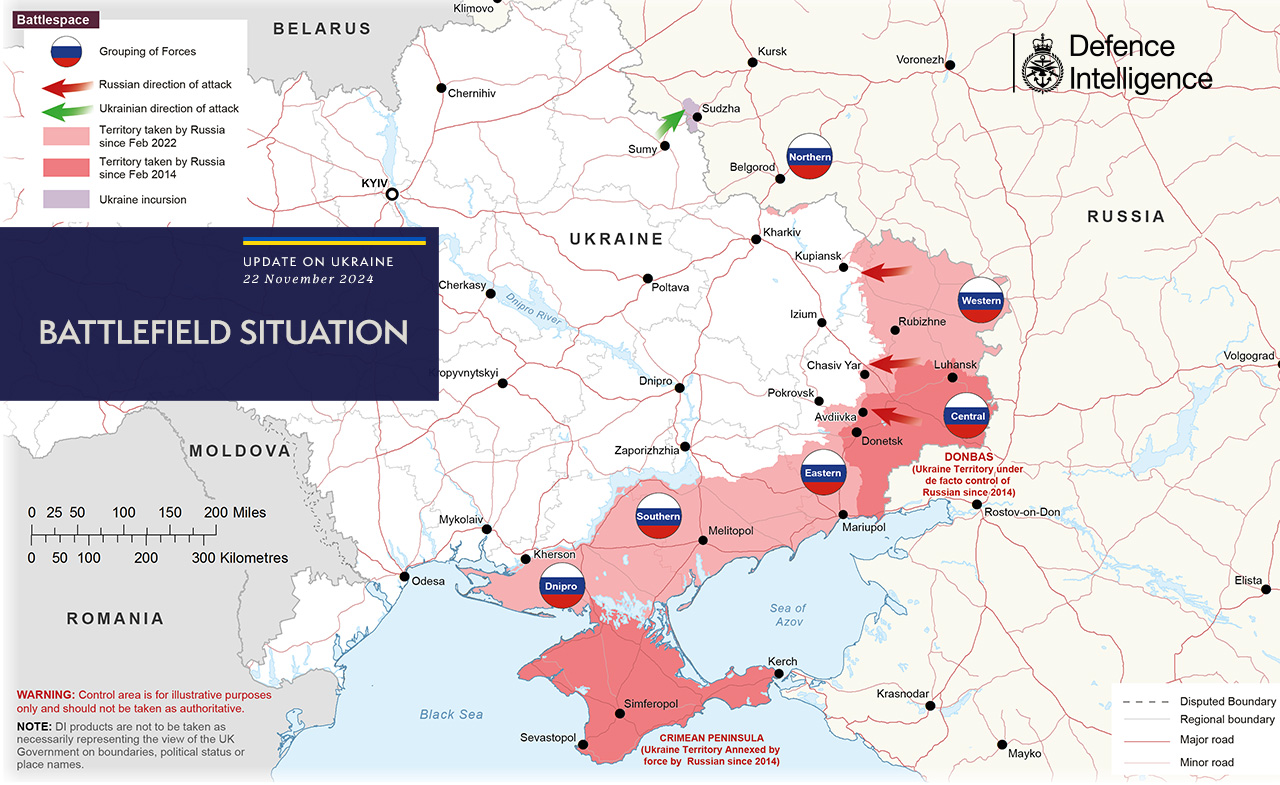
There was something truly surreal about President Biden suddenly changing course and agreeing to give Ukraine advanced long-range missiles to attack deep inside Russian territory in the last two months of his administration. There was no speech to the nation; no debate in the Senate; just a quiet demonstration of unilateral presidential fuck-you power. You know: the kind we’ve long worried about with Donald Trump. The missiles up the ante considerably against a nuclear power for a simple reason. As Putin noted:
experts are well aware, and the Russian side has repeatedly emphasized this, that it is it is impossible to use such weapons without the direct involvement of military specialists of the countries producing such weapons.
The tiny tsar continued:
We consider ourselves entitled to use our weapons against the military facilities of those countries that allow to use their weapons against our facilities. And in case of escalation of aggressive actions we will respond also decisively and mirrored.
And he looked on edge, bedraggled and belligerent, his arms and hands not moving a millimeter in what sure looks like AI.
There was a time when a NATO missile strike on Russian territory, followed by a Russian threat to attack NATO “military facilities” in response, would have caused the world to stop dead, paralyzed by the fear of nuclear armageddon. Yet here we are, blithely preoccupied by Pete Hegseth’s sexual exploits and Congressional bathrooms.
Others are not so sanguine. “I believe that in 2024 we can absolutely believe that the Third World War has begun,” Ukraine’s former military chief, Valery Zaluzhny, warned yesterday, noting both the new involvement of NATO troops and the involvement of North Korea. Our own president, having brought us much closer to the brink as a lame duck, seemed unconcerned. He was last seen wandering off-stage in the vague direction of the Brazilian rainforest. Not optimal.
The UK prime minister, Keir Starmer, was even punchier, and pledged to allow Ukraine to use British long-range missiles as well: “We need to double down. We need to make sure Ukraine has what is necessary for as long as necessary, because we cannot allow Putin to win this war”. When asked if he was prepared to risk the UK forces or Ukraine or a third country like Poland being nuked in response, as Putin has threatened, Starmer simply ignored the question.
Meanwhile, just to keep things from escalating, the deputy chief of the British defense staff told a parliamentary committee yesterday:
If the British Army was asked to fight tonight, it would fight tonight. I don’t think anybody in this room should be under any illusion that if the Russians invaded Eastern Europe tonight, then we would meet them in that fight.
There seems to be a general impression that Putin is of course bluffing, that NATO can keep lobbing missiles into Russian territory with minimal consequences, and nothing could possibly go wrong.
But Putin has responded by launching a long-range missile that could be used to carry a nuke but didn’t, as well as lowering the bar for the use of nukes in his military “doctrine“. And ask yourself: if Russia were found to have had its own troops assemble a long-range missile and help launch it into the United States, do you think a US president would feel able to let it slide? Here’s what the British missile, the Storm Shadow, did in hitting an underground military facility in Kursk, according to unverified Russia media sources:
[The strike] resulted in the Death of 18 Russian Officers, including a Senior Commander, as well as 3 North Korean Officers. In addition, a Dozen other Soldiers and Officers were Wounded in the Attack, including one of North Korea’s most Senior Generals.
I can’t verify that, but it’s perfectly possible. To have NATO’s fingers on the targeting and launch of that missile puts us in a whole new category of conflict.
The job of a president is to keep us far, far away from any risk of nuclear conflict, as Biden seemed to understand until now. And any student of history will know that blithe complacency as two sides trade military escalations is often exactly the precursor to something going very, very wrong. Accidents happen; misjudgments occur; the point of never getting to this point is that this point contains a host of unknowables, some of them globally existential.
I assume that this is all about strengthening Kyiv’s hand in what will be grueling negotiations to end the conflict once Donald Trump gets back into office. Or the intelligence is worse than we know and it’s about avoiding an Ukraine collapse before Biden leaves office — which, after Afghanistan, would be a final, damning verdict on his foreign policy. Or the intelligence is better than we know and the Russian economy is so weak and his military so depleted that NATO thinks this extra pressure will force Putin to crack. Or it’s a norm-defying attempt from an outgoing administration to derail any peace process the incoming one might want to start. The latter possibility — with Biden rolling the dice because he thinks someone else will have to face the music — is not a minimal risk.
How Allied and Nazi Generals Created the Clean Wehrmacht Myth
World War Two
Published 23 Nov 2024After the fall of the Third Reich, many of Hitler’s generals are convicted as war criminals by the Allies and condemned to prison and disgrace. Yet, within a few years, the Western Powers embrace them Cold War partners against the Soviet Union. In this new alliance, they rewrite history and create the enduring myth of the “clean Wehrmacht“.
(more…)
Comments Off on How Allied and Nazi Generals Created the Clean Wehrmacht Myth
How Newfoundland and Labrador lost their independence
Geography By Geoff
Published Jul 16, 2024Did you know that Newfoundland and Labrador were once an independent country in the same manner as Canada was? It’s true! It was called the Dominion of Newfoundland and due to a series of unfortunate events, it had to relinquish its independence. In today’s video, we cover the vast geography of the province, it’s very old history (including Vikings!) and how the country managed to lose its independence when it managed to survive on its own for decades. Oh … and we’ll also talk about why Labrador got included in the name upon confederating with Canada.
(more…)
Comments Off on How Newfoundland and Labrador lost their independence
November 23, 2024
How the US Paranoia of Leftism was Born
World War Two
Published 21 Nov 2024Elizabeth Bentley’s defection in 1945 didn’t just expose a Soviet spy network — it fueled America’s second Red Scare and a wave of anti-communist paranoia. Her revelations about Soviet infiltration within the U.S. government became a catalyst for McCarthyism, reshaping American politics and society in an era defined by fear and suspicion.
(more…)
Comments Off on How the US Paranoia of Leftism was Born


