Quotulatiousness

September 6, 2011

Switzerland devalues the franc

Filed under: Economics, Europe — Tags: , , — Nicholas @ 12:06

In what appears to be a successful attempt to devalue their currency, the Swiss have announced that they will peg the franc at €0.83, or SFr1.20 to the euro:

The Swiss National Bank in effect devalued the franc, pledging to buy “unlimited quantities” of foreign currencies to force down its value. The SNB warned that it would no longer allow one Swiss franc to be worth more than €0.83 — equivalent to SFr1.20 to the euro — having watched the two currencies move closer to parity as Switzerland became a “safe haven” from the ravages of the eurozone crisis.

The move stunned currency traders, and sent the Swiss franc tumbling against other currencies. Jeremy Cook, chief economist at currency brokers World First, said it was “intervention on a grand scale”, and the start of a “new battle in the currency wars”.

“That was the single largest foreign exchange move I have ever seen … The Swiss franc has lost close on 9% in the past 15 minutes. This dwarfs moves seen post-Lehman brothers, 7/7, and other major geo-political events in the past decade,” Cook said.

September 5, 2011

How the wreck of a ship-of-the-line led to the Mary Rose

Filed under: Britain, History — Tags: , , , — Nicholas @ 10:41

The bottom of the Solent must be carpeted with shipwrecks:

According to naval historian Dr John Bevan, the largely forgotten flagship, which sank in the Solent at Spithead in August 1782, helped divers to locate the wreckage of the Mary Rose in the 1830s — a full 150 years before the stricken vessel was raised from the seabed.

More than 900 people died when the Royal George sank, including 300 women and 60 children who were visiting the ship which was due to head for Gibraltar with HMS Victory.

It was the biggest loss of life in British waters.

The 100-gun battleship had been heeled on to its side for repairs to be carried out on its sea cock — a valve on the hull — when it began to take in water though its open gun ports. It capsized and sank.

“For weeks after the tragedy, bodies washed ashore at Southsea, Gosport and Ryde and were buried in mass graves along the seafront,” said Royal Marines Museum historian Stuart Haven.

The Royal George remained in shallow water just beyond the entrance to Portsmouth harbour for many years, “her masts standing above the water a macabre reminder of the tragedy,” Mr Haven said.

Some 50 years later the pioneering divers Charles and John Deane tried to recover the battleship, which had become a hazard to other vessels.

Between 1834-36 the brothers undertook a series of dives.

September 4, 2011

James Delingpole forced to offer an apology

Filed under: Britain, Environment — Tags: , , — Nicholas @ 11:45

Yes, it’s true. Delingpole made an error in a recent column and has to make a full apology for the error:

It has been brought to my attention that this blog owes Sir Reginald Sheffield, Bt. an apology. In a recent column entitled Green Jobs? Wot Green Jobs? (Pt 242), I carelessly suggested that Sir Reg — beloved dad of the famous environmentalist “Sam Cam”; distinguished father-in-law of the Prime Minister of Great Britain and Northern Ireland, no less — is making nearly £1000 a week from the wind turbines on his estates.

The correct figure is, of course, nearly £1000 a day.

In other words, Sir Reginald is making the equivalent of roughly 1000 looted widescreen plasma TV screens every year from the eight 400 foot wind turbines now enhancing the view for miles around on his 3,000 acre Normanby Hall estate, near Scunthorpe.

There will be those who suggest that my mistake is a resigning matter. I do share their concern. However it is my view that if a journalist is going to resign on a point of principle these days, it has to be over something immeasurably trivial, rather than over something merely quite trivial. What I do nevertheless agree is that I owe Sir Reginald Sheffield, Bt, an apology.

A big apology.

Scottish Conservative party too tainted to survive, claims leadership candidate

Filed under: Britain, Politics — Tags: , — Nicholas @ 11:10

Scotland has not been kind to the Conservative party for the last few decades, and a candidate for the leadership thinks the solution is to destroy the party in order to save it:

The Scottish Tory party could be scrapped and replaced by a new centre-right party, under radical reform proposals drafted by the favourite to become its next leader.

Murdo Fraser, deputy leader of the Scottish Conservatives, will launch his campaign to head the party on Monday by claiming that its only hope to attract greater popular support would be to split off from the UK party led by David Cameron.

Fraser, a former chairman of the Scottish Young Conservatives, will argue that creating a new Scottish centre-right, tax-cutting party would allow it to build up a fresh political mandate and attract voters disenchanted by the current party, which has failed to recover significantly from 25 years of decline.

After losing every Scottish seat at the 1997 Westminster election, the party now has only one MP at Westminster, David Mundell, the Scotland Office minister. It won just 15 out of 129 seats for the Scottish parliament at the last Holyrood elections and has failed to benefit from the collapse in Liberal Democrat support in Scotland.

UK “will lose 2 to 3 per cent GDP a year for around 20 years” on renewable energy subsidies

A report in The Register says that the subsidies for green renewable energy will be a big net drain on the national economy:

The UK’s headlong rush into renewable energy — one ignored by the rest of the world — will hit British jobs and then general incomes, an economic study finds.

The report, The Myth of Green Jobs by economist Professor Gordon Hughes of Edinburgh University, examines the long-term impacts of subsidising expensive “green” renewable energy projects. It says that if the UK continues to do so, it will lose 2 to 3 per cent GDP a year for around 20 years. If reducing CO2 emissions is your goal, says Hughes, your economy really can’t afford renewable energy.

[. . .]

“All forms of green energy tend to be substantially more expensive than conventional energy, so there is a trade-off between higher costs and lower emissions,” writes Hughes. “This trade-off is not specific to green energy, since there are many ways of reducing emissions of greenhouse gases. Hence, the starting point of any assessment of such programmes should be the total cost per tonne of carbon dioxide saved — or its equivalent — which will be incurred by relying upon different measures or policies to reduce emissions.”

September 2, 2011

Christopher Howse welcomes the new dark (ages)

Filed under: Environment, Europe, Humour, Technology — Tags: , , , — Nicholas @ 12:20

A welcoming column on the new “lights” of modern Europe:

Normally, to read a book, one turns on the light. I had thought of that, but the numerous light switches in the room only brought a dim glow from various lengths of compact fluorescent lamps, some shaped like paperclips, others coiled like something from the pavements of dog-loving Dijon. You could tell that they were switched on, but it was as if someone had given the lights several coats of opalescent lacquer. It almost seemed as if the lamps attracted light gravitationally from nearby parts of the room, which were consequently left in shadow.

[. . .]

Except for not emitting light, there is little wrong with the new energy-saving bulbs, apart from their causing night-time falls, triggering epilepsy and storing up deadly poisons. But we must expect to make little sacrifices to save energy.

All over Europe, people are tumbling down the stairs in the small hours, snapping their femurs like breadsticks when they venture out of their bedrooms, perhaps to go to the loo – it isn’t unknown. That is because the energy-saving bulbs in the landing light take time to warm up. Those who survive the nocturnal pitfall soon notice that the new kind of bulbs flicker. For some, this triggers migraine; for others, epileptic fits. For me, it merely induces nausea and a sensation that the room is moving backwards and forwards. So I should count my blessings.

As for the mercury that the energy-saving bulbs contain, I have always found it a most beautiful metal, aptly named quicksilver, shining like the moon. Certainly, the effects of mercury poisoning are no fun: shedding of skin, loss of teeth and hair, salivation, sweating and forgetfulness. Yet anxiety about such matters is soon dispelled by the FAQs on the Energy Saving Trust website. “Energy-saving bulbs contain only tiny traces of mercury,” it says soothingly. “Imagine a pellet smaller than the tip of a Biro.” Yes, I’ve imagined that. It sounds ideal for the tip of a blowpipe-arrow or a Bulgarian secret service umbrella.

So remember to be very careful when you dispose of these wonderful new high-tech devices.

     . . . each fluorescent light bulb contains about 5 milligrams of mercury. Though the amount is tiny, 5 milligrams of mercury is enough to contaminate 6,000 gallons of drinking water, according to the Environmental Protection Agency (EPA).

     Low level mercury exposure (under 5 milligrams) can cause tremors, mood shifts, sleeplessness, muscle fatigue, and headaches. High level or extended length exposure can lead to learning disabilities, altered personality, deafness, loss of memory, chromosomal damage, and nerve, brain, and kidney damage, as stated by the EPA. There is a particular risk to the nervous systems of unborn babies and young children.

H/T to Chris Greaves for the link.

Doubts about Britain’s next proposed high speed rail line

Filed under: Britain, Economics, Environment, Technology — Tags: , , — Nicholas @ 08:12

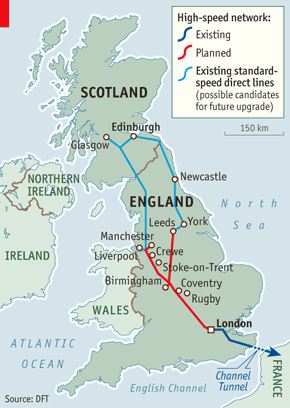
The Economist is usually pretty gung-ho about high speed rail development in general, so this article expressing some serious doubts is noteworthy:

Earlier this year the coalition government announced details of a £32 billion ($52 billion) super-fast railway line from London to Manchester and Leeds via Birmingham (see map). Philip Hammond, the transport secretary, claims it will be a “fast track” to prosperity. If the project goes ahead—and there is still, just, time to reconsider—the final route, and Stoke’s transport fate, will not be decided until 2012 at the earliest. The first trains won’t reach Birmingham until 2026, and Leeds and Manchester until 2032-3.



There are practical reasons to favour a new north-south line. Good infrastructure lasts a long time: Britain is still enjoying the fruits of Victorian railway investment. At some point in the next 20 years the existing west-coast main line will face a capacity crunch. Upgrading lines is disruptive and expensive, so constructing a new one appears sensible. The vision of a futuristic train scything across Britain at 250mph (400kph) is appealing.

But although the plan has cross-party support, the British public is not entirely convinced. Objections have so far focused on two concerns. First, the environmental damage, particularly to the Chilterns, an area of “outstanding natural beauty” and home to many well-off voters. Second, the business case for the line: the projected doubling of long-distance rail use by 2043 seems ambitious.

September 1, 2011

Did Google buy Motorola Mobility just for the tax advantages?

Filed under: Economics, Europe, Technology, USA — Tags: , , — Nicholas @ 12:12

If so, it was probably a brilliant move:

I think we all know that Google’s pretty good at, um, obeying tax laws to the letter. For example, they’ve paid an entire £8m in UK corporation tax on revenues of some £6bn from 2004 to 2010.

[. . .]

However, this deal to purchase Motorola Mobility might be a coup to beat that hands down. The headline price to purchase the handset-maker and their bundle of patents is $12.5bn but that’s not what the net cost to Google might turn out to be. How about $3.8bn for that? For, along with the company and the patents, Google has also bought a series of tax losses.

For the record, it’s cheap politics to accuse a person or a corporation for paying “only” so much tax. If the politicians have set up the system to allow certain deductions or credits, then you’re insane not to take advantage of them. Like a number of headlines over the last day or so, pointing out that this or that company paid less in taxes than they paid their CEO. If the company paid more than it should, it’s depriving its shareholders of what they are rightfully due, and will likely be facing them in court.

August 31, 2011

Far north transportation solution: heavy-lift dirigibles?

Filed under: Britain, Cancon, Technology — Tags: , — Nicholas @ 09:11

It’s like the airborne equivalent of the monorail: the wonderful solution to various air transportation problems. Unfortunately, they usually fail to live up to expectations. A joint British-Canadian effort to introduce heavy-lift airships for transportation in Canada’s far north hit the news today:

Last week, Yellowknife-based Discovery Air signed a preliminary agreement with British aviation startup Hybrid Air Vehicles to buy a fleet of futuristic dirigibles to haul cargo and supplies across the Canadian North

Costing $40-million each, the massive vehicles will be able to haul 50 tonnes of cargo, stay in the air for several weeks at a time and use a fraction of the fuel consumed by standard fixed-wing airliners.

By comparison, the largest aircraft in the current Discovery fleet can only carry 7,000 pounds and stay aloft for a matter of hours before refuelling.

The new vehicles, which are still in the early testing phase, may look like little more than sleek reboots of Depression-era dirigibles, but actually are a unique marriage of four different aviation technologies, say designers.

“It actually works more like an airplane than an airship,” said Gordon Taylor, marketing officer for Hybrid Air Vehicles.

The aircraft fly using a combination of aerodynamic lift and helium buoyancy, manoeuver by using a helicopter-style thrusters and they land on a curtain of air like a hovercraft.

It’ll be great if they can work as designed, and also survive the extreme weather conditions of Canada’s far north, but the smart money isn’t likely to bet that way.

Despite media reports, Australia didn’t “screw up” torpedo purchase

Filed under: Australia, France, Italy, Media, Military — Tags: , , — Nicholas @ 08:58

Strategy Page expresses a bit of contempt for the Fairfax media reporters who mangled a story to get a juicy headline or six:

Another good example of mass media screwing up a story on the military recently appeared in Australia. Fairfax, the largest media group in Australia ran a late August story asserting that the Australian Navy had mishandled the acquisition of new anti-submarine torpedo from France, and had to hire translators to turn the French and Italian user and technical manuals into English. The Defense Ministry quickly responded and pointed out that the Fairfax reporters had misunderstood the situation. The contract to purchase the torpedoes stipulated that all documents be in English. This is standard for such purchases, and has been for a long time. The Fairfax reporters should have known that. The Defense Ministry was hiring translators to handle additional data, not covered by the MU90 purchase, on some of the 200 test launches of the torpedo. This would save the Australian Navy a lot of money as some of their own test launches could be skipped, if the French and Italian tests covered the same situations. But the documents on most of those tests were in the language of the navy conducting them (French or Italian.) The reports were classified, but the two navies were willing to share them, although it was understood that Australia would have to handle translations. This has been standard practice for decades, but the Fairfax reporters didn’t dig that deep. This sort of facile military reporting has become increasingly common. It goes beyond calling all warships (except carriers and subs) “battleships” (a class of ship that went out of wide use half a century ago) or calling self-propelled artillery (or even infantry fighting vehicles) “tanks” simply because they all have turrets (but very different uses). The bad reporting extends to many other basic items of equipment, training, leadership, tactics and casualties.

The argument from the press is probably that the public doesn’t know — and doesn’t care about — the differences between warship classes or armoured vehicles anyway, so they don’t “waste their time” by being accurate.

August 30, 2011

Britons up in arms: Twinings to “change” Earl Grey tea

Filed under: Britain, Food, Randomness — Nicholas @ 07:42

Chris Greaves sent me this link, along with a hint that things could get dicey in English tea rooms:

Charles Grey, the second Earl Grey, gave the world many things, notable among them the Reform Act of 1832, but most of us remember him as the man they named a kind of tea after. Earl Grey is a brilliant tea; even its name conjures up both class and softness (most teas taste like they should be called Baron Harsh), and its taste — bergamot, by and large — is unique yet not too disturbing for the British palate.

I love it, and was once even mocked by John Cleese for ordering it at a writers’ meeting. (“Earl Grey?! Ooo! Ai’m going to have some AIRL GRAY!!” he yelled in a Monty Python shriek. He had himself ordered some sort of Californian fruit tea, so was not, I felt, in much of a position to criticise.)

Twinings’ bizarre plan to change the flavour of Earl Grey seems a misguided one. It has added more lemon and more bergamot to make it even more “wonderful”. Leaving aside the fact that only in the world of tea-producing have the words “more bergamot” and “wonderful” ever been combined, you do feel that they have, how can I put it, gone barmy. Earl Grey is Earl Grey. Variants like the apparently popular “Lady Grey” — it’s got orange in it — and this new Earl Grey Bergamot City, or whatever it’s called, are not really needed. (The Earl Grey-flavoured Kit-Kat was, if Wikipedia is to be believed, fortunately confined to the Japanese market.)

August 29, 2011

Site of Royal Navy’s WW1 submarine disaster to be used for wind farm

Filed under: Britain, History, Military, WW1 — Tags: , , — Nicholas @ 13:16

In 1918, the Royal Navy suffered the loss of two submarines, with another three damaged along with a light cruiser. And you’ve probably never heard of it. It’s okay, I hadn’t heard of it either, and the British government went to great lengths to conceal the incident, because no enemy vessels were involved:

An underwater war grave containing the victims of one of the worst British naval disasters of the first world war has been surveyed for the first time so it can be preserved in the middle of a windfarm.

The two K Class submarines were destroyed on 31 January 1918 during the so-called battle of the Isle of May, in which 270 lives were lost. The two submarines were sunk and three more damaged along with a surface cruiser.

But no enemy ships were involved in the sinkings, 20 miles off Fife Ness on Scotland’s east coast. The deaths were all caused by a series of night-time collisions within the British fleet.

So embarrassing was the incident that even though one officer was court-martialed, the facts were not generally admitted for more than 60 years, until after the death of the last survivor.

A longer account of the accident is on the Wikipedia page. It’s pretty grim reading.

August 28, 2011

Britain’s next military target?

Filed under: Britain, Humour, Military — Tags: , , , — Nicholas @ 09:29

James Delingpole tries to draw up a list of the next most likely place for David Cameron’s military adventure:

China

Pros: on the verge of taking over the world and enslaving us all; mines evil rare earth minerals in environmentally unfriendly fashion which Sam Cam, like, totally, like hates, even though it’s OK really because they go towards the wind farms which make Daddy nearly £1000 a day on his estates; a big, juicy target that would impress David Cameron’s Notting Hill friends way more than poxy Libya.

Cons: We’d lose

[. . .]

France

Pros: Would be hugely popular with the home crowd and guarantee re-election in 2015

Cons: Victory would depend, crucially, on whose turn it is to use the aircraft carrier.

[. . .]

The USA

Pros: Would send a clear signal to Guardianistas that Britain is not going to be “America’s poodle”; might well result in a sexy-sexy congratulatory tete a tete with Christine Lagarde; would make the Lib Dem element of the Coalition feel more at home than ever.

Cons: Our record of beating America in wars is not good. Then again, with a President as lame-duck as Obama in charge this could yet be our best hope.

August 27, 2011

World collapse explained in three minutes

Filed under: Economics, Europe, Government — Tags: , — Nicholas @ 13:39

Germany is an intensely weird place

Filed under: Europe, Germany, History, WW2 — Tags: , — Nicholas @ 12:30

Michael Lewis highlights one of the ways Germany is different from anywhere else on the planet:

Published in 1984 by a distinguished anthropologist named Alan Dundes, Life Is Like a Chicken Coop Ladder set out to describe the German character through the stories that ordinary Germans liked to tell one another. Dundes specialized in folklore, and in German folklore, as he put it, “one finds an inordinate number of texts concerned with anality. Scheisse (shit), Dreck (dirt), Mist (manure), Arsch (ass).… Folksongs, folktales, proverbs, riddles, folk speech — all attest to the Germans’ longstanding special interest in this area of human activity.”

He then proceeded to pile up a shockingly high stack of evidence to support his theory. There’s a popular German folk character called der Dukatenscheisser (“The Money Shitter”), who is commonly depicted crapping coins from his rear end. Europe’s only museum devoted exclusively to toilets was built in Munich. The German word for “shit” performs a vast number of bizarre linguistic duties — for instance, a common German term of endearment was once “my little shit bag.” The first thing Gutenberg sought to publish, after the Bible, was a laxative timetable he called a “Purgation-Calendar.” Then there are the astonishing number of anal German folk sayings: “As the fish lives in water, so does the shit stick to the asshole!,” to select but one of the seemingly endless examples.

Dundes caused a bit of a stir, for an anthropologist, by tracking this single low national character trait into the most important moments in German history. The fiercely scatological Martin Luther (“I am like ripe shit, and the world is a gigantic asshole,” Luther once explained) had the idea that launched the Protestant Reformation while sitting on the john. Mozart’s letters revealed a mind, as Dundes put it, whose “indulgence in fecal imagery may be virtually unmatched.” One of Hitler’s favorite words was Scheisskerl (“shithead”): he apparently used it to describe not only other people but himself as well. After the war, Hitler’s doctors told U.S. intelligence officers that their patient had devoted surprising energy to examining his own feces, and there was pretty strong evidence that one of his favorite things to do with women was to have them poop on him. Perhaps Hitler was so persuasive to Germans, Dundes suggested, because he shared their quintessential trait, a public abhorrence of filth that masked a private obsession. “The combination of clean and dirty: clean exterior-dirty interior, or clean form and dirty content — is very much a part of the German national character,” he wrote.

« Newer PostsOlder Posts »

Powered by WordPress