Quotulatiousness

January 6, 2014

Boris Johnson – Germany started the war

Filed under: Europe, Germany, History, WW1 — Tags: — Nicholas @ 08:29

In the Telegraph Boris Johnson is exasperated by recent comments that try to obscure or minimize the German role in starting the First World War:

It is a sad but undeniable fact that the First World War — in all its murderous horror — was overwhelmingly the result of German expansionism and aggression. That is a truism that has recently been restated by Max Hastings, in an excellent book, and that has been echoed by Michael Gove, the Education Secretary. I believe that analysis to be basically correct, and that it is all the more important, in this centenary year, that we remember it.

That fact is, alas, not one that the modern Labour Party believes it is polite to mention. According to the party’s education spokesman, Tristram Hunt, it is “crass” and “ugly” to say any such thing. It was “shocking”, he said in an article in yesterday’s Observer, that we continued to have this unacceptable focus on a “militaristic Germany bent on warmongering and imperial aggression”.

He went on — in a piece that deserves a Nobel prize for Tripe — to mount what appeared to be a kind of cock-eyed exculpation of the Kaiser and his generals. He pointed the finger, mystifyingly, at the Serbs. He blamed the Russians. He blamed the Turks for failing to keep the Ottoman empire together, and at one stage he suggested that we were too hard on the bellicose Junker class. He claimed that “modern scholarship” now believes that we have “underplayed the internal opposition to the Kaiser’s ideas within the German establishment” — as if that made things any better.

[…]

Hunt is guilty of talking total twaddle, but beneath his mushy-minded blether about “multiple histories” there is what he imagines is a kindly instinct. These wars were utterly horrific for the Germans as well as for everyone else, and the Germans today are very much our friends. He doesn’t want the 1914 commemorations to pander to xenophobia, or nationalism, or Kraut-bashing; and I am totally with him on that.

We all want to think of the Germans as they are today — a wonderful, peaceful, democratic country; one of our most important global friends and partners; a country with stunning technological attainments; a place of incomparable cultural richness and civilisation. What Hunt fails to understand — in his fastidious Lefty obfuscation of the truth — is that he is insulting the immense spiritual achievement of modern Germany.

The Germans are as they are today because they have been frank with themselves, and because over the past 60 years they have been agonisingly thorough in acknowledging the horror of what they did. They don’t try to brush it aside. They don’t blame the Serbs for the 1914-18 war. They don’t blame the Russians or the Turks. They know the price they paid for the militarism of the 20th century.

January 5, 2014

Infamous Edinburgh bodysnatchers’ final five victims?

Filed under: Britain, History — Tags: , , — Nicholas @ 10:36

If you’ve ever visited Edinburgh, you’ll probably have heard about the sinister pairing of Burke and Hare, the bodysnatchers who murdered 16 people and sold the bodies to medical students for dissection. In 2012, five skeletons were uncovered during a townhouse renovation in the Haymarket district, and it’s speculated that the four adults and a child were previously unknown victims:

Archaeologists have only now determined that the five date back to the early 19th century following studies by Historic Scotland and consultants Guard Archaeology.

Altogether around 60 bones were found, including four adult jawbones and others believed to be from a child.

The bodies are thought to be those of criminals or dwellers of the poor houses. Those that were not claimed were frequently used for either dissection, to be anatomical skeletons, or both.

Irish immigrants William Burke and William Hare murdered 16 people in Edinburgh in 1828 and sold the bodies as dissection material, but it is thought unlikely that the pair were responsible for the five found in Grove Street as the notoriety of their crimes means that all their victims are believed to have been accounted for.

John Lawson, from the Edinburgh City Council Archaeology Service, was the first to examine the remains on site.

He said: “At the end of the Enlightenment period there was significant demand for cad­avers and which indeed outstripped supply, and that led to a thriving illegal trade, with Burke and Hare clearly the most infamous of those who supplied bodies to medical schools.

“We can’t rule out that those found on Grove Street were sold by the resurrectionists, as they were called, although it might be a stretch to say it was Burke and Hare themselves, given their crimes are well-documented.”

He said that most would be used for dissection, with the skeletons of others used to teach anatomy to students.

But Lawson said it was still unclear why they would have been buried in the garden.

This is a good example of the division of work in the newsroom: the headline says the bodies are linked to Burke and Hare, while the article itself quotes an expert saying it’s “a stretch” to say that. Headlines are usually written by editors, rather than the journalists who put the stories together.

January 2, 2014

John and Sherlock

Filed under: Britain, Media — Tags: , , , , — Nicholas @ 09:26

The first episode of Sherlock season three was aired in the UK yesterday. On this side of the pond, we won’t get to see it until later in the year, so we have to rely on media reaction to the show, and Tim Stanley wasn’t over-pleased with the producers’ efforts, calling it a “roller-coaster ride” that “leaves you confused and nauseous”:

Holmes has always been a wonder, but here he is wondrous to the point of smug and irritating. How can Watson love him? Presumably because they are such good friends and one of Sherlock‘s strong points is the genuine chemistry between Martin Freeman and Benedict Cumberbatch. But even this comes with an irritating postmodern twist. Everyone presumes they’re gay. Because of course if two men spend more than five minutes in each other’s company they’re obviously candidates for some Brokeback-style hot cowboy action in a tent.

One of the saddest things about our culture is the death of brotherhood. Watch any of the pre-Millennium Sherlocks and you’ll be in no doubt that these men would take a bullet for one another. In the excellent Murder By Decree, Christopher Plummer and James Mason’s heroes are so tender that they share a blanket on a carriage ride — Sherlock gently tucking Watson in. When Vasily Livanov’s Holmes “dies” in the Russian version of The Final Problem, Vitaly Solomin’s Watson collapses against a tree and weeps uncontrollably. But no one ever questions their sexual preference. There’s no need to. They’re just friends.

By contrast, contemporary British culture has become so pornified and sex-obsessed that the running gag in Sherlock is that everyone thinks Cumberbatch and Freeman are in a civil partnership. Don’t get me wrong — I’m sure there’s an enjoyable version of Holmes yet to be written in which they’re at it like knives. But the constant snickering that goes on in Sherlock just adds to a sense of the show’s lack of maturity. It’s knowing, clever-clever, hip, ironic, tech-obsessed, geeky, hipster and just about everything else that gets in the way of a sophisticated yarn well told. For that, you have to go back to the Jeremy Brett Sherlock, which was distinctly lacking in action but high on good prose. Most episodes were an hour of Jeremy sitting in the gloom in Baker Street complaining that he’s got nothing to do. Compulsive viewing.

December 28, 2013

Facebook ages out

Filed under: Europe, Technology — Tags: , , , — Nicholas @ 10:12

In the Guardian, Jemima Kiss explains why European teens are finding other social networking tools to be more attractive than Facebook:

Facebook is ‘dead and buried’ to older teenagers, an extensive European study has found, as the key age group moves on to Twitter, Instagram, WhatsApp and Snapchat.

Researching the Facebook use of 16-18 year olds in eight EU countries, the Global Social Media Impact Study found that as parents and older users saturate Facebook, its younger users are shifting to alternative platforms.

Facebook is not just on the slide — it is basically dead and buried,” wrote Daniel Miller, lead anthropologist on the research team, who is professor of material culture of University College London.

“Mostly they feel embarrassed to even be associated with it. Where once parents worried about their children joining Facebook, the children now say it is their family that insists they stay there to post about their lives.”

Teens do not care that alternative services are less functional and sophisticated, and they also unconcerned about how information about them is being used commercially or as part of surveillance practice by the security services, the research found.

“What appears to be the most seminal moment in a young person’s decision to leave Facebook was surely that dreaded day your mum sends you a friend request,” wrote Miller.

December 27, 2013

QotD: The Church of England

Filed under: Britain, Humour, Quotations, Religion — Tags: , , — Nicholas @ 08:47

“Getting the PM to choose the right bishop is like a conjuror getting a member of the audience to choose a card. With the Church of England the choice is usually between a knave and a queen.”

“The bench of bishops should have a proper balance between those who believe in God and those who don’t.”

“Bishops tend to live a long time, perhaps because the Almighty is not all that keen for them to join him.”

“The plans for a new church in South London had places for dispensing orange juice, family planning, and organizing demos, but nowhere to celebrate Holy Communion.”

“Theology is a device for helping agnostics to stay within the Church of England.”

“The Queen is inseparable from the Church of England. God is an optional extra.”

Jonathan Lynn, “Yes Minister Series: Quotes from the dialogue”, JonathanLynn.com

December 24, 2013

The challenge facing all modern armed forces

Filed under: Britain, Military — Tags: , , — Nicholas @ 10:04

Sir Humphrey is on-the-money with his disdain for “fantasy fleet” enthusiasts and those nostalgic for the days when the Soviet hordes were poised to descend on Western Europe at the drop of a helmet. While he’s talking specifically about the British army, Royal Navy, and Royal Air Force, the very same issues are being faced in all Western nations. He also explains why cuts to armies are easier to make than cuts to navies or air forces:

In broad terms the General noted the real difficulties for the armed forces in the current operating environment, noting “The advent of more diverse and less state based threats has become an increasing feature of the age. Most mature Western democracies no longer face existential state-on-state threats in classic force-on-force terms. Rather the challenges are more insidious. There are threats which relate to terrorism, to international crime, to energy resources and critical national infrastructure. There are challenges to our human security, our way of life; there are hazards which derive from the dangerous conditions attendant on a warming planet. And these are threats which have emerged in the rising domain of warfare: cyberspace”.

This is a useful reminder to those whose belief that force structures today do not allow us to defend against the encroaching Soviet hordes — there is a very good reason for that! It is genuinely difficult to envision circumstances at present where the UK would be dragged unwillingly into a physically existential battle for survival against another state. Instead our threats are more challenging — if you consider the damage that can be done from a well placed cyber attack, it could be argued that there is no need for a conventional military existential threat now. A well placed cyber unit able to carry out crippling attacks on national infrastructures, power and support services could probably do more damage in one fell swoop than a sustained air campaign could over many months. It may be better to suggest that we simultaneously do not face a credible military existential threat, but there is a very credible existential threat from both nations and third party groups from the cyberspace domain.

The question that always needs to be at the top of the agenda when discussing military spending is “What specific and general threats to the nation need to be warded against?” rather than “How many tanks/planes/ships do we want?” With the F-35 decision looming near for many NATO countries, the initial cost of the planes is only part of the economic picture:

For instance consider the cost of providing a fast jet training pipeline — from the initial flying training through to conversion aircraft and the provision of instructors, tactics schools, opposition jets for sorties etc — to sustain a pipeline for an ever small fast jet fleet looks horrendously expensive. When you consider that most NATO nations are going to be operating fleets of less than 50 fast jets in future, the cost of providing a purely national solution to the pipeline will be an ever larger proportion of the total budget. One can easily see a case for trying to provide a multi-national solution for many of the smaller nations, if only to keep them credibly in the fast jet game, otherwise in a few years time it may well be the case that they simply cannot afford to stay in the fast jet business.

Not to denigrate the army — I was an army reservist in my time — but the cost to train soldiers for the majority of combat or combat support roles is only a fraction of what is needed to train sailors or aircrew:

It is easy to focus on pure numbers and not look beneath at the make up of the force. For instance the Army requires a larger manpower pool, but its manning pyramid is perhaps disproportionately focused on providing lots of junior troops (Pts & Lcpls) who have the lowest salaries and often require the least amount of technical training. There is also some flex in the system in that you can bear a gap of a couple of junior troops or SNCOs on a Company or Battalion sized deployment. By contrast the Royal Navy relies heavily on a very skilled and technical workforce — the days of ships being manned by the press gang being long gone. To operate a Frigate needs highly skilled operators and engineers to run the very complex equipment on board. If you look the collective man years of training required to put a fully effective Frigates crew to sea, you are talking about needing centuries of investment. Even a junior weapons or mechanical engineering rating requires several years of training to be at the stage where they are operationally useful. By contrast an Army private can be doing a role in an infantry unit within a year.

This higher training footprint has several issues — it costs more to run the shore schools like COLLINGWOOD and SULTAN. It means the crews generally require higher salaries and retention incentives to stay in for the medium term, as the private sector will quickly try and lure disaffected sailors with higher pay packets. Additionally the impact of a well-qualified rating leaving can often have a direct impact on the ability of a ship to deploy. For instance, in the nuclear submarine fleet, the loss of a suitably qualified nuclear SNCO watchkeeper could theoretically prevent deployment of a submarine until the gap is filled. It also takes many years to train a replacement — people leaving early will leave gaps in the system that will take years to fill. What this means is that as training cuts bite, and deployments are extended to cover the gaps caused by having less ships available, the pressure on the RN workforce grows. The more people who leave early, the harder it is for the RN to keep ships at sea for the medium term. The problem also grows as the more gaps that exist, the harder those who are left have to work, thus increasing the likelihood of them leaving too.

And the folks whose views of a “proper military” are based on their early collections of Airfix ship and tank models:

It also served as a useful reminder that the ability to rapidly regenerate the front line no longer exists. If you browse the net, you quickly come across ‘fantasy fleet’ sites where discussions quickly veer into the impossible wishlisting of new ships for the RN. What is often forgotten is that to use the ships / tanks / planes, you need the training pipeline in place to support them. People forget that the 2010 SDSR slashed the underpinning training and support services for the front line. Not only were units cut, but the assumptions on how many people would be needed in future was also reduced. This means that the manpower and equipment to rapidly grow the forces doesn’t exist anymore. There is little point in saying ‘we need 20 extra frigates or 3 more Typhoon squadrons’ because the pipeline to produce that many people with the right skills in the right timeline simply isn’t there. The hollow force is a good demonstration of what happens when you focus on buying new equipment over investing in the equally vital support services linked to it.

Brendan O’Neill on how to become a cause célèbre

Filed under: Media, Russia — Tags: , , — Nicholas @ 09:25

It may sound rather cynical, but it does seem to capture the essential elements:

Yesterday, as the world cheered the release of two members of the punk band Pussy Riot from prison in Russia, 450 members of the Muslim Brotherhood went on hunger strike in jails in Egypt. These political prisoners, whose ‘crimes’ include supporting deposed President Mohamed Morsi and taking part in protests calling for his reinstatement, have received rather less global sympathy than Pussy Riot. Even when, last month, 14 women and seven girls were sentenced to 11 years’ imprisonment in Egypt for taking part in an unauthorised pro-Morsi protest, still there was little global outrage. The women and girls (whose punishment has since been reduced to a one-year suspended sentence) were not emblazoned on trendy Westerners’ t-shirts; Madonna didn’t demand their release; Amnesty didn’t pump vast amounts of its resources into calling for their sentences to be squashed, as it has done with Pussy Riot, who have been its main campaigning priority over the past year.

So what does it take for political prisoners to become a cause célèbre among influential Westerners? How can political prisoners overseas win the attention and flattery of human-rights groups, celebs and the concerned commentariat? Here’s an invaluable guide for any locked-up man or woman of conscience who craves the support of human-rights activists.

December 21, 2013

QotD: Baldrick and the workhouse Nativity play

Filed under: Britain, Humour — Tags: , , — Nicholas @ 00:01

Baldrick: I’ve been helping out with the workhouse Nativity play.

Ebenezer Blackadder: Oh, of course. How did it go?

Baldrick: Well, not very well. At the last moment, the baby playing Jesus died!

Ebenezer Blackadder: Oh, dear! This high infant mortality rate’s a real devil when it comes to staging quality children’s theatre. What did you do?

Baldrick: Got another Jesus.

Ebenezer Blackadder: Oh, thank goodness. And his name?

Baldrick: “Spot.” There weren’t any more children so we had to settle for a dog instead.

Ebenezer Blackadder: Oh, dear. I’m not convinced that Christianity would have established its firm grip over the hearts and minds of mankind, if all Jesus had ever said was “woof!”

Baldrick: Well, it went all right until the shepherds came on. See, we haven’t been able to get any real sheep, so we had to stick some wool…

Ebenezer Blackadder: On some other dogs!

Baldrick: Yeah. And the moment Jesus got a whiff of them, he’s away! While the angel’s singing “peace on earth, good will to mankind,” Jesus scampers across and tries to get one of the sheep to give him a piggy-back ride!

Ebenezer Blackadder: Scarcely appropriate behavior for the Son of God, Mister Baldrick! Weren’t the children upset?

Baldrick: No, they loved it! They want us to do another one at Easter. They want to see us nail up the dog!

Blackadder’s Christmas Carol, 1988.

December 19, 2013

Patrick West on “the mourning wars”

Filed under: Britain, History, Media, Politics — Tags: , , — Nicholas @ 09:07

In sp!ked, Patrick West notes the difference in tone for two recently deceased world leaders:

Remember when Margaret Thatcher died in April? ‘Ding dong, the witch is dead!’ they rejoiced on the streets and on social media, the recalcitrant losers of the old left uniting with today’s self-styled radicals, for whom Thatcher was a semi-mythical creature from the past who had wronged their ancestors. The Iron Lady was a mean old bitch, they cried, her creed of individualism being responsible for today’s troubled times.

A few months later, the hero of the left dies. Where was the comparable vitriol from the right, as was expected, about ‘Nelson Mandela the terrorist’? Sure, there was the odd, fringe UKIP fruitcake (isn’t there always?), but for the most part there was warmth and praise. Some, like former UK prime minister John Major, even said that the Conservatives were wrong on South Africa in the 1980s. Even the right-wing press has been quiet on Mandela’s real legacy and South Africa’s future. Curiously, only the Guardian — in articles by Simon Jenkins and Slavoj Žižek — has really questioned the saintly status accorded to Madiba (though not nearly as well as spiked has done, of course).

Indeed, the only tangible vitriol to emerge has come from old lefties themselves, complaining on social media when David Cameron paid homage. How dare the Tories try to appropriate a foreign leader to make themselves appear virtuous? We bagsied him first!

Politics isn’t meant to be this way. Right-wing people are meant to be horrid and selfish and left-wingers caring and nice. Yet, episodes such as this seem to suggest, once again, the opposite. It’s one of the paradoxes today that the liberal-left is often far nastier, more vitriolic, censorious and egotistical than the ‘selfish’ Tories they profess to loath.

QotD: Blackadder greets Queen Victoria and Prince Albert

Filed under: Britain, Humour — Tags: , , — Nicholas @ 00:01

Ebenezer Blackadder: Cork it, fatso! Don’t you realise that this is the Victorian Age, where apart from Queen Piglet-Features herself, women and children are to be seen and not heard!

Prince Albert: Queen Piglet-Features!

Ebenezer Blackadder: Yes! “Empress Oink,” us lads call her. The only person in the kingdom who looks dafter than her is that stupid Frankfurter of a husband. “The Pig and the Prig,” we call them. How they ever managed to produce their one hundred and twelve children is quite beyond me. The bed-chambers of Buckingham Palace must be copiously supplied with blindfolds!

Blackadder’s Christmas Carol, 1988.

December 18, 2013

Bank of England switching to plastic from paper

Filed under: Britain — Tags: , , — Nicholas @ 09:41

Following the example of Australia (and more recently, Canada), the Bank of England will be printing bank notes on plastic from 2016 onwards:

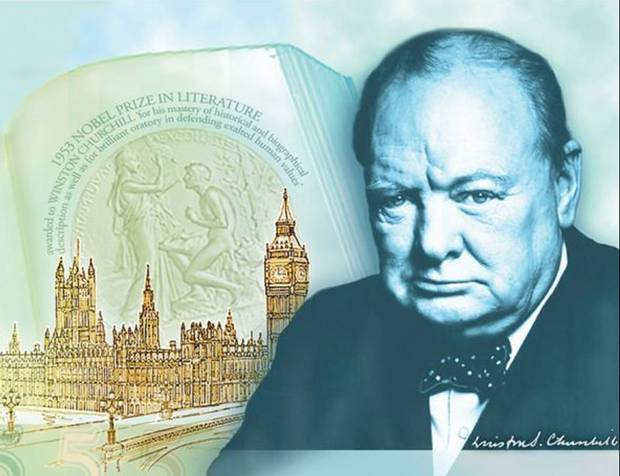
Winston Churchill concept art for 5 pound note

Mark Carney, the governor of the Bank of England, has formally announced that Britain will switch to using plastic banknotes in 2016, ending 320 years of paper money.

After a public consultation in which 87% of the 13,000 respondents backed the new-style currency, the Bank said it would introduce “polymer” notes, as it prefers to call them, in two years’ time, starting with the new £5 note featuring Winston Churchill in 2016 and the Jane Austen £10 a year later.

Speaking at a press conference in the Bank’s Threadneedle Street headquarters, Carney said: “Our polymer notes will combine the best of progress and tradition. They will be more secure from counterfeiting and more resistant to damage while celebrating the history and tradition that is important both to the Bank and the nation as a whole.”

The move follows Carney’s native Canada, where plastic notes are being rolled out, and Australia, where they have been in circulation for more than two decades.

Carney launched a public consultation on polymer banknotes, seen as cleaner and more durable, shortly after arriving at the Bank this summer. However, the Bank’s notes division has been considering plastic money for several years.

I’m still not convinced about the Canadian polymer banknotes: they tend to stick together much more than the paper notes did and they are reportedly susceptible to “fusing” together in high heat.

QotD: Blackadder and Melchet exchange Christmas greetings

Filed under: Britain, Humour — Tags: , — Nicholas @ 08:51

Lord Edmund Blackadder: I trust Christmas brings to you its traditional mix of good food and violent stomach cramp.

Lord Melchet: Greetings of the season to you, Blackadder! May the Yule log slip from your fire and burn your house down!

Blackadder’s Christmas Carol, 1988.

December 17, 2013

Sherlock Series 3 Launch Trailer – BBC One

Filed under: Britain, Media — Tags: , — Nicholas @ 10:26

December 11, 2013

The media and the Mandela funeral

Filed under: Africa, Britain, Media — Tags: , , , — Nicholas @ 10:29

In the Guardian Simon Jenkins discusses the way the media covered Nelson Mandela’s funeral:

Enough is enough. The publicity for the death and funeral of Nelson Mandela has become absurd. Mandela was an African political leader with qualities that were apt at a crucial juncture in his nation’s affairs. That was all and that was enough. Yet his reputation has fallen among thieves and cynics. Hijacked by politicians and celebrities from Barack Obama to Naomi Campbell and Sepp Blatter, he has had to be deified so as to dust others with his glory. In the process he has become dehumanised. We hear much of the banality of evil. Sometimes we should note the banality of goodness.

Part of this is due to the media’s crude mechanics. Millions of dollars have been lavished on preparing for Mandela’s death. Staff have been deployed, hotels booked, huts rented in Transkei villages. Hospitals could have been built for what must have been spent. All media have gone mad. Last week I caught a BBC presenter, groaning with tedium, asking a guest to compare Mandela with Jesus. The corporation has reportedly received more than a thousand complaints about excessive coverage. Is it now preparing for a resurrection?

More serious is the obligation that the cult of the media-event should owe to history. There is no argument that in the 1980s Mandela was “a necessary icon” not just for South Africans but for the world in general. In what was wrongly presented as the last great act of imperial retreat, white men were caricatured as bad and black men good. The arrival of a gentlemanly black leader, even a former terrorist, well cast for beatification was a godsend.

[…]

Mandela was crucial to De Klerk’s task. He was an African aristocrat, articulate of his people’s aspirations, a reconciler and forgiver of past evils. Mandela seemed to embody the crossing of the racial divide, thus enabling De Klerk’s near impossible task. White South Africans would swear he was the only black leader who made them feel safe — with nervous glances at Desmond Tutu and others.

South Africa in the early 90s was no postcolonial retreat. It was a bargain between one set of tribes and another. For all the cruelties of the armed struggle, it was astonishingly sparing of blood. This was no Pakistan, no Sri Lanka, no Congo. The rise of majority rule in South Africa was one of the noblest moments in African history. The resulting Nobel peace prize was rightly shared between Mandela and De Klerk, a sharing that has been ignored by almost all the past week’s obituaries. There were two good men in Cape Town in 1990.

December 9, 2013

The “epidemic of slavery” in Britain is an urban legend

Filed under: Britain, Media — Tags: , , , — Nicholas @ 11:53

In sp!ked, Frank Furedi talks about the much-talked-about but almost certainly mythical “epidemic of slavery” in Britain:

A London detective inspector, Kevin Hyland, informed the world that ‘we have never seen anything of this magnitude before’. The UK home secretary, Theresa May, echoed his sentiments and said she would make tackling modern-day slavery her top priority. She said there was ‘one positive’ to the case of the south London slave house: the public had finally become aware of the issue of slavery, which, according to May, continues to have a ‘shocking presence in modern Britain’. By this time, claims that thousands of people in Britain were being held in conditions of ‘slavery’ were circulating in the media.

Detective inspector Hyland may not have seen ‘anything of this magnitude’ before — but the fact is that what he saw, or imagined he saw, was a fantasy of slavery rather than the grim reality of forced servitude. Indeed, the story of the south London slaves rapidly unravelled. Early reports hinted at a heroic rescue mission involving detailed planning and up to 40 police operatives. But within a few days it became evident that the three ‘slaves’ were not slaves as we have traditionally understood that term. Certainly they were not physically held against their will. Contrary to early media reports, which suggested the three women had been imprisoned in a house for 30 years, later accounts revealed that they went outdoors to run errands and had access to telephones and a television.

As the initial story of forced imprisonment became difficult to sustain, the narrative of scaremongering shifted — now focusing on the psychological and emotional horrors the women allegedly suffered. Suddenly, the image of the iron collar and chains used by slave-owners gave way to talk of ‘invisible handcuffs’. From this point on, the promoters of this urban legend about modern-day slavery argued that what is really significant about this hitherto unrecognised crime is not what can be seen by the naked eye but rather the often ‘invisible’ problem of mental enslavement. These are slaves who are not physically chained into a life of servitude, but rather are wrapped up in ‘emotional chains’ by their psychologically manipulative captors. ‘Brainwashed’ became the term most commonly used by campaigners spreading myths about an epidemic of ‘slavery’.

« Newer PostsOlder Posts »

Powered by WordPress


