
Published on 23 Mar 2015
Adolf Hitler later said about his experience on the Western Front that it was the happiest time of his life. His time on the front and at home influenced his understanding of society and nation, the military gave his life structure for the first time in his life. Indy tells you everything about the early life of the man who later would become the Führer.
March 26, 2015
Adolf Hitler in World War 1 I Portrait
Comments Off on Adolf Hitler in World War 1 I Portrait
March 25, 2015
Millennials, philosophical malaise, and the moving target of “adulthood”
In Spiked, Tom Slater reviews a recent book by Susan Neiman, calling it “the philosophical kick up the arse my generation so desperately needs”:
Why Grow Up?, the latest book by American philosopher and essayist Susan Neiman, begins with a slyly subversive statement: ‘Being grown up is itself an ideal.’ In Britain today, this couldn’t seem further from the truth. Today, we’re told, is the worst time to be reaching adulthood. With economic strife, rising house prices, tuition fees and widespread youth unemployment weighing on Generation Y’s pasty back, coming of age merely means coming to the realisation that debt, destitution and living with mum and dad into your thirties is your inevitable inheritance. And that’s hardly an adulthood worth having.
The question this book seeks to answer is why growing up seems such a grim prospect today. From the off, Neiman dispenses with the sort of neuroscientific apologism that we’ve become accustomed to in recent years. Within the current, fatalistic climate, adulthood has been defined down. The Science now says that adolescence stretches into your mid-twenties. But, as Neiman observes in her introduction, there’s nothing scientific about growing up. The lines between childhood, adolescence and adulthood are mutable, and have changed over time. Less than a century ago, childhood, as a time of pampered play and dependence, lasted barely a few years for the vast majority of the population. And when most young people were out of school and married by the end of their teens, adolescence – the rebellious grace period between Tonka trucks and 2.4 children – didn’t even exist.
Instead, Neiman presents adulthood as a process of coming to terms with the circumstances you find yourself in and then committing to changing them – reconciling the ‘is’ and the ‘ought’. She situates this in the history of Enlightenment thought, in which the doomy realism of Hume clashed with the rugged idealism of Rousseau. ‘It would take Kant’, Neiman writes, ‘to appreciate the fact that we must take both seriously – if we are ever to arrive at an adulthood we need not merely acquiesce in but actively claim as [our] own’.
Comments Off on Millennials, philosophical malaise, and the moving target of “adulthood”
March 23, 2015
What’s in a name?
Mark Steyn linked to this rather amusing communication from the British embassy in Moscow, back in 1943:

If it’s not quite legible, he also provided a text version:
H.M. EMBASSY
MOSCOWLord Pembroke
The Foreign Office
London6th April 1943
My Dear Reggie,
In these dark days man tends to look for little shafts of light that spill from Heaven. My days are probably darker than yours, and I need, my God I do, all the light I can get. But I am a decent fellow, and I do not want to be mean and selfish about what little brightness is shed upon me from time to time. So I propose to share with you a tiny flash that has illuminated my sombre life and tell you that God has given me a new Turkish colleague whose card tells me that he is called Mustapha Kunt.
We all feel like that, Reggie, now and then, especially when Spring is upon us, but few of us would care to put it on our cards. It takes a Turk to do that.
Archie
Sir Archibald Clark Kerr
H.M. Ambassador
Comments Off on What’s in a name?
Changing Times – Railroads & Canals I IT’S HISTORY
Published on 10 Mar 2015
It certainly is no big deal to have a small cruise along the canals or ride a train. But what is essential infrastructure today had to be invented out of necessity in the late 18th and early 19th century. In our new episode Brett tells you everything about canals and railways and how they changed the way we transport things.
Comments Off on Changing Times – Railroads & Canals I IT’S HISTORY
March 22, 2015
A different interpretation of the Battle of Bosworth
In the Telegraph, Chris Skidmore looks at the end of the Battle of Bosworth in the light of the injuries suffered by King Richard:
Richard III’s body was discovered among the dead strewn across the battlefield, “despoiled to the skin” and “all besprung with mire and filth”. It was hard to believe that this naked and bloodied corpse had once belonged to a king. Still Richard III’s body had one final journey to make. After “many other insults were heaped upon it”, one chronicler reported how “not very humanely, a halter was thrown round the neck, and it was carried to Leicester”. With “nought being left about him, so much as would cover his privy member”, the last Plantagenet king was trussed up on the back of a horse, “as a hog or another vile beast” to be brought into the town “for all men to wonder upon, and there lastly irreverently buried”.
The new king — Henry Tudor, now crowned Henry VII — had good reason to put Richard’s body on display. Few could believe that Richard was dead, much less that a Welsh rebel who had landed on the tip of Wales two weeks earlier, leading an army of a few thousand men, mostly French mercenaries, had defeated a reigning king. Only hours earlier, Richard had led his army of 15,000 men, the largest army ever assembled “on one side” that England had ever witnessed, into battle against a rebel army barely one third its size. Bosworth, quite simply, was a battle that Richard should never have lost. Why did it go so badly wrong?
Treason, without a doubt:
With the collapse of his vanguard, Richard would have expected that his rear-guard, led by Henry Percy, the earl of Northumberland, to provide re-inforcements. Instead the earl did nothing. One chronicler was insistent that ‘in the place where the earl of Northumberland was posted, with a large company of reasonably good men, no engagement could be discerned, and no battle blows given or received”. Northumberland, Jean Molinet observed, should have “charged the French” but instead “did nothing except to flee, both he and his company, and to abandon his King Richard” since he had already agreed a secret pact with Henry Tudor.
Northumberland was a northern lord whose own power had diminished over the past decade as a result of Richard’s rise to power. He had nothing to lose and everything to gain from abandoning his king. Other reports from the battlefield suggest that Northumberland may have not only left Richard to his fate, but actively turned against him and “left his position and passed in front of the king’s vanguard”, at which point, “turning his back on Earl Henry, he began to fight fiercely against the king’s van, and so did all the others who had plighted their faith to Earl Henry”. If this were the case, it would explain why Richard had been heard “shouting again and again that he was betrayed, and crying ‘Treason! Treason! Treason!’”
Not just treason, but double treason:
The “first onslaught” of Richard’s attack saw some men surrounding Tudor been killed instantly, including Henry’s standard bearer, William Brandon, standing just feet away. It seemed that victory was now in Richard’s grasp. Not only had some of Henry’s men chose to flee, his standard had been ‘thrown to the ground’. Henry’s own men were ‘now wholly distrustful of victory’. Richard’s frenzied energy seemed to be turning the tables, as the king “began to fight with much vigour, putting heart into those that remained loyal, so that by his sole effort he upheld the battle for a long time”. It was at this point that Sir William Stanley, having sat out the battle on its fringes, sent orders for his forces, numbering perhaps 3,000 men, to crash into the side of Richard’s detachment, taking Tudor’s side. Richard stood no chance. He was swept off his horse and into a marsh, where he was killed, “pierced with numerous deadly wounds” one chronicler wrote, “while fighting, and not in the act of flight”.
Update: Maclean’s has a long article up on the Canadian connections to Richard III.
Comments Off on A different interpretation of the Battle of Bosworth
QotD: Conveying useful information
I wish to be equally frank with the reader of this book. I wish here conscientiously to let forth its shortcomings. I wish no one to read this book under a misapprehension.
There will be no useful information in this book.
Anyone who should think that with the aid of this book he would be able to make a tour through Germany and the Black Forest would probably lose himself before he got to the Nore. That, at all events, would be the best thing that could happen to him. The farther away from home he got, the greater only would be his difficulties.
I do not regard the conveyance of useful information as my forte. This belief was not inborn with me; it has been driven home upon me by experience.
In my early journalistic days, I served upon a paper, the forerunner of many very popular periodicals of the present day. Our boast was that we combined instruction with amusement; as to what should be regarded as affording amusement and what instruction, the reader judged for himself. We gave advice to people about to marry — long, earnest advice that would, had they followed it, have made our circle of readers the envy of the whole married world. We told our subscribers how to make fortunes by keeping rabbits, giving facts and figures. The thing that must have surprised them was that we ourselves did not give up journalism and start rabbit-farming. Often and often have I proved conclusively from authoritative sources how a man starting a rabbit farm with twelve selected rabbits and a little judgment must, at the end of three years, be in receipt of an income of two thousand a year, rising rapidly; he simply could not help himself. He might not want the money. He might not know what to do with it when he had it. But there it was for him. I have never met a rabbit farmer myself worth two thousand a year, though I have known many start with the twelve necessary, assorted rabbits. Something has always gone wrong somewhere; maybe the continued atmosphere of a rabbit farm saps the judgment.
We told our readers how many bald-headed men there were in Iceland, and for all we knew our figures may have been correct; how many red herrings placed tail to mouth it would take to reach from London to Rome, which must have been useful to anyone desirous of laying down a line of red herrings from London to Rome, enabling him to order in the right quantity at the beginning; how many words the average woman spoke in a day; and other such like items of information calculated to make them wise and great beyond the readers of other journals.
Jerome K. Jerome, Three Men on the Bummel, 1914.
Comments Off on QotD: Conveying useful information
March 21, 2015
Who was Sappho?
In the New Yorker, Daniel Mendelsohn discusses our evolving views of the poet Sappho:
One day not long after New Year’s, 2012, an antiquities collector approached an eminent Oxford scholar for his opinion about some brownish, tattered scraps of writing. The collector’s identity has never been revealed, but the scholar was Dirk Obbink, a MacArthur-winning classicist whose specialty is the study of texts written on papyrus — the material, made of plant fibres, that was the paper of the ancient world. When pieced together, the scraps that the collector showed Obbink formed a fragment about seven inches long and four inches wide: a little larger than a woman’s hand. Densely covered with lines of black Greek characters, they had been extracted from a piece of desiccated cartonnage, a papier-mâché-like plaster that the Egyptians and Greeks used for everything from mummy cases to bookbindings. After acquiring the cartonnage at a Christie’s auction, the collector soaked it in a warm water solution to free up the precious bits of papyrus.
Judging from the style of the handwriting, Obbink estimated that it dated to around 200 A.D. But, as he looked at the curious pattern of the lines — repeated sequences of three long lines followed by a short fourth — he saw that the text, a poem whose beginning had disappeared but of which five stanzas were still intact, had to be older.
Much older: about a thousand years more ancient than the papyrus itself. The dialect, diction, and metre of these Greek verses were all typical of the work of Sappho, the seventh-century-B.C. lyric genius whose sometimes playful, sometimes anguished songs about her susceptibility to the graces of younger women bequeathed us the adjectives “sapphic” and “lesbian” (from the island of Lesbos, where she lived). The four-line stanzas were in fact part of a schema she is said to have invented, called the “sapphic stanza.” To clinch the identification, two names mentioned in the poem were ones that several ancient sources attribute to Sappho’s brothers. The text is now known as the “Brothers Poem.”
Remarkably enough, this was the second major Sappho find in a decade: another nearly complete poem, about the deprivations of old age, came to light in 2004. The new additions to the extant corpus of antiquity’s greatest female artist were reported in papers around the world, leaving scholars gratified and a bit dazzled. “Papyrological finds,” as one classicist put it, “ordinarily do not make international headlines.”
But then Sappho is no ordinary poet. For the better part of three millennia, she has been the subject of furious controversies — about her work, her family life, and, above all, her sexuality. In antiquity, literary critics praised her “sublime” style, even as comic playwrights ridiculed her allegedly loose morals. Legend has it that the early Church burned her works. (“A sex-crazed whore who sings of her own wantonness,” one theologian wrote, just as a scribe was meticulously copying out the lines that Obbink deciphered.) A millennium passed, and Byzantine grammarians were regretting that so little of her poetry had survived. Seven centuries later, Victorian scholars were doing their best to explain away her erotic predilections, while their literary contemporaries, the Decadents and the Aesthetes, seized on her verses for inspiration. Even today, experts can’t agree on whether the poems were performed in private or in public, by soloists or by choruses, or, indeed, whether they were meant to celebrate or to subvert the conventions of love and marriage. The last is a particularly loaded issue, given that, for many readers and scholars, Sappho has been a feminist heroine or a gay role model, or both. “As far as I knew, there was only me and a woman called Sappho,” the critic Judith Butler once remarked.
Comments Off on Who was Sappho?
British journalist mourns the loss of innocence in model railway layouts
From the tone of Mr. Simkins’ “shocked-and-horrified” tone, I can only assume he’s been in a coma since roughly 1967:
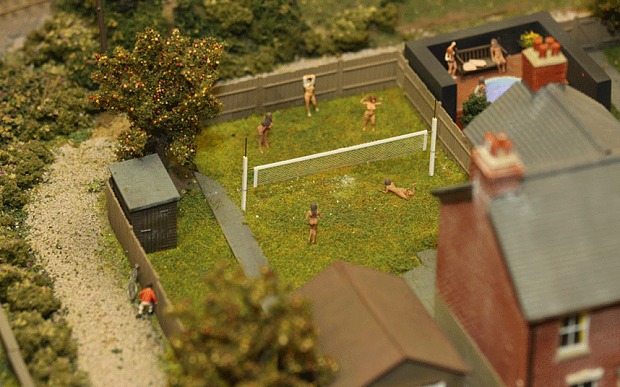
I’d always considered the world of model railways to be the last surviving example of a rose-tinted Britain that no longer exists. Enthusiasts of this quaint and captivating hobby invariably seem to use 1950 as their cultural template when designing their layouts.
In the real world it may all be Pendolino trains, gleaming concourses in steel and glass, and rail replacement bus services; but in model railwayland you’d always find puffing steam trains barrelling along in front of an idealised balsawood countryside that was never far from Adlestrop.
And therein, of course, lay their charm. Whenever I visited an exhibition I always revelled in the tiny trackside details as much as the engines themselves: the miniature sheep, the artificial grass, the miniature coal lorries waiting at the level crossing, and the old-fashioned station platforms.
Best of all, I loved the human figurines awaiting the arrival of the train they’re destined never to board. In the world of model railwayland, fashion as well as technology seemed to have stopped around the end of rationing, with each tiny passenger clad in pleated skirts or duffel coats.
But now an enterprising model railway emporium in Devon is set to shatter this cosy fictional world. Buffers of Axminster is selling a new range of steamy miniature figurines to reflect the laid-back (literally in some cases) attitudes and cultural mores of modern Britain.
They may be new to Mr. Simkins, but scale figures of nudes have been available as long as I can remember (although North American ads for them had to be careful not to expose too much scale detail, for fear of offending the postal authorities…)
H/T to Elizabeth for the link.
Comments Off on British journalist mourns the loss of innocence in model railway layouts
QotD: The modern snob
Walking through Amsterdam recently, a paradox that I had long noticed in an inchoate way formulated itself clearly in my mind. It was this: A century ago, there would have been one clothes shop for every hundred well-dressed people. Nowadays there is one well-dressed person (if that) for every hundred clothes shops. What accounts for this strange reversal of ratios?
Beyond the fact that clothes are now mass-produced rather than made individually, there is an act of will involved. Practically everyone now dresses not merely in a casual way, but with studied slovenliness for fear of being thought elegant, as elegance is a metonym for undemocratic sentiment or belief. You can dress as expensively as you like, indeed expensive scruffiness is a form of chic, but on no account must you dress with taste and discrimination. To do so might be to draw hostile attention to yourself. Who on Earth do you think you are to dress like that?
[…]
Modern scruffiness, then, is a manifestation of egotism. Outside one of the shops in Amsterdam was a large plasma screen showing models wearing the kind of clothes to be had within. They were precisely the insolently ragged clothes that the great majority of people in the street were wearing anyway. This was a form of flattery of the public, for it implied that its members had nothing to aspire to in the matter of dress higher than that which they themselves were already wearing — that in the matter of appearance they had already reached acme of the possible.
There was yet more. The models, in their T-shirts, baseball caps, sneakers, and so forth, as uniform as any army, walked with the kind of vulpine lope that one associates with the less law-abiding young males of the American ghettoes. But even more striking was the expression on their faces, which were cachectic in the case of the women, androgynous in the case of men: a fixed, determined, humorless stare that indicated a hatred of the world and all that was in it, including their fellow-beings. If one saw such a person at a social event, one would go to some effort to avoid or to flee or not to talk to him or her. The models’ faces were vacantly earnest, as if they wished for annihilation of everything around them for some personal reason, no doubt trifling.
This is the first age in which people do not dress to please others, but dress to displease others, to make sure that everyone knows that I’m not going to make any effort just for you. And this, no doubt, is because I am as good as anyone in the world, bar none: His Majesty, myself. And what starts out as an attitude becomes an unexamined and ingrained habit.
Theodore Dalrymple, “Slobbery as Snobbery”, Taki’s Magazine, 2014-06-15.
Comments Off on QotD: The modern snob
March 20, 2015
A Slice of The Pie – Splitting Up The Middle East I THE GREAT WAR Week 34
Published on 19 Mar 2015
Even though the Entente offensive near Constantinople didn’t really take off yet, the allied powers were already dreaming about splitting up the Ottoman Empire between themselves – and even promised territory to other nations. In the meantime, Austria-Hungary started its third offensive in the Carpathians to free the besieged army in Galicia.
Comments Off on A Slice of The Pie – Splitting Up The Middle East I THE GREAT WAR Week 34
March 19, 2015
Thirty years on, what was the impact of the Miners’ strike in Britain?
Frank Furedi points out six ways that Britain’s political scene has changed as a result of the year-long miners’ strike:
To defeat the National Union of Miners, UK prime minister Margaret Thatcher and her Conservative government had to use almost every available resource, including the mass mobilisation of the police. The Miners’ Strike became the defining event of British politics in the 1980s. And in retrospect, it’s clear that it was the last class-focused dispute of its kind.
Over the past three decades, the political climate, culture and institutions that served as the background for the Miners’ Strike have fundamentally altered. Here are six things that changed enormously in the wake of that industrial conflict.
1) The defeat of the Miners’ Strike signalled the end of the era of militant trade unions
[…]
2) The demise of the British labour movement was paralleled by the decline of the left
The Labour Party has survived the post-1985 tumult, yes, but only by reinventing itself as the party of the middle-class, public-sector professional. Thanks to the vagaries of the electoral system, Labour can still have MPs in many of its traditional working-class seats. The decline of labourism also coincided with the implosion of the Stalinist communist movement and the collapse of the Soviet Union.
[…]
3) Paradoxically, the demise of the left has not benefited the right
Thatcherism, which was very much the dominant force during the Miners’ Strike, has lost its authority. Today’s so-called Conservatives regard Thatcher as an embarrassment and self-consciously distance themselves from her legacy. So defensive is the right today that it continually protests that it is no longer a ‘toxic brand’.
Comments Off on Thirty years on, what was the impact of the Miners’ strike in Britain?
Getting to know the “the cocaine of Chardonnay”
At Wine Folly, Morgan Harris talks about the original home of Chardonnay:
For winemakers, white Burgundy may just be the Helen of Troy of Chardonnay because nearly everyone who’s ever made Chardonnay has looked towards white Burgundy as the golden standard. All in all, white Burgundy is just Chardonnay, but the region is also the origin place of the variety, which is by the way, the world’s most planted white grape. In Burgundy, the combination of climate, land and tradition produce a wine that is coveted by many and never precisely replicated anywhere else.
Once you’re hooked on white Burgundy, there’s no going back. White Burgundy is the crack cocaine of Chardonnay. Sommeliers and retailers who sell white Burgundy sound like drug dealers: “Just try some, you’ll love it…”
Now that you’ve had a proper introduction, let’s get started exploring the region and the wine. While people have dedicated their lives to understanding the region, anyone can be learn how buy and appreciate white Burgundy.
Broadly, white Burgundy can be found in four production areas within Burgundy. Each area has a different terroirs and characteristics and thus, different flavor profiles:
- Bourgogne Blanc ($$$): unoaked simple wines with mineral and apple notes
- Chablis ($$$$): unoaked wines that are zippy and lean with lime-like mineral flavors
- Mâconnais ($$$): usually unoaked wines with melon and starfruit notes
- Côte de Beaune ($$$$$): typically oak-aged wines with rich fleshy melon and starfruit flavors and undertones of truffle and hazelnut
($) $5–10; ($$) $10–15; ($$$) $15–20; ($$$$) $20–30; ($$$$$) $30+;
NOTE: There are a few wines from outlier regions within Burgundy not included in this guide.

Click to see full-sized map
I’m a fan of oaked chardonnay … I don’t particularly like unoaked chardonnay, but add that hit of oak and it’s a wonderful experience. The best white Burgundy I’ve ever had was a Chassagne-Montrachet, but I rarely risk buying French wines these days due to the sometimes chancy relationship between the price at the LCBO and the actual quality of the wine.
Comments Off on Getting to know the “the cocaine of Chardonnay”
QotD: The Scottish diaspora
The Scots are almost everywhere you go – every corner on the planet — anything that’s worth it, doesn’t matter whether you’re talking about banks in Hong Kong or rubber plantations in Malaya or the Canadian Pacific Railway, everywhere you go on the planet was built by Scots. And you go back to contemporary Scotland now, and they’re these pathetic, feeble, passive economic swamp of dependency – parts of Glasgow, male life expectancy … they all sit around eating fried Mars bars all day, and life expectancy is getting down to West African rates in certain wards of Glasgow. So if you’re someone who knows the Scottish diaspora, all that great stuff they did around the planet, and you go back to Scotland, you think, “What the hell happened?” Well what happened is government. What happened is welfare.
“America’s decline and fall in 13 quotes from our interview with Mark Steyn”, The Blaze, 2014-04-24
Comments Off on QotD: The Scottish diaspora
March 18, 2015
What About Canada? I OUT OF THE TRENCHES
Published on 16 Mar 2015
Indy sits in the chair of wisdom to answer your questions about World War 1. This week you asked about the chance of Scandinavia joining the war and what was the deal with Canada?
Comments Off on What About Canada? I OUT OF THE TRENCHES
March 16, 2015
Parallels between the Regia Marina of the 1930s and the PLAN today
In The Diplomat, Franz-Stefan Gady shows how it could be that China’s People’s Liberation Army Navy (PLAN) may be following a similar strategy to Mussolini’s Regia Marina (Royal Italian Navy):
The history of the inter-war Italian navy, the Regia Marina, which faced a strategic outlook similar to the PLAN and was also confronted by technologically superior naval opponents, provides a great lesson in why overestimating your enemy’s capabilities is maybe just as dangerous as underestimating military power.
In short, miscalculating the fighting strengths of Mussolini’s navy prior to and during World War II diverted precious allied resources from dealing with more important military challenges (and as a consequence it inadvertently contributed to various allied defeats in the first three years of the war, such as during the Battle of France, and especially during the campaigns in North Africa). It also influenced policy making by granting Italy too big of a say in European politics (e.g., look up the history of the signing of the Munich Agreement) in comparison to the country’s real military capabilities.
Like the PLAN today, the Italians were engaged in many military innovations throughout the 1930s. For example, one article notes: “The Italian navy was impressive for its pioneering naval research into radar and its prowess in torpedo technology — the latter resulting in powerful aerial and magnetic torpedoes and contributing to the maiali, or small human-guided torpedoes — the ultimate weapons in asymmetric naval warfare.”
Also, the post-World War I Italian Navy, similar to today’s People’s Liberation Army Navy, harbored regional aspirations. With the conclusion of the war in 1918, the Italian admirals agreed that the navy must first dominate the Adriatic Sea and then expand into the Mediterranean and the Red Sea. China has a similar sequential strategy with attempting to dominate the Taiwan Strait as well as the South China Sea, followed by a push beyond the First Island Chain, and finally projecting power all the way to the Second Island Chain and beyond.
Comments Off on Parallels between the Regia Marina of the 1930s and the PLAN today


