
Published on 19 Mar 2013
In the sapling years of the post-war world in an English market town
I do believe we travelled in schoolboy blue, the cap upon the crown
Books on knee; our faces pressed against the dusty railway carriage panes
As all our lives went rolling on the clicking wheels of trainsThe school years passed like eternity and at last were left behind
And it seemed the city was calling me to see what I might find
Almost grown, I stood before horizons made of dreams
I think I stole a kiss or two, while rolling on the clicking wheels of trainsTrains…
All our lives were a whistle stop affair; no ties or chains
Throwing words like fireworks in the air, not much remains
A photograph in your memory, through the colored lens of time
All our lives were just a smudge of smoke against the skyThe silver rails spread far and wide through the nineteenth century
Some straight and true, some serpentine, from the cities to the sea
And out of sight of those who rode in style, there worked the military mind
On through the night to plot and chart the twisting paths of trainsOn the day they buried Jean Jaures, World War One broke free
Like an angry river overflowing its banks impatiently
While mile on mile the soldiers filled the railway stations’ arteries and veins
I see them now go laughing on the clicking wheels of trainsTrains…
Rolling off to the front across the narrow Russian gauge
Weeks turn into months and the enthusiasm wanes
Sacrifices in seas of mud, and still you don’t know why
All their lives are just a puff of smoke against the skyThen came surrender; then came the peace
Then revolution out of the east
Then came the crash; then came the tears
Then came the thirties, the nightmare years
Then came the same thing over again
Mad as the moon, that watches over the plain
Oh, driven insaneBut oh, what kind of trains are these, that I never saw before
Snatching up the refugees from the ghettoes of the war
To stand confused, with all their worldly goods, beneath the watching guards’ disdain
As young and old go rolling on the clicking wheels of trainsAnd the driver only does this job with vodka in his coat
And he turns around and he makes a sign with his hand across his throat
For days on end, through sun and snow, the destination still remains the same
For those who ride with death above the clicking wheels of trainsTrains…
What became of the innocence they had in childhood games
Painted red or blue, when I was young they all had names
Who’ll remember the ones who only rode in them to die
All their lives are just a smudge of smoke against the skyNow forty years have come and gone and I’m far away from there
And I ride the Amtrak from New York City to Philadelphia
And there’s a man to bring you food and drink
And sometimes passengers exchange a smile or two rolling on the humming wheels
But I can’t tell you if it’s them or if it’s only me
But I believe when they look outside they don’t see what I see
Over there, beyond the trees, it seems that I can just make out the stained
Fields of Poland calling out to all the passing trainsTrains…
I suppose that there’s nothing in this life remains the same
Everything is governed by the losses and the gains
Still sometimes I get caught up in the past, I can’t say why
All our lives are just a smudge of smoke, or just a breath of wind against the sky
May 22, 2015
Al Stewart – “Trains”
May 21, 2015
This year will be the last in the air for XH558, the last of the Avro Vulcan bombers
At The Register, Lester Haines explains why the trust that operates XH558 is having to ground the aircraft permanently:
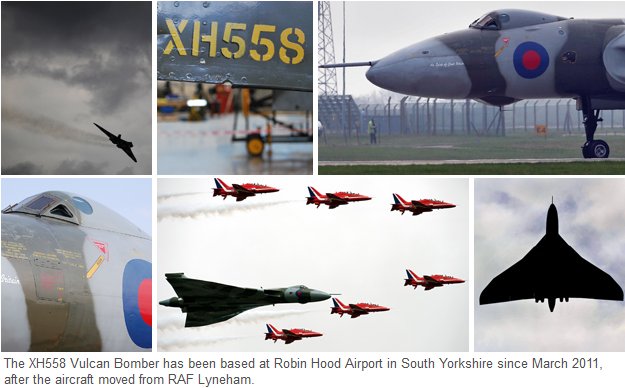
The Vulcan To The Sky Trust has announced “with considerable sadness” that this summer will be the public’s last chance to catch Avro Vulcan XH558 thundering through British skies, as the legendary V-bomber will be permanently grounded at the end of this flying season.
The trust explains that the axe will fall because “three expert companies on whom we depend – known as the ‘technical authorities’ – have together decided to cease their support at the end of this flying season”.
It elaborates:
At the heart of their decision are two factors. First, although we are all confident that XH558 is currently as safe as any aircraft flying today, her structure and systems are already more than ten percent beyond the flying hours of any other Vulcan, so knowing where to look for any possible failure is becoming more difficult. These can be thought of as the ‘unknown unknown’ issues, which can be impossible to predict with any accuracy. Second, maintaining her superb safety record requires expertise that is increasingly difficult to find.
Keeping XH558 in the air has been an epic undertaking, and not without wing-and-a-prayer moments involving last-minute injections of cash.
The Brunel Museum
Brid-Aine Parnell talks about the Brunels — father, son, and grandson — and their impact on Britain during the industrial revolution:
When you mention Brunel to most people, they think of the one with the funny name – Isambard Kingdom Brunel. A few folks will know that his father Marc Isambard Brunel was the first famous engineering Brunel, but not many will know that Isambard’s own son, Henry Marc Brunel, was also an engineer and finished some of Isambard’s projects after his death.
Between the three of them, the Brunels created landmarks all over the UK; perhaps most famously the Clifton Suspension Bridge, which spans the Avon Gorge, linking Clifton in Bristol to Leigh Woods in Somerset.
That bridge, which Isambard Kingdom Brunel designed and often called his “first child,” wasn’t actually completed until after his death and only came about at all because Isambard was nearly drowned in an accident at the massive project he was working on in London with his father: the Thames Tunnel.
It is this masterpiece of engineering, which invented new methods of tunnelling underground and is why the Brunels are credited with creating underground transportation – and by extension, the modern city itself – that you see if you go along to the Brunel Museum in Rotherhithe, London.
The museum itself is in Marc Brunel’s Engine House, built in 1842, the year before the Thames Tunnel was opened, for the engines that pumped to keep the Tunnel dry. The small exhibition tells the story of the design and construction of the 396-metre-long tunnel, the first to have been successfully built underneath a navigable river. The display panels also detail the innovative tunnelling shield technique invented by Marc and Isambard that’s still used to build tunnels today, although these days it’s machines doing the hard work instead of men. Back then, labourers would spent two hours at a time digging, often while also being gassed and showered with shit.
The River Thames at that time was the sewer of London and the tunnel was constantly waterlogged, leading to a build up of effluent and methane gas. The result was that not only would miners pass out from the gas – even if they didn’t, men who re-surfaced were left senseless after their two-hour shift – but there were also explosions as the gas was set alight by the miners’ candles.
Although it’s a tidy and well-kept little exhibition, it is not really why you come to the museum. You come for the underground chamber below, which was only opened up to the public in 2010 after 150 years of being closed off by the London transportation system. This is the Grand Entrance Hall to the Thames Tunnel, used in Brunel’s day as a concert hall and fairground and now in the process of being turned into a permanent exhibition.
May 20, 2015
Mustafa Kemal Atatürk I WHO DID WHAT IN WORLD WAR 1?
Published on 18 May 2015
Mustafa Kemal or simply Atatürk was the founder of the modern, secular Turkish Republic. He earned his stripes as an officer in World War 1 as the defender of Gallipoli against the ANZAC troops. You can find out all about Mustafa Kemal Atatürk during the last years of the Ottoman Empire in our biography.
Scuttled Soviet submarines in the Arctic
The Soviet Union had a remarkably casual approach to disposing of nuclear-powered submarines that were no longer useful in active service:
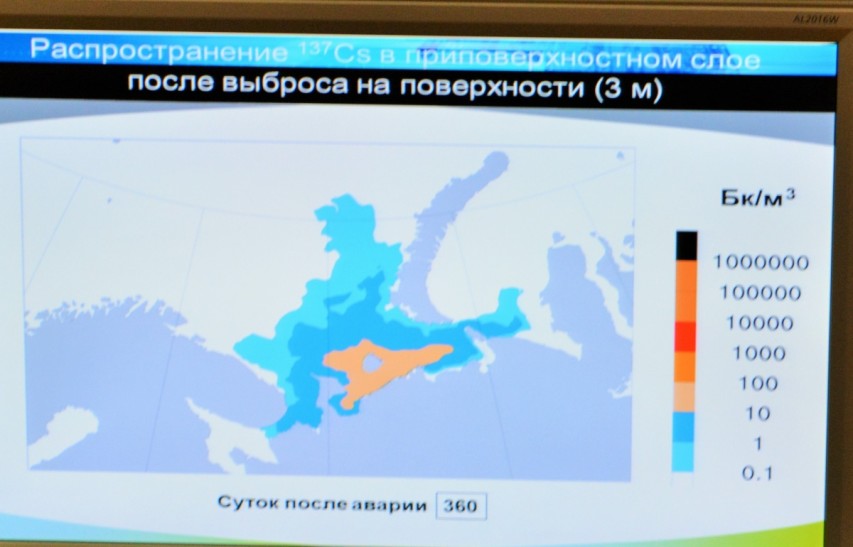
Russian scientists have made a worst-case scenario map for possible spreading of radionuclides from the wreck of the K-159 nuclear-powered submarine that sank twelve years ago in one of the best fishing areas of the Barents Sea.
Mikhail Kobrinsky with the Nuclear Safety Institute of the Russian Academy of Science says the sunken November-class submarine can’t stay at the seabed. The two reactors contain 800 kilos of spent uranium fuel.
At a recent seminar in Murmansk organized jointly by Russia’s nuclear agency Rosatom and the Norwegian environmental group Bellona, Kobrinsky presented the scenario map most fishermen in the Barents Sea would get nightmares by seeing.The map shows expected spreading of radioactive Cs-137 from potential releases from the K-159 that still lays on the seabed northeast of Murmansk in the Barents Sea.
Some areas could be sealed off for commercial fisheries for up to two years, Mikhail Kobrinsky explained.
Ocean currents would bring the radioactivity eastwards in the Barents Sea towards the inlet to the White Sea in the south and towards the Pechora Sea and Novaya Zemlya in the northeast.
May 19, 2015
The 1982 amphibious landings at San Carlos Water
Think Defence looks back at the successful amphibious landings in the Falkland Islands by a less-than-fully-prepared British military:
If the amphibious operations in Normandy were unprecedented because of the scale those in 1982 in the Falkland Islands were equally remarkable, nor for scale but for the huge distance involved. Another breathtaking feature of Operation Corporate was the speed in which it was mounted and the degree of improvisation that would in the end, be needed.
One might argue that even taking into account Inchon and Suez it was the worlds most complex and demanding amphibious operation since D-Day.
Since VE day and Suez the UK’s amphibious capabilities had dwindled both in scale and capability, the Royal Marines concentrating on their Northern Europe role.
When Argentina invaded the Falkland Islands in 1982 the scale of the challenge had many echoes of D-Day; a need for joint service cooperation and a number of technical challenges to overcome for example. What we did not have was the luxury of time, no time to develop new and novel solutions, no time for testing and no time for practice beyond what was available on the journey south.
Due to the short timescales British Rail could not reposition their rolling stock to get the War Material Reserve (about 9,000 tonnes just for 3CDO, 30 days combat supplies and 60 days of general stores) to the ships so instead, a fleet of RCT and civilian trucks were used.
More or less, we went with what we had.
In little over a month from the invasion, the first ships had departed the UK on their 8,000 mile journey South.
There is no need to recount the general history of the campaign but from a ship to shore logistics perspective there were a number of equipment and capabilities available to Commodore Clapp and Brigadier Thompson worth describing.
Earlier posts on the Falklands War can be found here.
May 18, 2015
Death rides a pale horse … called “Binky”
In the June issue of Reason, Scott Shackford talks about the work of the late, great Terry Pratchett:
Terry Pratchett may not have been the first writer to personify Death as a walking, talking skeleton tasked with reaping the souls of the living, but he was the first to give him a horse named Binky and a granddaughter named Susan.
This Death was no less efficient or inevitable despite all the whimsy, of course. As various characters in Pratchett’s long-lasting, wildly popular series of fantasy novels passed on, Death traveled across Discworld — a flat planet resting on the backs of four elephants who stood on a giant turtle that swam through the universe — to ferry the newly deceased to whatever came afterward.
So it was highly appropriate that after Pratchett’s death at age 66 on March 12, following a long and deliberately public faceoff with early-onset Alzheimer’s disease, the novelist’s official Twitter account described his passing as Death gently escorting Pratchett from our rounder, less turtle-dependent world.
But let’s not dwell on Death. Pratchett’s Discworld books, all 40 of them (not counting short stories and related works), teemed with messy, disorganized life. And because he wrote in the fantasy genre, they were also packed with wizards, witches, dwarves, dragons, vampires, zombies, demons, werewolves, and the occasional orangutan. His books were humorous in tone, but tackled weighty matters of self-determination, identity, innovation, and, above all else, liberty.
“Whoever created humanity left in a major design flaw. It was the tendency to bend at the knee.” That piece of insight came from Feet of Clay, a book from right in the middle of his series, published in 1996. The witticism encapsulates a consistent theme in his books approaching how humans (and other sentient species) struggle between the desire to be free and the comfort of letting somebody more powerful or smarter (or claiming to be smarter, anyway) call the shots. In Pratchett’s books, both the heroes and the villains tended to be people in positions of authority. What separated his heroes — people like police commander Samuel Vimes, witch Esme “Granny” Weatherwax, and even Patrician Havelock Vetinari, an assassin turned ruler of the sprawling city of Ankh-Morpork — from the villains was their insistence on letting people live their own lives, whatever may come of it, even when they made a mess of things.
Doctor Who Theme – PLAYER PIANO
Published on 21 Apr 2015
Composer/Pianist Sonya Belousova and Director Tom Grey celebrate over 50 years of Doctor Who by paying tribute to its iconic theme.
May 17, 2015
The Little World of Don Camillo (1951)
Published on 26 Dec 2014
Narrated by ORSON WELLES (O.W. bonus: voice of Christ)
QotD: Taming the wilds in Germany
Your German is not averse even to wild scenery, provided it be not too wild. But if he consider it too savage, he sets to work to tame it. I remember, in the neighbourhood of Dresden, discovering a picturesque and narrow valley leading down towards the Elbe. The winding roadway ran beside a mountain torrent, which for a mile or so fretted and foamed over rocks and boulders between wood-covered banks. I followed it enchanted until, turning a corner, I suddenly came across a gang of eighty or a hundred workmen. They were busy tidying up that valley, and making that stream respectable. All the stones that were impeding the course of the water they were carefully picking out and carting away. The bank on either side they were bricking up and cementing. The overhanging trees and bushes, the tangled vines and creepers they were rooting up and trimming down. A little further I came upon the finished work — the mountain valley as it ought to be, according to German ideas. The water, now a broad, sluggish stream, flowed over a level, gravelly bed, between two walls crowned with stone coping. At every hundred yards it gently descended down three shallow wooden platforms. For a space on either side the ground had been cleared, and at regular intervals young poplars planted. Each sapling was protected by a shield of wickerwork and bossed by an iron rod. In the course of a couple of years it is the hope of the local council to have “finished” that valley throughout its entire length, and made it fit for a tidy-minded lover of German nature to walk in. There will be a seat every fifty yards, a police notice every hundred, and a restaurant every half-mile.
They are doing the same from the Memel to the Rhine. They are just tidying up the country. I remember well the Wehrthal. It was once the most romantic ravine to be found in the Black Forest. The last time I walked down it some hundreds of Italian workmen were encamped there hard at work, training the wild little Wehr the way it should go, bricking the banks for it here, blasting the rocks for it there, making cement steps for it down which it can travel soberly and without fuss.
For in Germany there is no nonsense talked about untrammelled nature. In Germany nature has got to behave herself, and not set a bad example to the children. A German poet, noticing waters coming down as Southey describes, somewhat inexactly, the waters coming down at Lodore, would be too shocked to stop and write alliterative verse about them. He would hurry away, and at once report them to the police. Then their foaming and their shrieking would be of short duration.
“Now then, now then, what’s all this about?” the voice of German authority would say severely to the waters. “We can’t have this sort of thing, you know. Come down quietly, can’t you? Where do you think you are?”
And the local German council would provide those waters with zinc pipes and wooden troughs, and a corkscrew staircase, and show them how to come down sensibly, in the German manner.
It is a tidy land is Germany.
Jerome K. Jerome, Three Men on the Bummel, 1914.
May 16, 2015
Kazakhstan’s looming succession crisis
At The Diplomat, Catharine Putz wonders if there can be a Kazakhstan without President Nursultan Nazarbayev:
In a new report, the International Crisis Group says that Kazakhstan is facing a stress test – its only president since independence turns 75 this summer and Russia’s “actions in Ukraine cast a shadow over Kazakhstan.” To date, the report notes, Kazakhstan’s devotion to continuity has trumped needed democratic reforms. Nursultan Nazarbayev’s recent landslide reelection demonstrates his absolute centrality to political stability in the country and could prove to be “a serious vulnerability.”
The report encourages Kazakhstan to act soon – reconfirming its independence from Russia and lifting the veil on government operations in order to reassure citizens and foreign powers “that the state is not the work of one man or an exclusive ethnic project and that the transition to a post-Nazarbayev era will be smooth.” The report recommends that Kazakhstan continue to pursue a multi-vector foreign policy by engaging equally with Russia and the EU; take a “recognizable role” in pursuing a solution to the Ukraine crisis; give senior officials – other than Nazarbayev – some stage time; practice restraint in issues of language, ethnicity, and nationalism; and broaden economic development beyond Astana.
This is not the first time parallels have been drawn between Ukraine and Kazakhstan. Kazakhstan, like all of Central Asia, had a sizeable ethnic Russian population when the Soviet Union dissolved. That population has dwindled; in a country of 17 million a 2009 census determined that ethnic Russians accounted for 23 percent, ethnic Kazakhs more than 60 percent. This is a more modern development, as it wasn’t until the mid-1980s that the ethnic Kazakh population bypassed that of ethnic Russians in the region. Now, most ethnic Russians are concentrated along the northern border with Russia.
How do you say “Après moi, le déluge” in Kazakh?
London on film, 1890-1920
Open Culture posted this video which includes some of the oldest known footage of London:
May 15, 2015
Artillery Crisis on the Western Front – The Fall of Windhoek I THE GREAT WAR Week 42
Published on 14 May 2015
The 2nd Battle of Ypres is still going but no side can gain a decisive advantage. The main reason on the British side is a lack of artillery ammunition. Even the delivered shells are not working correctly. But even the German supply lines are stretched thin. At the same time German South-West Africa falls to South African troops under Louis Botha.
QotD: Portuguese genetics
On the face of it it sounds like the nice narrative we are fed every time something like this happens. I haven’t been following the international scene, and frankly it wouldn’t even surprise me if Europe headed for nativism and blood-related nationality. It is what is at the basis of their nation states (even if it’s often a lie. For instance I’d hazard that a lot of people in Portugal — yes, d*mn it, I’ll do the DNA testing. Let the house sell and let me have some money first — are as mixed as Americans. My kids call Portugal the reservoir tip at the end of Europe, which is unkind but somewhat accurate since that portion of land was part of the Celtic commonwealth, before being invaded by Carthaginians, Greeks, Romans, Germanic tribes, Moors (though their contribution in the North is minimal as the North was usually administered by overseers with little or no actual colonization) French crusaders, Viking raiders. Then there were British and Irish merchants due to ties going back before the Carthaginians who would set up trading posts, send their younger sons over, sometimes engage in a bit of raiding, etc. There are unkind proverbs about blue eyed Portuguese, but there are also a lot of them. (Two of my grandparents. A third was green eyed.) And in the end sometimes I think all of us are the result of some girl who tripped (on purpose or not) while evading a foreigner. All this to say that when my dad talks of the “The Portuguese Race” (and boy, does he) he’s mostly talking of a mythical entity. But it’s one they all believe in as hard as they can.)
Sarah A. Hoyt, “Multiculturalism IS Racism”, According to Hoyt, 2015-04-04.
May 12, 2015
The Sky Was The Limit – World War 1 In The Air I THE GREAT WAR
Published on 11 May 2015
World War 1 saw several completely new technologies develop rapidly. The airplane itself was only a few years old but pioneering engineers soon saw its potential for military use. For recognisance and later as fighter or bomber, World War 1 had huge impact on aviation and warfare in general. This special episode gives you an idea about the obstacles that had to be overcome.


