
Published on 6 Sep 2017
September 18 – Meeting at Kobarid, Slovenia: http://bit.ly/Kobarid
September 19 – Meeting at Vittorio Veneto, Italy: http://bit.ly/VittorioVeneto
September 20 – Meeting at Lagazuoi: http://bit.ly/LagazuoiWW1
September 7, 2017
We Are Coming To Italy and Slovenia! I THE GREAT WAR On The Road
Comments Off on We Are Coming To Italy and Slovenia! I THE GREAT WAR On The Road
Roman Roads of Britain
Last month, Colin Marshall shared this post on Open Culture:
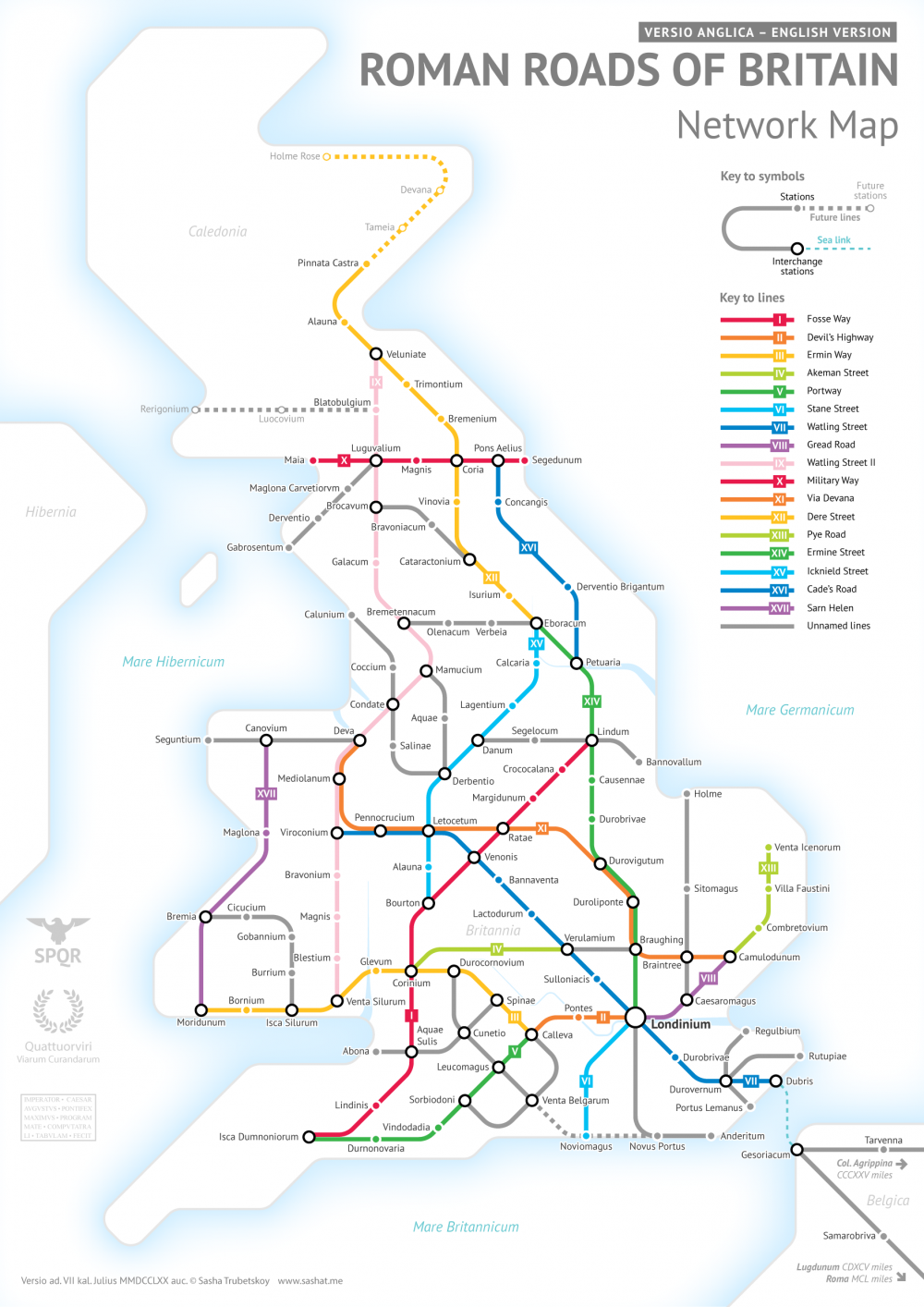
[Click to embiggen]
Though some of Britain’s Roman Roads have become modern motorways, most no longer exist in any form but those bits and pieces history buffs like to spot. This makes it difficult to get a sense of how they all ran and where — or at least it did until Sasha Trubetskoy made a Roman Roads of Britain Network Map in the graphic-design style of the subway maps you’ll find in London or any other major city today. Trubetskoy, an undergraduate statistics major at the University of Chicago, first found cartographical fame a few months ago with his “subway map” of roads across the entire Roman Empire circa 125 AD.
“Popular request,” he writes, demanded a Britain-specific follow up, a project he describes as “far more complicated than I had initially anticipated.” The challenges included not just the sheer number of Roman Roads in Britain but a lack of clarity about their exact location and extents. As in his previous map, Trubetskoy admits, “I had to do some simplifying and make some tough choices on which cities to include.” While this closer-up view demanded a more geographical faithfulness, he nevertheless “had to get rather creative with the historical evidence” in places, to the point of using such “not exactly Latin-sounding” names as “Watling Street” and “Ermin Way.”
Comments Off on Roman Roads of Britain
September 6, 2017
When in doubt, cry “Fascist!” or “Racist!”
Brendan O’Neill on Facebook recently:
The left’s greatest mistake so far this century has been to accept at face value the establishment’s explanation for why people gave it a bloody nose. Stunned by Brexit, dizzied by Hillary’s loss, the establishment has gone into serious moral and political meltdown. It can only understand the various populist revolts against it as mass acts of racism, maybe even fascism, as the handiwork of demagogues who “got at” the people and twisted our minds. I mean, why else would anyone reject such wonderful institutions as the EU and the Democratic elite…? And, for shame, most of the left has embraced this propaganda, this made-up horror story. They have nodded along to this perverse politics of fear born of a wounded establishment’s fury with the “deplorable” demos. All those Antifa and commentators out there screaming “OMG, fascists everywhere!” think they’re being radical when in truth they are the unwitting spindoctors of the old establishment, bit-part players in a top-down narrative of hysteria that has no relation to reality.
Comments Off on When in doubt, cry “Fascist!” or “Racist!”
September 5, 2017
Georges Guynemer – The Flying Icon of France I WHO DID WHAT IN WW1?
Published on 4 Sep 2017
George Guynemer was one of the top scoring flying aces of the entire First World War with 54 aerial victories. In his lifetime, he was celebrated as a hero, an icon and an inspiration in France. When he went missing 100 years ago, in September 1917, it was a great shock to the nation and to this day his death is not fully understood.
Comments Off on Georges Guynemer – The Flying Icon of France I WHO DID WHAT IN WW1?
Tank Chats #18 Mark I
Published on 15 Apr 2016
David Fletcher has returned to host the latest Tank Chat, on the Mark I tank.
The Museum’s Mark I is the only surviving example of this, the first tank produced to go into battle.
Find out more about the First World War on the Tank Museum’s Centenary blog, Tank 100 http://www.tank100.com
Comments Off on Tank Chats #18 Mark I
September 4, 2017
How to Pronounce UK Place Names – Anglophenia Ep 23
Published on 21 Jan 2015
Anglophenia’s Siobhan Thompson teaches Science Friction’s Rusty Ward — and the rest of America — how to pronounce difficult British place names.
Learn how to pronounce even more British place names here: http://www.bbcamerica.com/anglophenia/2014/01/pronounce-deliberately-offputting-british-place-names/
Visit the Anglophenia blog: http://www.bbcamerica.com/anglophenia
Comments Off on How to Pronounce UK Place Names – Anglophenia Ep 23
September 3, 2017
Battlefield 1 Historical Analysis – In The Name Of The Tsar – They Shall Not Pass I THE GREAT WAR
Published on 2 Sep 2017
WW1 Armoured Trains: https://www.youtube.com/watch?v=e5Jl5KdG-Tc
WW1 China: https://www.youtube.com/watch?v=TofCRaOBWZ0
Women’s Battalion: https://www.youtube.com/watch?v=cndgoEd3fkkTwo new expansions for Battlefield 1 dropped in the past few months and they introduced two of the most important factions of World War 1: France and Russia. And since you guys liked our other trailer analysis videos, we decided to review the existing trailer footage and give you some background.
Please send your comments about the mistaken General Liu rifle to: allww1erarifleslookthesametous@thegreatwar.tv
Comments Off on Battlefield 1 Historical Analysis – In The Name Of The Tsar – They Shall Not Pass I THE GREAT WAR
Medieval Castles – Elements of Fortifications
Published on 17 Jan 2017
This episode covers the various elements of castle fortification elements like towers, walls, moats, loopholes, gates, gatehouses, portcullises, battlements, hoardings, draw bridges, etc.
Military History Visualized provides a series of short narrative and visual presentations like documentaries based on academic literature or sometimes primary sources. Videos are intended as introduction to military history, but also contain a lot of details for history buffs. Since the aim is to keep the episodes short and comprehensive some details are often cut.
» SOURCES & LINKS «
Kaufmann, J.E; Kaufmann, H.W.: The Medieval Fortress – Castles, Forts, and Walled Cities of the Middle Ages.
Piper, Otto: Burgenkunde. Bauwesen und Geschichte der Burgen.
Toy, Sidney: Castles – Their Construction and History
Comments Off on Medieval Castles – Elements of Fortifications
The Bronze Age Collapse Explained
Published on 11 Jun 2016
If you are like many people these days, you fawn over the latest episode of The Walking Dead, enjoy movies like the Hunger Games, or lost your mind during Mad Max Fury Road. We seem to think a lot about what the apocalypse for our society might be like. Well, what if the apocalypse already happened… say 3,200 years ago.
Read More:
Dickinson, Oliver (2007). The Aegean from Bronze Age to Iron Age: Continuity and Change Between the Twelfth and Eighth Centuries BC
Cline, Eric H. (2014). 1177 B.C.: The Year Civilization CollapsedStep Back is a history channel releasing videos biweekly that endeavors to go past the names, dates, and battles you might find elsewhere. It invites you to take a step back, consider the past and how it connects to today. We search for the quirky, unconventional, and just plain weird parts of our collective story.
Comments Off on The Bronze Age Collapse Explained
September 2, 2017
[Medieval] Castles – Functions & Characteristics (1000-1300)
Published on 30 Sep 2016
» SOURCES & LINKS «
France, John: Western Warfare in the Age of the Crusades 1000-1300#
Ohler, Norbert: Krieg & Frieden im Mittelalter
Contamine, Philippe: War in the Middle Ages
Pounds, Norman J. G. Pounds: Medieval Castle in England & Wales: A Political and Social History
http://faculty.goucher.edu/eng240/early_english_currency.htm
http://www.ancientfortresses.org/medieval-occupations.htm
https://www.britannica.com/technology/castle-architecture#ref257454
http://www.castrabritannica.co.uk/texts/text04.html
https://en.wikipedia.org/wiki/Harlech_Castle
Comments Off on [Medieval] Castles – Functions & Characteristics (1000-1300)
September 1, 2017
The Moscow State Conference – Black Sea Revolutionaries I THE GREAT WAR Week 162
Published on 31 Aug 2017
The political factions that oppose the rise of Bolshevism in post-revolutionary Russia come together for a conference this week 100 years ago. But apart from the Moscow State Conference, some people in the military actually aim for a military dictatorship to restore order in Russia and continue the war. At the same time the 2nd Battle of Verdun comes to an end with a French victory and revolutionary fever also spreads across the Black Sea Fleet.
Comments Off on The Moscow State Conference – Black Sea Revolutionaries I THE GREAT WAR Week 162
August 31, 2017
“… as if millions of future lit-crit students suddenly cried out in terror and were suddenly silenced”
The late Sir Terry Pratchett hatched a cunning plan to thwart the inchoate plans of uncounted would-be literary ghouls:
A hard drive containing the unfinished books of Terry Pratchett has been destroyed by a steamroller, in fulfilment of the late author’s last wishes.
The works were crushed by a vintage John Fowler & Co steamroller at the Great Dorset Steam Fair, ahead of the opening of a new exhibition about the author’s life and work. It is thought up to 10 incomplete novels were flattened.
Friend Neil Gaiman, with whom Pratchett cowrote Good Omens, had revealed in 2015 that Pratchett had instructed that he wanted “whatever he was working on at the time of his death to be taken out along with his computers, to be put in the middle of a road and for a steamroller to steamroll over them all”.
Pratchett’s former assistant Rob Wilkins tweeted that he was “about to fulfil [his] obligation to Terry”.
The hard drive will go on display as part of a major exhibition about the author’s life and work, Terry Pratchett: HisWorld, which opens at the Salisbury Museum in September.
About to fulfill my obligation to Terry @SalisburyMuseum @Wiltshire_flo pic.twitter.com/B0xr3V5Cbg
— Terry Pratchett (@terryandrob) August 25, 2017
There goes the browsing history… Many thanks to @steamfair. Soon to be on display at @SalisburyMuseum in September https://t.co/Di8tvTO4Hi pic.twitter.com/onGGWLDYL4
— Terry Pratchett (@terryandrob) August 25, 2017
Comments Off on “… as if millions of future lit-crit students suddenly cried out in terror and were suddenly silenced”
The Dieppe raid and the failure of the Churchill tank
Published on 15 Oct 2010
The Dieppe Raid, also known as the Battle of Dieppe, Operation Rutter and, later, Operation Jubilee, was a Second World War Allied attack on the German-occupied port of Dieppe. The raid took place on the northern coast of France on 19 August 1942. The assault began at 5:00 a.m. and by 10:50 a.m. the Allied commanders were forced to call a retreat. Over 6,000 infantrymen, predominantly Canadian, were supported by a Canadian Armoured regiment and a strong force of Royal Navy and smaller Royal Air Force landing contingents. It involved 5,000 Canadians, 1,000 British troops, and 50 United States Rangers.
Objectives included seizing and holding a major port for a short period, both to prove that it was possible and to gather intelligence. Upon retreat, the Allies also wanted to destroy coastal defences, port structures and all strategic buildings. The raid had the added objectives of boosting morale and demonstrating the firm commitment of the United Kingdom to open a western front in Europe.
Virtually none of these objectives were met.
Comments Off on The Dieppe raid and the failure of the Churchill tank
August 30, 2017
James May loves airships! MORE EXTRAS – James May’s Q&A – Head Squeeze
Published on 17 Mar 2013
You asked for it! In a previous episode of James May’s Q&A, James discussed the sad demise of the airship as a popular mode of transport. And during filming we literally couldn’t get him to stop talking about them! Clearly he loves airships and loves to talk about airships. A lot! Lucky for all you people we captured it all and can present it now as Exclusive Extended Extras on the rise and fall of airships.
Original clip here: http://www.youtube.com/watch?v=ug5UafJFEYc
James May’s Q&A:
With his own unique spin, James May asks and answers the oddball questions we’ve all wondered about from ‘What Exactly Is One Second?’ to ‘Is Invisibility Possible?’
Comments Off on James May loves airships! MORE EXTRAS – James May’s Q&A – Head Squeeze
August 29, 2017
Inside A British Bristol Scout WW1 Airplane I THE GREAT WAR Special
Published on 28 Aug 2017
★★★★★ “Bristol Scout Rebuilding History” on Vimeo: http://bit.ly/BristolScoutVimeo ★★★★★
★★★★ “Bristol Scout Rebuilding History on DVD:
http://bit.ly/BristolScoutDVD ★★★★In our first episode from Stow Maries Great War Aerodrome we talk with David Bremner about his Bristol Scout 1264 which is an exact copy of his granddad’s WW1 airplane that he flew on the Mesopotamian front.
Comments Off on Inside A British Bristol Scout WW1 Airplane I THE GREAT WAR Special


