
The Grand Tour Fans
Published on 16 Mar 2018Do you think James May never ran on TV and during the episode of The Grand Tour where Jeremy Clarkson drove the Ford GT was the first time ever?
Well you’re wrong. In the third season of James May Man Lab he ran on public TV. Check out this video and see James Running (twice !!)
March 23, 2018
The Grand Tour James May Running
Comments Off on The Grand Tour James May Running
Tank Chats #25 Mark VIII | The Tank Museum
The Tank Museum
Published on 12 Aug 2016In the 25th Tank Chat David Fletcher explores the First World War Mark VIII tank. The Mark VIII tank, also known as The International was a joint project between the British and American forces, following their entry into the war. Once the designs had been refined massive orders were placed in 1918 and then swiftly cancelled with the end of the war. In the end six Mark VIII tanks were built for Britain of which The Tank Museum’s is the sole surviving example.
http://tankmuseum.org/museum-online/vehicles/object-e1949-363
Comments Off on Tank Chats #25 Mark VIII | The Tank Museum
March 22, 2018
Feature History – Spanish Civil War
Feature History
Published on 12 Mar 2017Hello and welcome to Feature History, featuring The Spanish Civil War, zero mic etiquette, and a super subtle political lesson.
Comments Off on Feature History – Spanish Civil War
March 20, 2018
Inside the German A7V WW1 Tank I THE GREAT WAR On The Road
The Great War
Published on 19 Mar 2018The German Tank Museum: http://daspanzermuseum.de/
We visited the German Tank Museum (in Munster, not Münster) and talked to the director Ralf Raths about the German tanks in World War 1. The only one that saw action was the A7V and will find out how it was designed, how up to 23 men fit inside one of these and what the operational history was.
Comments Off on Inside the German A7V WW1 Tank I THE GREAT WAR On The Road
March 19, 2018
Prehistoric migrations
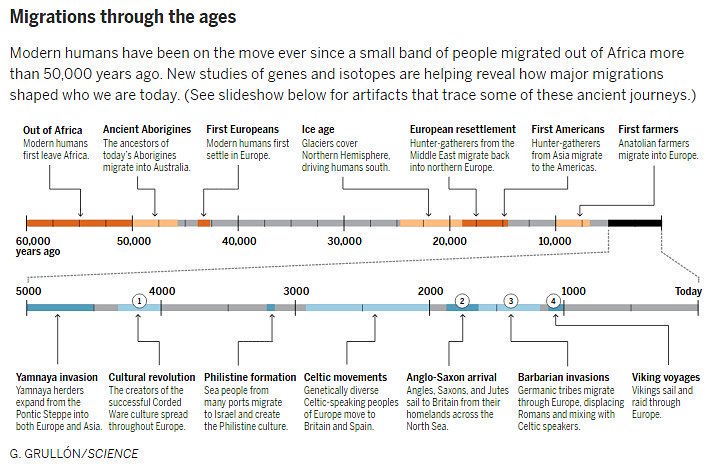
In a Science article from last year, Ann Gibbons discusses the ancient migrations that can now be traced using DNA analysis:
After World War II, many scholars recoiled from studying migrations, in reaction to the Nazi misuse of history and archaeology. The Nazis had invoked migrations of “foreign” groups to German territory to justify genocide. “The whole field of migration studies was ideologically tainted,” says archaeologist Kristian Kristiansen of the University of Gothenburg in Sweden. Some researchers also resisted the idea that migration helped spread key innovations such as farming, partly because that might imply that certain groups were superior.
Nor did researchers have a reliable method to trace prehistoric migrations. “Most of the archaeological evidence for movement is based on artifacts, but artifacts can be stolen or copied, so they are not a real good proxy for actual human movement,” says archaeologist Doug Price of the University of Wisconsin in Madison, who tracks ancient migration by analyzing isotopes. “When I started doing this in 1990, I thought people were very sedentary and didn’t move around much.”
Today, however, new methods yield more definitive evidence of migration, sparking an explosion of studies. The isotopes Price and others study are specific to local water and food and thus can reveal where people grew up and whether they later migrated. DNA from ancient skeletons and living people offers the “gold standard” in proving who was related to whom.
The new data confirm that humans have always had wanderlust, plus a yen to mix with all manner of strangers. After the first Homo sapiens arose in Africa, several bands walked out of the continent about 60,000 years ago and into the arms of Neandertals and other archaic humans. Today, almost all humans outside Africa carry traces of archaic DNA.
That was just one of many episodes of migration and mixing. The first Europeans came from Africa via the Middle East and settled there about 43,000 years ago. But some of those pioneers, such as a 40,000-year-old individual from Romania, have little connection to today’s Europeans, Reich says.
His team studied DNA from 51 Europeans and Asians who lived 7000 to 45,000 years ago. They found that most of the DNA in living Europeans originated in three major migrations, starting with hunter-gatherers who came from the Middle East as the glaciers retreated 19,000 to 14,000 years ago. In a second migration about 9000 years ago, farmers from northwestern Anatolia, in what is now Greece and Turkey, moved in.
That massive wave of farmers washed across the continent. Ancient DNA records their arrival in Germany, where they are linked with the Linear Pottery culture, 6900 to 7500 years ago. A 7000-year-old woman from Stuttgart, Germany, for example, has the farmers’ genetic signatures, setting her apart from eight hunter-gatherers who lived just 1000 years earlier in Luxembourg and Sweden. Among people living today, Sardinians retain the most DNA from those early farmers, whose genes suggest that they had brown eyes and dark hair.
H/T to PaleoAnthropology+ for the link.
Comments Off on Prehistoric migrations
March 18, 2018
King George V in World War 1 I WHO DID WHAT IN WW1?
The Great War
Published on 17 Mar 2018He was monarch over the largest empire the world has ever seen. When the war came he saw his duty as the face of determination for his people: King George V.
Comments Off on King George V in World War 1 I WHO DID WHAT IN WW1?
March 17, 2018
“Schedule 7 of [Britain’s] Terrorism Act … effectively treats speech as terror, ideas as violence”
Brendan O’Neill on the British government’s decision to refuse admission to Canadian videographer Lauren Southern:
In Britain in the 21st century you can be punished for mocking gods. You can be expelled from the kingdom, frozen out, if you dare to diss Allah. Perversely adopting medieval Islamic blasphemy laws, modern Britain has made it clear that it will tolerate no individual who says scurrilous or reviling things about the Islamic god or prophet. Witness the authorities’ refusal to grant entrance to the nation to the alt-right Christian YouTuber Lauren Southern. Her crime? She once distributed a leaflet in Luton with the words ‘Allah is gay, Allah is trans, Allah is lesbian…’, and according to the letter she received from the Home Office informing her of her ban from Britain, such behaviour poses a ‘threat to the fundamental interests of [British] society’.
This is a very serious matter and the lack of outrage about it in the mainstream press, not least among those who call themselves liberal, is deeply disturbing. For what we have here is the ringfencing of Britain from anti-Islam blasphemy. The purification of the kingdom against those who would take the mick out of the Muslim faith. In refusing leave to enter to Ms Southern because she handed out those leaflets, the UK authorities are making it clear that this is a nation in which certain things cannot be said about Allah. They are sending a message not only to Ms Southern but to Britons, too: trolling of Islam is a ‘threat’ to society and counter to ‘the public policy of the United Kingdom’. They haven’t only banned one woman; they have sought to chill an entire sphere of ‘blasphemy’.
Ms Southern was stopped at the border in Calais. She was reportedly questioned under Schedule 7 of the Terrorism Act. This is an extraordinarily broad and illiberal part of the law. It can be used to stop anyone at Britain’s borders, even if there is no suspicion that they are involved in terrorism. The individual can be detained and questioned for up to nine hours. There is no right to silence. There is no right to a publicly funded lawyer if the person is at a border. That such a repressive measure was allegedly deployed in the questioning of someone for distributing leaflets, for speech, should horrify anyone who cares about liberty. This effectively treats speech as terror, ideas as violence, mere words as things to be kept out of the nation, setting a terrible precedent for free speech in this country.
H/T to Perry de Havilland for the link.
Comments Off on “Schedule 7 of [Britain’s] Terrorism Act … effectively treats speech as terror, ideas as violence”
The Battle of Cannae (Second Punic War) (Lecture)
The Study of Antiquity and the Middle Ages
Published on 16 Mar 2018This lecture aimed towards High School students features the battle of Cannae.
The Battle of Cannae (/ˈkæniˌ-neɪˌ-naɪ/[) was a major battle of the Second Punic War that took place on 2 August 216 BC in Apulia, in southeast Italy. The army of Carthage, under Hannibal, surrounded and decisively defeated a larger army of the Roman Republic under the consuls Lucius Aemilius Paullus and Gaius Terentius Varro. It is regarded both as one of the greatest tactical feats in military history and as one of the worst defeats in Roman history.
Having recovered from their losses at Trebia (218 BC) and Lake Trasimene (217 BC), the Romans decided to engage Hannibal at Cannae, with roughly 86,000 Roman and allied troops. They massed their heavy infantry in a deeper formation than usual, while Hannibal used the double-envelopment tactic. This was so successful that the Roman army was effectively destroyed as a fighting force. Following the defeat, Capua and several other Italian city-states defected from the Roman Republic to Carthage.
Comments Off on The Battle of Cannae (Second Punic War) (Lecture)
Tank Chats #24 Vickers A1E1 Independent | The Tank Museum
The Tank Museum
Published on 5 Aug 2016In the 24th Tank Chat, David Fletcher looks at the rather unusual Vickers A1E1 Independent. The Independent originated in 1922 with a War Office specification for a heavy tank. Ultimately it proved to be a failed project was abandoned in 1935, by which time it had cost more than £150,000, and sent to Bovington. It is the only tank of its kind in existence.
Comments Off on Tank Chats #24 Vickers A1E1 Independent | The Tank Museum
March 16, 2018
Allied Unified Command On The Horizon I THE GREAT WAR Week 190
The Great War
Published on 15 Mar 2018While Germany is occupying a territory from the Baltics to the Black Sea and planning its huge spring offensive, the Allies are still trying to get behind the idea of a unified command.
Comments Off on Allied Unified Command On The Horizon I THE GREAT WAR Week 190
The Imperial German Army’s final throw of the dice – Operation Michael, March 1918
Victor Davis Hanson summarizes the Central Powers’ brief moment of strength early in 1918:
One hundred years ago this month, all hell broke loose in France. On March 21, 1918, the German army on the Western Front unleashed a series of massive attacks on the exhausted British and French armies.
German General Erich Ludendorff thought he could win World War I with one final blow. He planned to punch holes between the French and British armies. Then he would drive through their trenches to the English Channel, isolating and destroying the British army.
The Germans thought they had no choice but to gamble.
The British naval blockade of Germany after three years had reduced Germany to near famine. More than 200,000 American reinforcement troops were arriving each month in France. (Nearly 2 million would land altogether.) American farms and factories were sending over huge shipments of food and munitions to the Allies.
Yet for a brief moment, the war had suddenly swung in Germany’s favor by March 1918. The German army had just knocked Russia and its new Bolshevik government out of the war. The victory on the Eastern Front freed up nearly 1 million German and Austrian soldiers, who were transferred west.
Germany had refined new rolling artillery barrages. Its dreaded “Stormtroopers” had mastered dispersed advances. The result was a brief window of advantage before the American juggernaut changed the war’s arithmetic.
The Spring Offensive almost worked. Within days, the British army had suffered some 50,000 casualties. Altogether, about a half-million French, British and American troops were killed or wounded during the entire offensive.
But within a month, the Germans were sputtering. They could get neither supplies nor reinforcements to the English Channel. Germany had greedily left 1 million soldiers behind in the east to occupy and annex huge sections of conquered Eastern Europe and western Russia.
The British and French had learned new ways of strategic retreat. By summer of 2018, the Germans were exhausted. In August, the Allies began their own (even bigger) offensive and finally crushed the retreating Germans, ending the war in November 1918.
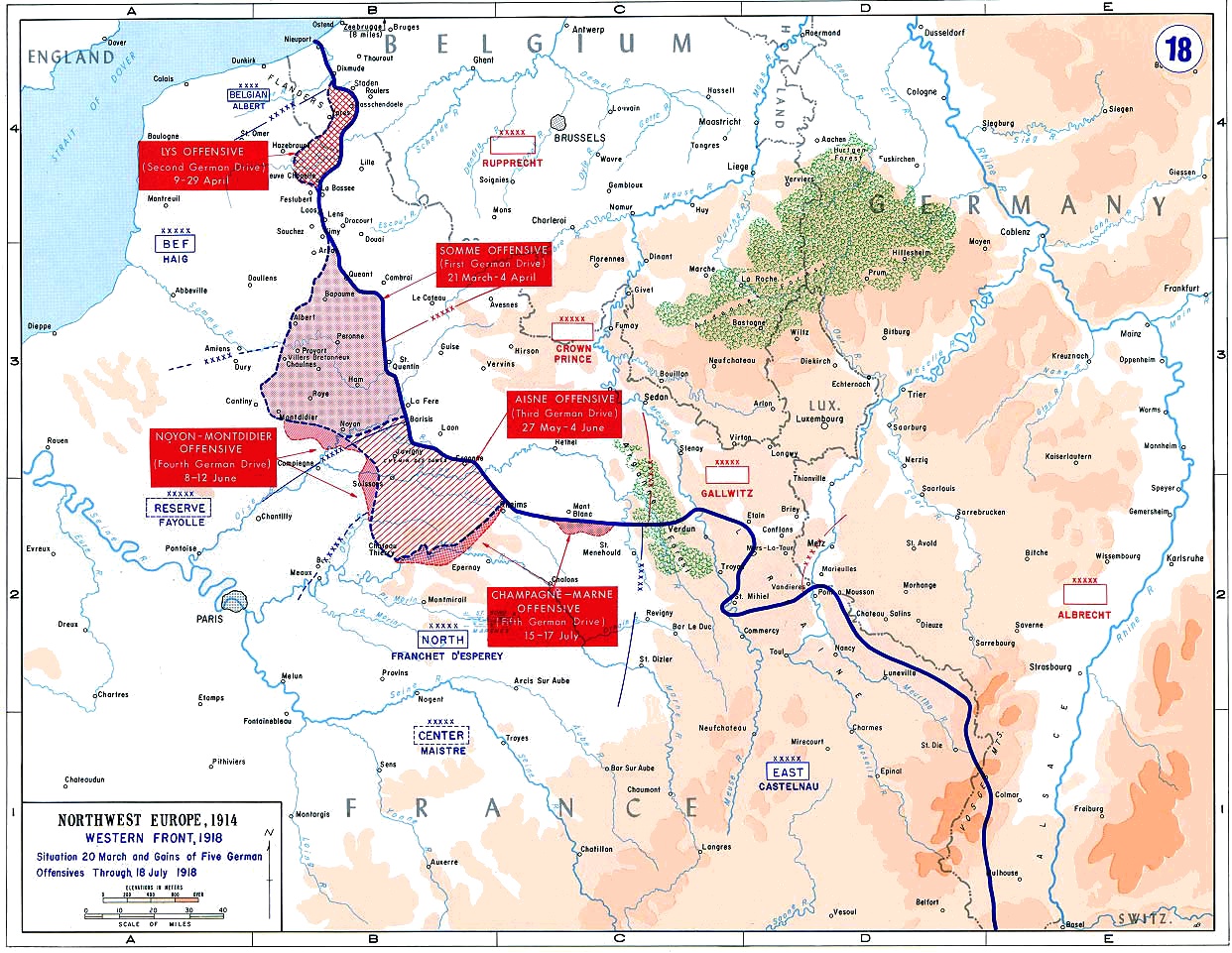
Click to see full-sized image.
For more information on Operation Michael, sometimes known as “The Kaiser’s Battle”, here’s the Wikipedia entry.
Comments Off on The Imperial German Army’s final throw of the dice – Operation Michael, March 1918
How Rifles & Railroads influenced Warfare in the 19th Century
Military History Vlogs
Published on 23 Feb 2018The introduction of the breech-loading rifle and the railroad had a tremendous influence on Warfare in the 19th Century. Although, not everyone was as fast or able to adopt then the Prussians. Austria, France and Russia had major issues. Most notably visible in the Austro-Prussian War (1866) and Franco-Prussian War (1870-1871).
Comments Off on How Rifles & Railroads influenced Warfare in the 19th Century
March 14, 2018
Battle Stack: The Battle of Isandlwana tactics
BattleStack
Published on 25 Nov 2016The Battle of Isandlwana was fought between the British and Zulus in 1879. Find out what happened with this animated tactics video!
Comments Off on Battle Stack: The Battle of Isandlwana tactics
March 13, 2018
German Tactics For 1918 Spring Offensive I THE GREAT WAR Special
The Great War
Published on 12 Mar 2018The German Spring Offensive in 1918, the so called Kaiserschlacht or Operation Michael, was the biggest German offensive of World War 1 and Quartermaster-general Erich Ludendorff prepared his troops for this battle by incorporating everything the German Army had learned in this war until now. Hutier Infiltration Tactics, Georg Bruchmüller’s artillery targeting and more lessons from the Eastern Front mean the Entente was facing a different army than before.
Comments Off on German Tactics For 1918 Spring Offensive I THE GREAT WAR Special


