
Lindybeige
Published on 15 Oct 2016For two years, I went to a British public boarding school, and recently, I attended a reunion. I talk about them.
Support me on Patreon: https://www.patreon.com/LindybeigeIt was difficult in the edit to achieve the balance I wanted, but this can be redressed in later videos. I recorded a few more pieces to camera and took more shots of the school. I don’t feature the people there because this was a personal project, and it would be unfair to involve them in something they may find expresses opinions and ideas with which they disagree. Besides, I wanted to talk to old friends, not poke a camera in their faces.
Lindybeige: a channel of archaeology, ancient and medieval warfare, rants, swing dance, travelogues, evolution, and whatever else occurs to me to make.
April 1, 2018
Boarding Schools – what are they like?
March 31, 2018
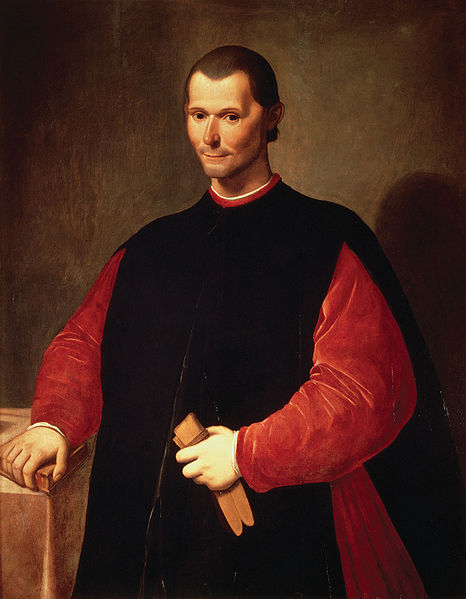
If anybody could be described as Machiavellian, it’d surely be Machiavelli, right?
At the Foundation for Economic Education, Paul Meany tries to rescue the reputation of Niccolò Machiavelli:
Portrait of Niccolò Machiavelli by Santi di Tito (1536-1603)
Via Wikimedia Commons.If you have ever studied Shakespeare, you might have heard your teacher use the word “Machiavellian” to describe amoral characters such as Iago from Othello or Edmund from King Lear. “Machiavellian” denotes a person or action that disregards morality and is wholly self-serving. The origin of the word derives from the famous Florentine politician and writer Niccoló Machiavelli.
[…]
Published posthumously, The Prince left Machiavelli with an infamous reputation as an amoral, atheistic, and cynical writer. In 1559, the Catholic Church put Machiavelli’s works on the Index of Prohibited Books. In the play The Jew of Malta by Christopher Marlowe, written in 1589, Machiavelli appears in the prologue, boldly exclaiming, “I count religion but a childish toy, and hold there is no sin but ignorance.”
Machiavelli came to be associated with an Elizabethan term, “Old Nick,” used to denote the devil. There is a subject of modern psychology, known as the “dark triad,” which focuses on three malevolent personality traits: narcissism, psychopathy, and Machiavellianism.
However, this deeply negative image of Machiavelli did not always exist. In the 17th and 18th centuries, a more positive view of Machiavelli emerged, with authors such as the Republican James Harrington referring to Machiavelli as “the prince of politicians.” During the Italian Renaissance, humanist Giovanni Battista Busini fondly described Machiavelli as “a most extraordinary lover of liberty.”
This praise might seem confusing; after all, the word “Machiavellian” denotes someone who is cunning and unscrupulous. How could a man so devious and pragmatic be called a lover of liberty? The answer lies with Machiavelli’s other book, known as Discourses on Livy, which presents a very different image of his political beliefs.
[…]
The stark differences between Machiavelli’s Discourses on Livy and The Prince come from the nature of the aims of each book. The Prince aims to refine the conduct of a single prince, while Discourses on Livy offers guidance for the entire citizen body. The Prince was written to address a unique political opportunity that quickly evaporated, whereas Discourses on Livy was written to articulate the principles required by republics that sought longevity, liberty, and prosperity.
To this day, there still remains a huge debate over the intricacies and contradictions that characterize Machiavelli’s writings. Machiavelli was an extremely nuanced and original thinker whose reputation should not exclusively be that of an evil schemer. He argued for a republic whose liberty is safeguarded by the common person, in which free, unhindered debate provides the best course of action, and where compromises between opposing groups create harmony. Discourses on Livy reveals another side of Machiavelli, a man committed to the ideals of freedom through the means of representative government.
March 29, 2018
British Schools Explained – Anglophenia Ep 25
Anglophenia
Published on 5 Mar 2015How much do you know about the U.K.’s education system? Siobhan Thompson teaches you the basics. Study up!
QotD: The decline of Epicureanism
The philosophy seems to have continued strong into about the 3rd century AD. Thereafter, it went into decline. By the middle of the 6th century, when the Emperor Justinian closed all the philosophical schools in Athens and dispersed the teachers, Epicureanism appears to have been already dead.
The main traditions of thought during the last few centuries of the ancient world were turned away from the everyday world. There were the neoplationists, with their settled belief in a higher reality that could be approached through a combination of mathematics and magic. There were, of course, the Christians, for whom the world is simply a preparation for the better life that is to come.
As said, relating what people think to what is happening around them is not easy. But the last few centuries of the ancient world were ages of great uncertainty. There were epidemic diseases that swept away multitudes without warning and without apparent cause. There were barbarian raids and civil wars. There was catastrophically overextended government to grind the survivors into helplessness and poverty. In this sort of world, teachings of Epicurus about seeking happiness in this life may have lost their attraction.
In one of his more sensible comments on Epicurus, Plutarch writes:
As to the vulgar sort… when they lose their children, wives, or friends, they would rather have them be somewhere and still remain, though in misery, than that they should be quite destroyed, dissolved, and reduced to nothing. And they are pleased when they hear it said of a dying person, that he goes away or departs, and such other words as intimate death to be the soul’s remove and not destruction. …. …. And they are discomposed when they hear it said of any one, he is perished, or he is gone or he is no more…. And therefore it is very plain that with the belief of immortality they [the Epicureans] take away the sweetest and greatest hopes the vulgar sort have.
In a world where life is uncertain and often unpleasant, there will tend to be an emphasis on some happier supernatural future.
There may be nothing sinister in the loss of virtually the whole body of Epicurean writings. Perhaps they were destroyed by a triumphant Church that had room for Plato and Aristotle but none for a naturalist enemy of all that Christianity proclaimed. But there is no reason to suppose any deliberate act of destruction. Papyrus rolls were by their nature delicate things. They were also far more expensive and therefore scarce in number than modern books. In any European climate, a papyrus roll would last for about a century, and then the glue that held it together would perish. Without careful recopying, a work might easily be lost.
The last centuries of the ancient world were mostly ages of depression. There was a shortage of all the means that had so far kept libraries together. Such means as remained were naturally given to recopying works for which there was an active demand. That means Christian theology, those parts of the pagan philosophies that could be reconciled to Christianity, and the greatest products of the pagan high culture. Since, with the exception of Lucretius — whose work largely survived — the works of Epicurus and his followers were in a style remarkable only for its plainness, it is unreasonable to suppose that librarians, forced to choose what to copy and what to leave to die, would take up the 37 volumes of On Nature and not the Ecclesiastical History of Eusebius.
So far as I can tell, whatever works of Epicurus survived were not studied in the Byzantine Empire. In the West, all but his name and whatever is said about him in Cicero vanished for a thousand years.
Sean Gabb, “Epicurus: Father of the Enlightenment”, speaking to the 6/20 Club in London, 2007-09-06.
March 28, 2018
Backs To The Wall – All Eyes On Amiens I THE GREAT WAR Week 192
The Great War
Published on 27 Mar 2018The German Operation Michael continues this week and after some uncertainty, the Germans put their eyes on Amiens. The city is a vital communications and transport hub for the Entente and so Ferdinand Foch decides to mount a defence in front of the city.
Samuel HaNagid – A Prince of Jews – Extra History
Extra Credits
Published on 11 Jun 2016Forced to flee from his home in Cordoba, Samuel HaNagid made a new name for himself in the kingdom of Granada. He picked his allies carefully and rose to the position of vizier, an unheard of honor for a Jew in a Muslim kingdom. His fame as a poet, a leader, and a patron of Judaic studies spread across the Mediterranean.
March 27, 2018
German WW1 Prototype Tanks Of 1918 I THE GREAT WAR On The Road
The Great War
Published on 26 Mar 2018Get Our New Oberschlesien Tank Poster: http://bit.ly/PanzerOberschlesien
The German Tank Museum: https://www.youtube.com/DasPanzermuseum
While the German Army only fielded 20 A7V tanks during World War 1, they understood the potential of the tank and started working on different designs in the last year of the war. Some designs like the LKII almost got deployed while the Sturmpanzerwagen Oberschlesien or the Krupp-Protze never left the prototype stage.
March 26, 2018
Kalashnikov vs Sturmgewehr!
Forgotten Weapons
Published on 17 Sep 2016http://jamesdjulia.com/item/3024-394/ (MP-44)
http://jamesdjulia.com/item/3020-394/ (Type 56 AK)The German Sturmgewehr and the Soviet Kalashnikov are widely and rightly considered the two most influential and iconic of the modern military rifles. While the German rifle certainly influenced the Soviet design, the two were designed with different intentions and goals. The Sturmgewehr was an attempt to blend the roles of rifle and light machine gun, while the Kalashnikov was intended to blend the roles of rifle and submachine gun – and yet they both reached largely the same practical reality.
Which do you think was the better system?
March 25, 2018
The appearance of wealth
Victor Davis Hanson on how the wealthy once were eager to appear as distinct from the common herd as possible:
Even in the mostly egalitarian city-states of relatively poor classical Greece, the wealthy were readily identifiable. A man of privilege was easy to spot by his remarkable possession of a horse, the fine quality of his tunic, or by his mastery of Greek syntax and vocabulary.
An anonymous and irascible Athenian author — dubbed “The Old Oligarch” by the nineteenth-century British classicist Gilbert Murray — wrote a bitter diatribe known as “The Constitution of the Athenians.” The harangue, composed in the late fifth century B.C., blasted the liberal politics and culture of Athens. The grouchy elitist complained that poor people in Athens don’t get out of the way of rich people. He was angry that only in radically democratic imperial Athens was it hard to calibrate a man by his mere appearance: “You would often hit an Athenian citizen by mistake on the assumption that he was a slave. For the people there are no better dressed than the slaves and metics, nor are they any more handsome.”
The Old Oligarch’s essay reveals an ancient truth about privilege and status. Throughout history, the elite in most of the Western world were easy to distinguish. Visible class distinctions characterized ancient Rome, Renaissance Florence, the Paris of the nineteenth century, and the major cities of twentieth century America.
A variety of recent social trends and revolutionary economic breakthroughs have blurred the line separating the elite from the masses.
First, the cultural revolution of the 1960s made it cool for everyone to dress sloppily and to talk with slang and profanity. Levis, T-shirts, and sneakers became the hip American uniform, a way of superficially equalizing the unequal. Contrived informality radiated the veneer of class solidarity. Multimillionaires like Bruce Springsteen and Bono appear indistinguishable from welders on the street.
The locus classicus is perhaps Facebook owner Mark Zuckerberg, who wears T-shirts, jeans, and flip flops to work. His reported wealth of $71 billion makes him the world’s fifth-richest man. The median net worth of Americans is about $45,000. Zuckerberg is worth more than the collective wealth of about 1.5 million Americans — or about all the household wealth in Philadelphia put together. And yet, he looks perfectly ordinary. When I walk the Stanford campus — where many of the world’s wealthiest send their children — the son of a Silicon Valley billionaire looks no different from a machinist’s daughter on full support from Akron.
Second, technology has done its part to dilute superficial class distinctions. The nineteenth-century gap between a rich man in his fine carriage — with footman and driver — and someone walking three miles to work has disappeared. The driving experience between a $20,000 Kia bought on credit with $1,000 down and a $80,0000 Mercedes paid in cash is mostly reduced to the superficial logo on the hood and trunk. An alien from Mars could not easily distinguish, at least by sight, between the two cars. Even after a ten-minute ride, an alien might be puzzled: What exactly did that extra $60,000 buy?
Conscientious Objectors – Water – “Wastage” I OUT OF THE TRENCHES
The Great War
Published on 24 Mar 2018Chair of Wisdom Time!
Great Northern War | 3 Minute History
Jabzy
Published on 5 Nov 2015Thanks to Xios, Alan Haskayne, Lachlan Lindenmayer, William Crabb, Derpvic, Seth Reeves and all my other Patrons. If you want to help out – https://www.patreon.com/Jabzy?ty=h
March 24, 2018
QotD: Joining “The Firm”
Personally I think Meghan Markle would be a catastrophic addition to The Firm if she does not understand why it is a terrible idea for the Royals to get political. Do that and they stop being symbols (essentially endearing living flags whose job is to wave strangely and act as a navigational datum for flypasts) and become legitimate political targets. There is no surer route to a republic and I would regret that (as I do not share Spiked’s democracy fetish) but not necessarily oppose it if the House of Windsor does indeed go full retard.
Perry de Havilland, “Samizdata quote of the day”, Samizdata, 2018-03-01.
March 23, 2018
Kaiserschlacht – German Spring Offensive 1918 I THE GREAT WAR Week 191
The Great War
Published on 22 Mar 2018It was all or nothing for the German Army under General Erich Ludendorff now: They unleashed the biggest offensive of the entire war on the Western Front trying to split the British and French Armies, drive the British off the continent and capture Paris.
The use of the euphemism “grooming”
Mark Steyn from a recent Clubland Q&A session:
If you missed our livestream Clubland Q&A on Tuesday, here’s the action replay. Simply click above for an hour of my answers to questions from Mark Steyn Club members around the planet on various aspects of identity politics, from micro-aggressions at the University of California to macro-aggressions in Telford and Rotherham – with a semantic detour into nano-aggressions and quantum-aggressions. Speaking of semantics, I saw this question after the show ended, from Steyn Club Founding Member Toby Pilling:
If with regard to language, clarity is the remedy (as Orwell would say), shouldn’t the ‘Asian Grooming Gangs’ be re-named ‘Moslem Rape Gangs’? I’ve been trying to make the case that they should at the local council I work for, but over here in the UK one can be hauled in for hate speech at the drop of a hat.
I agree with Messrs Orwell and Pilling on clarity in language, and have never liked the word “grooming”, a bit of social-worker jargonese designed to obscure that what’s going on all over England is mass serial-gang-rape sex-slavery. “Grooming” is, in that sense, a euphemism. An hour or two after yesterday’s show I chanced to stop at the Upper Valley Grill and General Store on an empty strip of road in the middle of the woods in Groton, Vermont, a small town of a thousand souls that feels, if anything, rather smaller than that. And paying at the counter I noticed that they had a can next to the cash register for donations to what the hand-written card called the “Groton Grooming Fund”.
Having just been on the air yakking about Telford, I was momentarily startled. It is, in fact, not a whip-round to enable the gang-rapists to buy more petrol to douse the girls in, but a contribution toward the volunteer group that maintains the local ski and snowmobile trails – ie, they “groom” the snow. Happy the town in which grooming is left to the snowmobile club rather than the Muslim rape gangs. The slogan that greets you on the edge of the village is “Welcome to Groton – Where a Small Town Feels Like a Large Family”, which I always find faintly dispiriting. But it’s better than Telford, where a large town feels like a small prison.


