
OverSimplified
Published on 24 Jan 2019
January 26, 2019
The Cold War – OverSimplified (Part 1)
Comments Off on The Cold War – OverSimplified (Part 1)
The US Army’s tank development and “The Emergency” in Eire
A discussion on the TimeGhost forums the other day included a link to this fascinating article by World of Tanks writer The Chieftain:
Wouldn’t it have been a terrible thing if, in the middle of WW2, the people responsible for training and equipping the US Army’s armored force were taken prisoner? Well, they were.
Wait, what? I’m sure we’d have heard all about this if it had really happened, and it’s certainly news to me, so he’s just pulling the long bow here, right? Well, no, he’s not. It really did happen, but there were several reasons why it didn’t become even a nine-day wonder in 1942, because it happened in what had been the Irish Free State but known after 1937 as Éire. Ireland was neutral in WW2, and had a policy of interning combatant personnel who found themselves in Ireland during the war. Keep this in mind, as it’s the key point of the story.
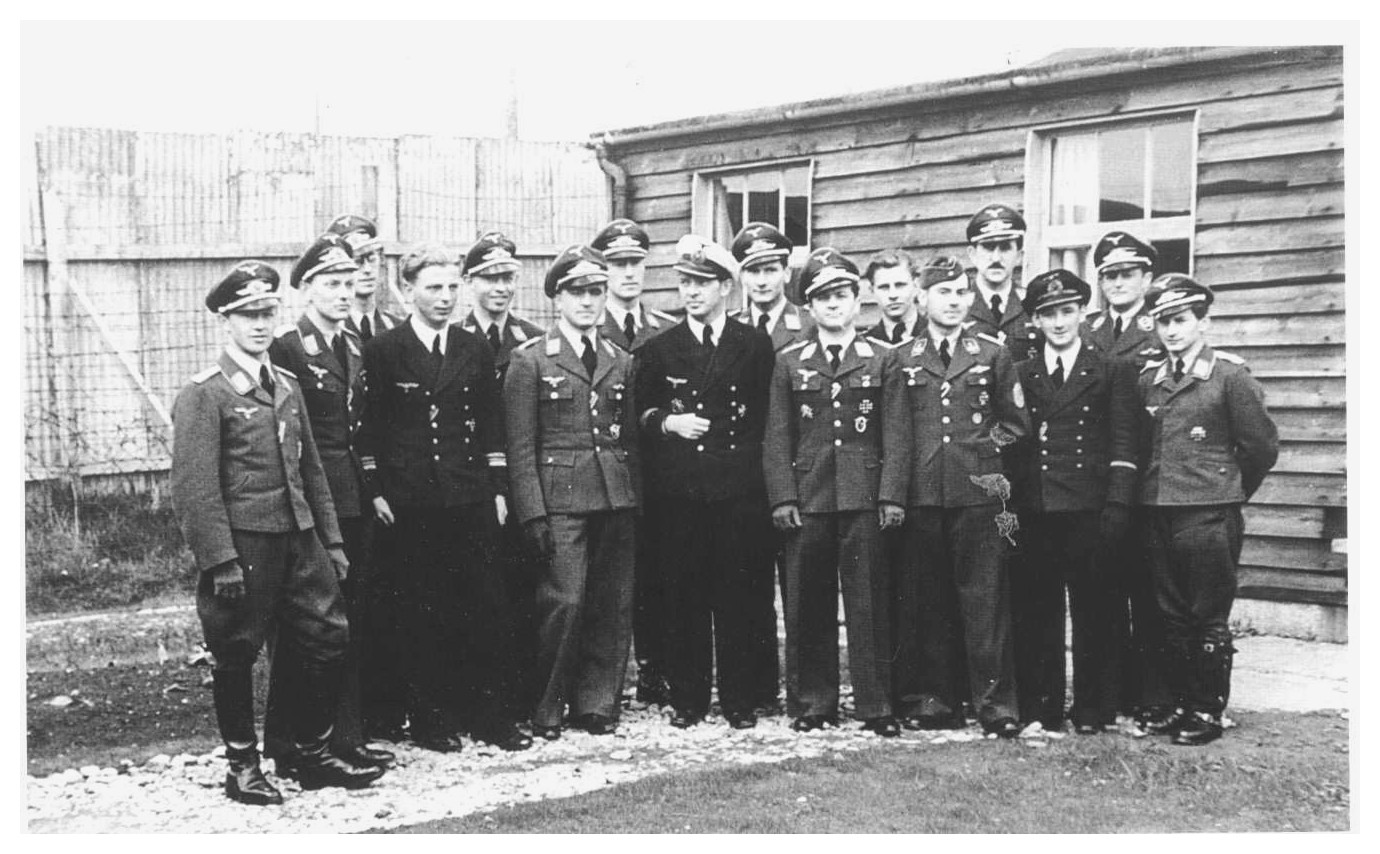
Interned German military personnel at the K-Lines Internment Camp in the Curragh.
Going on another brief tangent, you may be aware of the fact that what we know as “World War II” […] is not known by that name universally. Over on the former Soviet side of the house, it’s “The Great Patriotic War”. (Well, OK, they do distinguish between WWII and TGPW, but not in everyday conversation). The Soviet Union wasn’t the only country to give the conflict a less common name: In Eire, (Ireland), it was known as “The Emergency”
The background to this is that the Irish government wanted to enact emergency powers due to the unusual state of affairs which obtained in Europe in September 1939. The Irish Constitution granted the government such emergency powers in case of war, but it wasn’t entirely sure if the war in Europe counted. So the First Amendment to the Irish Constitution was approved, to add, in effect, that “state of war” could include “wars of which Ireland is not a part if the government thinks it’s important enough.” Once that little clarification was made, the Oireachtas (Parliament) passed its declaration of a state of emergency with the Emergency Powers Act. As a general rule, the Irish ruling bodies were not fans of the concept of acknowledging that there was a war going on which they had chosen not to be a part of. It went so far that when the son of a notable member of the Irish gentry in Malahide was killed when HMS Hood was sunk, his death was noted in the Irish Times as being due to a boating incident. As a result, the entire period 1939-1946 is known as “The Emergency.”
In this, as in so many other things, Ireland is a weird place. But we digress.
In December of 1942, Lieutenant General Jacob Devers, head of the Armored Force, decided to go on a fact-finding mission to the European Theatre of Operations to see how the tank units were holding up. Well, actually, it was mainly the North African Theatre of Operations, as European tank combat hadn’t really gotten off the ground. So he took with him a couple of colleagues, including one Major General Edward Brook, two Brigadier Generals named Gladeon Barnes and William Palmer, a Colonel William Thaddeus Sexton, and to carry the baggage, a Major Earl Hormell. They set off on December 14th, going south to Brazil, Ascension, The Gold Coast, Nigeria and Sudan, arriving Cairo five days later after a distance of 11,140 miles. After spending a little time with the British, they hopped over to Algeria, Tunisia and Morocco. At the end of trip, they went to Gibraltar for a week to consolidate their findings 7-14 January. The result of all this flying around and taking people away from their jobs for a month was one page and a quarter of conclusions, and one half-page of recommendations (the other half is six signature blocks).
[…]
Their duty from their trip being completed, they took advantage of the fact that they were already on the other side of the Atlantic to go to the UK to check in with the goings-on there.
So they boarded their aircraft, a B-17 converted to a VIP transport role, departed Gibraltar, and set off North up the Atlantic’s Eastern edge, looping around to the West of France to avoid German interception. Their B-17 was named “Stinky”.
You can probably guess where this is going.
The daily diary of the Devers mission reads as follows:
“At 2:00pm, January 15th, departed from Gibraltar, weather splendid. At approximately 10:00am, just after daylight, sighted land which navigator described as Lundy Island. From the map, this island appeared to be 100 miles north of the point at which the plane should have turned east towards Port Reath. Retracing south, the contour of the coastline did not correspond to that on available maps. Searched for approximately two hours without finding a familiar landmark. The radio operator was unable to contact any stations. The navigator admitted that he was lost. The ground consisted of small grass fields traversed by stone walls. With the gasoline supply nearly exhausted, a crash landing was made near Athenry at 11:50am. The size of the field was such that after hitting the ground, the plane crashed through a stone wall at approximately 70 miles per hour. Although the plane was wrecked, the members of the party were uninjured. The plane was immediately surrounded by Irish civilians and members of the Home Guard. The local inhabitants were very friendly, offered food and any medical assistance necessary. Shortly thereafter, representatives of the Eire Army arrived and took charge of the situation”
Er, oops? Read the whole thing for the full story.
Comments Off on The US Army’s tank development and “The Emergency” in Eire
January 25, 2019
The Greco-Turkish War and Legalisation of Ethnic Cleaning | Between 2 Wars | 1922 Part 2 of 2
TimeGhost History
Published on 24 Jan 2019When the Ottoman empire is torn apart by the Treaty of Sevres, ethnic conflicts in the old empire that have been boiling for almost a century lead to war between Greece and the parts of the Empire that will soon become the Republic of Turkey. A war that will have lasting effect on the world as both sides proceed to carry out stunning actions of ethnic violence, which is shockingly also sanctioned by international treaty after the fact.
Special thanks to Jonas Yazo Srouji and Valantis Athanasiou, who helped us with the research and image research for this episode. This behemoth of an episode is with 27 minutes the longest Between Two Wars episode yet. We really wanted to do the events justice. To deliver an unbiased, full telling of this eventful and controversial part of history, we couldn’t and didn’t want to make it any shorter.
An important note about the difference between ‘nationality’ and ‘ethnicity’: While ‘nationality’ is merely the relationship between an individual person and a state, someones ‘ethnicity’ depends on the racial, cultural, or religious group that a person is part of or identifies with. While these can overlap, they don’t necessarily have to.
Extra note: we recorded this way back in 2018, when our sound was not optimized. We apologise for the varying audio quality.
Cheers, Joram.
Join us on Patreon: https://www.patreon.com/TimeGhostHistory
Hosted by: Indy Neidell
Directed by: Spartacus Olsson
Written by: Spartacus Olsson
Produced by: Astrid Deinhard
Executive Producers: Bodo Rittenauer, Astrid Deinhard, Indy Neidell, Spartacus Olsson
Creative Producer: Joram Appel
Edited by: Wieke Kapteijns
Research by: Spartacus Olsson and Jonas Yazo Srouji and Valantis Athanasiou.Thumbnail depicts Ataturk colorised by Olga Shirnina aka Klimbim.
Colorized Pictures by Olga Shirnina and Norman Stewart
Olga’s pictures: https://klimbim2014.wordpress.com
Norman’s pictures https://oldtimesincolor.blogspot.com/Video Archive by Screenocean/Reuters http://www.screenocean.com
A TimeGhost chronological documentary produced by OnLion Entertainment GmbH
Comments Off on The Greco-Turkish War and Legalisation of Ethnic Cleaning | Between 2 Wars | 1922 Part 2 of 2
QotD: Unacceptable facts
If one harbours anywhere in one’s mind a nationalistic loyalty or hatred, certain facts, although in a sense known to be true, are inadmissible. Here are just a few examples. I list below five types of nationalist, and against each I append a fact which it is impossible for that type of nationalist to accept, even in his secret thoughts:
BRITISH TORY: Britain will come out of this war with reduced power and prestige.
COMMUNIST: If she had not been aided by Britain and America, Russia would have been defeated by Germany.
IRISH NATIONALIST: Eire can only remain independent because of British protection.
TROTSKYIST: The Stalin regime is accepted by the Russian masses.
PACIFIST: Those who ‘abjure’ violence can only do so because others are committing violence on their behalf.
All of these facts are grossly obvious if one’s emotions do not happen to be involved: but to the kind of person named in each case they are also intolerable, and so they have to be denied, and false theories constructed upon their denial. I come back to the astonishing failure of military prediction in the present war. It is, I think, true to say that the intelligentsia have been more wrong about the progress of the war than the common people, and that they were more swayed by partisan feelings. The average intellectual of the Left believed, for instance, that the war was lost in 1940, that the Germans were bound to overrun Egypt in 1942, that the Japanese would never be driven out of the lands they had conquered, and that the Anglo-American bombing offensive was making no impression on Germany. He could believe these things because his hatred for the British ruling class forbade him to admit that British plans could succeed. There is no limit to the follies that can be swallowed if one is under the influence of feelings of this kind. I have heard it confidently stated, for instance, that the American troops had been brought to Europe not to fight the Germans but to crush an English revolution. One has to belong to the intelligentsia to believe things like that: no ordinary man could be such a fool. When Hitler invaded Russia, the officials of the MOI issued ‘as background’ a warning that Russia might be expected to collapse in six weeks. On the other hand the Communists regarded every phase of the war as a Russian victory, even when the Russians were driven back almost to the Caspian Sea and had lost several million prisoners. There is no need to multiply instances. The point is that as soon as fear, hatred, jealousy and power worship are involved, the sense of reality becomes unhinged. And, as I have pointed out already, the sense of right and wrong becomes unhinged also. There is no crime, absolutely none, that cannot be condoned when ‘our’ side commits it. Even if one does not deny that the crime has happened, even if one knows that it is exactly the same crime as one has condemned in some other case, even if one admits in an intellectual sense that it is unjustified — still one cannot feel that it is wrong. Loyalty is involved, and so pity ceases to function.
George Orwell, “Notes on Nationalism”, Polemic, 1945-05.
Comments Off on QotD: Unacceptable facts
January 24, 2019
The Sinking of HMS Glorious: An Avoidable Tragedy?
Historigraph
Published on 27 Aug 2018The Sinking of HMS Glorious, on June 8 1940, was one of the worst British naval disasters of the Second World War. Over 1500 losing their lives as two German battleships sunk three British ships. In this video, we will recount the events and the heroism of Glorious’ two escorts (HMS Ardent and HMS Acasta), before looking at the post-war controversy over whether the disaster was ‘covered up’ by the Admiralty.
If you enjoyed this video and want to see more made, consider supporting my efforts on Patreon: https://www.patreon.com/historigraph
► Twitter: https://twitter.com/historigraph
►Patreon: https://www.patreon.com/historigraph
►Discord: https://discord.gg/f8JZw93
►My Gaming Channel: https://www.youtube.com/c/AddawaySources:
John Winton, Carrier Glorious (Cassell: 1986)
Stephen Roskill, Churchill and the Admirals (Pen and Sword, 1977)
Corelli Barnett, Engage The Enemy More Closely: The Royal Navy in the Second World War (Penguin, 1991)
Henrik Lunde, Hitler’s Preemptive War: The Battle for Norway, 1940. (kindle edition)
Earl Ziemke, German Northern Theater of Operations 1940-1945. (kindle edition)
Record of the Hansard Debate from 1999: https://api.parliament.uk/historic-ha…
Full Casualty List for HMS Glorious can be found here: http://www.naval-history.net/xDKCas19…
From the comments:
1. Unlike the Battle of the River Plate from my last video, we do not know the precise movements of the ships, particularly the British ones, during the battle. The movements in this video should thus be taken as purely illustrative.
2. As you might be able to tell there is still a pretty intense debate over the reasons for Glorious’ sinking, particularly over what knowledge the officers on board Devonshire had or didn’t have about Glorious’ trouble. In particular there is testimony from one midshipman that the ship’s captain and Admiral Cunningham (who was on board) knew what was happening and took no action. It is only his word, so many of the historians I have read do not seem to have bought much into it, but it appears in this documentary from 1997: https://www.youtube.com/watch?v=1yAahSUiXt4
Comments Off on The Sinking of HMS Glorious: An Avoidable Tragedy?
January 22, 2019
“I grew up in pre-history, or rather in Portugal (in some ways, same thing) in the 60s”
Sarah Hoyt on “toxic masculinity” and the rise of angry feminism:
… it’s such a just-so story it spreads and hides. It hides so well that people don’t realize they’re infected. But its distorting effects twist society’s processes to the point that something vital stops working.
Yes, the entire myth of “toxic masculinity” is one of these. It was born of the disappointment of feminists. Look, in the days when women were actually held back, those that made it were exceptional people.
Since I grew up in pre-history, or rather in Portugal (in some ways, same thing) in the 60s, where sexism was matter of fact and every day, I can tell you that, yes, to have the same grades as a boy you needed to work twice as hard, be brighter, more nimble, and more consistently good. Any boy started out with a good 20% on me in any teacher’s head, because “boys are smarter” wasn’t disputed, or even questioned.
So I understand that in the early twentieth century, women that made it to positions of prominence, where they became known for professional excellence, had to be GOOD at it. Amazing, in fact.
And even then, they might hit a glass ceiling, because they were the nail that stuck up. Everything conspired to bring them down.
Female liberation was played against this. People looked at these women, knew what they’d achieved against what obstacles, and dreamed that “if only women were allowed to be on an even footing with men, they’d be the best at everything. Every woman would be a leader.”
This is a form of insanity, because women are still human, and most humans are … average. That’s why they call it “average.”
But you can see how what they saw would deceive them.
Except that the obstacles were removed and women … were people. Sure. There are exceptional women, just as there are exceptional men, but in many ways, even with contraceptives, we women are still running with our legs in a biological sack. Oh, men too. They’re just different sacks. And men’s impairments, in a way, apply better to business, to creating, to competition.
Look, it’s become “sexist” to refer to PMS and women’s hormonal cycle as being at all different than men’s hormonal gearing up. Yeah. Any ideology that requires me to ignore my lying eyes in favor of their theory is bad-crazy which can destroy society, so these are my middle fingers. Reality is what it is.
Comments Off on “I grew up in pre-history, or rather in Portugal (in some ways, same thing) in the 60s”
Rowan Atkinson Live – Headmaster kills student
Rowan Atkinson Live
Published on 24 Jan 2014One of the most loved clips from Rowan’s vast back catalogue, a hilarious sketch where the angry teacher played by Rowan invites a father in to talk about the trouble with son…
Whether mesmerising us with the sheer visual mastery of Mr. Bean, beguiling us with the acerbic wit of Edmund Blackadder, or simply entertaining us as the suave, but rather hapless British Secret Agent Johnny English, you surely won’t have escaped the comic genius that is Rowan Atkinson.
In Rowan Atkinson Live, co-written with Richard Curtis (4 Weddings & a Funeral, Notting Hill, Love Actually) and Ben Elton, Atkinson runs the whole gamut of his remarkably versatile 30 year career, with sketches, mimes and monologues that are guaranteed to have you shedding tears of laughter. Performing live on stage alongside ‘straight man’ Angus Deayton, the show features a number of original and familiar routines, including sketches that appeared in the original Mr. Bean series.
I first heard this sketch many years ago (pre-internet days when we knapped our own flint) on an audio tape of clips from the Dr. Demento radio show, put together by my friend William. He didn’t know the performer, so he titled it “Fatal beatings”.
Comments Off on Rowan Atkinson Live – Headmaster kills student
QotD: From Athenian democracy to the Magna Carta
It is always tempting to look for our roots in ancient Athens … tempting, but wrong. The ancient Athenian “democracy” in the agora was, to be charitable, just mob rule, and the mob was incited, most often bought and paid for, by a series of loud mouthed bullies and celebrities ~ so, I can hear some of you saying, not much different from Canada and the USA in the 21st century, right? Now and again, Thucydides, for example, the loud mouth bully also had some brains and good ideas, but, more often than not they were just unqualified pretty boys and clowns.
The Romans gave us something a wee, tiny bit better: rule by law. But the Romans are, rightfully, often best remembered as engineers and they “engineered”, rigged, their political system to ensure that while there were, indeed, laws, to protect and serve the interests of the common people, the plebeians, the system ensured that no law could stand if it ever threatened the privileges of the patricians ~ Rome’s equivalent of our Laurentian elites.
The first time we find something that I think we can properly claim as a “root” of our, modern, liberal democracy is in Anglo Saxon England where, somewhat haphazardly to be sure, a council, called the Witan, advised and constrained and sometimes even elected the monarch for about 400 years, until the Norman conquest. The Witan (members of the Witenaġemot ~ the “meeting of wise men”) were the first privy council, the prototype of modern, Australian, British and Canadian cabinet government.
Next, in Norman times, came Magna Carta, echoes of which can still be heard in our great common law. Magna Carta itself was not as important as two men who, in their turn, gave it life. King John had no difficulty in persuading the Pope to disallow Magna Carta but the British barons actually went into open revolt and, first, William Marshal, acting as Earl Marshal of England and regent for the boy King Henry III, traded Magna Carta for an independent exchequer, and then Simon de Montfort, acting for the barons against the grown King Henry III, forced Magna Carta and parliamentary supremacy on to England.
Ted Campbell, “Our Conservative Roots”, Ted Campbell’s Point of View, 2017-03-05.
Comments Off on QotD: From Athenian democracy to the Magna Carta
January 20, 2019
Swedes not Sweden to Finland’s Rescue – WW2 – 021 – January 19 1940
World War Two
Published on 19 Jan 2019As the Winter War rolls on the only help the Finns are getting are from volunteers. The Western Allies still have their thoughts on Norway, little do they know that the Phony War almost ends this week…
Follow WW2 day by day on Instagram @World_war_two_realtime https://www.instagram.com/world_war_t…
Between 2 Wars: https://www.youtube.com/playlist?list…
Join us on Patreon: https://www.patreon.com/TimeGhostHistory
Or join The TimeGhost Army directly at: https://timeghost.tvWritten and Hosted by: Indy Neidell
Produced and Directed by: Spartacus Olsson and Astrid Deinhard
Executive Producers: Bodo Rittenauer, Astrid Deinhard, Indy Neidell, Spartacus Olsson
Research by: Indy Neidell
Edited by: Iryna Dulka
Map animations by: Eastory
Community Manager: Joram AppelColorizations by Spartacus Olsson and Norman Stewart.
Photos of the Winter War are mostly from the Finnish Wartime Photograph Archive (SA-Kuva).
Eastory’s channel: https://www.youtube.com/channel/UCEly…
Archive by Screenocean/Reuters https://www.screenocean.comA TimeGhost chronological documentary produced by OnLion Entertainment GmbH
Thumbnail depicts First Sergeant John Horseholm and Åke Ek of the Swedish Volunteer Battalion in 1944
https://www.flickr.com/photos/jenosco…
Colorised by Jared Enos https://www.flickr.com/people/jenosco…
Comments Off on Swedes not Sweden to Finland’s Rescue – WW2 – 021 – January 19 1940
January 19, 2019
The Lancet‘s new guidelines are a great leap forward … to worse-than-WW2 rationing
A new initiative by The Lancet and EAT, a billionaire’s pro-starvation advocacy group, involves new food guidelines that may leave Britons feeling a tiny bit … hungry:
The Lancet has got into bed with EAT to transform the global food supply. EAT is a campaign group run by a Norwegian billionaire who flies around the world in a private jet telling people to eat less meat to save the planet. The Lancet‘s interest is in getting people to live off lentils for the good of their health.
How much less meat do these people think we should be eating? Much, much less. Less than a sausage a week would be the pork ration in their brave new world.
[WATCH] The IEA's very own health warrior @CJSnowdon decided to try the @TheLancet's delicious nutrition guidelines for breakfast this morning! 🥓🍳 pic.twitter.com/0zJhqQTs6T
— IEA (@iealondon) January 17, 2019
[WATCH] Part 2 of the IEA's @CJSnowdon following @TheLancet's nutrition guidelines. Doesn't that beef sandwich look like the stuff that dreams are made of? 🥪https://t.co/h9cdxIgoUx pic.twitter.com/ncsEuMAAgp
— IEA (@iealondon) January 17, 2019
[WATCH] Part 3 of @cjsnowdon following @TheLancet diet. 🍗
Not a fan of the diet yourself? "You don’t need to worry about choice or personal responsibility. They’re gonna use a system of taxes and bans… to make sure you don't really have much choice!"https://t.co/h9cdxIgoUx pic.twitter.com/Sscnswc5aQ
— IEA (@iealondon) January 17, 2019
The Lancet meat guidelines are smaller than a WWII ration, but then the UK govt’s *actual* sugar guidelines are smaller than a WWII ration. https://t.co/auxYDuyMUK
— Christopher Snowdon (@cjsnowdon) January 19, 2019
As “Captain Nemo” commented on David Thompson’s blog:
“It appeared that there had even been demonstrations to thank The Lancet for raising the sausage ration to seven grams a week. And only yesterday, he reflected, it had been announced that the ration was to be REDUCED to seven grams a week…”
My apologies to Orwell.
Comments Off on The Lancet‘s new guidelines are a great leap forward … to worse-than-WW2 rationing
January 18, 2019
Xenophon’s Anabasis, Memorabilia, and Symposium
I’ve read an English translation of Xenophon’s Anabasis, but I only know a little bit about the Memorabilia, so Eve Browning‘s essay at Aeon was quite interesting:
The Anabasis is the first military memoir in the history of Western literature, and it recounts Xenophon’s experiences in the Persian campaign of Cyrus against his brother King Artaxerxes, and the long march ‘up country’. Since Xenophon waited several decades to commit these memories to writing, some have argued that they cannot be accurate. But as anyone who has listened to combat veterans will know, there’s a lot about the remembrance of past tours of duty that time cannot soften nor the years wear away.
Xenophon also wrote histories, portraits of leaders, practical treatises on horse training, hunting and running a household, among other things. An enduring theme that runs through much of his writing, and which has received scholarly attention in recent years, is that of leadership. What makes a good leader? What kind of leader can induce humans to endure hardships and expend effort toward a common goal? What exemplary traits mark out a leader and allow him or her to execute the requisite tasks with skill, induce a harmonious fellowship among those for whom he is responsible, maintain loyalty and mission clarity among the ‘troops’, whomever they might be? It is not difficult to see the formative roots of these questions, and of Xenophon’s answers to them, in that literally death-defying, embattled 2,000-mile march up-country to the sea.
Xenophon also wrote down his remembrances of a local philosopher named Socrates. Those who know Socrates mainly through the writings of Plato – Xenophon’s near-exact contemporary – will find Xenophon’s Socrates something of a surprise. Plato’s Socrates claims to know nothing, and flamboyantly refutes the knowledge claims of others. In the pages of Xenophon’s Memorabilia, however, Socrates actually answers philosophical questions, dispenses practical life advice, provides arguments proving the existence of benevolent gods, converses as if peer-to-peer with a courtesan, and even proposes a domestic economy scheme whereby indigent female relatives can become productive through the establishment of a textile business at home.
Socrates’ conversation, according to Xenophon, ‘was ever of human things’. This engaged, intensely practical, human Socrates can be refreshing to encounter. Anyone who has felt discomfort at how the opponents of Plato’s Socrates suffer relentless public refutations and reductions to absurdity can take some comfort in Xenophon’s Socrates who ‘tries to cure the perplexities of his friends’.
For instance, what could be more enchanting than a Socrates who solo-dances for joy and exercise, so unlike the Socrates we know from Plato? In Xenophon’s Symposium, Socrates asks the Phoenician dance-master to show him some dance moves. Everyone laughs: what will you do with dance moves, Socrates? He replies: ‘I’ll dance, by God!’ A friend of Socrates then tells the group that he had stopped by his house early in the morning, and found him dancing alone. When questioned about it, Socrates happily confesses to solo-dancing often. It’s great exercise, it moves the body in symmetry, it can be done indoors or outdoors with no equipment, and it freshens the appetite.
Another surprising side of Xenophon’s Socrates is shown through his encounter with a person who not only doesn’t honour the gods, but makes fun of people who do. To this irreligious person, Socrates presents a careful and persuasive line of reasoning about the designed usefulness of all elements of creation. For humans and many other animals, there are ‘eyes so that they can see what can be seen, and ears so that they can hear what can be heard’, eyelids, eyelashes, molars and incisors, erotic desire to aid procreation; all these are ‘the contrivance of some wise craftsman who loves animals’. And what about the cosmos as a whole? ‘Are you, then, of the opinion that … those surpassingly large and infinitely numerous things are in such an orderly condition through some senselessness?’ Human beings even have the spiritual capacity to perceive the existence of gods, ‘who put in order the greatest and noblest things’, and ‘they worry about you!’
H/T to Never Yet Melted for the link.
Comments Off on Xenophon’s Anabasis, Memorabilia, and Symposium
Tank Chats #41 Sherman Firefly | The Tank Museum
The Tank Museum
Published on 28 Jul 2017A Tank Chat from David Fletcher on an inspired British modification. As an all-round, general purpose tank the Sherman was one of the best of World War II, but by 1943 it was getting past its prime. An officer at Lulworth Camp, near Bovington, came up with the idea of fitting a better gun, the British 76.2mm, known as the 17 pounder. The new design would be known as the Sherman Firefly.
Support the work of The Tank Museum on Patreon: ► https://www.patreon.com/tankmuseum
Or donate http://tankmuseum.org/support-us/donateSUBSCRIBE to The Tank Museum YouTube channel: ► http://www.youtube.com/channel/UChl-X…
Press the little bell above to enable NOTIFICATIONS so you don’t miss the latest Tank Museum videos.
Twitter: ► https://twitter.com/TankMuseum
Tiger Tank Blog: ► http://blog.tiger-tank.com/
Tank 100 First World War Centenary Blog: ► http://tank100.com/ #tankmuseum #tanks
Comments Off on Tank Chats #41 Sherman Firefly | The Tank Museum
January 17, 2019
How effective was the Tiger really?
Military History Visualized
Published on 18 Dec 2018There are quite many debates about the Panzerkampfwagen VI Ausführung E & B – the Tiger & Königstiger – tanks, so in this video we look at how effective or ineffective these panzers were in combat. This means we look at doctrine, kill to loss ratios, mission accomplishment and various other issues.
»» SUPPORT MHV ««
» patreon – https://www.patreon.com/mhv
» subscribe star – https://www.subscribestar.com/mhv»» SOCIAL MEDIA ««
» twitter – https://twitter.com/MilHiVisualizedMilitary History Visualized provides a series of short narrative and visual presentations like documentaries based on academic literature or sometimes primary sources. Videos are intended as introduction to military history, but also contain a lot of details for history buffs. Since the aim is to keep the episodes short and comprehensive some details are often cut.
Comments Off on How effective was the Tiger really?
January 15, 2019
Celtic Myth – The Isle of Destiny – Extra Mythology – #1
Extra Credits
Published on 14 Jan 2019Join the Patreon community! http://bit.ly/EMPatreon
Inis Fáil is the Isle of Destiny, in Ireland. It was here that the Children of the Danu were sent on a quest to find their destiny, but they would have to encounter the Fir Bolg first…
Comments Off on Celtic Myth – The Isle of Destiny – Extra Mythology – #1


