Quotulatiousness

April 27, 2020

The Economy of Ancient Rome

Filed under: Economics, Europe, History — Tags: , , , , , — Nicholas @ 04:00

Economics Explained
Published 26 Apr 2020

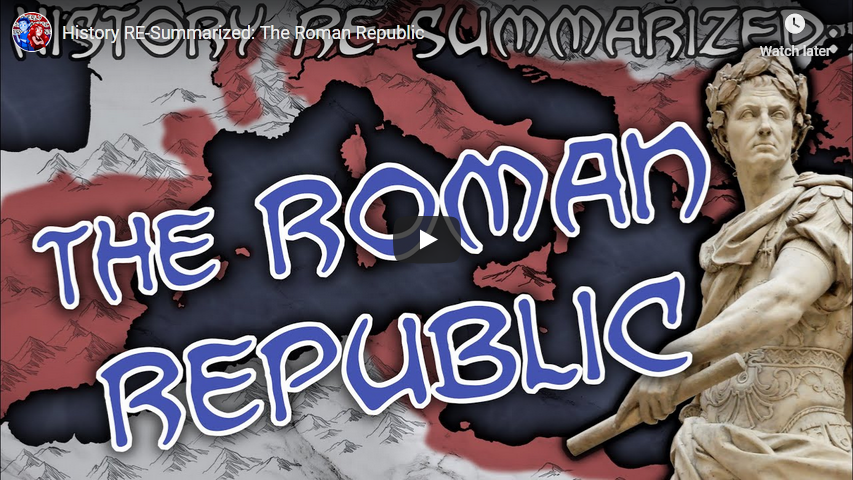
Ancient Rome was perhaps the most significant ancient civilisation to have existed throughout history, the empire lived for over 1000 years and in that time, it gave us the foundations for our modern society. Democracy, a court based legal system, Latin languages and alphabet, three course meals, and perhaps it was one of the first modern economies to move beyond a simple agrarian empire and develop things like modern banking, lending, taxation and yes even financial crisis as we know them today.

In the same way that scholars study a dead language like Latin to discerned the foundation of meaning in our modern dialects economists can study the histories of ancient civilisations like Rome to determine basic economic functions in a time before modern financial systems could skew results and Rome was perhaps the most developed case study we could look at.

#rome #economics #recession

Patreon – https://www.patreon.com/EconomicsExpl…

Discord – https://discord.gg/7kM7Tw9

Enquiries – loungejita@gmail.com

References –

Morley, N., 2002. Metropolis and hinterland: the city of Rome and the Italian economy, 200 BC-AD 200. Cambridge University Press.

Temin, P., 2006. “The economy of the early Roman Empire”. Journal of Economic Perspectives

Temin, P., 2017. The Roman market economy. Princeton University Press.

Garnsey, P., Hopkins, K. and Whittaker, C.R. eds., 1983. Trade in the ancient economy

Brown, P., 2012. Through the Eye of a Needle: Wealth, the Fall of Rome, and the Making of Christianity in the West, 350-550 AD. Princeton University Press.

Braund, D.C., 1983. Gabinius, Caesar, and the publicani of Judaea. Klio

Articles

http://penelope.uchicago.edu/Thayer/E…

https://www.rug.nl/ggdc/historicaldev…

https://www.pwc.com.au/publications/a…

April 26, 2020

Another Last Stand at Thermopylae – The Battle of Greece – WW2 – 087 – April 25, 1941

Filed under: Africa, Britain, Europe, Germany, Greece, History, Italy, Military, WW2 — Tags: , , , , , , — Nicholas @ 06:00

World War Two
Published 25 Apr 2020

The Battle of Greece continues as forces clash once more at the historic site of Thermopylae.

Join us on Patreon: https://www.patreon.com/TimeGhostHistory
Or join The TimeGhost Army directly at: https://timeghost.tv

Follow WW2 day by day on Instagram @World_war_two_realtime https://www.instagram.com/world_war_t…
Between 2 Wars: https://www.youtube.com/playlist?list…
Source list: http://bit.ly/WW2sources

Written and Hosted by: Indy Neidell
Director: Astrid Deinhard
Producers: Astrid Deinhard and Spartacus Olsson
Executive Producers: Astrid Deinhard, Indy Neidell, Spartacus Olsson, Bodo Rittenauer
Creative Producer: Joram Appel
Post-Production Director: Wieke Kapteijns
Edited by: Iryna Dulka
Sound design: Marek Kamiński
Map animations: Eastory (https://www.youtube.com/c/eastory)

Colorizations by:
– Norman Stewart – https://oldtimesincolor.blogspot.com/
– Jaris Almazani (Artistic Man), https://instagram.com/artistic.man?ig…
– Julius Jääskeläinen – https://www.facebook.com/JJcolorization/
– Dememorabilia – https://www.instagram.com/dememorabilia

Sources:
– Bundesarchiv, CC-BY-SA 3.0, Bild 101I-163-0318-09/Bauer, Bild 101I-163-0319-03A/Bauer
– Edo leitner from Wikimedia
– Imperial War Museum: E 3830, TR 1762, IWM ART LD 3355, E 676, E 3182, E 3187, E 3178, E 3183, E 2363
– Roll by rivercon from the Noun Project
– Grains by Gan Khoon Lay from the Noun Project

Archive by Screenocean/Reuters https://www.screenocean.com.

A TimeGhost chronological documentary produced by OnLion Entertainment GmbH.

From the comments:

World War Two
2 days ago (edited)
The war keeps on growing, and were doing our best to keep up with it. As you notice the episodes are often longer these days, but there are still many details we just can’t cover in the weekly episodes for time reasons. That’s why we do our specials and also why we have our Instagram and Facebook feed with headlines of the war day by day. For instance, while we cover the Allied retreat at Thermopylae, Indy just didn’t have space to go into the details about how Australian and New Zealand forces hold back the Wehrmacht while the others retreat. That will instead be the topic of our post on Instagram / Facebook on April 24 here: https://www.instagram.com/world_war_two_realtime/ and on the TimeGhost facebook page. We also dedicated the thumb to that event by featuring a soldier of the 28th (Māori) Battalion of the NZ forces, photographed in North Africa somewhat later in 1941 while doing the Haka. His unit was part of the rear guard at Thermopylae.

And on that note we would like to acknowledge that we would never be able to do this massive endeavor without the TimeGhost Army and their financial contribution. Valantis who supported this episode by dedicating it to the Cypriots fighting for the Allies in the war is not only a member of the TG Army, he’s also a valuable contributor in our comment sections and volunteers his time to help us sift through and read every comment posted under any of our videos. So, in this place we would like to once again thank Valantis and the entire TimeGhost Army for keeping us in kit, supplies, and manpower to continue the good fight for remembrance and education, especially in these trying times. You can join our forces here https://www.patreon.com/TimeGhostHistory or here https://timeghost.tv

Spartacus on behalf of the entire TimeGhost team.

“Soldier of Three Armies” Pt. 1 – Winter War – Sabaton History 064 [Official]

Filed under: Europe, Germany, History, Media, Military, Russia, WW2 — Tags: , , , , — Nicholas @ 04:00

Sabaton History
Published 25 Apr 2020

Started out as a reserve, soon promoted well deserved, and the legend has begun. Lauri Allan Törni, the soldier of three armies. Born and raised in Viipuri in Finnish Karelia, Lauri Törni grew up into a world of tensions, of class-consciousness and conflicting ideologies. Boxed in between the Soviet Union and Germany, Finland was preparing for war of survival. The Winter War would be the first place for Lauri Törni to see battle and begin his legacy as a born soldier.

Support Sabaton History on Patreon: https://www.patreon.com/sabatonhistory

Listen to “Soldier of Three Armies” on the album Heroes:
CD: http://bit.ly/HeroesStore
Spotify: http://bit.ly/HeroesSpotify
Apple Music: http://bit.ly/HeroesAppleMusic
iTunes: http://bit.ly/HeroesiTunes
Amazon: http://bit.ly/HeroesAmz
Google Play: http://bit.ly/HeroesGoogleP

Check out the trailer for Sabaton’s new album The Great War right here: https://www.youtube.com/watch?v=HCZP1…

Listen to Sabaton on Spotify: http://smarturl.it/SabatonSpotify
Official Sabaton Merchandise Shop: http://bit.ly/SabatonOfficialShop

Hosted by: Indy Neidell
Written by: Markus Linke and Indy Neidell
Directed by: Astrid Deinhard and Wieke Kapteijns
Produced by: Pär Sundström, Astrid Deinhard and Spartacus Olsson
Creative Producer: Joram Appel
Executive Producers: Pär Sundström, Joakim Broden, Tomas Sunmo, Indy Neidell, Astrid Deinhard, and Spartacus Olsson
Post-Production Director: Wieke Kapteijns
Edited by: Iryna Dulka
Sound Editing by: Marek Kaminski
Maps by: Eastory – https://www.youtube.com/c/eastory

Archive by: Reuters/Screenocean https://www.screenocean.com
Music by Sabaton.

Sources:
– Lauri Törni Perinnekilta
– Helsinki City Museum
– Finnish Heritage Agency
– sa-kuva.fi

An OnLion Entertainment GmbH and Raging Beaver Publishing AB co-Production.

© Raging Beaver Publishing AB, 2019 – all rights reserved.

From the comments:

Sabaton History
2 days ago
Hello everyone! We hope you all stay safe and healthy! Due to the current situation, the interview part had to be recorded via webcam and the quality is sadly not the best. We apologize for that. Still we try to keep to our weekly schedule and bring you exciting new episodes of Sabaton History!

Where have all the airships gone? | James May’s Q&A (Ep 8) | Head Squeeze

Filed under: Britain, Germany, History, Military, Technology, WW1 — Tags: , — Nicholas @ 02:00

BBC Earth Lab
Published 21 Feb 2013

James May talks us through the rise and fall of airships.

James May’s Q&A:
With his own unique spin, James May asks and answers the oddball questions we’ve all wondered about from “What Exactly Is One Second?” to “Is Invisibility Possible?”

April 25, 2020

History-Makers: Shakespeare

Overly Sarcastic Productions
Published 24 Apr 2020

“The Bard” is not only an essential class in any D&D party, but a byword for England’s most famous writer. We’ve covered a bit of Shakespeare before on OSP — just a bit, really, nothing major, only a dozen — but today we’ll look at how William got to Bard-ing, and how he accidentally became England’s biggest Historian.

SOURCES and Further Reading: The Introduction and play-texts of the Folger Shakespeare Library (The best way to read Shakespeare), “Shakespeare: A Very Short Introduction” by Wells

This video was edited by Sophia Ricciardi AKA “Indigo”. https://www.sophiakricci.com/
Our content is intended for teenage audiences and up.

PATREON: https://www.Patreon.com/OSP

DISCORD: https://discord.gg/h3AqJPe

MERCH LINKS: https://www.redbubble.com/people/OSPY…

OUR WEBSITE: https://www.OverlySarcasticProductions.com
Find us on Twitter https://www.Twitter.com/OSPYouTube
Find us on Reddit https://www.Reddit.com/r/OSP/

Professor Neil Ferguson – “I wrote the code (thousands of lines of undocumented C) 13+ years ago to model flu pandemics…”

Filed under: Britain, Government, Health — Tags: , , , — Nicholas @ 03:00

An anonymous guest post at Hector Drummond’s blog pivots on the disturbing quote in the headline from one of the key advisors to the British government on the Wuhan Coronavirus epidemic:

To say I was gobsmacked at his admission is an understatement. He’s one of the experts advising the government about the Covid-19 pandemic, and was consulted in previous health crises such as Foot & Mouth disease. Like the approach to combating that, we’re seeing a kind of scorched earth approach to containing another transmissible disease.

Even though the “C” programming language that Ferguson used is nearly 50 years old, the language chosen isn’t the problem. Undocumented means that modules and other code fragments are not commented, so their purpose may be unclear to someone unfamiliar with the code. In the worst case it means that modules and variables don’t have self-documenting names. For example, an accounting program could have the variables BalanceBroughtForward and BalanceCarriedForward, but a sloppy programmer might call them B1 and B2 instead – a sure recipe for confusion.

The “C” language is good to work with but has some inherent issues which can lead to subtle bugs affecting the output without causing an error. A common problem is the conditional which uses two equals signs rather than one.

To compare variables A and B for equality you would write this: if (A == B). However, it’s easy to accidentally write this: if (A = B). The latter always returns true and assigns the value of variable B to A. I have no idea whether Ferguson’s code contains any bugs, this is just one minor example of the need for strict testing.

The reason for commenting code extensively and properly is so that the programmer himself, and anyone else who maintains it, can understand what it does and how it works, reduce the chance of mistakes and avoid unnecessary effort. During my IT career I would have terminated the contract of any contractor working for me who wrote thousands of lines of undocumented code. Not only is such code a nightmare for others to work on, it can be difficult for the original programmer to maintain if coming back to it after a long time. Sloppiness in the coding raises the worry of a concomitant lack of rigour in testing, although that’s not to assert Ferguson’s code isn’t working as intended and/or wasn’t tested.

April 24, 2020

Field Rations, Foreign Legion, and French Anti-Semitism – WW2 – OOTF 010

Filed under: Europe, France, Germany, History, Italy, Military, WW2 — Tags: , , , , — Nicholas @ 04:00

World War Two
Published 23 Apr 2020

What did soldiers eat on the frontlines? What happened to the French Foreign Legion? And how is the legacy of Alfred Dreyfus handled in the anti-semitic Vichy France? Find out in this exciting episode of Out of the Foxholes!

Submit your own question for Out of the Foxholes: https://community.timeghost.tv/c/Out-…

Join us on Patreon: https://www.patreon.com/TimeGhostHistory
Or join The TimeGhost Army directly at: https://timeghost.tv

Follow WW2 day by day on Instagram @World_war_two_realtime https://www.instagram.com/world_war_t…
Between 2 Wars: https://www.youtube.com/playlist?list…
Source list: http://bit.ly/WW2sources

Hosted by: Indy Neidell
Written by: Rune Væver Hartvig
Director: Astrid Deinhard
Producers: Astrid Deinhard and Spartacus Olsson
Executive Producers: Astrid Deinhard, Indy Neidell, Spartacus Olsson, Bodo Rittenauer
Creative Producer: Joram Appel
Post-Production Director: Wieke Kapteijns
Research by: Rune Væver Hartvig
Edited by: Mikołaj Cackowski
Sound design: Marek Kamiński
Map animations: Eastory (https://www.youtube.com/c/eastory)

Colorizations by:
Norman Stewart – https://oldtimesincolor.blogspot.com/

Sources:
Bundesarchiv
German soldiers eating (courtesy Josef Gierse)
Narodowe Archiwum Cyfrowe
IWM E 3799
From the Noun Project: Spam by Jay Adams, Biscuits by Xela Ub, can by Anniken & Andreas, Bread by Vallone Design, Jam by Vichanon Chaimsuk, honey by Marta Ambrosetti, Coffee by Larea, stew by Smalllike, Soup by Ben Davis

Soundtracks from the Epidemic Sound:
Trabant 33 – “When in Bavaria”
Rannar Sillard – “March Of The Brave 4”
Johannes Bornlof – “Deviation In Time”

Archive by Screenocean/Reuters https://www.screenocean.com.

A TimeGhost chronological documentary produced by OnLion Entertainment GmbH.

Prizes, patents, and the Society of the Encouragement of Arts, Manufactures and Commerce

In the most recent Age of Invention newsletter, Anton Howes explains why the Society of the Encouragement of Arts, Manufactures and Commerce (now the Royal Society of Arts) wasn’t a fan of the British patent system and preferred to award prizes in areas that were unlikely to generate monopoly situations:

The back of the Royal Society of Arts building in London, 25 August 2005.
Photo by C.G.P. Grey (www.CGPGrey.com) via Wikimedia Commons.

… the Society’s early members had an aversion to monopolies, and patents are, after all, temporary monopolies. But there was actually a more practical reason to not give rewards to patented inventions. In fact, quite a few active members of the Society were themselves patentees, and patents for inventions were not generally lumped together for condemnation with practices like forestalling and engrossing. The practical reason for banning patents was that there was no point giving a prize for something that people were already doing anyway. Patents were expensive in the eighteenth century — depending on how you account for inflation, it could cost about £300,000 in modern terms to obtain one — so the fact that there was a patent for a process was a clear indication that it might be profitable. The Society, by contrast, was supposed to encourage things that would not otherwise have been done.

Thus, when a patent had already been granted for a process the Society had been considering giving a premium for, it purposefully backed down — not because the prize would infringe on the patent, but because its encouragement was no longer necessary. And so the effect of the ban on patented inventions was that the Society received, even unsolicited, exactly the kinds of inventions that there was less monetary incentive to invent. Occasionally, this meant trivial improvements — minor tweaks, here and there, to existing processes. An engineer might patent one invention, but not see it worth their time patenting another — through the Society’s prizes, they might at least get a bit of cash for it, or some recognition. The improvement would also be promoted through the Society’s publications. Or, the Society received inventions that were far from trivial, like the scandiscope for cleaning chimneys [here], but which were not all that profitable: inventions that saved lives, or had other beneficial effects on the health and wellbeing of workers and consumers. And finally, the Society received innovations that could not be patented, such as agricultural practices and the opening of new import trades. In the early nineteenth century the Society awarded its prizes to a whole host of naval officers, including an admiral, who came up with flag-based signalling systems between ships — early forms of semaphore.

Another effect of the ban on patents was that the Society also attracted submissions from different demographics. Many of its submissions came from people who were too poor to afford patents, as well as from those who were too rich — wealthy aristocrats for whom commercial considerations might seem vulgar. The poor would generally go for the cash prizes, and the aristocrats for the honorary medals. And the prizes were used by people who might otherwise be socially excluded from invention. In 1758, for example, the Society instructed its members in the American colonies to accept submissions from Native Americans. It also allowed women to claim premiums (just as it allowed them to be members). My favourite example is Ann Williams, postmistress at Gravesend, in Kent, who won twenty guineas from the Society in 1778 for her observations on the feeding and rearing of silk-worms. She kept them in one of the post-office pigeon-holes, referring to them affectionately as “my little family” of “innocent reptiles”. Unlike other elements of society, the Society of Arts accepted, as she put it to them, that “curiosity is inherent to all the daughters of Eve.”

The Society thus encouraged the kinds of inventions that might not otherwise have been created, and catered to the kinds of inventors who might not otherwise have been recognised. Rather than competing with the patent system, it complemented it, filling in the gaps that it left. The Society operated at the margins, and only at the margins, to the better completion of the whole. It found its niche, to the benefit of innovation overall.

Mauser-Norris Prototype: Origins of the Mauser Legacy

Filed under: Business, Europe, France, Germany, History, Military, Weapons — Tags: , , , , — Nicholas @ 02:00

Forgotten Weapons
Published 10 Jan 2020

http://www.patreon.com/ForgottenWeapons

https://www.floatplane.com/channel/Fo…

Cool Forgotten Weapons merch! http://shop.bbtv.com/collections/forg…

Today we are looking at one of the rarest and earliest rifles built by Paul and Wilhelm Mauser, a design which would set in motion all the events that led to the Mauser company becoming one of the great world leaders in small arms. The Mauser brothers were born in Oberndorf am Necker in the Kingdom of Württemberg, sons of a gunsmith. They would take up their father’s trade and were creative and intelligent boys, but opportunities were limited in the small, rural town of Oberndorf. In 1865 they presented a rifle to the Austrian Army in Vienna for trials, where it was rejected. However, it was noticed by an American sales rep for the Remington Company, a man named Samuel Norris. Norris saw the potential in the Mauser brothers’ design to convert needlefire rifles to metallic cartridges, and he signed a deal with the brothers to further develop the system.

The Mausers moved to Liege Belgium to do their work, and within just a few years they were making rifles for Norris. This example is based on a Chassepot, as Norris hoped to sell the conversion system to the French Army. That deal was rejected, however (the French were happy sticking with paper cartridges as of 1868), and Norris’ plans began to unravel when the Remington company discovered that he was making dealings in his own name instead of for them. The Mauser brothers ended up walking away from the deal with ownership of the patents they had filed with Norris, and when they submitted the design to the Prussians a process began which would result in the Mauser Model 1871 being adopted. From there, their talents would lead to the whole line of Mauser repeating rifles culminating in the Model 1898, arguably the pinnacle of the bolt action military rifle.

Thanks to the Liege Arms Museum for access to film this for you! If you are in Belgium, definitely plan to stop into the museum, part of the Grand Curtius. They have a very good selection of interesting and unusual arms on display. Further thanks to the Paul Mauser Archive for helping to arrange this filming!

https://www.grandcurtius.be

http://www.paul-mauser-archive.com

Contact:
Forgotten Weapons
6281 N. Oracle #36270
Tucson, AZ 85740

April 23, 2020

1945: Japan Joins the Allies | The Indonesian War of Independence Part 1

Filed under: Asia, Britain, Europe, History, Japan, Military, WW2 — Tags: , , , , , — Nicholas @ 04:00

TimeGhost History
Published 22 Apr 2020

In Indonesia, following the end of the Second World War catalyses the end of brutal Japanese rule. Their exit prompts the Dutch to begin restoring their prewar colonial status over the archipelago. But nationalist spirits are brewing, their opportunity to proclaim Indonesian independence is transpiring.

Join us on Patreon: https://www.patreon.com/TimeGhostHistory

Watch the Prologue to the Indonesian War of Independence series right here: https://youtu.be/IkKJSRaeOik

Hosted by: Indy Neidell
Written by: Isabel Wilson and Joram Appel
Director: Astrid Deinhard
Producers: Astrid Deinhard and Spartacus Olsson
Executive Producers: Astrid Deinhard, Indy Neidell, Spartacus Olsson, Bodo Rittenauer
Creative Producer: Joram Appel
Post-Production Director: Wieke Kapteijns
Research by: Isabel Wilson and Joram Appel
Edited by: Karolina Dołęga
Sound design: Marek Kaminski

Colorizations:
Dememorabilia – https://www.instagram.com/dememorabilia/
Jaris Almazani (Artistic Man) – https://instagram.com/artistic.man?ig…

Sources:
Archive by Screenocean/Reuters https://www.screenocean.com.
Tropenmuseum, part of the National Museum of World Cultures
Imperial War Museum Arts: Ronald Searle, SE5895 , SE-5865, SE5663, SE5724
Rijksmuseum

Music:
“Deviation In Time” – Johannes Bornlof
“Last Point of Safe Return” – Fabien Tell
“Deflection” – Reynard Seidel
“Disciples of Sun Tzu” – Christian Andersen
“Split Decision” – Rannar Sillard
“Other Sides of Glory” – Fabien Tell
“Last Man Standing 3” – Johannes Bornlöf
“Magnificent March 3” – Johannes Bornlöf
“Deviation In Time” – Johannes Bornlof

A TimeGhost chronological documentary produced by OnLion Entertainment GmbH.

From the comments:

TimeGhost History
1 day ago (edited)
For the last decades, writing colonial histories on events such as the Indonesian War of Independence has been a difficult task. Due to the incriminating nature of the events, records were either never made or have been regularly “lost” since. Political interest in the events was minimal in both The Netherlands and Indonesia, but times are changing. In recent years, a lot more research power has been allocated to this topic by Dutch and Indonesian Universities and Research collectives. Finding colonial truths is a huge focus of academia right now and their work has allowed us to get real with colonialism in this series. We’re sure that even more sources and stories will surface in the coming years, allowing for more books and documentary such as ours to be made. We’re interested to hear what you think about this episode! Make sure to let us know in the comments!

Cheers,
Izzy

Trial by jury

Filed under: Britain, History, Law, Liberty — Tags: , , , , — Nicholas @ 03:00

Peter Hitchens recounts the essential role of the jury system in the evolution of the English (and, by inheritance, the Australian, Canadian, and even American) constitutional rights of the individual, which today seems to be in peril:

A still from the 1957 movie Twelve Angry Men, directed by Sidney Lumet, starring Henry Fonda, Lee J. Cobb, and Martin Balsam.

Am I going to have to fall out of love with juries? For decades I have defended these curious committees, which can ruin a man’s life in an afternoon. It has been a romance as much as it has been a reasoned position. Most people get their best lesson in jury trials from the 1957 movie Twelve Angry Men. In that version, a single determined juror, played by Henry Fonda, gradually wins the rest of the panel round to an acquittal, at great cost in emotion and patience. But what really won my heart was Thomas Macaulay’s account of the Trial of the Seven Bishops, in which a London jury defied the wishes of the would-be autocrat King James II in 1688. It was an astonishing event, a monarch’s authority challenged by — of all unlikely things — a collection of Anglican prelates. Their acquittal, perhaps more than anything else, led to James’s fall a few months later. It was the beginning of true constitutional monarchy in Europe, the genesis of the English Bill of Rights and the forerunner of the very similar American document of the same name. It could not have happened without a jury.

For without a jury, any trial is simply a process by which the state reassures itself that it has got the right man. A group of state employees, none of them especially distinguished, are asked to confirm the views of other state employees. With a jury, the government cannot know the outcome and must prove its case. And so the faint, phantasmal ideal of the presumption of innocence takes on actual flesh and bones and stands in the path of power. Juries grew up in England almost entirely by happy accident, and no government would nowadays willingly create them where they do not already operate. A brief fashion for them in 19th-century Europe was swiftly stamped out by governments that understood all too well how much they limited their power. I believe the last true Continental juries, sitting in the absence of a judge, were abolished in France in 1940 by the German occupation authorities. People in Anglosphere countries, unaware that true independent juries rarely exist outside the English-speaking world, have no idea what a precious possession they are.

I remember actually pounding the arm of my chair with delight as I read Macaulay’s account of the response of the bishops’ attorney, Francis Pemberton, when threatened by the chief Crown prosecutor, the solicitor general: “Record what you will. I am not afraid of you, Mister Solicitor!” So this was England after all, and even the majesty of the Stuart Crown could not overawe the defense. This was wholly thanks to the fact that the trial took place before a jury — which duly acquitted the bishops of “seditious libel,” the ludicrous charge by which James had hoped to crush opposition to his plans to reverse the Reformation. Without a jury, the king would of course have won his case, and England would have gone down the road to absolutism (already followed in France, Prussia, Russia, and the Habsburg dominions) with incalculable consequences for the whole world. Instead we had what came to be called the Glorious (or Bloodless) Revolution.

And my blood still runs faster when I recall this and other moments at which the mere existence of juries has made us all more free. Yet I also have terrible doubts. Is the independence of juries possible in the modern world, in which the English Bill of Rights is all but forgotten and a new dispensation reigns? All too often, I read reports of trials in my own country that fill me with doubt. I did my fair share of court reporting as an apprentice journalist many years ago, and I have a good understanding of how these things used to work and ought to work. Something has changed. There is a worrying number of sex cases now coming before the courts in which clear forensic proof of guilt is often unobtainable.

The alleged crimes themselves are repulsive, and the mere accusation is enough to nurture prejudice. The defendants have often been arrested in the scorching light of total publicity, in spectacular dawn raids totally unjustified by any immediate danger they present. Pre-trial media reporting has further undermined the presumption of innocence. In England there is still officially a strong rule against the media taking sides before the jury delivers its verdict. But this is not enforced as it once was. The prosecutions are frequently as emotional as they are unforensic, the opposite of the proper arrangement. Yet the defendants are often convicted even so (sometimes by majority verdicts, which in my view violate the whole jury principle). The state seems somehow to have turned the jury — often swayed by emotion — into its own weapon. And it is worse than the alternative. A wrongfully-convicted defendant, pronounced culpable by a jury of his peers, must feel a far deeper despair than one cast into prison by a mere panel of judges.

Quintinshill, the Worst Railway Disaster in British History

Filed under: Britain, History, Military, Railways, WW1 — Tags: , , , — Nicholas @ 02:00

The History Guy: History Deserves to Be Remembered
Published 15 Sep 2018

Railroads played a critical role for the United Kingdom in the Great War. But the increased burden on the nation’s railways had its cost. In the early morning hours of May 22, 1915, a crowded schedule resulted in the 1915 Quintinshill Rail Disaster, the worst railway disaster in British history. Its victims, mostly men of the 1/7 Royal Scots regiment, deserve to be remembered.

The History Guy uses media that are in the public domain. As photographs of actual events are sometimes not available, photographs of similar objects and events are used for illustration.

The episode includes historical photos involving the Great War and a 1915 railway disaster. Those photos are provided in context of the historical events. No graphic violence is shown.

Patreon: https://www.patreon.com/TheHistoryGuy

The History Guy: History Deserves to Be Remembered is the place to find short snippets of forgotten history from five to fifteen minutes long. If you like history too, this is the channel for you.

Awesome The History Guy merchandise is available at:
https://teespring.com/stores/the-hist…

The episode is intended for educational purposes. All events are portrayed in historical context.

#quintinshill #wwi #thehistoryguy

April 22, 2020

Tanks of the Early North Africa Campaigns, by The Chieftain – WW2 Special

Filed under: Africa, Britain, Germany, History, Italy, Military, Weapons, WW2 — Tags: , , — Nicholas @ 06:00

World War Two
Published 21 Apr 2020

The Chieftain takes us to North Africa, where he talks us through the tanks that were used during the first months of the Battles in North Africa between the Italians and Germans on the one side and British and Commonwealth forces on the other.

Check out The Chieftains channel: https://www.youtube.com/channel/UCp4j…

Join us on Patreon: https://www.patreon.com/TimeGhostHistory
Or join The TimeGhost Army directly at: https://timeghost.tv

Follow WW2 day by day on Instagram @World_war_two_realtime https://www.instagram.com/world_war_t…
Between 2 Wars: https://www.youtube.com/playlist?list…
Source list: http://bit.ly/WW2sources

Written and Hosted by: The Chieftain
Director: Astrid Deinhard
Producers: Astrid Deinhard and Spartacus Olsson
Executive Producers: Astrid Deinhard, Indy Neidell, Spartacus Olsson, Bodo Rittenauer
Creative Producer: Joram Appel
Post-Production Director: Wieke Kapteijns
Research by: The Chieftain
Edited by: Mikołaj Cackowski
Sound design: Marek Kamiński
Map animations: Eastory (https://www.youtube.com/c/eastory)

Colorizations by:
Carlos Ortega Pereira,
BlauColorizations, https://www.instagram.com/blaucoloriz…
Adrien Fillon – https://www.instagram.com/adrien.colo…

Sources:
Bundesarchiv
IWM KID 502, H 20697, E 443, H 1148, E380, KID346, E 1002, E 5366, E676, F 4594, E 1416, E 6605, E 15182, O 747, E 5559, E 142, F 2919, E 5036, F 2441, E 1772, E 9562, NA 2304, E 7304, E 2138
Noun Project: company soldiers by Andrei Yushchenko, Radio by Pravin Unagar, gearbox by Baboons, Shield by Nikita Kozin, Weight by Vadim Solomakhin, Game by Ecem Afacan, Target by RITASYA

Soundtracks from the Epidemic Sound:
Reynard Seidel – “Deflection”
Johannes Bornlof – “Deviation In Time”
Johan Hynynen – “Dark Beginning”
Max Anson – “Ancient Saga”
Rannar Sillard – “Split Decision”
Fabien Tell – “Last Point of Safe Return”
Johannes Bornlof – “The Inspector 4”
Rannar Sillard – “Easy Target”
Philip Ayers – “Trapped in a Maze”
Phoenix Tails – “At the Front”

Archive by Screenocean/Reuters https://www.screenocean.com.

A TimeGhost chronological documentary produced by OnLion Entertainment GmbH.

April 21, 2020

The Curator at Home | Film Review: Kelly’s Heroes | The Tank Museum

Filed under: Europe, Germany, History, Italy, Media, Military, USA, WW2 — Tags: , , , — Nicholas @ 04:00

The Tank Museum
Published 19 Apr 2020

Join Curator David Willey at Home, as he reviews the classic film: Kelly’s Heroes.
https://tankmuseumshop.org/products/k…

Support the work of The Tank Museum on Patreon: ► https://www.patreon.com/tankmuseum
Visit The Tank Museum SHOP & become a Friend: ► https://tankmuseumshop.org/

Twitter: ► https://twitter.com/TankMuseum
Instagram: ► https://www.instagram.com/tankmuseum/
Tiger Tank Blog: ► http://blog.tiger-tank.com/
Tank 100 First World War Centenary Blog: ► http://tank100.com/

Soviet 122mm D30 Cannon (Firing)

Filed under: History, Military, Russia, Weapons — Tags: , , , — Nicholas @ 02:00

Forgotten Weapons
Published 4 Jan 2020

http://www.patreon.com/ForgottenWeapons

Cool Forgotten Weapons merch! http://shop.bbtv.com/collections/forg…

The D30 is a Soviet 122mm multi-role gun introduced in the 1960s and still in use around the world today. It has a somewhat unusual 3-leg mount that is slower to set up than a standard trail, but allows for complete 360-degree rotation of the gun. The piece was designed for both indirect fire (maximum range 15.4km; more with rocket-assisted munitions) or direct anti-tank fire. Note that it came with an armor shield for the crew, which was left off the gun for this trip to the range.

Thanks to Battlefield Vegas for the chance to film this awesome cannon firing! It belongs to them, and will be set up at their facility for a pretty awesome rental firing experience if you are into that…

http://www.battlefieldvegas.com

Contact:
Forgotten Weapons
6281 N. Oracle #36270
Tucson, AZ 85704

« Newer PostsOlder Posts »

Powered by WordPress