Quotulatiousness

May 3, 2020

Slaying Gladiator

Filed under: Europe, History, Humour, Media — Tags: , , , , — Nicholas @ 05:00

Over at Steyn Online, Kathy Shaidle tag-teamed someone else on staff (it probably rhymes with Dark Time) to put the caligulae to Ridley Scott’s Gladiator with Russell Crowe in the leading role:

Germania, 180 AD. Rome is at war with the, er, Germaniacs, who stand around in the Black Forest grunting like Brits on the piss who’ve nutted themselves in one pub fight too many. You need a cool head to take on the Roman Army, and the only one the barbarians have belongs to Caesar’s emissary, whom they thoughtfully decapitated before sending back. They wave the old noggin around like a treasured footie ball, grunting, “Ug Eugh Blug” or, translated from the original gibberish, “Over ‘ere, mate.” It’s a scene that rings oddly contemporary in the age of Isis, although when I first saw it, a year before 9/11, it gave me the giggles. But then barbarians always seem funny from a distance, don’t they? Here they scratch their pelts and grunt some more, seemingly unconcerned by the fact that the Roman legions are lighting up their blazing arrows and fireballs, the smart bombs of the day. The ensuing battle, whose outcome would seem never to be in doubt, is apparently the final bloody act in a twelve-year war.

Despite having had twelve years to get there, the Emperor’s son nevertheless shows up late. “Did I miss it?” he simpers. “Did I miss the battle?” The son’s name is Commodus. No, not Commodus, but Commodus, which sounds like he dates back to a Mel Brooks sketch circa 1962 but in fact goes all the way back to the real Roman Empire. Commodus is that old stand-by of the dynastic drama, the disappointing son. His father, Marcus Aurelius, is a noble philosopher-king, but Commodus is no chip off the old block. We can tell that from the moment we first glimpse Commodus, sprawled in his commodious caravan, but just in case we miss the point Joaquin Phoenix lays on the mincing like a trowel, and the make-up, too. He’s weak, vain, decadent, and has the hots for his sister Lucilla (Connie Nielsen). Even the Bushes would think twice before running this guy for emperor.

Having spent 25 years waging war for the glory of Rome, Marcus Aurelius (Richard Harris) senses there’s not much point leaving it in the hands of an emperor who’d be queen for a day. So he tells Commodus he will not succeed him. Instead, he is going to make his brave general Maximus a “trustee” until Rome is ready to become a republic again. Maximus (Russell Crowe) is a Colin Powell type of general: a nice fellow everyone respects who supposedly has no public ambitions. Commodus, though, has other ideas, and suffocates his father. As the old showbiz saying has it, dying is easy, Commodus is hard. The effete decadent mincer becomes emperor, and promptly orders the death of Maximus and the crucifixion of the general’s wife and child back in Spain.

But Maximus escapes, and what follows in Gladiator is the story of how he takes his revenge and becomes the eponymous Gladiator lui-même. It’s payback time, and, under Ridley Scott’s lean direction, that means there’s no room for sub-plots. Somewhere in pre-production, the archers lobbed their flaming shafts at the script and laid it as bare as those Germanic forests. Not only are there no sub-plots, there’s barely any plot for any sub-plot to be sub-. Once the wife and kid are dead, there’s nothing very emotional at stake. There’s no romantic interest, unless you count Commodus trying to get it on with sis. There’s a hint of backstory at the Senate, where the massed ranks of British Equity have gathered for a vast toga party (the Toga Party having a majority in the Senate at that time). But there’s no dialogue worth speaking of, except statements of the obvious. When the mob is being fickle, as mobs are wont to be, the Emperor is told: “The mob is fickle, sire.” All the lines have been pre-tested in earlier toga romps, and the only one that seems to have been specially written for this picture is Oliver Reed’s complaint that some crook dealer has sold him a pair of homosexual giraffes.

But none of that matters because Ridley Scott photographs the film so brilliantly and mesmerically that they could all be speaking Germaniac and it wouldn’t impair the storytelling. It helps that almost everyone in the movie is a pre-designated great actor, so you tend to assume there’s a lot of great acting going on, even though most of it’s just thoughtful reaction shots. The mob bays for blood. Cut to Derek Jacobi looking thoughtful. They bay some more. Cut to Connie Nielsen looking pensive from atop her fabulous neck. They stop baying. Cut to Russell Crowe looking thoughtful. What are they thinking so pensively? “Hmm. I wish I’d got the gay giraffe line”?

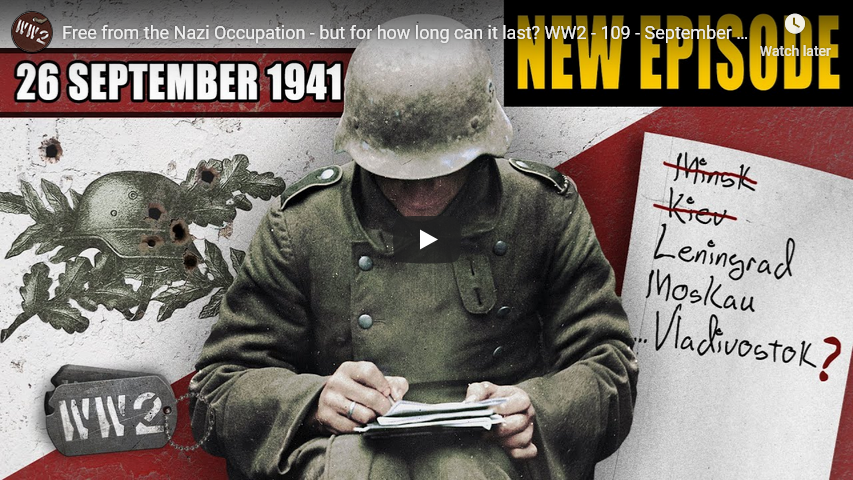
Balkans in Nazi Hands – A Greek Tragedy – WW2 – 088 – May 02, 1941

World War Two
Published 2 May 2020

Greece falls as Axis troops push through the last Allied defences. New plans are made for a German invasion of Crete, and a new war breaks out between Great Britain and Iraq.

Join us on Patreon: https://www.patreon.com/TimeGhostHistory
Or join The TimeGhost Army directly at: https://timeghost.tv

Follow WW2 day by day on Instagram @World_war_two_realtime https://www.instagram.com/world_war_t…
Between 2 Wars: https://www.youtube.com/playlist?list…
Source list: http://bit.ly/WW2sources

Written and Hosted by: Indy Neidell
Director: Astrid Deinhard
Producers: Astrid Deinhard and Spartacus Olsson
Executive Producers: Astrid Deinhard, Indy Neidell, Spartacus Olsson, Bodo Rittenauer
Creative Producer: Joram Appel
Post-Production Director: Wieke Kapteijns
Edited by: Iryna Dulka
Sound design: Marek Kamiński
Map animations: Eastory (https://www.youtube.com/c/eastory)

Colorizations by:
– Olga Shirnina, a.k.a. Klimbim – https://klimbim2014.wordpress.com/
– Julius Jääskeläinen – https://www.facebook.com/JJcolorization/
– Dememorabilia – https://www.instagram.com/dememorabilia/
– Carlos Ortega Pereira, BlauColorizations, https://www.instagram.com/blaucoloriz…

Sources:
– Bundesarchiv, CC-BY-SA 3.0, Bild_146-1977-163-05A, Bild 146-1977-122-16, Bild_141-0816, Bild 101I-757-0023-32
– National Portrait Gallery
– Imperial War Museum: Q 69840, HU 52264

Archive by Screenocean/Reuters https://www.screenocean.com.

A TimeGhost chronological documentary produced by OnLion Entertainment GmbH.

From the comments:

World War Two
2 days ago (edited)
Now, we have decided to leave out any Call to Action (the bit where Indy tells you to subscribe and support us on Patreon) to give room to the dramatic speech on Radio Athens. So allow me to write it right here: If you want to learn more about how Kurt Student’s Fallschirmjäger were developed and used earlier in the war, you can check out our Special Episode about that right here: https://youtu.be/RNr3E3Hr0bo. I don’t want to deny anyone the chance to get a random name shoutout in the video by writing it here, but it is thanks our supporters that we can continue to make content like this. You can join the TimeGhost Army on www.patreon.com/timeghosthistory or https://timeghost.tv. Don’t forget to subscribe, ring the notification bell and see you next time!
Cheers, Joram

The Great Exhibition of 1851

In the latest Age of Invention newsletter, Anton Howes looks at one of the biggest popular events of Queen Victoria’s reign, the Great Exhibition:

The Crystal Palace from the northeast during the Great Exhibition of 1851, image from the 1852 book Dickinsons’ comprehensive pictures of the Great Exhibition of 1851
Wikimedia Commons.

On this day, in 1851, Londoners were finally allowed to enter one of the most spectacular edifices to grace their city. Over the previous months they had watched it spring up in Hyde Park — the largest enclosed structure that had ever been built, and made with three hundred thousand of the largest panes of glass ever produced. Set against the blackened, soot-stained buildings of London, the massive glass edifice gleamed. It soon became known as the Crystal Palace.

Although it no longer exists — it was rebuilt in Sydenham, but the new version burnt down in the 1930s — the fame of the Crystal Palace endures. The same goes for the event that it was originally built for, the Great Exhibition of 1851. But, despite that name-recognition, I’ve found that most people don’t really know what the Great Exhibition was for. Yes, it attracted six million visitors in the space of just a few months — an estimated two million people, almost a tenth of the entire population of Great Britain, most of them returning again and again. But why? I must admit, despite having mentioned the event before in some of my work, I’d never really considered it properly before I started researching the history of the Society of Arts.

The idea of such an exhibition in Britain originated with the Society’s secretary in the 1840s, the civil engineer Francis Whishaw. He had seen the use of industrial exhibitions in France, as a means of catching up with Britain in terms of technology. Every few years since 1798, the French government had held an exhibition of its national industries in Paris. The state paid for everything — a grand temporary building, as well as the expenses of the exhibitors — and the head of state himself awarded medals and cash prizes for the bet works on display. Some of the very best exhibitors were even admitted to the Légion d’honneur, France’s highest order of merit. The benefits to exhibitors were so high that essentially every manufacturer wished to take part. In the days before GDP statistics, the exhibitions were thus an effective means of getting a detailed snapshot of the nation’s manufacturing capabilities. An exhibition served as the nation’s industrial audit.

[…]

Although there had been a few local exhibitions of industry in Britain in the late 1830s and early 1840s, there had been nothing on a national scale to rival the French ones. So Francis Whishaw began the work of getting the Society to organise such an event — a national exhibition of industry for Britain. His initial plan came to nothing, partly as he left the Society to take another job, but in the late 1840s the project was resurrected by a new member of the Society, a civil servant named Henry Cole. In fact, Cole almost entirely took over the Society in the late 1840s, turning it into an exhibition-holding organisation. It held exhibitions devoted to particular living artists, on ancient and medieval art, on inventions, and especially on industrial design — what Cole liked to call “art-manufactures”. And, at the 1849 national exhibition in Paris, he adopted an idea that had already been floated for some years by French officials: an international exhibition, to show the industry of all nations.

This was the crucial step. The idea of an international exhibition of industry appealed to the free trade movement in Britain, which had achieved success in the 1840s with the abolition of the Corn Laws. By displaying the products of other nations, the argument went, British consumers would demand that they be able to buy them more cheaply. And free trade would hopefully bring an end to war, too. Free trade campaigners argued that the productive classes of rival nations competed peacefully, simply by trying to outdo one another in the quality and quantity of what they produced. It was the landed aristocracy, they argued, who let the competition become violent, feeding their pride by causing destruction. Thus, a grand exhibition of the products of all nations — the Great Exhibition — would be a physical manifestation of free trade and international harmony: a “competition of arts, and not of arms”.

The Great Exhibition thus had many roles. It was partly born of national paranoia, about French industrial catch-up, as well as about Britain being the first to hold such an event. It was also about exciting competitive emulation between manufacturers, showing consumers what they did not know they wanted, and achieving world peace and free trade. It certainly spurred on dozens of examples of international cooperation. In fact, just the other day I discovered that the first international chess tournament was held in London to coincide with the exhibition. And it served as an audit of the world’s industries, allowing people to judge who was ahead and who was behind. It thereby gave domestic reformers the ammunition to push for changes in areas where Britain seemed to be falling behind, in areas like education, intellectual property, and design. But more on those another time.

Scottish army ration (MRE) with radioactive heater

Filed under: Britain, Food, Humour, Military — Tags: , , — Nicholas @ 02:00

bigclivedotcom
Published 17 Jan 2020

A review of a VERY rare Scottish army ration. Carbohydrate-rich to match the Scottish diet and protect against the harsh cold environment of war and Scotland in general.

It appears to be made of all the key Scottish, Irish and Canadian food groups with the bonus of a slightly dangerous ration heater based on radioactive components also used by the Russian army.

It almost seems to be engineered to encourage fighting.

If you enjoy these videos you can help support the channel with a dollar for coffee, cookies and random gadgets for disassembly at:-
http://www.bigclive.com/coffee.htm
This also keeps the channel independent of YouTube’s advertising algorithms allowing it to be a bit more dangerous and naughty.

May 2, 2020

After The Berlin Wall: Making Germany’s Armed Forces (Bundeswehr 1991 Documentary)

Filed under: Europe, Germany, History, Military — Tags: , , , , , , — Nicholas @ 02:00

Forces TV
Published 5 Jan 2018

It’s more than 27 years since German reunification, when East and West Germany came together again after the fall of the Berlin Wall. This documentary looks at the challenges facing the West German Army as they took over the East German National People’s Army.

Read more: http://www.forces.net/news/comment-bu…
Subscribe to Forces TV: http://bit.ly/1OraazC
Check out our website: http://forces.net
Twitter: https://twitter.com/ForcesNews

How things change … back in 1991, the Bundeswehr had a vast over-supply of military vehicles between the mass of Soviet-era equipment inherited from the DDR and the excess due to planned down-sizing of Germany’s overall military expenditure (the “peace dividend”). Earlier this year, Bild reported that German soldiers are being advised to take personal vehicles during military training exercises, due to a lack of infantry fighting vehicles and other military transport.

May 1, 2020

Why Pearl Harbor? Peaceful Portugal, and the poor Kriegsmarine – WW2 – OOTF 011

Filed under: Britain, Europe, Germany, History, Japan, Military, WW2 — Tags: , , , — Nicholas @ 06:00

World War Two
Published 30 Apr 2020

How were relations between Japan and the United States at the beginning of the war? What were both sides doing to try and make Portugal enter the war? And to what extent did the Kriegsmarine match the Royal Navy? Find out as we answer these questions in this Out of the Foxholes episode!

Links to the Between 2 Wars videos mentioned in the episode:
Japan, the Bureaucratic War Machine | BETWEEN 2 WARS I 1931 Part 2 of 3: https://youtu.be/vVgCy6iwrHQ
The World Takes Advantage of American Isolationism | BETWEEN 2 WARS | 1933 part 3 of 3: https://youtu.be/-iuQcxXAdfw
Did WW2 Start in 1937? – The Rape of China | BETWEEN 2 WARS I 1937 Part 1 of 2: https://youtu.be/_3vPGpamtDI

Join us on Patreon: https://www.patreon.com/TimeGhostHistory
Or join The TimeGhost Army directly at https://timeghost.tv

Follow WW2 day by day on Instagram @World_war_two_realtime https://www.instagram.com/world_war_t…
Between 2 Wars: https://www.youtube.com/playlist?list…
Source list: http://bit.ly/WW2sources

Hosted by: Indy Neidell
Written by: Rune Væver Hartvig
Director: Astrid Deinhard
Producers: Astrid Deinhard and Spartacus Olsson
Executive Producers: Astrid Deinhard, Indy Neidell, Spartacus Olsson, Bodo Rittenauer
Creative Producer: Joram Appel
Post-Production Director: Wieke Kapteijns
Research by: Rune Væver Hartvig
Edited by: Mikołaj Cackowski
Sound design: Marek Kamiński
Map animations: Eastory (https://www.youtube.com/c/eastory)

Colorizations by:
Carlos Ortega Pereira, BlauColorizations, https://www.instagram.com/blaucoloriz…
Dememorabilia – https://www.instagram.com/dememorabilia/

Sources:
BIBLIOTECA DE ARTE DA FUNDAÇÃO CALOUSTE GULBENKIAN
Bundesarchiv

Soundtracks from the Epidemic Sound:
Reynard Seidel – “Deflection”
Fabien Tell – “Last Point of Safe Return”
Johannes Bornlof – “Deviation In Time”

Archive by Screenocean/Reuters https://www.screenocean.com.

A TimeGhost chronological documentary produced by OnLion Entertainment GmbH.

The Scottish Sentencing Council recommends that no under-25s be sent to prison

Filed under: Britain, Law — Tags: , , , , , — Nicholas @ 05:00

Theodore Dalrymple isn’t impressed with this proposal:

A judges’s wig and advocate’s wig on temporary display in Parliament Hall, Edinburgh, 26 October 2013.
Photo by Kim Traynor via Wikimedia Commons.

Just as one begins to imagine that the liberal pseudo-conscience can go no further in foolishness, it comes up with new schemes to make the world a little worse. Its inventiveness, in fact, is infinite, and no victory over it by common sense is ever more than temporary. The price of sanity, at least in the modern world, is eternal vigilance.

This is not to say, of course, that no liberal reform in the past was ever justified or did no good, or that none will ever do any good in the future. It is simply that, as a matter of contingent sociological fact, many liberals seem to have lost their minds.

The Scottish Sentencing Council, an advisory body with no legislative powers but whose recommendations judges disregard at their peril, put forward a proposal earlier this year that those under the age of 25 should not be sent to prison because research shows that their brains have not yet fully matured. It is difficult to know where to begin in arguing with this fatuity.

Let us then start with the notion that no man under 25 is sufficiently mature to know that it is wrong to strangle old ladies in their beds and the further proposition that, until that age, they are unable to control their impulse to do so.

[…]

The idea that a man’s brain is so immature before age 25 that he does not know that all manner of crimes are wrong would suggest a revision of our electoral laws, for if a man can neither distinguish right from wrong nor control his impulses, should he have the vote? Should he, in fact, be considered of legal age? Should he be allowed even to choose his own career? I doubt that the Sentencing Council would preen itself on the corollaries of its proposal.

There is, of course, an element of truth in what the Sentencing Council says. Our characters are not fully formed by the age of 25 — mine certainly wasn’t. It is true also that there is a biological component to crime, inasmuch as the vast majority of criminals in all societies in which crime is a category of behaviour are young and male. The rate at which even recidivist criminals commit crimes declines with age and most often reaches zero. Time is the great therapist.

But punishment is not therapy. It is a very good thing, of course, if punishment (such as imprisonment) reforms the criminal, and I think that it is a moral obligation of the state, if it is to lock up people, to try to give them something purposeful and worthwhile to do. But that is not the primary purpose of punishment. If it could be shown that rewarding criminals with large fortunes would change their behaviour — as almost certainly it would in most cases — we should not advocate such a course, even if it were a better way of reforming them in the sense of reducing their recidivism rate.

Soldier of Three Armies Pt. 2 – Continuation War – Sabaton History 065 [Official]

Filed under: Europe, Germany, History, Media, Russia, WW2 — Tags: , , , , , — Nicholas @ 04:00

Sabaton History
Published 30 Apr 2020

With a bounty on his head, the Red Army wants him dead, Soviet enemy number one. Second part of the Lauri Törni trilogy. The Winter War between Finland and the Soviet Union was over, but the world was further tumbling down into war. Finland saw itself trapped between two power blocks. A new arrangement with Nazi Germany gave men like Lauri Törni an opportunity to train with the newly established Waffen-SS. But it was an opportunity with lasting consequences.

Support Sabaton History on Patreon: https://www.patreon.com/sabatonhistory

Listen to Soldier of Three Armies on the album Heroes:
CD: http://bit.ly/HeroesStore
Spotify: http://bit.ly/HeroesSpotify
Apple Music: http://bit.ly/HeroesAppleMusic
iTunes: http://bit.ly/HeroesiTunes
Amazon: http://bit.ly/HeroesAmz
Google Play: http://bit.ly/HeroesGoogleP

Check out the trailer for Sabaton’s new album The Great War right here: https://www.youtube.com/watch?v=HCZP1…

Listen to Sabaton on Spotify: http://smarturl.it/SabatonSpotify
Official Sabaton Merchandise Shop: http://bit.ly/SabatonOfficialShop

Hosted by: Indy Neidell
Written by: Markus Linke and Indy Neidell
Directed by: Astrid Deinhard and Wieke Kapteijns
Produced by: Pär Sundström, Astrid Deinhard and Spartacus Olsson
Creative Producer: Joram Appel
Executive Producers: Pär Sundström, Joakim Broden, Tomas Sunmo, Indy Neidell, Astrid Deinhard, and Spartacus Olsson
Post-Production Director: Wieke Kapteijns
Edited by: Iryna Dulka
Sound Editing by: Marek Kaminski
Maps by: Eastory – https://www.youtube.com/c/eastory

Archive by: Reuters/Screenocean https://www.screenocean.com
Music by Sabaton.

Additional video footage from Dennis Henson

Sources:
– Bundesarchiv, CC-BY-SA 3.0, Bild 101III-Hoffmann-04-23/Hoffmann
– Narodowe Archiwum Cyfrowe
– sa-kuva.fi

An OnLion Entertainment GmbH and Raging Beaver Publishing AB co-Production.

© Raging Beaver Publishing AB, 2019 – all rights reserved.

Theodore Dalrymple on the authoritarian innovations we’ve so meekly accepted thanks to the Wuhan Coronavirus epidemic

Filed under: Britain, Government, Health, Law, Liberty — Tags: , , , , , — Nicholas @ 03:00

Getting back to “normal” is going to be much more difficult now that the powers-that-be know for certain that we’re all quite comfortable tugging the forelock and bending the knee given the right kind of orders:

Armed Metropolitan Police near Downing Street in London.
Photo by Stanislav Kozlovskiy via Wikimedia Commons.

As for the collective or political lessons of the epidemic, I fear them more than rejoice in them. They seem to me likely to reinforce a tendency to authoritarianism, and to embolden bureaucrats with totalitarian leanings. One of the surprising things (or perhaps I should say the things that surprised me) was how meekly the population accepted regulations so drastic that they might have made Stalin envious, all on the say-so of technocrats whose opinions were not completely unopposed by those of other technocrats. There was, as far as I can tell, no popular demand for the evidence that supposedly justified the severe limitations on freedom that were imposed on the population. I suppose an encouraging interpretation of this readiness of the population to do as it was told is that it demonstrated that, all the froth and foam of opposition to political leaders notwithstanding, fundamentally the authorities were trusted by the population to do the right thing. Much as we lament, therefore, the intellectual and moral level of our political class, there are limits to how much we despise it. In other words, we believe that our institutions still work even when guided or controlled by nullities.

A less optimistic interpretation, as usual, is possible. Our population is now so used to being administered, supposedly for its own good, under a regime of bread and circuses, that it is no longer capable of independent thought or action. We have become what Tocqueville thought the Americans would become under their democratic regime, namely a herd of docile animals. Only at the margins — for example, the drug-dealers of banlieues of Paris — would the refractory actually rebel against the regulations, and that not for intellectual reasons or in the name of freedom, but because they wanted to carry on their business as usual. (I should perhaps mention here that I number myself among the sheep.)

In Britain, at any rate, the epidemic revealed how quickly the police could be transformed from a civilian force that protects the population as it goes about its business into a semi-militarised army of quasi-occupation. This transformation is not entirely new, alas; it has been a long time since the policeman was the decent citizen’s friend. Under various pressures, not the least of them emanating from intellectuals, he has become instead a bullying but ineffectual keeper of discipline, whom only the law-abiding truly fear.

I first sensed this development many years ago this when a traffic policeman asked to see my licence. “Well, Theodore …” he started, calling me by my first name when a few years before he would have called me “Sir.” This change was significant. I had gone from being his superior, as a member of the public in whose name he exercised his authority, to being a kind of minor, whom it was his transcendent right to call to order. He was now the boss, and I was now the underling.

The change in uniform, too, has worked in the same direction. Traditionally, since the time of Sir Robert Peel, the uniform of the British policeman was unthreatening, deliberately so, his authority moral rather than physical. Now, he is festooned with the apparatus of repression, if not of oppression, though in effect he represses very little of what ought to be repressed in case it fights back. The modern police intimidate only those who do not need deterring; those who do need it know that they have nothing much to fear from these whited sepulchres, these empty vessels. Incidentally, the French police have undergone a similar deterioration in appearance: gone is the reassuring képi in favour of the moron’s baseball cap, and some of them now dress in jeans with a black shirt with the word POLICE across its back, which is not difficult to imitate and makes it impossible to know whether a policeman really is a policeman or a lout in disguise.

French Gendarmerie at the Eurockéennes of 2007.
Photo by Rama via Wikimedia Commons.

The Covid-19 epidemic has come as a great boon to the British police. Increasingly criticised for their concentration on pseudo-crimes such as hate speech at the expense of neglecting real crimes such as assault and burglary, to say nothing of organised sexual abuse of young girls by gangs of men of Pakistani origin, they could now bully the population to their heart’s content and imagine that in doing so they were performing a valuable public service, preserving the law and public health at the same time. Thus they transformed their previous moral and physical cowardice into a virtue.

Of course, in bullying the average citizen who was very unlikely to retaliate they took no risks, unlike with genuine wrongdoers and law-breakers, who tend to be dangerous; but the fact remains that most individual policemen joined the force motivated by some kind of idealism, a desire to do society some service, though they soon had these naïve fantasies knocked out of them by the morally corrupt or bankrupt leadership of the hierarchy which owes its ascendency to its willingness to comply with the latest nostrums of political correctness. The faint embers of the policeman’s initial idealism were no doubt rekindled by the opportunity to prevent the spread of the virus, as they supposed that they were doing, but some of them, at least, far exceeded even their flexible and vaguely-defined authority and began to inspect citizens’ shopping bags to determine whether they were hoarding goods that might be in short supply. This was a step too far, and at last there were protests; the police desisted.

April 29, 2020

Haile Selassie – The New Messiah – WW2 Biography Special

Filed under: Africa, History, Italy, Military, Religion, WW2 — Tags: , , , , , , — Nicholas @ 06:00

World War Two
Published 28 Apr 2020

Haile Selassie was the Emperor of the Ethiopian Empire. He led the country against the Italians in the Second Italo-Ethiopian War after which he is exiled to Britain.

Join us on Patreon: https://www.patreon.com/TimeGhostHistory
Or join The TimeGhost Army directly at: https://timeghost.tv

Follow WW2 day by day on Instagram @World_war_two_realtime https://www.instagram.com/world_war_t…
Between 2 Wars: https://www.youtube.com/playlist?list…
Source list: http://bit.ly/WW2sources

Hosted by: Indy Neidell
Written by: Isabel Wilson
Director: Astrid Deinhard
Producers: Astrid Deinhard and Spartacus Olsson
Executive Producers: Astrid Deinhard, Indy Neidell, Spartacus Olsson, Bodo Rittenauer
Creative Producer: Joram Appel
Post-Production Director: Wieke Kapteijns
Research by: Isabel Wilson
Edited by: Karolina Dołęga
Sound design: Marek Kamiński

Colorizations by:
Dememorabilia – https://www.instagram.com/dememorabilia/
Adrien Fillon – https://www.instagram.com/adrien.colo…
Klimbim – https://klimbim2014.wordpress.com/

Sources:
National Museum of the U.S. Navy

Music:
“Other Sides of Glory” – Fabien Tell
“The Unexplored” – Philip Ayers
“March Of The Brave 10” – Rannar Sillard
“Deviation In Time” – Johannes Bornlof
“Epic Adventure Theme 3” – Håkan Eriksson
“Heroes On Horses” – Gunnar Johnsén
“Deviation In Time” – Johannes Bornlof

Archive by Screenocean/Reuters https://www.screenocean.com.

A TimeGhost chronological documentary produced by OnLion Entertainment GmbH.

Curator’s Tour of The Tank Museum | Blitzkrieg | WW2: Part 1

Filed under: Britain, Europe, France, Germany, History, Military, Weapons, WW2 — Tags: , , , , — Nicholas @ 04:00

The Tank Museum
Published 25 Apr 2020

Join Curator David Willey as he takes you on a tour of The Tank Museum’s Tank Story Hall, which houses over 30 key vehicles from Little Willie to Challenger 2. In this section he looks at early Second World War vehicles and gives you a potted history of the Blitzkrieg.

Support the work of The Tank Museum on Patreon: ► https://www.patreon.com/tankmuseum
Visit The Tank Museum SHOP & become a Friend: ► https://tankmuseumshop.org/

Twitter: ► https://twitter.com/TankMuseum
Instagram: ► https://www.instagram.com/tankmuseum/
Tiger Tank Blog: ► http://blog.tiger-tank.com/
Tank 100 First World War Centenary Blog: ► http://tank100.com/
#tankmuseum #tanks #MuseumFromHome

Feudalism: A Brief Explanation

Thersites the Historian
Published 26 Oct 2017

In this video, I try to bring order to the chaos that is feudalism and render it comprehensible.

April 28, 2020

Tank Chats #68 T-34 | The Tank Museum

Filed under: History, Military, Russia, Weapons, WW2 — Tags: , , , , , — Nicholas @ 02:00

The Tank Museum
Published 9 Mar 2019

The T-34 is an iconic Soviet Second World War tank. It was the most produced tank of WW2 and remains a symbol of Russian sacrifice in the Great Patriotic War.

David Willey talks about both the T-34/76 and T-34/85 variants, used in World War Two.

Many thanks to RecoMonkey for providing many of the modern images of the T-34 https://www.recomonkey.com/

Support the work of The Tank Museum on Patreon: ► https://www.patreon.com/tankmuseum

Visit The Tank Museum SHOP: ► https://tankmuseumshop.org/
Twitter: ► https://twitter.com/TankMuseum
Tiger Tank Blog: ► http://blog.tiger-tank.com/
Tank 100 First World War Centenary Blog: ► http://tank100.com/ #tankmuseum #tanks #tankchats

QotD: Rent control in Stockholm

Filed under: Bureaucracy, Economics, Europe, Quotations — Tags: , , , , , — Nicholas @ 01:00

Take Sweden, which introduced effective rents controls nationwide in 1947. They were supposed to be a temporary measure, yet they remain in place to this day, despite criticism from academics, think tanks and the OECD. While the intention to create a more socially dynamic society was laudable, the reality has been much bleaker.

Instead of a fairer rental market, where tenants can easily afford rent and live in high-quality housing, Sweden suffers from increased social segregation; eruptions of violence as a result of disagreements in its massive black market of sublet housing; and companies that face immense difficulties in recruiting talent, as potential workers are unable to find suitable accommodation.

Proponents of rent control often emphasise the fairness the measure: rent controls are meant to create a more egalitarian society, where individuals irrespective of their income live in the same neighbourhood and can afford similar quality housing. This could not be further from the truth.

The Swedish experiment shows that it is high-income, well-educated individuals who benefit from rent controls the most, whereas less-educated, or not as well-connected individuals such as younger renters or immigrants, are highly disadvantaged by the system.

In theory, housing stock that becomes available for rent is allocated through the Stockholm Housing Agency, which ensures the rental prices are kept on “an average level”. The average waiting time in Stockholm for such housing allocation is over 11 years. As tenants realise the true value of their contract — e.g. the money they can receive for their apartment on the secondary rental market — they are unwilling to return the property to the agency, even when they move out. Instead, they rent it out to someone in their extended circle of friends or exchange the flat for one in a different area — only in practice, not on paper of course. No wonder that only 0.5% of the housing is returned to the agency, resulting in a massive queue of 670,000 people on Stockholm’s housing waitlist — out of a total population of 970,000.

This system benefits the most well-connected individuals, but highly disadvantages people who lack broad social connections. These groups are often forced into the informal rental market, where the prices are on average double that of the official rent controlled numbers. One in five young Swedish renters face have admitted renting on the black market. Due to the lack of legal arbitration, disagreements between parties can lead to violence and in some cases even murder.

Another problem has been the inflexibility of rental contracts, which have made it difficult for people to move between cities, leading to a fifth of Swedish companies facing severe recruitment problems due to the lack of suitable housing.

Adam Bartha, “Rent controls have failed in cities throughout Europe”, Institute of Economic Affairs, 2020-01-23.

April 27, 2020

Spoils of War for Britain and France – Redrawing the Map of the Middle East I THE GREAT WAR 1920

The Great War
Published 25 Apr 2020

Sign up for Curiosity Stream and Nebula – and get 40% off annual plans right now: https://curiositystream.com/thegreatwar

100 years ago at the conference of San Remo, one thing became clear: Great Britain and France wanted control over the Middle East. Justified by the fighting in the previous years and painted as “liberators” of the Middle Eastern minorities, the new map of the Middle East emerged – under the cover of the League of Nations Mandate system.

» SUPPORT THE CHANNEL
Patreon: https://www.patreon.com/thegreatwar
Merchandise: https://shop.spreadshirt.de/thegreatwar/

» SOURCES
Karsh, Efraim & Karsh, Inari, Empires of the Sand: The Struggle for Mastery in the Middle East 1789-1923, (Cambridge, MA : Harvard University Press, 1999)

“Dans Le Levant” Le Temps, August 31, 1919 issue, https://gallica.bnf.fr/ark:/12148/bpt…

Lloyd George, David, Memoirs of the Peace Conference, (New Haven : Yale University Press, 1939) vol. 2

“Mounted Rifles Units” New Zealand History, https://nzhistory.govt.nz/war/aucklan…

Paris, Timothy J. Britain, The Hashemites and Arab Rule 1920-1925, (London : Frank Cass, 2003)

Provence, Michael, The Last Ottoman Generation and the Making of the Modern Middle East, (Cambridge : Cambridge University Press, 2017)

O’Neill, Robert, Official History of Australia in the War of 1914–1918, Volume VII – The Australian Imperial Force in Sinai and Palestine, 1914–1918, (Australian War Memorial, 1941)

“King-Crane Commission Digital Collection” Oberlin College Library. http://dcollections.oberlin.edu/cdm/s…

» SOCIAL MEDIA
Instagram: https://instagram.com/the_great_war
Twitter: https://twitter.com/WW1_Series
Reddit: https://reddit.com/r/TheGreatWarChannel

»CREDITS
Presented by: Jesse Alexander
Written by: Jesse Alexander
Director: Toni Steller & Florian Wittig
Director of Photography: Toni Steller
Sound: Toni Steller
Editing: Toni Steller
Mixing, Mastering & Sound Design: http://above-zero.com
Maps: Daniel Kogosov (https://www.patreon.com/Zalezsky)
Research by: Jesse Alexander
Fact checking: Florian Wittig

Channel Design: Alexander Clark
Original Logo: David van Stephold

A Mediakraft Networks Original Channel

Contains licensed material by getty images
All rights reserved – Real Time History GmbH 2020

« Newer PostsOlder Posts »

Powered by WordPress