Quotulatiousness

April 16, 2026

The EU has managed to revive smuggling as a viable career

Filed under: Bureaucracy, Europe, Government, Law — Tags: , , , , — Nicholas @ 04:00

We’ve all read reports on how bold and forward-focussed the European Union is, but do we give them equal credit for their diligent efforts to revive dying industries?
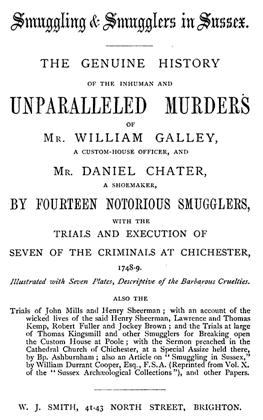
Title page of a book covering the trial of seven smugglers for the murder of two revenue officers. In the preface the author says “I do assure the Public that I took down the facts in writing from the mouths of the witnesses, that I frequently conversed with the prisoners, both before and after condemnation; by which I had an opportunity of procuring those letters which are herein after inserted, and other intelligence of some secret transactions among them, which were never communicated to any other person.”
W.J. Smith, Smuggling and Smugglers in Sussex, 1749, via Wikimedia Commons.

In late March, European Union (E.U.) officials announced they had taken down a five-country cigarette-smuggling operation and seized over 40 tons of tobacco products. The ambitious network reportedly transshipped the cigarettes far and wide to obscure their sources and destinations, while also hiding them in hidden compartments built into cargo containers. Why would smugglers go through such effort to move perfectly legal products, and why would the authorities care? In Europe, as in the United States, the answer is the same: sky-high taxes.

Smuggled Smokes in Hidden Compartments

In announcing its efforts against the smuggling network operating in Italy, France, Poland, Switzerland, and the U.K., the European Public Prosecutor’s Office, which worked with international law enforcement agencies as well as police in all five countries, noted the smugglers used “maritime and commercial routes designed to evade customs inspections”, passed shipments “through Georgia, Kenya, the Netherlands and Turkey, in order to hide the true origin of the illicit goods”, and that “false bottoms were used as hidden compartments built into containers to conceal the tobacco”.

At the conclusion of the investigation, “enforcement activities were carried out at the Port of Genoa, leading to the seizure of close to 41 tonnes of manufactured cigarettes, with an estimated loss of customs duties, excise duties and VAT exceeding €10 million”.

Absolutely nothing motivates government officials like the extraction of taxes from the public. And lots of tax money is at stake when it comes to cigarettes.

Taxes Make Up Most of the Price of Cigarettes

This month, the Tax Foundation, which has a branch in Brussels, reported that “cigarette smokers in the European Union pay far more in excise taxes than they do for the cigarettes themselves”. Report authors Jacob Macumber-Rosin and Adam Hoffer wrote that excise taxes in the E.U., which are intended to deter smoking as much as to raise revenue, start at the equivalent of $2.11 per pack and that the “total excise duty is at least 60 percent of the national weighted average retail price”. Value-added taxes are tallied after excise duties are levied.

“The highest tax in the EU is levied in Ireland at €10.71 ($12.58) per pack of 20 cigarettes, followed by France at €8.09 ($9.51) and the Netherlands at €7.77 ($9.13)”, they added.

April 15, 2026

Do “combat-trained Islamists in Britain … now outnumber the British Army”?

Filed under: Britain, Government, Middle East, Military, Politics — Tags: , , , — Nicholas @ 05:00

In The Conservative Woman, Julian Mann asks Conservative party leader Kemi Badenoch if Britain’s immigration policies have imported enough “combat-trained Islamist” to outnumber the ever-decreasing number of soldiers in the British army:

You won’t find anyone less military-minded than me but Conservative leader Kemi Badenoch’s speech to the London Defence Conference last week prompted me to put these questions to her on X:

“How many combat-trained Islamists do you estimate there to be in Britain? Would they now outnumber the British Army and, if so, by how many?”

I very much doubt that I will get an answer. She is a busy woman and she might be reluctant to comment for fear of being drawn into an anti-Muslim conspiracy theory. She should note that the question is about Islamists, not about integrated and peaceable British Muslims.

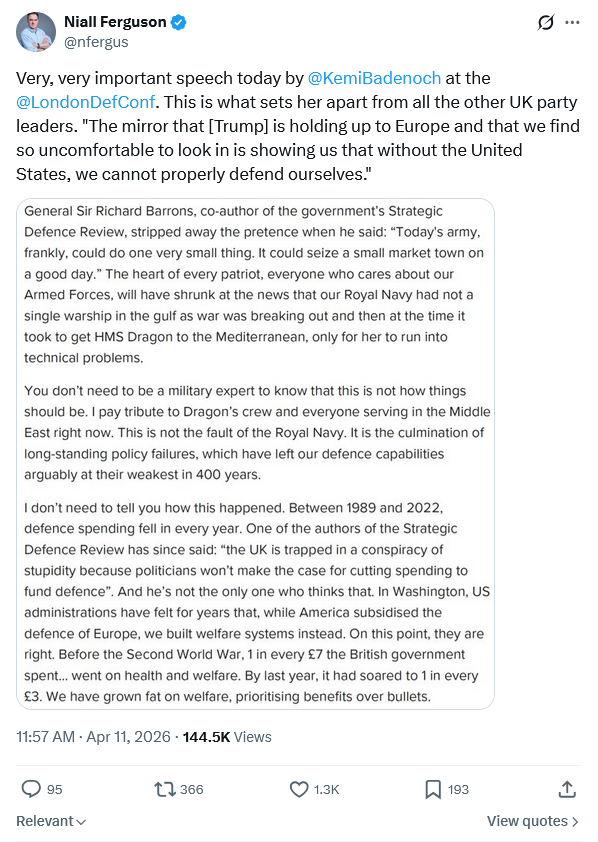
It was this part of her speech, highlighted by historian Niall Ferguson on X, that provoked the questions:

    General Sir Richard Barrons, co-author of the Government’s Strategic Defence Review, stripped away the pretence when he said: “Today’s army, frankly, could do one very small thing. It could seize a small market town on a good day”.

Ms Badenoch also said: “Between 1989 and 2022, defence spending fell in every year. One of the authors of the Strategic Defence Review has since said: ‘The UK is trapped in a conspiracy of stupidity because politicians won’t make the case for cutting spending to fund defence’. And he’s not the only one who thinks that. In Washington, US administrations have felt for years that, while America subsidised the defence of Europe, we built welfare systems instead. On this point, they are right. Before the Second World War, one in every £7 the British government spent went on health and welfare. By last year, it had soared to one in every £3. We have grown fat on welfare, prioritising benefits over bullets.”

According to the House of Lords Library: “As at 1 April 2025, there were 181,890 people in the UK armed forces, a 1 per cent decrease compared with the previous year. This total includes:

  • all full-time service personnel (known as the UK regular forces) and Gurkhas, who comprise 77.7 per cent of the total number of personnel
  • volunteer reserves (17.5 per cent of the total personnel)
  • other personnel, including the serving regular reserve, sponsored reserve and military provost guard service (4.8 per cent of the total personnel)

“The total size of the full-time UK armed forces, comprising the UK regular forces, Gurkhas and full-time reserve service, was around 147,000. Of these, 82,000 were Army personnel, 33,000 were members of the Royal Navy or Royal Marines, and 32,000 belonged to the Royal Air Force.”

So if there were 100,000 combat-trained Islamists in Britain, they would outnumber the British Army by about 20,000. I realise that there are various levels of combat training. It is possible that British Army personnel are better trained than any Islamist forces they might face on British soil. But would they be better motivated, given the way they are being treated by the Government? Why has the Government apparently failed to reckon with the appalling impact on morale and recruitment from the lawfare it is allowing against special forces and Northern Ireland veterans?

Update, 16 April: Welcome, Instapundit readers! Have a look around at some of my other posts you may find of interest. I send out a daily summary of posts here through my Substack – https://substack.com/@nicholasrusson that you can subscribe to if you’d like to be informed of new posts in the future.

Origins of the Legendary CZ-75: Short Rail and Pre-B Models

Filed under: Europe, History, Weapons — Tags: , , , , , , , — Nicholas @ 02:00

Forgotten Weapons
Published 28 Nov 2025

The CZ-75 began development in the late 1960s as a commercial project. It was not intended for Czechoslovak military use, but instead for export sales to bring foreign currency into Czechoslovakia. It was designed by František Koucký with some elements from other pistols (like frame rails and camming lug from the SIG P210 and a magazine based on the Browning High Power) and a healthy dose of original creativity (including the trigger mechanism). The design was finalized in 1973, approved for production in 1976, and the first production models were ready in June 1977.

The first model of the pistol is quite distinctive, with frame rails much shorter than what we see on examples today. This is called the Short Rail or Slab Side model, and it comprised just the first 16,000 guns produced, with the last ones made very early in 1980. This frame design proved prone to cracking, and in 1980 a longer frame replaced it. A half-cock notch was also added to the hammer in 1980. A few additional points in the production timeline include:

1984: Heavy black enamel paint replaces bluing as the standard finish
1986: Slightly enlarged trigger guard, grip panel design changes
1987: Magazines cease being marked with serial numbers
1988: Serial numbering changes to from 6 digits to 1 letter and 4 digits
1989: Ring hammer replaces spot
1993: CZ-75B introduced with a firing pin block in the slide

In 1992 the communist government in Czechoslovakia fell, and the country split into Slovakia and the Czech Republic. CZ became a privately owned company, and a slew of new options on the CZ-75 were rapidly introduced — so we will leave those for a separate video.
(more…)

April 14, 2026

Britain’s Green Party stakes out bold new immigration policies

Filed under: Britain, Government, Media, Politics — Tags: , , — Nicholas @ 03:00

With the ongoing shake-up in British politics — long-established “mainstream” parties losing support across the board — once-fringe parties are becoming electorally viable at least in the short term. On Substack Notes, Donna-Louise Flowers talks about the Green Party’s amazingly generous plans for immigrants to Britain should they be elected:

Someone on X just called me a scaremonger. 🙄

For quoting the Green Party’s own published immigration policy.

I’m a former Detective Constable. Serious sexual violence. CSE. I didn’t scaremonger for a living.

So let me be VERY clear about what the Green Party are actually proposing. In their own words. From their own published, member-voted policy document.

Every illegal arrival gets an automatic visa. No questions. No country of origin checks. Free legal advice to regularise their status. No penalty for being here unlawfully.

Guaranteed accommodation. Families get a house or flat with exclusive use. Free Universal Basic Income. No work required. Full NHS access from the moment they arrive — and their policy explicitly states these rights remain even if their asylum case is rejected.

And then — and I need you to read this carefully — they want to give every visa resident the right to vote in all elections and referendums.

All of this while our welfare bill has just exceeded our income tax revenue for the first time in British history.

All of this while we have a shortage of 6.5 million homes.

All of this while foreign nationals account for up to a quarter of all rape convictions in England and Wales. Up to 34% of sexual assault on a female convictions. Ministry of Justice data. Freedom of Information. Not opinion.

Not scaremongering.

Facts.

I’ve written a full thread on X breaking down every single point with sources. Link below.

Read it. Share it. Because this is what 18% of the country is apparently voting for.

x.com/nolongerthefuzz/s…

Caligula – Feeding Rome’s Most Evil Emperor

Tasting History with Max Miller
Published 7 Oct 2025

Skin-on marinated and roasted pork belly decorated with edible gold paint

City/Region: Rome
Time Period: 1st Century

Caligula, the third Roman Emperor, is remembered as one of the most notorious and cruel of the lot. While he tortured and killed whomever he pleased, he also threw lavish banquets. Suetonius writes that Caligula’s reckless extravagance included “loaves and meats of gold”, and while it’s possible that he meant loaves and meats made of actual gold, I’m going with an edible interpretation.

The Roman flavors of garum, asafoetida, and other seasonings come through strongly, but aren’t overpowering. The meat is wonderfully crispy while being meltingly tender, and the sauce is a nice sweet counterpoint. The gilding is, of course, optional, but it does look rather impressive.

As always, feel free to change up the amounts of anything in the marinade and sauce to suit your tastes as Apicius doesn’t give us any amounts to go on; your version will be just as authentic as this one.

    Offelas Ostienses
    You slice the meat beneath the skin, so that the skin remains intact. Grind pepper, lovage, dill, cumin, silphium, and one bay laurel berry; moisten with liquamen (garum), pound. Pour over the meat pieces in a roasting pan. When they have marinated for two or three days, take them out, tie them crosswise and put them into an oven. When cooked, separate each piece, and grind pepper and lovage; moisten with liquamen, and add a little passum so that it is sweet. When it comes to a boil, thicken the sauce with starch, pour over the meat pieces and serve.
    — De re coquinaria by Apicius, 1st century

(more…)

April 13, 2026

20 Biplanes vs Six Battleships – The Battle of Taranto

Filed under: Britain, History, Italy, Military, WW2 — Tags: , , , , — Nicholas @ 04:00

TimeGhost Cartographic
Published 12 Apr 2026

Follow up this episode with our North Africa Miniseries on our WW2 channel: • North Africa

November 1940. In the Mediterranean, the British Royal Navy launches a daring carrier strike against the Italian fleet at Taranto. In Operation Judgement, Fairey Swordfish torpedo bombers from HMS Illustrious attack the main base of the Regia Marina, crippling multiple battleships in a single night.

This is the story of the attack on Taranto: a bold naval air raid that changed the balance of power in World War 2 and showed what carrier-based air power could do. With Admiral Andrew Cunningham orchestrating a complex deception operation, the strike caught Italy off guard and reshaped naval warfare in the Mediterranean.

Watch this episode of TimeGhost Cartographic for a detailed breakdown of the Taranto raid, Operation MB8, and the battle for control of the Mediterranean Sea.
(more…)

April 12, 2026

How to Legalize Scapegoating – Death of Democracy 11 – Q3 1935

Filed under: Germany, History, Law — Tags: , , , , — Nicholas @ 04:00

World War Two and Spartacus Olsson

Published 11 Apr 2026

Nuremberg Laws explained: how Nazi Germany turned antisemitic street violence into state policy in 1935. In this episode, Spartacus Olsson reports from Berlin on the third quarter of 1935, when the Kurfürstendamm riots, Goebbels’ propaganda campaigns, and Hitler’s regime culminated in the passage of the Nuremberg Laws.

This historical analysis breaks down how the Reich Citizenship Law and the Law for the Protection of German Blood and German Honor stripped German Jews of civil rights, redefined citizenship around “German blood”, and replaced chaotic mob violence with systematic bureaucratic persecution. The video also explores the role of Joseph Goebbels, the SA, the coming 1936 Berlin Olympics, Leni Riefenstahl’s Triumph of the Will, worsening shortages in the Nazi economy, and the collapse of democracy, human rights, and freedom of expression in the Third Reich.

This episode is essential viewing for anyone interested in Nazi Germany, Holocaust history, antisemitism, Nazi propaganda, the rise of fascism, and the origins of World War II. It shows how legal language, public conformity, and state power combined to normalize persecution long before the worst crimes were fully visible.

TKIV-85: Finland’s Ultimate Mosin Nagant Sniper Rifle

Filed under: Europe, History, Military, Weapons — Tags: , , , , , — Nicholas @ 02:00

Forgotten Weapons
Published 24 Nov 2025

Finland’s final iteration of Mosin Nagant sniper was adopted in the 1980s to replace a mix-and-match assortment of m/39-43, m/27-66, and m/28-76 rifles. The two options were a Mosin system using a new bedding block (developed by Border Guard officer E. Toro) or a purpose-made new rifle made by Valmet (the Model 86). The Valmet was clearly the better rifle, but the Mosin option was acceptably good and much cheaper — so that’s what was adopted. The parts for the conversions were made by Valmet and assembled at Asevarikko 1.

Two different models were made. One was a military specific type, and the other was a dual-use rifle for competition shooting as well as potential military use. The competition rifles had a lighter barrel profile to meet the international competition weight limit and were fitted with competition aperture sights in addition to mounts for scopes.

Thanks to Frozen Trigger in Finland for giving me access to these examples to film for you!
(more…)

April 11, 2026

Aussies & Tanks: The Story of Australian Armour

Filed under: Australia, Britain, History, Military, USA, WW1, WW2 — Tags: , , , , — Nicholas @ 02:00

The Tank Museum
Published 30 Jan 2026

Australia has always been an outlier when it comes to tanks. The first time Australians fought alongside tanks, it was such a disaster they almost gave up on the whole idea. And the first time they fought IN tanks, they were pinched from the enemy.

They’re the only Allied nation to reject the M4 Sherman. More than once, they’ve used their tanks very differently to how they were designed. Yet somehow, they’ve almost always been successful.

So, why do the Australians use tanks so differently to everybody else?

Join James and Fam as they explore the weird and wonderful ways that our Australian cousins have used their tanks. From captured tanks in the desert, to heavy metal in the jungle, the Aussie methods of armoured warfare have always seemed a little upside down from the outside.

While Australian interest in tanks has come and gone, when the need has arisen, the Australian tank force has been up to the challenge. Simply put, Australian soldiers usually use tanks differently because they usually fight differently. And despite long periods of neglect, tanks in the Australian Army always seem to find a way to bounce back.

00:00 | Introduction
00:36 | A Bad Start
03:44 | Tanks of their Own
06:19 | Welcome to the Jungle
11:07 | Lessons Relearned
13:53 | Defence of Australia
(more…)

QotD: Kingdoms were not “nations” in the Middle Ages

Filed under: Europe, History, Media, Quotations — Tags: , , , , — Nicholas @ 01:00

Medieval kingdoms and Early Modern states were both built around the personal holdings of individual rulers. For instance, to talk of “Austria” or “Burgundy” in the 1400s as states/countries/governments is to engage in a degree of anachronism. There was no Austrian state, merely the collection of lands either owned or controlled by whoever the reigning Habsburg was at the time. Likewise, Burgundy in, say, 1440 was not a coherent entity, it was simply the collection of lands that Philip the Good (Duke of Burgundy, but also Duke of Brabant, Limburg, Luxemburg and Lothier, Count of Artois, Flanders, Charolais, Haniaut, Holland and Zeeland, and the Margrave of Namur). The “kingdom” was thus not a permanent, durable entity so much as a collection of possessions the same way my personal “library” is not permanent building but just a term for “books I happen to own right now”.

It is thus a bit odd that the regions of Westeros are seen by its inhabitants as being clear and unchanging. For instance, the Reach has borders, those borders do not move and everyone in those borders is loyal to House Tyrell. This is not how medieval rule works. The borders of, say, France, shifted over time (some places we consider “obviously” part of France were added only quite late, like French Flanders or Provence) as the ability of the French king to control those regions changed. For long periods of the Middle Ages, large parts of France were effectively controlled by the Kings of England (because they were also Dukes of this or that French duchy).

The idea that France, or Germany or Italy was a distinct, permanent entity with its own existence apart from a given royal family – more than just a space on a map – which comprised a people, their language and the government of those people, this is a modern phenomenon. Indeed, one may argue, it – that is, the nation-state – is the modern phenomenon.

Bret Devereaux, “New Acquisitions: How It Wasn’t: Game of Thrones and the Middle Ages, Part III”, A Collection of Unmitigated Pedantry, 2019-06-12.

April 10, 2026

A Brief History of GRAVY

Filed under: Britain, Food, History — Tags: , , — Nicholas @ 02:00

Tweedy Misc
Published 2 Dec 2025

For the next instalment of the series of classic British sauces we take a look at the history of gravy.

In this video I look into some of the earliest historical references to gravy, then some 18th Century recipes. I investigate whether gravy might be a derivative of a classic French sauce, and look in some detail into one important component of traditional gravy recipes: the roux, used for thickening.

I also investigate some products which have emerged since the 19th Century to help with the process of making gravy, from gravy salt and gravy browning, through Bisto’s original gravy powder of 1908, and their fully instant product in the form of “gravy granules”, launched in the 1970s.

Also, have you ever wondered why Bisto is called Bisto? We’ll get into that too.

0:00 Introduction
0:32 What is gravy?
1:27 Early history of gravy
2:01 18th Century gravy recipe
2:25 The importance of the roux
3:37 More 18th Century gravy recipes
4:07 Is gravy actually…. French?!?!
5:29 Gravy salt
6:47 Gravy browning
7:31 History of Bisto
9:19 Modern Bisto
10:25 Conclusion

QotD: William Cobbett

Filed under: Books, Britain, Economics, History, Quotations — Tags: , , , , , , — Nicholas @ 01:00

… The truest reason I love The King’s Head is that William Cobbett once gave a lecture there: an event commemorated by a nice print on the wall of the man — in red jacket, white britches and black boots, all properly Georgian — and a bit of accompanying biographical text.

Cobbett was a scrapper on the same majestic scale as our Henry V and our Horatio, except he dished it out to Vested Interest rather than Jean-Pierre Foreigner. He is the faded star of the British Awkward Squad (Capt. Jon. Swift; Vice Capt. Geo. Orwell) and he needs a boost. He needs a blue plaque on every place he ever visited. In his long life — he was born in 1763 and died in 1835 — Cobbett was a farmer, Tory, soldier, Radical, MP, agony uncle (his books include Advice to Young Men), and the founder of Hansard.

His obituary in The Times, after categorising him as a “self-taught peasant”, declared Cobbett “by far the most voluminous writer that has ever lived for centuries”. The funniest, too: when some town council somewhere banned his anti-Malthusian play Surplus Population, he riposted with a drama entitled Bastards in High Places.

Above all, though, Cobbett was the champion of the rural poor, the village labourer and the small farmer. He was their one true tribune. He spoke at The King’s Head in 1820 because country folk were suffering a triple wham from agricultural depression, enclosure and the rise of agri-business. Or, to precis, “Hodge” (his name for the generic farm worker) was low-waged or unwaged and deprived of the bits of land he had once enjoyed under commoner’s rights.

Cobbett railed against “The Thing” (the capitalist, manufactory system) and the centrifugal, corrupting force of smoky London (“The Wen”, in Cobbettian). But he was no bloviator: he was a farm boy, and hence entirely empirical and properly pragmatic. He spent a decade travelling around the English sticks to discover the true state of affairs. His descriptions of his horseback journeys were published in 1830 as Rural Rides, the first sociological study of the English countryside.

No dry-as-dust tome by the way, the Rides: it brims with pinned-to-the-specimen-board descriptions of people and places, nature, wit. Cobbett knew beauty and, the proper Englishman that he was, he loved horses:

    The finest sight in England is a stage coach ready to start. A great sheep or cattle fair is a beautiful sight; but in the stage coach you see more of what man is capable of performing. The vehicle itself, the harness, all so complete and so neatly arranged; so strong and clean and good. The beautiful horses, impatient to be off. The inside full and the outside covered, in every part with men, women, children, boxes, bags, bundles. The coachman taking his reins in hand and his whip in the other, gives a signal with his foot, and away go, at the rate of seven miles an hour.

    One of these coaches coming in, after a long journey is a sight not less interesting. The horses are now all sweat and foam, the reek from their bodies ascending like a cloud. The whole equipage is covered perhaps with dust and dirt. But still, on it comes as steady as the hands on a clock.

Speaking at The King’s Head coaching inn in Monmouth must have been the dream gig for Cobbett the horseman.

John Lewis-Stempel, “Why Britain needs a peasants’ revolt”, UnHerd, 2020-08-06.

April 9, 2026

Aly & Kaufman AKB-23: Better Than the SA80 / L85

Filed under: Britain, USA, Weapons — Tags: , , — Nicholas @ 02:00

Forgotten Weapons
Published 19 Nov 2025

The Aly & Kaufman AKB-23 is a set of parts that allows one to use a Brownells BRN-180 upper to create an SA80 / L85 lookalike. It’s a very clever adaptation, based on the fact that the original British L85A1 was essentially copied from the AR-180 design. By creating a new bullpup lower for Brownells’ modernized AR-180 (the BRN-180), the basic mechanics of the SA80 are used, but in a form that is well tested and reliable.

The parts include, of course, the new lower (which is legally a firearm, and requires FFL transfer). The lower is milled aluminum, and uses standard AR fire control parts. It also includes iron sights that mount onto the BRN-180 picatinny rail and a high quality 3D-printed cheek rest and front handguard.

This is a really fun rifle, and a very clever way to create an L85 analog that is affordable and accessible.
(more…)

April 8, 2026

“Queering the Past”

Filed under: Britain, History, Media, Politics — Tags: , , , , — Nicholas @ 05:00

It sometimes seems as though modern historians are spending all their time postulating that pretty much every prominent figure in western history was gay or lesbian or trans*. The latest attempt to present someone from British history as being trans is Queen Elizabeth I (admittedly in a drama rather than a documentary):

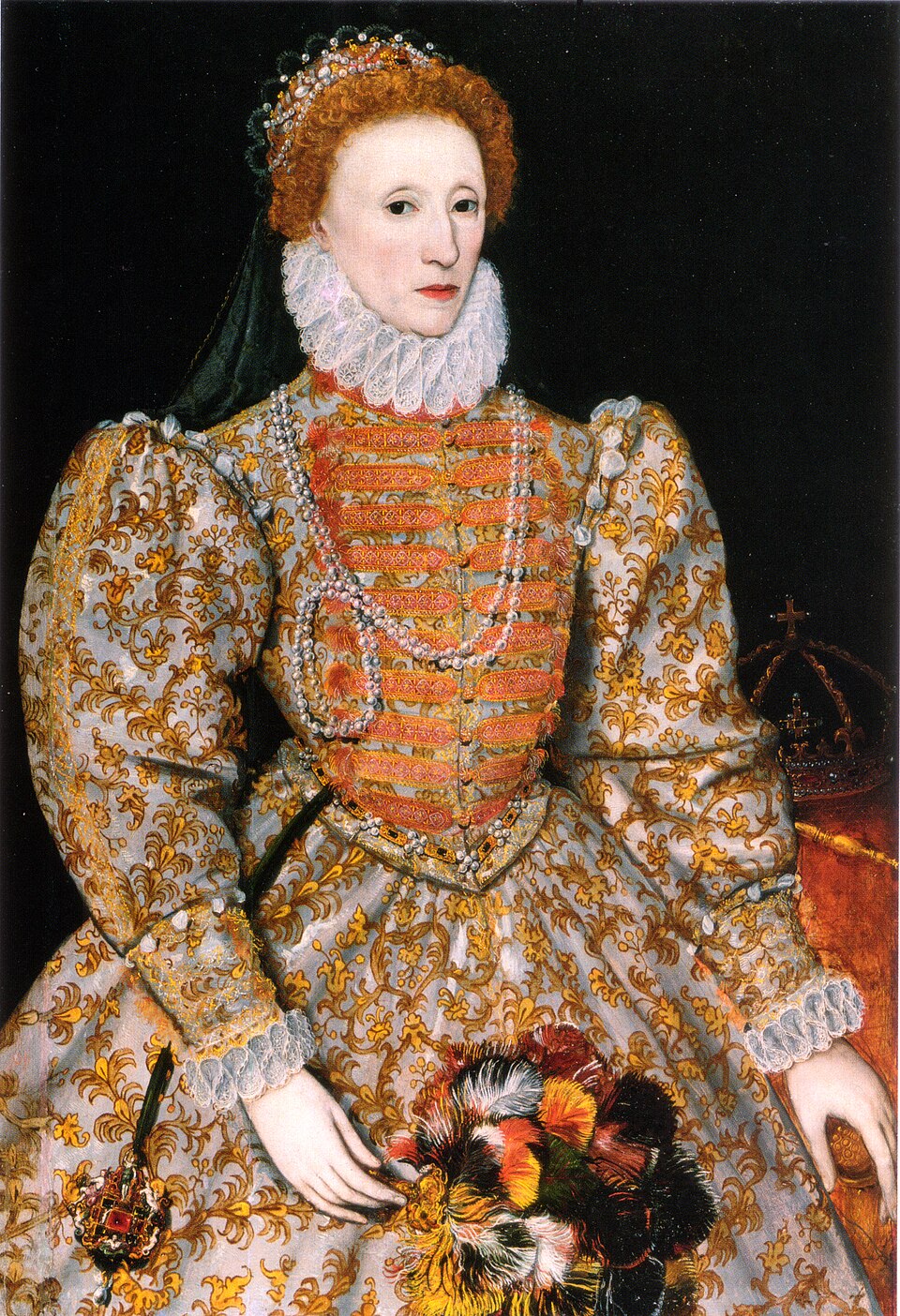
The “Darnley Portrait” of Elizabeth I of England (circa 1575).
National Portrait Gallery via Wikimedia Commons.

Appropriately, it was April Fool’s Day when I read that Queen Elizabeth I is to be portrayed as a cross-dressing man in a forthcoming television show. But we live in times when the more silly and outlandish a rumoured cultural or political plan, the more likely it is to be true. Majesty – an oddly “heritage” title for a project that clearly considers itself “transgressive” – is set to film this summer, and is seeking “trans actresses” (what we used to call cross-dressers, before they got really cross) to play the monarch.

The Sun, which first reported it, seemed drearily inclined to go along with the usual sexist claims of the trans lobby. “She is known for having traits associated with a male monarch”, it mouthed in a mealy manner in an article last week. What would those be – not getting her tits out for, if not the cameras, then the portrait painters of the era? “Some have speculated she had male pseudo-hermaphroditism, known as testicular feminisation”, the Sun continued, also noting that “others are obsessed with the Bisley Boy myth”. Yes, “obsessed” isn’t too extreme a word here – I often hear people at bus stops discussing the Bisley Boy myth. This is the claim that Princess Elizabeth died in her youth and was replaced by a local boy with red hair. It was popularised by Bram Stoker in his 1910 book, Famous Imposters – because Bram “Dracula” Stoker never made up far-fetched stories based extremely loosely on real people, did he?

The Sun quoted a “TV insider” who insists: “Most historians dismiss the claims as misogyny motivated by the idea no woman could be as strong or capable without actually being a man. But it’s a theory which captures the imagination and appears to answer a lot of other questions around the unique queen.”

What would these questions be? That Elizabeth never married and had no children? Must be a bloke, then – what real woman would forego such unqualified pleasures? It’s a sign that trans thought is so woefully conventional, so gender straitjacketed, that it just doesn’t seem able to grasp, in this case, why a woman would refuse to hand over her hard-won power to a man by marrying a stranger who didn’t even speak her language. Or that she said on the eve of the Spanish Armada invasion: “I know I have the body of a weak and feeble woman, but I have the heart and stomach of a king”? It’s called wordplay, I believe, and was extremely common until people with Tin Ear Syndrome – a disease affecting the “trans community” and their inordinate number of “allies” – became so prevalent among those in the arts and media.

This, of course, is our old mate “Queering the Past” (or “lying” as those not educated beyond all common sense and honesty know it) beloved of universities, museums and other beclowned institutions. There have been some truly rib-tickling examples of it, such as the claim that “trans Vikings” existed, which sounds like a Monty Python sketch; sometimes the whole circus gets too much even for the most proudly gay public figure. In 2023, the museum dedicated to conserving the Mary Rose hosted a blog, promising to understand the collection of everyday objects found on the 16th-century ship “through a queer lens”. This prompted the great Philip Hensher to post on X: “I am as keen as anyone on gay sex, but I have to say to these curators – you’re fucking mental”.

Ian McCollum’s Perfect Car: Driving His Citroen 2CV

Filed under: France, History — Tags: , , , , — Nicholas @ 02:00

Jimports
Published 22 Nov 2025

This isn’t Forgotten Weapons, this is James Reeves here for Jimports with my close personal friend Ian McCollum, and today we are looking at what might be the most on-brand car on all of YouTube, Ian’s Citroen 2CV. This is a late production 1988 car, but it traces its roots back to the 1930s as a French farmer’s replacement for a horse and cart, and Ian walks us through how it survived World War II, why it shares DNA with cars like the VW Beetle and Fiat 500, and how a two cylinder, 26 horsepower French tin can can still cruise at 60 miles per hour and somehow feel great. We talk about the bizarre but clever suspension, inboard front disc brakes, the “French bolt action” shifter, the fold up windows, roll back roof, and all of the little details that make the 2CV weird, practical, and weirdly desirable. If you know Ian from Forgotten Weapons you already know how deep he goes on history and engineering, and this is that same energy pointed at one of the coolest European classics ever made. Check out Forgotten Weapons and Deep Dive With Ian if you have not already, and if you are new here, subscribe to Jimports so I can justify buying more dumb cars like this.

« Newer Posts — Older Posts »

Powered by WordPress