Quotulatiousness

September 19, 2025

Edmund Burke, lawfare, and the East India Company

In The Coolidge Review, Amity Shlaes discusses “the most outrageous campaign of lawfare in the history of the Anglosphere”, as Edmund Burke assailed Warren Hastings, the first governor general of India:

Why do even principled statesmen — and there are some in this administration, too — not dig in their heels and try to arrest the chain of revenge? Why do even cautious, logical men and women succumb to the passion of lawfare?

The most outrageous campaign of lawfare in the history of the Anglosphere, the impeachment and trial of the first governor general of India, Warren Hastings, was mounted by Mr. Incrementalism himself, Edmund Burke. The father of modern conservatism spent nearly a decade of his time in Parliament—from 1787 to 1795—crusading against Hastings, antagonizing allies all around.

Impeaching the “Wicked Wretch”

There were reasons to investigate what was going on in India: Hastings exploited the fact that the East India Company was, at that time, an adjunct of the Crown. That connection between a powerful company and a government — a far more powerful company than, say, Intel — was the trouble, for as Burke would put it, it created “a state in disguise of a merchant“.

Burke chose to prosecute Hastings — and failed. The “wicked wretch”, one of Burke’s slime phrases for Hastings, emerged from the ordeal with a pension, not a conviction. Burke biographer Russell Kirk has argued that the public flaying of Hastings served posterity — in England at least. After Burke’s death, at “every grammar and public school”, the story of Burke and Hastings “impressed upon the boys who would become colonial officers or members of Parliament some part of Burke’s sense of duty and consecration in the civil social order”. That slowed another chain, the chain of abuse by Britons of Indians. After Burke, England recognized that, as Kirk puts it, she had a “duty to her subject peoples in the East”.

Still, even Kirk’s excellent biography leaves readers wondering: Was Hastings truly the archest of the arch villains, as Burke maintained? And is this the right way to go about it all? A book that Burke penned in the same years that he waged his Hastings war, Reflections on the Revolution in France, influenced a far greater number, and in a greater number of lands, than the Hastings story. Burke might have had the same reach with a Reflections on the Abuses of the East India Company.

All the more welcome then is James Grant’s Friends Until the End, which gives the best-yet account of the chain reaction in Burke’s soul that drove him to weaponize government, what his crusade cost him, and what such crusades may cost all of us.

[…]

Next, however, came a challenge that deeply frustrated Burke. Scanning the empire’s horizon for a place to commence a model reform, Fox and Burke settled on the East India Company, which abused the some thirty million Indians it oversaw with the same admixture of plunder, condescension, and cruelty familiar to Catholics of Ireland. The pair put their hearts into the Indian reform: Fox promised a “great and glorious” reform to save “many, many millions of souls”. They also put their minds into the project. To track the East India Company, Burke personally purchased sufficient shares to win him rights to attend and vote at quarterly meetings. He steeped himself in knowledge of a land he’d never seen, learning names of “numerous Indian nawabs, rajas, nizams, subahs, sultans, viziers, and begums“.

Such prep work, as Grant points out, enabled the Whigs to identify the correct solution: de-mercantilization. “Separate the company’s two incompatible missions: sovereign rule and moneymaking”, Grant writes. The compromised statute that emerged from the House of Commons was not as neat: A seven-man commission would rule India, while a board would govern East India’s commercial operations. But the commercial board would be a subsidiary to the commission. And in marshaling their votes for the measure, the pair still confronted the formidable obstacle of East India shareholders in Britain, furious at the threat to their fortunes that such reform represented. Fox might emancipate Hindus, their opponent William Pitt warned, but he must also “take care that he did not destroy the liberties of Englishmen”.

The king and his allies in any case defeated Fox’s India Bill, as it was known, in the House of Lords. The king, who had that prerogative, booted Fox and Burke from paid posts. In the 1784 general election, Burke held on to his seat in Parliament, as did Fox (by a hair), but so many Whigs, now labeled “Fox’s martyrs”, were ousted by voters from Parliament that the Whigs’ opponent, Pitt, became prime minister. Burke’s disillusionment ran deep: “I consider the House of Commons as something worse than extinguishd”, he wrote.

It was thus, at the age of fifty-nine and merely an opposition parliamentarian, that Burke risked his high-stakes lawfare. He commenced impeachment proceedings with a four-day anti-Hastings polemic. Of course, Burke universalized his point: The Hastings trial was “not solely whether the prisoner at the bar be found innocent or guilty, but whether millions of mankind shall be made miserable or happy”. And of course he raised the stakes for fellow lawmakers by appealing to their honor: “Faults this nation may have; but God forbid we should pass judgment upon people who framed their laws and institutions prior to our insect origin of yesterday!” The House must join him in impeachment, the Lords convict Hastings.

The House did join him, handing to the Lords charges that Hastings had “desolated the most flourishing provinces”, “pressed, ruined, and destroyed the natives of those provinces”, and violated “the most solemn treaties”. In thousands of hours of speeches before a jury from the House of Lords, the eager prosecutor, Burke, dwelt on Hastings’s cruelty to the Rohillas, an Afghan tribe from land bordering Nepal. He also charged that Hastings had taken revenge on a crooked tax collector, Nandakumar, for alleging that he — Hastings — had taken a bribe, seeing to it that Nandakumar was convicted and hanged for forgery. Not all of this was proven. And, as the jury of Lords slowly considered the charges, as the months and years passed, Burke found himself more and more isolated. Fox, Burke’s initial ally in the undertaking, faded. By the time the Lords’ jury voted not to convict, eight years on, a full third of their original number had already passed away.

What Medieval Fast Food Restaurants Were Like

Filed under: Britain, Food, France, History — Tags: , , , , , — Nicholas @ 02:00

Tasting History with Max Miller
Published 15 Apr 2025

Golden brown fried pastries filled with a fruit and spice paste

City/Region: Paris
Time Period: c. 1393

Fast food has been around since the Middle Ages, and while a lot has changed in food production and cooking in the last six hundred years or so, then, as now, you could get a fried apple pie.

Rissoles were fried filled pastries (modern versions are usually some kind of filling rolled in breadcrumbs and fried), and they could be made savory or sweet. These ones are made with roasted apples, raisins, figs, and sweet spices. I chose cinnamon, ginger, and nutmeg, but you can choose whatever spices you like.

    It is common that rissoles are made of figs, raisins, roast apples, and nuts peeled to imitate pine nuts, and powder of spices [and a little fine salt]; and let the paste be well saffroned and then let them be fried in oil [and sugar them].
    Le Ménagier de Paris, c. 1393

(more…)

September 18, 2025

Broken feedback paths lead to broken organizations … like government

Lorenzo Warby on the ever-increasing dysfunction of most western governments due to the deliberate sabotage of what used to be functional feedback paths:

That institutions within Western democracies have deteriorated in recent decades is clear. That the march of progressivism through the institutions is at the heart of this deterioration is also clear.1

This has been progressives acting like progressives, with all the perverse relationship with information that is at the heart of progressivism. A perverse relationship that leads directly to their degradation of institutions.

Progressives use the imagined future as their benchmark of judgement, but there is no information from the future, so there is no reality-test in their benchmark of judgement. The imagined future can, however, be as glorious as one likes.

Conversely, anything actually created by humans will have downsides and even sins attached. This gives progressives a great rhetorical advantage over anyone who attempts to defend anything humans have actually built. All of the painful history of human achievement is rendered as naught, as mute, in the face of the splendours in their head.

Arnold Kling’s Three Languages of Politics model.

If a group is disproportionately successful, that is not an example to emulate but a sign of their oppressor status. If they are comparatively unsuccessful, that is not a warning about what to avoid, but a sign of their oppressed status. This is an outlook deeply hostile to learning from what does, and does not, work.

For using the glorious imagined future as the benchmark of judgement creates the basis for denigrating anything that comes from the past: which is all the information we have about what works and does not. This includes denigrating the embedded learning in institutions. Even fundamental questions about what is required to sustain a social order get written out of acceptable discourse as not fitting with their imagined-future benchmark of judgement, with the splendours in their heads.

Using the imagined future as one’s benchmark of judgement also naturally leads to concluding that one owns morality, as any opposition to the glorious imagined future is clearly immoral. This leads to, at best, comprehensive disengagement with, and at worse, systematic denigration and delegitimisation of, those who disagree. A systematic denigration and delegitimisation that often involves systematic misrepresentation of those who disagree. The consequence of all this is to block feedback about one’s political projects.

The most extreme instance of this has been the UK, where the BlairBrown Governments of 1997-2010 took power away from elected officials (apart from the PM) and handed it to “experts” in quangoes, to judges via human rights legislation and to the EU. Those with the “correct” understandings could do their thing, insulated from voters. This made the UK a state, a polity, with broken feedbacks.

Modern Western civilisation is a civilisation with broken feedbacks — as I discuss here, here, here, here and here — but the Blair-Brown constitutional vandalism extended that pattern of broken feedbacks systematically to the British state. The consequences have become grimly obvious. Massive waves of unwanted migrants as part of a massively dysfunctional British state.

If you systematically kill feedbacks from voters, you systematically kill accountability. Of course dysfunction will spread across the organs of the state, as it has. (See here for a discussion of aspects of that horrifying dysfunction.)


  1. Feminisation of institutions has also been a corrosive factor, but that is deeply intertwined with the march of progressivism through the institutions.

Update, 19 September: Welcome, Instapundit readers! Please do have a look around at some of my other posts you may find of interest. I send out a daily summary of posts here through my Substackhttps://substack.com/@nicholasrusson that you can subscribe to if you’d like to be informed of new posts in the future.

“The British fleet is strong and at the ready” (1939)

Filed under: Britain, History, Media, Military, WW2 — Tags: , , , , — Nicholas @ 02:00

British Pathé
Published 12 Nov 2020

GAUMONT BRITISH NEWSREEL (REUTERS)

Comprehensive documentary of the Royal Navy in the lead up to war

Full Description:

SLATE INFORMATION: Britain’s Navy Ready for Any Challenge, The Combined Fleets Filmed by Gaumont-British News

Comprehensive documentary of the British fleet and their preparedness for action including shots of numerous ships at sea and at anchor, sailors on deck, aircraft on deck, ship’s guns, officers in quarters, destroyers, aircraft flying off deck and landing on water

Archive: Reuters
Archive managed by: British Pathé

QotD: Americans, poker, and chess

Filed under: Europe, Gaming, Government, History, Quotations, USA — Tags: , , — Nicholas @ 01:00

The game of chess has never been held in great esteem by the North Americans. Their culture is steeped in deeply anti-intellectual tendencies. They pride themselves in having created the game of poker. It is their national game, springing from a tradition of westward expansion, of gun-slinging skirt chasers who slept with cows and horses. They distrust chess as a game of Central European immigrants with a homesick longing for clandestine conspiracies in quiet coffee houses. Their deepest conviction is that bluff and escalation will achieve more than scheming and patience (witness their foreign policy).

J.H. Donner, “The King: Chess Pieces”, New In Chess, 2008.

September 16, 2025

Fenian Needham Conversion: Just the Thing for Invading Canada

Filed under: Britain, Cancon, History, Military, USA, Weapons — Tags: , , , , — Nicholas @ 02:00

Forgotten Weapons
Published 10 May 2025

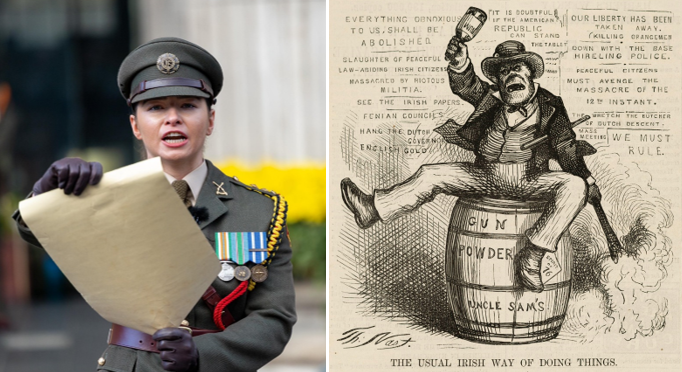
The Fenian Brotherhood was formed in the US in 1858, a partner organization to the Irish Republican Brotherhood. The groups were militant organizations looking to procure Irish independence from the British, and they found significant support among the Irish-American immigrant community. In November 1865 they purchased some 7500 1861- and 1863-pattern muskets left over from Civil War production, and used them to invade Canada in April 1866. The idea was to capture the country and then trade it to the British in exchange for Irish independence … but the invasion went quite badly. The Fenians briefly held Fort Erie, but were pushed out after a few hours and largely arrested by American forces.

The Fenians’ muskets were confiscated, but all returned by the end of 1866 in exchange for promised Irish-American support of embattled President Johnson. By 1868, the group was making plans for another attempt at conquering Canada. This time they would have better arms — they obtained a disused locomotive factory in Trenton NJ and set up the Pioneer Arms Works to convert 5,020 muskets into centerfire Needham Conversion breechloaders. These were given chambers that could fire standard .58 centerfire ammunition, or the .577 Snider ammunition that the Fenians expected to be able to procure once in Canada. Most of the guns also had their stocks cut, to allow them to be packed in shorter crates for transit. These usually have a distinctive “V” cut in the stock, which was spliced back together before use.

When the second invasion came in April 1870, it was again a failure. Only 800-1000 men turned out of the 5,000+ expected. They were scattered among several different muster points on the border, and the Canadians were once again aware of their plans. The most substantial fight was at a place called Eccles Hill, where the Missisiquoi Home Guard was ready and waiting for them with good Ballard rifles. Upon crossing the border, the Fenians were soundly defeated.

This second time, the guns were confiscated and not returned. Instead, the Watervliet Arsenal sold them as surplus in 1871. They were purchased by Schuyler, Hartley & Graham for commercial resale, and thanks to that several hundred remain in collector hands today.
(more…)

QotD: The Dictatorship in the late Roman Republic

I’d also argue that the office [of Dictator as created by Sulla and then by Caesar] didn’t work for the goals of either of the men that recreated it.

For Sulla, the purpose of using the dictatorship was to offer his reforms to the Republic some degree of legitimacy (otherwise why not just force them through purely by violence without even the fig leaf of law). Sulla was a reactionary who quite clearly believed in the Republic and seems to have been honestly and sincerely attempting to fix it; he was also a brutal, cruel and inhuman man who solved all of his problems with a mix of violence and treachery. While we can’t read Sulla’s mind on why he chose this particular form, it seems likely the aim here was to wash his reforms in the patina of something traditional-sounding in order to give them legitimacy so that they’d be longer lasting, so that Sulla’s own memory might be a bit less tarnished and to make it harder for a crisis like this to occur again.

And it failed at all three potential goals.

When it comes to the legitimacy of Sulla’s reforms and the memory that congealed around Sulla himself, it is clear that he was politically toxic even among many more conservative Romans. A younger Cicero was already using Sulla’s memory to tarnish anyone associated with him in 80, casting Chrysogonus, Sulla’s freedman, as the villain of the Pro Roscio Amerino, delivered in that year. In the sources written in the following decades at best Sulla is a touchy subject best avoided; when he is discussed, it is as a villain. Our later sources on Sulla are uniform in seeing his dictatorship as lawless. Moreover, his own reforms were picked apart by his former lieutenants, with key provisions being repealed before he was even dead (in 78 BC so that’s not a long time).

Finally, of course, far from securing the Republic, Sulla’s dictatorship provided the example and opened the door for more mayhem. Crucially, Sulla had not fixed the army problem and in fact had made it worse. You may recall one benefit of the short dictatorship is that no dictator – indeed, no consul or praetor either – would be in office long enough to secure the loyalty of his army against the state. But in the second and early first century that system had broken down. Gaius Marius had been in continuous military command from 107 to 100. Moreover, the expansion of Rome’s territory demanded more military commands than there were offices and so the Romans had begun selecting proconsuls and propraetors (along with the consuls and praetors) to fill those posts. Thus Sulla was (as a result of the Social War in Italy) a legate in 90, a propraetor in 89, and consul in 88 and so had been in command for three consecutive years (albeit the first as a legate) when he decided to turn his army – which had just, under his command, besieged the rebel stronghold of Nola – against Rome in 88, precisely because his political enemies in Rome had revoked his proconsular command for 87 (by roughing up the voters, to be clear). And then Sulla has that same army under his command as a proconsul from 87 to 83, so by the time he marches on Rome the second time with the intent to mass slaughter his enemies, his soldiers have had more than half a decade under his command to develop that ironclad loyalty (and of course a confidence that if Sulla didn’t win, their service to him might suddenly look like a crime against the Republic).

Sulla actually made this problem worse, because one of the things he legislated by fiat as dictator was that the consuls were now to always stay in Italy (in theory to guard Rome, but guard it with what, Sulla never seems to have considered). That, along with Sulla having butchered quite a lot of the actual experienced and talented military men in the Senate, left a Senate increasingly reliant on special commands doled out to a handful of commanders for long periods, leading (through Pompey‘s unusual career, holding commands in more years than not between 76 and 62) to Julius Caesar being in unbroken command of a large army in Gaul from 58 to 50, by which point that army was sufficiently loyal that it could be turned against the Republic, which of course Caesar does in 49.

For Caesar, the dictatorship seems to have been purely a tool to try to legitimate his own permanent control over the Roman state. Caesar is, from 49 to 44, only in Rome for a few months at a time and so it isn’t surprising that at first he goes to the expedient of just having his appointment renewed. But it is remarkable that his move to dictator perpetuo comes immediately after the “trial balloon” of making Caesar a Hellenistic-style king (complete with a diadem, the clear visual marker of Hellenistic-style kingship) had failed badly and publicly (Plut. Caes. 61). Perhaps recognizing that so clearly foreign an institution would be a non-starter in Rome – unpopular even among the general populace who normally loved Caesar – he instead went for a more Roman-sounding institution, something with at least a pretense of tradition to it.

And if the goal was to provide himself with some legitimacy, the effort clearly catastrophically backfired. The optics of the dictatorship were, at this point, awful; as noted, the only real example anyone had to work with was Sulla, and everyone hated Sulla. Many of Caesar’s own senatorial supporters had probably been hoping, given Caesar’s repeatedly renewed dictatorship, that he would eventually at least resign out of the office (as Sulla had done), allowing the machinery of the Republic – the elections, office holding and the direction of the Senate – to return. Declaring that he was dictator forever, rather than cementing his legitimacy clearly galvanized the conspiracy to have him assassinated, which they did in just two months.

It is striking that no one after Caesar, even in the chaotic power-struggle that ensued, no one attempted to revive the dictatorship, or use it as a model to institutionalize their power, or employ its iconography or symbolism in any way. Instead, Antony, who had himself been Caesar’s magister equitum, proposed and passed a law in 44 – right after Caesar’s death – to abolish the dictatorship, make it illegal to nominate a dictator, or for any Roman to accept the office, on pain of death (App. BCiv, 3.25, Dio 44.51.2). By all accounts, the law was broadly popular. As a legitimacy-building tool, the dictatorship had been worse than useless.

So what might we offer as a final verdict on the dictatorship? As a short-term crisis office used during the early and middle republic, a tool appropriate to a small state that had highly fragmented power in its institutions to maintain internal stability, the dictatorship was very successful, though that very success made it increasingly less necessary and important as Rome’s power grew. The customary dictatorship withered away in part because of that success: a Mediterranean-spanning empire had no need of emergency officials, when its military crises occurred at great distance and could generally be resolved by just sending a new regular commander with a larger army. By contrast, the irregular dictatorship was a complete failure, both for the men that held it and for the republic it destroyed.

The real problem wasn’t the office of dictator, but the apparatus that surrounded it: the short duration of military commands, the effectiveness and depth of the Roman aristocracy (crucially undermined by Sulla and Marius) and – less discussed here but still crucial in understanding the collapse of the Republic – the willingness of the Roman elite to compromise in order to maintain social cohesion. Without those guardrails, the dictatorship became dangerous, but without them any office becomes dangerous. Sulla and Caesar, after all, both marched on Rome not as dictators, but as consuls and proconsuls. It is the guardrails, not the office, that matter.

Bret Devereaux, “Collections: The Roman Dictatorship: How Did It Work? Did It Work?”, A Collection of Unmitigated Pedantry, 2022-03-18.

September 15, 2025

A few thousand deplorable “gammons” disrupt the peace in London

Filed under: Britain, Media, Politics — Tags: , , , — Nicholas @ 05:00

At least, the headline is how I assume most establishment types in Britain would try to describe the Unite the Kingdom march in London over the weekend (all photos by Esmeralda Weatherwax of the New English Review):

As I said earlier I have never seen a crowd like it – the police were overwhelmed with the numbers and I think even the organisers were pleasantly surprised at the turnout.

I gave up all hope early on of getting near enough to a screen to see or hear the speakers. But you can catch them up on line. I’m sure there are already links to Katie Hopkins, Laurence Fox, Tommy himself, Elon Musk by video link and the others.

I decided I was of most use photographing the numbers and variety, talking to people and following events away from the stage.

The march was scheduled to muster at Waterloo on the south bank. Knowing the turn out would be good attendees were advised to leave at Blackfriars Station and cross Blackfriars Bridge to join the march in Stamford Street east of Waterloo Station. The route was to be along the South Bank, over Westminster Bridge and into Whitehall at the south end. Antifa and Stand up to Racism were expected to march from Russell Square and would be rallying in the north end of Whitehall by Trafalgar Square with a long corden sanitaire between. Well that worked well last time.

I went straight to Whitehall and went to greet friends who were involved as marshals. Already the area was filling up fast and there were queues for the portaloos. They had to be provided as Westminster Council had shut and locked the public ones outside Westminster Station and on Westminster Pier. I don’t know why they do this. There will be mess afterwards.

September 14, 2025

Why Did Fascists and Communists Hate Each Other? OOTF Community Questions

Filed under: Germany, History, Italy, Military, Russia, WW2 — Tags: , , , , , , — Nicholas @ 04:00

World War Two
Published 13 Sept 2025

In this episode of Out of the Foxholes, we dive into your community questions about World War II. Why did fascists and communists despise each other? Was Barbarossa a pre-emptive strike by Hitler? How did forced repatriations at the end of the war influence the 1951 Refugee Convention? How did Hitler and Mussolini’s cults of personality compare?
(more…)

History of Britain VIII: Welsh, Picts, and Irish in the Early Middle Ages

Filed under: Britain, History — Tags: , , , , , — Nicholas @ 02:00

Thersites the Historian
Published 7 Mar 2025

In this video, we look at the other major ethnic groups in the British Isles and trace their development, insofar as our limited sources allow.

September 12, 2025

Britain’s network of weather stations is becoming less and less reliable

Well-sited weather stations can provide useful raw data on temperature ranges, wind speed, precipitation, and other measurables, but that “well-sited” makes a huge difference. Older weather stations situated in areas of rapid urban expansion will often be less reliable as they become part of the urban heat island and report higher temperatures due to locally generated heat sources rather than the ambient temperature they were able to record before. This is what has apparently happened to far too many of the UK’s temperature measuring sites, according to Chris Morrison in The Daily Sceptic:

The latest WMO Class figures at the Met Office shown in block graph form. The higher the class number, the less reliable the station reports become.
Image from The Daily Sceptic

In March 2024 the Daily Sceptic shocked the science and political world by disclosing that nearly 80% of the UK Met Office’s temperature measuring sites were so poorly located that potential “uncertainties” could corrupt the readings by a numbers of degrees of centigrade. World Meteorological Organisation (WMO) Classes 4 and 5 in its CIMO scale come with “uncertainties” up to 2°C and 5°C respectively, and a Freedom of Information (FOI) request found that 77.9% of its sites were in these two “junk” categories. It should have been a wake-up call demanding immediate improvement of the nationwide network, not least because the Met Office frequently catastrophises its temperature figures in the interest of promoting the Net Zero fantasy. Alas, no. A new FOI has found that the Classes 4 and 5 junk sites have increased significantly over the last 18 months and now total an appalling 80.6% of the entire network. Pristine Class 1 sites – which measure a credible ambient air temperature with little chance of unnatural heat corruption – are just 4.9% of the total, having fallen in number in this short period from 24 to 19.

Hundreds of millions of pounds have flowed through this Government department over the last 18 months but little effort seems to have been made to improve its basic and important meteorological measuring function. What is worse is that the Met Office doesn’t seem to understand the scale of the problem. Over the 18 months, it appears that 20 new sites have been opened in its now 387-strong network. Seventeen of these have been given WMO classifications, of which a frankly ludicrous 64.7% are starting life in the Class 4/5 junk lane.

The WMO rates weather stations by the degree of possible temperature corruption caused by nearby unnatural or natural influences. Classes 1 and 2 are considered what we might call pristine, with no significant errors arising from artificial influences. The latest figures show that the Met Office has just 12.1% of its sites in these two unadulterated categories. Class 3 comes with an uncertainty of up to 1°C and accounts for 7.23% of the total. The real shocker is Class 4 where the percentage of the total has risen from 48.7% to over half at 50.1%. Class 5 has no defining conditions and could be located next to a blast furnace door. It has risen over the last 18 months from 29.2% to 30.5%. The WMO states that a Class 1 location can be considered a “reference site”. A Class 5 site is said to be a location “where nearby obstacles create an inappropriate environment for a meteorological measurement that is intended to be representative of a wide area”.

Despite this, Class 5 “extremes”, often caused by temporary but obvious heat spikes, litter the Met Office databases and record books. Of course such Class 5 data, unsuitable for providing an accurate temperature for a “wide area”, are loaded into databases producing “hottest evah” days, months, seasons and years. Their final destinations are the global datasets that exaggerate recent warming, again to promote Net Zero. Sprinkling the Class 4 and 5 fairy dust over the figures adds a bit more of the urgency required for elite political purposes.

Ancient Roman Table Manners & Etiquette

Filed under: Europe, Food, History — Tags: , , , , — Nicholas @ 02:00

Tasting History with Max Miller
Published 8 Apr 2025

Spiral-shaped fritters drizzled with honey and sprinkled with white poppyseeds

City/Region: Rome
Time Period: 2nd Century B.C.E.

These fritters are kind of like a mix between globi and jalebi. The batter is simple like the globi, made of just spelt flour and ricotta, but they’re piped into hot fat in spiral shapes like jalebi. The technique can be a little tricky to get right so that the spirals hold together, but you should get about 12 to 15 tries out of the amount of batter this recipe makes.

The encytum are delicious and kind of remind me of a healthy pancake, but with honey instead of maple syrup. They don’t stay crispy for very long, so plan on serving them right away if you’d like to retain maximum crispness.

    Make encytum the same way as globi, except that you use a vessel with a hole in the bottom which you can stream through into hot fat, and shape like the spira, coiling and turning it with two sticks. Spread and color with honey while still warm. Serve with honey or mulsum.
    De Agri Cultura by Cato the Elder, 2nd century B.C.E.

    (more…)

September 11, 2025

The Archbishop of York misunderstands a recent child poverty report

Filed under: Britain, Economics, Education, Food, Religion — Tags: , , , — Nicholas @ 04:00

Tim Worstall knows that it’s unrealistic to expect a prelate of the Church of England to believe in anything, but in this case His Grace Stephen Cottrell, the Most Reverend and Right Honourable Archbishop of York appears to believe that child poverty in Britain is a very serious problem:

His Grace Stephen Cottrell, Archbishop of York since July, 2020.
Photo 2014 via Wikipedia Commons.

So we’ve the Archbishop of York here telling us all how it should be. Of course, given that that prelacy is Church of England he doesn’t actually believe anything, of course not. But he does roll out what he considers to be facts. Which, sadly, are not.

    With all children across the UK back in school as of this week, I am reminded that almost one in three are in poverty. That statistic is shocking enough – but behind every number is a child, and what this statistic means is children arriving at school hungry, living in insecure housing, and missing out on the activities that help them thrive.

Well, no. His near one in three comes from this JRF report. Which is not measuring poverty at all. It’s measuring inequality — the number of people living in a household on less than 60% of median household income. Which is not, in fact, poverty.

No, think on it. If we doubled the — real — income of everyone in the country then clearly we’d have less poverty. But by this measure, the one of inequality of incomes, the number in poverty would change by not one single person nor child. Equally, if we halved everyone’s incomes — real incomes that it — there would be a lot more poverty. But by this measure there would be no change at all.

There’s also this:

    I visited a school in the north-east of England a couple of years ago where many of the pupils turned up with empty lunchboxes. There was a breakfast club that fed them on arrival. They were eligible for free school meals, so got a hot lunch. After school, trestle tables were set up in the playground laden with food donated from the local food bank. As they went home, they filled up their lunchboxes so that they could have some tea.

    I have rarely been so shocked. This is the reality of child poverty.

Kids are packed to the gunwales with food and this is a sign of poverty? Eh? Sure, sure, I know consubstantiation is pretty heady stuff but really, a little contact with reality please? Kids get two full meals and tuck to take home. This is all free. So, logically, their parents send them to school with empty tuck boxes so that they get two free meals and stuff to take home. I mean, free stuff, who wouldn’t?

Who goes to the pub to pay £7 a pint when booze is flowing free from the town fountain?

Update, 12 September: Welcome, Instapundit readers! Please do have a look around at some of my other posts you may find of interest. I send out a daily summary of posts here through my Substackhttps://substack.com/@nicholasrusson that you can subscribe to if you’d like to be informed of new posts in the future.

September 10, 2025

QotD: “The [western Roman Empire] did not drift hopelessly towards its inevitable fate. It went down kicking, gouging and screaming”

Filed under: Europe, History, Military, Quotations — Tags: , , , , — Nicholas @ 01:00

The fall of the Roman Empire in the West (please, right now, just mentally add the phrase “in the west” next to every “the fall of Rome” and similar phrase here and elsewhere) is complicated. I don’t mean it is complicated in its causes or effects (though it is that too), I mean it is complicated in its raw events: the who, what, where and when of it. Most students are taught a fairly simple version of this because most of what they need to actually learn is the cause and the effects and so the actual “fall” part is a sort of black box where Huns, Vandals, Goths, plague, climate and economic decline go in and political fragmentation, more economic decline and the European Middle Ages come out. The fall itself ends up feeling like an event rather than a process because it is compressed down to a single point, the black box where all of the causes become all of the effects. That is, frankly, a defensible way to teach the topic at a survey level (where it might get at most a lecture or two either at the end of a Roman History survey or the beginning of a Medieval History survey) and it is honestly more or less how I teach it.

But if you want to actually try to say something intelligent about the whole thing, you need to grapple with what actually happened, rather than the classroom black-box model designed for teaching efficiency rather than detail. We are … not going to do that today … though I will have some bibliography here for those who want to. The key thing here is that the “Fall of Rome” (in the West) is not an event, but a century long process from 376 to 476. Roman power (in the West) contracts for a lot of that, but it expands in periods as well, particularly under the leadership of Aetius (433-454) and Majorian (457-461); there are points where it would have really looked like the Romans might actually be able to recover. Even in 476 it was not obvious to anyone that Roman rule had actually ended; Odoacer, who had just deposed what was to be the last Roman emperor in the west promptly offered the crown to Zeno, the Roman emperor in the East (there is argument about his sincerity but James O’Donnell argues – very well, though I disagree on some key points – that this represented a real opportunity for Rome to rise from defeat in a new form yet again).

Glancing even further back historically, this wasn’t even the first time the Roman Empire had been on the brink of collapse. Beginning in 238, the Roman Empire had suffered a long series of crippling civil wars and succession crises collectively known as the Crisis of the Third Century (238-284). At one point, the empire was de facto split into three, with one emperor in Britain and Gaul, another in Italy, and the client kingdom of Palmyra essentially running the Eastern half of the empire under their queen Zenobia. Empires do not usually survive those kinds of catastrophes, but the Roman Empire survived the Crisis, recovered all of its territory (save Dacia) and even enjoyed a period of relative peace afterwards, before trouble started up again.

The reason that empires do not generally survive those kinds of catastrophes is that generally when empires weaken, they find that they contain all sorts of people who have been waiting, sometimes patiently, sometimes less so, for any opportunity to break away. The rather sudden collapse of the (Neo-)Assyrian Empire (911-609 BC) is a good case study. After having conquered much of the Near East, the Assyrians fell into a series of succession wars beginning in 627; their Mesopotamian subjects smelled blood and revolted in 625. That was almost under control by 620 when the Medes and Persians, external vassals of the Assyrians, smelled blood too and invaded, allying with the rebelling Babylonians in 616. Assyria was effectively gone by 612 with the loss and destruction of Ninevah; they had gone from the largest empire in the world at that time or at any point prior to non-existent in 15 years. While the Assyrian collapse is remarkable for its speed and finality, the overall process is much the same in most cases; once imperial power begins to wane, revolt suddenly looks more possible and so the downward slope of collapse can be very steep indeed (one might equally use the case study of decolonization after WWII as an example: each newly independent country increased the pressure on all of the rest).

Yet there is no great rush to the doors for Rome. Instead, as Guy Halsall puts it in Barbarian Migrations and the Roman West (2007), “The West did not drift hopelessly towards its inevitable fate. It went down kicking, gouging and screaming”. Among the kicked and gouged of course were Attila and his Huns. Fought to a draw at the Battle of the Catalaunian Plains, his empire disintegrated after his death two years later under pressure from both Germanic tribes and the Eastern Roman Empire (and the standard tendency for Steppe empires to fragment); of his three sons, Ellac was killed by revolting Germanic peoples who had been subject to the Huns, Dengizich by the (Eastern) Romans (we’re told his head was put on display in Constantinople) and the last, Ernak just disappears in our narrative after the death of Dengizich. The Romans, it turns out, did eventually get down to business to defeat the Huns. But the Romans doing all of that kicking, gouging and screaming were not the handful of old families from the early days of the Repulic; most of those hard-fighting Romans were people who in 14 AD would have been provincials. And indeed, the Roman Empire would survive, in the East, where Rome wasn’t, making for a Roman Empire that by 476 consisted effectively entirely of “provincial” Romans.

Instead what we see are essentially three sets of actions by provincial elites who in any other empire would have been leading the charge for the exits. There were the kickers, gougers and screamers, as Halsall notes. There were also, as Ralph Mathisen, Roman Aristocrats in Barbarian Gaul (1993) has noted, elites who – seeing the writing on the wall – made no effort to hasten the collapse of the empire but instead retreated into their estates, their books and their letters; these fellows often end up married into and advising the new “barbarian” kings who set up in the old Roman provinces (which in turn contributes quite a bit to the preservation and continued influence of Roman law and culture in the various fragmented successor states of the early Middle Ages). Finally, there were elites so confident that the empire would survive – because it always had! – that they mostly focused on improving their position within the empire, even at the cost of weakening it, not because they wanted out, but because “out” was inconceivable to them; both Halsall and also James O’Donnell, The Ruin of the Roman Empire (2009) document many of these. If I may continue my analogy, when the exit door was yawning wide open, almost no one walked through; some tried to put out the burning building they were in, others were content to be at the center of the ruins. But no one actually left.

During the Crisis of the Third Century, that set of responses had been crucial for the empire’s survival and for brief moments in the 400s, it looked like they might even have saved it again. For all of the things that brought the Roman Empire down, it is striking that “internal revolts” of long-ruled peoples weren’t one of them. And that speaks to the power of Rome’s effective (if, again, largely unintentional) management of diversity. The Roman willingness to incorporate conquered peoples into the core citizen body and into “Roman-ness” meant that even by 238 to the extent that the residents of the Empire could even imagine its collapse, they saw that potentiality as a disaster, rather than as a liberation. That gave the empire tremendous resiliency in the face of disaster, such that it took a century of unremitting bad luck to bring it down and even then, it only managed to take down half of it.

(As an aside, those provincial Romans were correct in the judgement that the collapse of the empire would mean disaster. The running argument about the fall of the Roman Empire is generally between the “decline and fall” perspective, which presents the collapse of the Roman Empire as a Bad Thing and the “change and continuity” perspective, which both stresses continuity after the collapse but also tends to try minimize the negative impacts of it, even to the point of suggesting that the average Roman peasant might have been better off in the absence of heavy Roman taxes. That latter view is particularly common among many medievalists, who are understandably quite tired of the unfairly poor reputation their period gets. This is an argument that for some time lived in the airy space of narrative and perspective where both sides could put an argument out. Unfortunately for some of the change-and-continuity arguments about living standards, archaeology has a tendency to give us data that is somewhat less malleable. That archaeological data shows, with a high degree of consistency, that while there is certainly some continuity between the Late Antique and the early Middle Ages the fall of Rome (in the West) killed lots of people (precipitous declines in population in societies without reliable birth control; probably this is mostly food scarcity, not direct warfare) and that living standards also declined to a degree that the results are archaeologically visible. As Brian Ward-Perkins notes in The Fall of Rome and the End of Civilization (2005), the collapse causes cows to shrink, speaking to sudden scarcity of winter fodder (which in turn likely speaks to a general reduction in available nutrition). Some areas were worse hit than others; Robin Flemming, Britain After Rome (2010) notes, for instance, that in post-Roman Britain, pot-making technology was lost (because ceramic production had been focused in cities which had been largely depopulated out of existence). The fall of Rome might have been good for some people, but the evidence is, I think, at this point inescapable that it was quite bad for most people. Especially, one assumes, all of the people who got depopulated.)

Bret Devereaux, “Collections: The Queen’s Latin or Who Were the Romans, Part V: Saving and Losing and Empire”, A Collection of Unmitigated Pedantry, 2021-07-30.

September 8, 2025

June 17, 1953: The Day East Germany Erupted – W2W 43

Filed under: Germany, History, Russia — Tags: , , , , , — Nicholas @ 04:00

TimeGhost History
Published 7 Sept 2025

Breadlines, quotas, and Stasi fear collide with propaganda promises as East Germany erupts. In June 1953, strikes on Stalinallee ignite a nationwide uprising — Soviet tanks roll into Berlin, thousands are arrested, and the GDR tightens control. How did the regime survive this shock?
(more…)

« Newer PostsOlder Posts »

Powered by WordPress