
Adrian Goldsworthy. Historian and Novelist
Published 1 Oct 2025The first of this year’s video’s in answer to viewers’ questions — today we think about and compare Alexander and Caesar. This is not new, for in the ancient world the pair were often connected, even though they lived centuries apart. Appian compared and contrasted them, Plutarch paired his biographies of them, while Suetonius and others told stories about Caesar’s admiration for the famous Macedonian.
April 23, 2026
Alexander the Great and Julius Caesar
Comments Off on Alexander the Great and Julius Caesar
QotD: The problems of a “no first use” nuclear weapons policy
Now, you might ask at this point: why not defuse some of this tension with a “no first use” policy – openly declare that you won’t be the first to use nuclear weapons even in a non-nuclear conflict?
For the United States during the Cold War, the problem with declaring a “no first use” policy was the worry that it would essentially serve as a “green light” for conventional Soviet military action in Europe. Recall, after all, that the Soviet military was stronger in conventional forces in Europe during the Cold War and that episodes like the Berlin Blockade (and resultant Berlin Airlift) seemed to confirm Soviet interest in expanding their control over central Europe. At the same time, the Soviet use of military force to crush the Hungarian Revolution (1956) and the Prague Spring (1968) continued to reaffirm that the USSR had no intention of letting Central or Eastern Europe choose their own fates – this was an empire that ruled by domination and intended to expand if it could.
The solution to blocking that expansion was NATO, the North Atlantic Treaty Organization. Not because NATO collectively could defeat the USSR in a conventional war – the general assumption was that they probably couldn’t – but because NATO’s article 5 clause pledging mutual defense essentially meant that the nuclear powers of NATO (Britain, the United States, and France) pledged to defend the territory of all NATO members with nuclear weapons. But just like deterrence, mutual defense alliances are based on the perception that all members will defend each other. Declaring that the United States wouldn’t use nuclear weapons first would essentially be telling the Germans, “we’ll fight for you, but we won’t use our most powerful weapons for you” in the event of a conventional war; it would be creating a giant unacceptable asterisk next to that mutual defense clause.
So the United States had to be committed to at least the possibility that it would respond to a conventional military assault on West Germany with nuclear retaliation (often envisaged as a “tactical” use of nuclear weapons – that is, using smaller nuclear weapons against enemy military formations. That said, even in the 1950s, Bernard Brodie was already warning that restraining the escalation to general use of nuclear weapons once a tactical nuclear weapon was used would be practically impossible).
Bret Devereaux, “Collections: Nuclear Deterrence 101”, A Collection of Unmitigated Pedantry, 2022-03-11.
Comments Off on QotD: The problems of a “no first use” nuclear weapons policy
April 22, 2026
“Finally authorities gave up and decided to let Timmy the Whaletard die in peace”
The German media has been breathlessly covering the story of a wandering whale who seems to delight in getting stranded on sandbanks along the northern coast of Germany in the Baltic Sea:

Timmy
Photo from eugyppius
Timmy is the name the German press have given to a confused humpback whale who got himself caught in a fishing net off the coast of Mecklenburg-Vorpommern in early March.
Authorities cut Timmy free in the hopes that he would swim back to the Atlantic like a good whale, but instead he continued to poop around off the German Baltic coast where he does not belong, finally stranding himself on a sandbar near Niendorf like a complete fucking retard.1 An intensive rescue ensued – breathlessly livestreamed by the German press and regrettably also live-tweeted by myself. Ultimately the effort succeeded and Timmy swam free, only to strand himself again, and again, and again, and still again.
Finally authorities gave up and decided to let Timmy the Whaletard die in peace, but soon a whole raft of philanthropists and “whale whisperers” (this is literally what the press called one of them) descended on the problem and the drama of Timmy continues to this moment. The latest subplot unfolded yesterday, as our whale saviours prepared a complex scheme to lift Timmy via air cushions onto a tarp, tie him to pontoons and tug him around Denmark back into the North Atlantic. Alas, a rising tide loosened the hapless Timmy from his sandbar and he swam free, escaping this indignity at least and leaving all the whale-whispering shitheads with nothing to do but give more pointless media interviews. For two hours children across the Federal Republic jubilated as Timmy lurked aimlessly in shallow coastal waters, until of course he beached himself again, provoking a whole new narrative epicycle.
The case of Timmy the Retard Whale is oddly captivating. Most obviously it illustrates the naiveté and neotenous emotional incontinence of Germans today, many of whom have countered the pervasive secularisation of society with an exaggerated and childish faith in the overarching sacrality of the natural world and its creatures. The media have constructed a perverse Disney plot out of the endless ups and downs of Timmy’s plight: Now the whale is free! Now he is dying! Now he must be rescued! Now he is free again! Now he is stranded! Now there is hope! Now he is dying! Not only children but plenty of adults have lost themselves in this transparently repetitive drama. At one point a gaggle of dumb women even protested to demand that authorities do more to save our unsaveable humpback – who is of course merely one of perhaps 100,000 humpbacks across the world, the vast majority of whom will die in complete obscurity with nary a news article.
In my more delirious moments I wonder if Timmy is not also an omen from on high, a metaphor from the heavens to illustrate for us the ridiculous, circular farce that Germany has become.
- He was named Timmy for Timmendorfer Strand, where he beached himself for the first time. My efforts to christen him Horst have not caught on. I know the good Timmy is probably disoriented due to illness or injury and not actually retarded but this is how I have chosen to maintain emotional distance from the fate of this particular incorrigible mammal, who is beyond all human capacity to rescue but unfortunately not beyond all of my sympathies.
Comments Off on “Finally authorities gave up and decided to let Timmy the Whaletard die in peace”
Walther’s Forgotten SMG: The MPK (and MPL)
Forgotten Weapons
Published 3 Dec 2025Walther began developing a modern stamped sheet metal SMG in the late 1950s, and it entered production in 1963. It was an open-bolt, simple blowback gun available in a short (MPK; 6.75″ barrel) and long (MPL; 10.25″ barrel) version. It was cheap and simple, but well thought out with a number of quite good features.
The standard design was just safe/full, but a semiautomatic selector position was available if desired by the client. An excellent safety sear prevented the bolt from bouncing open and firing, and the charging handle was both non-reciprocating and capable of also serving as a forward assist if needed. The sights were a bit too clever for Walther’s own good, with a 75m notch and a 150m aperture, both of which were not really great.
Faced with competition from contemporaries like the Uzi and MP5, the Walther never really became massively popular. It did get enough small and medium sized contracts (German police, South African police, Mexican Navy, Portuguese Navy, US Delta Force, etc) to remain in production until 1985 though. Overall a solid and reliable gun even if it failed to really stand out from the other options on the market.
(more…)
Comments Off on Walther’s Forgotten SMG: The MPK (and MPL)
April 21, 2026
Hungary in the news
Theodore Dalrymple considers the recent change in government as Victor Orbán was replaced by Péter Magyar, who had been an Orbán supporter until the last few years:

Hungarian Prime Minister-elect Péter Magyar, on 15 March 2026 during a national day demonstration at Heroes’ Square in Budapest. Magyar is wearing a traditional bocskai jacket and a national cockade.
Photo by Norbert Banhalmi and released under CC BY-SA 4.0 via Wikimedia Commons.
It is perfectly normal and healthy that in an electoral democracy a government should be voted out of office after 16 years in power. One of the complaints often heard in such democracies is that “they are all the same”, they being members of the political class of whatever political party.
But there is benefit in a change of government personnel irrespective of all else, for those who remain too long in power come to think of that power as their right, and the citizenry as their servants rather than of themselves as servants of the citizenry.
The recent removal from power by election of Viktor Orbán in Hungary after so long as prime minister (and his full acceptance of the defeat, despite accusations that he was like an authoritarian dictator) was perfectly normal. He had been replaced by a man who is no fire-eating radical, Péter Magyar, a young man who was, until comparatively recently, a supporter of the leader he has replaced.
The electorate, according to polls, was concerned about the state of the economy and the level of corruption in the country. Governments that come into power promising to eradicate corruption often reveal themselves to be no different in this respect from the last: the fruits of corruption are distributed to different people, that is all.
The new prime minister differs greatly from the old in two attitudes: firstly, to the war in Ukraine and secondly to the European Union. Unlike Mr. Orbán, he is no friend of Vladimir Putin’s; and unlike Mr. Orbán, he is more likely to do the Union’s bidding in order to gain access to the latter’s funds. One important question is whether he will be forced to change Hungary’s attitude to mass immigration, opposition to which was a source not only of Mr. Orbán’s conflict with the Union, but of his long domestic popularity.
His policy was regarded as xenophobic, but this was an unjustified slur. Xenophobia is a hatred or fear of foreigners as such, ex officio, and on my visits to Hungary I found none of this. I met, for example, a Kurdish physiotherapist well integrated into Hungary, and a Moroccan academic likewise, who did not complain of personal antagonism to them. Other foreign residents whom I met did not complain of it either. A desire to protect a small country from the effects of mass immigration that have been seen in Sweden (a country of similar size of population), for example, is not xenophobia: it might on the contrary be regarded as both prudent and as a manifestation of love of one’s country. It is part of the malign legacy of Hitler and the Nazis that love of one’s country is now felt by many European intellectuals to be inherently vicious and aggressive. But love of one’s country is not the same as hatred of everyone else’s, though it is true that patriotism can sometimes degenerate into such hatred.
The European Union’s attitude to mass immigration is contradictory. It regards ethnic and cultural diversity as good in themselves, as if what existed before was lacking some important ingredient that such diversity will automatically bring.
Comments Off on Hungary in the news
Ivan the Terrible – Feeding the Evil Russian Tsar
Tasting History with Max Miller
Published 14 Oct 2025Soft buns filled with cabbage, onion and dill
City/Region: Russia
Time Period: 16th CenturyIn Russian, Ivan the Terrible is Ivan Grozny, and the translation of “terrible” was meant more in the way of “fearsome” or “formidable” rather than “cruel” or “awful”, though Ivan ended up being all of those. What started off as a good reign with military victories, building Saint Basil’s Cathedral, and restricting the boyars‘ (aristocracy) power over the people descended into a reign of terror with a secret police, the massacre of a city, and even killing his eldest son in a fit of rage.
While Ivan truly was terrible, these piroshki are not. They are absolutely delicious. The bread is soft, and the filling is savory and slightly sweet with the dill really coming through. These were made with all different kinds of fillings, so feel free to try out other ingredients, like meat, fish, fruit, or other vegetables, or put in a hard boiled egg for a modern touch.
Small pies filled with mushrooms, poppy seeds, kasha, turnips, cabbage, or whatever else God sends.
When the servants bake bread, order them to set some of the dough aside, to be stuffed for piroshki.— The Domostroi, 16th Century
Comments Off on Ivan the Terrible – Feeding the Evil Russian Tsar
April 20, 2026
QotD: The quality of evidence problem for historians
And yet, you can’t entirely discount them, either. Crecy (along with of course Agincourt) is supposed to be the triumph of the English longbow, and that’s the thing: We’ve reconstructed English longbows, and put them through all kinds of trials. The results, as I understand it — which, again, ain’t much — were highly variable. A very strong, well-fed, highly trained longbowman, firing an ideally constructed and maintained bow under optimal conditions, really can put X number of arrows up a flea’s ass at Y range in Z time.
Or they could miss the broad side of a barn at twenty feet, depending.
So: What was the weather like in Northern France on 26 August 1346? That’s not an idle question. Rather, it’s the central question. Assume perfect shooting conditions, and you’ve got a far, far different picture of the battle than if you assume poor ones. And if that seems to be giving too much credit to the weather, watch a few baseball games — you’ll quickly discover that quite often, the difference between a home run and a long out is just a few percentage points of relative humidity.
Ultimately it comes down to judgment. More importantly, it’s a judgment on how any particular event fits into the larger argument you’re trying to make. In a way, then, the details really don’t matter very much on their own — the mechanics of how the English won are almost irrelevant, except insofar as they feed into an analysis of why they won. Why did the French king attack uphill, in the mud? Was he stupid? Overconfident? Did he feel he had to, because of political problems inside his host? Did he have faulty information? Did he have accurate information, but just made a bad call?
That’s the art of History, and why, despite what the Peter Turchin (and Karl Marx) crowd keeps insisting, it will always be an art, not a science. We can have a high degree of confidence, most times, in what happened — there really was a battle at Crecy, and the English really did win it. It’s the why that is susceptible to radical reinterpretation.
Severian, “Friday Mailbag”, Founding Questions, 2022-06-17.
Comments Off on QotD: The quality of evidence problem for historians
April 19, 2026
How to Tank the Economy for War – Death of Democracy 12 – Q4 1935
World War Two and Spartacus Olsson
Published 18 Apr 2026Nazi Germany in late 1935 was becoming more ruthless, more militarized, and more dangerous. In this episode, Spartacus Olsson reports from Berlin on the final months of 1935, when Hitler’s regime tightened its grip through food shortages, propaganda, rearmament, and the continued implementation of the Nuremberg Laws. As ordinary Germans faced rising prices, scarce meat and butter, and mounting pressure to sacrifice for the Reich, the Nazi state pushed its “guns before butter” economy even further. We examine the “fat gap”, Winter Relief, Eintopfsonntag, and the growing burden placed on German families while resources were diverted to war preparation.
At the same time, the First Supplementary Decree to the Reich Citizenship Law gave the regime a bureaucratic definition of who counted as a Jew, accelerating exclusion, dismissal, and persecution. Courts, police, and the Gestapo increasingly enforced the racist order, while Goebbels’ propaganda machine worked to normalize hardship, suppress criticism, and intensify antisemitism.
Against the backdrop of Mussolini’s invasion of Abyssinia and the paralysis of the League of Nations, Hitler found new room to maneuver internationally while consolidating dictatorship at home. This episode explores how the Third Reich turned scarcity into discipline, prejudice into law, and national pride into obedience — bringing Germany one step closer to catastrophe.
Never Forget.
Comments Off on How to Tank the Economy for War – Death of Democracy 12 – Q4 1935
QotD: The (only?) man who didn’t fear Margaret Thatcher
Thatcher reacted with cold fury, but Hoskyns was unabashed. Another story tells of his arriving for a meeting with the PM only to be intercepted by Ian Gow, her personal secretary. “Our girl is tired,” said Gow, trying to bar his path. “I’m tired too,” muttered Hoskyns. “It goes with the bloody job. I’m going in.”
Such irreverence to the “Great She-Elephant”, “She who must be obeyed”, “Attila the Hen” is rare enough, but this isn’t the main thing to remember Hoskyns for. Far more interesting – and relevant to now – is the work he did with fellow conservative Norman Strauss in the mid-1970s to diagnose the exact sources of Britain’s economic malaise, and come up with clear policies about how the country could haul itself out of it.
Robin Ashenden, “Thatcher’s ‘Wiring Diagram’ and why we need it once again”, The Critic, 2020-08-25.
Comments Off on QotD: The (only?) man who didn’t fear Margaret Thatcher
April 18, 2026
“The whole thing was one giant attempt to gaslight both young men and the public at large”
On the social media site formerly known as Twitter, Christian Heiens responds to a cover story in The New Statesman:
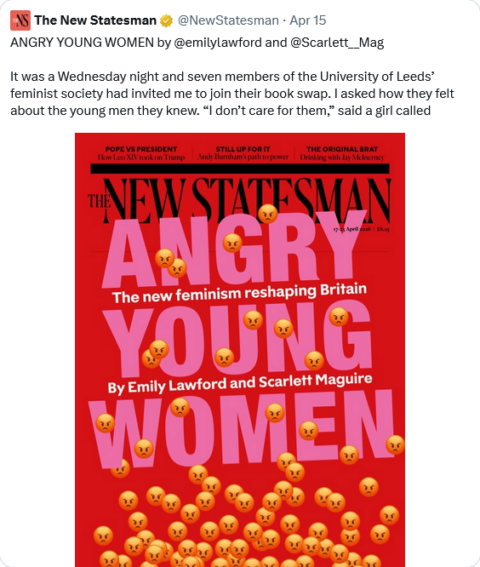
We were subjected to years of “young men are becoming radicalized, what’s driving this and how do we stop it?” discourse when in reality the typical young man saw practically zero change in his political outlook over the last 30 years.
The whole thing was one giant attempt to gaslight both young men and the public at large that they had suddenly moved well outside the Overton window and were either self-radicalizing or falling for extremist propaganda.
In reality, the problem was that young men were staying put rather than adopting increasingly radical progressive views. The real issue was that young women were flying off the rails, espousing views that would lead to the complete dissolution of civilization itself while acting like these were basic normal positions that completely sane people should hold.
That disconnect between what was being said and what was being done became so off kilter with reality that something finally began to break after 2020.
The problem isn’t with young men. The problem is that young women have gone certifiably insane. They’ve made radical progressivism their religion. They’re acting out on the perfectly healthy female tendency to act to uphold and preserve the existing social order.
Young women are trying to conserve an ideology they see as the stable bedrock of society, even if it’s actually an acidic collection of delusions that will inevitably destroy society itself. And they’re upset that young men aren’t doing what they see as their role to uphold that order as well.
In short, women are natural conservatives. They’re trying to conserve progressivism because it’s the reigning social order and theological governing system of Western civilization. And they’re upset and confused as to why young men aren’t stepping up to uphold it as well.
On Substack Notes, John Carter commented on the same New Republic The New Statesman cover story:
Women have never had it better than they do in modern Western countries. They are affluent, thanks to being given every advantage in education and employment; young women now hold more degrees, and make more money, than young men. They can marry whoever they want, from anywhere in the world, or they can marry no one at all. They can sleep with whoever they want, with however many people they want, with no risk of pregnancy, and if they get the ick later they can decide that it was rape and their abuser will be punished. Any opposition to their cultural or political preferences is automatically classified as hate, and every institution acts to denounce and punish this unacceptable hatred on their behalf … in no small part because they have taken over these institutions.
Women have never had it better, and they are absolutely incandescent with fury about that.
Comments Off on “The whole thing was one giant attempt to gaslight both young men and the public at large”
The First M60 Prototype: FG42 + MG42 = T44
Forgotten Weapons
Published 1 Dec 2025The FG-42 caught the attention of a lot of countries at the end of World War Two. The British and Swiss both used it as the starting point for some developments. The US went one step simpler, and simply cut up a captured FG-42 to make into the T44, the first prototype of what would become the M60 machine gun.
This project was done in 1946 by the Bridge Tool & Die Company, who spent about six months reinforcing an FG42 and adding an MG42 feed system to it to create an unholy hybrid kludge of a gun. It was, however, successful enough to justify continuing the project. Only this one example was made before moving on to much more practical models built from the ground up instead of hacking up captured German guns.
(more…)
Comments Off on The First M60 Prototype: FG42 + MG42 = T44
April 17, 2026
Hungary in the news
The way the mainstream media reacted to the recent Hungarian election results, you’d think it was the 2020s equivalent to the fall of the Iron Curtain. Outgoing leader Viktor Orbán has been portrayed as Hungary’s Trump when he hasn’t been discussed as Hungary’s Mussolini. His successor, Péter Magyar is largely unknown outside Hungary where he had been a member of Orbán’s Fidesz party before leaving to join his current party, Tisza. In The Critic, Ben Sixsmith provides some useful background on the state of politics in Hungary today:
Hungarian Prime Minister-elect Péter Magyar, on 15 March 2026 during a national day demonstration at Heroes’ Square in Budapest. Magyar is wearing a traditional bocskai jacket and a national cockade.
Photo by Norbert Banhalmi and released under CC BY-SA 4.0 via Wikimedia Commons.
Tisza — the name being a portmanteau of the Hungarian words tisztelet (respect) and szabadság (freedom), and a reference to the nation’s second largest river — was founded in 2020 and registered in 2022. It was a very marginal conservative party with policies like “raise the minimum pension” and “stop migration”.
In the 2022 parliamentary elections, the party fielded no candidates at all.
Tisza became a major force in Hungarian elections when Péter Magyar joined the party. Magyar, who has a legal background, had been a member of Viktor Orbán’s party Fidesz. More significantly, he had been married to the Hungarian Minister of Justice, Judit Varga, from 2006 to 2023.
In 2024, Varga resigned, along with Hungarian president Katalin Novák, after both were exposed as having signed a pardon for a convicted paedophile who had been a director of a state-run children’s home. Magyar resigned from Fidesz, accusing Orbán of “hiding behind women’s skirts”.
“For a long time I believed in an idea, a national, sovereign, civic Hungary,” wrote Magyar in a much-quoted statement, “But in recent years, I have slowly and finally realized that all of this is really just a political product.”
Magyar became a ferocious critic of alleged government corruption. His ex-wife responded to his anti-Orbán activities by accusing him of domestic abuse. Magyar denied this. Undaunted, he led various anti-government demonstrations, which attracted tens of thousands of Hungarians. He was also chosen to lead Tisza.
Magyar has profited from good timing. He is also a photogenic man who has performed well on social media. His politics are more mysterious. He has called himself a “critical pro-European and a conservative liberal”.
He is not the sort of liberal that anti-Orbán Westerners might want him to be. While he has said that he will “move away from the current, uncritically friendly approach towards Russia”, he has also said that it will take time to stop buying Russian fuel, and he has criticised the Ukrainian approach to Hungarian minorities. He has sometimes tried to outflank Orbán on sovereignty, saying that Fidesz have brought in too many guest workers, and even questionably saying that migrants have been stealing ducks from Hungarian ponds. Still, it remains to be seen if the pro-EU Magyar will maintain his more right-wing opinions or be swept along by European orthodoxy — not least when he has emphasised the importance of unlocking EU funds.
At The Sceptic, James Alexander says that the situation is more complicated than a split between Orbán and what he terms “the Roral Response”:

President Donald Trump and Hungarian Prime Minister Viktor Orban pose for a photo in the Oval Office, Friday, November 7, 2025.
Official White House photo by Daniel Torok via Wikimedia Commons.
What is the Orbán-Roral Divide? It is the Manichaean yin-yang binary of the simplistic political imagination, which supposes that, on one side, we have Orbán, Putin, Trump etc., and that, on the other side, we have von der Leyen, Merz, Starmer, Carney, Zelensky and of course the man after whom I name the category: Rory Stewart.
It has some truth in it, but it is bewildering when we see the binary exalted as if it is the only truth of politics. The downfall of Orbán illustrates this almost perfectly.
The subject today is Orbán Developments. And the Roral Response.
News.
As you all know, Orbán, after 16 years of power, fell in the recent election.
- Viktor Orbán = Fidezs = 37.8% = 55 seats
- Peter Magyar = Tisza = 53.6% = 138 seats
“Who loses and who wins, who’s in, who’s out,” quoth King Lear.
Orbán lost.
Now, I like Orbán, symbolically. I don’t know about actually: never studied him. I read one of his speeches once, and it read as more intelligent than any equivalent political speech. I have one thing in common with him, which is that he was present at the funeral of Norman Stone. Anyhow, like him or loathe him, we have to be philosophical. And we have to respect him, even if he is an Oxford man.
- Oxford: Obsessed with power. Corrupt. Cecil Rhodes, Lord Milner, Tony Blair, David Cameron, Boris Johnson, Dominic Cummings, Viktor Orbán etc.
- Cambridge: Lord Acton: “Power corrupts and absolute power corrupts absolutely.”
So let us look at what people say. The amusing thing is that people immediately editorialise. Twitter, X, Whatyouwill.com, turns everyone into William Rees-Mogg. Look at all these Editors.
Here is Ferenc Horcher, a very important Hungarian scholar:
Time to face reality: the Hungarian electorate ousted the ruling power. The electoral system Fidesz introduced gave its opponent a two-thirds majority. Orbán established a one-man rule, tailored the campaign to himself, he is responsible for the defeat, he has to resign.
That’s grim talk from a conservative. So here on the jolly side is Sam Moyn, a very important Yale Law School professor:
Yay for Hungary. What if the answer to illiberalism is democracy?
Ho hum. I sigh a bit over the innocence of making a contrast between illiberalism and democracy, as if liberalism = democracy.
Comments Off on Hungary in the news
Canada joining the EU is a terrible idea
On the social media site formerly known as Twitter, Dean Allison explains a few of the reasons Canada should not be attempting to join the European Union, despite Prime Minister Carney’s obvious love for the idea:
One of the dumbest ideas floating around right now: Canada joining the European Union.
This isn’t a trade deal. This is a surrender.
You don’t “partner” with the EU. You hand power to unelected technocrats in Brussels who dictate policy across 27 countries.
Let’s be clear what that means for Canada:
- You lose control of monetary policy. Goodbye independent Bank of Canada.
- Your federal budget gets reviewed and constrained by foreign bureaucrats.
- Regulations get imposed from overseas with zero accountability to Canadians.
And if you think Ottawa is slow now, wait until every decision requires EU-level consensus. Nothing gets done without layers of approvals, committees, and political trade-offs across continents.
Then there’s censorship.
The EU is aggressively regulating online speech, platforms, and content. Handing them influence over Canada means more control over what you see, say, and share.
This isn’t sovereignty. It’s outsourcing it.
As Brian Lilley points out, we’d be giving up more control than in any U.S. trade deal.
Rejecting becoming the 51st state of the U.S. only to become the 28th state of Europe isn’t strategy, it’s pure stupidity!
And Canadians will pay the price.
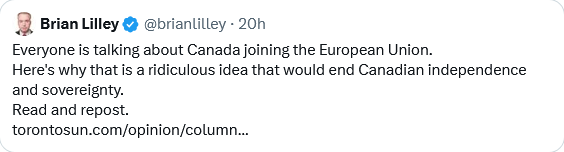
Comments Off on Canada joining the EU is a terrible idea
QotD: The decline of cities in the late western Roman Empire
This was the world the Romans knew and the world they were most comfortable governing. Consequently, while the Romans were utterly uninterested in “civilizing” anyone, when they conquered areas which weren’t urbanized, they tended to found cities or encourage local urbanization in order to create the administrative structures through which the Romans could extract revenue most efficiently.
As mentioned above, the Romans generally wanted these cities to be mostly self-governing. While at conquest, the Romans found themselves managing a bewildering array of different styles of local urban government, over time a mix of Roman administrative preference and cultural diffusion tended to produce a fairly similar set of civic institutions. City governments, which also administered their rural countryside, were run by a town council which consisted of the wealthiest notables of the town – the curiales – in much the same way that the Roman upper-class had dominated the running of the city during the Republic. Roman authority generally protected the curiales and their wealth from the sorts of popular uprisings that tempered many Greek oligarchies in the classical period and in return the curiales managed the population and the collection of taxes for the Romans.
The curiales both managed the town affairs and were also expected to use their own wealth to fund public activity and works: maintain temples and baths, fund religious rituals and festivals, and so on. Through the first and second century, that process was mostly responsible for providing the cities of the Roman Empire with the impressive collection of often still-visible public works they boasted: baths, theaters, amphitheaters, aqueducts, temples, courthouses, public spaces and so on. While some of these structures were little more than the public posturing of the elites, many of them were open to the general public and will have represented, in as much as anything before the industrial revolution could, meaningful improvements in the lives of regular people.
While most of the wealth of any of these cities was derived from the rents and taxes extracted from their agricultural hinterlands, these cities also substantially lived off of trade and markets. Because the local city typically housed the local market, they were the obvious point for local products to enter the stream of provincial-wide or empire-wide trade or for distant imports to reach their final customers. We’ll come back to this next time when we discuss trade and the economy, but for now I want to note that this trade provided a fair bit of the economic vitality of these cities but also that it did in fact reach down beyond mere luxury goods into the basic staples that even the relatively poor might buy.
The decline and fall of these Roman cities is most extensively described in J.H.W.G. Liebeschuetz’ aptly titled, Decline and Fall of the Roman City (2001). Given his title, as you might imagine, Liebeschuetz is in the “decline and fall” camp, arguing that the classical city which defined the Roman world largely did not survive it. Regional patterns differ, with Liebescheutz identifying three “patterns”: I) Western and Central Anatolia, II) Syria, Palestine and Arabia, III) the west, including North Africa).
We’ll deal with the situation in the east in just a moment, so let’s focus here on the cities of the west, which were at the start generally smaller, less wealthy and generally far younger than those of the east (with some exceptions in Italy). Decline sets in fastest and is most severe in Britain, with the final collapse of the cities coming as early as the 360s, whereas in North Africa, the classical city doesn’t seem to tip into decline until after 400.
While each individual region and indeed each city will have been subject to its own unique conditions, a few basic causes seem to have been active everywhere to some degree. First, the crisis of the third century seems to have fundamentally disrupted empire-wide Roman trade, which then stabilized at a lower level for the fourth century, before declining precipitously in the fifth. That first decline seems to have been somewhat offset by the increased demands of imperial administration and in particular the centralized taxation in-kind and movement of goods which had to move through cities. Peter Brown describes the late Roman state as, “the crude but vigorous pump which had ensured the circulation of goods in an otherwise primitive economy” (The Rise of Western Christendom, 2nd ed., 13). We’ll return to this when we discuss the shape of the economy next time, but for now it works as a crude, but vigorous description of that facet of the late Roman economy.
At the same time, as Liebescheutz describes, the role of the curiales steadily atrophies in the fourth century. On the one hand, much of the authority and power of being on the council was steadily eroded as those functions were pulled upwards into the imperial bureaucracy. At the same time, members of the curial class who sought imperial office could get immunities from the progressively more severe taxation which otherwise often fell on the curiales and so the imperial elite often crowded out the curiales when it came to wealth and prestige in the community. As they lost both control and responsibility for their cities, the curiales‘ investment in public works and monumental architecture also ceased (though local elites do invest in church-building and monastic foundations), leading to the decay of the physical urban centers.
Finally, the warfare of the fifth century had its impact, though as Liebescheutz notes, it cannot be presented as a sole cause simply because many urban areas were already clearly in decline when conflict hit. In the case of Britain, the cities were gone by 420, decades before the arrival of any invaders. Nevertheless, political instability and violence in the fifth century seems to have delivered death-blows to ailing communities, especially in the Balkans and along the Rhine.
The end result was that in the West, urbanism declined severely between the fourth and sixth centuries. Rome, once a city of a million people, collapsed down to a population of just 80,000. Arles, which had been a thriving Roman city with an amphitheater, an aqueduct, a chariot-racing track, a theater and full city walls shrunk so severely that the remains of the city moved inside its amphitheater, repurposing it as a new set of city walls, with the town square in the middle and houses built in the stands. While many towns survived in their new, shrunken and impoverished form, urbanism in Europe outside of the Eastern Roman Empire would largely have to be reinvented during the High Middle Ages, (though with some key institutional survivals from the Roman era and often rising out of the diminished remains of Roman cities). Instead, the society of the early Middle Ages was overwhelmingly rural in both population and focus. If on politics we have a bit of a mix between decline and continuity, when it comes to the cities that made up the old political system, the “decline and fall” knight strikes a clear blow: the system of social organization that characterized the ancient world practically vanished and would have to be redeveloped centuries later. The institutions that had maintained it (like the curiales) largely vanished, replaced in some cases by local “notables” and in other cases by ruralization.
Bret Devereaux, “Collections: Rome: Decline and Fall? Part II: Institutions”, A Collection of Unmitigated Pedantry, 2022-01-28.
Comments Off on QotD: The decline of cities in the late western Roman Empire
April 16, 2026
The EU has managed to revive smuggling as a viable career
We’ve all read reports on how bold and forward-focussed the European Union is, but do we give them equal credit for their diligent efforts to revive dying industries?
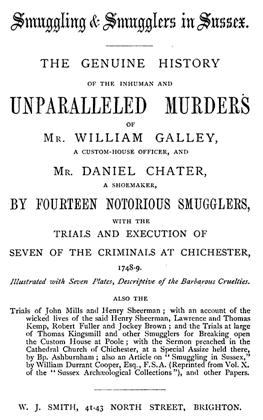
Title page of a book covering the trial of seven smugglers for the murder of two revenue officers. In the preface the author says “I do assure the Public that I took down the facts in writing from the mouths of the witnesses, that I frequently conversed with the prisoners, both before and after condemnation; by which I had an opportunity of procuring those letters which are herein after inserted, and other intelligence of some secret transactions among them, which were never communicated to any other person.”
W.J. Smith, Smuggling and Smugglers in Sussex, 1749, via Wikimedia Commons.
In late March, European Union (E.U.) officials announced they had taken down a five-country cigarette-smuggling operation and seized over 40 tons of tobacco products. The ambitious network reportedly transshipped the cigarettes far and wide to obscure their sources and destinations, while also hiding them in hidden compartments built into cargo containers. Why would smugglers go through such effort to move perfectly legal products, and why would the authorities care? In Europe, as in the United States, the answer is the same: sky-high taxes.
Smuggled Smokes in Hidden Compartments
In announcing its efforts against the smuggling network operating in Italy, France, Poland, Switzerland, and the U.K., the European Public Prosecutor’s Office, which worked with international law enforcement agencies as well as police in all five countries, noted the smugglers used “maritime and commercial routes designed to evade customs inspections”, passed shipments “through Georgia, Kenya, the Netherlands and Turkey, in order to hide the true origin of the illicit goods”, and that “false bottoms were used as hidden compartments built into containers to conceal the tobacco”.
At the conclusion of the investigation, “enforcement activities were carried out at the Port of Genoa, leading to the seizure of close to 41 tonnes of manufactured cigarettes, with an estimated loss of customs duties, excise duties and VAT exceeding €10 million”.
Absolutely nothing motivates government officials like the extraction of taxes from the public. And lots of tax money is at stake when it comes to cigarettes.
Taxes Make Up Most of the Price of Cigarettes
This month, the Tax Foundation, which has a branch in Brussels, reported that “cigarette smokers in the European Union pay far more in excise taxes than they do for the cigarettes themselves”. Report authors Jacob Macumber-Rosin and Adam Hoffer wrote that excise taxes in the E.U., which are intended to deter smoking as much as to raise revenue, start at the equivalent of $2.11 per pack and that the “total excise duty is at least 60 percent of the national weighted average retail price”. Value-added taxes are tallied after excise duties are levied.
“The highest tax in the EU is levied in Ireland at €10.71 ($12.58) per pack of 20 cigarettes, followed by France at €8.09 ($9.51) and the Netherlands at €7.77 ($9.13)”, they added.
Comments Off on The EU has managed to revive smuggling as a viable career


