… in all societies the common people must live to some extent against the existing order. The genuinely popular culture of England is something that goes on beneath the surface, unofficially and more or less frowned on by the authorities. One thing one notices if one looks directly at the common people, especially in the big towns, is that they are not puritanical. They are inveterate gamblers, drink as much beer as their wages will permit, are devoted to bawdy jokes, and use probably the foulest language in the world. They have to satisfy these tastes in the face of astonishing, hypocritical laws (licensing laws, lottery acts, etc., etc.) which are designed to interfere with everybody but in practice allow everything to happen. Also, the common people are without definite religious belief, and have been so for centuries. The Anglican Church never had a real hold on them, it was simply a preserve of the landed gentry, and the Nonconformist sects only influenced minorities. And yet they have retained a deep tinge of Christian feeling, while almost forgetting the name of Christ. The power-worship which is the new religion of Europe, and which has infected the English intelligentsia, has never touched the common people. They have never caught up with power politics. The “realism” which is preached in Japanese and Italian newspapers would horrify them. One can learn a good deal about the spirit of England from the comic coloured postcards that you see in the windows of cheap stationers’ shops. These things are a sort of diary upon which the English people have unconsciously recorded themselves. Their old-fashioned outlook, their graded snobberies, their mixture of bawdiness and hypocrisy, their extreme gentleness, their deeply moral attitude to life, are all mirrored there.
The gentleness of the English civilization is perhaps its most marked characteristic. You notice it the instant you set foot on English soil. It is a land where the bus conductors are good-tempered and the policemen carry no revolvers. In no country inhabited by white men is it easier to shove people off the pavement. And with this goes something that is always written off by European observers as “decadence” or hypocrisy, the English hatred of war and militarism. It is rooted deep in history, and it is strong in the lower-middle class as well as the working class. Successive wars have shaken it but not destroyed it. Well within living memory it was common for “the redcoats” to be booed at in the streets and for the landlords of respectable public-houses to refuse to allow soldiers on the premises. In peace-time, even when there are two million unemployed, it is difficult to fill the ranks of the tiny standing army, which is officered by the country gentry and a specialized stratum of the middle class, and manned by farm labourers and slum proletarians. The mass of the people are without military knowledge or tradition, and their attitude towards war is invariably defensive. No politician could rise to power by promising them conquests or military “glory”, no Hymn of Hate has ever made any appeal to them. In the last war the songs which the soldiers made up and sang of their own accord were not vengeful but humorous and mock-defeatist. The only enemy they ever named was the sergeant-major.
George Orwell, “The Lion And The Unicorn: Socialism and the English Genius”, 1941-02-19.
November 26, 2021
QotD: English working class culture
November 25, 2021
History of Venice: Rise to Glory
Epic History TV
Published 14 Dec 2018Listen to or download the music HERE: smarturl.it/epichistoryvenice
Music by https://www.musicdesigngroup.comThanks to Elias Tsiantas for the 3D Venetian galley footage
Thanks to Miłek Jakubiec for the Battle of Marignano imageSupport the channel & get exclusive previews at Patreon:
https://www.patreon.com/epichistorytvWant to learn more? We recommend A History of Venice by the late John Julius Norwich, a great popular historian on all things Mediterranean (as an Amazon Associate I earn from qualifying purchases): http://geni.us/7q71zx
#EpicHistoryTV #HistoryofVenice

November 24, 2021
The Marshall Plan
The Cold War
Published 6 Jul 2019Our series on the history of the Cold War period continues with a documentary on the Marshall Plan and how the USA was able to help in the rebuild of the post-War World and gained valuable allies while doing it
Consider supporting us on Patreon: https://www.patreon.com/thecoldwar

Tank Chats #133 | Renault UE Chenillette | The Tank Museum
The Tank Museum
Published 6 Aug 2021In this weeks Tank Chat, Curator David Willey talks about the Renault UE Chenillette. A light tracked armoured carrier produced by France between 1932 and 1940.
(more…)
November 23, 2021
Canadian Army Newsreel – Baby Flat-Tops Protect Convoys
canmildoc
Published 18 Nov 2012Newsreels shot between 1940 and 1946 by the Canadian Army Film Unit for presentation to servicemen and women. A unique document of Canada’s role in the war on the front lines as well as on the home front.
Tags: Canadian Army Film Unit, Canadian Army, war, World War II, front lines, home front, servicemen, servicewomen, newsreel, military, WWII

November 22, 2021
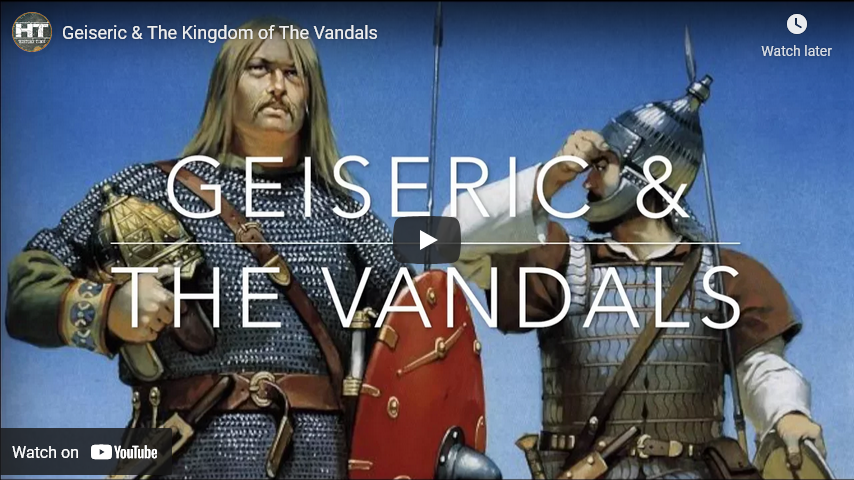
Geiseric & The Kingdom of The Vandals
History Time
Published 5 Sep 2017A brief look at Geiseric and the Vandals
Further reading:-
Edward Gibbon, The Decline and Fall of the Roman Empire
Walter Goffart, Barbarian & Romans
Peter Heather, The Fall of the Roman Empire
Andrew Merrills, The VandalsMusic:-
Morning Light – “Deep Thoughts” https://www.youtube.com/watch?v=1tXOL…
Peter Gundry – “Víðbláinn” https://www.youtube.com/watch?v=ZnCML…
Kevin MacLeod – “Ossuary 2: Turn” https://www.youtube.com/watch?v=e6jZS…If you liked this video and have as little as a dollar to spare then please consider supporting me on Patreon for more and better content in the future:-
http://www.patreon.com/historytimeUKAre you a budding artist, illustrator, cartographer, or music producer? Send me a message! No matter how professional you are or even if you’re just starting out, I can always use new music and images in my videos. Get in touch! I’d love to hear from you.
I’ve also compiled a reading list of my favourite history books via the Amazon influencer program. If you do choose to purchase any of these incredible sources of information, many of which form the basis of my videos, then Amazon will send me a tiny fraction of the earnings (as long as you do it through the link) (this means more and better content in the future) I’ll keep adding to and updating the list as time goes on — https://www.amazon.com/shop/historytime
I try to use copyright-free images at all times. However if I have used any of your artwork or maps then please don’t hesitate to contact me and I’ll be more than happy to give the appropriate credit.
—Join the History Time community on social media:-
Patreon — https://www.patreon.com/historytimeUK
Instagram — https://www.instagram.com/historytime…
Twitter — https://twitter.com/HistoryTimePete
A new study may show that “Justinian’s plague” reached Britain before Constantinople
Instapundit linked to a news release on a recent Cambridge study on the plague which devastated the Byzantine Empire during the reign of Justinian I, but which may have come through an as-yet undiscovered northern European path that reached the British Isles well before appearing within the Eastern Roman territories:
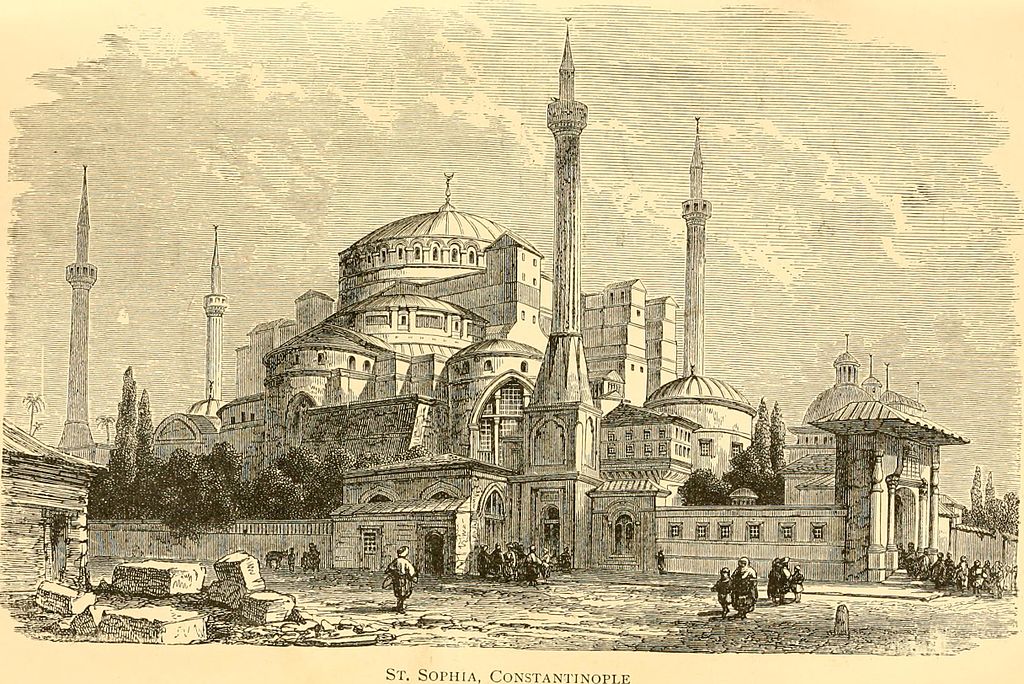
Illustration of the Hagia Sophia from European History: An outline of its development by George Burton Adams, 1899.
Wikimedia Commons
“Plague sceptics” are wrong to underestimate the devastating impact that bubonic plague had in the 6th–8th centuries CE, argues a new study based on ancient texts and recent genetic discoveries.
The same study suggests that bubonic plague may have reached England before its first recorded case in the Mediterranean via a currently unknown route, possibly involving the Baltic and Scandinavia.
The Justinianic Plague is the first known outbreak of bubonic plague in west Eurasian history and struck the Mediterranean world at a pivotal moment in its historical development, when the Emperor Justinian was trying to restore Roman imperial power.
For decades, historians have argued about the lethality of the disease; its social and economic impact; and the routes by which it spread. In 2019-20, several studies, widely publicised in the media, argued that historians had massively exaggerated the impact of the Justinianic Plague and described it as an “inconsequential pandemic”. In a subsequent piece of journalism, written just before COVID-19 took hold in the West, two researchers suggested that the Justinianic Plague was “not unlike our flu outbreaks”.
In a new study, published in Past & Present, Cambridge historian Professor Peter Sarris argues that these studies ignored or downplayed new genetic findings, offered misleading statistical analysis and misrepresented the evidence provided by ancient texts.
Sarris says: “Some historians remain deeply hostile to regarding external factors such as disease as having a major impact on the development of human society, and ‘plague scepticism’ has had a lot of attention in recent years.”
Sarris, a Fellow of Trinity College, is critical of the way that some studies have used search engines to calculate that only a small percentage of ancient literature discusses the plague and then crudely argue that this proves the disease was considered insignificant at the time.
Sarris says: “Witnessing the plague first-hand obliged the contemporary historian Procopius to break away from his vast military narrative to write a harrowing account of the arrival of the plague in Constantinople that would leave a deep impression on subsequent generations of Byzantine readers. That is far more telling than the number of plague-related words he wrote. Different authors, writing different types of text, concentrated on different themes, and their works must be read accordingly.”
History of Wine: Ancient Rome
History of Wine
Published 20 Apr 2014How was wine was made in Ancient Rome?
What did wine taste like in Ancient Rome?
Convivium and customs of drinking.
Wine Tasting.

November 21, 2021
The Red Army Kicks Ass – Operation Uranus! – WW2 – 169 – November 20th, 1942
World War Two
Published 20 Nov 2021After months of stubborn defense the time has finally come for the Soviet counterstroke, but is it in time to save Stalingrad? And can the Allies reach Tunis and take all of North Africa before the Axis can reinforce?
(more…)
SA80 History: XL60 Series in 4.85mm
Forgotten Weapons
Published 10 May 2017Armament Research Services (ARES) is a specialist technical intelligence consultancy, offering expertise and analysis to a range of government and non-government entities in the arms and munitions field. For detailed photos of the guns in this video, don’t miss the ARES companion blog post:
http://armamentresearch.com/british-e…
Once the basic configuration of the new British rifle was determined, the next step was to build a series of prototypes. The design that took form was basically a bullpup copy of the Armalite AR-18. The design team at Enfield were mostly senior draftsmen, with virtually no firearms experience among them. To make things worse, most of the design team was regularly rotated onto other projects, preventing them from developing any project experience on the rifle.
Several prototype batches were made (typically of a dozen guns each, both IWs and LSWs), all in the unique British 4.85x49mm cartridge, with a variety of different feature sets. Through the different patterns, configurations would change on the safety (push button vs lever) fire selector (push button vs lever), and magazine catch (straight-in side lever vs rock-in side lever vs rock-in rear paddle). At this time, plans still existed to make both left- and right-handed versions of the final gun, so prototypes of both were manufactured.
Because cost-cutting measures had not yet been forced on the project, these XL-60 series guns were generally reliable, at least in normal conditions. They are quite comfortable to fire, with a cartridge very similar to the 5.56mm NATO in practical terms. There is nothing particularly wrong with that cartridge, but it would be dropped when it lost NATO trials to the Belgian SS109 … but we will address that in the next episode of the SA80 history.
http://www.patreon.com/ForgottenWeapons
Cool Forgotten Weapons merch! http://shop.bbtv.com/collections/forg…
If you enjoy Forgotten Weapons, check out its sister channel, InRangeTV! http://www.youtube.com/InRangeTVShow

QotD: Britain’s middle class after WW1
England is a country in which property and financial power are concentrated in very few hands. Few people in modern England own anything at all, except clothes, furniture and possibly a house. The peasantry have long since disappeared, the independent shopkeeper is being destroyed, the small business-man is diminishing in numbers. But at the same time modern industry is so complicated that it cannot get along without great numbers of managers, salesmen, engineers, chemists and technicians of all kinds, drawing fairly large salaries. And these in turn call into being a professional class of doctors, lawyers, teachers, artists, etc., etc. The tendency of advanced capitalism has therefore been to enlarge the middle class and not to wipe it out as it once seemed likely to do.
But much more important than this is the spread of middle-class ideas and habits among the working class. The British working class are now better off in almost all ways than they were thirty years ago. This is partly due to the efforts of the Trade Unions, but partly to the mere advance of physical science. It is not always realized that within rather narrow limits the standard of life of a country can rise without a corresponding rise in real-wages. Up to a point, civilization can lift itself up by its boot-tags. However unjustly society is organized, certain technical advances are bound to benefit the whole community, because certain kinds of goods are necessarily held in common. A millionaire cannot, for example, light the streets for himself while darkening them for other people. Nearly all citizens of civilized countries now enjoy the use of good roads, germ-free water, police protection, free libraries and probably free education of a kind. Public education in England has been meanly starved of money, but it has nevertheless improved, largely owing to the devoted efforts of the teachers, and the habit of reading has become enormously more widespread. To an increasing extent the rich and the poor read the same books, and they also see the same films and listen to the same radio programmes. And the differences in their way of life have been diminished by the mass-production of cheap clothes and improvements in housing. So far as outward appearance goes, the clothes of rich and poor, especially in the case of women, differ far less than they did thirty or even fifteen years ago. As to housing, England still has slums which are a blot on civilization, but much building has been done during the past ten years, largely by the local authorities. The modern council house, with its bathroom and electric light, is smaller than the stockbroker’s villa, but it is recognizably the same kind of house, which the farm labourer’s cottage is not. A person who has grown up in a council housing estate is likely to be – indeed, visibly is – more middle class in outlook than a person who has grown up in a slum.
George Orwell, “The Lion And The Unicorn: Socialism and the English Genius”, 1941-02-19.
November 20, 2021
Modern navigation aids compared
In common with most people in this age of pandemic, I don’t travel very much these days. Back when I did manage to get out and about on the roads, I had an early Garmin GPS device in my vehicle and when I eventually updated the sound system in my truck to a new device, it included a built-in GPS (that constantly “loses” satellite fixes and loudly informs me, even when I’m not using the mapping function). I’ve had both good and bad experiences with these devices, but Alistair Dabbs is much more entertaining with his story:
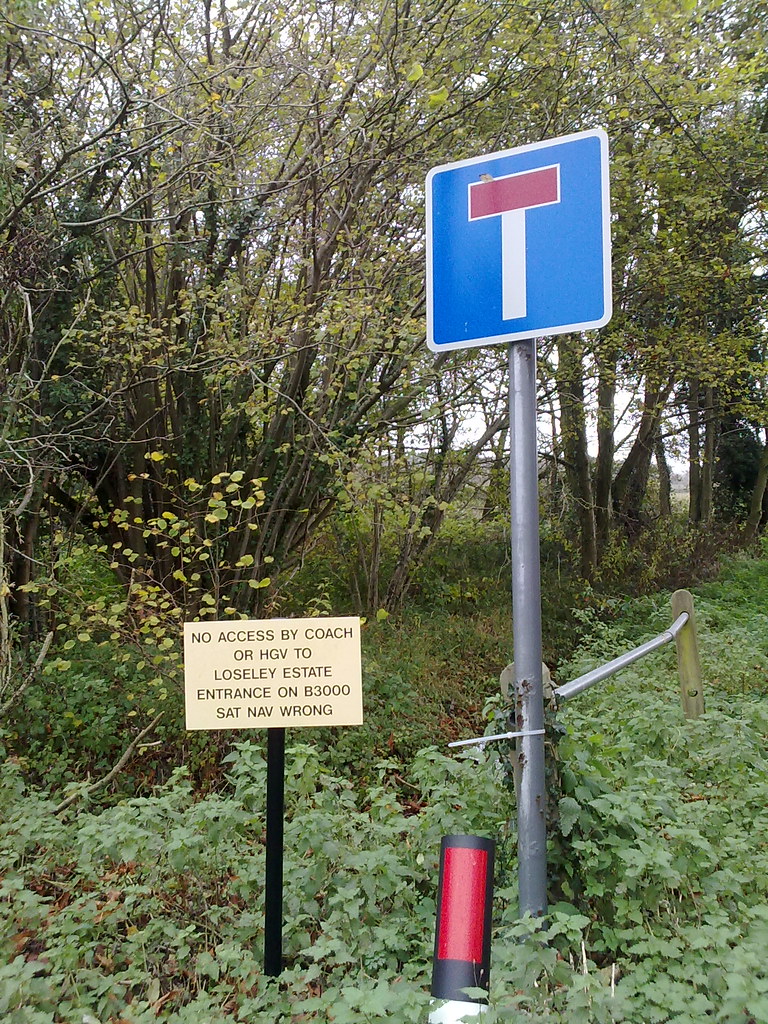
“Sat Nav FAIL” by J-o-n-o is licensed under CC BY-SA 2.0


Turn left. Turn right. At the roundabout, take the fourth exit.
Nobody enjoys being told what to do all the time but in the case of Google Maps I will make an exception. What I like about it best is that I can ignore her directions – should dissent take my fancy – and she doesn’t get cross.
This is in sharp contrast with all the classic sat-navs I have ever used, including the one embedded permanently into my current vehicle. Not only does it have a penchant for taking me on pointlessly circuitous routes, the wrong way up one-way streets, and along shortcuts too narrow for a bicycle, it grows angrier by the second when I refuse its orders.
“Turn right, turn right, turn right, turn left,” it would yell at increasing volume, trying to browbeat me into making a U-turn. Well no, I don’t want to drive through that building site or weave between those ambulances and fire engines dealing with that overturned lorry. Can’t you take me on an alternative route?
“Recalculating …” it would bark like a sulking dalek, but never accomplishing such. “Recalculating … Recalculating …”
Clearly I am not the only reluctant motorist to have given up on traditional sat-navs: not a single ad for one of these has turned up in my Black Friday spam deluge this year. And good riddance. Of the £3m per minute spent by Brits on their Black Friday shopping, roughly £0 will be spent on in-car nags.
Google Maps is more chilled. It’s as if she has resigned herself to my penchant for taking the wrong exits and missing turns. This is a habit I acquired by trying too hard not to drive like my father, who would obey every instruction from his sat-nav with military immediacy. As soon as he heard the words “Turn left”, he’d turn hard on the steering wheel straight away and we’d find ourselves heading up someone’s front drive, into an underground office car park or across a pedestrianised shopping walkway.
Me, I prefer to wait a bit – maybe a bit too long. Google Maps doesn’t mind and gives me no grief. Perhaps she also recognises her own faults in occasionally trying to direct me to drive through bricked-up entrances and children’s playgrounds. “Pff, whatever,” she probably thinks. “He’s too thick to follow the normal route. Let’s try a longer one.”
The odd thing is that she talks to Mme D in a very different way. On her smartphone, Google Maps is, well, chatty.
While all I get is a functional “Turn left/right” or “In 300 metres take the slip-road,” Mme D is treated to a tirade of verbosity. “Move into the filter lane and turn left at the next traffic lights heading north-northwest into B3496 Lower High Street but keep to the right to avoid the turnoff, mind the pedestrian crossing and wave hello to the butcher on the corner …” it spews, one directive tumbling into the next in a single continuous description of the journey and all its finest details.
DicKtionary – M is for Mathematics – Newton and Hooke
TimeGhost History
Published 19 Nov 2021Today we turn away from killers and sociopathic rulers and look at two men from the world of science. Isaac Newton and Robert Hooke were certainly very intelligent and creative, but were they dicks as well?
(more…)
Meet The Last Artisans Making Traditional Bagpipes By Hand In Scotland’s Capital | Still Standing
Business Insider
Published 2 Jul 2021Bagpipes have been a symbol of Scottish heritage for centuries, but traditional artisans have faced stiff competition with the rise of mass manufacturing. Kilberry Bagpipes is now the last workshop in the capital city of Edinburgh where they still make them by hand.
For more information, visit:
https://kilberrybagpipes.com/——————————————————
#Bagpipes #Scotland #BusinessInsider
Business Insider tells you all you need to know about business, finance, tech, retail, and more.
Visit us at: https://www.businessinsider.com
BI on Instagram: https://read.bi/2Q2D29T
BI on Twitter: https://read.bi/2xCnzGF
BI on Amazon Prime: http://read.bi/PrimeVideoMeet The Last Artisans Making Traditional Bagpipes By Hand In Scotland’s Capital | Still Standing
From the comments:
Kilberry Bagpipes
1 month ago
It was a pleasure having you guys in to film with us! Thank you for putting together such a fantastic video illustrating what we do and why we do it! If anyone has any further questions or is keen to learn to play then please feel free to email us where we will be happy to help!All the best,
Dave and Ruari
The Kilberry Team

November 19, 2021
Bismarck Gets Closer To German Unification – A New Spanish King I GLORY & DEFEAT
Real Time History
Published 18 Nov 2021Sign up for Curiosity Stream and get Nebula bundled in and SAVE 26%: https://curiositystream.com/realtimeh…
While the Franco-Prussian War is continuing its messy guerilla phase, the German leaders are negotiating towards a united Germany. Hesse and Baden join the promptly renamed German Confederation — but Württemberg and Bavaria still want more concessions. Meanwhile the question of Spanish succession that started the war is solved in Madrid.
» THANK YOU TO OUR CO-PRODUCERS
John Ozment
James Darcangelo
Jacob Carter Landt
Thomas Brendan
James Giliberto
Kurt Gillies
Albert B. Knapp MD
Tobias Wildenblanck
Richard L Benkin
Scott Deederly
John Belland
Adam Smith
Taylor Allen
Jim F Barlow
Rustem Sharipov» OUR PODCAST
https://realtimehistory.net/podcast – interviews with historians and background info for the show.» LITERATURE
Arand, Tobias: 1870/71. Der Deutsch-Französische Krieg erzählt in Einzelschicksalen. Hamburg 2018Gouttman, Alain: La grande défaite. 1870-1871. Paris 2015
Koch, Roland : “Les canons à balles dans l’armée du Rhin en 1870” in Revue historique des armées, 255 (2009), p. 95-107.
» SOURCES
Braun, Lily (Hrsg): Kriegsbriefe aus den Jahren 1870/71 von Hans von Kretschman weiland General der Infanterie. Berlin 1911Carr, Raymond: Spain 1808–1939. Oxford: At the Clarendon Press, 1975
Deuerlein, Ernst: Die Gründung des Deutschen Reichs 1870/71 in Augenzeugenberichten. Düsseldorf 1970
Goncourt, Edmond de: Journal des Goncourts. II.1. 1870-1871. Paris 1890
Kühnhauser, Florian: Kriegs-Erinnerungen eines Soldaten des königlich bayerischen Infanterie Leibregiments. Partenkirchen 1898
Lowndes, Emma: Récits de femmes pendant la guerre franco-prussienne (1870-1871). Paris, 2013.
Meisner, Heinrich Otto (Hrsg.): Kaiser Friedrich III. Das Kriegstagebuch von 1870/71. Berlin, Leipzig 1926
N.N: + Amadeus von Savoyen in: Neue Presse v. 19. Januar 1890. S. 2
N. N. (Hrsg.): Bismarcks Briefe an seine Gattin aus dem Kriege 1870/71. Stuttgart, Berlin 1903
Schikorsky, Isa (Hrsg.). “Wenn doch dies Elend ein Ende hätte”. Ein Briefwechsel aus dem Deutsch-Französischen Krieg 1870/71. Köln, Weimar, Wien 1999
» OUR STORE
Website: https://realtimehistory.net»CREDITS
Presented by: Jesse Alexander
Written by: Cathérine Pfauth, Prof. Dr. Tobias Arand, Jesse Alexander
Director: Toni Steller & Florian Wittig
Director of Photography: Toni Steller
Sound: Above Zero
Editing: Toni Steller
Motion Design: Philipp Appelt
Mixing, Mastering & Sound Design: http://above-zero.com
Maps: Battlefield Design
Research by: Cathérine Pfauth, Prof. Dr. Tobias Arand
Fact checking: Cathérine Pfauth, Prof. Dr. Tobias ArandChannel Design: Battlefield Design
Contains licensed material by getty images
All rights reserved – Real Time History GmbH 2021