
Tasting History with Max Miller
Published 16 Aug 2022
(more…)
January 10, 2023
Catherine the Great & the Volga Germans
Comments Off on Catherine the Great & the Volga Germans
January 8, 2023
The (historical) lure of London
In the latest Age of Invention newsletter, Anton Howes considers the puzzle that was the phenomenol growth of London, even at a time that England had a competitive advantage in agricultural exports to the continent:
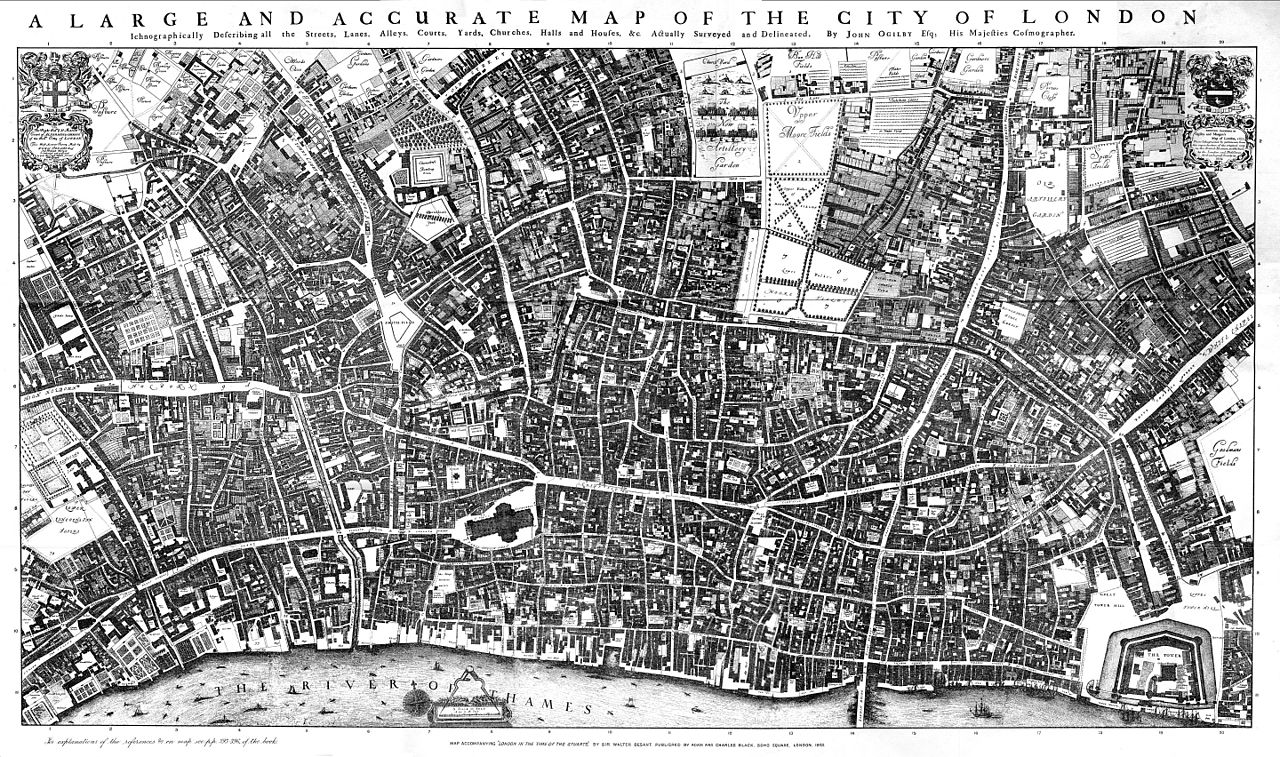
Ogilby & Morgan’s Map of London, 1677.
Scanned copy of reproduction in Maps of Old London (1908).
… the extraordinary inflow of migrants to London in the period when it grew eightfold — from an unremarkable city of a mere 50,000 souls in 1550, to one of the largest cities in Europe in 1650, boasting 400,000. I’ve written about that growth a few times before, especially here. It may not sound like much today, but it has to be one of the most important facts in British economic history. It is, in my view, the first sign of an “Industrial Revolution”, and certainly the first indication that there was something economically weird about England. It requires proper explanation.
In brief, the key question is whether the migrants to London — almost all of whom came from elsewhere in England — were pushed out of the countryside, thrown off their land thanks to things like enclosure, or pulled by London’s attractions.
I think the evidence is overwhelmingly that they were pulled and not pushed:
- The English rural population continued to grow in absolute terms, even if a larger proportion of the total population made their way to London. The population working in agriculture swelled from 2.1 million in 1550 to about 3.3 million in 1650. Hardly a sign of widespread displacement.
- As for the people outside of agriculture, many remained in or even fled to the countryside. In the 1560s, for example, York’s textile industry left for the countryside and smaller towns, pursuing lower costs of living and perhaps trying to escape the city’s guild restrictions. In 1550-1650, the population engaged in rural industry — largely spinning and weaving in their homes — swelled from about 0.7 to 1.5 million. Again, it doesn’t exactly suggest rural displacement. If anything, the opposite.
- There were in fact large economic pressures for England to stay rural. England for the entire period was a net exporter of grain, feeding the urban centres of the Netherlands and Italy. The usual pattern for already-agrarian economies, when faced with the demands of foreign cities, is to specialise further — to stay agrarian, if not agrarianise more. It’s what happened in much of the Baltic, which also fed the Dutch and Italian cities. Despite the same pressures for England to agrarianise, however, London still grew. To my mind, it suggests that London had developed an independent economic gravity of its own, helping to pull an ever larger proportion of the whole country’s population out of agriculture and into the industries needed to supply the city.
- As for the supposed push factor, enclosure, the timing just doesn’t fit. Enclosure had been happening in a piecemeal and often voluntary way since at least the fourteenth century. By 1550, before London’s growth had even begun, by one estimate almost half of the country’s total surface had already been enclosed, with a further quarter gradually enclosed over the course of the seventeenth century. A more recent estimate suggests that by 1600 already 73% of England’s land had been enclosed. As for the small remainder, this was mopped up by Parliament’s infamous enclosure acts from the 1760s onwards — much too late to explain London’s population explosion.
- Perhaps most importantly, people flocked specifically to London. In 1550 only about 3-4% of the population lived in cities. By 1650, it was 9%, a whopping 85% of whom lived in London alone. And this even understates the scale of the migration to the city, because so many Londoners were dropping dead. It was full of disease in even a good year, and in the bad it could lose tens of thousands — figures equivalent or even larger than the entire populations of the next largest cities. Waves upon waves of newcomers were needed just to keep the city’s population stable, let alone to grow it eightfold. In the seventeenth century the city absorbed an estimated half of the entire natural increase in England’s population from extra births. If England’s urbanisation had been thanks to rural displacement, you’d expect people to have flocked to the closest, and much safer, cities, rather than making the long trek to London alone.
It’s this last point that I’ve long wanted to flesh out some more. The further people were willing to trek to London, the more strongly it suggests that the city had a specific pull. I’d so far put together a few dribs and drabs of evidence for this. Whereas towns like Sheffield drew its apprentices from within a radius of about twenty miles, London attracted young people from hundreds of miles away, with especially many coming from the midlands and the north of England. Indeed, London’s radius seems to have shrunk over the course of the seventeenth century, suggested that they came from further afield during the initial stages of growth. Records of court witnesses also suggest that only a quarter of men in some of London’s eastern suburbs were born in the city or its surrounding counties.
Comments Off on The (historical) lure of London
“Russians 27 miles from Poland!” – Ep 228 – January 7, 1944
World War Two
Published 7 Jan 2023That’s what the headlines say as the Red Army continues its advance in Ukraine. There are also plans afoot for a northern offensive to end the siege of Leningrad. There are also plans afoot for an Allied amphibious attack in Italy at Anzio. Both of these are set to go off within a couple weeks, so January promises to be full of active conflict.
(more…)
Comments Off on “Russians 27 miles from Poland!” – Ep 228 – January 7, 1944
Caesar Salad and Satan’s Playground
The History Guy: History Deserves to Be Remembered
Published 7 Sep 2022The rare example of a food fad that has maintained its popularity, the tangy dressing on romaine lettuce salad has a history as rich as a coddled egg, involving multiple nations, a bevy of movie stars, an infamous American divorcee, a disputed origin story, and, prominently, alcohol. And, perhaps surprising to many, is unrelated to the notorious Roman dictator.
(more…)
Comments Off on Caesar Salad and Satan’s Playground
January 7, 2023
Converting the Lebel to 7.5mm: The M27 Lebel
Forgotten Weapons
Published 12 Dec 2017In the aftermath of World War One, the French military instituted a plan to introduce a completely new roster of small arms. This would begin with the development of a modern rimless rifle cartridge, which was adopted in 1924. With the new cartridge in hand, programs were begun to develop a light machine gun, bolt action rifle, and semiautomatic rifle using it. To supplement these new arms — especially during their development and production — plans were also made to convert existing 8mm rifles to the new cartridge.
The two rifles in large supply, of course, were the Lebel and the Berthier. The St Etienne arsenal was tasked with developing a Berthier conversion (this would become the M34 Berthier), and the Tulle arsenal was assigned to do the same with the Lebel. The first prototype was ready for testing in 1927. That first example was not satisfactory, and iterative development would continue into the early 1930s. Ultimately, the Lebel conversion was simply not as well liked by troops or as effective as the M34 Berthier, and so the Berthier was chosen for mass production. A total of about 1500 Lebel M27 conversions would be made by 1940, in a wide variety of configurations including different barrel lengths, rifling patterns, and optics mounting setups. While this did not result in a successful production rifle, it would inform the development of the MAS-36, and not go to waste. In addition, a number of M27 rifles would be converted into pressure testing guns to assist in ammunition development.
(more…)
Comments Off on Converting the Lebel to 7.5mm: The M27 Lebel
QotD: The “camp followers” of a pre-modern army
It is worth keeping in mind that an army of 10,000 or 20,000 men was, by ancient or medieval standards, a mid-sized town or city moving across the landscape. Just as towns and cities created demand for goods that shaped life around them, so did armies (although they’d have to stay put to create new patterns of agriculture, though armies that did stay put did create new patterns of agriculture, e.g. the Roman limes). Thousands of soldiers demand all sorts of services and often have the money to pay for them and that’s in addition to what the army as an army needs. That in turn is going to mean that the army is followed by a host of non-combatants, be they attached to the soldiers, looking to turn a profit, or compelled to be there.
We can start with sutlers, merchants buying or selling from the soldiers themselves (the Romans called these fellows lixae, but also called other non-soldiers in the camp lixae as well, see Roth (2012), 93-4; they also call them mercatores or negotiatores, merchants). Sutlers could be dealing in a wide array of goods. Even for armies where ration distribution was regular (e.g. the Roman army), sutlers might offer for sale tastier and fancier rations: meat, better alcohol and so on. They might also sell clothing and other goods to soldiers, even military equipment: finding “custom” weapons and armor in the archaeology of military forts and camps is not uncommon. For less regularly rationed armies, sutlers might act as a supplement to irregular systems of food and pay, providing credit to soldiers who purchased rations to make up for logistics shortfalls, to collect when those soldiers were paid. By way of example, the regulations of the Army of Flanders issued in 1596 allowed for three sutlers per 200-man company of troops (Parker, op. cit.), but the actual number was often much higher and of course those sutlers might also have their own assistants, porters, wagons and so on which moved with the army’s camp. Women who performed this role in the modern period are often referred to by the French vivandière.
For some armies there would have been an additional class of sutlers: slave dealers. Enslaved captives were a major component of loot in ancient warfare and Mediterranean military operations into and through the Middle Ages. Armies would abduct locals caught in hostile lands they moved through or enemies captured in battles or sieges; naturally generals did not want to have to manage these poor folks in the long term and so it was convenient if slave-dealer “wholesalers” were present with the army to quickly buy the large numbers of enslaved persons the army might generate (and then handle their transport – which is to say traffic them – to market). In Roman armies this was a regularized process, overseen by the quaestor (an elected treasury official who handled the army’s finances) assigned to each army, who conducted regular auctions in the camp. That of course means that these slave dealers are not only following the army, but are doing so with the necessary apparatus to transport hundreds or even thousands of captives (guards, wagons, porters, etc.).
And then there is the general category of “camp follower”, which covers a wide range of individuals (mostly women) who might move with the camp. The same 1596 regulations that provided for just three sutlers per 200-man Spanish company also provided that there could be three femmes publiques (prostitutes), another “maximum” which must often have been exceeded. But prostitutes were not the only women who might be with an army as it moved; indeed the very same regulations specify that, for propriety’s sake, the femmes publiques would have to work under the “disguise of being washerwomen or something similar” which of course implies a population of actual washerwomen and such who also moved with the army. Depending on training and social norms, soldiers may or may not have been expected to mend their own clothes or cook their own food. Soldiers might also have wives or girlfriends with them (who might in turn have those soldier’s children with them); this was more common with professional long-service armies where the army was home, but must have happened with all armies to one degree or another. Roman soldiers in the imperial period were formally, legally forbidden from marrying, but the evidence for “soldier’s families” in the permanent forts and camps of the Roman Empire is overwhelming.
The tasks women attached to these armies have have performed varied by gender norms and the organization of the logistics system. Early modern gunpowder armies represent some of the broadest range of activities and some of the armies that most relied on women in the camp to do the essential work of maintaining the camp; John Lynn (op. cit., 118-163) refers to the soldiers and their women (a mix of wives, girlfriends and unattached women) collectively as “the campaign community” and it is an apt label when thinking about the army on the march. As Lynn documents, women in the camp washed and mended clothes, nursed the sick and cooked meals, all tasks that were considered at the time inappropriate for men. Those same women might also be engaged in small crafts or in small-scale trade (that is, they might also be sutlers). Finally, as Lynn notes, women who were managing food and clothing seem often to have become logistics managers for their soldiers, guarding moveable property during battles and participating in pillaging in order to scrounge enough food and loot for they and their men to survive. I want to stress that for armies that had large numbers of women in the camp, it was because they were essential to the continued function of the army.
And finally, you have the general category of “servants”. The range of individuals captured by this label is vast. Officers and high status figures often brought either their hired servants or enslaved workers with them. Captains in the aforementioned Army of Flanders seem generally to have had at least four or five servants (called mozos) with them, for instance; higher officers more. But it wasn’t just officers who did this. Indeed, the average company in the Army of Flanders, Parker notes, would have had 20-30 individual soldiers who also had mozos with them; one force of 5,300 Spanish veterans leaving Flanders brought 2,000 such mozos as they left (Parker, op. cit. 151).
Looking at the ancient world, many – possibly most – Greek hoplites in citizen armies seem to have very often brought enslaved servants with them to carry their arms and armor; such enslaved servants are a regular feature of their armies in the sources. The Romans called these enslaved servants in their armies calones; it was a common trope of good generalship to sharply restrict their number, often with limited success. At Arausio we are told there were half as many servants (calonum et lixarum) as soldiers (Liv. Per. 67, on this note Roth (2013), 105), though excessive numbers of calones et lixae was a standard marker of bad general and the Romans did lose badly at Arausio so we ought to take those figures with a grain of salt, as Livy (and his sources) may just be communicating that the generals there were bad. That said, the notion that a very badly led army might have as many non-combatants following it as soldiers is a common one in the ancient sources. And while Roman armies were considered notable in the ancient world for how few camp servants they relied on and thus how much labor and portage was instead done by the soldiers, getting Roman aristocrats to leave their vast enslaved household staff at home was notoriously difficult (e.g. Ps.Caes. BAfr. 54; Dio Cass. 50.11.6). Much like the early modern “campaign community”, our sources frequently treat these calones as part of the army they belonged to, even though they were not soldiers.
Bret Devereaux, “Collections: Logistics, How Did They Do It, Part I: The Problem”, A Collection of Unmitigated Pedantry, 2022-07-15.
Comments Off on QotD: The “camp followers” of a pre-modern army
January 6, 2023
Will Stalin Liberate or Occupy Poland? – War Against Humanity 094
World War Two
Published 5 Jan 2023The last week of 1943 is a busy one. Stalin deports the Kalmyk minority from Kalmykia, the escapees from Fort IX get away, and the US President moves to found the post-war UN.
(more…)
Comments Off on Will Stalin Liberate or Occupy Poland? – War Against Humanity 094
The Church of England’s latest attempt to become “relevant”
In Spiked, Gareth Roberts discusses the announcement of Reverend Bingo Allison of themself’s “non-binary” status as the first openly genderqueer individual ordained as a priest in the established church:

Rev. Bingo Allison selfie supplied to the Liverpool Echo.
Many have pinned the beginning of the “Great Awokening” – the transition of the venomous cocktail of extremely niche Tumblr culture and naff identity politics into the mainstream – to 2013. As we move into this 10th anniversary year of raving teenage internet nonsense being taken seriously in the real world by grown adults, perhaps we need a spiritual guide to lead us in our celebrations?
Step forward the Rev Bingo Allison, vicar of a church in a Liverpool suburb, and apparently both “nonbinary” and “genderqueer”. (We do not learn from Bingo’s New Year’s Day interview in the Liverpool Echo if Bingo is actually his – sorry, Them’s – real name-o.)
As ever, working out what the terms nonbinary and genderqueer actually mean is like knitting butter. In the case of the Rev Bingo, it seems from what he says and from the pictorial evidence in the Echo that this has something to do with wearing very, very badly applied cosmetics and regaling anybody silly enough to listen with cut-and-paste boilerplate, like “the history of biblical interpretation is littered with the opinions of rich, white, straight, cisgender, able-bodied, neurotypical men” – basically, ChatGPT with eyeshadow applied à la Black+Decker.
I’ve recently been wondering why so many men with a lady soul are so bad at the application of make-up – both the Rev Bingo and cyclist Emily Bridges seem to have particular difficulty with eyeliner. Applying cosmetics well is not that difficult. In my brief teenage flirtation with the crossover point between New Romantic and Goth, I mastered the art while travelling into London on the very bumpy stretch of the Metropolitan Line between Moor Park and Harrow-on-the-Hill. (It was fatal to even attempt androgyny while still in Hertfordshire, particularly if the end result just made you look like a very camp Herman Munster.) I’m beginning to realise that the wonky slap is an essential part of the non-illusion, of the passive-aggressive, male status display that is at work. It is saying: “I’m not even going to try and you still have to kneel to me.”
“Jesus loves sparkly eyeshadow”, Bingo told his Insta followers recently. I have news for the Rev. Us lads can wear sparkly eyeshadow too with no effect on our bodies or souls. It does not change your sex. It just makes you a man wearing sparkly eyeshadow, like the Sweet doing “Block Buster” on Top of the Pops – although in Bingo’s case there is, owing to a very binary dose of male-pattern baldness, a more marked resemblance to Brian Eno in his Roxy Music days, with a hint of Max Wall in there, too.
Comments Off on The Church of England’s latest attempt to become “relevant”
This is the most interesting roof in London
Tom Scott
Published 5 Sep 2022The @Royal Albert Hall is 150 years old; the roof is 600 tonnes of glass and steel. And it turns out that there’s a terrifying technicians’ trampoline, acoustic-dampening mushrooms, and a complete lack of connections.
(more…)
Comments Off on This is the most interesting roof in London
January 5, 2023
Roman Emperors, Part 8 – Nero: Life and Death
seangabb
Published 20 Dec 2022This is a video record of a lecture given by Sean Gabb, in which he discusses what we can know or suspect about the life of the Emperor Nero. Some criticism here of Tacitus as a reliable source.
The Roman Empire was the last and the greatest of the ancient empires. It is the origin from which springs the history of Western Europe and those nations that descend from Western Europe. It is the political entity within which the Christian faith was born, and the growth of the Church within the Empire, and its eventual establishment as the sole faith of the Empire, have left an indelible impression on all modern denominations. Its history, together with that of the Ancient Greeks and the Jews, is our history. To understand how the Empire emerged from a great though finally dysfunctional republic, and how it was consolidated by its early rulers, is partly how we much understand ourselves.
(more…)
Comments Off on Roman Emperors, Part 8 – Nero: Life and Death
The injustices inherent in “asymmetrical multiculturalism”
Ed West traces the start of “asymmetrical multiculturalism” to a 1916 article in The Atlantic by Greenwich Village intellectual Randolph Bourne and traces the damage that resulted from widespread adoption of the policy:

“Asymmetrical multiculturalism” was first coined by demographer Eric Kaufmann in his 2004 book The Rise and Fall of Anglo-America, and later developed in his more recent Whiteshift, in a chapter charting Bourne’s circle, the “first recognisably modern left-liberal open borders movement”.
Kaufmann wrote how asymmetrical multiculturalism “may be precisely dated” to the article where Bourne, “a member of the left-wing modernist Young Intellectuals of Greenwich Village and an avatar of the new bohemian youth culture,” declared “that immigrants should retain their ethnicity while Anglo-Saxons should forsake their uptight heritage for cosmopolitanism.”
Kaufmann suggested that: “Bourne’s desire to see the majority slough off its poisoned heritage while minorities retained theirs blossomed into an ideology that slowly grew in popularity. From the Lost Generation in the 1920s to the Beats in the ’50s, ostensibly ‘exotic’ immigrants and black jazz were held up as expressive and liberating contrasts to a puritanical, square WASPdom. So began the dehumanizing de-culturation of the ethnic majority that has culminated in the sentiment behind, among other things, the viral hashtag #cancelwhitepeople.”
The hope, as John Dewey said of his New England congregationalist denomination around the same time as Bourne, was that America’s Anglo-Saxon core population would “universalise itself out of existence” while leading the world towards universal civilisation.
These ideas certainly didn’t remain in New England or even the United States, as Britain has certainly seen just how destructive they can be recently:
Late last year I wrote about the tragedy of Telford, a town in the English midlands where huge numbers of young girls had been sexually abused. Telford, along with Rotherham in South Yorkshire, had become synonymous with this form of sexual abuse, mostly committed by men of Kashmiri origin against girls who were poor, white and English.
This is the subject of an upcoming GB News documentary by journalist Charlie Peters, and it is quite clear, from all the various reports, that grooming had been allowed to carry on in part because of the different ways the system treats different groups.
Had the races of the perpetrators and victims been reversed, this tragedy would almost certainly be the subject of countless documentaries, plays, films and even official days of commemoration. But it wouldn’t have come to that, because the authorities would have intervened earlier, and more journalists would have been on the case.
Sex crime is perhaps the most explosive source of conflict between communities, and most recently the 2005 Lozells riots began over such a rumour. It is understandable why journalists and reporters were nervous about this subject; less forgivable is the way that, away from the public eye, those in charge signal how gravely they view what happened.
Until Peters revealed the story, Labour had planned to make the former head of Rotherham council its candidate for Rother Valley; this week Peters revealed that one of the councillors named in a report into the town’s failures to deal with the grooming gangs scandal has gone onto become a senior Diversity & Inclusion Manager working for the NHS. Presumably the people who hired Mahroof Hussain knew about his previous job, and still felt that it was appropriate to have him in a “diversity and inclusion” position. Again, were things different, would a Mr Smith whose council had been condemned for its handling of the gang rape of Asian girls have landed that job? The whole thing seems as morbidly comic as Rotherham becoming Children’s Capital of Culture.
Such a clear inconsistency can only exist because of socially-enforced taboos and norms which have developed over race. In Whiteshift, Kaufmann cited sociologist Kai Erikson’s description of norms as the “accumulation of decisions made by the community over a long time” and that “each time the community censures some act of deviance … it sharpens the authority of the violated norm and re-establishes the boundaries of the group”. Every time an individual is punished for violating the anti-racism norm, it strengthens society’s taboo around the subject, to the point where it begins to overwhelm other moral imperatives.
Then there is regalisation, the name for the process “in which adherents of an ideology use moralistic politics to entrench new social norms and punish deviance”, in Kaufmann’s words. This has proved incredibly effective; after paedophilia or sexual abuse, racism is perhaps the most damaging allegation that can be made.
Few people wish to be accused of deviance, which perhaps explains why Peters’s story has received so little coverage in the press this week. Again, were the roles reversed, it’s not wild speculation to suggest that it would feature on the Today programme, seen as clear evidence of racism at the heart of Britain. When the Telford story broke, it did not even feature on the BBC’s Shropshire home page.
Comments Off on The injustices inherent in “asymmetrical multiculturalism”
Tank Chats #162 | Springer | The Tank Museum
The Tank Museum
Published 2 Sep 2022Join Curator David Willey in his latest Tank Chat as he delves into the Springer, a German demolition vehicle.
(more…)
Comments Off on Tank Chats #162 | Springer | The Tank Museum
January 4, 2023
“Sarajevo” – Assassination of Archduke Franz Ferdinand – Sabaton History 116
Sabaton History
Published 3 Jan 2023Where did the war to end all wars begin? The assassination in Sarajevo may have only killed two, but the repercussions killed millions, destroyed empires, and changed the course of history.
(more…)
Comments Off on “Sarajevo” – Assassination of Archduke Franz Ferdinand – Sabaton History 116
The First Modern Military Rifle: The Modele 1886 Lebel
Forgotten Weapons
Published 5 Dec 2017The Lebel was a truly groundbreaking development in military small arms, being the first rifle to use smokeless powder. This gave it — and in turn the French infantry — a massive advantage in range over everyone else in the world at the time. This advantage was short-lived, but the French did their best to exploit it.
French chemist Paul Vielle successfully developed his smokeless powder (“poudre B“) formula in 1884, and French ordnance spent 1885 experimenting with different calibers of small bore bullet to see what would work best. They also began looking at rifle actions to use, including specifically the Remington-Lee and the Mannlicher. However, a new Minister of War was appointed in January of 1886 and he demanded a completed prototype rifle and ammunition be completed by May 1886. This was a nearly impossibly short deadline to meet, and it meant that the Ordnance officers could not possibly develop a wholly new rifle, and instead would have to modify something already in the inventory.
The only suitable option was the Model 1884/5, a combination of the Gras bolt and Kropatschek tube magazine. The new smokeless cartridge was made by simply necking down the 11mm Gras round, and the 1884 rifle was given a new barrel in 8mm and a new dual-locking-lug bolt head to accommodate the high chamber pressure of the new powder. The result was the Lebel, and it was formally accepted in April 1887 after a relatively short period of testing. The weapon may not have been used the most advanced elements, but it was without any doubt the foremost military rifle in the world at the time, by a substantial margin.
The three main French state arsenals of St Etienne, Chatellerault, and Tulle would all tool up to produce the Lebel, and by the end of 1892 approximately 2.8 million had been produced, enough to equip the entire Army. The rifle would remain in service as France’s primary infantry rifle until World War One, would be declared obsolete in 1920, and remain in inventory and in use until the end of World War Two.
(more…)
Comments Off on The First Modern Military Rifle: The Modele 1886 Lebel


