
World War Two
Published 1 Jan 2023This war is massive. Our chronological coverage helps give us an understanding of it, but sometimes statistics help us understand the bigger picture.
(more…)
January 3, 2023
1943 in Numbers – WW2 Special
Comments Off on 1943 in Numbers – WW2 Special
For the King’s coronation, amp up the pageantry and pomp
In The Critic, Thomas Brian makes the case against a quiet, restrained coronation for King Charles III:
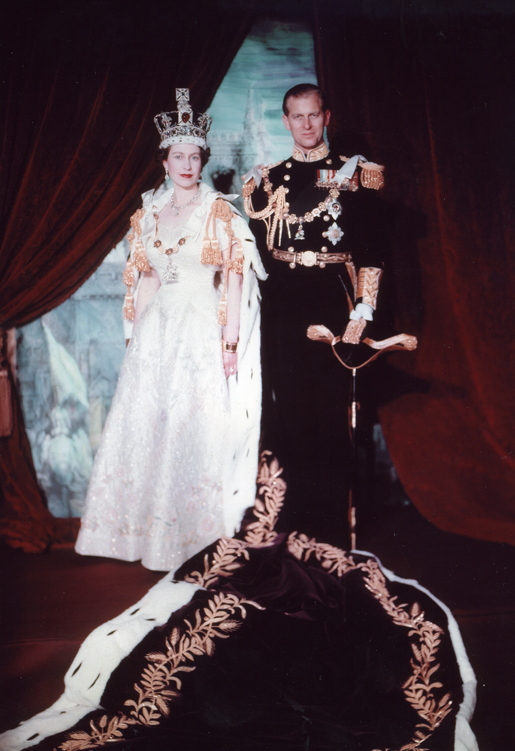
Queen Elizabeth II and Prince Philip, Duke of Edinburgh. Coronation portrait, June 1953, London, England.
Photographed by Cecil Beaton, Public Domain image via Library and Archives Canada reference number DAPDCAP82719.
As surely as the sun rises, the Sisyphean hacks take up their pens. The occasion is the State Opening of Parliament, or some such ceremony, and the audacity of it angers them. A golden throne, polished boots, diamond-encrusted crowns and scarlet cloth. Is it not, they jointly wonder, a bit childish? A bad look? I mean, in 21st century Britain, should we not be more like a grown up country, where all of this procession and pomp and prayer business is left behind? A bit like Germany?
Of course not. Year after year such questions are raised, and year after year, God willing, we shall ignore them. Had you raised this subject with me until this year, I would not be so optimistic. Our country rarely expresses much appreciation for the rich and dignified pageantry that still surrounds so much of our daily life. Yet the unfortunate events of September brought on such an expression of grief, such a wide-eyed fascination and enthusiasm for the ancient rituals of mourning and accession, that I have more faith in Britain knowing and valuing its common heritage. Valued it should be. In an ever more fractious age, what can be more unifying than the binding power of these ceremonies? As we proclaim a new king, we are reminded that the defining feature of “Britishness” is not race or birth, but fealty. Subjects need not have jus soli.
The debunkers denounce such precious things as childish. Even if it were, what shame would it be? The instincts of the child continue to move us with love and wonder. In a letter to the Times last month, a judge described a visit he made to a school where, when he shed the gown and wig, no pupil would believe he was really a judge. In few places is this power of the higher and mystical seen more vividly than in the courtroom. In fact, almost all countries understand this — even grown-up Germany.
When posing as normal people, officials lose their power to move and inspire — whether they wish to inspire trust, or hope, or virtue. States will fail if they are not taken seriously by their subjects. States will not be taken seriously if they do not take themselves seriously. How can we expect any degree of good government, any degree of duty, any degree of seriousness from someone who has so little respect for the service of his country that he thinks its business should be carried out with such casualness that not even a child could be awed into understanding?
For all the virtues of the child, and for all we preserve those adoring childish instincts, it is not we who are childish. That honour goes to the debunker. Perhaps “adolescent” is a better word. These are men who ignore the clear and ready power of the tried and true, the proven, in favour of wordy essays and papers which promise snake oil solutions to the problem of government. What is more a mark of youth than fervour for novel, abstract ideas? What more of a mark of age is love of the proven and experienced? Nothing is more proven, more experienced than the British constitution, with all its pageantry and paraphernalia.
Comments Off on For the King’s coronation, amp up the pageantry and pomp
Debunking the Myths of Leonardo da Vinci
Tasting History with Max Miller
Published 9 Aug 2022
(more…)
Comments Off on Debunking the Myths of Leonardo da Vinci
QotD: Spartan dominance over the Peloponnese
Sparta initially seems to have attempted (Hdt. 1.66-8) to have extended its treatment of Messenia to other parts of the Peloponnese (namely Tegea) in the mid sixth-century – the failure of this policy led to a more measured effort to subjugate the Peloponnese more loosely into a Spartan-lead military league (the Peloponnesian League). This project was never fully completed: Argos – the next largest power in the Peloponnese proper, but a solidly second-tier power compared to Athens, Corinth, Sparta or Thebes – successfully resisted Spartan efforts to dominate it throughout the period. But on the whole, by the late 6th century, Sparta did exert a (perhaps somewhat loose – the trend in scholarship lately has been to stress the plastic and fairly loose organization of the Peloponnesian League) kind of dominance over the Peloponnese.
The core of this control lasted until 371, when Spartan defeat at the Battle of Leuktra shattered this control. Epaminondas, the Theban commander, used the opportunity to free the helots of Messenia and reform them into a polis to provide a local counter-weight to Sparta, while Arcadia and Elis split off from Sparta’s alliance to form their own defensive league against Sparta and, to top it off, a number of the perioikic communities – including the Spartans’ elite light infantry scouts, the Skiritae – along with various borderlands also formed the new polis of Megalopolis on the northern Spartan border – it promptly joined the Arcadian league (this polis would later give us the historian Polybius; his anti-Spartan stance comes out clearly in how he treats Cleomenes III). Sparta, surrounded now by hostile poleis who had once been allies, would spend the rest of Antiquity as a political non-entity, save for one brief effort to restore Spartan greatness in the 220s, crushed by the Macedonian Antigonids who were in no mood to entertain Spartan delusions of grandeur.
We might then say that Sparta is successful – though not entirely so (Argos!) – in establishing a hegemony over the Peloponnese, but only maintains it for c. 175 years. That’s not a bad run, but for the record of a larger state dominating its backyard, it is not tremendously impressive either.
Bret Devereaux, “Collections: This. Isn’t. Sparta. Part VII: Spartan Ends”, A Collection of Unmitigated Pedantry, 2019-09-27.
Comments Off on QotD: Spartan dominance over the Peloponnese
January 2, 2023
An in-depth look at the Type 26 frigate design
Navy Lookout
Published 31 Dec 2022The Type 26 frigates being built for the Royal Navy [and Royal Canadian and Royal Australian navies] are specialist submarine hunters but with a range of other capabilities. This video provides a primer on the overall warship design, its weapons, sensors and decoys.
(more…)
Comments Off on An in-depth look at the Type 26 frigate design
January 1, 2023
The days when just graduating high school was a significant life achievement
At Founding Questions, Severian responds to a reader comment about educational achivement before WW2 (when the US economy was almost the last one standing among major industrialized nations, and high school graduates finally passed 50% of the population):

Proposed coat of arms for Founding Questions by “urbando”.
The Latin motto translates to “We are so irrevocably fucked”.
In the “Friday Questions” post yesterday, toastedposts asks:
I’ve been reading some more old random things (bits of philosophy and history in no particular order with no particular program.) I’m again struck by the impression that people from around 1700 to 1920 or so were noticeably smarter than people before or since. It’s something that seems obtrusive when I read the sort of things they write. Compared to the sullen stupidity and fanatacism of the communists and fellow pseudo-intellectual travellers, compared to the childish level of the propaganda with which people were manipulated post 50s and pre modern, it is striking …
I wonder why the idiocracy? Did all these supergeniuses get killed preferentially in world wars and communist enslavement afterwards? Did something about our culture change disastrously, and can it be reversed? What was in their water, and can I have some?
I’ve seen this myself. You go look at any random letter collection from the 18th or 19th century, and even their “How’s it going? The weather is nice here”-type letters are just smarter …
Or maybe not. I hate to sound like one of those “Education Theory” numbnuts here, but it’s hard to separate what you might call “native intelligence” from “rigorous schooling”. Since we’ve all been on the Internet within the last 30 years, we’ve seen that “This was a fifth grade math test in 1905” thing. Here’s an example published in The Guardian, the paper that all the very Smartest people these days read. I’ll just stick with math and history:
Arithmetic
1. Multiply 642035 by 24506
2. Subtract 3.25741 from 3.3; multiply 28.436 by 8.245; divide 0.86655 by 26.5
3. Simplify 183/4 minus 22/3 divided by 11/5 minus 31/2 multiplied by 4/7
English history
1. What kings of England began to reign in the years 871, 1135, 1216, 1377, 1422, 1509, 1625, 1685, 1727, 1830?
2. Give some account of Egbert, William II, Richard III, Robert Blake, Lord Nelson.
3. State what you know of Henry II’s quarrel with Becket, the taking of Calais by Edward III, the attempt to make Lady Jane Grey queen, the trial of the Seven bishops, the Gordon riots.
I’d have trouble with some of those. Isn’t Robert Blake an actor?
That said, those questions aren’t particularly hard. Muti-digit multiplication is more time-consuming than anything else; it’d look like a Christmas tree, spread across the page. The fact that I can’t do them now (without a refresher course) doesn’t mean I couldn’t do them then. I was taught the process; I’m just rusty. Same thing with English history. The Lady Jane Grey thing … ummm, something something Reformation? But if I’d recently taken a course on it, I’d be much more up on it.
But then again, I was able to grok the process in the first place. “Universal” education is very new, and on balance I’d have to say it’s a negative. A high school diploma was a real achievement almost within living memory. This here table says that high school graduation rates didn’t top 50% until 1940, and didn’t clear 60% until 1950. It used to be a trope in the “rags to riches” story that “So-and-So only had a fifth-grade education”, but in that world, 5th grade was plenty. Even now, 5th graders kinda sorta have the Three Rs. (Adding the fourth R, of course — that would be “Rainbow”, or maybe “rump rangering” — but still).
So the entrance exam for “King Edward’s School” — the example in the Graun article — in 1898 would be the equivalent of a very tough college entrance exam today (and note that the referenced school is very pricey and very, very elite, even now).
This is not to say that people back then weren’t smarter. They sure seem to be, and I’ve written many times that the not-elite but certainly very respectable school that awarded me a PhD in the early 21st century wouldn’t have admitted me as an undergrad as late as 1960, if not 1970. I’m just noting some context — in 1898, 5th graders were already something of an intellectual elite, and their day-to-day education reflected that.
Comments Off on The days when just graduating high school was a significant life achievement
Canadians Take Little Stalingrad – WW2 – 227 – December 31, 1943
World War Two
Published 31 Dec 20221943 reaches its end with no end in sight for the war. In Italy, the Canadians take Ortona after bloody close fighting, the US Marines advance on New Britain, and a new Soviet offensive makes huge gains in the USSR. This isn’t enough for the Allies, though, who have a big shake up in their European Command to help prepare for future attacks.
(more…)
Comments Off on Canadians Take Little Stalingrad – WW2 – 227 – December 31, 1943
December 31, 2022
Coming of the Sea Peoples: Part 6 – Crete and the Minoans
seangabb
Published 6 Jul 2021The Late Bronze Age is a story of collapse. From New Kingdom Egypt to Hittite Anatolia, from the Assyrian Empire to Babylonia and Mycenaean Greece, the coming of the Sea Peoples is a terror that threatens the end of all things. Between April and July 2021, Sean Gabb explored this collapse with his students. Here is one of his lectures. All student contributions have been removed.
(more…)
Comments Off on Coming of the Sea Peoples: Part 6 – Crete and the Minoans
Tour of the AREX Defense Factory in Slovenia
Forgotten Weapons
Published 30 Aug 2022During my visit to Slovenia, I had a chance to tour the AREX Defense factory in Šentjernej. I came away really impressed by the quality and the breadth of operations that the factory performs in-house. They have only been making their own handgun designs for about 5 years, but they have been a subcontractor making parts for other big-name companies (like FN) for decades.
(more…)
Comments Off on Tour of the AREX Defense Factory in Slovenia
December 30, 2022
Stalin Deports An Entire Ethnicity – War Against Humanity 093
World War Two
Published 29 Dec 2022The last week of 1943 is a busy one. Stalin deports the Kalmyk minority from Kalmykia, the escapees from Fort IX get away, and the US President moves to found the post-war UN.
(more…)
Comments Off on Stalin Deports An Entire Ethnicity – War Against Humanity 093
The continued relevance of Orwell’s “Politics and the English Language”
In Quillette, George Case praises Orwell’s 1946 essay “Politics and the English Language” (which was one of the first essays that convinced me that Orwell was one of the greatest writers of the 20th century), and shows how it still has relevance today:
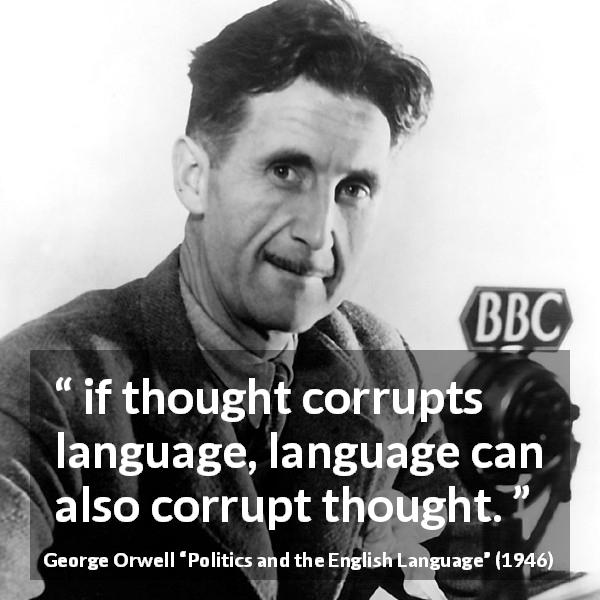
George Orwell’s “Politics and the English Language” is widely considered one of the greatest and most influential essays ever written. First published in Britain’s Horizon in 1946, it has since been widely anthologized and is always included in any collection of the writer’s essential nonfiction. In the decades since its appearance, the article has been quoted by many commentators who invoke Orwell’s literary and moral stature in support of its continued relevance. But perhaps the language of today’s politics warrants some fresh criticisms that even the author of Nineteen Eighty-Four and Animal Farm could not have conceived.
“Politics and the English Language” addressed the jargon, double-talk, and what we would now call “spin” that had already distorted the discourse of the mid-20th century. “In our time,” Orwell argued, “political speech and writing are largely the defence of the indefensible. … Thus political language has to consist largely of euphemism, question-begging and sheer cloudy vagueness. … Political language — and with variations this is true of all political parties, from Conservatives to Anarchists — is designed to make lies sound truthful and murder respectable, and to give an appearance of solidity to pure wind.” Those are the sentences most cited whenever a modern leader or talking head hides behind terms like “restructuring” (for layoffs), “visiting a site” (for bombing), or “alternative facts” (for falsehoods). In his essay, Orwell also cut through the careless, mechanical prose of academics and journalists who fall back on clichés — “all prefabricated phrases, needless repetitions, and humbug and vagueness generally”.
These objections still hold up almost 80 years later, but historic changes in taste and technology mean that they apply to a new set of unexamined truisms and slogans regularly invoked less in oratory or print than through televised soundbites, online memes, and social media: the errors of reason and rhetoric identified in “Politics and the English Language” can be seen in familiar examples of empty platitudes, stretched metaphors, and meaningless cant which few who post, share, like, and retweet have seriously parsed. Consider how the following lexicon from 2023 is distinguished by the same question-begging, humbug, and sheer cloudy vagueness exposed by George Orwell in 1946.
[…]
Climate, [mis- and dis-]information, popular knowledge, genocide, land claims, sexual assault, and racism are all serious topics, but politicizing them with hyperbole turns them into trite catchphrases. The language cited here is largely employed as a stylistic template by the outlets who relay it — in the same way that individual publications will adhere to uniform guidelines of punctuation and capitalization, so too must they now follow directives to always write rape culture, stolen land, misinformation, or climate emergency in place of anything more neutral or accurate. Sometimes, as with cultural genocide or systemic racism, the purpose appears to be in how the diction of a few extra syllables imparts gravity to the premise being conveyed, as if a gigantic whale is a bigger animal than a whale, or a horrific murder is a worse crime than a murder.
Elsewhere, the words strive to alter the parameters of an issue so that its actual or perceived significance is amplified a little longer. “Drunk driving” will always be a danger if the legal limits of motorists’ alcohol levels are periodically lowered; likewise, relations between the sexes and a chaotic range of public opinion will always be problematic if they can be recast as rape culture, hate, or disinformation. This lingo typifies the parroted lines and reflexive responses of political communication in the 21st century.
In “Politics and the English Language”, George Orwell’s concluding lesson was not just that parroted lines and reflexive responses were aesthetically bad, or that they revealed professional incompetence in whoever crafted them, but that they served to suppress thinking. “The invasion of one’s mind by ready-made phrases … can only be prevented if one is constantly on guard against them, and every such phrase anaesthetizes a portion of one’s brain”, he wrote. He is still right: glib, shallow expression reflects, and will only perpetuate, glib, shallow thought, achieving no more than to give an appearance of solidity to pure wind.
Comments Off on The continued relevance of Orwell’s “Politics and the English Language”
December 29, 2022
Anti-Tank Chats #5 | PIAT | The Tank Museum
The Tank Museum
Published 26 Aug 2022Bring up the PIAT! Join Stuart Wheeler as he takes a look at the iconic WW2 British anti-tank weapon — the PIAT. With thanks to @The Armourer’s Bench and @History in Firearms
(more…)
Comments Off on Anti-Tank Chats #5 | PIAT | The Tank Museum
December 28, 2022
The Myth of the Nazi Police State – WW2 Documentary Special
World War Two
Published 27 Dec 2022The popular image of the Gestapo is as black leather-jacketed fiends whose spies keep the nation under constant surveillance. They are so powerful that the terrified population has no choice but to sell out its family and friends. But how true is this? Are all Germans living in fear of the Gestapo all the time?
(more…)
Comments Off on The Myth of the Nazi Police State – WW2 Documentary Special
What we still don’t know about historical European swordfighting
I was for many years a member of the SCA partly for the attraction of the historical period and partly for the swordfighting. The Society developed a (mostly) safe simulation of (some) medieval combat styles and later introduced (some) renaissance rapier combat as well (initially borrowing equipment standards from modern sport fencing). Around the time the SCA began to consider expanding from high medieval sword-and-shield styles, separate organizations in Europe and the United States sprang up to be more consciously historical in how they recreated historical blade combat, these groups are often collectively referred to as Historical European Martial Arts (HEMA) or Western Martial Arts (WMA). The foundation documents for HEMA and other historical combat enthusiasts are the various surviving manuals of swordmasters and fencing school owners which cover a kaleidoscope of weapons, techniques, advice, and how-to illustrations … some of which appear to be physically impossible for ordinary human beings:
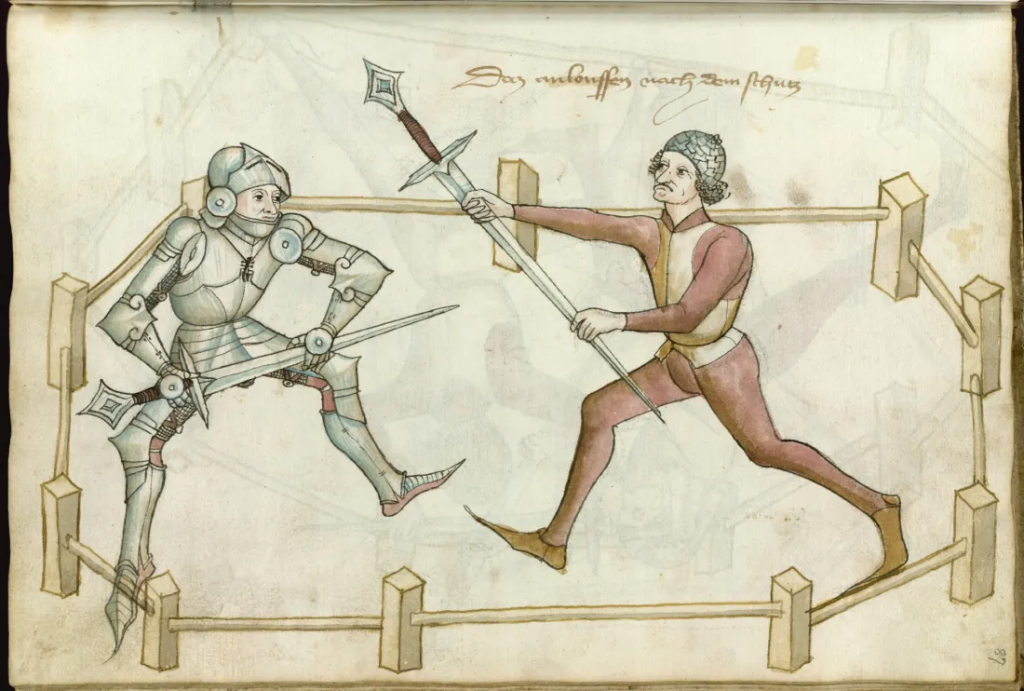
MS Thott.290.2º f.87r.
The ultimate experts in medieval sword fighting were the “fight masters” – elite athletes who trained their disciples in the subtle arts of close combat. The most highly renowned were almost as famous as the knights they trained, and many of the techniques they used were ancient, dating back hundreds of years in a continuous tradition.
Little is known about these rare talents, but the scraps of information that have survived are full of intrigue. Hans Talhoffer, a German fencing master with curly hair, impressive sideburns and a penchant for tight body suits, had a particularly chequered past. In 1434, he was accused of murdering a man and admitted abducting him in the Austrian city of Salzburg.
Fight masters worked with a grisly assortment of deadly weapons. The majority of training was dedicated to fencing with the longsword, or the sword and buckler (a style of combat involving holding a sword in one hand, and a small shield in the other). However, they also taught how to wield daggers, poleaxes, shields, and even how to fight with nothing at all, or just a bag of rocks (more on this later).
It’s thought that some fight masters were organised into brotherhoods, such as the Fellowship of Liechtenauer – a society of around 18 men who trained under the shadowy grandmaster Johannes Lichtenauer in the 15th Century. Though details about the almost-legendary figure himself have remained elusive, it’s thought he led an itinerant life, travelling across borders to train a handful of select proteges and learn new fencing secrets.
Other fight masters stayed closer to home – hired by dukes, archbishops and other assorted nobles to train themselves and their guards. A number even set up their own “fight schools”, where they gathered less wealthy students for regular weekly sessions.
[…]
For all their beauty, the hand-drawn works could also be decidedly bloodthirsty. In Talhoffer’s 1467 manual, neat sequences of moves that look almost like dancing end abruptly with swords through eye-sockets, violent impalings, and casual instructions to beat the opponent to death. Some signature techniques even have names – chilling titles like the “wrath-hew”, “crumpler”, “twain hangings”, “skuller” and “four openings”.
Despite passing through countless generations of owners, and – in some cases – centuries of graffiti, burns, theft, and mysterious periods of vanishment from the historical record, a surprising number survive today. This includes at least 80 codexes from German-speaking regions alone.
Impossible moves and missing clues
But there’s a problem. Many of the techniques in combat manuals, also known as “fechtbücher“, are convoluted, vague, and cryptic. Despite the large corpus of remaining books, they often offer surprisingly little insight into what the fight master is trying to convey.
“It’s famously difficult to take these static unmoving woodcut images, and determine the dynamic action of combat,” says Scott Nokes, “This has been a topic of debate, research and experimentation for generations.”
On some occasions these manuals seem to depict contortions of the body that are physically impossible, while those that attempt to convey moves in three dimensions sometimes give combatants extra arms and legs that were added in by accident. Others contain instructions that are frustratingly opaque – sometimes depicting actions that don’t seem to work, or building upon enigmatic moves that have long-since been lost.
Oddly, the text is often written as poetry, rather than prose – and a few authors even made it hard to interpret their works on purpose.
Lichtenauer recorded his instructions in obscure verses which remain almost incomprehensible today – one expert has gone so far as to call them “gibberish”. According to a contemporary fight master he trained, the grandmaster wrote in “secret words” to prevent them from being intelligible to anyone who didn’t value his art highly enough.
Even when it is possible to decipher what a combat manual is describing or demonstrating, some experts suspect that crucial contextual information is always missing.
Comments Off on What we still don’t know about historical European swordfighting
Useful Beer Reviews: Newcastle Brown Ale
Jago Hazzard
Published 12 Jun 2019Today, an old favourite – Newcastle Brown Ale.
DISCLAIMER: Contains rambling that may bear no resemblance to reality.
Comments Off on Useful Beer Reviews: Newcastle Brown Ale


