
In a not terribly long life, I have known well three transsexuals (as we used to say), and another three not so well. Not because I especially sought out their company, but just because I’ve spent a lot of my time around theatre and music and areas that attract those who feel “different”. Two of those three friends I didn’t know were transsexual until they were “outed”, one very publicly — although with hindsight certain curious aspects of both their physiognomy and behavior suddenly made a lot more sense.
But that’s the point: Even those far closer to them than I was weren’t aware — because back then the object of having a “sex change” (also as we used to say) was to change from being a man to being a woman. There were still only two teams and you were simply crossing over to bat for the other side. The trans-life had little in common with “gay pride” — because the object wasn’t to come out of the closet, but to blend into it so smoothly no one would know you hadn’t always been there. Before their outing, the two ladies in question were more lady-ier than thou: both used to show up once a month with a box of Tampax “discreetly” poking out from the top of their handbags — even though, as we all understood in retrospect, they had no need of it. But they had chosen to live as women, and so they wished to be as other women. And they were mortified when they were exposed.
This was the conventional view as late as the Nineties, when Armistead Maupin’s celebration of the gay life, Tales Of The City, became must-see TV for sophisticated liberals on Britain’s Channel 4 and America’s PBS. The big plot point was the matriarch Mrs Madrigal (Olympia Dukakis) “revealing” her “secret” — that she was not born a woman.
To be sure, as the chromosomocentrists argue, one cannot, biologically, “change sex”. But I’ll skip that argument, because, as usual, conservatives are fighting over ground the left has already scorched and moved on from for new conquests. I have no great objection to a grown man who “identifies” as a woman and wishes to live as one. Guys have been doing that, to one degree or another, throughout history, and all that’s happened is that cosmetic surgery has caught up with their desires. If half the women in California can walk around with breast implants, I don’t see why the chaps can’t.
But the chromosomocentrists are missing the point. The left’s saying, “Yeah, XY chromosomes, big deal. You’re right, but so what? No one’s saying she’s a woman. We’re saying she’s a transwoman — a new, separate and way more glamorous category that’s taking its seat at the American table and demanding public affirmation. This isn’t your father’s sex change. Changing from man to woman is so last century.”
Mark Steyn, “Birth of the New”, Steyn Online, 2015-06-05.
April 19, 2023
QotD: Transsexuals before Trans* politicization
April 18, 2023
“Here it is then. This is The Hill.”
Simon Evans rightfully decides that fighting the bowdlerization of P.G. Wodehouse is the hill to die on:
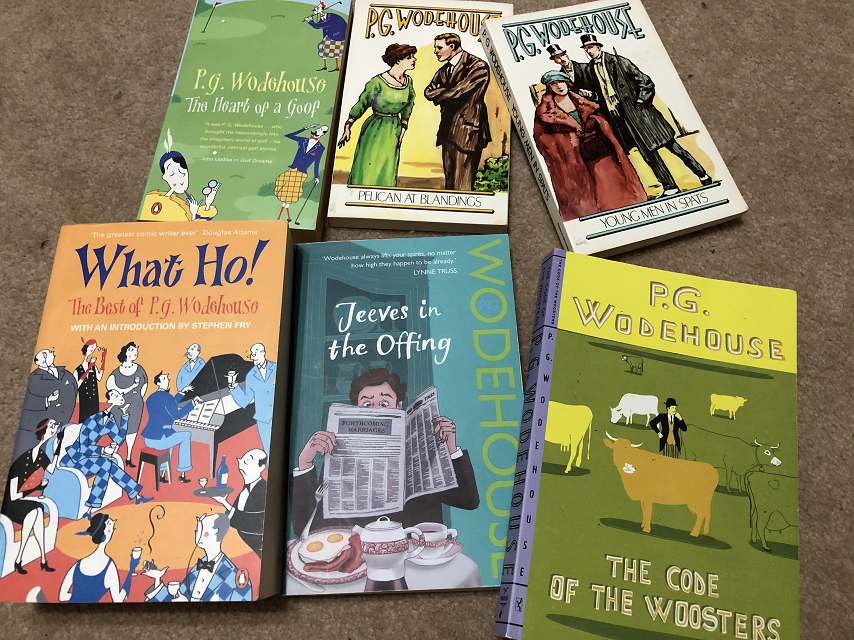
PG Wodehouse has become the latest author to fall victim to the “sensitivity readers”. Passages have been purged and words have been altered for the new editions of his Jeeves and Wooster novels, including Thank You, Jeeves and Right Ho, Jeeves. According to Penguin, the publishers, some of the racial language and themes of these 1930s novels are “outdated” and “unacceptable”. This includes the use of the n-word.
When I saw the news, my tweet sort of fell out of me before I’d consciously drafted it: “Here it is then. This is The Hill.”
There is an interesting contrast here. We live in a time when every much-loved and out-of-copyright literary artefact that is brought to the screens is being stiffened, like an old Christmas pudding recipe that clearly needs more brandy, with swearing and novel scenes of sexual deviation never imagined in the original. Just think of the BBC’s recent modernising and coarsening of Charles Dickens, Agatha Christie et al, which have rendered them all but unwatchable for millions. So it is more than a little odd that Wodehouse, the mildest, most weightless comedy of the last century, should suddenly seem deserving of the nit comb.Yes, it is true that Wodehouse uses the n-word. And no other word is now, or arguably ever has been, quite so radioactive, so sui generis in its capacity for offence. It is not that I want to defend this word. Rather, the hill on which I will die is the pristine perfection of Wodehouse’s prose, and its right to remain so. He is – and by an extraordinary degree of consensus, in a field that is almost maddeningly subjective – the Bach of comic literature. And I’m sorry, but you just don’t tinker with Bach.
Though a fan, Christopher Hitchens, in a review of a Wodehouse biography, wrote of the tiresome habit of certain people in referring to Wodehouse as “The Master”, so I will try to avoid that unctuous, fulsome tone. But one of the very few writers of my lifetime who approached him for touch (though sadly not in output) was Douglas Adams, who often referred to Wodehouse as just that: “He’s up in the stratosphere of what the human mind can do, above tragedy and strenuous thought, where you will find Bach, Mozart, Einstein, Feynman and Louis Armstrong, in the realms of pure, creative playfulness.”
The point is not that the presence of the odd unfortunate archaic usage, which might indeed jolt the casual reader into a brief awareness that they are reading something older than their grandfather, is necessarily a good thing. It is simply, who the hell do the sensitivity readers think they are, to decide what stays and what goes?
April 17, 2023
Orwell’s The Road to Wigan Pier
Daniel Nuccio on one of George Orwell’s early works that prefigured the bestsellers he is best known for today:
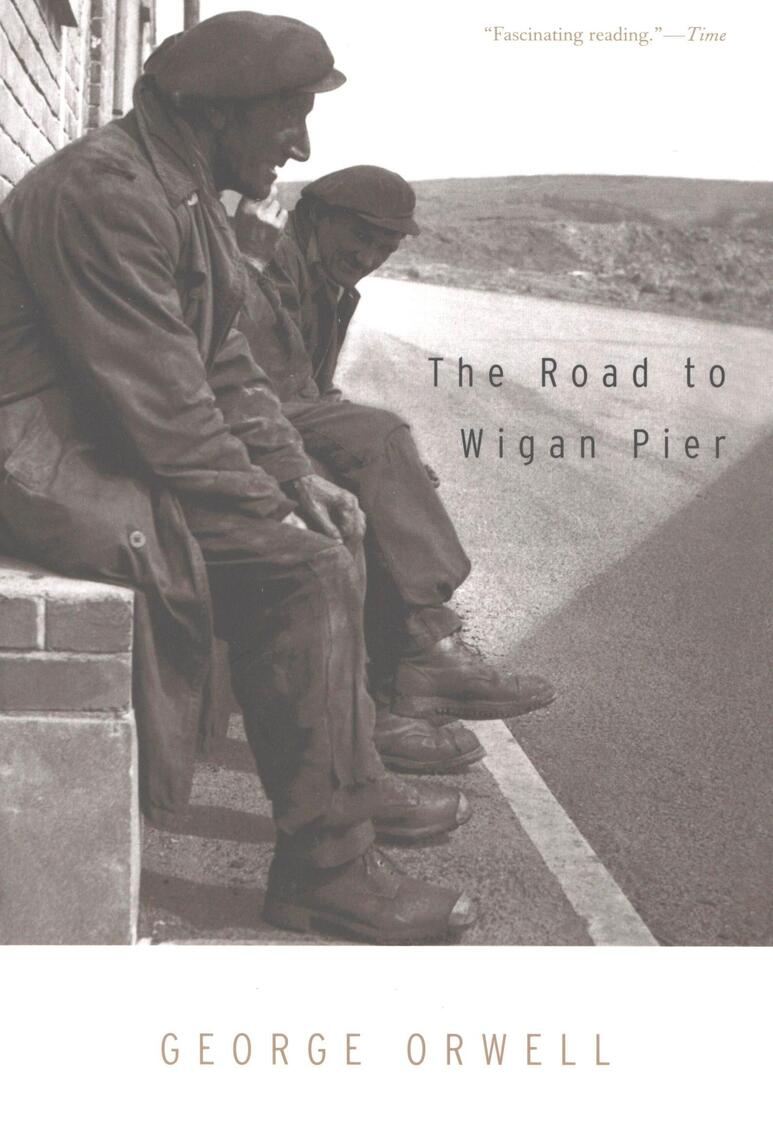
Written for a group of British socialists known as the Left Book Club, the oeuvre is part documentation of the life of Britain’s impoverished working class with particular focus on the dignity and importance of coal miners and part autobiographical account of Orwell overcoming his own class prejudices, united by themes developed throughout regarding the economic commonalities of and social distinctions between Britain’s low-level bourgeoisie and working class, as well as the downside of industrialization and hypocrisy of fashionable socialism.
By Orwell’s account, Britain’s class system at the time, partly based on economic stratification, partly in an unofficial caste system, fostered a seemingly contradictory world in which middle-class bourgeoisie and the working class might experience little difference in income, but drastic differences in their respective places in British society. Yet, even as unemployment and poverty festered and spread, with the middle class eventually “feeling the pinch”, social distinctions, Orwell reported, naturally won out over the narrowing economic gap between classes. Lower-level middle class Brits, despite being working class by any objective economic metric, still chose to identify as bourgeoisie.
Rampant industrialism likely exacerbated these problems as it fundamentally transformed Britain into a machine society, likely to its detriment, according to Orwell’s description. Consequently, these and other factors, Orwell argued, positioned Britain at a crossroads at which the country and its people inevitably would be forced to choose between socialism and fascism.
From his depiction of 1930s British society, it would seem fascism was perhaps going to win out (and perhaps would have if not for later events unbeknownst to Orwell at the time). His prescribed antidote was socialism. Yet, Orwell claimed, the hypocrisy, offensiveness, and buffoonish self-satirizing nature of many socialists tended to drive most normal people away.
Reading The Road to Wigan Pier as an American more than eighty years after its publication, the world Orwell depicts in some ways seems foreign. In many others it is amusingly, if not unsettlingly familiar.
Although not as ingrained as in Britain, the United States maintains its own version of a class system in the form of a superficial yet meaningful distinction between middle class and working class that many Americans yoke to personal character and economic reality.
Nowhere is this more obvious than America’s approach to higher education and the jobs afforded to those with a college degree versus those without. Attaining a degree from a four-year college or university, at least to many members of the American middle class, is seen as something of a sacrament that affirms one’s position in the American middle class. Receiving the sacrament of higher education signals one’s position along with one’s sophistication, respectability, and intelligence. It saves one from the indignity of blue-collar work and the impecunious state with which such work is associated.
Tank Chats Reloaded | Panzer IV | The Tank Museum
The Tank Museum
Published 30 Dec 2022Let’s go inside Panzer IV with another episode of Tank Chats Reloaded. Chris Copson takes a detailed look inside the tank which was considered the backbone of the Wehrmacht‘s Panzer force, uncovering the reality of what it might’ve been like to serve as a Panzer crew member in WW2.
(more…)
QotD: Tenant-farming (aka “sharecropping”) in pre-modern societies
In many cases, small freeholders might also work as tenants on a nearby large estate as well. There are many good reasons for a small free-holding peasant to want this sort of arrangement […]. So a given area of countryside might have free-holding subsistence farmers who do flexible sharecropping labor on the big estate from time to time alongside full-time tenants who worked land entirely or almost entirely owned by the large landholder. Now, as you might imagine, the situation of tenants – open to eviction and owing their landlords considerable rent – makes them very vulnerable to the landlord compared to neighboring freeholders.
That said, tenants in this sense were generally considered free persons who had the right to leave (even if, as a matter of survival, it was rarely an option, leaving them under the control of their landlords), in contrast to non-free laborers, an umbrella-category covering a wide range of individuals and statuses. I should be clear on one point: nearly every pre-modern complex agrarian society had some form of non-free labor, though the specifics of those systems varied significantly from place to place. Slavery of some form tends to be the rule, rather than the exception for these pre-modern agrarian societies. Two of the largest categories of note here are chattel slavery and debt bondage (also called “debt-peonage”), which in some cases could also shade into each other, but were often considered separate (many ancient societies abolished debt bondage but not chattel slavery for instance and debt-bondsmen often couldn’t be freely sold, unlike chattel slaves). Chattel slaves could be bought, sold and freely traded by their slave masters. In many societies these people were enslaved through warfare with captured soldiers and civilians alike reduced to bondage; the heritability of that status varies quite a lot from one society to the next, as does the likelihood of manumission (that is, becoming free).
Under debt bondage, people who fell into debt might sell (or be forced to sell) dependent family members (selling children is fairly common) or their own person to repay the debt; that bonded status might be permanent, or might hold only till the debt is repaid. In the later case, as remains true in a depressing amount of the world, it was often trivially easy for powerful landlord/slave-holders to ensure that the debt was never paid and in some systems this debt-peon status was heritable. Needless to say, the situation of both of these groups could be and often was quite terrible. The abolition of debt-bondage in Athens and Rome in the sixth and fourth centuries B.C. respectively is generally taken as a strong marker of the rising importance and political influence of the class of rural, poorer citizens and you can readily see why this is a reform they would press for.
Bret Devereaux, “Collections: Bread, How Did They Make It? Part II: Big Farms”, A Collection of Unmitigated Pedantry, 2020-07-31.
April 16, 2023
The short-term mindset in architecture
Our house was built in the first half of the 19th century, although we’re not sure exactly when. We know it was here in the early 1840s but it could be 20 years older than that … in the first half of the 1800s, you didn’t need to get a building permit in Upper Canada before you started, and there was minimal government record-keeping at the time. Our house isn’t anything special architecturally, but it was built extremely solidly. It was intended to stand the test of time. This is not at all true for most of what we build today:
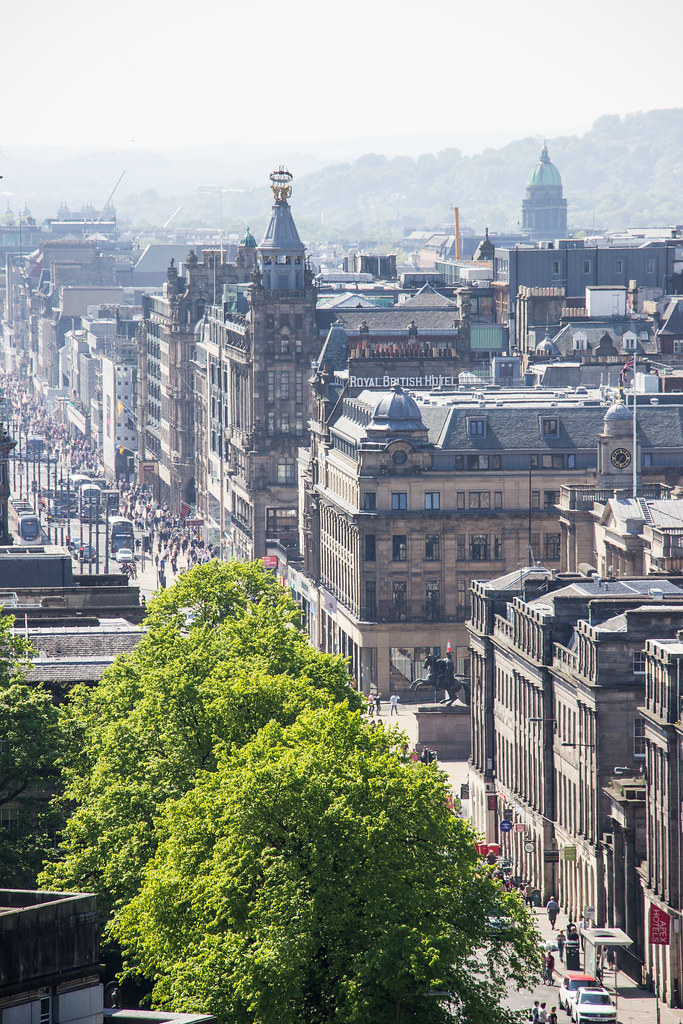
“Princes Street, New Town, Edinburgh, Scotland” by Billy Wilson Photography is licensed under CC BY-NC 2.0 

 .
.
I have had some work done on my house recently. For context, it’s an Edwardian terrace with a rear extension built sometime in the 1980s. Oddly fascinating for me was the sheer difference in build quality between the original section of the property and the newer part at the back. The older part of the house is sturdy, solid and lauded by the workmen as a “proper building”. The newer section has been a huge source of ridicule and contempt: shoddy timber placement, wobbly floors, dangerous electrical wiring, crumbling cement and poor brickwork plague it.
The tradesmen’s comments had me thinking a lot about the general quality of our infrastructure, both national and local, and how we sometimes take for granted the fact that a huge portion of what we use every day is so old. Not only that, but a lot of it is almost universally considered very beautiful and important to our shared cultural heritage.
Take a stroll through any city in Great Britain, and you are more than likely to at some point come across the “old town”. Despite the Luftwaffe’s (and post war town planner’s) best efforts, a lot of pre-war buildings still inhabit the centres of our towns and cities. These prove to be fine examples of the world we used to live in. Even in the poorest of cities, my own town of Hull for example, there exists a great plethora of dramatic and beautiful buildings which were constructed, almost exclusively, by the late Georgians, Victorians and Edwardians. Take a trip to London, Edinburgh, central Durham and a number of other places, and you will see that even the lampposts are adorned gorgeously, with striking and intricate ironwork.
Why is this? Why did they bother to do such a good job? Why do we still heavily rely on their work for our own sense of cultural identity and our basic infrastructural needs? Why can’t our own contemporary efforts compete, despite great advances in the field of civil engineering and construction materials? I think the answer boils down to one thing: civic pride.
The Victorians were building for eternity; we build for temporary needs in a utilitarian fashion. They knew their “mission”, and they saw it an absolute necessity to make everything they did permanent; we do not. They designed buildings to be functional and beautiful; we seek to make buildings which will be functional for 50 years before they are “recycled”.
Speak to a modern student of architecture about their course, and you will find that very few opportunities exist for those who want to pursue a path for traditional design techniques. Their learning aim is to make things which can be used temporarily, then pulled down for something else. This is an attitude which would be totally alien to the Victorians who designed and built the lecture halls these students now learn in.
Raising the minimum retirement age may be necessary, but it will never be politically popular
As protests and riots continue against the French government’s attempt to raise the minimum retirement age from 62 to 64, Theodore Dalrymple explains why he finds sympathy with the working poor who will be most directly hurt by the change:

Riot police on the streets of Bordeaux as violent protests against French government plans to raise the retirement age continue.
YouTube screen capture from an AFP report.
As I hope to be able to work till my dying day, I am perhaps not the right person to animadvert on the present disturbances in France about the raising of the retirement age from 62 to 64. My work has always been pleasing to me, and it remains so; I even manage to delude myself sometimes that it is important.
I am forced to recognize, however, that not everyone is in the same happy position as I. I am sure that if I had been a dustman all my life, I should not hope to be emptying dustbins at my present age (73), let alone at the age of 85. While my work remains work, and in a certain sense occasionally even hard work, especially when I have to think, what I do is not physically demanding. No one ever got arthritis or fibrosis of the lung by writing a few articles.
The reform of the pension system in France, from my limited understanding of it, is rather unfair. It is true that some reform is necessary: There are ever fewer workers to fund the pensions of ever more pensioners (the system being entirely unfunded by investment). On the other hand, it is those who do the most unpleasant and unremunerative jobs who have to work the longest, and the reform only increases this unfairness. As the old cockney song has it, it’s the rich what gets the pleasure.
Nevertheless, the extreme opposition to the reform, which is hardly a radical one, strikes most foreigners as rather strange. In a way it is also sad, for it implies that a long retirement is the main aim of all that precedes it, which in turn implies that all the work done for several decades before retirement has been an unpleasant imposition rather than something of value in itself. That the quid pro quo for a longer life expectancy is a greater number of years spent working seems not to strike anyone with force.
The demonstrators probably think, no doubt correctly, that the reform is the thin end of a wedge: If it is allowed to pass without a fuss, there will be further such reforms until the retirement age will be 70, 80, or never, depending on life expectancy. As for the younger demonstrators, they do not seem to worry much that it is they who will be paying for the people older than themselves to retire early, the distant prospect of early retirement being more real to them than the far more proximate high rates of taxation.
4,000 German teens trapped in Tarnopol – WW2 – Week 242 – April 15, 1944
World War Two
Published 15 Apr 2023Thousands of German soldiers, mostly new teenage recruits, are obeying Hitler’s “Fortress Directive” and are surrounded in Tarnopol; it does not go well for them. German forces in Ukraine manage to all pull back across the Dniester, but they are under serious pressure in the Crimea. Meanwhile, in India, the Japanese siege of Kohima continues, and in China they are poised to launch a gigantic offensive.
(more…)
Do Foucault and Derrida deserve the blame for PoMo excesses?
In Spiked, Patrick West says that it’s a misunderstanding of Foucault and Derrida to blame them for the rise of wokeness:

Michel Foucault speaking at the Hospital das Clínicas of the State University of Guanabara in Brazil, 1974.
Public domain image from the Arquivo Nacional Collection via Wikimedia Commons.
It has become common to blame wokeness on its supposed philosophical parent: postmodernism. As the standard narrative goes, postmodernism is the ideology that entrenched itself in Anglophone universities in the 1980s and 1990s. It talked of relativism, of the absence of objective truth, of the spectre of a pervasive, invisible power, and it was generally anti-Western. A whole generation of professors, writers, journalists and a fair few activists have subsequently been raised on this diet of postmodern thinking. And the result is a cultural elite that is wedded to wokeness.
[…]
For these critics of woke, Foucault’s influence, in particular, is seemingly everywhere. According to [Douglas] Murray [in The War on The West], it’s through the “anti-colonial” philosophy popularised by the Foucault-inspired scholar, Edward Said, that Foucault and therefore postmodernism have filtered down into woke philosophy, which holds that Western society is uniquely racist and to blame for all of today’s ills. Equally, right-wing critics of wokeness will claim that the trans movement has sprung from the postmodern contention that sexuality and gender are entirely socially constructed and therefore plastic and malleable.
If Foucault is regarded as the father of wokeness then 19th-century philosopher Friedrich Nietzsche tends to be regarded as the grandfather. After all, Foucault was profoundly influenced by Nietzsche and even proudly declared himself to be “Nietzchean”. Nietzsche, like Foucault, also saw all human behaviour stemming from the desire for power. And he conceived of morality – good and evil, right and wrong – as the mere manifestation of the will to power. As he wrote of the “origin of knowledge”, in The Joyous Science (1883): “Gradually, the human brain became full of such judgements and convictions, and a ferment, a struggle, and lust for power developed in this tangle. Not only utility and delight but every kind of impulse took sides in this fight about ‘truths’.” One can see this Nietzschean sentiment at work in Foucault’s Discipline and Punish (1975): “Power produces knowledge … power and knowledge directly imply one another.”
So, according to this largely right-wing narrative, wokeness is the product of a 20th-century philosophical assault on truth, objectivity and the West. And it was inspired by Nietzsche and led by several “cultural Marxist” thinkers.
There are several problems with this rather neat story. The first error is to use the phrase “cultural Marxism” to talk of postmodernism or wokeness. This term doesn’t really make sense. Marx himself conceived of his work as a historical materialism. It was focussed on class and the means of production, not on culture. Yes, in the 1940s and 1950s, some Frankfurt School thinkers, who sometimes presented themselves as Marxist, did focus on culture rather than class. But as Joanna Williams writes in How Woke Won (2022), their thinking “represented less a continuation of Marxism and more a break with Marx”.
Moreover, postmodern thinkers were broadly opposed to Marxism. Many may have been signed-up Communists in their youth (the French Communist Party dominated left-wing politics at the time), but by the 1960s they had become highly critical of Marxist politics. They rejected the idea that history was progressing “dialectically” towards a communist future, or “telos”. And they were often hostile to the scientific objectivity and “Enlightenment” values so central to Marxism. Foucault wrote that history was not the story of progress; it was but a series of non-linear discontinuities and contingencies. And Jean-François Lyotard (1924-1998), in his highly-influential The Postmodern Condition (1979), announced and celebrated the end of “grand narratives”, and with it the end of the Marxist “grand narrative” of progress. Lyotard’s writings from the 1970s onwards were violently antithetical to Marxism, especially its claims to objective truth.
As for wokeness itself, it has nothing to do with Marxism. With their myopic focus on race and gender, woke activists are utterly blind to the material, class-structure of society. Today, bizarrely, it’s often conservatives who are more attuned to the plight of the working class than woke “radicals”. As Williams writes, “critics who insist that woke is simply Marxism in disguise are wide of the mark”.
QotD: Homo electronicus and the permanent caloric surplus
Excess fat cranks up estrogen levels. You don’t need to be House MD to interpret this finding:
In males with increasing obesity there is increased aromatase activity, which irreversibly converts testosterone to estradiol resulting in decreased testosterone and elevated estrogen levels.
Or this one:
A study supports the link between excess weight and higher hormone levels. The study found that estrogen and testosterone levels dropped quite a bit when overweight and obese women lost weight.
This is not to say those swishy subalterns were fat — indeed, they were comically scrawny compared to Postmodern people. But a little goes a long way when it comes to hormones, especially in a world where “intermittent fasting” wasn’t a fad diet, but a way of life. Any one of us would keel over from hunger if we were forced to eat the kind of diet George Orwell described as his public school’s standard fare.
Follow that trend out to the Current Year, when pretty much everyone is grossly obese compared to even the Silent Generation. Heartiste and other “game” bloggers loved pointing out that the average modern woman weighs as much as the average man did in the 1960s. And while I think that’s overblown — we’re also several inches taller, on average, than 1960s people — there’s definitely something to it, especially when you consider how far the bell curve has shifted to the fat end. Not only do people weigh a lot more on average, the people who weigh more than average now weigh a hell of a lot more than heavier-than-average people did back when. See, for example, the ballooning weight of offensive linemen, who are professionally fat — in 2011 a quarterback, Cam Newton, weighed more than the average offensive lineman in the 1960s.
Put the two trends together and you have, on average, a hormone cocktail way, way different than even 50 years ago … and that’s before you add in things like all-but-universal hormonal contraception, lots of which ends up in municipal drinking water.
Severian, “Recent Evolution”, Rotten Chestnuts, 2020-09-28.
April 15, 2023
Do the Germans Know About Operation Overlord?
World War Two
Published 14 Apr 2023We are getting closer and closer to D-Day and the potential liberation of Nazi Europe. But how much do the Germans know about this? Is the leak inside the British Embassy in Ankara enough to thwart the efforts of Operation Bodyguard, Operation Fortitude, and everything else the Allies are doing to deceive Adolf Hitler? Let’s find out. This is the story of Cicero.
(more…)
Type 68 North Korean Tokarev/High Power Hybrid
Forgotten Weapons
Published 18 May 2020The Type 68 is a North Korean hybrid of the Tokarev and the High Power, used as a military service pistol until replaced by the Beak-Du-San copy of the CZ75. The general outline of the gun is a copy of the Tokarev, with a modular removable fire control group, lack of manual safety, and tall thin sights. It is chambered for 7.62x25mm, and uses a magazine identical to the standard Tokarev except for not having a magazine catch cut, as the Type 68 has a heel magazine release.
Internally, the High Power elements include a detent-retained barrel pin, use of a solid barrel cam instead of a 1911/Tokarev swinging link, and a fixed barrel bushing. Two patterns of markings exist, one with a date and North Korean marking, and one (like this example) with only a serial number.
North Korean guns of all types are very rare in the United States. A very small number of Type 68s have come into the US, generally through Central America (probably via Cuba) and South Africa (via Rhodesia/Zimbabwe).
Update: It appears that the original design work for these was done by an independent engineering firm in Yugoslavia. The design (a TT33 with High Power type locking and angled slide serrations) was not completed in time for the trials that would lead to adoption of the Yugoslav M57, and the drawings were transferred to “another country” — probably North Korea.
(more…)
April 13, 2023
Beeching plus 60
In The Critic, Peter Caddick-Adams notes that it’s just past 60 years since one of the most controversial documents the British government published during the latter half of the 20th century: The Beeching Report.
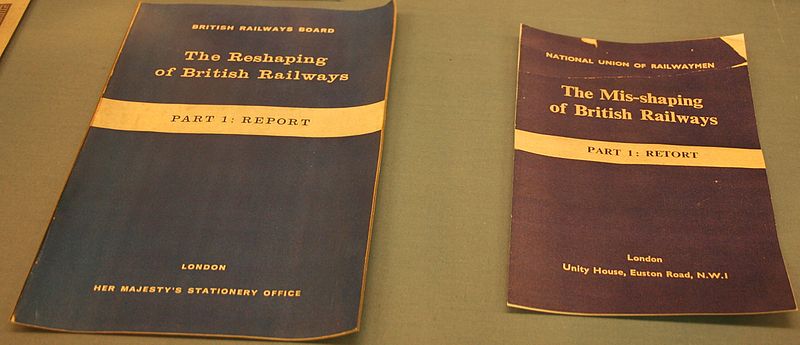
The British Railways Board’s publication The Reshaping of British Railways, Part 1: Report, Beeching’s first report, which famously recommended the closure of many uneconomic British railway lines. Many of the closures were implemented. This copy is displayed at the National Railway Museum in York beside a copy of the National Union of Railwaymen’s published response, The Mis-shaping of British Railways, Part 1: Retort.
Photo by RobertG via Wikimedia Commons.
Wednesday, 27 March 1963 marked the day when a civil servant with a doctorate in physics, seconded from ICI, proudly flourished a report he had written. That man was Dr Richard Beeching, and the result of his recommendations contained in The Reshaping of British Railways are with us to this day.
Beeching identified many unprofitable rail services and suggested the widespread elimination of a huge number of routes. He identified 2,363 stations for closure, along with 6,000 miles of track — a third of the existing network — with the loss of 67,700 jobs. His stated aim was to prune the railway system back into a profitable concern. Behind Beeching, seconded to the newly-established British Railways Board, stood the figure of the publisher-turned-Prime Minister, Harold Macmillan. He knew a thing or two about railways, having been a pre-nationalisation director of the Great Western Railway. It put him in the delightful position of never having to pay for a train ticket.
Macmillan observed from a shareholder’s point of view, “you can pour all in money you want, but you can never make the damned things pay for themselves”. In his view, the railway network and infrastructure of wagon works, tiny branch lines, cottages for signallers, crossings keepers and station masters, with most halts staffed 18 hours a day, amounted to a social service, albeit an expensive one. It had made the prosperity of Victorian Britain possible and was sustaining it still. From nationalisation in 1948, the railways themselves had attempted to make savings, closing 3,000 miles of track and reducing staff from 648,000 to 474,000. That famous Ealing comedy film of 1953, The Titfield Thunderbolt, about a group of villagers trying to keep their branch line operating after British Railways decided to close it, already reflected concern and railway nostalgia.
Britain’s literary and celluloid love affair with iron rails and steam began as long ago as 1905 with the publication of Edith Nesbit’s The Railway Children, a success which peaked when the book was made into a highly successful movie in 1970. Meanwhile, professional sleuths and loafers like Sherlock Holmes, Bulldog Drummond, Lord Peter Wimsey, Hercule Poirot and Bertie Wooster capitalised on the branch line network in their methodology of moving swiftly about pastoral England in their hunts for miscreants. It was the success of The Lady Vanishes, a 1938 mystery thriller set on a continental train, that launched Alfred Hitchcock as a world-class director. David Lean’s Brief Encounter of 1945, based on Noël Coward’s earlier one-act play, Still Life, attached deep romance to station platforms and waiting rooms, reminiscent of so much heartache in the recently fought world war. It is still regarded as one of the greatest of all British-made films. None of this mattered to Beeching, the man who was “Britain’s most-hated civil servant” at his death in 1985, a moniker still used today.
There’s an argument that Beeching was deliberately set up as a patsy for the real villains, Ernest Marples and Harold MacMillan:
The cold, dispassionate Beeching was absolutely the wrong man for the job. As he told the Daily Mirror at the time, “I have no experience of railways, except as a passenger. So, I am not a practical railwayman. But I am a very practical man.” John Betjeman, writing persuasively and eloquently in the Daily Telegraph each week, and later Ian Hislop, hit the right note in observing that Beeching, and all he stood for were technocrats. They “weren’t open to arguments of romantic notions of rural England, or the warp-and-weft of the train in our national identity. They didn’t buy any of that, and went for a straightforward profit and loss approach, from which we are still reeling today”.
However, it has also been argued that Beeching was the unwitting fall-guy for the Minister of Transport of the day, Ernest Marples. He was a self-made businessman who “got things done”, but he retained an air of shadiness about him. Macmillan should have known better. Marples had been managing director of Marples Ridgway, awarded contracts to build the first motorways. When challenged about a conflict of interest, he sold his 80 per cent shareholding to his wife. Elevated to the peerage, Marples fled to Monaco in 1975 to avoid prosecution for tax fraud. So, in some ways, the thing was a stitch-up. Marples directly benefited from the widespread cuts advocated by his subordinate, Beeching. Macmillan had his eye off the ball and was already considering retirement, hastened by an operation for prostate cancer six months after Beeching’s report.
The Prime Minister was astute enough to ensure the press presented the cuts in a positive way, however. From the Cabinet papers of the day, we now know the day before the publication of The Reshaping of British Railways, Beeching’s findings were rewritten to suggest the cuts were the first phase of a co-ordinated national transport policy, with advanced plans to replace the axed rail networks with improved minor roads and local bus services. In reality this was political fantasy (my inner lawyer cautions against more extremist language), for the bus-road subsidy would have cost more than that already paid to the railways. The promise of replacement bus services should have come with a guarantee of remaining in place for at least 10-15 years, because most were withdrawn after two, forcing more motor traffic onto an already inadequate road network.
A Brief History of Gin
No Nonsense Gin Drinking
Published 21 Jul 2019Pay attention class! No running, shouting or talking at the back! It’s time to learn all about gin!
(more…)
April 12, 2023
French Onion Soup from 1651
Tasting History with Max Miller
Published 11 Apr 2023
(more…)


