
The Great War
Published Nov 10, 2023Germany’s defeat in the First World War has been blamed on all kinds of factors or has even been denied outright as part of the “stab in the back” myth. But why did Germany actually lose?
(more…)
February 28, 2024
Why Germany Lost the First World War
Comments Off on Why Germany Lost the First World War
February 27, 2024
Greek History and Civilisation, Part 4 – The Ancient Greeks: The Great Invasion
seangabb
Published Feb 18, 2024This fourth lecture in the course deals with the Persian invasion of Greece in 480 BC, ending with the glory of Thermopylae and the burning of Athens.
(more…)
Comments Off on Greek History and Civilisation, Part 4 – The Ancient Greeks: The Great Invasion
February 26, 2024
Time to pry the smartphones from the clutches of our dopamine-addicted youngsters?
A couple of articles this weekend deal with the already acknowledged problem of dopamine addiction especially among the young whose brains and personalities are still in the formative stages. First, here’s Christopher Gage reporting with some delight that British schoolchildren are going to have to learn how to cope with a full school day without the electronic binkies they’ve grown so dependent on:
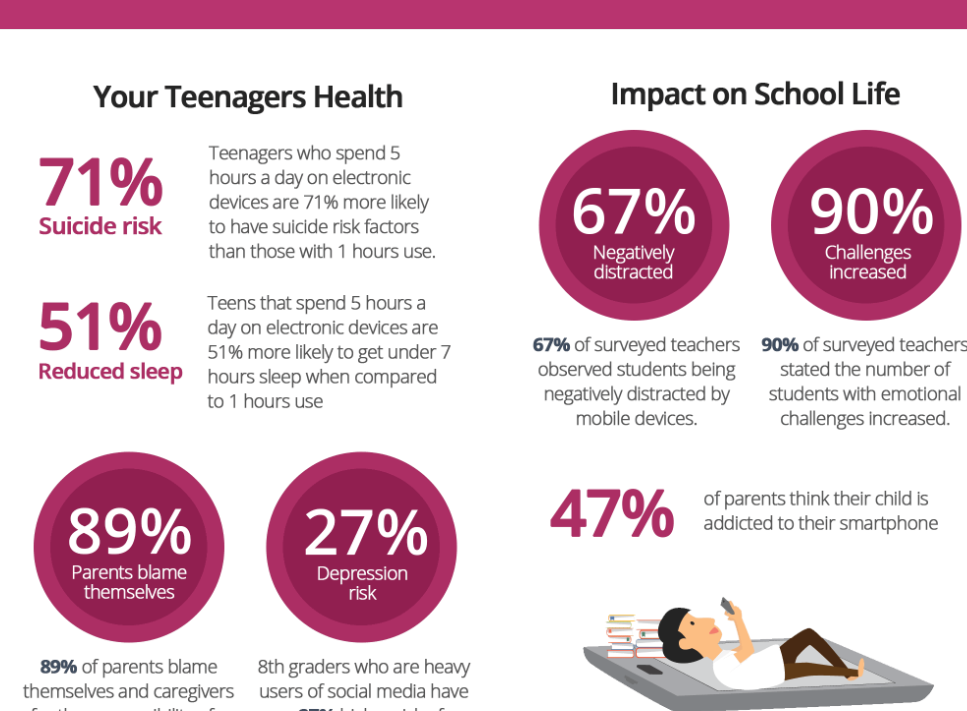
Detail of an article at bankmycell.com
I long for the day when gawking at one’s phone like a lobotomy patient invokes derision. Don’t you know your filthy addiction pollutes every atom of our society? You selfish bastard. You perverts should be ashamed of yourselves, etc. That day is on the horizon.
This week, British lawmakers banned smartphones in schools. Those pocket perils are lobotomising those whom sentimentalists call “the nation’s future”. Denied their devil devices, schoolchildren will endure hours of reading, thinking, and writing. Heaven forbid, they’ll talk to their friends and teachers in flesh and blood.
In these matters, I am militant. Children are not vessels of wisdom and wonder corrupted by a cruel world. They’re ignorant. By teaching them how to think and live, adults civilise children. That bleeping burping buzzing beehive in their pockets renders that civilising mission impossible.
Many disagree. But their knee-jerk reaction to this “knee-jerk reaction” crashes against concrete evidence. Smartphones erode concentration, dull critical thinking, blunt memory, and shred retention. The monstrous equation: Smartphones plus face-hugger apps equals ignorant, depressed, anxious youths.
Yes, technology invites moral panic. Plato worried that the written word would mulch minds into mush. But this is serious.
Last year, Dr Vivek Murthy, the United States surgeon general, issued a rare public health advisory. Across 19 pages, Dr Murthy warned that the effects of social media on adolescent mental health were “not fully understood”.
“There are ample indicators that social media can also have a profound risk of harm to the mental health and well-being of children and adolescents,” he said.
And what did we say? Not much. We had more important matters to attend. If I remember correctly, on that very day, Kim Kardashian revealed on Instagram her latest arse or her newest boyfriend.
However, serious people think this is a serious problem. Dr Benjamin Maxwell, a director of child and adolescent psychiatry at Rady Children’s Hospital in San Diego, said he is “immensely concerned” by a study linking social media and poor mental health. That “highly stimulating environment” may corrode “cognitive ability, attention span and memory during a time when their brains are still developing,” Maxwell said. “What are the long-term consequences? I don’t think we know.”
The UN’s education, science, and culture agency says the more young Jack scrolls through TikTok and the like, the lower his grades sink.
Countless studies show smartphones and their face-hugger apps — designed by behavioural psychologists to addict and milk the user — worsen anxiety, depression, and self-esteem. Not to mention lining up children for the predation of bullies 24/7.
Psychologists Jonathan Haidt and Jean Twenge are the canaries in the cultural coalmine. They say HMS Progress is crashing toward the icebergs — rising rates of suicide, depression, and anxiety. To them, the evidence is almost irrefutable. Turn back now, they say, or the ship sinks.
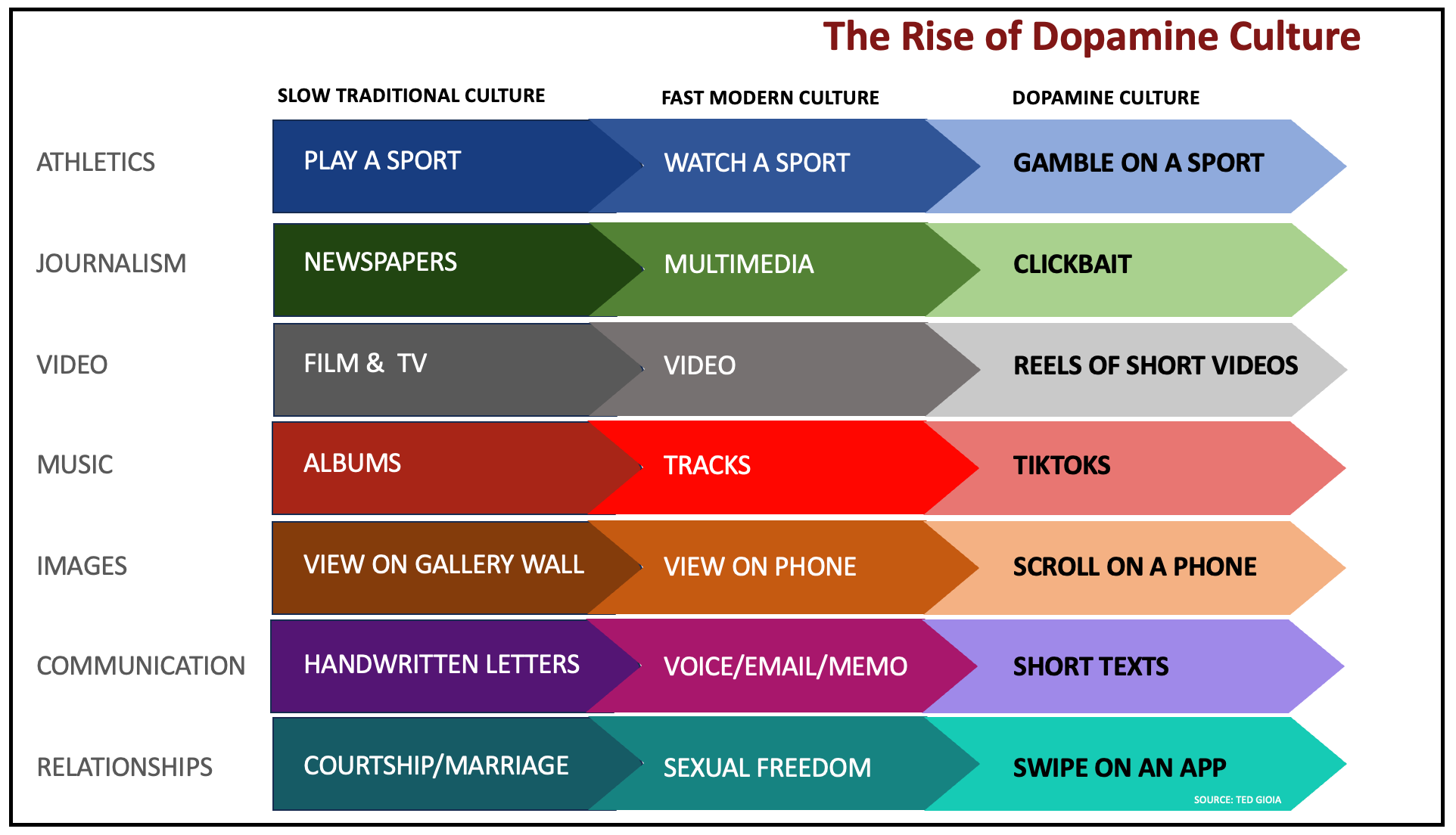
The second item is a follow-up by Ted Gioia to his post on dopamine culture last week:
My article on “dopamine culture” has stirred up interest and (even more) raised concerns among readers who recognize the symptoms I described.
One of the illustration went viral in a big way. And I’ve gotten requests from all over the world for permission to translate and share the material. (Yes, you can all quote generously from the article, and reprint my charts with attribution.)
This image was shared widely online
But many have asked for more specific guidance.
What can we do in a culture dominated by huge corporations that want us to spend hours every day swiping and scrolling?
I find it revealing and disturbing that readers who work on the front lines (in education, therapy, or tech itself) expressed the highest degree of alarm. They know better than anybody where we’re heading, and want to find an escape path.
Here’s a typical comment from teacher Adam Whybray:
I see it massively as a teacher. Kids desperately pleading for toilet breaks, claiming their human rights are being infringed, so they can check TikTok, treating lessons as though they’re in a Youtube reaction video, needing to react with a meme or a take — saying that silence in lessons scares them or freaks them out.
One notable difference from when I was at school was that I remember a lesson in which we got to watch a film was a relief or even pleasurable (depending on the film). My students today often say they are unable to watch films because they can’t focus. I had one boy getting quite emotional, begging to be allowed to look at his phone instead.
Another teacher asked if the proper response is to unplug regularly? Others have already embraced digital detox techniques of various sorts (see here and here).
I hope to write more about this in the future.
In particular, I want to focus on the many positive ways people create a healthy, integrated life that minimizes scrolling and swiping and mindless digital distractions. Many of you have found joy and solace — and an escape from app dependence — in artmaking or nature walks or other real world activities. There are countless ways of being-in-the-world with contentment and mindfulness.
Today I want to discuss just one bedrock of real world life that is often neglected — or frequently even mocked: Ritual.
I know how much I rely on my daily rituals as a way of creating wholeness and balance. I spend every morning in an elaborate ritual involving breakfast, reading books (physical copies, not on a screen), listening to music, and enjoying home life.
Even my morning coffee preparation is ritualistic. (However, I’m not as extreme as this person — who rivals the Japanese tea ceremony in attention to detail.)
I try to avoid plugging into the digital world until after noon.
I look forward to this daily time away from screens. But my personal rituals are just one tiny example. There are many larger ways that rituals provide an antidote to the more toxic aspects of tech-dominated society.
Below I share 13 observations on ritual.
Comments Off on Time to pry the smartphones from the clutches of our dopamine-addicted youngsters?
Rome: Part 4 – The First Punic War 264-241 BC
seangabb
Published Feb 25, 2024This course provides an exploration of Rome’s formative years, its rise to power in the Mediterranean, and the exceptional challenges it faced during the wars with Carthage.
• Growth of Tensions between Rival Powers
• Differences of Civilisation
• The Outbreak of War
• The Course of War
• Growth of Roman Sea Power
• The End and Significance of the War
(more…)
Comments Off on Rome: Part 4 – The First Punic War 264-241 BC
The Freedom Convoy’s European echoes
Niccolo Soldo on the widespread protests against the EU and various national governments’ intrusive and anti-human attempts to restrict or destroy European farmers in pursuit of their climate change agenda:

I wish there was a way to measure the gulf between ruling elites and the people that they lord over. Don’t Political Scientists have such a methodology already on hand? I don’t know.
What I do know is that this gulf is very palpable on both sides of The Pond, and that this gulf shows no signs of narrowing any time soon. Whether the issue is migration, crime, COVID-19, etc., it seems that the views of the people are simply ignored by those who can and do ignore them, and proceed to make policy that suits their own interests and the interests of their allies and class.
Judging by American media reporting, you would most likely not be aware that massive farmers’ protests are rocking the European continent as we speak. From Portugal to Poland, farmers are protesting the EU’s drive to push policies like “Net Zero” in order to “combat Climate Change” … policies that would severely impact the livelihoods of our food producers. These proposed changes are entirely top-down, indicative of just how divorced the Brussels elites are from the daily lives of the people whose lives they wish to upend with a stroke the pen. “Oppose us? You must be far right … probably a Nazi too.”
The “far-right” political libel against hard-pressed farmers is really a sign of how far the EU elites have lost touch with the reality of life for the peoples of Europe. We should ignore the slurs, and get behind the fighting farmers.
The protests by angry farmers have spread across the European Union, with mighty convoys of tractors blockading roads and cities from Romania to Rome, from Portugal to Poland, from Bulgaria to Brussels and beyond.
There might be some national variations in the farmers’ specific demands. But what unites them all is opposition to the way that the EU elites are subordinating agricultural policy to their Green agenda and Net Zero obsession, leading to more hardship for farmers and higher food prices for other Europeans.
As tractor convoys blockaded German cities in January, farmers’ association president Joachim Rukwied spelt out that they were protesting not just against the government’s proposed cuts in fuel subsidies, but against an EU-wide system where “agricultural policy is being made from an unworldly, urban bubble and against farming families and rural areas”.
This week in Poland, 62-year-old protesting farmer Janusz Bialoskorski told the media that, “They’re talking about climate protection. But why should it be done at farmers’ expense?” Farmers, he pointed out, are not responsible for industrial pollution, and “nor do we fly to Davos on our jets”.
Pitchfork Populism. The fact that the elites in Brussels have invited this in a year when elections for the EU’s Parliament are scheduled to occur indicates just how out of touch they really are.
These farmers are now in the front line of a wider populist revolt, against those elitists who DO fly in their private jets to the World Economic Forum in luxurious Davos, Switzerland, where they lecture the rest of us about how to save the planet by sacrificing our living standards.
Their protests expose the yawning gap between the high-minded talk of the Brussels Green oligarchy, and the grim reality of what those Net Zero policies mean for normal people in the muddy fields of Flanders or on the supermarket shelves of Florence.
If you can’t shut them up, call them “far right”:
Last weekend, UK Observer newspaper (Sunday sister of the liberal Guardian), the most pro-EU voice in the British media, worried aloud about how the European farmers’ cause “has been enthusiastically adopted by a resurgent populist far-right”.
Similar fears have repeatedly been expressed in the Brussels-backing news media this year: “Brussels struggles to placate farmers as far-right stokes protests,” and “EU farmers egged on by the far-right” (Financial Times); “How the far-right aims to ride farmers’ outrage to power in Europe” (Politico); “Far-right harvests farmers’ anger across Europe” (France 24) etc., etc.
The EU establishment and its media pals are so out of touch with the reality of people’s lives that they apparently imagine Europe’s naïve farmers are protesting only because they have been “egged on” or “stoked up” by “far-right” agitators. The idea that these farmers might be entirely reasonable, hard-working people who are simply at the end of their collective tether with EU bureaucracy seems beyond the comprehension of those bureaucrats and their media mouthpieces.
“A Silent War on Farming”:
As the title of a recent report by the think-tank MCC Brussels puts it, Europe’s agricultural communities are facing nothing less than a “Silent War on Farming,” waged from Brussels.
For decades, EU agricultural policy was about the efficient, cheap, and safe production of food to feed the peoples of Europe and ensure that the continent never suffered famine again. Now, that policy has instead been captured by Green ideology, which demands that farmers use less land and less intensive methods to produce lower emissions. In sum, that must mean less farming—and less food being produced.
Farmers are bearing the brunt of the ideologically-driven regulations imposed by the EU, with falling incomes and the closure of family farms. The rest of Europe faces a scarcity-driven surge in prices—with shortages being met by food imports from countries with far higher emissions than the EU’s hi-tech farming sector.
For many Europeans now supporting the farmers, however, this is about even more than the price of food on their table. Farming and rural communities are at the heart of traditional European ideas of community and self-image. People who live far from the countryside can now identify with farmers who are resisting the same sort of threat to their way of life that they see posed by, for example, EU policies on mass migration.
All Brussels seems to be able to do these days is pass laws to micromanage the lives of Europeans, while increasing the contempt that these same people have for them.
FN Model 30: The First Belgian BAR
Forgotten Weapons
Published Nov 22, 2023FN played a role in the production of Polish wz.28 BARs, and in the process obtained a copy of the technical package for the weapon, and converted it to metric measurements. Under the supervision of Dieudonne Saive, this was used as the basis for FN’s own BAR production, called the Modelé 30. Production was done with a license from Colt, who owned the rights to Browning’s patents on the BAR.
The Model 30 was basically a Colt R75 (Model 1925), but incorporated a few improvements. Most significantly, the male and female parts of the gas system were swapped, which prevented carbon from building up and eventually jamming the gas piston. In addition, the bolt removal latch was improved from the US pattern, and the Polish wz.28-style rear sight was used. Lastly, a rate-reduction mechanism on the fire control group gave the gun “slow” and “fast” settings, of roughly 350rpm and 600rpm instead of the traditional semi and full auto settings.
Production began in 7.65mm, and the Belgian Army adopted the weapon, taking deliveries from 1930 until occupation in 1940. The Model 30 was also made in 8mm Mauser, and exported to China and Ethiopia. The design was fairly quickly supplanted in 1932 by the FN Modelé D, which added a quick-change barrel mechanism to the design, and this pattern sold more widely.
(more…)
Comments Off on FN Model 30: The First Belgian BAR
February 25, 2024
Iwo Jima! – WW2 – Week 287 – February 24, 1945
World War Two
Published 24 Feb 2024This week the Battle of Iwo Jima begins and American forces raise the Stars and Stripes on Mount Suribachi. Elsewhere, the Allies fight the stiff Japanese defences in Manila. The Red Army continues fighting through East Prussia and Pomerania as Stalin plans the next stage of the advance on the Reich. There are Allied advances in Western Europe and Italy too.
00:01 Intro
00:54 Recap
01:16 Iwo Jima Begins
06:32 The war in the Philippines
07:56 The Battle of Manila
11:12 Fighting in Burma
12:14 Operation Grenade
13:46 Operation Encore
14:38 Soviet plans for new offensives
21:28 Moscow Commission Meets
(more…)
Comments Off on Iwo Jima! – WW2 – Week 287 – February 24, 1945
Battleships – Ruling the Waves Across the 7 Seas – Sabaton History 124 [Official]
Sabaton History
Published Nov 16, 2023They were as much symbols of national pride as they were mighty weapons of war, but they were indeed MIGHTY. Dreadnoughts, battleships, super battleships — Sabaton has covered them in songs more than once, and today we dive into the battleship craze of the early 20th century: the Age of the Battleship!
(more…)
Comments Off on Battleships – Ruling the Waves Across the 7 Seas – Sabaton History 124 [Official]
February 24, 2024
Feeding Napoleon – Chicken Marengo
Tasting History with Max Miller
Published Nov 21, 2023
(more…)
Comments Off on Feeding Napoleon – Chicken Marengo
February 23, 2024
“Why are the climate fanatics all so posh? The Just Stop Oil activists are always called Cressida or Amy Rugg-Easey or Indigo Rumbelow”
Julie Burchill on the wealthy and well-connected eco-loons in organizations like “Just Stop Oil” and other performative nuisances:
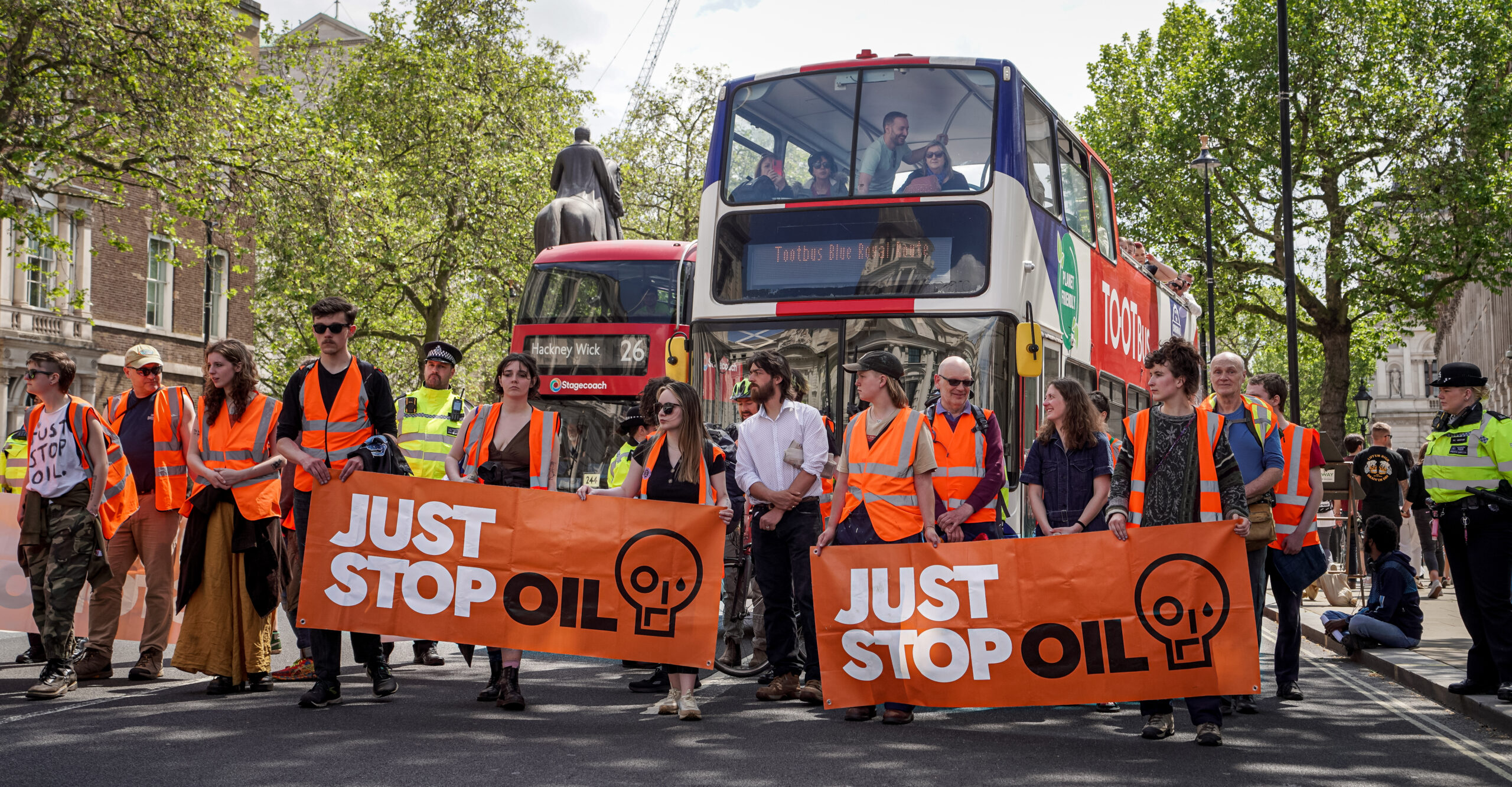
“Just Stop Oil Activists Walking Up Whitehall” by Alisdare Hickson is licensed under CC BY-SA 2.0 

 .
.
[Cressida] Gethin is a 22-year-old music student who, among other things, clambered on to a gantry over the M25 in 2022. In doing so, she ruined the trips of 4,000 airline passengers. Whether swinging from gantries or attempting to destroy great art, these young people have the air of never having heard the word “No”.
Why are the climate fanatics all so posh? The Just Stop Oil activists are always called Cressida or Amy Rugg-Easey or Indigo Rumbelow. (Rumbelow has inspired an amusing Twitter game called Find Your Silly Posh Girl Name “by combining a colour with a defunct shop”.) In this, JSO is simply carrying on the glorious tradition of Extinction Rebellion, the leading lights of which had such names as Robin Ellis-Cockcroft and Robin Boardman-Pattinson.
Infamously, Boardman-Pattinson opined in 2019 that “air travel should only be used in emergencies”, despite having been on a number of skiing trips that very year, which he had foolishly posted on social media. It’s no wonder Cressida Gethin picked on desperate sun-seekers to make her point. Like the dowager countess in Downton Abbey who once asked, “What is a weekend?”, posh people who do nothing find it hard to understand what a holiday means to ordinary folk.
Like aristocrats down the ages, these posh clowns get together and breed new generations of clowns. Trans activist Riz Possnett, who glued her hands to the floor of the Oxford Union to protest against feminist Kathleen Stock last year, is the daughter of Extinction Rebellion activist Robert Posnett. He has been arrested several times for making a nuisance of himself. He once glued himself to a Brexit Party bus. The bananas don’t fall far from the tree in this family’s case.
Posnett was once a member of a “band” called Working Class Broccoli, even though her father is a wealthy businessman and her mother is the chief executive of South Cambridgeshire district council. They live in a five-bedroomed house, complete with a swimming pool, in a Suffolk village. Who could blame Tory MP Sir John Hayes, chairman of the Common Sense Group, for opining to the Telegraph that Riz had “gone off the rails” because she hailed from a “deranged bourgeois liberal family, blinded by privilege”?
The privileged have always been drawn to ecological concerns – as I wrote of King Charles many moons ago: “It’s easy for the rich to be Friends of the Earth – it’s always been a good friend to them.” Environmentalism gives our rulers a new way to corral and control hoi polloi now that the old ways of pushing us around are deemed unprogressive.
It is striking that only white people of a certain class and level of over-education enjoy making commuters’ lives a misery. And it is heartening that the people pleading with them to get out of the way are of every colour, creed and class imaginable. Think of the rousing attempts by a crowd to pull a pair of XR clowns from the roof of a rush-hour commuter train (electric!) in Canning Town back in 2019. Or take the summer of 2023, when Stratford schoolchildren were seen remonstrating with Just Stop Oil for making them late to lessons, in some cases ripping protesters’ banners from their hands.
A hastily deleted tweet by XR, comparing its activists to Rosa Parks, probably wasn’t the cleverest move. Not least as every climate-change protest is so overwhelmingly white that it makes the Lib Dem party conference look like the Notting Hill Carnival.
Comments Off on “Why are the climate fanatics all so posh? The Just Stop Oil activists are always called Cressida or Amy Rugg-Easey or Indigo Rumbelow”
The Royal Navy ballistic missile submarine commander’s “Letter of Last Resort”
Britain’s Royal Navy always has a nuclear submarine — currently one of the Vanguard-class — at sea with a unique mission … stay undetected to ensure the survival of Britain’s nuclear deterrent in the form of the boat’s live nuclear weapons. Ned Donovan reposted an article on the mission orders each sub commander has locked in a safe for the duration of the mission:
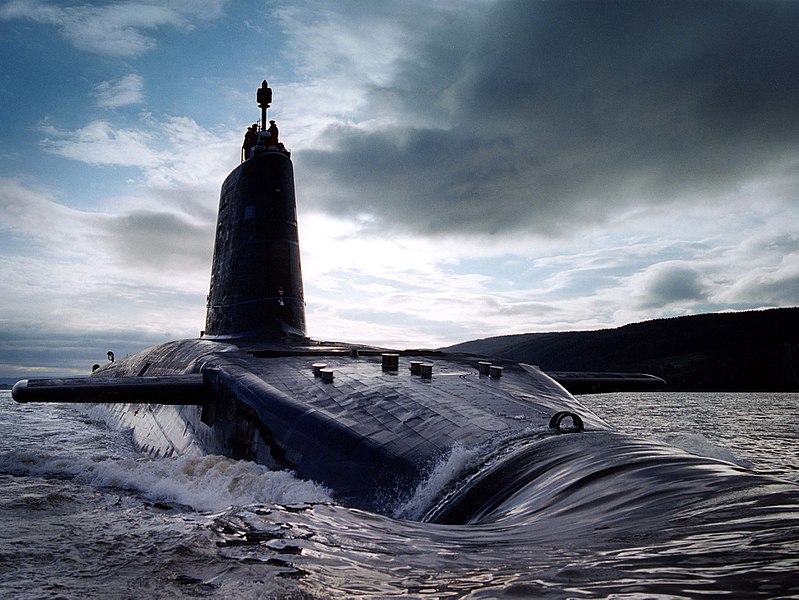
HMS Victorious, a Vanguard-class ballistic missile submarine in the Clyde estuary on transit to base at Faslane on 8 December, 2003.
Photo: LA(phot) Mez Merrill/MOD via Wikimedia Commons
Somewhere out in the North Atlantic, every hour of the day, every day of the year, a lone submarine glides through the ocean with no real destination. Since 1969, one of the four boats of the UK’s Continuous At-Sea Submarine Deterrent has always been on patrol. Its location is known to only a handful, even many of her crew will have no idea where they are.
While many Royal Navy captains hold responsibility for their crew, Trident submarine commanders also bear a far more macabre role: the duty to play Britain’s final political and diplomatic hand possible. Within the bowels of each boat lays two safes, an outer and an inner, and within that inner safe sits the letter of last resort.
One of the first tasks of the Cabinet Secretary on the appointment by the Queen of a new prime minister, is to have the new leader write that very letter.
After the elation of an election victory, the civil servant informs the politician that this letter will lay out the action the prime minister wishes to take, should the government and chain of command be totally destroyed by nuclear attack. Tony Blair, according to his cabinet secretary, was said to have gone “quite white” on being told of his options.
Options do allow a great deal of latitude, with varying degrees of widespread destruction of human life:
- Retaliate with nuclear weapons without prejudice.
- Do not retaliate at all.
- Allow the commander to act within his own discretion.
- Place the boat under the control of an allied navy, specifically the Royal Australian Navy or US Navy.
Given some time alone, the prime minister is requested to decide and write it in a letter addressed to the commanders of each of the Vanguard-class submarines in the navy. The message is then sealed in an envelope and sent to be placed into the boats’ safes. So far, none of these missives have been opened, and the letters are burned at the end of each premier’s term.
The only prime minister to comment openly on their orders was Lord Callaghan in an interview with historian Peter Hennessy:
If it were to become necessary or vital, it would have meant the deterrent had failed, because the value of the nuclear weapon is frankly only as a deterrent. But if we had got to that point, where it was, I felt, necessary to do it, then I would have done it. I’ve had terrible doubts, of course, about this. I say to you, if I had lived after having pressed that button, I could never ever have forgiven myself.
To get to the stage where the letters can be opened is a long and purposefully difficult journey. First, the prime minister must have perished or become incapacitated in some way. Then, his proposed alternate decision makers would had to have met the same fate. It is only after that point that the submarine commanders go anywhere near their safes.
Updated to fix broken link.
Comments Off on The Royal Navy ballistic missile submarine commander’s “Letter of Last Resort”
The Gun Science Says Can’t Work – Madsen LMG Mechanics
Forgotten Weapons
Published 21 Nov 2023The Madsen LMG is generally considered an extremely complex and confusing system — but is it really? Today we are taking one apart to see just how it actually works. Because in fact, it’s a very unusual system, but not really any more complicated than any other easy self-loading action.
(more…)
Comments Off on The Gun Science Says Can’t Work – Madsen LMG Mechanics
February 22, 2024
Trump’s crude, threatening rhetoric on NATO’s cheapskates is … right
In The Line, Philippe Lagassé joins all right-thinking people in condemning Donald Trump’s campaign trail threats to not defend NATO’s freeloaders if they’re attacked by, say, Vladimir Putin:
Donald Trump recently called into question the core principle of the North Atlantic Treaty Organization (NATO). As a collective defence alliance, NATO operates on the principle that an attack against one member is an attack against all. This principle is enshrined in Article 5 of the NATO agreement. Although Article 5 allows each ally to respond as they see fit, there’s an understanding that allies have an obligation to defend each other.
On the campaign trail, Trump declared that, if elected, he wouldn’t defend NATO allies if they’ve failed to spend two per cent of their Gross Domestic Product (GDP) on defence. Not only that, he said he’d encourage Russia to attack these allies. As Trump reiterated last week: “Look, if they’re not going to pay, we’re not going to protect, okay?” These comments raised serious concerns within NATO. Jens Stoltenberg, NATO Secretary General, warned that Trump is striking at the underlying logic of the alliance. The Secretary General stressed that “We should not undermine the credibility of NATO’s deterrent”.
What should we make of Trump’s threat? On the one hand, it’s clearly dangerous and evidence that a second Trump presidency could shake the foundations of the alliance. We should rightly be worried and condemn such reckless rhetoric. On the other hand, this is classic Trump. His approach to international politics can best be understood as “mobster diplomacy”. He demands personal loyalty as the head of the “family” of Western liberal democracies. When it comes to trade deals, he echoes Don Corleone in making offers that partners can’t refuse. As for alliances, he sees them as a protection racket. When it comes to NATO allies, his message is simple and direct: “Nice country you have there … pity if something happened to it”.
Allied leaders and academics can protest that the two per cent target isn’t a payment to the United States; it’s a measure of the relative amount allies spend on their own militaries, not a fee they owe Washington. While true, it’s a waste of breath to point this out. Trump and his supporters don’t care. They see most allies as freeloaders who’ve been coasting on American military power for too long. And you know what? They’re not wrong. That’s the rub for those who are understandably horrified by Trump’s comments. Far too many NATO allies, including Canada, have been content let the United States carry a heavy defence spending burden, while we focus on other priorities. That’s what Trump is ultimately getting at here, however menacingly.
Canada has been particularly unwilling to pay its agreed share, actually cutting the military budget late last year while many of our European allies were increasing theirs. We’re habitually the ones who slip out of the room when it’s our turn to buy a round, militarily speaking.
Comments Off on Trump’s crude, threatening rhetoric on NATO’s cheapskates is … right
The Malayan Emergency – Britain’s Jungle War v Communists
The History Chap
Published Nov 16, 2023Britain’s Victorious Jungle War Against the Communists
Get My FREE Weekly Newsletter
https://www.thehistorychap.com
Comments Off on The Malayan Emergency – Britain’s Jungle War v Communists
February 21, 2024
Greek History and Civilisation, Part 3 – The Ancient Greeks: Rising Tensions with Persia
seangabb
Published Feb 18, 2024This third lecture in the course deals with the rise of the Persian Empire, and the growing tensions between the Persians and the Greeks, culminating in an account of the Battle of Marathon in 490 BC.
(more…)
Comments Off on Greek History and Civilisation, Part 3 – The Ancient Greeks: Rising Tensions with Persia


