
[The Franco-Prussian War] is generally considered the magnum opus of the titanic Prussian commander, Field Marshal Helmuth von Moltke. Exercising deft operational control and an uncanny sense of intuition, Moltke orchestrated an aggressive opening campaign which sent Prusso-German armies streaming like a mass of tentacles into France, trapping the primary French field army in the fortress of Metz in the opening weeks of the war and besieging it. When the French Emperor, Napoleon III, marched out with a relief army (comprising the rest of France’s battle-worthy formations), Moltke hunted that army down as well, encircling it at Sedan and taking the entire force (and the emperor) into captivity.
From an operational perspective, this sequence of events was (and is) considered a masterclass, and a major reason why Moltke has become revered as one of history’s truly great talents (he is on this writer’s Mount Rushmore alongside Hannibal, Napoleon, and Manstein). The Prussians had executed their platonic ideal of warfare — the encirclement of the main enemy body — not once, but twice in a matter of weeks. In the conventional narrative, these great encirclements became the archetype of the German kesselschlacht, or encirclement battle, which became the ultimate goal of all operations. In a certain sense, the German military establishment spent the next half-century dreaming of ways to replicate its victory at Sedan.
This story is true, to a certain extent. My objective here is not to “bust myths” about blitzkrieg or any such trite thing. However, not everyone in the German military establishment looked at the Franco-Prussian War as an ideal. Many were terrified by what happened after Sedan.
By all rights, Moltke’s masterpiece at Sedan should have ended the war. The French had lost both of their trained field armies and their head of state, and ought to have given in to Prussia’s demand (namely, the annexation of the Alsace-Lorraine region).
Instead, Napoleon III’s government was overthrown and a National Government was declared in Paris, which promptly declared what amounted to a total war. The new government abandoned Paris, declared a Levee en Masse — a callback to the wars of the French Revolution in which all men aged 21 to 40 were to be called to arms. Regional governments ordered the destruction of bridges, roads, railways, and telegraphs to deny their use to the Prussians.
Instead of bringing France to its knees, the Prussians found a rapidly mobilizing nation which was determined to fight to the death. The mobilization prowess of the emergency French government was astonishing: by February, 1871, they had raised and armed more than 900,000 men.
Fortunately for the Prussians, this never became a genuine military emergency. The newly raised French units suffered from poor equipment and poor training (particularly because most of France’s trained officers had been captured in the opening campaign). The new mass French armies had poor combat effectiveness, and Moltke managed to coordinate the capture of Paris alongside a campaign which saw Prussian forces marching all over France to run down and destroy the elements of the new French Army.
Big Serge, “The End of Cabinet War”, Big Serge Thought, 2023-11-30.
March 7, 2024
QotD: Helmuth von Moltke’s Kabinettskriege of 1870
March 6, 2024
You had me at “Cartchy tuns, exarserdray lollipops” and “a pasadise of sweet teats”
Charlie Stross checks in with a Willy Wonka-adjacent story from Glasgow that utterly failed to live up to the billing:
This is no longer in the current news cycle, but definitely needs to be filed under “stuff too insane for Charlie to make up”, or maybe “promising screwball comedy plot line to explore”, or even “perils of outsourcing creative media work to generative AI”.
So. Last weekend saw insane news-generating scenes in Glasgow around a public event aimed at children: Willy’s Chocolate Experience, a blatant attempt to cash in on Roald Dahl’s cautionary children’s tale, Willy Wonka and the Chocolate Factory. Which is currently most prominently associated in the zeitgeist with a 2004 movie directed by Tim Burton, who probably needs no introduction, even to a cinematic illiterate like me. Although I gather a prequel movie (called, predictably, Wonka), came out in 2023.
(Because sooner or later the folks behind “House of Illuminati Ltd” will wise up and delete the website, here’s a handy link to how it looked on February 24th via archive.org.)
INDULGE IN A CHOCOLATE FANTASY LIKE NEVER BEFORE – CAPTURE THE ENCHANTMENT ™!
Tickets to Willys Chocolate Experience™ are on sale now!
The event was advertised with amazing, almost hallucinogenic, graphics that were clearly AI generated, and equally clearly not proofread because Stable Diffusion utterly sucks at writing English captions, as opposed to word salad offering enticements such as Catgacating • live performances • Cartchy tuns, exarserdray lollipops, a pasadise of sweet teats.* And tickets were on sale for a mere £35 per child!
Anyway, it hit the news (and not in a good way) and the event was terminated on day one after the police were called. Here’s The Guardian‘s coverage:
The event publicity promised giant mushrooms, candy canes and chocolate fountains, along with special audio and visual effects, all narrated by dancing Oompa-Loompas — the tiny, orange men who power Wonka’s chocolate factory in the Roald Dahl book which inspired the prequel film.
But instead, when eager families turned up to the address in Whiteinch, an industrial area of Glasgow, they discovered a sparsely decorated warehouse with a scattering of plastic props, a small bouncy castle and some backdrops pinned against the walls.
Anyway, since the near-riot and hasty shutdown of the event, things have … recomplicated? I think that’s the diplomatic way to phrase it.

Venezuelan FN49: The First FN49 Contract
Forgotten Weapons
Published Dec 1, 2023Venezuela was the first nation to purchase the FN-49 rifle, before even the Belgian military. In fact, the Venezuelan contract was signed in 1948, before the “FN-49” designation was even in place. Venezuela bought a total of 8,012 rifles in two batches — 4,000 rifles plus 12 cutaway training examples delivered in 1949 and a further 4,000 more rifles delivered in June 1951. All of them included the integral muzzle brake and scope mounting cuts, although no scopes were ever procured. They were all semiautomatic models.
Some of the rifles were issued and used, but some appear to have remained in depots their entire life. Venezuela was also an early adopter of the FAL, and the FN-49 was only used for a short time. In 1966, all of them (or virtually all) were sold as surplus to InterArms, and brought onto the US collector market.
(more…)
March 5, 2024
The 1st Punic War – Corvus, Rams and Drachma
Drachinifel
Published Sep 13, 2023Today we take a look at the strategy and shipping of the 1st Punic War with expert Bret Devereaux!
(more…)
March 3, 2024
Allied Deception Surrounds Japanese in Burma – WW2 – Week 288 – March 2, 1945
World War Two
Published 2 Mar 2024Bill Slim’s master plan is near fruition and the Japanese are surrounded at Meiktila in Burma. The Allies have also nearly cleared Manila on Luzon, but the fighting on Iwo Jima is just growing in intensity. In Europe, the Soviets are still on the move in Poland, though attacking now to the north, but in Hungary it’s the Germans who are making plans for a new offensive. The big news on the Western Front is the Allies reaching the Rhine, though how they’ll cross that mighty river is anyone’s guess.
(more…)
Argentine Brass Maxim: A Machine Gun of the Steampunk Age
Forgotten Weapons
Published Nov 29, 2023The Maxim Gun was the first successful true machine gun, and it became extremely popular worldwide. Maxim sent his first two working models to Enfield for testing in 1887, and by 1889 he had what he termed the “World Standard” model. No two contracts were quite identical, as the gun was constantly being tweaked and improved, but the 200 guns sold to Argentina in 1895 (50), 1898 (130) and 1902 (20) are a great time capsule into the configuration of the early Maxim guns in military service.
The Argentine Maxims had gorgeous brass jackets, along with ball grips, triggers, feed blocks, and fusee spring covers. The have the early 1889 pattern lock, complete with a walnut roller to assist belt feeding into the action. These guns were in Argentine military service until 1929 (which included a retrofit at DWM in 1909 to use the new Spitzer 7.65mm Mauser cartridge). They then passed into police use until 1956, and 91 were sold to Sam Cummings of InterArms in 1960. Of those, 8 were exported out of the US, 28 went to government agencies and museums, and the remaining 55 were sold onto the US collector market. They are the single largest group of early Maxims in the country today, and make fantastic collectors’ pieces.
(more…)
QotD: The pushback against EVs
Don’t think me a luddite – EVs are lovely in their own right. Smooth, brisk and easy to drive, there is a certain serenity in piloting a battery-powered vehicle. But EVs don’t exist in isolation. Instead, they are competing with a century of petrol and diesel power that has established cars as providers of comfort, freedom and convenience. And while the quiet nature of an EV arguably brings more comfort than an engine, batteries offer so much less freedom and convenience than fuel tanks as to barely be worth comparing.
My old diesel Mercedes, for instance, cost £4,000 and could go from London to Aberdeen, and most of the way back, on a single tank of fuel. A typical EV would need to recharge at least twice – just on the way up. This would add perhaps 90 minutes to the journey, assuming the public plugs were working and conveniently located. That, in my book, makes an EV demonstrably inconvenient. And cries of “how often do you drive to Aberdeen?” don’t hold water, because the freedom cars bring is absolutely intrinsic to their appeal. Perhaps tomorrow I get the urge to cross the Bridge of Dee; perhaps it’s none of your business. That’s freedom for you, and EVs curtail it.
Hugo Griffiths, “Why the public isn’t buying electric cars”, Spiked, 2023-11-20.
March 2, 2024
Crossing the Irrawaddy
Dr. Robert Lyman is on a visit to the site of a very significant event in the battle for Burma in 1945:
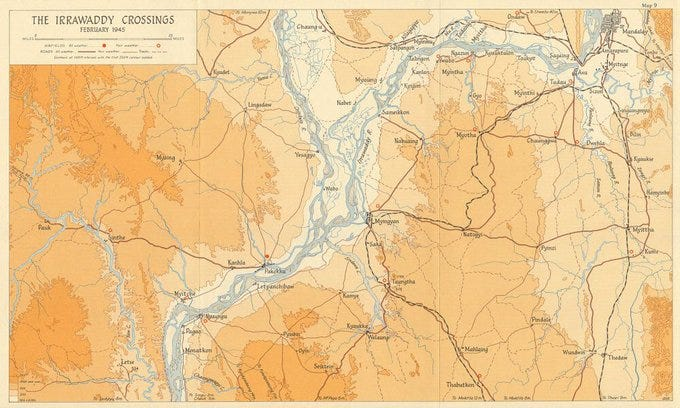
On 13-14 February 1945, 79-years ago this month the 7th Indian Division commanded by Major General Geoffrey Evans secured crossings over the Irrawaddy at Pakkoku and Nyaung-U/Bagan. The northern crossing (Pakkoku) was designed to allow Punch Cowan’s 17th Indian Division, and the Sherman tanks of 255 Indian Tank Brigade, to race across country to seize Meiktila. The southern ones, at Nyaung-U and Bagan (a few miles to the south still), were designed to prevent the enemy from interfering with the operations against Meiktila, and to make him believe that securing the Irrawaddy as a route to Rangoon — and not Meiktila — was Slim’s primary objective. In 2005, for the 60th anniversary of the Irrawaddy crossings, I was privileged to walk the battlefield with three veterans of these crossings, John Chiles (Probyn’s Horse), Manny Curtis (South Lancashire Regiment) and Bert Wilkins (RA, in support of the South Lancs). During that trip we travelled along the Irrawaddy from Bagan, anxiously scouring the maps in the South Lancs’ War Diary searching for B4 beach, where on the early morning of 14 February 1945 two hundred men of 2nd Battalion South Lancashire Regiment had rowed silently across the river to form the vanguard of the 7th Indian Division beachhead. I remember vividly the excitement as we found B4 — it was much easier than I had thought — disembarked from the boat and climbed to the top of the cliffs to find old trenches from the battle. It was an emotional event for the veterans as they recalled the battle and found trenches left by the defenders decades before.
At Nyaung-U the first wave of a company of the 2nd Bn South Lancs (including Manny Curtis) managed to seize the high ground above B4 in the early morning of 14 February. It was the longest opposed river crossing in any theatre of the Second World War. The beaches had been recced by a Sea Reconnaissance Unit and a Special Boat Section. However, subsequent waves of troops from the remainder of the South Lancs, the 4th Battalion 14th Punjab Regiment and the 4th Battalion 1st Gurkha Rifles were mauled by enemy machine gun fire as the leaky canvas boats and temperamental outboard motors failed to cope with the distance they had to cover and the strength of the river’s flow. The enemy? Pagan and Nyaungu were defended not by the Japanese but by three battalions of the Indian National Army’s 4th Guerrilla Regiment, some 2,000 men in well-sited positions overlooking the Irrawaddy. This was the only major engagement of the war when troops of the Indian Army fought in direct combat against the INA. To subdue the enemy positions causing casualties on the water, Sherman tanks of the Gordon Highlanders sniped the enemy positions, and an artillery bombardment by 25-pdrs and a Hurribomber strike pummelled the east bank of the river. Together these actions succeeded in forcing the INA to surrender. Further to the west, at Pagan, the INA’s 9th Battalion took a heavy toll of the assaulting 1/11th Sikh Regiment, before they withdrew to Mount Popa to the rear. River crossing are dangerous, especially for troops with little training in boatmanship, across one of the world’s greatest rivers. But this time the 7th Indian Division succeeded with little training or preparation. By the end of the day the east bank was in its hands. Amazingly, a cinematographic unit were available to film some of the crossings at Nyaung-U. An 8-minute reel of the landings can be seen in the IWM on JFU35.
Today I was able to revisit B4. Not much had changed in nearly 20-years. The size of the Irrawaddy even in the dry season is astonishing, the task given to the men of 33 Brigade enormous. In 2005 we climbed the cliffs that Manny and his friends had raced up in 1945. Looking at them again today, I realised just how Gallipoli-like was the terrain. In the hands of of better trained enemy, 33 Brigade should never have managed to get off the beachhead. Rippling rows of gullies flow behind the initial landing site: if these had all been defended, a position of great depth and near impregnability could have been achieved. These photos look down on B4 and across to the position up which the men of 2nd South Lancs scrambled.
The Hindenburg Disaster – Dining on the Zeppelin
Tasting History with Max Miller
Published Nov 28, 2023Decadent vanilla rice pudding with poached pears, chocolate sauce, and candied fruit
City/Region: France
Time Period: 1903Everything about this dish exudes fanciness, and it comes as no surprise. A ride across the Atlantic on the Hindenburg cost around $9,000 in today’s money, and the whole experience was meant to be luxurious. The head chef on the Hindenburg, Xaver Maier, had worked at the Ritz Hotel in Paris, which was still cooking from the recipes of Auguste Escoffier.
The Escoffier recipe for pears condé seems simple enough, until you realize he references about 5 other recipes in total in order to make the dish. It’s a lot of work, but it’s so good. The rice pudding has such an intense vanilla flavor that really elevates it and is the perfect base for the poached pears. Don’t get too much of the rich chocolate sauce or it will overwhelm the other flavors.
Really you could make just the rice pudding and have that be a fancy dessert all on its own if you don’t want to go to all the fuss.
Poires Condé:
Very small pears which are carefully peeled and shaped are most suitable for this preparation. Those of medium size should be cut in half. Cook them in vanilla-flavored syrup then proceed as for Abricots Condé, recipe 4510.
Abricots Condé:
On a round dish prepare a border of vanilla-flavored Prepared Rice for sweet dishes (recipe 4470)— Auguste Escoffier, 1903
March 1, 2024
Was JUNO BEACH The Deadliest On D Day? | Canadian Army | Normandy WW2
The History Explorer
Published Oct 27, 2023During the invasion of Fortress Europe the casualty figures sustained on Omaha beach were terrifying; approximately 2,500 US casualties were sustained of which around 800 were killed, depending on which source you use. The ratio was said to be 1 in 19 soldiers would become a casualty.
But it was at Juno beach where the fighting Canadians landed that the casualties were 1 in 18. The fighting on Juno beach resembled modern urban warfare – silencing fortified residential houses, clearing rooms and bunker busting. So was this the more deadly beach? This is the story, of Juno beach and the brave sons of Canada.
On June 6th, 1944, the 3rd Canadian Infantry Division and the 2nd Armoured Brigade were tasked with establishing a bridgehead on the beach codenamed “Juno”. This was an eight-kilometre long stretch of beach between Sword beach to the East and Gold beach to the West.
Come with me as we walk the beaches and take a look at what made this beach so well defended.
(more…)
February 29, 2024
Ukraine asks for mothballed Canadian missiles that should have been destroyed 20 years ago
In The Line, Alex McColl makes a case against granting a Ukrainian request for obsolete CRV7 70mm air-to-ground rockets:
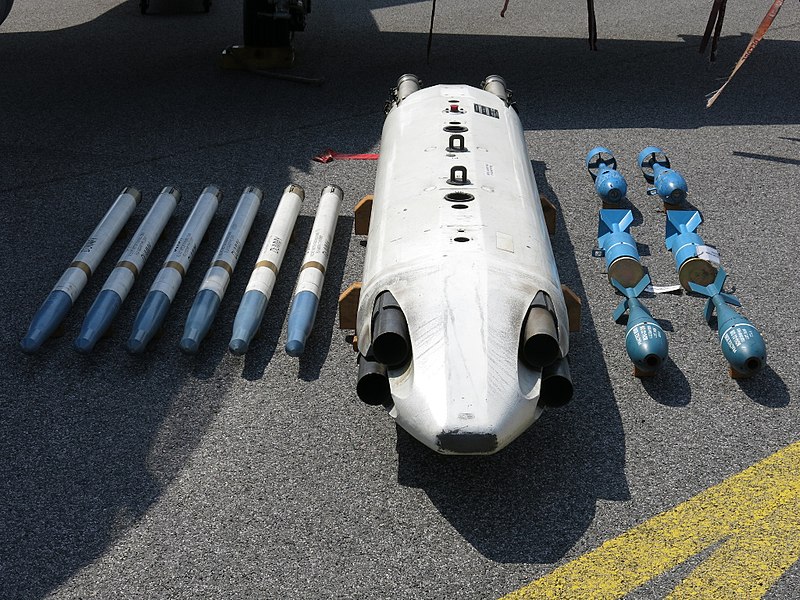
An SUU-5003 bomblet dispenser with six CRV7 air-to-ground rockets (left) and six BDU-33 bombs (right).
Photo by Boevaya mashina via Wikimedia Commons.
Canadian parliamentary committees — and even the leader of the official opposition — are endorsing a request by the Ukrainian military to send that beleaguered country thousands of mothballed rockets that have not been adequately stored or maintained. The plan has received nothing but approval from Canadians; however, according to multiple sources I have interviewed, the rockets in question are probably useless. In a worst case scenario, a few could go off and hurt or kill the Ukrainians trying to jury rig them into a short-range rocket artillery weapon.
This is about Canada’s stockpile of expired CRV7 rocket motors, which were slated for environmentally responsible disposal twenty years ago. Despite this, these weapons are being requested by the Ukrainian military, which is desperate for any kind of munitions as the war with Russia drags on.
[…]
During the Cold War, the Canadian-made CRV7 was one of the best 70mm NATO rockets thanks to its powerful motor, high speed, and consistent accuracy. It was carried by NATO fighter jets and attack helicopters. In the early 1970s, it could outrange most Soviet short-range man-portable surface-to-air missiles (MANPADS), giving pilots an advantage in air-to-ground missions. Our pilots could shoot at the bad guys from far enough away that the bad guys couldn’t shoot back.
That was then. Today, surface-to-air weapons have advanced to the point where unguided rocket attacks are rarely worth the risk, which is why these rockets were retired 20 years ago.
One of the CAF officers I interviewed reached out again the next day to get in the final word. Here’s what I was told:
“In general, I’d say that the phase when donating from existing inventory was relevant ended in early 2023. Canada has donated many useful things, but focussed on what Canadian industry can provide, not what Ukraine desperately needs. Unarmed ACSVs and drone cameras are useful, but Ukraine needs predictable and reliable supplies of battle decisive munitions, most of all air defence missiles and artillery ammunition. The conversation Canada should be having isn’t about rotten surplus, but how we support new production of key ammunition, ideally at home but ultimately whoever we can fund to get it to Ukraine fastest.”
I couldn’t agree more.
Hotchkiss Portative: Clunky But Durable
Forgotten Weapons
Published Nov 27, 2023The Portative was an attempt by the Hotchkiss company to make a light machine gun companion to their heavy model (which had found significant commercial success). The Portative used the same feed strips, albeit loaded upside down, and the same gas piston operation, but a very different locking system. Instead of a tilting locking block the Portative had a “fermeture nut” that rotated to lock onto the bolt with three sets of interrupted thread locking lugs. In addition, many of the traditionally internal parts were mounted externally on the Portative, and it was quite the awkward gun to use.
The Portative was adopted by the American Army as the Model 1909 Benet-Mercié, and by the British early in World War One as a cavalry and tank-mounted gun. The remainder of Portative contracts were relatively small from second-tier military forces, including several South American countries.
(more…)
February 28, 2024
V-2: Hitler’s Wunderwaffe
World War Two
Published 27 Feb 2024Hitler hopes that the V-2 rocket will turn the tide of the war. It’s cutting edge technology and impossible to intercept. Right now, the first long-range ballistic missile is raining death on London and Antwerp. But is it too little, too late? Find out the backstory to this powerful weapon.
(more…)
Why Germany Lost the First World War
The Great War
Published Nov 10, 2023Germany’s defeat in the First World War has been blamed on all kinds of factors or has even been denied outright as part of the “stab in the back” myth. But why did Germany actually lose?
(more…)


