
As I pass through my incarnations in every age and race,
I make my proper prostrations to the Gods of the Market Place.
Peering through reverent fingers I watch them flourish and fall,
And the Gods of the Copybook Headings, I notice, outlast them all.We were living in trees when they met us. They showed us each in turn
That Water would certainly wet us, as Fire would certainly burn:
But we found them lacking in Uplift, Vision and Breadth of Mind,
So we left them to teach the Gorillas while we followed the March of Mankind.We moved as the Spirit listed. They never altered their pace,
Being neither cloud nor wind-borne like the Gods of the Market Place,
But they always caught up with our progress, and presently word would come
That a tribe had been wiped off its icefield, or the lights had gone out in Rome.With the Hopes that our World is built on they were utterly out of touch,
They denied that the Moon was Stilton; they denied she was even Dutch;
They denied that Wishes were Horses; they denied that a Pig had Wings;
So we worshipped the Gods of the Market Who promised these beautiful things.When the Cambrian measures were forming, They promised perpetual peace.
They swore, if we gave them our weapons, that the wars of the tribes would cease.
But when we disarmed They sold us and delivered us bound to our foe,
And the Gods of the Copybook Headings said: “Stick to the Devil you know.”On the first Feminian Sandstones we were promised the Fuller Life
(Which started by loving our neighbour and ended by loving his wife)
Till our women had no more children and the men lost reason and faith,
And the Gods of the Copybook Headings said: “The Wages of Sin is Death.”In the Carboniferous Epoch we were promised abundance for all,
By robbing selected Peter to pay for collective Paul;
But, though we had plenty of money, there was nothing our money could buy,
And the Gods of the Copybook Headings said: “If you don’t work you die.”Then the Gods of the Market tumbled, and their smooth-tongued wizards withdrew
And the hearts of the meanest were humbled and began to believe it was true
That All is not Gold that Glitters, and Two and Two make Four
And the Gods of the Copybook Headings limped up to explain it once more.As it will be in the future, it was at the birth of Man
There are only four things certain since Social Progress began.
That the Dog returns to his Vomit and the Sow returns to her Mire,
And the burnt Fool’s bandaged finger goes wabbling back to the Fire;And that after this is accomplished, and the brave new world begins
When all men are paid for existing and no man must pay for his sins,
As surely as Water will wet us, as surely as Fire will burn,
The Gods of the Copybook Headings with terror and slaughter return!Rudyard Kipling, 1919.
August 10, 2024
QotD: “The Gods of the Copybook Headings”
August 9, 2024
Domicidal maniacs in charge
Lorenzo Warby provides an oh-so-useful word to accurately capture what the diversity-at-all-costs elites running most western countries these days are actually up to:
Domicide is the destruction of home. It comes in the “hard” version — the physical destruction of houses and infrastructure.
Domicide also comes in a “soft” version — flooding localities with new people, separating people from, and otherwise degrading, their heritage. When folk say Britain is becoming “unrecognisable”, it is the domicidal effect of mass migration they are referring to.
The UK is suffering from a domicidal elite, one that uses mass migration to break up working-class communities; asymmetric multiculturalism to elevate incoming cultures over those of native English (the Celtic fringe get minority brownie points); favours non-“white” faces in advertising; asymmetric race-swapping in entertainment against the native English; denigration of British history as racist, white supremacist, imperialist, colonialist, etc.
Much of this is insulting virtue-signalling allied to, or presenting, cartoonish (simplified) and caricature (distorted) history. It all undermines social cohesion. But it is the use of migration policy as a systematic weapon against the resident working class which does the most damage. Though two-tier policing — obviously treating Muslims in particular with a deference not shown to the natives, especially when it comes to policing speech — is also highly corrosive of social cohesion.
Many working-class communities in Britain were already fairly dysfunctional — though the British state is not innocent in those dysfunctions1 — and sections of the British working class are very far from admirable. None of this justifies the use of mass migration to make things worse for such folk, however much it may help to explain the moralised class contempt that underlies so much of modern progressivism and modern managerialism.
To improve such things, to “level up”, requires a strong sense of how to create and maintain social order. Modern progressivism is strongly antipathetic to such understanding. To “level up” also requires a strong sense of custodianship, which managerialism typically lacks: particularly progressivist managerialism.
Indeed, modern feminist, progressivist, managerialism—in its lack of custodianship; lack of social solidarity;2 in its antipathy to taking the problems of social order seriously — is running the British state into the ground. The post-medieval British aristocratic and mercantile elite did a much better job of state management. But those elites had mechanisms — such as duelling, that forced men to defend their reputation at the risk of their life, and grand country houses, that turned into expensive investments in social isolation if you behaved badly — that selected for character.
Nowadays, the British elite only selects for capacity and even that is being degraded by DEI undermining the signals of competence. It turns out, over the longer term, character matters more than capacity. For capacity without character selects for manipulative, anti-social personalities that degrade institutions over time.
1. For a particularly brutal depiction in fiction of the dysfunctional British welfare state — especially its school system — see Christopher Nuttall’s Mystic Albion series, especially the first book.
2. Feminisation of institutions and discourse has tended to degrade social solidarity, see Benenson et al, 2009. The most conspicuous example of this in the UK is how uncouth it is in elite circles to mention the systematic rape and sexual exploitation of underage working class girls by overwhelmingly Muslim gangs.
August 8, 2024
The Korean War Week 007 – The Pusan Perimeter – August 6, 1950
The Korean War by Indy Neidell
Published Aug 6, 2024The UN forces are withdrawn this week across the Naktong River into a new defensive zone in the Southeast corner of the Peninsula — the Pusan Perimeter, but already as the week begins they are in great danger from the right hook near the coast by the North Korean 6th Division, that threatens to upend everything, taking Chinju and aiming for Masan. There are also machinations afoot with the Chinese in Taiwan, and the fear that a larger war could erupt if things aren’t handled right concerning the Chinese; it’s a week full of tension.
(more…)
Panzer III: Versatile stalwart of the Panzer force
The Tank Museum
Published Apr 19, 2024See inside the Panzer III and discover the story of the most numerous German armoured fighting vehicle of World War II.
Intended as the German army’s main gun tank, with its brother, the Panzer IV, acting as support, the Panzer III fought in Europe and North Africa but was effectively obsolete by 1942 in the face of better opposition like the Soviet T-34. So the two changed places – an up-gunned Panzer IV becoming the gun tank with the Panzer III — now with a short barrelled 75mm gun — in the support role. This wouldn’t last long — but the Panzer III chassis would form the basis of the highly successful Stug III.
00:00 | Introduction
00:15 | Background
02:12 | Two Similar Designs
02:57 | Panzer III Designs
10:22 | Take a Look Inside
14:46 | An Interview with Mike Hayton
23:52 | What’s it like to Drive?
26:00 | ConclusionThis video features archive footage courtesy of British Pathé.
#tankmuseum #panzeriii
August 7, 2024
“Two Tier Keir” fails the latest challenge
Violent protests continued in many British cities over the weekend, and despite promising to crack down on violent groups, Prime Minister Sir Keir Starmer fluffed it again:

Young Muslim men rampaging through Birmingham should have offered the government a convenient chance to quash the accusations that the Prime Minister is “Two Tier Keir”.
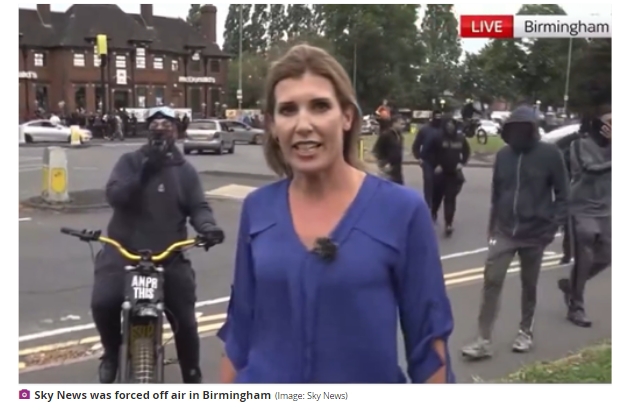
Fuelled by rumours that the far right were organising a protest in the area, the demonstration soon took on a dark life of its own. Young men in balaclavas harassed journalists, driving Sky News’ “communities correspondent” off the air, with an attempt even being made to slash the wheels of the Sky van. LBC’s Fraser Knight was chased out of the area. Mr Knight explained that “6 men ran after us down a road with what looked like a weapon”, and that “cars followed us”. “There wasn’t a safe place for us to go for miles,” he says.
Meanwhile, a white man was attacked outside a pub by a mob of masked men, and attempts were made to stop random drivers. This violence and intimidation, of course, mirrors that which has been perpetrated in riots elsewhere.
But there is a difference. Where were the police in Birmingham? We have seen riot police wielding dogs and batons against the far right, and Keir Starmer was promising that rioters would face the “full force of the law“. In Birmingham, though, the police appear to have acted with a light touch. One officer was recorded apparently dismissing the violence as a “small scuffle“.
Local MP Jess Phillips is famed for her outspoken and combative manner, so one might have expected swift condemnation. (Indeed, given that Phillips was recently bragging about how “unflappable” she is around criminals, it’s a shame she wasn’t there to resolve things.)
Actually, Phillips’ first public response to the disorder was to quote tweet a video of a group of masked men and write:
To be clear all day rumours have been spread that a far right group were coming and it was done entirely to get Muslim people out on the street to drive this content. It is misinformation being spread to create trouble.
Okay, I can believe it. But surely this was time to tell them to disperse and go home? Phillips then quote tweeted Richard Tice MP, who had published a video of the Sky News team being intimidated. “These people came to this location because it has been spread that racists were coming to attack them,” she wrote:
This misinformation was spread entirely to create this content. Don’t spread it MR Tice!
Sure, again, we get it. The gathering was fuelled by misinformation. But when a group of journalists — with a female correspondent, no less — is being intimidated by masked men flashing trigger fingers at the camera, it has clearly evolved into something more hooliganistic. These men were not confronting a skinhead in a “Blood and Honour” t-shirt. They were confronting a woman trying to do her job.
Esmerelda Weatherwax gathers reports from local media in Birmingham over the weekend:
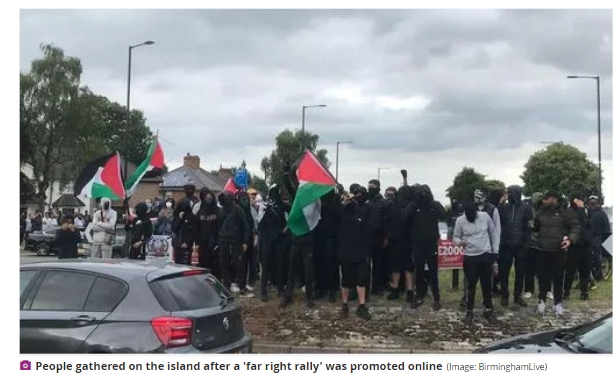
A huge crowd gathered in Bordesley Green this evening following rumours that a “far right rally” was going to take place … hundreds of mostly young men in balaclavas and face masks gathered outside the McDonald’s at the junction of Bordesley Green and Belchers Lane.
300 or so people mostly Asian and male, many dressed in black and wearing masks or coverings, turned up after the rumour spread rapidly online.
Despite the rumours circulating today, there was no rally and the crowd was seen later dispersing, with some young men using the opportunity to show off on motorbikes.
A 45-year-old from Bordesley Green said he was there to stand up against fascism … “We don’t want this portrayed as Muslim men causing trouble …”
Yardley West and Stechford Cllr Baber Baz was among the crowd this evening and said there was a “strong response from the community”. Cllr Baz added: “As long as it remains peaceful which I am sure it will we are sending a strong message to the EDL that they are not welcome here and will not divide our community.”
A Sky News reporter was forced off air after she was sworn at, with one man on a bike riding towards the camera before saying: “Free Palestine, f*** EDL“. A man wearing a balaclava and wielding a knife “stabbed” the tyre of a Sky News van after its reporter was forced off air, it has been reported. Sky News had to cut short its broadcast in Bordesley Green after its reporter was sworn at on TV.
Maxims in the Skies: the German LMG 08/15
Forgotten Weapons
Published Apr 24, 2024As soon as the MG08/15 “light” machine gun was adopted by Germany, it was recognized as an ideal basis for an aircraft gun. Weight was of the essence for WW1 aircraft, and a lightened Maxim was just the thing to use. So the Spandau Arsenal began producing the LMG08/15 (the “L” in which might stand for either air-cooled or lightweight; we really don’t know which) in May 1916. In addition to cutting a ton of lightening slots in the water jacket, the guns also had mechanisms added to allow a pilot to cycle both the bolt and the feed system from behind the gun (something not possible with a standard ground model). The example we are looking at today has a great example of an early style of such device completely intact …
(more…)
QotD: The crew of HMS Sheffield in the Falklands
But it’s 40 years since the Falklands. And from that we get this:
May 4th 1982: As HMS Sheffield is abandoned and the fire spreads towards the Sea Dart ammunition. The remaining crew gather on the foredeck singing “Always look on the bright side of life”.
Now I have heard that story and I’ve always thought it were more than a little bit mythmaking. And yet, and yet. Someone I know (our fathers knew each other, he took a sister out a few times, we worked together for 6 months later on) was actually there. Running the flight control stuff from the next ship over:
Singing led by the FC that we had loaned to them. One of our Sea Kings closed on the fo’c’sle to pick up wounded and saw them all swaying from side to side with their arms outstretched. I learned why when he got back.
I’ll take that as being something that really happened then. Not for publication, not something published for home consumption, but something that actually happened. Young men, on a burning ship, not knowing whether they’d be lifted off before the fire got to the missiles and the kaboom of their little bits all over the South Atlantic. […]
We’re a weird, weird culture here in Britain. We will, and do, take the piss out of absolutely anything, including our own impending death.
Now, whether that’s quite what the economists mean by institutions that aid in economic development is another thing but it is indeed one of those institutions of that British culture.
It’s also wholly glorious but then I’m a Brit so I would say that, wouldn’t I?
Tim Worstall, “The British Are A Very, Very, Weird People”, It’s all obvious or trivial except …, 2024-05-06.
August 6, 2024
Britain’s immigration debate turns violent
At The Last Ditch, Tom discusses how the immigration issue has become the issue in modern Britain:
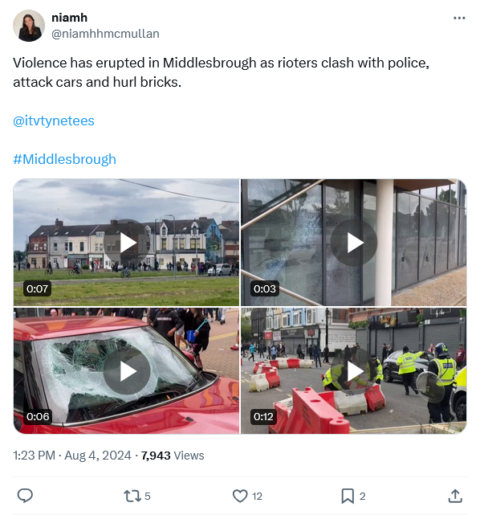
Protest and counter-protest in Middlesbrough over the weekend of August 3-4.
Margaret Thatcher famously quoted Kipling’s Norman and Saxon to President Mitterand of France in an EU meeting;
The Saxon is not like us Normans. His manners are not so polite.
But he never means anything serious till he talks about justice and right.
When he stands like an ox in the furrow – with his sullen set eyes on your own,
And grumbles, “This isn’t fair dealing”, my son, leave the Saxon alone.She was trying, perhaps not as delicately as her diplomats would have wished, to explain how the apparently calm British will react – eventually – to being wronged.
I spent twenty years in three other countries and worked closely in business with people from many more. I have often smiled to myself since returning when I hear British people speak of our unique sense of fair play. It’s not unique at all. Everyone has it. We do not own fairness. We do not own tolerance.
We do, however, traditionally pride ourselves on both and the way we see ourselves has shaped our reactions over the last twenty-five years as we welcomed more immigrants than in the previous two millennia. A few years ago I listened quietly to a Bangladeshi friend – a would-be human rights lawyer – talk about racism in our country. I asked her where in the world was a better place to live as a member of an ethnic minority. On reflection, she agreed with me that there is nowhere.
I am not saying we couldn’t treat each other better. Of course we could and should try. But let’s take a moment, as our streets burn and our elites condemn us as far-right racists, to be proud of how we’ve behaved in general towards so many new arrivals in such a short time.
[…]
One day history may reveal which politician in the capital of an old European empire realised there was a ready supply of workers in the former colonies. People who spoke our languages and were familiar with our systems of government – because both had been forced on their ancestors. It was a perilous idea that may yet prove to be the end of European civilisation but he must have looked like a genius to his peers.
The doors were opened and cheap labour flooded in. From the lofty heights where the elites survey us, it looked like a perfect solution. On the ground, not always so much. Mostly we’ve been welcoming, accepting and tolerant. We’ve sometimes even gone beyond tolerance and flattered our new arrivals that they’ve enhanced our magnificent old culture with their jerk chicken and curries.
Yet already when I was a youngster practising criminal law problems had begun to emerge. A custody sergeant with whom I used to chat when waiting to see clients in the cells told me suicide rates among Muslim girls in our Midlands city were disturbingly high. Asked why that was, he said they were not suicides, but honour killings – the first time I’d heard that phrase. No-one, he said, commits suicide by pouring paraffin over themselves and setting themselves alight. It’s just too painful. Muslim men were killing their daughters and sisters. Asked why there were no prosecutions, he said senior police officers made it clear to their subordinates that it was “racist” to suggest the dead girls’ families’ stories of suicide were untrue.
Fresh out of my university law faculty, I sneered that his bosses were right and he was a racist. I will never forget the last words he said to me;
Young man, then you’re part of the problem.
And I was. In that moment, I’d turned away from murdered women to preserve my smug world view. Just as, decades later, council staff and police officers in cities all over Britain turned away from young girls groomed and raped by Muslim men, for fear of being called bad names.
Gary Fouse in the New English Review asks whatever happened to Merry Olde England:
If you have been following the news out of England for the past week, you might think that the country has all but fallen into civil war. Riots and various forms of violent protests and counterprotests have broken out in cities all over the country in reaction to a shocking murder that occurred in the town of Southport last week. On July 29, a group of little schoolgirls were attending some sort of Taylor Swift-themed dancing class when a 17-year-old son of Rwandan immigrants (who was born in England) attacked them with a knife. Three of the schoolgirls (ages 6. 7, and 9) have died and eight others went to the hospital with serious knife wounds.
The entire nation has erupted in shock and anger. Obviously, the anger is being directed at immigrants in general — given the country’s out of control migration situation and long-simmering tensions with the largely-radicalized Muslim communities. It seems that now-finally — the people have had enough. At least one migrant shelter has been attacked, and several Muslim young men are showing up to counter-protest and do battle with young white men. Now the cops in several cities are trying to keep the two sides apart.
I should state at this point that I will not condone the violence and destruction that is taking place and the objects being thrown at police who are trying to keep order. While I do not condone the violence, I think I can understand why it is taking place. I recall back in the 1960s when there were many riots in inner city areas of the US during the Civil Rights era and in response to the murders of black civil rights leaders like Martin Luther King and Medgar Evers. Many responsible black leaders condemned the violence but also added that they could understand the reasons for it. It was a different era then in America, and in the South, segregation had the force of local laws behind it. Many blacks felt that the government was not responding to their grievances.
[…]
The fact is that far too many nations in the West, including ours, have suffered from bad political leadership. We see it in our cities, we see it in our state capitals, and we see it in Washington DC. Bad political leadership results in bad cities, bad states, and a bad country. The fish rots from the head, and what we need to do-in England-in France, in America, etc is elect responsible people who recognize that their government’s number one duty is to protect the citizens. When a government fails to do so, eventually what happens is what we see in England today.
Me262 – Why It Was Rubbish
HardThrasher
Published Feb 16, 2024A brief and sober discussion of the multi-faceted nature of aircraft development in the 3rd Reich, and an assessment of the aircraft itself in context of the political and organisational challenges and changes from 1939-1945. Or to put it another way, why it was rubbish from start to finish.
Timestamps
00:00 – 00:22 – Trailer
00:22 – 01:49 – Introduction
01:49 – 05:14 – Willy Messerschmitt’s World Falls Apart
05:18 – 08:03 – Udet’s Flying Circus
08:07 – 11:26 – Me262’s Development
11:26 – 11:32 – Popcorn
11:33 – 13:37 – The Me163 Affair
13:42 – 19:30 – Milch Tries to Break His Willy
19:33 – 30:18 – Hitler’s Big Brain Moment
30:21 – 42:03 – Speeds and Feed of the Me262
42:05 – 46:53 – Operational History
46:54 – 48:50 – Survivor’s Club
(more…)
August 4, 2024
Mokusatsu! – WW2 – Week 310 – August 3, 1945
World War Two
Published 3 Aug 2024The Japanese reaction to the Allied ultimatum for unconditional surrender is … mokusatsu. This can be translated several ways, but all involve not giving a response. Meanwhile, materials for atomic bombs to be dropped on Japan are delivered to Tinian, though the ship making the delivery is sunk by a Japanese submarine days afterward. The active war continues in Burma and China, and the Potsdam Conference ends in Germany with the map of Poland very much re-drawn.
00:00 Intro
00:56 Mokusatsu
05:47 Delivering Atomic Material
07:22 Sinking The Indianapolis
09:26 Bombing Japan
12:22 The War In Burma And China
14:07 Potsdam Confernece Ends
17:02 Conclusion
(more…)
Caesar Crosses the Rubicon – Historia Civilis Reaction
Vlogging Through History
Published Apr 22, 2024See the original here – Caesar Crosses the Rubicon (52 to 49 …
#history #reaction
August 3, 2024
The Battle of Lepanto, 7 October 1571
Big Serge looks at the decisive battle between the “Holy League” (Spain, Venice, Genoa, Savoy, Tuscany, the Papal States and the Order of St. John) against the Ottoman navy in the Ionian Sea in 1571:
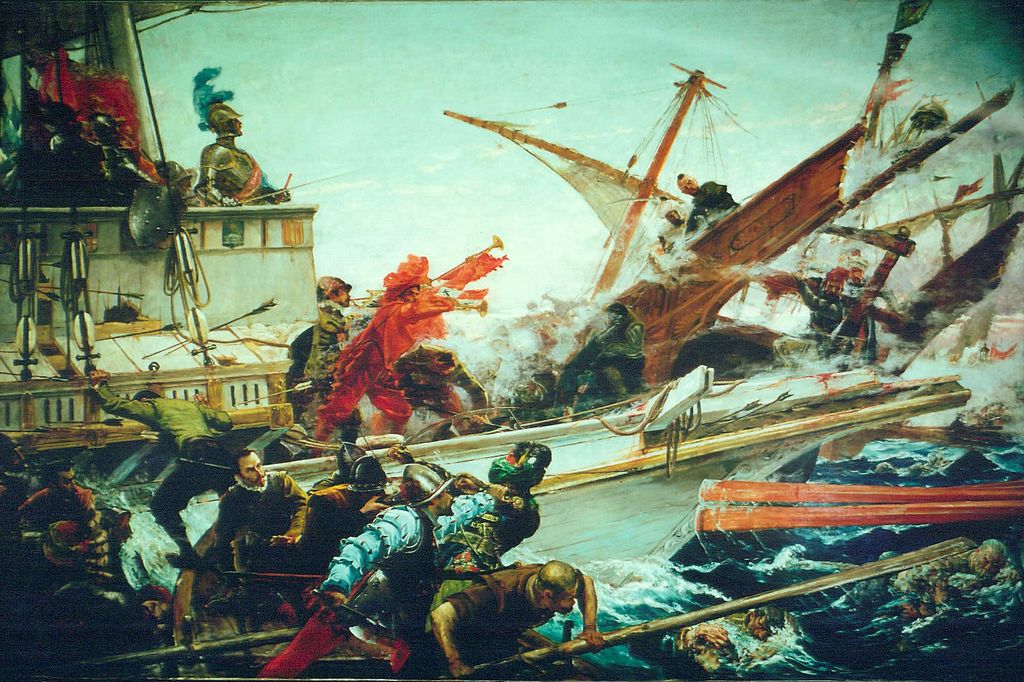
“The Battle of Lepanto”
Oil painting by Juan Luna, 1887. From the Senate of Spain collection via Wikimedia Commons.
Lepanto is a very famous battle, and one which means different things to different people. To a devout Roman Catholic like Chesterton, Lepanto takes on the romanticized and chivalrous form of a crusade — a war by the Holy League against the marauding Turk. At the time it was fought, to be sure, this was the way many in the Christian faction thought of their fight. Chesterton, for his part, writes that “the Pope has cast his arms abroad for agony and loss, and called the kings of Christendom for swords about the Cross”.
For historians, Lepanto is something like a requiem for the Mediterranean. Placed firmly in the early-modern period, fought between the Catholic powers of the inland sea and the Ottomans, then on the crest of their imperial rise, Lepanto marked a climactic ending to the long period of human history where the Mediterranean was the pivot of the western world. The coasts of Italy, Greece, the Levant, and Egypt — which for millennia had been the aquatic stomping grounds of empire — were treated to one more great battle before the Mediterranean world was permanently eclipsed by the rise of the Atlantic powers like the French and English. For those particular devotees of military history, Lepanto is very famous indeed as the last major European battle in which galleys — warships powered primarily by rowers — played the pivotal role.
There is some truth in all of this. The warring navies at Lepanto fought a sort of battle that the Mediterranean had seen many times before — battle lines of rowed warships clashing at close quarters in close proximity to the coast. A Roman, Greek, or Persian admiral may not have understood the swivel guns, arquebusiers, or religious symbols of the fleets, but from a distance they would have found the long lines of vessels frothing the waters with their oars to be intimately familiar. This was the last time that such a grand scene would unfold on the blue waters of the inner sea; afterwards the waters would more and more belong to sailing ships with broadside cannon.
Lepanto was all of these things: a symbolic religious clash, a final reprise of archaic galley combat, and the denouement of the ancient Mediterranean world. Rarely, however, is it fully understood or appreciated in its most innate terms, which is to say as a military engagement which was well planned and well fought by both sides. When Lepanto is discussed for its military qualities, stripped of its religious and historiographic significance, it is often dismissed as a bloody, unimaginative, and primitive affair — a mindless slugfest (the stereotypical “land battle at sea”) using an archaic sort of ship which had been relegated to obsolescence by the rise of sail and cannon.
Here we wish to give Lepanto, and the men who fought it, their proper due. The continued use of galleys well into the 16th century did not reflect some sort of primitiveness among the Mediterranean powers, but was instead an intelligent and sensible response to the particular conditions of war on that sea. While galleys would, of course, be abandoned eventually in favor of sailing ships, at Lepanto they remained potent weapons systems which fit the needs of the combatants. Far from being a mindless orgy of violence, Lepanto was a battle characterized by intelligent battle plans in which both the Turkish and Christian command sought to maximize their own advantages, and it was a close run and well fought affair. Lepanto was indeed a swan song for a very old form of Mediterranean naval combat, but it was a well conceived and well fought one, and Turkish and Christian fleets alike did justice to this venerable and ancient form of battle.
“Multiculturalism is when yummy food”
Fortissax pours scorn on the defenders of multiculturalism-at-all-costs for one of the most common arguments in favour:
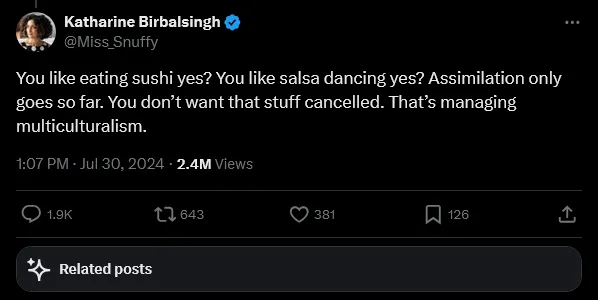
“Multiculturalism is when yummy food” is a real position people take. If you ask them what benefits of multiculturalism are, they’re going to say food and nothing else. Westerners don’t watch Bollywood films, they don’t listen to Desi music, they don’t watch cartoonishly bad Latin American dramas, usually for Hispanic abuelas still living in Mexico where every actor is suspiciously fairer-featured than everyone in their whole family. People can’t say “I love the food, the music, the culture” because they don’t engage in any of this. Salsa isn’t even popular; it hit its peak at the end of the 1990s because white boomer Americans approached an intensely Anglicised, sanitised form of Latin-American culture as introduced to them through the likes of Enrique Iglesias and other English-speaking Latin pop artists.
I don’t believe all leftists say this out of sincerity. It’s a knee-jerk reaction to any criticism of multiculturalism. They don’t put a lot of thought into it. The justification is usually related to how “bad” that “white people food” is. This follows the same thread of accusations that “white people can’t dance”, “white people can’t jump”, “white people can’t fight”, and “white people can’t fuck”. It’s another lib-coded tract to bash English-speaking white Americans over the head with, to justify demographic displacement by portraying them as boring, ugly, weird, or uncool. On some level, they probably know food isn’t worth human lives, but they have to reinforce their moral view or the whole thing collapses, and they have to admit fault for doing things and promoting ideas that are so destructive that people would want to unalive them. If they give up now, it’s over. It’s sunk cost fallacy.
For the rest who’re wholly sincere: it’s just straight up bullshit. Foreign restaurants serve you a Westernized version of their slop. Their bulk food suppliers are Western, the ingredients are Western-derived, but they sell it as “authentic” when it isn’t. That crab rangoon you just spent $40 on Doordash was bulk bought at Costco during a last ditch grocery run. They’re selling you the experience. A sampling of the real thing, deliberately fitted to your people’s general dietary preferences. All of these “ethnic”, “exotic” restaurants do this. Everyone knows about “secret menus” at Chinese or Indian restaurants. Anybody who works in culinary, hell, anybody whose watched the UK version of Hell’s Kitchen where Gordan Ramsay tries to rescue failing restaurants owned by small business owners can tell you most of these people aren’t using fresh or original ingredients. You go to any “Japanese” restaurant in North America, the staff are a random assortment of Asian, or sometimes Korean or Chinese, or maybe even Filipino but it doesn’t matter because they look Asian enough to boomers, correctly guessing people can’t tell the difference at a passing glance.
The Rise, Fall, And Revival Of Art Deco | A Style Is Born W/ @KazRowe
Wayfair
Published Jun 15, 2023Welcome to A Style is Born, hosted by YouTuber, cartoonist, and champion of under-represented history, Kaz Rowe!
Join us as we go down the rabbit hole and uncover the unique histories and origin stories behind your favorite design styles. In this first episode of Season 2, we delve into the history-rich Art Deco movement.
Chapters
Intro – 00:00
History – 00:45
Influences, Elements, & Materials – 04:58
1980s Art Deco Revival Via Memphis Group – 07:46
Conclusion – 09:13
(more…)
August 2, 2024
46-second beatdown in Paris – Olympic hypocrisy on full, disgusting display
On the social media site formerly known as Twitter, ESR reacts to the Olympic boxing travesty of a male boxer being in the ring with a female boxer:
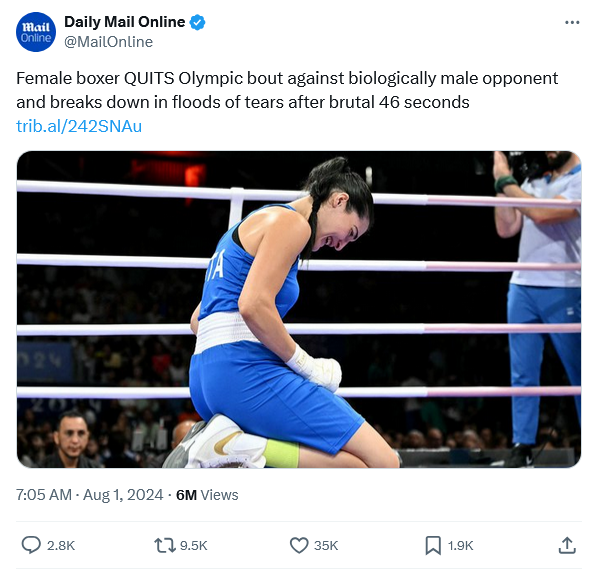
I have mixed feelings about the beatdown of Angela Carini at the Olympics and the feminists complaining that she should never have been put in the ring with a biological male.
On the one hand, yes, it’s disgusting that a man pretending to be a woman battered Carini to the point where she threw the match in justified fear of being killed in the ring.
On the other hand, this travesty seems like such an obvious consequence of feminist doctrine and the feminization of politics that I think most of the women (and “male feminist” allies) decrying it should shut the hell up until they seriously rethink their premises.
It wasn’t “the patriarchy” or defenders of traditional gender roles pushing for this. It was a consequence of decades of insistence that men and women are interchangeable, that gender roles are “socially constructed” – mutable at whim, and that people’s feelings about their own victimization and self-assigned identity trump objective facts.
Feminism and political correctness put Carini’s face in the path of Imane Kelif’s fists. It’s the same ideological cluster that has led to an epidemic of rapes by biological males in women’s prisons and homeless shelters.
Most women – and far too many weak-kneed men – said nothing for decades as this fantasy ideology of feelz laid waste to our cultural norms. And in news that I’m completely sure is utterly unrelated, over 50% of young women identifying as “liberal” have a diagnosed mental disorder.
Maybe, just maybe, feminists and postmodernists and critical theorists ought to stop punching Angela Carini’s face?


