
The Great War
Published Apr 12, 2024Trench warfare is one of the lasting symbols of the First World War, especially on the Western Front. But when the war began, the German and French armies envisioned sweeping advances and defeating the enemy swiftly. So, how and why did the Western Front in 1914 turn into the trench system we associate with WW1?
(more…)
August 2, 2024
Why WW1 Turned Into Trench Warfare
Comments Off on Why WW1 Turned Into Trench Warfare
July 31, 2024
The Korean War Week 006 – Stand or Die! – July 30, 1950
The Korean War by Indy Neidell
Published 30 Jul 2024The UN Forces have been pushed back ever further, but this week, US 8th Army Commander Walton Walker issues the order to “stand or die”; he sees no other options. American reinforcements are finally getting into the actual fight, though, and Britain has decided they will send in ground troops, so things might turn around … if they can hold out long enough for those troops to arrive, because a brilliant North Korean strategy might win the war and soon.
(more…)
Comments Off on The Korean War Week 006 – Stand or Die! – July 30, 1950
The History of the British Rail Symbol
Jago Hazzard
Published Apr 21, 2024Moving forward or indecision?
Comments Off on The History of the British Rail Symbol
July 30, 2024
Sparta’s bane – Cicero labelled him “the foremost man of Greece”
The Theban general who finally broke the military power of Sparta:
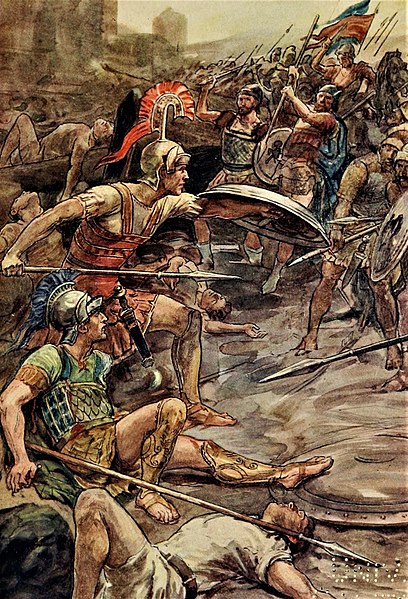
Epaminondas defending Pelopidas by William Rainey.
Illustration from Plutarch’s Lives for Boys and Girls: being selected lives freely retold (1900) via Wikimedia Commons.
The ancient Roman orator and statesman Cicero labeled him “the foremost man of Greece”. Cornelius Nepos, a biographer and contemporary of Cicero’s, regarded him as “incorruptible”. The 16th-century French Renaissance philosopher Michel de Montaigne judged him “one of the three worthiest and most excellent men” in all of history.
This man was a warrior-philosopher, a revolutionary, an ascetic, a statesman and diplomat, a liberator, and a military genius. Yet the deeds for which he is best remembered spanned less than two decades (379–362 BC), 2,400 years ago.
To whom am I referring?
His name was Epaminondas. If it doesn’t ring a bell, you’re not alone. Outside of Greece, few people anywhere today know of him. I never heard his name until this past April when an economist friend, Dr. Luke Jasinski of Maria Sklodowska University in Lublin, Poland, suggested I write about him. Luke says he:
…was a broad-minded man with a libertarian streak, a visionary who showed the Greek world a viable alternative to the endless wars of the time. For modern libertarians, his story is worth remembering. Impressed by it myself, I dedicated one of my economics books to him.
What we know about Epaminondas comes entirely from secondary sources. He left behind no writings that have survived, but from contemporaries and later historians, we do know at least this much about him:
- He was born in the Greek city-state of Thebes in the central Greek region of Boeotia, sometime between 419 and 411 BC, when Thebes was a tiny backwater. It would be largely due to Epaminondas and his loyal friend and fellow general Pelopidas that Thebes would become a powerhouse a few decades later.
- Sparta, the brutal city-state that governed the Greek region of the Peloponnesus, orchestrated a coup against the Theban government in 382 BC and installed an armed garrison there. Three years later, Epaminondas played a key role in a revolution that ended the Spartan dictatorship, restoring local, democratic government.
- In the wake of the Theban revolution, Sparta went to war with Thebes and its Boeotian allies for the next decade. When peace talks broke down in 371 BC, the stage was set for the climactic Battle of Leuctra. Through masterful and unprecedented tactics on the battlefield, Epaminondas led the outnumbered Theban armies to a decisive victory over the Spartans.
- To end the Spartan threat for good, Epaminondas invaded the Peloponnesus a year later. He liberated the region of Messenia that the Spartans had occupied and savaged two centuries earlier. Epaminondas did not subsume and subdue the Messenians; instead, he introduced democratic rule and then left. Grateful for their liberation, the Messenians became allies of Thebes and a buffer against the Spartans. Shortly thereafter, Epaminondas founded a new city in the northern Peloponnesus and named it Megalopolis. With Sparta shrunken and bottled up, its days as a menacing bully were numbered.
Comments Off on Sparta’s bane – Cicero labelled him “the foremost man of Greece”
QotD: The Roman Republic and the Social War
Rome’s tremendous run of victories from 264 to 168 (and beyond) fundamentally changed the nature of the Roman state. The end of the First Punic War (in 241) brought Rome its first overseas province, Sicily which wasn’t integrated into the socii-system that prevailed in Italy. Part of what made the socii-system work is that while Etruscans, Romans, Latins, Samnites, Sabines, S. Italian Greeks and so on had very different languages, religions and cultures, centuries of Italian conflict (and then decades of service in Rome’s armies) had left them with fairly similar military systems, making it relatively easy to plug them in to the Roman army. Moreover, being in Rome’s Italian neighborhood meant that Rome could simply inform the socii of how many troops they were expected to supply that year and the socii could simply show up at the muster at the appointed time (which is how it worked, Plb. 6.21.4). Communities on Sicily (or other far-away places) couldn’t simply walk to the point of muster and might be more difficult to integrate into core Roman army. Moreover, because they were far away and information moves slowly in antiquity, Rome was going to need some sort of permanent representative present in these places anyway, in a way that was simply unnecessary for Italian communities.
Consequently, instead of being added to the system of the socii, these new territories were organized as provinces (which is to say they were assigned to the oversight of a magistrate, that’s what a provincia is, a job, not a place). Instead of contributing troops, they contributed taxes (in money and grain) and the subordination of these communities was much more direct, since communities within a province were still under the command of a magistrate.
We’ll get to the provinces and their role in shaping Roman attitudes towards identity and culture a bit later, but for the various peoples of Roman Italy, the main impact of this shift was to change the balance of rewards for military service. Whereas before most of the gains of conquest were in loot and land – which the socii shared in – now Roman conquests outside of Italy created permanent revenue streams (taxes!) which flowed to Rome only. Roman politicians began attempting to use those revenue streams to provide public goods to the people – land distribution, free military equipment, cheap grain – but these benefits, provided by Rome to its citizens, were unavailable to the socii.
At the same time, as the close of the second century approached, it became clear that the opportunity to march up the ladder of status was breaking down, consumed by the increasingly tense maelstrom of the politics of the Republic. In essence while it was obvious as early as the 120s (and perhaps earlier) that a major citizenship overhaul was needed which would extend some form of Roman citizenship to many of the socii, it seems that everyone in Rome’s political class was conscious that whoever actually did it would – by virtue of consolidating all of those new citizens behind them as a political bloc – gain immensely in the political system. Consequently, repeated efforts in the 120s, the 100s and the 90s failed, caught up in the intensifying gridlock and political dysfunction of Rome in the period.
Consequently, just as Rome’s expanding empire had made citizenship increasingly valuable, actually getting that citizenship was made almost impossible by the gridlock of Rome’s political system gumming up the works of the traditional stepwise march up the ladder of statuses in the Roman alliance.
Finally in 91, after one last effort by Livius Drusus, a tribune of the plebs, failed, the socii finally got fed up and decided to demand with force what decades of politics had denied them. It should be stressed that the motivations behind the resulting conflict, the Social War (91-87), were complex; some Italians revolted for citizenship, some to get rid of the Romans entirely. The sudden uprising by roughly half of the socii at last prompted Rome to act – in 90, the Romans offered citizenship to all of the communities of socii who had stayed loyal (as a way of keeping them so). That offer was quickly extended to rebellious socii who laid down arms and rejoined the Romans. The following year, the citizenship grant was extended to communities which had missed the first one. The willingness to finally extend citizenship won Rome the war, as the socii who had only wanted equality with the Romans, being offered it, switched sides to get it, leaving only a handful of the hardest cases (particularly the Samnites, who never missed an opportunity to rebel against Rome) isolated and vulnerable.
The consequence of the Social War was that the slow process of minting new citizens or of Italian communities slowly moving up the ladder of status was radically accelerated in just a few years. In 95 BC, out of perhaps five million Italians, perhaps one million were Roman citizens (including here men, women and children). By 85 BC, perhaps four million were (with the remainder being almost entirely enslaved persons); the number of Roman citizens had essentially quadrupled overnight. Over time, that momentous decision would lead to a steady cultural drift which would largely erase the differences in languages, religion and culture between the various Italic peoples, but that had not happened yet and so confronted with brutal military necessity, the Romans had once again chose victory through diversity, rather than defeat through homogeneity. The result was a Roman citizen body that was bewilderingly diverse, even by Roman standards.
(Please note that the demographic numbers here are very approximate and rounded. There is a robust debate about the population of Roman Italy, which it isn’t worth getting in to here. For anyone wanting the a recent survey of the questions, L. de Ligt, Peasants, Citizens and Soldiers: Studies in the Demographic History of Roman Italy 225 BC – AD 100 (2012) is the place to start, but be warned that Roman demography is pretty technical and detail oriented and functionally impossible to make beginner-friendly.)
Bret Devereaux, “Collections: The Queen’s Latin or Who Were the Romans, Part II: Citizens and Allies”, A Collection of Unmitigated Pedantry, 2021-06-25.
Comments Off on QotD: The Roman Republic and the Social War
July 29, 2024
W.H. Smith attempts to rebrand their stores to “raise awareness” or something
British bookseller from time immemorial, W.H. Smith, apparently decided that the corporate branding they’d been using since the 18th century was just too boring for modern consumers, so they brainstormed a daring new design for the 21st century … that sucked.

“UK High Street” from https://www.whsmithplc.co.uk/media/media-gallery/images
When the British retailer, W.H. Smith, rebranded its logo last year, confusion and bafflement ensued.
The high street fixture, its Times New Roman logo mostly unchanged since 1792, earned its reputation by selling books, stationery, and for fleecing bleary-eyed travellers in airports. Through sheer zombie persistence, W.H. Smith remains a constant of British retail. Never mind the threadbare carpets, the general dilapidation, or the desperate staff forced to offer you a bottle of knock-off perfume with your twenty Lambert and Butler.
W.H. Smith endures because its business model concentrates on a captive audience. Go to an airport or a hospital — any place in which people cannot escape — and you’ll find a W.H. Smith reliably charging double for a Lucozade Sport. W.H. Smith will outlive Great Britain. The retailer’s existence — puzzling to the most scientific of minds — defies natural law.
Last year, creative designers attempted to play God. They sanded off the logo’s regnant edges and stripped “Smiths” altogether. The dynamic branding screamed minimalism: a plain, white “WHS” stamped on to a blue background.
I’d imagine the big revelation underwhelmed those paying for the work. “That’s interesting.” Or “It’s certainly different“.
Mockery ensued. “Baffling” said one. “It looks like the NHS logo,” observed another.
No doubt the designers plotted a revolution in design. Of course, these “creatives” — invariably young and invariably uncreative — fancied their vandalism as “forward thinking” and “dynamic”. I’ll wager at least one thought the new logo addressed the plight of some faraway progressive cause to which they subscribe. The public, unschooled in the most voguish developments in design, concluded: The new logo is shit.
W.H. Smith soon backtracked. Passive-aggressive defences of the staid new logo melted into sulky denial. It’s just a trial, they mewled.
A breathless spokesman revealed the truth. Or some addled version of the truth. The fresh signs, they revealed, were “designed to raise awareness of the products W.H. Smith sells”. What else, I wonder, is a shop sign meant to achieve?
The phrase “raising awareness” is one of a litany of linguistic evasions which say nothing. By shoehorning that ghastly phrase into a sentence, the speaker hopes to evade criticism. Reader, I’m not ploughing through a duty-free bottle of Chateau le Peuy Saincrit in the obscene Bulgarian sunshine. I’m raising awareness of the plight of southern French winemakers.
That passive-aggressive statement of the obvious — our shop sign raises awareness of our shop — you plebeian fools — crystallises the creative industry’s age problem.
Three-quarters of the creative industry is under 45. Perhaps this age gap (not the sexually consensual and fun kind) explains why so much of what we see and hear is cliché-riddled evasive hoo-hah.
When talking to anyone under 45, I mentally add a question mark to the end of their sentence. Millennials and Zoomers avoid declarative sentences. Listen. Almost every utterance sounds like a question. Further to this quirk, I note the adverbs and filler words. Young people stuff their speech with “basically”, “actually”, “literally”, and “like”. Zoomers are especially militant. They eschew capital letters. Capital letters are grammatical fascism. Full stops reveal a latent proclivity for Zyklon-B. Influencers add another tic to this repertoire of anxiety and unsurety. They crackle their voice as if a frog has lodged in their throat.
Comments Off on W.H. Smith attempts to rebrand their stores to “raise awareness” or something
“Queering” the Olympics
The 2024 Summer Olympic Games in Paris have started, with the traditional “fuck you!” to those the elites most disdain, who in this case are apparently the more than two billion Christians around the globe:
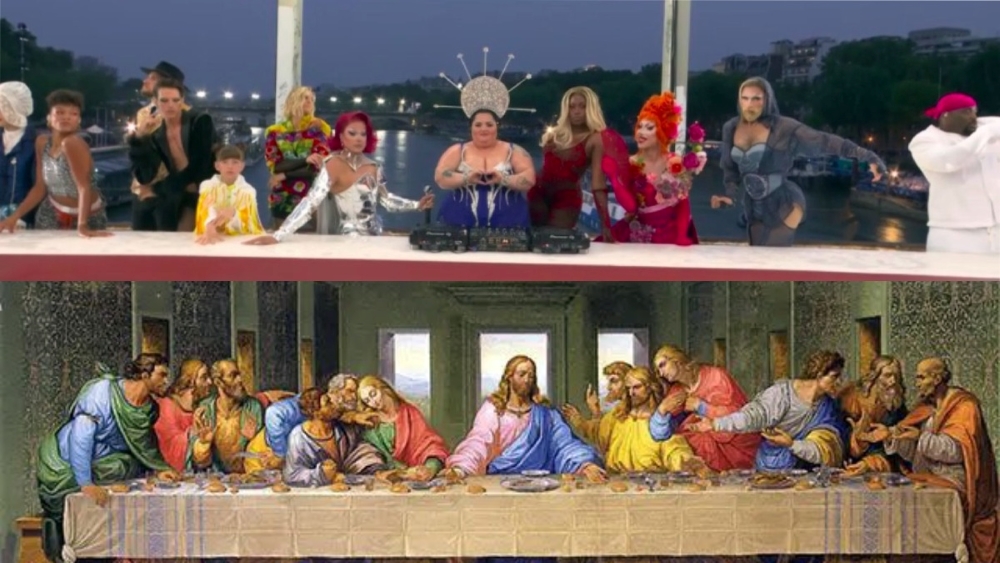
At Spiked, Brendan O’Neill notes that our kakistocratic elites are still not tired of “queering” everything they possibly can, especially if it gets up the noses of those disgusting dirt people in the provinces:
Is anyone else bored of “queering”? Everything’s getting “queered” these days. We’ve had “Queering the Curriculum“. “Queering the Arts“. And my personal favourite: “Queering Palestine“. This entails academics “unpack[ing] the multiple intersections of queer politics and the Palestinian struggle”. Hot tip for these profs: if Hamas ever invites you to discuss your theories, don’t agree to meet them on the high floor of a building. “Queering the Pavement” is the only thing they’re interested in.
Now, with soul-zapping inevitability, we’ve had the “queering” of the Olympic Games. Yesterday’s rain-sodden opening ceremony in Paris was super LGBTQIAzzz. There were drag acts everywhere. A bearded bloke twerked for the world. A bollock-naked man in blue paint was served on a platter of fruit to a gaggle of diet-dodging drag queens. Look, if I wanted to be exposed to the camp debauchery of drag culture, I’d go to a kindergarten.
It really was a naff, dispiriting affair. It was the first opening ceremony to take place, not in a stadium, but in the heart of the hosting city. Boat after boat after boat carried the Games’ athletes along the Seine as 300,000 spectators in soaked plastic macs craned their necks for a glimpse. It seemed to go on forever. It was so bad that even square liberals on X started using the favoured slogan of the right: “STOP THE BOATS”.
The weather didn’t help. The lashing rain hampered the audio, making it hard to hear the ceremony’s star turns, Celine Dion and Lady Gaga (an upside of the downpour, I suppose). What we could hear was just weird. Like when a headless Marie Antoinette sang the opening bars to an ear-splitting heavy-metal ditty. The ceremony organiser, Thomas Jolly, said he wanted his spectacle to be a “celebration of being alive” – here we had a celebration of being dead.
Then there was the “queering”. Just as you can’t switch on the BBC, visit a library or have a quiet pray these days without encountering a drag queen, so you can’t watch the opening ceremony of the Olympics without seeing portly men in moob-hugging outfits voguing and gloating. It was more Eurovision than Olympian. More Ru Paul than Ancient Greece. More “Sashay away” than “Citius, Altius, Fortius“. That’s the original Olympic motto. It means “Faster, higher, stronger”. Because, believe it or not, we were once a species that celebrated the moral beauty of sporting heroism rather than the ability of a middle-aged man to lard himself into a sequined gown.
The part of the ceremony that caused the biggest stink was the camp Last Supper. A bunch of drag acts gathered around a buxom woman adorned in an aureole halo crown in an unmistakable mimicking of da Vinci’s painting of Christ and the apostles at their final meal. Wearing the smug look of all glib performance artists who love nothing more than to piss off “normies” – because they lack the talent for anything else – the drag queens giddily got into their disciple positions and heaped holy adoration on the lady Jesus. You could almost hear their thoughts: “Ooh boy, this is going to piss off old farts – yes!”
Comments Off on “Queering” the Olympics
MG11: The Magnificent Swiss Maxim Gun
Forgotten Weapons
Published Apr 19, 2024The Swiss were one of the first countries to test Hiram Maxim’s new automatic machine gun in 1887, and they found it far superior to their just-recently-purchased Gardner guns. The first Swiss Maxims were delivered in 1889, and the country came back three more times for newer models. The MG94 was the first major adoption, followed by the MG00 for cavalry. Finally, after the Maxim patents expired and DWM introduced their improved 1909 commercial pattern, the Swiss adopted it as the MG11. The first 167 MG11s were produced by DWM, but deliveries ceased in 1915 because of the war. This prompted the Swiss National Assembly to order the government arsenal W.F. Bern to begin production, and between 1915 and 1946 the Swiss made 10,269 more MG11s domestically. They were absolutely beautifully made weapons.
In 1934/35, a modernization program made a number of improvements to the guns. The booster was simplified, the trigger was made one-hand friendly (so the second hand could be used to adjust aim while firing), a bracket for antiaircraft sights was added, and traverse and elevation stops were added to the tripods. Most significantly, the cloth belt was replaced by a fully metal belt. That belt is widely regarded as the best Maxim belt ever produced, and it is particularly valuable to shooters today, as it will function with essentially any caliber in any model of Maxim.
Swiss Maxims were never exported in quantity, and they are quite rare today.
(more…)
Comments Off on MG11: The Magnificent Swiss Maxim Gun
July 28, 2024
Allies Issue Potsdam Declaration – WW2 – Week 309 – July 27, 1945
World War Two
Published 27 Jul 2024China, Britain, and the US issue a Declaration demanding Japan’s unconditional surrender, and promising complete destruction if this does not happen and happen soon. The plan is to for the Americans to use their atomic bombs on Japan if she does not comply, but by the end of the week the Japanese have not replied. They still have hopes for the Soviets to mediate some sort sort of peace. What they don’t have is a navy, as its final destruction comes this week.
00:00 Intro
00:50 Recap
01:32 The Potsdam Conference
04:41 Japanese Hopes
05:56 The Potsdam Declaration
10:53 The Initial Reaction
14:48 The End Of The Japanese Navy
15:05 The War On Land
19:10 Summary
19:30 Conclusion
(more…)
Comments Off on Allies Issue Potsdam Declaration – WW2 – Week 309 – July 27, 1945
July 27, 2024
Cancelling Orwell (again)
In The Daily Sceptic, Paul Sutton recounts a recent discussion with some Oxford graduate students where the topic of George Orwell came up:
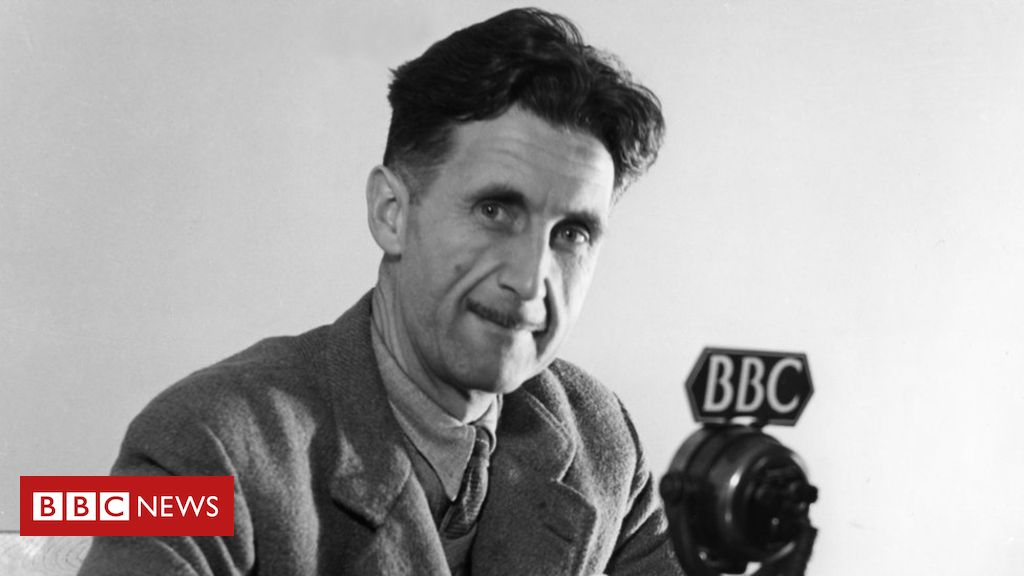
The students maintained that the important thing is quality of writing but, paradoxically, this can only be judged by a strict contemporary “evaluation” of any Right-wing or outdated views. Inevitably, this contextualisation then reveals that said writers are “problematic” and “not as good as XYZ” – usually some figure who fits their sensibilities, and coincidentally one who’s almost always female – or at least better suited to the diversity required by these commissars.
So far, so well known and wearily familiar. The absolute impossibility of literature under such a mindset – one enthusiastically endorsed by graduate students who professed to live for literature – is utterly depressing. We’re in effect dealing with its cancellation.
I made a perfunctory effort in observing their complete inconsistency, but things got more interesting when Orwell was discussed. Of course, Orwell famously wrote against their stand, not least in his brilliant defence of Kipling’s literary merit and his refusal to allow orthodoxy to dictate his aesthetic preferences, in “Benefit of Clergy“.
Unfortunately, Orwell’s stint in the Burmese Imperial Police made him a despicable figure to the students, little better than a Waffen SS or Gestapo officer. True, he’d belatedly retrieved himself by his “eventual writing” in the 1940s, but he’d spent many years performing the dirty work of the British Empire. His famous essay, “A Hanging“, showed him enthusiastically hands on at it.
I’d honestly never heard such a narrow and limited view, and was intrigued. As a preposterous misrepresentation, it needs little rebuttal. “A Hanging” is indeed a brilliantly disturbing account of an Indian murderer being hanged, a man who’d have been executed at that time in any country. The essay explores the deep unease Orwell felt about his role, so it’s a lie to claim it shows him uncritically doing his job, let alone revelling in his exertion of British authority.
Such an interpretation shows a shocking lack of understanding. As does the idea that Orwell only recanted any pro-Imperial views in the 1940s; his underrated Burmese Days was published in 1934 and he wrote extensively about his disgust for the job he did in the late 20s and 1930s. Of course, he didn’t only feel disgust, nor would he pretend that the British brought only misery and were unique as imperial exploiters.
What I’m most interested in is how an alternative Orwell was then offered up, a writer who’d accepted the British Empire was “problematic” yet offered a nice comforting view of how nice and comforting life can be – if you agree with the progressives, that is.Step forward Jan Morris and his trilogy Pax Britannica. Now, I haven’t read this non-fictional account of the British Empire but from background knowledge, it’s not in any way a replacement for Orwell or even remotely comparable. It’s an exhaustive historical work, not a personal creative one. But this trilogy was extolled by the students as what Orwell should have done when discussing empire. There was the implication that Orwell could now be – somewhat thankfully – ignored.
Bizarrely, the Englishman then introduced Joyce, first saying that the man was a lifelong sponger who’d have probably fleeced him, but as a writer was the very model of a pan-European, liberal and open to all cultures. Again, the grubby contradictions and sheer banality of such a perspective are eye-popping – from a DPhil student in perhaps the country’s finest university.
And I’ve a nagging feeling that Jan Morris – a famous case of gender realignment (he “transitioned” to female in 1972) – was picked for the “acceptable author” reasons. That’s the problem with “author context” vetting – as with “diversity hires”. Much as I’ve enjoyed Morris’s travel writing, especially Oxford, it’s staggering for this author to be proposed as some alternative to Orwell! Not only in terms of obvious lesser importance, but they’re not remotely comparable in terms of genre or aims. How could any serious reader – let alone one at a leading university – talk such gibberish?
Comments Off on Cancelling Orwell (again)
Dining on the Orient Express
Tasting History with Max Miller
Published Apr 16, 2024Côtelettes d’Agneau à la Minute
Simple, delicious fried lamb cutlets with a lemon-butter sauce with swirls of Duchess PotatoesCity/Region: France
Time Period: 1903The food and dining cars of the Orient Express were a big part of the luxurious experience that drew in passengers. The chefs, who were brought in from top French institutions, prepared meals on moving train cars, sometimes themed to which countries the train was passing through.
These lamb cutlets are simple, tender, and delicious. The lemon-butter sauce has only two ingredients, and pairs perfectly with Duchess Potatoes for a wonderful meal (or more accurately, single course) aboard the Orient Express.
Côtelettes d’Agneau à la Minute
Cut the cutlets very thin, season them and shallow fry in very hot clarified butter. Arrange them in a circle on a dish, sprinkle with a little lemon juice and the cooking butter after adding a pinch of chopped parsley, Serve immediately.
— Le Guide Culinaire by Auguste Escoffier, 1903
Comments Off on Dining on the Orient Express
July 26, 2024
QotD: Comparative advantage
David Ricardo, On the Principles of Political Economy and Taxation (1817), quoted on the Library of Economics and Liberty site.
Comments Off on QotD: Comparative advantage
July 25, 2024
QotD: Why devolution has not worked in the United Kingdom
I remember when arguments were originally made for devolution, commentators would claim that devolution would work in the same way that the federal structure of the US works, or, for that matter, how the cantonal system works in Switzerland. By which they meant that if a state such as Zug in Switzerland or Wisconsin in the US tried a specific policy (encouraging cryptos, or enacting Workfare, to take two actual examples), that the perceived success or failure of these policies would be studied by other cantons and states. Hence the idea that devolution allows a sort of “laboratory experiment” of policy to take place. It creates a virtuous kind of competition. That’s the theory.
What seems to have happened is that since devolution in the UK, Scotland, Wales and to some extent, Northern Ireland, have competed with England in who can be the most statist, authoritarian and in general, be the biggest set of fools. Whether it is 20 mph speed limits spreading to many places and harsh lockdowns (Wales) or minimum pricing on booze and “snitching” on your own family for views about gender (Scotland), the Celtic fringe appears to be more interested in being more oppressive, rather than less. I cannot think of a single issue in which the devolved governments of the UK have been more liberal, and more respectful, of liberty under the rule of law. (Feel free to suggest where I am mistaken.)
One possible problem is that because the UK’s overall government holds considerable budgetary power, the devolved bits of the UK don’t face the consequences of feckless policy to the extent necessary to improve behaviour.
Even so, I don’t entirely know why the Scots and Welsh have taken this turn and I resist the temptation to engage in armchair culture guessing about why they tend to be more collectivist at present. It was not always thus. Wales has been a bastion of a kind of liberalism, fused to a certain degree with non-conformity in religion, and Scotland had both the non-conformist thing, and the whole “enlightment” (Smith, Hume, Ferguson, etc) element. At some point, however, that appears to have stopped. Wales became a hotbed of socialism in the 20th century, in part due to the rise of organised labour in heavy industry, and then the whole folklore – much of it sentimental bullshit – about the great achievements in healthcare of Nye Bevan. Scotland had its version of this, plus the resentments about Mrs Thatcher and the decline of Scotland as a manufacturing power.
[…]
Maybe the “test lab” force of devolution will play a part in demonstrating that, as and when we get a Labour government for the whole of the UK, it will be a shitshow on a scale to put what has happened in the Celtic parts of the UK in the shade.
Johnathan Pearce, “Why has devolution not worked in a liberal direction?”, Samizdata, 2024-04-23.
Comments Off on QotD: Why devolution has not worked in the United Kingdom
July 24, 2024
Tiberius Caesar, the second emperor
In The Critic, Jaspreet Singh Boparai reviews Iron Imperator: Roman Grand Strategy Under Tiberius by Iskander Rehman:
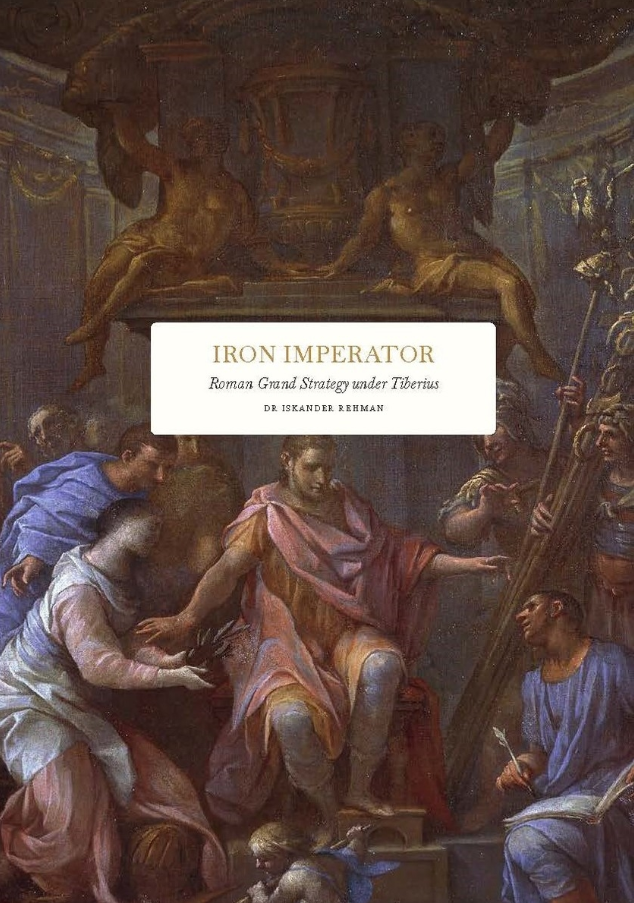
Tiberius was 55 years old when he became the second Roman emperor. He ruled from AD 14 to 37, spending most of the second half of his reign on the island of Capri, where he never lost his grip on power despite being over 130 miles from Rome.
Like most bureaucratic administrators, he was far from popular. Tacitus (AD 56–120), the greatest of all Roman historians, presents Tiberius as paranoid, ruthlessly cruel, and pathologically unable to say what he meant. The imperial biographer Suetonius (69–122) completes the Tacitean picture of a dour, charmless pervert, miserable even in his increasingly sordid pleasures.
Not all writers are quite so hostile to Tiberius: since the Enlightenment he has won qualified praise from thinkers including Montesquieu and Voltaire, who have often been willing to overlook at least some of his vices. The great Russian poet Alexander Pushkin wrote in 1825: “The more I read Tacitus, the more I come to like Tiberius. He was one of the greatest administrative minds of antiquity.”
Of course, Pushkin could take revisionism to contrarian extremes, as when he said of a notorious assassination: “If murder can be guiltless in an autocratic state when it is for reasons of political necessity, then Tiberius was justified”.
Iskander Rehman doesn’t go quite so far as Pushkin; yet he does want us to look past all the gossip and scandals, and see what we can learn in practical terms from this controversial emperor. Tiberius was not a conqueror; his main task was to consolidate his predecessor’s achievements and establish stability throughout the empire.
He was faced with the question of how you govern a massive, unwieldy state as an absolute monarch without the benefit of personal charisma, reliable subordinates or the momentum of conquest. Rehman focuses on foreign policy, military affairs and imperial management in general, and concludes that, whatever else might have been wrong with Tiberius, at least he understood grand strategy, international relations, and how to handle the Roman economy.
I must admit that my impression of Tiberius was largely informed by my childhood encounter with Robert Graves’ excellent novels I, Claudius and Claudius The God, which definitely drew the character details of Tiberius in the novels from Tacitus and Suetonius. But Graves also pointed out that whatever personal flaws were displayed in his private life, for the vast majority of the empire he was a competent successor to the great god Augustus.
Comments Off on Tiberius Caesar, the second emperor
Chieftain V T-62 | Operation Nasr, Iran – Iraq War, 1981
The Tank Museum
Published Apr 13, 2024Two tanks designed to fight each other in Northern Europe would face each other during the Iran-Iraq war in 1981. On one side, the British built Chieftain MBT. On the other, the Soviet-built T-62.
In this video, we examine what happened during Operation Nasr to find out which tank came out on top …
00:00 | Intro
01:19 | Meet the Tanks
02:15 | The T-62
03:26 | The Chieftain
06:21 | From Paper to the Battlefield
09:25 | The Outcome and Findings
(more…)
Comments Off on Chieftain V T-62 | Operation Nasr, Iran – Iraq War, 1981


