
The Great War
Published on 6 Oct 2018Chair of Wisdom Time!
October 8, 2018
Enzo Ferrari – Tank Sounds – French-American Animosity I OUT OF THE TRENCHES
Comments Off on Enzo Ferrari – Tank Sounds – French-American Animosity I OUT OF THE TRENCHES
September 2, 2018
Adrian Carton de Wiart – WW1 Paratroopers? I OUT OF THE TRENCHES
The Great War
Published on 1 Sep 2018Chair of Wisdom Time!
Comments Off on Adrian Carton de Wiart – WW1 Paratroopers? I OUT OF THE TRENCHES
August 30, 2018
August 26, 2018
Italians in AH Army – Military Missions I OUT OF THE TRENCHES
The Great War
Published on 25 Aug 2018Chair of Wisdom Time!
Comments Off on Italians in AH Army – Military Missions I OUT OF THE TRENCHES
August 25, 2018
Why was Italy so Ineffective in WWII? | Animated History
The Armchair Historian
Published on 27 Jul 2018Potential History’s Video: https://youtu.be/QB2GINNs3Aw
Our Patreon: https://www.patreon.com/armchairhistory
Our Twitter: https://twitter.com/ArmchairHist
Sources:
The Rise and Fall of the Third Reich, William L. Shirer
Fascist Italy’s Military Struggles from Africa and Western Europe to the Mediterranean and Soviet Union 1935-45, Frank Joseph
Hitler’s Italian Allies: Royal Armed Forces, Fascist Regime, and the War of 1940-1943, MacGregor Knox
Comments Off on Why was Italy so Ineffective in WWII? | Animated History
August 18, 2018
The collapse of Genoa’s Ponte Morandi
Austin Williams reviews what information is currently available on the collapse of one of the towers of the Morandi Bridge (Ponte Morandi) on Tuesday:

The Morandi Bridge in Genoa shortly after the collapse of one of the towers, viewed from Coronata.
Photo by Salvatore Fabbrizio via Wikimedia Commons
The appalling tragedy of the Morandi Bridge, which collapsed on Tuesday, 14 August 2018, is a disaster that is still under investigation. At the moment, there are reports of 40 lives lost, but not much is known about the causes or the wider consequences. I am loath to speculate about either, but there needs to be a wider conversation and not simply kneejerk demands for corporate manslaughter charges against the private bridge-operating company, Autostrade per l’Italia. Heads will roll – deservedly so – but we must look at wider concerns about infrastructure, per se. (I caveat all of this by saying that pre-empting the ongoing investigation may reveal me to be wide of the mark.)
Firstly, the collapse was extraordinary. The bridge – built in the mid-1960s and named after the civil engineer Riccardo Morandi – is architecturally unique, and with this comes unique stresses that may have given rise to the catastrophic failure. A similar collapse of a similar nature and magnitude has not occurred before with a cable-stayed bridge. This bridge had 90m-high concrete towers that held tensioned cables fixed at an angle to the deck (the roadway), meaning that as the cables were being stretched by the loads, the towers were being squashed by the same loads. In engineering terms, the weight of the deck (and the traffic on it) was carried by the combined structure, meaning that the towers were under tremendous compression while the cables were under tension.
Bridge design always makes allowances – contingencies – for localised failure, and therefore even the most efficient, slender structures tend to be over-designed so that the engineers can sleep at night. The bridge has to imagine, for example, wind loads, snow loads, or 250 lorries being on the bridge rather than just 250 cars. But have the owners and managers of this bridge kept up with the reality, that in the 60 years or so since this bridge was constructed, loading conditions have significantly increased owing to increased freight volumes and vehicle sizes? Has this unseen attritional damage finally come home to roost?
In this bridge design, there is only one angled ‘stay’ (made up of four steel cables) encased in a concrete covering. The idea was that the concrete would protect the steel from weathering, corrosion and failure. Maintenance work as recently as 15 or so years ago replaced some of the cable stays and recoated them in concrete. Suggestions that cracks in the concrete exacerbated the ingress of water, which speeded the corrosion of the cables, are possible, but not totally convincing.
Were the cables to snap – possibly requiring more than one to snap due to the engineering contingency discussed above – then the deck would fall and possibly overbalance the entire structure. However, the fact that the towers collapsed in such a horrific fashion – seeming to crumble – may hint that the problem may lie in the foundations, where regular maintenance work was being carried out. We just don’t yet know. As Professor Gordon Masterton, from the University of Edinburgh’s school of engineering, told the Guardian, there needs to be a ‘forensic and thorough’ investigation to get to the root cause.
Comments Off on The collapse of Genoa’s Ponte Morandi
August 16, 2018
Three Great British Wartime Deceptions
Lindybeige
Published on 15 Aug 2018http://www.audible.com/Lindybeige or text ‘Lindybeige’ to 500 500 for a free thirty-day trial and one free audio book.
Support me on Patreon: https://www.patreon.com/LindybeigeTales of Gallipoli and the Dardanelles in World War One, El Alamein in WW2, and of the extraordinarily successful failure that was Operation Camilla in East Africa. One man with terrific hair rambles for over half an hour about ruses of deceit against the enemies of the Empire.
Lindybeige: a channel of archaeology, ancient and medieval warfare, rants, swing dance, travelogues, evolution, and whatever else occurs to me to make.
▼ Follow me…
Twitter: https://twitter.com/Lindybeige I may have some drivel to contribute to the Twittersphere, plus you get notice of uploads.
Facebook: https://www.facebook.com/Lindybeige (it’s a ‘page’ and now seems to be working).
website: http://www.LloydianAspects.co.uk
Comments Off on Three Great British Wartime Deceptions
August 8, 2018
Malta’s Hand-Hewn Bomb Shelter Tunnels
Forgotten Weapons
Published on 7 Aug 2018http://www.patreon.com/ForgottenWeapons
During World War Two, the Grand Harbor in Malta was the most-bombed place in the world, under aerial bombardment for two full years because of its position as a central Mediterranean base for British air and sea forces. While these attacks were focused on the harbor facilities, most of the island’s population lived right in the same area, and civilian casualties during the war were substantial. In an effort to safeguard the population, a vast number of underground bomb shelter tunnels were dug.
The island of Malta is mostly relatively soft limestone, and the Maltese are quite experienced in working it, after millenia of quarrying limestone to build structures and digging it out to make cisterns and wells. This allowed an otherwise enormous project to be successful – using mostly hand tools, enough shelters were dug to safely house the entire at-risk population. Many of these shelters and shelter complexes are open to the public today, including the system under the Malta At War Museum, which we are visiting today…
I am grateful for the Malta Tourism Authority’s assistance in helping to make this visit and video possible!
If you enjoy Forgotten Weapons, check out its sister channel, InRangeTV! http://www.youtube.com/InRangeTVShow
Comments Off on Malta’s Hand-Hewn Bomb Shelter Tunnels
August 7, 2018
The Tide Is Turning I THE GREAT WAR Summary Part 14
The Great War
Published on 6 Aug 2018After 4 years of global war, there are signs that the war of attrition is over and the situation is shifting in favor of the Allies.
Comments Off on The Tide Is Turning I THE GREAT WAR Summary Part 14
July 30, 2018
Forgotten History: World’s Biggest Black Powder Cannon – a 100-Ton Gun
Forgotten Weapons
Published on 10 Jul 2018http://www.patreon.com/ForgottenWeapons
The largest muzzleloading black powder cannons ever built were the Armstrong 100-ton guns which saw service with the Italian Navy and with British coastal fortifications on Malta and Gibraltar. They were purchased by the Italians first, to outfit a pair of new super battleships, each vessel having two turrets with two of these guns in each. To avoid being outclassed, the British ordered two guns for installation to protect the Grand Harbor of Malta and two more to protect Gibraltar. Today one survives at each location, and we are visiting the Rinella Battery in Malta, which was built to house one of the Maltese guns.
These guns had a maximum range of 8 miles, and was capable of piercing 15 inches of iron armor at 3 miles. It had a 17.7 inch (45cm) bore fired a 2000 pound (900 kg) shell with a 450 pound (200kg) charge of black powder. The gun itself weighed approximately 102 tons, and with its cradle and a shell the whole assembly came in at 150 tons.
Aside from the massive scale of the piece, the most interesting part of its design is actually the loading machinery. Because of the titanic size of the gun and ammunition, Armstrong designed a fascinating hydraulic reloading facility which makes up the body of the fortress in which the gun is set. A pair of steam engines drove a pair of hydraulic accumulators, which provided hydraulic pressure to move the gun on its carriage, to douse the barrel after firing, to hoist ammunition into position for loading and power a 60-foot (18m) ramrod to mechanically ram the charge and shell into place. Two mirror-image reloading galleries under the fortification operated in turn, giving the gun a sustained rate of fire of 1 round every 6 minutes – at least until its 120-round barrel life was exhausted.
I am grateful for the Malta Tourism Authority’s assistance in helping to make this visit and video possible, and would also like to give special thanks to Simon, our awesome reenactor guide!
If you enjoy Forgotten Weapons, check out its sister channel, InRangeTV! http://www.youtube.com/InRangeTVShow
Comments Off on Forgotten History: World’s Biggest Black Powder Cannon – a 100-Ton Gun
July 27, 2018
QotD: All pizza is local
When it comes to pizza, you like what you like; and the weird regionalized nature of pizza suggests that we are most likely to like what we know. Real travellers are aware that it is almost impossible to anticipate what you might get ordering pizza outside its twin cultural homes of Italy and North America. Try it in the U.K.: any sort of two-dimensional horror might materialize. Is that yogurt? Endive? Are those eggs? To the depraved British, it makes sense, like Marmite.
Colby Cosh, “The Edmonton pizza hypothesis”, National Post, 2016-10-03.
Comments Off on QotD: All pizza is local
July 24, 2018
A Farewell to Arms – Ernest Hemingway I WHO DID WHAT IN WW1?
The Great War
Published on 23 Jul 2018He is regarded as one of the greatest writers of the 20th century, but before that, he was an ambulance driver on the Italian Front in the Great War and also took part in the Spanish Civil War and World War Two.
Comments Off on A Farewell to Arms – Ernest Hemingway I WHO DID WHAT IN WW1?
July 10, 2018
Operation Husky with the “D-Day Dodgers”
On this day in 1943, the Allies invaded Sicily as their first step toward knocking Italy out of the war. It was the first major allied operation (other than the abortive Operation Jubilee in 1942) in which a major formation of the Canadian Army took part. The 1st Canadian Infantry Division under the command of Major General Guy Simonds was part of General Montgomery‘s Eighth Army, which landed on the southeast coast of the island.
The Canada History Project describes the Canadian participation in Operation Husky:
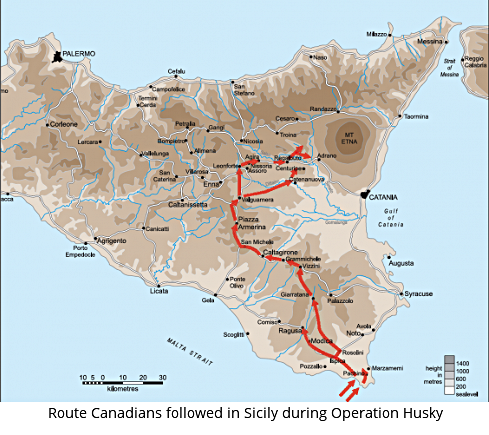
The men were young, of course, many just 18 to 24 years old. The roads were narrow dirt tracks switchbacking over steep, volcanic mountains. Temperatures hovered around 37 degrees, turning water bottles into hot water bottles, as one soldier put it. Three dry and dusty weeks into the campaign, there was a five-hour downpour, and all the troops relished the chance to shower off the dirt caked to their skin. By this time they were well into the middle of the island where their enemy was the fierce Hermann Goering division of the German army.
For six weeks, from July 10th to August 17th 1943, the Canadians, fighting as an independent unit for the first time, slogged through the interior of Sicily as part of Operation Husky, the first stage of taking back Europe from the Nazis after four years of war. Meanwhile, the Americans skirted the more level western coastline of the island and the British came up the east side, each competing with the other for glory.
American General Patton wrote in a letter, “This is a horse race in which the prestige of the US Army is at stake…we must take Messina before the British.”
That may be the way the generals saw it. For the soldiers, pushing through, village by village, mountaintop by mountaintop, it was no game.
Sicily, a rural mountainous island known for its orange groves and almond orchards, olives and the Mafia, sits strategically in the Mediterranean off the foot of Italy. The Canadian contingent was 25,000 strong. All men and materials were brought in by sea, making it the largest amphibious operation yet, though D-Day, a year later, would be bigger still.
In the first few days the Canadians passed through an area that is now a Unesco World Heritage site. Today tourists come to this southeast corner of Sicily to see the restored baroque architecture. But the young Canadian lads were eyeing the pillboxes, watching for snipers and lookouts. In the early days many Italian soldiers surrendered without too much resistance and the local people gave them grapes and oranges to quench their thirst in the scorching heat.
[…]
Operation Husky did succeed in gaining back the first European soil for the Allies. In the midst of it, Mussolini resigned and soon after Italy surrendered, another goal of the campaign. It started a second front forcing Hitler to back off his aggressive attack on our ally, Russia. And it provided a rehearsal for the larger amphibious landing on the beaches of Normandy, France in June of 1944. As well, it was the first time Canadians had fought as an independent unit. Their young commander was Guy Simonds. 1200 Canadians were wounded in Sicily and 562 died there. 490 of them are buried in the Canadian cemetery at Agira.
For their efforts, the soldiers fighting in Sicily and Italy became known as the “D-Day Dodgers”, a careless epithet supposedly delivered by Lady Astor, but embraced by the soldiers themselves who, with some sarcastic humour, turned it into the song, “We are the D-Day Dodgers, in sunny Italy…”
The Canadian part of the campaign from canadiansoldiers.com:
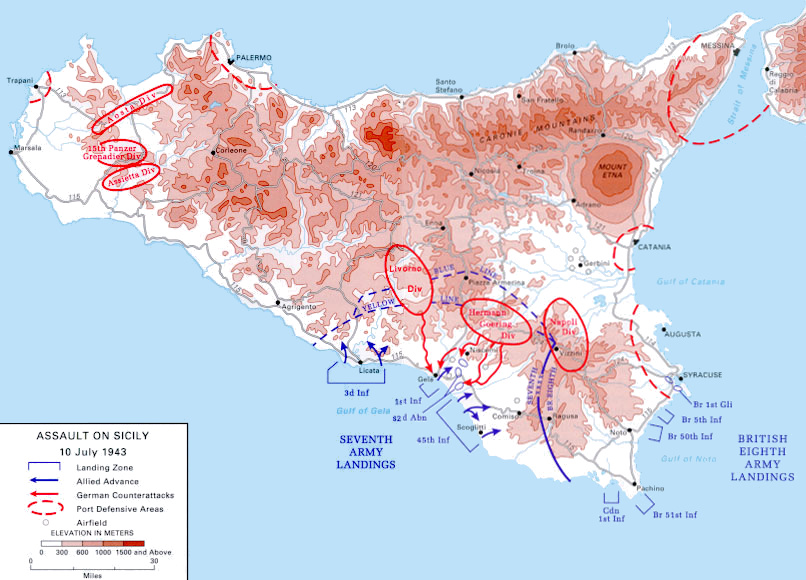
Sailing secretly at the end of June, the Division took its place on the left flank of General Bernard Montgomery’s famed Eighth Army for the Sicilian landings. The amphibious attack against Pachino peninsula was an unqualified success. The defenders were surprised and overrun with very few Allied casualties, and so began a controversial 38-day campaign. General Simonds’ troops advanced inland under difficulties:
The weather was extremely hot, the roads extremely dusty, and there was little transport; the troops were fresh from a temperate climate and a long voyage in crowded ships; and even though for a time there was scarcely any opposition, mere marching was a very exhausting experience under these conditions.
Continuing over the rocky terrain, they had their first fight with the Germans at Grammichele on 15 July. Three days later they captured Valguarnera. Both were rear-guard actions by a withdrawing enemy, and the first real tests came on the July 20 at Assoro and Leonforte. At the former, the 1st Brigade launched a surprise attack at night against an ancient Norman stronghold on the summit of a lofty peak. They seized and held their place in the face of fierce counter attacks, the records for the 15th Panzer Grenadier Division afterwards revealing generous tributes to the fieldcraft (Indianerkrieg) of the Canadians. Leonforte, an equally difficult situation, was captured by the 2nd Brigade after a bitter fight. These three days cost the Division about 275 casualties.
The advance then turned the east towards Adrano, at the base of Mount Etna. In their path stood Agira, “one of the most imposing of Sicily’s innumerable hill-towns,” and in the neighbouring hills the enemy put up a stubborn resistance. Both the 1st and 2nd Brigades were heavily engaged during the last week of July. The operations were, however, effectively supported by Canadian tanks and by the divisional artillery, reinforced by units of the Royal Artillery. General Simonds also had temporarily under his command the 231st British Infantry Brigade (the Malta Brigade), which threatened German communications from the south. After a bitter struggle Agira was captured on the 28th. Between Agira and Adrano the Hermann Goering Division made a stand at Regalbuto, using tanks as pillboxes in the debris of the town. While part of the 1st Division loosened the enemy’s grip on this town, the 3rd Brigade, temporarily under the command of the British 78th Infantry Division, assisted that formation in the Dittaino Valley.
American encircling operations in the western and northern districts of the island, combined with steady British pressure north of the Catania Plain, forced the enemy out of the defences based on Etna, and the campaign ended when the Allies entered Messina on 16-17 Aug. The 1st Division had performed all of its allotted tasks and had acquired valuable battle experience at a total cost of 2,155 casualties. The measure of the achievement was contained in General Montgomery’s statement: “I now consider you one of my veteran Divisions.”
The Division passed from XXX Corps to XIII Corps on 10 Aug, and moved to a concentration area in the rear on 11-13 Aug, relieved of operational responsibilities. Divisional headquarters moved to Francofonte. During the battle of Sicily they had travelled 120 miles, over largely rough and mountainous terrain.
Comments Off on Operation Husky with the “D-Day Dodgers”
June 30, 2018
Adventures in Sicilian non-verbal communication
At El Reg, Alistair Dabbs recounts some tales from a recent trip to Italy:
This isn’t the first time I have strayed into a Twilight Zone of cross-lingual and intercultural bafflement during this vacation. Throwing caution to the wind a few days earlier, I’d rashly allowed Google Maps to plot a walking route from the centre of Palermo to La Zisa. Why I did this, I cannot say, especially given my poor experience of Google Maps’ walking routes in the past. This is, after all, the app that once directed me to walk through the centre of an unlit Hyde Park at 2am and whose audio inexplicably but routinely barks “Turn left!” when you’re supposed to turn right.
On this occasion, Google Maps decided to take me on a scenic tour of the city’s most impoverished slums. Given that what few pavements existed along the way were knee high in refuse and canine excretia, it was less of a walking route than a wading route. The final 100 metres appeared to be some kind of theme park attraction along the lines of Disney World’s “Pirates of the Caribbean”, except this was “Dope-addled Inbreds of the Mediterranean”.
To access this den of iniquità, I had to pass through one of those pedestrian gates design to stop cyclists from riding through it. It was blocked by a tweenager who’d been trying to ride his bicycle through it and got stuck. The unlikely resolution of such an attempt was emphasised by two obvious challenges: it was an adult bike and the boy was so fat that he looked like an inflatable sofa. Both the bicycle and his body were at least two sizes too big for him.
By waving his arms around, he indicated that I was welcome to pass through the gate. By waving my arms back at him, I indicated that I would certainly do so after he had extricated himself. This attracted some shifty onlookers who helpfully grunted and waved their arms around at both of us until eventually we were all gesticulating like delegates at a semaphore convention.
Fearing an unfortunate outcome from this clash of cultures in unfamiliar territory, I coaxed the fat kid and his bike out of the gate and taught him to play the banjo he was carrying, ending with a spontaneous duet between the two of us. It was only by sheer luck that I’d remembered to pack my bagpipes.
Comments Off on Adventures in Sicilian non-verbal communication
June 24, 2018
Europe and the refugees
Theodore Dalrymple on the various European governments’ attitudes and actions on the refugee problem:
Europe, despite its Union, is as divided as ever. Recently, when Italy’s new right-wing government — anxious to prove its credentials — refused to allow a boat carrying 629 African migrants to dock in Italy, Spain’s new left-wing government — equally anxious to do the same — accepted the boat. When the French president, Emmanuel Macron, criticized the Italians for their decision, the Italian government accused the French of hypocrisy, inasmuch as they had refused to take more than 9,000 migrants from Italy that they had previously agreed to accept.
This story is revealing in several aspects. The first is that, whatever attitude governments take to the migrants, no one truly believes that they are more of an asset than a liability. Madrid’s action, for example, was taken on “humanitarian” grounds, rather than because it believed that Spain would benefit from the migrants’ presence. When European leaders discuss the migrant question, it is always in terms of sharing the burden, not the assets, equitably. No one speaks of foreign investment in this way, which suggests that European politicians believe, whether rightly or wrongly, that the free movement of people and capital are different in an important way.
The leaders speak of sharing the burden, then, and are incensed when countries such as Hungary and Poland refuse point-blank to take any migrants from Africa or the Middle East. But I have never seen mentioned in this context the question of where the migrants themselves want to go. They might as well be inanimate toxic waste as far as the discussion is concerned, rather than human beings with wishes, desires, ambitions, and so forth. They are but pawns in a political game. Hungary, for example, is deemed duty-bound to take x number of migrants: no one asks whether x number of migrants can be found who want to go to Hungary. Nor is the question ever discussed in public whether Hungary, having open borders, would be held responsible for making the migrants stay there once they had arrived. Short of penning them in, how exactly would you keep them in Hungary, or in Poland?
Comments Off on Europe and the refugees


