
Published on 17 May 2015
In 1815, eight miles south of Brussels, two of history’s greatest generals met in battle for the first and only time: Napoleon Bonaparte, Emperor of the French, and the Duke of Wellington. The result was an epic, brutal battle that would decide the fate of Europe.
September 28, 2015
Epic History: Battle of Waterloo
Comments Off on Epic History: Battle of Waterloo
September 14, 2015
Cash is still king … and we’d be insane to abolish it
In the Telegraph last month, Matthew Lynn made the case against eliminating cash:
Trying to get a plumber in France? In the rather unlikely event that you can actually find one who isn’t still on his grandes vacances, gone above his permitted 35 hours a week, or indeed long since relocated himself to South Kensington, then you’ll also have to make sure that you can pay by cheque or bank transfer.
From today, France is banning the use of cash for transactions worth more than €1,000, or slightly more than £700. On one level, that is about combating crime and terrorism. But on another, it is also part of a growing movement among academics and now governments to gradually ban the use of cash completely. It is inefficient, oils the underground economy, and makes it harder for central banks to manage the economy, or so runs the argument.
Much like gold, it is a “barbarous relic”, as some publications loftily dismiss it. The trouble is, cash is also incredibly efficient. And it is a crucial part of a free society. There is no convincing case for abolition.
When it comes to creeping state control, it is no surprise to find the French out in front. In the wake of this year’s attack on the Charlie Hebdo office, the government has clamped down on the use of cash. The maximum permitted transaction has been reduced from €3,000 to €1,000, and any cash withdrawal of more than €10,000 will be automatically flagged up to the police (tourists have a higher limit, but even that is being reduced to €10,000 – just in case you are planning on ordering some very expensive wine on your next trip to Paris).
[…]
In reality, cash is far too valuable to be given up lightly. In truth, the benefits of abolition are largely oversold. While terrorists and criminals may well use cash to buy weapons, or deal in drugs, it is very hard to believe that they would not find some other way of financing their operations if it was abolished. Are there really any cases of potential jihadists being foiled because they couldn’t find two utility bills (less than three months old, of course) in a false name to open an account? The web is full of false payment systems and anonymous names.
Nor is clamping down on the black economy such a big deal. Admittedly these things are hard to measure, but according to research by the London School of Economics, the black economy only accounts for 10pc of British GDP, which is the fourth lowest in the EU. Many of the people working in it are below the tax threshold anyway, and certainly below the VAT threshold. So the tax collected even if you clamped down completely is unlikely to amount to more than 1pc of GDP. As for negative interest rates, do we really want those? Or have we concluded that central bankers are doing more harm than good with their attempts to manipulate the economy?
Comments Off on Cash is still king … and we’d be insane to abolish it
September 1, 2015
French Pistols of World War 1 featuring Othais from C&RSENAL I THE GREAT WAR – Special
Published on 31 Aug 2015
The next live event will be on September 3 6pm CET. Othais will introduce us to German rifles and pistols. You can already find a few episodes about them online on his channel: http://bit.ly/OthaisChannel
This is the 2nd part of our special episodes on French small arms of WW1 and how they were used in battle. Othais explains the problems of manufacturing pistols like the Ruby Mle 1915 on a big scale. The French “Lebel revolver” also known as Model 1892 has a few interesting features like being a single action and a double action revolver at the same time. Particularly, the unusual reloading mechanism has a fascinating military history.
Comments Off on French Pistols of World War 1 featuring Othais from C&RSENAL I THE GREAT WAR – Special
August 30, 2015
QotD: The debatable Vosges
Having completed to our satisfaction the Black Forest, we journeyed on our wheels through Alt Breisach and Colmar to Münster; whence we started a short exploration of the Vosges range, where, according to the present German Emperor, humanity stops. Of old, Alt Breisach, a rocky fortress with the river now on one side of it and now on the other — for in its inexperienced youth the Rhine never seems to have been quite sure of its way, — must, as a place of residence, have appealed exclusively to the lover of change and excitement. Whoever the war was between, and whatever it was about, Alt Breisach was bound to be in it. Everybody besieged it, most people captured it; the majority of them lost it again; nobody seemed able to keep it. Whom he belonged to, and what he was, the dweller in Alt Breisach could never have been quite sure. One day he would be a Frenchman, and then before he could learn enough French to pay his taxes he would be an Austrian. While trying to discover what you did in order to be a good Austrian, he would find he was no longer an Austrian, but a German, though what particular German out of the dozen must always have been doubtful to him. One day he would discover that he was a Catholic, the next an ardent Protestant. The only thing that could have given any stability to his existence must have been the monotonous necessity of paying heavily for the privilege of being whatever for the moment he was. But when one begins to think of these things one finds oneself wondering why anybody in the Middle Ages, except kings and tax collectors, ever took the trouble to live at all.
For variety and beauty, the Vosges will not compare with the hills of the Schwarzwald. The advantage about them from the tourist’s point of view is their superior poverty. The Vosges peasant has not the unromantic air of contented prosperity that spoils his vis-a-vis across the Rhine. The villages and farms possess more the charm of decay. Another point wherein the Vosges district excels is its ruins. Many of its numerous castles are perched where you might think only eagles would care to build. In others, commenced by the Romans and finished by the Troubadours, covering acres with the maze of their still standing walls, one may wander for hours.
The fruiterer and greengrocer is a person unknown in the Vosges. Most things of that kind grow wild, and are to be had for the picking. It is difficult to keep to any programme when walking through the Vosges, the temptation on a hot day to stop and eat fruit generally being too strong for resistance. Raspberries, the most delicious I have ever tasted, wild strawberries, currants, and gooseberries, grow upon the hill-sides as black-berries by English lanes. The Vosges small boy is not called upon to rob an orchard; he can make himself ill without sin. Orchards exist in the Vosges mountains in plenty; but to trespass into one for the purpose of stealing fruit would be as foolish as for a fish to try and get into a swimming bath without paying. Still, of course, mistakes do occur.
Jerome K. Jerome, Three Men on the Bummel, 1914.
Comments Off on QotD: The debatable Vosges
August 27, 2015
The plight of the Calais migrants
At sp!ked, Brendan O’Neill talks about the situation in Calais between the migrants who want to enter the UK and the government that very much wants them to stay on the other side of the Channel:
What’s worse: treating people like animals or referring to them in animal-like language? Most normal people would say the former. Actions speak louder than words, after all. To treat someone as less than human — by denying them their rights, caging them, beating them — has a direct detrimental impact on their individual autonomy and everyday lives. In contrast, comparing someone to an animal, through your choice of words, is just unpleasant; it doesn’t physically hold that individual back. Sticks and stones can seriously impede our ability to live freely; words can only make us feel bad (if we let them).
Yet in the morally inverted world of political correctness, where speaking in the clipped morals of the new clerisy is the key and hollow duty of every citizen, words are more important than behaviour. You’re judged on how you express yourself, not on what you believe, or what you do. Take Swarmgate, the media fury over British PM David Cameron’s use of the word ‘swarm’ to refer to those few thousand migrants in Calais who long to come to Britain. When Cameron was talking about sending soldiers and barbed wire and dogs to keep these aspirant Brits out of Britain, the self-styled guardians of public decency — the Twitterati, liberal editorialists, Labourites — said little, except perhaps that he should do it more quickly. Yet as soon as he referred to the migrants as a ‘swarm of people’, these Good People became pained: they banged their fists on tables, spilt their tea, went on the telly.
Ladies and gentlemen, behold the inhumanity of political correctness, which bats not one eyelid when 5,000 human beings are reduced to the level of animals, yet which becomes wide-eyed with anger when their animal-like status is mentioned in polite society. ‘Treat them like shit, just don’t use shitty language while you do it’ — that’s the glorious motto of the PC.
Right now, nothing better captures PC’s Kafkaesque levels of dishonesty and censorious linguistic trickery than Swarmgate. This controversy has exposed that many influential people now mistake politeness for morality, linguistic temperance for decency. So it was that Harriet Harman, acting leader of the Labour Party, could go on TV and rail against Cameron for using that s-word and then in her very next breath call on him to do more to prevent these migrants from getting to Britain. ‘He should remember he’s talking about people and not insects’, she said. Then, in mere seconds, without embarrassment, she talked about the ‘nightmare’ of having all these noisy migrants at the English Channel and said Cameron should put pressure on the French to assess ‘these people’ to see which ones ‘should be deported’. Sent back to where they came from, which in some cases is Afghanistan and Iraq: nations Harman’s party helped to destroy.
Comments Off on The plight of the Calais migrants
August 25, 2015
The French Rifles of World War 1 featuring Othais from C&RSENAL I THE GREAT WAR – Special
Published on 24 Aug 2015
Check out C&Rsenal for more background information on historic firearms: http://bit.ly/HistoricGuns
In the very first edition of our livestream with Othais from C&Rsenal, he introduced us to the French guns of World War 1, such as the Berthier carbine or the Lebel rifle. This is the first summary of our session surrounding the rifles that the French took into battle and their design. If you are curious to find out more about these, check out Othais’ videos where he goes into even more detail about the individual firearms. In the second summary we will talk about French pistols.
The next live session will be on September 3 and we will talk about German rifles and pistols. You can ask questions for that episode using the hashtag #OthaisGermanGuns
Comments Off on The French Rifles of World War 1 featuring Othais from C&RSENAL I THE GREAT WAR – Special
August 21, 2015
Allocating the blame for “Operation Jubilee”
In a BBC post from a few years back, Julian Thompson looks at the Dieppe raid:
On 19 August 1942, a disastrous seaborne raid was launched by Allied forces on the German-occupied French port of Dieppe. Why was such a raid ever undertaken? Because, with Germany operating deep in the Soviet Union, the Russians were urging the Allies to relieve the pressure on them by opening a second front in north-west Europe.
At the same time the British Chief of Combined Operations, Rear Admiral Louis Mountbatten, was agitating for a practical trial beach landing, against real opposition, for his troops. In the face of this pressure, Churchill decided that Operation Rutter, a ‘hit and run’ raid on Dieppe, should go ahead.
[…]
Churchill and the Chiefs of Staff — the heads of the Navy, Army and Air Force, who met daily to discuss strategy and advise Churchill — were responsible for this disastrous misjudgement. But, because no written record exists of the Chiefs of Staff approving the raid in its final form, it has sometimes been suggested that it was really Mountbatten who remounted it without authorisation. This is almost certainly nonsense.
The Chiefs of Staff disliked Mountbatten, regarding him as an upstart foisted on them by Churchill, so any unauthorised action on his part would have given them the ammunition to recommend his removal. Since Mountbatten was not removed, and the Chief of the Imperial General Staff, General Sir Alan Brooke, in his frank and detailed diary, makes no mention of his having exceeded his authority, it seems unlikely that Mountbatten can be accused of mounting the raid without authority.
General Brooke was in the Middle East from 1 August 1942, returning on the 24th, after the event. This was unfortunate, for, as the most forceful and intelligent of the Chiefs of Staff, had he been in Britain in the days preceding the raid, he might have persuaded Churchill to call it off.
Much has been said since about the fact that the Dieppe raid was a necessary precursor to the great amphibious operations that were to follow, in terms of the lessons learned and experience gained. Mountbatten pursued that line all his life. But as Chief of Combined Operations, he did bear some of the responsibility for mounting the operation, so one can only comment, ‘he would say that, wouldn’t he?’
The disaster did point up the need for much heavier firepower in future raids. It was recognised that this should include aerial bombardment, special arrangements to be made for land armour, and intimate fire support right up to the moment when troops crossed the waterline (the most dangerous place on the beach) and closed with their objectives.
However, it did not need a debacle like Dieppe to learn these lessons. As judged by General Sir Leslie Hollis — secretary to the Chiefs of Staff Committee and deputy head of the Military Wing of the War Cabinet with direct access to Churchill — the operation was a complete failure, and the many lives that were sacrificed in attempting it were lost with no tangible result.
Comments Off on Allocating the blame for “Operation Jubilee”
August 20, 2015
Frédéric Bastiat
Lawrence W. Reed makes the case for Frédéric Bastiat to be awarded a Nobel Prize … if they awarded them posthumously, anyway:
If a posthumous Nobel Prize was awarded for crystal-clear writing and masterful storytelling in economics, no one would be more deserving of it than Frédéric Bastiat (June 30, 1801–December 24, 1850). He set the standard over a century and a half ago.
This remarkable Frenchman was an economist in more than the traditional sense. He understood the way the economic world works, and he knew better than anybody how to explain it with an economy of words. He employed everyday language and a conversational tone, an innate clarity that flowed from his logical and orderly presentation. Nothing he wrote was stilted, artificial, or pompous. He was concise and devastatingly to the point. To this day, nobody can read Bastiat and wonder, “Now what was that all about?”
Economic writing these days can be dull and lifeless, larded with verbosity and presumptuous mathematics. Bastiat proved that economics doesn’t have to be that way: the core truths of the science can be made lively and unforgettable. In literature, we think of good storytelling as an art and stories as powerful tools for understanding. Bastiat could tell a story that stabbed you with its brilliance. If your misconceptions were his target, his stories could leave you utterly, embarrassingly disarmed.
If you aspire to be an economist or a policy maker or a teacher or just an influential communicator, take time to study at the feet of this 19th-century master.
Comments Off on Frédéric Bastiat
August 12, 2015
Who might buy a Mistral?
At the International Business Times, Christopher Harress reports on the two Mistral-class helicopter carriers France built for Russia and is now trying to find new homes for:
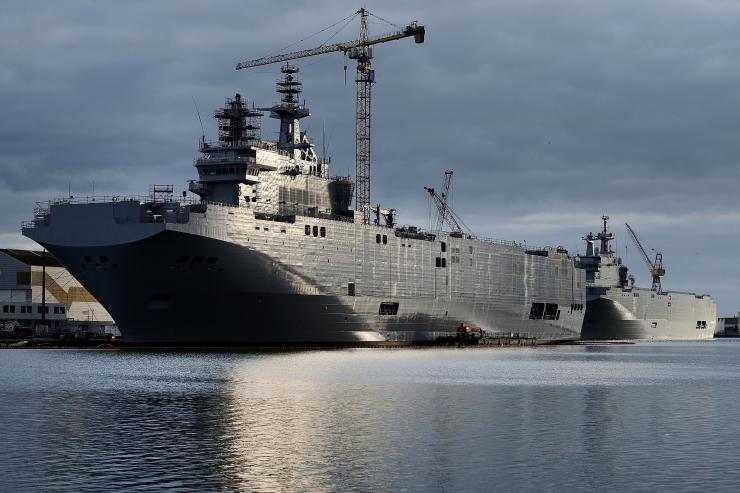
The Sevastopol (left) and the Vladivostok warships, two Mistral class LHD amphibious vessels ordered by Russia from STX France, are seen in St. Nazaire, France, Dec. 20, 2014. Jean-Sebastien Evrard/Agence France-Presse/Getty Images
Inside the sprawling dockyard in the ancient town of St. Nazaire in southwestern France sits $1.2 billion worth of unsold naval hardware. Despite having never left the dock, the two Mistral helicopter landing ships, originally built by France for use in the Russian navy, inadvertently have become involved in the growing international dispute between Russia and the West over the annexation of Crimea and the war in eastern Ukraine.
Now they are causing problems in France.
Two days after managing to negotiate a way out of the deal with Moscow that had become a divisive, ethical and political dilemma in Europe, France faces the fresh challenge of looking for a new buyer that has both the military need and the hard cash for the two 21,000 ton warships.
“I think this will be a difficult product to sell,” said Dakota Wood, senior research fellow of defense programs at the Heritage Foundation, a conservative Washington think tank. “Military ships are highly specialized and designed for a specific purpose that accounts for all the weapons systems and unique specifications that the navy in questions needs. In this case, the spacing and logistics to accommodate the unique aircraft that Russia was going to use. What other country shares those exact specifications?”
With Canada in the middle of a long, long election campaign, there’s no point in pretending that one or both of the ships might end up as part of the Royal Canadian Navy (unlike a few earlier reports), so France is forced to look further abroad for countries that have both the ready money (like Saudi Arabia) and the pressing need (uh, like Saudi Arabia).
July 19, 2015
Rising tides of anti-German feeling … in France
Theodore Dalrymple discusses the changing opinions about Germany within the European Union, but especially in France:
There seems to be growing anti-German feeling in France, at least if what I read is anything to go by (which it might not be, of course). For example, a book with the title Bismarck Herring (The German Poison) is on sale everywhere. It is not by an unknown person, but rather by a very well-known left-wing French politician, Jean-Luc Mélenchon.
You don’t have to go far in it to discover a tone of sheer hatred. The Germans, according to him, have returned to their old arrogant ways (which, of course, they never really lost); the price of their industrial and financial success is a land of oppressed, impoverished, and fat workers who don’t want any children; their industry spreads pollution all over Europe; and, unlike the French, who purified themselves of collaborationist industrialists after the war, the Germans just went on as if nothing had happened. At the end of the book, Mélenchon says that France (and presumably only France) has the wherewithal to liberate Europe from German imperialism. In a chapter headed “Spitting Out the Poison,” he mentions that, unlike Germany, France still has considerable military capacity. The obvious implication, I am afraid, is that France could, and perhaps should, use it to occupy the Ruhr again if Germany does not change its wicked ways.
Is it not strange that such thoughts should occur to a deputy of the European Parliament? After all, the most commonly used justification for the existence of the European Union is that it ensures the peace of the continent — by which, of course, is meant the pacification of France and Germany, since Belgium was never very likely to send its troops to occupy, say, Portugal. But from the first, the EU has taken Yugoslavia as its model, and Mélenchon’s rant at least has the merit of drawing our attention to a similar possible denouement.
Comments Off on Rising tides of anti-German feeling … in France
July 13, 2015
QotD: Paul Cambon, French ambassador in London
The senior ambassadors developed an extraordinarily elevated sense of their own importance, especially if we measure it against the professional ethos of today’s ambassadors. Paul Cambon is a characteristic example: hr remarked in a letter of 1901 that the whole of French diplomatic history amounted to little more than a long list of attempts by agents abroad to achieve something in the face of resistance from Paris. When he disagreed with his official instructions from the capital, he not infrequently burned them. During a tense conversation with Justin de Selves, minister of foreign affairs from June 1911 until January 1912, Cambon somewhat tactlessly informed de Selves that he considered himself the minister’s equal. This claim looks less bizarre if we bear in mind that between 1898, when he became ambassador to London, and the summer of 1914, Cambon saw nine ministers enter and leave office — two of them did so twice. Cambon did not regard himself as a subordinate employee of the government, but as a servant of France whose expertise entitled him to a major role in the policy-making process.
Underpinning Cambon’s exalted sense of self was the belief — shared by many of the senior ambassadors — that one did not merely represent France, one personified it. Though he was ambassador in London from 1898 until 1920, Cambon spoke not a word of English. During his meetings with Edward Grey (who spoke no French), he insisted that every utterance be translated into French, including easily recognized words such as “yes”. He firmly believed — like many members of the French elite — that French was the only language capable of articulating rational thought and he objected to the foundation of French schools in Britain on the eccentric grounds that French people raised in Britain tended to end up mentally retarded.
Christopher Clark, The Sleepwalkers: How Europe Went To War In 1914, 2012.
Comments Off on QotD: Paul Cambon, French ambassador in London
July 8, 2015
Socialist and Front Soldier – Louis Barthas I WHO DID WHAT IN WW1?
Published on 6 Jul 2015
Louis Barthas was a French soldier who served on the Western Front for 54 months. He served in the Battle of Verdun and other major battles of World War 1. His War Diary gave a voice to the senselessness of war. As a socialist, Barthas was a supporter of the French mutinies of 1917 and a vocal enemy of the war. All about Louis Barthas in our biography.
Comments Off on Socialist and Front Soldier – Louis Barthas I WHO DID WHAT IN WW1?
July 6, 2015
The 1870-71 Franco-Prussian War “was nearly the death of French Riesling”
Paul Lewandowski on the non-military impact of the Franco-Prussian War:
The name “Franco-Prussian War of 1870” conjures few images in the popular consciousness. It is an obscure war that is easily overshadowed by the Napoleonic wars of a few generations earlier, and the First World War a couple generations later. However, fans of military history and wine aficionados should both be intimately familiar with the conflict that is considered the first “modern” war, and was nearly the death of French Riesling.
The balance of power established in Europe after Napoleon’s defeat in the early 1800s had begun to erode in 1870. The greatest threat to this order was the upstart principality of Prussia. This relatively small nation had forged its independence and thrust itself onto the world stage through martial prowess and total devotion to military readiness among its people. Nineteenth-century Prussia was in many ways the first “garrison state.” By the late 1860s, the crafty Chancellor Otto Von Bismarck had consolidated Prussia into the hegemon of northern Germany. Everyone in Europe recognized that Prussia was a rising European power. France meanwhile, was the aging colossus of the European order. It had been a global power for hundreds of years, sparring with the Hohenzollerns and Hapsburgs for power and control of the European continent. For France, the world was changing, and the stagnant nation failed to change with it.
[…]
Alsace produces almost exclusively white wines. Historically the primary varietals are Rieslings and Gewürztraminer, both of which are also produced in Germany. Alsatian wines distinguish themselves from their German counterparts by their intense dryness. While German wines traditionally retain some sugar following fermentation, Alsatian wines are produced with almost no residual sugars.
Riesling is considered a “top three” white wine, together with Chardonnay and Sauvignon Blanc. It is most commonly grown in Germany and Alsace, but it is also cultivated in the United States, Australia, and Eastern Europe. Gewürztraminer meanwhile, is a wine variety that got its name in Alsace, though the grape it is derived from, the Traminer, has a somewhat hazy origin. Traminer is uniquely suited to Alsace, as it is considered by winemakers to be among the more difficult varietals to cultivate. Growers regard Traminer as “fussy” about different soils, unproductive, disease-prone, sensitive to frost, unruly on the vine, and inconsistent in result. Before modern cultivation methods, Gewürztraminer was difficult to cultivate consistently outside of Alsace.
Given the region’s unique productivity, Germany sought to obtain Alsace in the Armistice of Versailles. Once they took control of the region (along with parts of Lorraine), Germany’s actions became puzzling. They outlawed the production of Rieslings and Gewürztraminer in Alsace. Instead, the government imported low-quality, high-volume grape varietals like Chasselas and Elbling. Why would Germany want to destroy the unique productive capacity of their newly acquired region?
Comments Off on The 1870-71 Franco-Prussian War “was nearly the death of French Riesling”
July 3, 2015
QotD: “US tankers were notorious for identifying everything as a Tiger tank”
When you read unit accounts, whether it’s the actual unit after action reports or the published books, everyone talks about Tiger tanks. But in looking at it in both German records and US records, I’ve only found three instances in all the fighting from Normandy to 1945 where the US encountered Tigers. And by Tigers I mean Tiger 1, the type of tank we saw in the film [Fury]. I’m not talking King Tigers, the strange thing is that the US Army encountered King Tigers far more often than Tigers. That’s partly because there weren’t a lot of Tigers left by 1944, production ends in August 1944. There were not a lot of Tigers in Normandy, they were mostly in the British sector, the British saw a lot of Tigers. Part of the issue is that US tankers were notorious for identifying everything as a Tiger tank, everything from Stug III assault guns to Panzer IV and Panthers and Tigers.
There was one incident in August of 1944 where 3rd Armored division ran into three Tigers that were damaged and being pulled back on a train, they shot them up with an anti-aircraft half-track. And then there was a single Tiger company up in the Bulge that was involved in some fighting. And then there was one short set of instances in April 1945, right around the period of the film, where there was a small isolated Tiger unit that actually got engaged with one of the new US M26 Pershing tank units. They knocked out a Pershing and then in turn that Tiger was knocked out and the Pershing tanks knocked out another King Tiger over the following days. So I found three verifiable instances of Tigers encountering, or having skirmishes with US troops in 1944-45. So it was very uncommon. It definitely could have happened, there are certainly lots of gaps in the historical record both on the German side and the US side. I think the idea that the US encountered a lot of Tigers during WW2 is simply due to the tendency of the US troops to call all German tanks Tigers. It’s the same thing on the artillery side. Every time US troops are fired upon, it’s an 88, whether it’s a 75mm Pak 40 anti-tank gun, a real 88, a 105mm field howitzer, they were all called 88’s.
“Interview with Steven Zaloga”, Tank and AFV News, 2015-01-27.
Comments Off on QotD: “US tankers were notorious for identifying everything as a Tiger tank”
June 27, 2015
“Individualism” as an epithet
Frank Furedi explains the odd origins of the word “individualism”:
One reason why the idea of individualism generates so much confusion is because, throughout its history, it has been defined by parties that were hostile to it. Indeed, the very term itself was an invention of the opponents of liberalism. As Steven Lukes pointed out in in his useful study, Individualism (1973), the term first emerged in French – individualisme – as part of ‘the general European reaction to the French Revolution and to its alleged source, the thought of the Enlightenment’. For those opposed to the Enlightenment, individualism served as a swear word to be hurled at the enemy.
In Europe, nineteenth-century conservative and counter-revolutionary thought was dominated by hostility to reason and the rights of the individual. Individualism was blamed for the corrosion of traditional communities and the decline in community solidarity. And this conservative representation of individualism, as a narrow-minded, egotistical outlook that selfishly ignores the needs of others in society, continues to predominate. The Oxford English Dictionary, for example, describes individualism as ‘the habit of being independent and self-reliant; behaviour characterised by the pursuit of one’s goals without reference to others’. In case the reader missed the implicit moral judgement here, the OED adds that individualism comes ‘sometimes with negative connotations of self-centredness or anti-social behaviour’.
By the middle of the nineteenth century, it was increasingly common to attribute some of the most destructive consequences of the Industrial Revolution, particularly the break-up of communities and social disorganisation, to the rise of individualism. When Auguste Comte, the French philosopher and founder of the discipline of sociology, condemned individualism as ‘the disease of the Western world’, he gave voice to a sentiment that transcended the ideological divide between conservatives and socialists. Individualism had few friends on either the left or the right of the political spectrum. The representation of individualism as a selfish, anti-social and destructive creed provided an ideological narrative for demonising liberal currents of thought.
Comments Off on “Individualism” as an epithet


