
Published on 25 May 2017
This week 100 years ago, Germany is flying concentrated bomber attacks with multiple Gotha bombers on British cities – causing more damage than any Zeppelin raid before. In the Middle East, T.E. Lawrence and his allies from the Arab Revolt are on the march while on the Western Front, the last battles of the Nivelle Offensive come to an end.
May 26, 2017
German Bombers Over Britain – Arab Revolt On The Advance I THE GREAT WAR Week 148
Comments Off on German Bombers Over Britain – Arab Revolt On The Advance I THE GREAT WAR Week 148
May 16, 2017
Exploring Fort Douaumont With The VERDUN Developers I THE GREAT WAR Special
Published on 15 May 2017
Join our Live Stream with the Developers: http://twitch.com/tgw_series
Check out Verdun: http://www.verdungame.com/We went to the Verdun area in France this winter and visited Fort Douaumont together with the developers of the video game VERDUN. They rebuilt the fort in their game and their knowledge of the sight shows when Indy is walking through the fort.
Comments Off on Exploring Fort Douaumont With The VERDUN Developers I THE GREAT WAR Special
May 12, 2017
The Macedonian Standoff – The Five Nation Army Is Repelled I THE GREAT WAR Week 146
Published on 11 May 2017
Italy, France, Serbia, Britain and Russia joined forces at the Macedonian Front and the “five nation army” wants to break through the lines held by Bulgaria with some German support. But the Bulgarian defences can withstand the attack and so Maurice Sarrail is forced to abandon all hopes for a breakthrough. Meanwhile another offensive is about to proceed at the Italian front which had been quiet all winter.
Comments Off on The Macedonian Standoff – The Five Nation Army Is Repelled I THE GREAT WAR Week 146
May 9, 2017
The French presidency is sorted, but what about the opposition?
Megan McArdle reports on the state of the two former mainstream parties in France after both were unable to get their presidential candidate past the first round of voting:
When I arrived in France a week ago, many Americans were asking whether this election was going to be the French Brexit, and Marine Le Pen the French Trump. Given the strength of Emmanuel Macron’s lead in the polls, I thought this was the wrong question. France, in fact, already had a Brexit-sized political earthquake, when neither of the two mainstream parties of left and right made it into the second round.
The center-right Republican Party currently seems to be flailing around, trying to decide where it goes next. It is nonetheless in better shape than the left’s Socialist Party, whose devotees are currently standing around its sickbed, speaking in hushed tones. Jean-Luc Mélenchon pinched many Socialist voters, particularly lower-income and unemployed urban dwellers, with his “France Insoumise” (France unbowed) platform; Macron won over the prosperous by coming out full-bore for Europe, globalization, economic reform, and immigration. Even Le Pen got a few in the second round, mostly those who identify as “far left.” One hates to prematurely report a death, of course, but it’s certainly hard to see how the Socialists manage to recover from their humiliating single-digit performance in the first round of this election.
With both major parties in disarray, the question naturally arises: If Emmanuel Macron’s brand of ardent globalization becomes the focal ideology for one side of the political spectrum, what will constitute the natural opposition?
[…] Right now French politics doesn’t have two poles; according to political scientist Arun Kapil, it has five: the far left, the small and hardy band of loyal Socialists, En Marche!, the Republicans, and the National Front. And one possibility is that these poles winnow somewhat, but never come back to the old intra-right and intra-left alliances that stabilized French politics into something approaching a two-party system. Mélenchon is a true believer who so far seems unwilling to make strategic alliances, and the National Front is similarly uncooperative, even if other parties wanted to cooperate with them, which they don’t. If those blocs hold onto enough voters to tip an election, but never quite enough to win one, future French elections may get kind of wild.
It’s too early to tell yet which of these possible futures will hold. But we may start to get some guess in June’s legislative elections. How well En Marche! does will provide clues to just how big a shift Macron has actually achieved in French politics. How well the Republicans do will give us some sign of whether they can get their mojo back. And the performance of the far left and the far right will indicate whether France is on its way to establishing a “new normal” not that much different from the old — or striking out for uncharted territory, where there may well be some dragons lurking.
Comments Off on The French presidency is sorted, but what about the opposition?
US Joins WW1 – Spring Offensives 1917 I THE GREAT WAR Summary Part 9
Published on 8 May 2017
After a rather quiet winter, the war erupts into action in 1917. Not only do the United States join the war after weeks of unrestricted submarine warfare and the uncovering of the Zimmermann Telegram. The British and French launch their own spring offensives. In the East, chaos spreads in post-revolutionary Russia and Lenin returns from exile. And in Mesopotamia the British take Baghdad.
Comments Off on US Joins WW1 – Spring Offensives 1917 I THE GREAT WAR Summary Part 9
May 7, 2017
Joffre The Imbecile – Nivelle’s Catastrophe I OUT OF THE ETHER
Published on 6 May 2017
It’s time to shine a light on some of the great comments we received and in the past days you guys had a lot to say about Nivelle and the French High Command in general.
Comments Off on Joffre The Imbecile – Nivelle’s Catastrophe I OUT OF THE ETHER
May 6, 2017
Marine Le Pen versus Emmanuel Macron
Megan McArdle is in France this week and watched the televised debate between Le Pen and Macron on Wednesday. She found some interesting parallels between it and the US presidential debates, but some significant differences, too:
Watching last night’s presidential debate here in France, I found it hard not to think about our own presidential debates in the U.S., lo these many months ago. In many ways, it was the same: the populist upstart against the center-left representative of the establishment, the status quo against the YOLO, the woman against the man. In other ways, it was very different — which is why, according to almost everyone, Emmanuel Macron is going to be elected president next week, and Marine Le Pen will not.
Macron, like Hillary Clinton, is the candidate of “more of the same, but with, you know, more of the same.” His contempt for Le Pen was obvious, and if this were an American debate, would have hurt him. My French is good enough to read a newspaper (very slowly) and to sort of follow the debate as long as no one else was talking. So as I watched, I paid attention to tone and body language as much as content.
[…]
Le Pen, like Trump, is basically the candidate of “things were better 40 years ago, so let’s go back there.” And it’s easy to understand why that’s appealing for a lot of voters in both France and America. The problem is, even if it were desirable to migrate en masse back to the mid-20th century, no one knows how to do it. France may be struggling to integrate its immigrants, but they are here, and cannot simply be removed the way one might get rid of a piece of furniture that clashes with the rest of the décor. Trade may have resulted in painful deindustrialization, but de-industrialization is a one-way street, and pulling out of those trade relationships will not bring back the lost factories. The euro may have been a very bad idea — no, strike that, the euro was a very bad idea, probably the worst one France has had since “let’s get into a land war in Southeast Asia” — but leaving the euro is not the same as having never adopted it. In the short term, at least, it would be catastrophically messy.
To this, Le Pen’s supporters might reply “but at least we could stop making things worse.” But even if you hold out more hope for her agenda than I do, the fact remains that if you reject the status quo in favor of radical change, you necessarily raise the risk that things will get much worse. We know approximately what the status quo looks like. Radical action means launching off into the dark. Which is why radical candidates inevitably seem less prepared, knowledgeable and plausible than their mainstream opponents.
That said, compared to Donald Trump, Marine Le Pen sounds like a wonk’s wonk. Nor does she have his propensity to lose his cool. Watching the French debate, I was struck by a repeated thought: if Clinton had had Le Pen’s speaking ability, she would be president now. During the campaign, and after, Clinton’s supporters frequently complained that Clinton was being penalized for being an older woman. But Le Pen is living proof that middle-aged ladies can be effective politicians. I don’t like her agenda, and I really don’t like her party. But looking strictly at effectiveness on the stump, she’s pretty good.
Comments Off on Marine Le Pen versus Emmanuel Macron
May 5, 2017
The Battle of Arleux – Robert Nivelle Gets Fired I THE GREAT WAR Week 145
Published on 4 May 2017
The Battle of Arras continued in smaller scale attacks this week 100 years ago. Fighting focused on Arleux and the Scarpe river. Neither of these battles was able to repeat the success of the early Arras offensive. The casualties of the Nivelle Offensive were now costing Robert Nivelle his job as he was still blaming everyone but himself.
Comments Off on The Battle of Arleux – Robert Nivelle Gets Fired I THE GREAT WAR Week 145
May 4, 2017
Marine Le Pen may win or lose on May 7th, but the voters she represents will not go away
Bill Wirtz on the long-term trends that may or may not be represented in the voting for the second round of voting in the French presidential elections:
After the first round of voting last Sunday, the French electorate decided to send independent candidate Emmanuel Macron (23.8 percent) and far-right nationalist Marine Le Pen (21.6 percent) to the next round of voting on May 7th.
Opponents of Le Pen’s radical policies are now calling for a gathering of the so-called “Front Républicain,” the Republican Front.
Inspired by the name of Le Pen’s National Front, the Republican Front gathers those who reject the rampant nationalist positions of the French far-right, which they consider contrary to the “Republican spirit.”
While not an established party in itself, the Republican Front represents a coalition of different parties in the République against a particularly unpopular candidate like Marine Le Pen. […]
For many French voters, the second round is an ideological dilemma. If for instance, the candidate they were supporting fails to progress to the next round, they may be more or less forced to throw their support behind a candidate with whom they have severe disagreements.
Now, the country’s political role models and media personalities expect the electorate to cast a “vote utile,” the “useful vote,” preventing Le Pen from coming to power. And ultimately that is exactly what will happen.
Both candidates will get involved in heated debates but in the end, the gathering of the Republic Front, with all mainstream parties rallying behind Macron in order to avoid Le Pen, will prevent the French nationalist from taking the Elysée Palace.
And yet, the consequences of this policy might be dangerously ill-advised.
Comments Off on Marine Le Pen may win or lose on May 7th, but the voters she represents will not go away
May 2, 2017
Tank Chats #8 Renault FT-17
Published on 4 Aug 2015
The eight in a series of short films about some of the vehicles in our collection presented by The Tank Museum’s historian David Fletcher MBE.
Conceived by General Jean-Baptiste Estienne and manufactured under the control of the Renault Company this was the world’s first mass-produced tank, 3800 being built in all.
They went into action for the first time on 31 May 1918 near Ploissy-Chazelle and proved very successful when they were used in numbers. British forces used a few Renaults as liaison vehicles while the United States Army used them in combat and copied the design.
Comments Off on Tank Chats #8 Renault FT-17
April 28, 2017
The Battle of Doiran – Turmoil In The French Army I THE GREAT WAR Week 144
Published on 27 Apr 2017
The Salonica Front had been quiet over the winter, but much like the recent battles on the Western Front, it erupted this week. The British Army tried to take the Bulgarian positions at Doiran – these positions might have been some of the best defences of the entire war. After the failed Nivelle Offensive, some French soldiers start to question the whole war.
Comments Off on The Battle of Doiran – Turmoil In The French Army I THE GREAT WAR Week 144
April 21, 2017
The Nivelle Offensive – Carnage At The Chemin Des Dames I THE GREAT WAR Week 143
Published on 20 Apr 2017
French Commander Robert Nivelle was sure that his offensive would bring the final victory against Germany. He scaled up his successful plan from Verdun which had worked so well and even when other generals questioned the very idea of the offensive, he would refuse to alter it or call it off. The Germans knew that the French were coming and were well prepared. And so the disaster at the Chemin Des Dames unfolded.
Comments Off on The Nivelle Offensive – Carnage At The Chemin Des Dames I THE GREAT WAR Week 143
April 18, 2017
Western Front Artillery At The Outbreak of World War 1 I THE GREAT WAR Special
Published on 17 Apr 2017
World War 1 was a war of artillery, 75% of casualties are attributed to artillery fire. And since the late 19th century the development of field canons, howitzers and mortars had made rapid progress. We are taking a look at the standard artillery pieces of the German, French and British Army at the outbreak of the war in this first part of a new series.
Comments Off on Western Front Artillery At The Outbreak of World War 1 I THE GREAT WAR Special
April 16, 2017
The tale of unsalted butter in French cuisine
At his new blog, Splendid Isolation, Kim du Toit explains the historical roots of a French culinary oddity:
One of the quirks of French cuisine is that most often the butter is unsalted, and at a French dinner table you will usually find a tiny cruet of salt with a microscopic spoon inside, so that you can salt your butter (or not) according to taste. To someone like myself, accustomed only to salted butter, this seemed like an affectation, but it wasn’t that at all: it was the result of taxation, and this is one of the things changed forever by Napoleon’s administrative reforms.
One of the best parts of our U.S. Constitution is the “interstate commerce” clause, which forbids states from levying taxes on goods and services passing from one state to another, and through another in transit. This was not the case in pre-Napoleonic France. Goods manufactured in, say, Gascony or Provence would pass through a series of customs posts en route to Paris, and at each point the various localities would levy excise taxes on the goods, driving up the final price at its eventual destination.
Which brings us to salt. French salt, you see, was produced mainly on the Atlantic coastline, and was a major “export” of Brittany to the rest of France. Butter, of course, was produced universally — in and outside Paris and ditto for every major city — but the salt for the butter came almost exclusively from Brittany, and having been taxed multiple times by the time it reached points east like Paris or Lyons, it was expensive. So the cuisine and eating habits in those parts developed without the use of salt — or, if salt was requested, at an added cost. It’s why, to this day, many French recipes use unsalted butter as an ingredient. (In contrast, butter for local consumption in western France was [and still is] almost always salted, because salt was dirt cheap there.)
Napoleon’s reforms did away with all that; he saw to it that the douane locale checkpoints and toll booths along the main roads were abolished (causing salt prices in eastern France to plummet and become a mainstay of French cuisine at last). And when the towns and villages protested about the loss of tax revenue, Napoleon made up the shortfall with “federal” funds out of the national treasury.
Of course, the French treasury had in the meantime been emptied out by, amongst other things, the statist welfare policies of the Revolutionary government (stop me if this is starting to sound familiar). Which is why, to raise money, Napoleon invaded wealthy northern Italy and western Germany (as it is now), pillaged their rich cities’ treasuries and garnered revenue from the wealthy aristocracy, who paid bribes to avoid having their palaces sacked and their wealth confiscated.
Comments Off on The tale of unsalted butter in French cuisine
April 15, 2017
Charles Joseph Minard
I first encountered Charles Joseph Minard’s best-known work in Edward Tufte’s The Visual Display of Quantitative Information in the late 1980s:
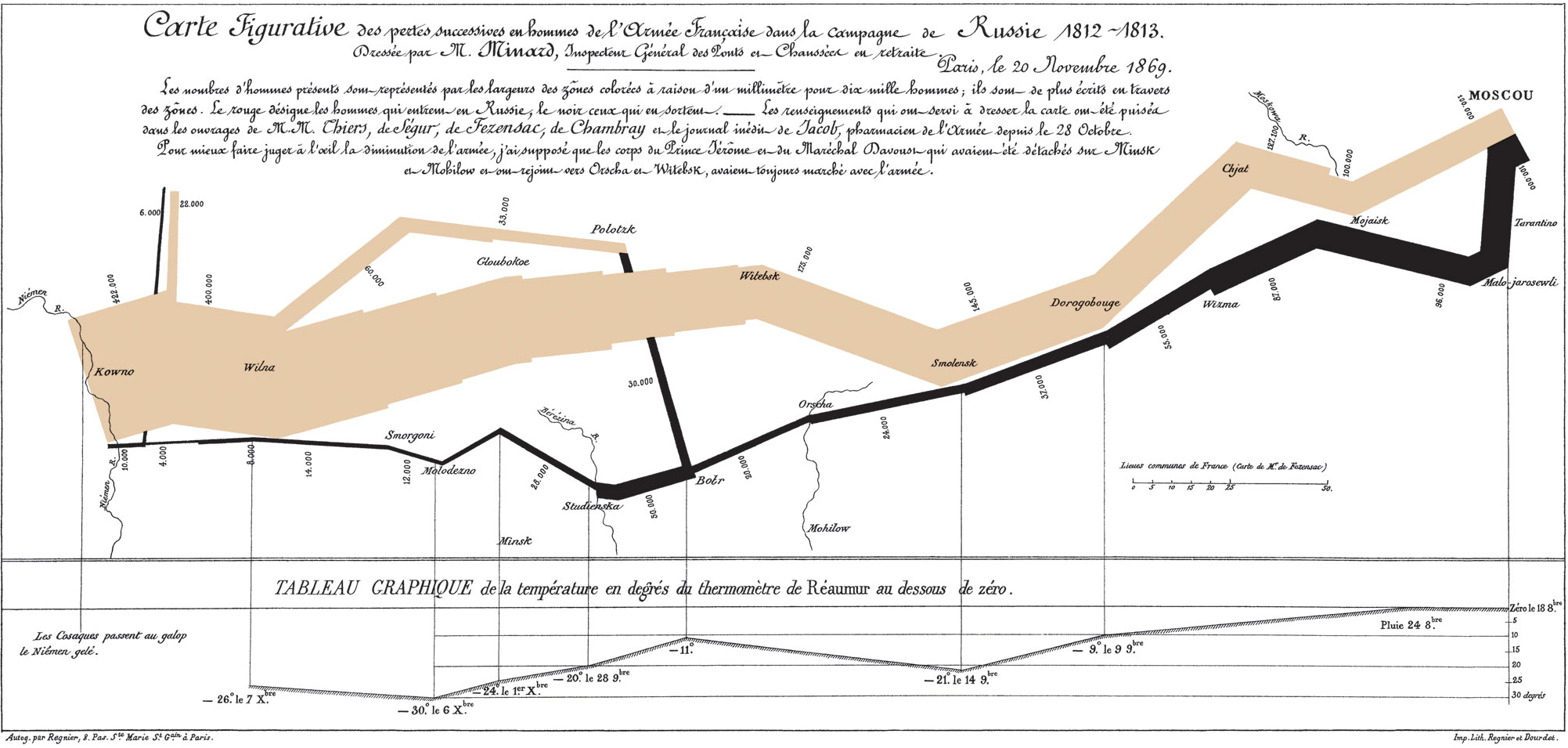
The map’s French caption reads:
Figurative Map of the successive losses in men of the French Army in the Russian campaign 1812-1813.
Drawn up by M. Minard, Inspector General of Bridges and Roads in retirement. Paris, November 20, 1869.
The numbers of men present are represented by the widths of the colored zones at a rate of one millimeter for every ten-thousand men; they are further written across the zones. The red [now brown] designates the men who enter into Russia, the black those who leave it. —— The information which has served to draw up the map has been extracted from the works of M. M. Thiers, of Segur, of Fezensac, of Chambray, and the unpublished diary of Jacob, pharmacist of the army since October 28th. In order to better judge with the eye the diminution of the army, I have assumed that the troops of prince Jerome and of Marshal Davoush who had been detached at Minsk and Moghilev and have rejoined around Orcha and Vitebsk, had always marched with the army.
The scale is shown on the center-right, in “lieues communes de France” (common French league) which is 4,444m (2.75 miles).
The lower portion of the graph is to be read from right to left. It shows the temperature on the army’s return from Russia, in degrees below freezing on the Réaumur scale. (Multiply Réaumur temperatures by 1¼ to get Celsius, e.g. −30°R = −37.5 °C) At Smolensk, the temperature was −21° Réaumur on November 14th.
(Image and translation from Wikimedia)
In National Geographic, Betsy Mason reveals more about the man who created the “best graphic ever produced”:
Charles Joseph Minard’s name is synonymous with an outstanding 1869 graphic depicting the horrific loss of life that Napoleon’s army suffered in 1812 and 1813, during its invasion of Russia and subsequent retreat. The graphic (below), which is often referred to simply as “Napoleon’s March” or “the Minard graphic,” rose to its prominent position in the pantheon of data visualizations largely thanks to praise from one of the field’s modern giants, Edward Tufte. In his 1983 classic text, The Visual Display of Quantitative Information, Tufte declared that Napoleon’s March “may well be the best statistical graphic ever produced.”
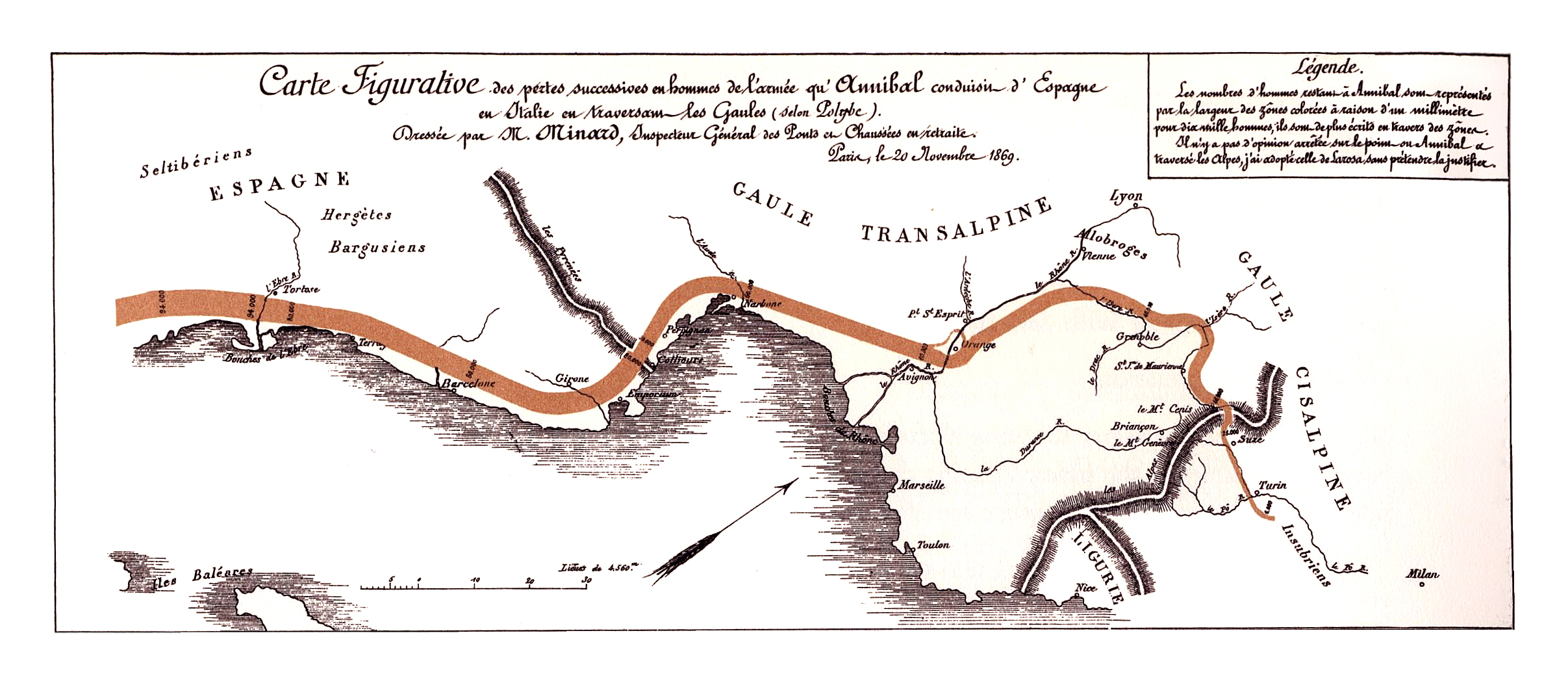
Today Minard is revered in the data-visualization world, commonly mentioned alongside other greats such as John Snow, Florence Nightingale, and William Playfair. But Minard’s legacy has been almost completely dominated by his best-known work. In fact, it may be more accurate to say that Napoleon’s March is his only widely known work. Many fans of the March have likely never even seen the graphic that Minard originally paired it with: a visualization of Hannibal’s famous military campaign in 218 BC, as seen in the image below.
Graphic information of the men losses in the raid of the troops of Hannibal from Spain to Italy (Wikimedia)
On its face, it may not seem remarkable that Minard is remembered for this one piece of work; after all, many people owe their fame to a single great achievement, and the Napoleon graphic is certainly worthy of its reputation. But Minard was most definitely not a one-hit wonder.
Comments Off on Charles Joseph Minard


