Quotulatiousness

October 25, 2009

Royal Navy carrier plans: going, going . . .

Filed under: Britain, Military — Tags: , , — Nicholas @ 20:34

A report in The Guardian walks a bit further down the road to the increasingly likely end of aircraft carrier operations in the Royal Navy:

Defence chiefs are considering scrapping plans to have two large aircraft carriers equipped with fast jets, a move that could save billions of pounds, Whitehall officials said today.

The idea would be to have just one carrier holding US-made joint strike fighters, with the second, more basic, ship, being used only as a platform for helicopters and possibly unmanned drones equipped with missiles and cameras.

The two proposed carriers, the Queen Elizabeth, due to go into service in 2016, and the Prince of Wales, to follow in 2018, are already running £1bn over budget. The original estimated cost was £3.9bn.

Consideration is being given to cutting the number of joint strike fighters to be flown from the carriers, from 138 to about 50, saving more than £7bn.

The head of the Royal Navy last month conceded that the decision to build two large aircraft carriers could be overturned. Admiral Sir Mark Stanhope said that though contracts had been signed to build the carriers, next year’s defence review could cause those plans to change.

Personally, I suspect that the final decision to cancel the carriers has already been taken, the government is just waiting for an opportune moment to make the announcement. Given that the rest of the fleet has been shrinking for years, eliminating the two carriers would allow the government to “save” an even-more-reduced Royal Navy from further cuts . . . until next budget period.

October 23, 2009

Wreck of WW1 British submarine found in Baltic

Filed under: Britain, History, Military — Tags: , , , — Nicholas @ 12:48

BBC News reports on a recent discovery by the Australian descendent of the only survivor of the sinking:

The wreck of a British naval submarine lost for more than 90 years has been found in the Baltic Sea off the coast of Estonia.

HMS E18 – with its complement of three officers and 28 ratings – went out on patrol in May 1916 and was never seen again.

The submarine was one of a handful sent to the Baltic during World War I by Winston Churchill, the First Lord of the Admiralty, to disrupt German shipments of iron ore from Sweden and support the Russian navy.

E18 left its base in the Russian port of Reval – now Tallinn, the capital of Estonia – on the evening of 25 May 1916 and headed west.

The following day she was reported to have engaged and torpedoed a German ship.

A few days later, possibly 2 June, she is believed to have struck a German mine and sunk with all hands.

When a poll goes very wrong

Filed under: Britain, Religion — Tags: , , — Nicholas @ 09:20

Lester Haines reports on a poll that didn’t go quite as the sponsors expected:

An online poll enquiring as to the possible existence of God has somewhat backfired on Christian outfit The Alpha Course, with 98 per cent of the popular vote currently saying he doesn’t:

poll_gone_wrong

According to the Sun, The Alpha Course kicked off a multi-million pound advertising campaign back in September to promote its particular road to enlightenment, described as “an opportunity for anyone to explore the Christian faith in a relaxed setting”.

The poster and ad drive was a response to a Humanist Society campaign last year suggesting there was “probably no God” – a view shared by the vast majority of the 154,500 online votes at time of publication.

October 22, 2009

Soon, they’ll demand a fee for thinking about the songs

Filed under: Britain, Law — Tags: , , , — Nicholas @ 07:44

Although this particular case appears to have ended correctly — with an apology from the heavy-handed enforcer — it does still illustrate just how far the copyright police are willing to go:

A shop assistant who was told she could not sing while she stacked shelves without a performance licence has been given an apology.

Sandra Burt, 56, who works at A&T Food store in Clackmannanshire, was warned she could be fined for her singing by the Performing Right Society (PRS).

However the organisation that collects royalties on behalf of the music industry has now reversed its stance.

They have sent Mrs Burt a bouquet of flowers and letter of apology.

Mrs Burt, who describes herself as a Rolling Stones fan, said that despite the initial warning from the PRS, she had been unable to stop herself singing at work.

October 21, 2009

Soccer stupidities, explained

Filed under: Britain, Economics, Soccer — Tags: — Nicholas @ 12:21

David Goldblatt reviews Why England Lose and Other Curious Football Phenomena Explained, by Simon Kuper and Stefan Szymanski:

“Anyone who spends any time inside football soon discovers that just as oil is part of the oil business, stupidity is part of the football business.” Well, football may not spend billions of pounds actively seeking out stupidity, piping, refining and selling it, but as Simon Kuper and Stefan Szymanski demonstrate over and over again in Why England Lose, it is certainly swimming in the stuff.

[. . .]

Economic rationality is just not football’s strong suit, and nor is emotional intelligence. As Kuper and Syzmanski demonstrate, the transfer market is full of obvious irrationalities. For example, scouts over-report blonde players — who stand out and stick in the mind — irrespective of their actual performance. Despite all evidence to the contrary, clubs also overpay for teenagers, for players of fashionable nationalities and for recent stars of international tournaments without properly assessing their likely course of development, their suitability for the football culture they are moving to or the latter’s real long-term track record and value.

In fact, almost every mainstream football homily is revealed by the authors of this book to be hokum: untested, prejudiced myth spawned by an unreflective, anti-educational and above all closed culture. What other business would allow a single person to take all the key purchasing and personnel decisions unexamined and untested by the rest of the company? They certainly don’t do that at Shell, but then Shell makes money while football and its megalomaniac managers pour it down the drain.

Southgate out at Middlesbrough

Filed under: Britain, Soccer — Tags: — Nicholas @ 09:29

It’s an unusual situation to dismiss a manager when you’re just a few points out of first place, even more so right after a home win, but that’s what’s happened to Gareth Southgate:

Middlesbrough boss Gareth Southgate has been sacked – despite the Championship club being fourth in the table and bidding for promotion.

His dismissal came in the early hours of Wednesday, shortly after a 2-0 home win over Derby.

The 39-year-old was appointed in June 2006 but last season Boro were relegated from the Premier League.

Chairman Steve Gibson said: “This has been the most difficult decision I’ve ever had to make in football.”

BBC Sport understands Gordon Strachan and Nigel Pearson are among the front-runners to take over at the Riverside, and an appointment could be made as soon as Thursday.

I’d expected Gibson to sack Southgate at the end of last season, where Middlesbrough dropped from the Premier League, but when he retained Southgate after that, I figured he was safe for the year . . . and if they went right back up to the Premier Leage in that year, he’d be safe for a few years yet.

QotD: England of bye-gone days

Filed under: Britain, History, Quotations — Tags: , , , — Nicholas @ 00:11

[I]t is worth noting a minor English trait which is extremely well marked though not often commented on, and that is a love of flowers. This is one of the first things that one notices when one reaches England from abroad, especially if one is coming from southern Europe. Does it not contradict the English indifference to the arts? Not really, because it is found in people who have no aesthetic feelings whatever. What it does link up with, however, is another English characteristic which is so much a part of us that we barely notice it, and that is the addiction to hobbies and spare-time occupations, the privateness of English life. We are a nation of flower-lovers, but also a nation of stamp-collectors, pigeon-fanciers, amateur carpenters, coupon-snippers, darts-players, crossword-puzzle fans. All the culture that is most truly native centres round things which even when they are communal are not official — the pub, the football match, the back garden, the fireside and the ‘nice cup of tea’. The liberty of the individual is still believed in, almost as in the nineteenth century. But this has nothing to do with economic liberty, the right to exploit others for profit. It is the liberty to have a home of your own, to do what you like in your spare time, to choose your own amusements instead of having them chosen for you from above. The most hateful of all names in an English ear is Nosey Parker. It is obvious, of course, that even this purely private liberty is a lost cause. Like all other modern people, the English are in process of being numbered, labelled, conscripted, ‘co-ordinated’. But the pull of their impulses is in the other direction, and the kind of regimentation that can be imposed on them will be modified in consequence. No party rallies, no Youth Movements, no coloured shirts, no Jew-baiting or ‘spontaneous’ demonstrations. No Gestapo either, in all probability.

George Orwell, “England, Your England”, The Lion and the Unicorn: Socialism and the English Genius, 1941-02-19.

October 16, 2009

Friday links of possible interest

Filed under: Britain, Football, Health, Humour, Religion, Technology — Tags: , , , , , , — Nicholas @ 12:25

October 15, 2009

The Billionaire’s vinegar-scented legal decision

Filed under: Britain, Law, Wine — Tags: , — Nicholas @ 00:06

Following up on an item posted a couple of months ago (“The Billionaire’s Vinegar-scented lawsuit“), Michael Broadbent wins his lawsuit against the publisher of The Billionaire’s Vinegar:

This week, the man who authenticated the Lafite and presided over its auction won an apology and damages from the publisher Random House over a bestselling book, which, he argued, had suggested he had sold the wine knowing its provenance to be suspect. Michael Broadbent has retired as the senior director of Christie’s wine department but remains, according to Adam Lechmere, editor of decanter.com, “among the top three most respected wine critics in the world”.

Broadbent described the ruling as a “great relief”, adding that he planned to celebrate with a magnum of Mouton 1990 over dinner at his club.

The settlement relates to a book called The Billionaire’s Vinegar by American journalist Benjamin Wallace, which outlines the now notorious case of “the Jefferson bottles” – and which Random House, according to Broadbent’s lawyer, Sarah Webb, must now remove from bookshop shelves in Britain.

October 14, 2009

Military false economies

Filed under: Britain, Military — Tags: — Nicholas @ 07:33

Strategy Page reports on the British Territorial Army:

Recently, Britain decided to suspend training for its Territorial Army, for six months, as a way to save money so that more resources could be devoted to the effort in Afghanistan. This has caused an uproar in Britain, where there is much popular support for the Territorial Army, even though it is a relatively small force, with only 34,000 troops.

Cutting training was widely seen as false economy, since the average Territorial only gets 4-5 weeks of training a year. The government saw it differently, noting that many non-combat jobs in the Territorial Army are held by people who do the same kind of work in their civilian job. This is particularly true of people with communications, maintenance or medical jobs in the Territorial Army. But Territorials only get two weeks of additional training before being sent off to a combat zone, and the feeling is that they need all the training they can get if they want to survive overseas.

I’m astonished not only at the bone-headed decision to suspend training, but the relatively tiny size of the current Territorial forces . . . bureaucratic war results, I suspect, as the part-timers don’t have a strong voice in either the military or civilian hierarchy to defend their interests.

October 12, 2009

Protip: a police station parking lot is not a “private place”

Filed under: Britain, Law — Tags: , , , — Nicholas @ 12:59

BBC News reports that a couple of Edinburgh pub-goers chose a particularly unsuitable place to go have sex after meeting in the pub:

An amorous couple have been fined for having sex in broad daylight — in a police station car park.

Leanne Richardson, 26, and Ross Welsh, 30, had to be physically stopped mid sex act by officers from Portobello police station in Edinburgh.

They both pleaded guilty to committing a breach of the peace in the car park on 21 April and were fined £200.

October 11, 2009

Will Cameron be the last PM of the United Kingdom?

Filed under: Britain, Europe, Politics — Tags: , , , , — Nicholas @ 11:05

Jackie Ashley (almost alone among British commentators, according to Charles Stross) examines the likely consequences of both the next British election and the promised-by-Tory-leader referendum on the European Union:

So the question facing the Tory leadership is quite clear: if, by next May, the Lisbon treaty has come into force and Europe has a new president, quite possibly Tony Blair, will Cameron keep his promise to hold a referendum? Yes or no? It’s a straightforward question. He knows that to do so would risk a huge row with the rest of Europe, and a fully operational treaty would be harder to unpick than one not yet signed. That’s why until now he has used the weaselly words that, if the treaty is signed, he would “not let matters rest there”.

Cameron also knows that many in his party, not least his would-be successor Boris Johnson, will push for a referendum and have the support of much of the media too. If Cameron appears to want to renege on his promise, he will provoke fury and rebellion on his own side. For now, his “wait and see” gambit is beginning to look indecisive. If he were Gordon Brown, he would undoubtedly be accused of dithering.

At the same time, Cameron is worrying about another referendum, one which may prove no less momentous for the future shape of Britain. He faces a two-sided constitutional struggle, looking south towards Europe — but also north towards the Scots.

The nightmare for Cameron is that, once George Osborne has revealed details of the cuts imposed by Tory Westminster on Scottish budgets, the SNP start to gain momentum for their proposed independence referendum. Alex Salmond, Scotland’s first minister and nobody’s fool, has been watching the Conservative agendas on cuts and on Europe with fascination.

The Scots will be having their own referendum on independence in 2011, and the Tories barely poll north of the River Tweed. Up in Scotland, it’s Labour and the Scottish Nationalist Party as the top two. Scotland is in an odd situation of having its own parliament, but also sending MPs to Westminster, where they can vote on issues affecting the rest of Britain, but non-Scottish MPs do not get to vote on Scottish issues.

Charles provides the odds:

The current government is a minority one (yes, we’ve got a hung parliament): the Scottish National Party are in charge, although they rely on other parties to get legislation passed. The SNP are formally in favour of outright independence for Scotland, as an EU member nation; and they’re committed to holding a referendum on independence in 2011, before the next election. (Labour and the Lib Dems oppose this. The Tories do too, but they’re so marginal that nobody pays any attention to them.)

Here’s the rub. As things stand, the SNP would lose a vote on independence at this point. But under a conservative government in Westminster — especially one that’s wielding the axe of public service cuts, which is going to happen whoever wins the election and which will disproportionately hit the less well off, which includes a lot of Scots — well, I’d handicap things by giving the pro-independence vote an automatic bonus of 10%.

A sensitive, caring, next-generation Conservative government will therefore be at pains to tread lightly north of the border, and to attempt to defuse nationalist sentiment. Or will it?

On the one hand, to give them their full title, they’re the Conservative and Unionist Party, dedicated to preserving the union. But if they cut Scotland loose, then, in a 650 seat parliamentary system, they lose 80 seats, 78 of which belong to their rivals. Leave aside the fact that Cameron is committed to reducing the number of constituency seats in the UK: the 10% of them elected by Scotland are overwhelmingly not conservative. Ditching them will give the Conservatives an electoral lift that will last for a generation.

That’s got to be a temptation, even to a leader who “loathes the idea of being the last ever prime minister of the United Kingdom”.


October 9, 2009

Army beats Navy and Airforce

Filed under: Britain, Military — Tags: , , , — Nicholas @ 12:11

Following up on yesterday’s post about the British Ministry of Defence directive to find savings to support the ongoing (primarily army) efforts in Afghanistan, Strategy Page calls the winner:

British Army Sinks The Navy And Grounds The Air Force

After several months of debate, the British Royal Navy and Royal Air Force have been ordered to cut back on spending, so that money and resources may be used to support army operations in Afghanistan. Among other things, the army has been pointing out that only ten percent of spending on new equipment goes to the army (based on actual and planned spending between 2003-18). This, despite the fact that it’s the army that is doing most of the fighting during this period. Although the army recently pulled out of Iraq (where it had been since 2003), it is still in Afghanistan, and more troops are headed there. The Royal Navy and Royal Air Force have not been fully involved in a major operation since the Falklands in 1982, although they have been involved in several more limited efforts. The point is that they face nothing like what the army is dealing with in Afghanistan.

The British armed forces have 191,000 troops on active service. Of those, 38,000 are in the Royal Navy, 109,000 in the Army, 41,000 in the Royal Air Force, and the rest in joint staffs and operations. The annual defense budget is about $58 billion.

Those aircraft carriers are looking less and less likely to be ever in service . . .

October 8, 2009

British military establishment facing cuts under next government?

Filed under: Britain, Bureaucracy, Military — Tags: , , — Nicholas @ 07:36

It would be too glib of me to suggest that the Ministry’s preferred way to respond to the Conservative opposition’s call “to cut MoD costs by 25%” would be to abandon the Royal Navy (or ground the Royal Air Force), but it’s hard to imagine them voluntarily cutting their own numbers:

Shadow defence secretary Liam Fox is expected to tell the party’s conference: “Some things will have to change and believe me, they will.”

The BBC’s Laura Kuenssberg said Mr Fox had asked for savings in bureaucracy – the MoD has 85,000 civil servants.

The Tories have pledged to cut overall Whitehall budgets by a third.

In his speech to party members in Manchester, Dr Fox will accuse Labour of having creating “a black hole” in defence budgets, which are affecting the war in Afghanistan and threatening to create an “on-going defence crisis for years to come”.

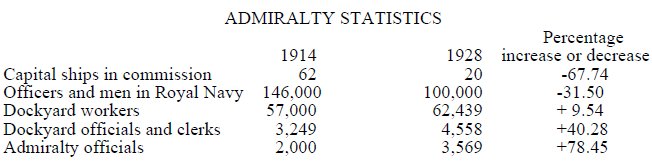
Of course, there’s nothing new about the administrative “tail” of the armed forces growing . . . C. Northcote Parkinson documented the phenomenon (PDF) back in 1955:

The accompanying table is derived from Admiralty statistics for 1914 and 1928. The criticism voiced at the time centered on the comparison between the sharp fall in numbers of those available for fighting and the sharp rise in those available only for administration, the creation, it was said, of “a magnificent Navy on land.” But that
comparison is not to the present purpose. What we have to note is that the 2,000 Admiralty officials of 1914 had become the 3,569 of 1928; and that this growth was unrelated to any possible increase in their work. The Navy during that period had diminished, in point of fact, by a third in men and two-thirds in ships. Nor, from 1922 onwards, was its strength even expected to increase, for its total of ships (unlike its total of officials) was limited by the Washington Naval Agreement of that year. Yet in these circumstances we had a 78.45 percent increase in Admiralty officials over a period of fourteen years; an average increase of 5.6 percent a year on the earlier total. In fact, as we shall see, the rate of increase was not as regular as that. All we have to consider, at this stage, is the percentage rise over a given period.

Parkinson_Admiralty_Statistics

September 26, 2009

British libraries now afraid to lend scissors to patrons

Filed under: Britain, Bureaucracy — Tags: , , — Nicholas @ 16:13

The staff at the Holborn Library in London are apparently very worried about the risk of being attacked by library patrons, so they won’t even lend scissors:

Lorna Watts, 26, a self-employed dressmaker, was turned down at Holborn Library in central London.

She said: “It’s ridiculous — public libraries are supposed to be supportive of small businesses.”

A spokeswoman for Camden Council, which runs the library, has apologised and said it would investigate the incident.

Ms Watts, from Islington, north London, said: “I asked why I couldn’t borrow a pair of scissors and she said, ‘they are sharp, you might stab me’.

“I then asked to borrow a guillotine to cut up my leaflets but she refused again — because she said I could hit her over the head with it!”

The way Britain has been going, I’m surprised they didn’t hit Ms. Watts with an ASBO for the implied threat here: “It’s absurd — there are plenty of heavy books I could have hit her with if I wanted to.”

« Newer Posts — Older Posts »

Powered by WordPress